
Life, 1914-12-31 · page 8 of 41
Life — December 31, 1914 — page 8: what you’re looking at
What you’re looking at
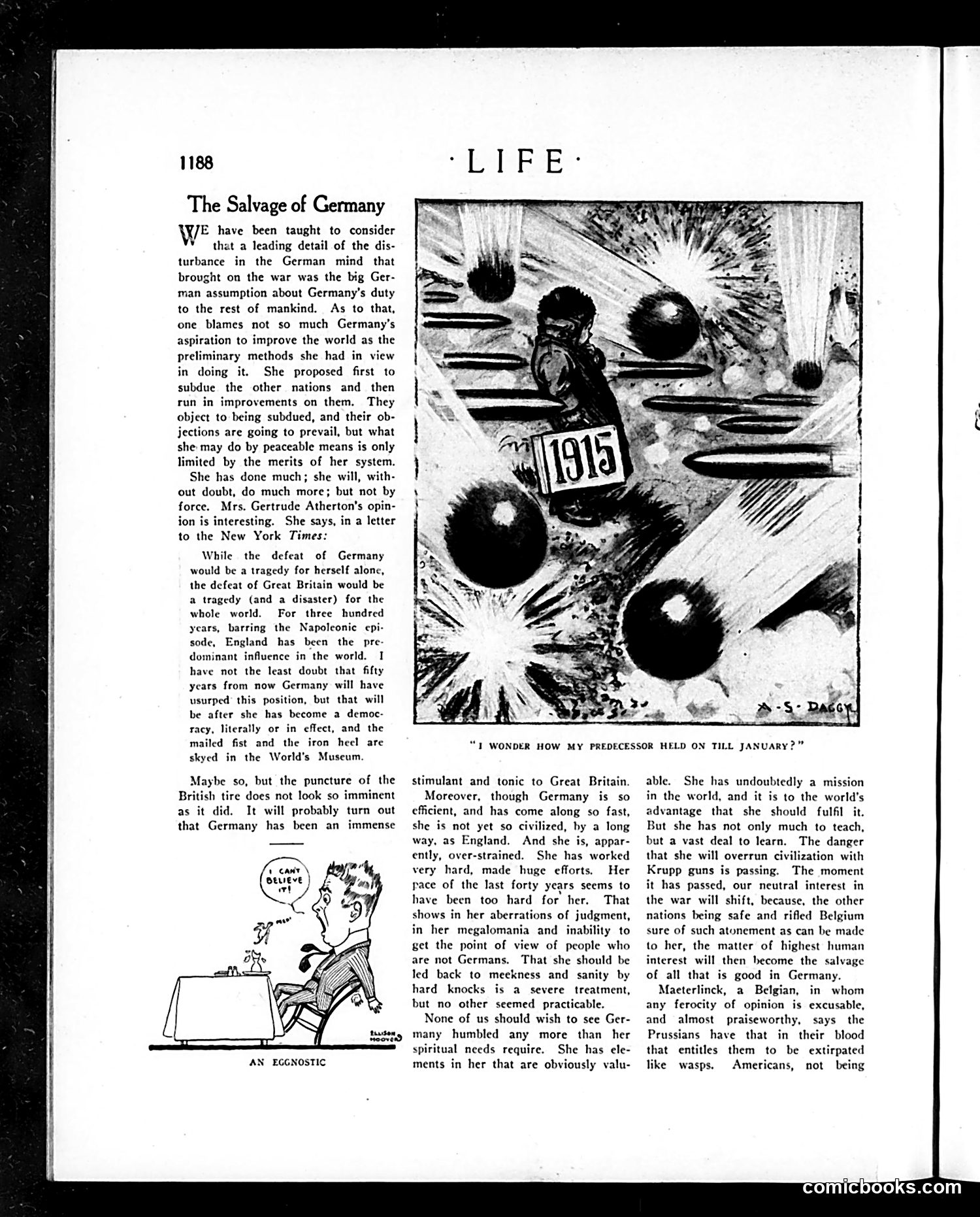
This 1915 satirical article criticizes German ambitions post-WWI. The main illustration shows a German figure amid destruction labeled "1915," asking "I wonder how my predecessor held on till January?" — suggesting Germany's leadership doubts their ability to sustain the war effort. The smaller cartoon titled "An Egnostic" depicts a figure at a table claiming "I CAN'T BELIEVE IT!" — likely mocking German denial about their military situation or war crimes. The text argues Germany has a "mission" to improve civilization but questions whether force can achieve this. It suggests Germany's military efficiency doesn't translate to moral superiority, and predicts Germany will eventually lose its dominant position, becoming merely historical salvage in a museum.
📄 Transcribed text from this page (OCR, searchable)
Machine-transcribed from the original scan — historical spelling and the odd misread are preserved.
1188 The Salvage of Germany WE have been taught to consider that a leading detail of the dis- turbance in the German mind that brought on the war was the big Ger- man assumption about Germany's duty to the rest of mankind. As to that, one blames not so much Germany's aspiration to improve the world as the preliminary methods she had in view in doing it. She proposed first to subdue the other nations and then run in improvements on them. They object to being subdued, and their ob- jections are going to prevail, but what she may do by peaceable means is only limited by the merits of her system. She has done much; she will, with- out doubt, do much more; but not by force. Mrs. Gertrude Atherton's opin- ion is interesting. She says, in a letter to the New York Times: While the defeat of Germany would be a tragedy for herself alone, the defeat of Great Britain would be a tragedy (and a disaster) for the whole world. For three hundred years, barring the Napoleonic epi- sode, England has been the pre- dominant influence in the world. I have not the least doubt that fifty years from now Germany will have usurped this position, but that will be after she has become a democ- racy, literally or in effect, and the mailed fist and the iron heel are skyed in the World's Museum. Maybe so, but the puncture of the British tire does not look so imminent as it did. It will probably turn out that Germany has been an immense AN EGGNOSTIC “1 WONDER HOW MY PREDECESSOR HELD ON TILL JANUARY?” stimulant and tonic to Great Britain. Moreover, though Germany is so efficient, and has come along so fast, she is not yet so civilized, by a long way, as England. And she is, appar- ently, over-strained. She has worked very hard, made huge efforts. Her pace of the last forty years seems to have been too hard for her. That shows in her aberrations of judgment, in her megalomania and inability to get the point of view of people who are not Germans. That she should be led back to meekness and sanity by hard knocks is a severe treatment, but no other seemed practicable. None of us should wish to see Ger- many humbled any more than her spiritual needs require. She has ele- ments in her that are obviously valu- able. She has undoubtedly a mi in the world, and it is to the world’s advantage that she should fulfil it. But she has not only much to teach, but a vast deal to learn. The danger that she will overrun civilization with Krupp guns is passing. The moment it has passed, our neutral interest in the war will shift, because, the other nations being safe and rifled Belgium sure of such atonement as can be made to her, the matter of highest human interest will then become the salvage of all that is good in Germany. Maeterlinck, a Belgian, in whom any ferocity of opinion is excusable, and almost praiseworthy, says the Prussians have that in their blood that entitles them to be extirpated like wasps. Americans, not being comicbooks.com