
Life, 1914-12-31 · page 22 of 41
Life — December 31, 1914 — page 22: what you’re looking at
What you’re looking at
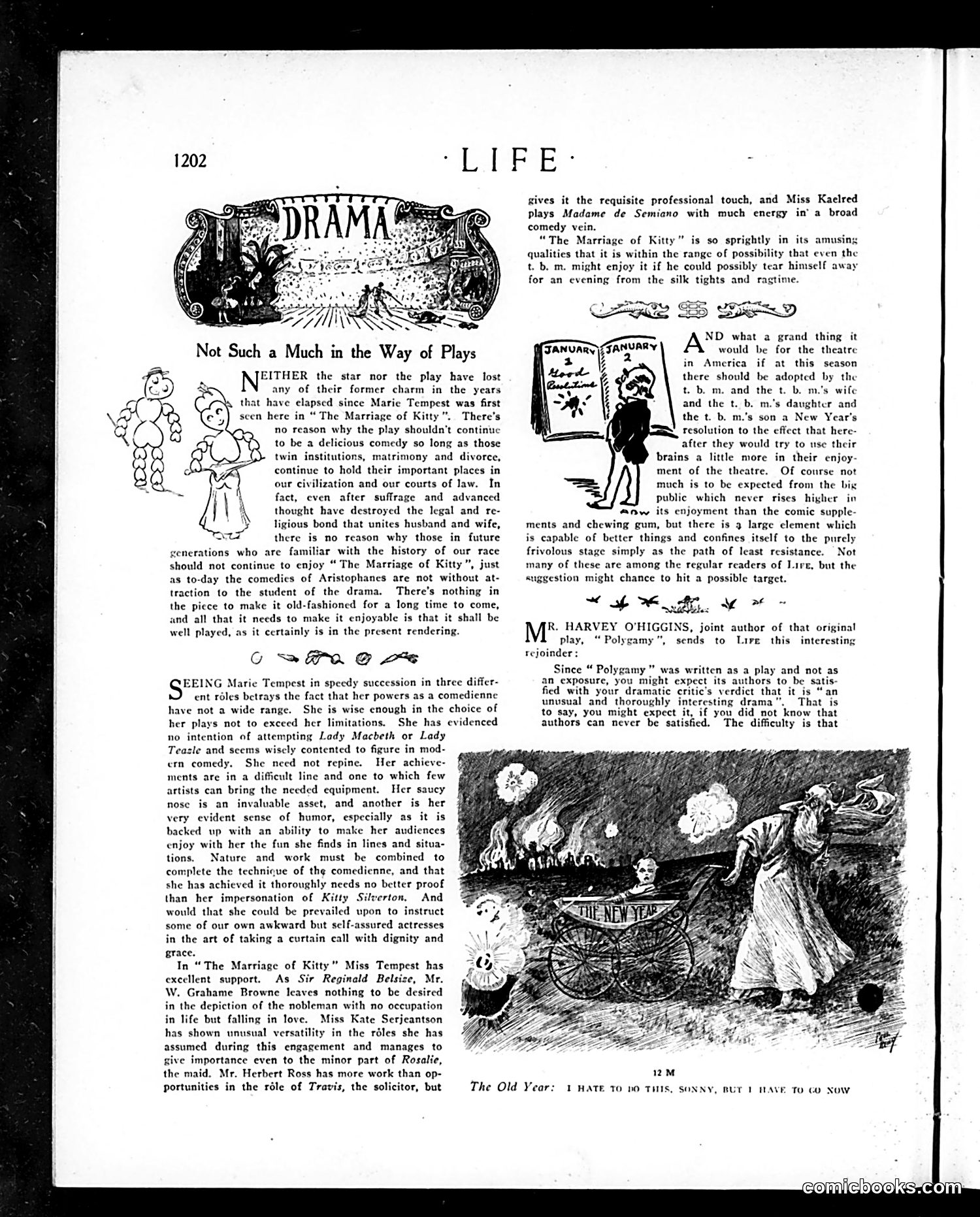
This page reviews "The Marriage of Kitty," a contemporary comedic play starring actress Marie Tempest. The critic argues the play remains timeless because its themes—marriage and divorce—are eternally relevant to society and law. The main satire targets the "t.b.m." (an abbreviation the text doesn't explain but appears to mean a type of theatergoer), criticized for preferring lowbrow entertainment like "comic supplements and chewing gum" over intelligent theatre. The accompanying illustration (bottom right) depicts a figure labeled "The Old Year" seemingly bidding farewell, likely accompanying a New Year's resolution theme the text promotes: that audiences should "use their brains a little more" in theatrical enjoyment rather than seeking only frivolous amusement. The critique reflects early 20th-century anxieties about mass culture and popular taste versus refined theatrical appreciation.
📄 Transcribed text from this page (OCR, searchable)
Machine-transcribed from the original scan — historical spelling and the odd misread are preserved.
"LPB * Not Such a Much in the Way of Plays EITHER the star nor the play have lost any of their former charm in the years that have elapsed since Marie Tempest was first scen here in “ The Marriage of Kitty”. There’s no reason why the play shouldn't continue to be a delicious comedy so long as those twin institutions, matrimony and divorce, continue to hold their important places in our civilization and our courts of Jaw. In fact, even after suffrage and advanced thought have destroyed the legal and re- ligious bond that unites husband and wife, there is no reason why those in future generations who are familiar with the history of our race should not continue to enjoy “ The Marriage of Kitty”, just as to-day the comedies of Aristophanes are not without at- traction to the student of the drama. There's nothing in the piece to make it old-fashioned for a long time to come, and all that it needs to make it enjoyable is that it shall be well played, as it certainly is in the present rendering. OC >&Oa Oo Xs EEING Marie Tempest in speedy succession in three differ- ent réles betrays the fact that her powers as a comedienne have not a wide range. She is wise enough in the choice of her plays not to exceed her limitations. She has evidenced no intention of attempting Lady Macbeth or Lady Teazle and seems wisely contented to figure in mod- ern comedy, She need not repine. Her achieve- ments are in a difficult line and one to which few artists can bring the nceded equipment. Her saucy nose is an invaluable asset, and another is her very evident sense of humor, especially as it is backed up with an ability to make her audiences enjoy with her the fun she finds in lines and situa- tions. Nature and work must be combined to complete the technique of the comedienne, and that she has achieved it thoroughly needs no better proof than her impersonation of Kitty Silverton, And would that she could be prevailed upon to instruct some of our own awkward but self-assured actresses in the art of taking a curtain call with dignity and grace. In “The Marriage of Kitt Miss Tempest has excellent support. As Sir Reginald Belsize, Mr. W. Grahame Browne leaves nothing to be desired in the depiction of the nobleman with no occupation in life but falling in love. Kate Serjeantson has shown unusual versatility in the réles she has assumed during this engagement and manages to give importance even to the minor part of Rosalie, the maid. Mr. Herbert Ross has more work than op- portunities in the rdle of Travis, the solicitor, but The Old Year: gives it the requisite professional touch, and Miss Kaelred plays Madame de Semiano with much energy in’ a broad comedy vein. “The Marriage of Kitty” is so sprightly in its amusing qualities that it is within the range of possibility that even the t. b, m. might enjoy it if he could possibly tear himself away for an evening from the silk tights and ragtime. ND what a grand thing it would be for the theatre in America if at this season there should be adopted by the t. b. m. and the t. b. m.’s wife and the t. b. m.’s daughter and the t. b. m.’s son a New Year's resolution to the effect that here- after they would try to use their brains a little more in their enjoy- ment of the theatre. Of course not much is to be expected from the bix public which never rises higher in @ow its enjoyment than the comic supple- ments and chewing gum, but there is 9 large element which is capable of better things and confines itself to the purely frivolous stage simply as the path of least resistance. Not many of these are among the regular readers of Lire, but the suggestion might chance to hit a possible target. ~ cdi HX R. HARVEY O'HIGGINS, joint author of that original “ Polygamy", sends to Lire this interesting fFanvary Since “ Polygamy ” was written as a play and not as an exposure, you might expect its authors to be satis- fied with your dramatic critic's verdict that it is “an unusual and thoroughly interesting drama", That. is to say, you might expect it, if you did not know that authors can never be satisfied. The difficulty is that I HATE TO HO THIS, SONNY, BUT 1 HAVE To Co NOW