
Life, 1914-12-31 · page 33 of 41
Life — December 31, 1914 — page 33: what you’re looking at
What you’re looking at
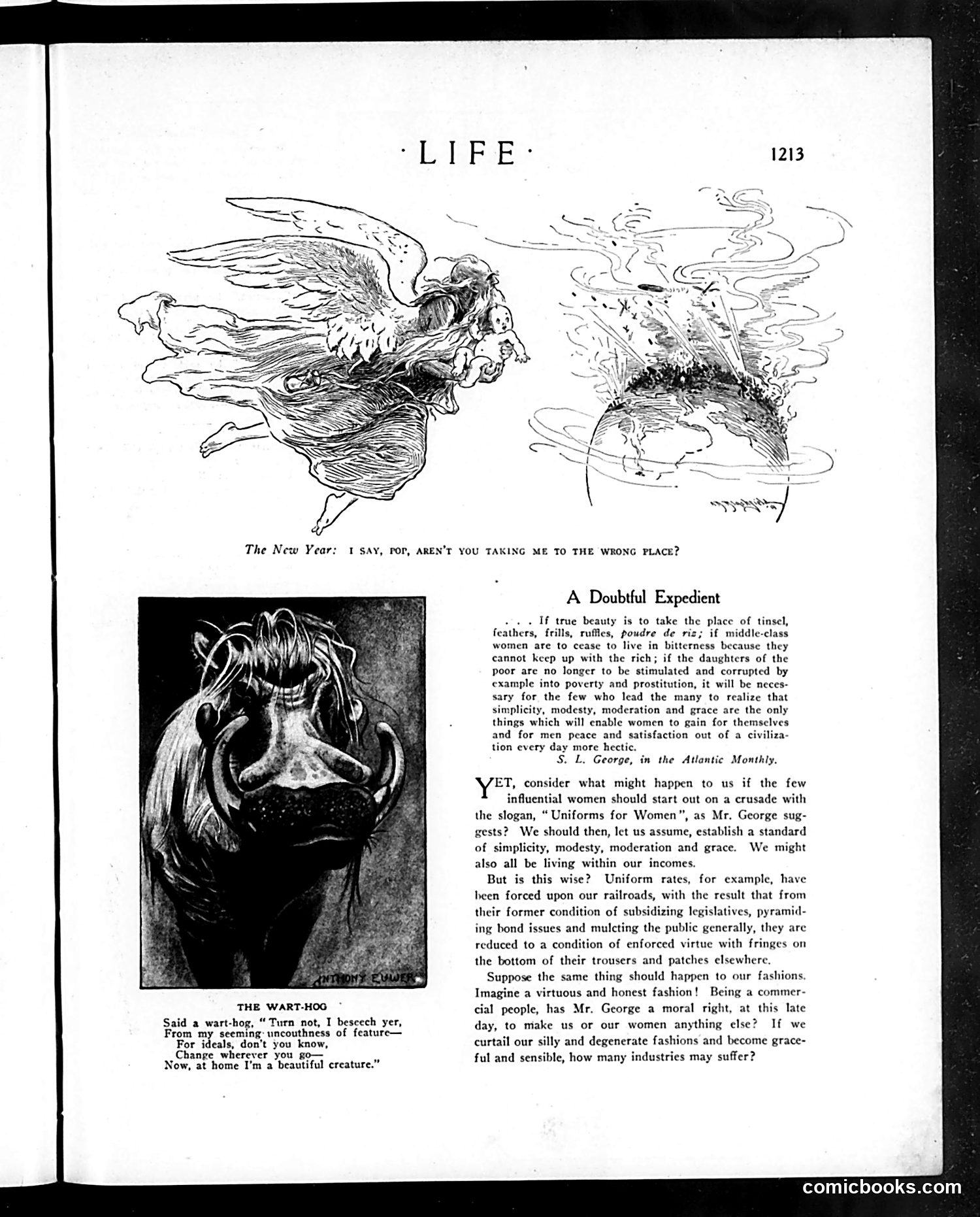
This 1913 *Life* page satirizes proposals to reform women's fashion through enforced simplicity and modesty. The top cartoon shows Father Time (the New Year) chaperoning a woman into chaos—suggesting fashion reform leads nowhere good. The main article mocks S.L. George's Atlantic Monthly proposal for "Uniforms for Women" to promote virtue and end class-based consumption anxiety. The author agrees it's theoretically appealing but argues it's economically dangerous: just as railroads forced into "virtue" through uniform rates became unprofitable, enforced modest fashion would devastate the fashion industry. The "Wart-Hog" cartoon reinforces this irony: the ugly creature claims that beneath its repellent exterior lies inner beauty—paralleling the argument that women don't need fashionable display. The satire suggests Americans won't accept such idealistic sacrifice; economic self-interest trumps moral reform.
📄 Transcribed text from this page (OCR, searchable)
Machine-transcribed from the original scan — historical spelling and the odd misread are preserved.
The New Year: 1 SAY, Por, AREN'T YOU TAKING ME TO THE WRONG PLACE? A Doubtful Expedient . . « If true beauty is to take the place of tinsel, feathers, frills, ruffles, poudre de riz; if middle-class women are to cease to live in bitterness because they cannot keep up with the rich; if the daughters of the poor are no longer to be stimulated and corrupted by example into poverty and prostitution, it will be neces- sary for the few who lead the many to realize that simplicity, modesty, moderation and grace are the only things which will enable women to gain for themselves and for men peace and satisfaction out of a civiliza- tion every day more hectic. S. L. George, in the Atlantic Monthly. T, consider what might happen to us if the few influential women should start out on a crusade with the slogan, “Uniforms for Women”, as Mr. George sug- gests? We should then, Iet us assume, establish a standard of simplicity, modesty, moderation and grace. We might also all be living within our incomes. But is this wise? Uniform rates, for example, have been forced upon our railroads, with the result that from their former condition of subsidizing legislatives, pyramid- ing bond issues and mulcting the public generally, they are reduced to a condition of enforced virtue with fringes on the bottom of their trousers and patches elsewhere, Suppose the same thing should happen to our fashions. Imagine a virtuous and honest fashion! Being a commer- THE\WART-HOO - cial people, has Mr. George a moral right, at this late Said a wart-hog, “Turn not, I beseech yer, day, to make us or our women anything else? If we From my seeming: uncouthness of feature— ‘ - For ideals, don’t you know, curtail our silly and degenerate fashions and become grace- Change wherever you g0— nsible, how many industries may suffer? Now, at home I'm a beautiful creature.” ful and sensible, y y comicbooks.com