
A complete issue · 44 pages · 1914
Life — November 26, 1914
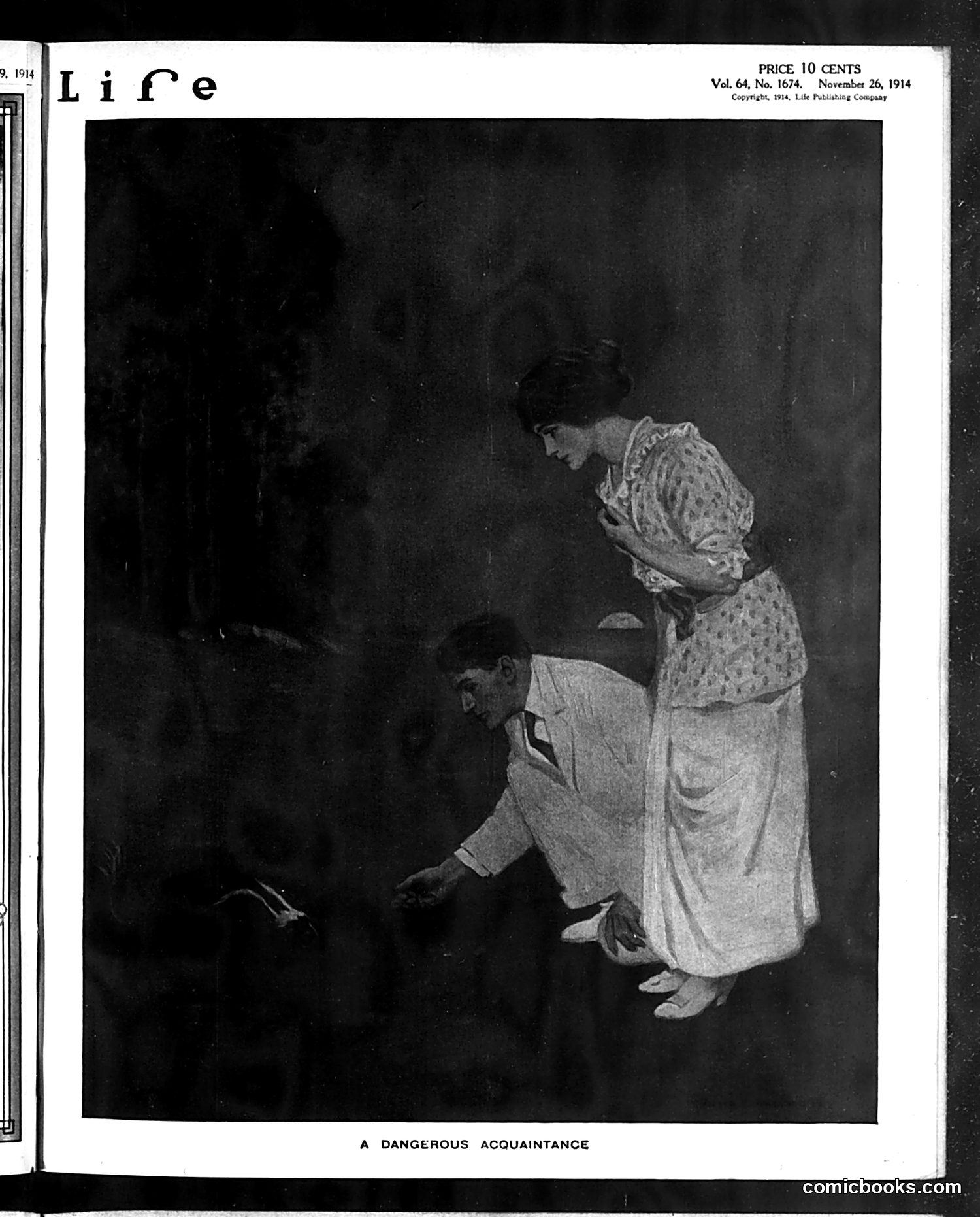
This photograph-based satirical image shows two figures in what appears to be a dramatic encounter. The caption "A Dangerous Acquaintance" suggests a cautionary or moralistic narrative typical of Life magazine's social commentary. Without additional context visible on this page, the specific identity of the figures and the particular social danger being referenced remains unclear. However, given the 1914 date and Life's typical concerns, this likely addresses contemporary social issues—possibly involving class differences, impropriety, or moral peril. The theatrical staging and dramatic lighting suggest this may be illustrating a cautionary tale about unexpected or risky social interactions. The image's composition emphasizes vulnerability and imbalance in the relationship depicted.
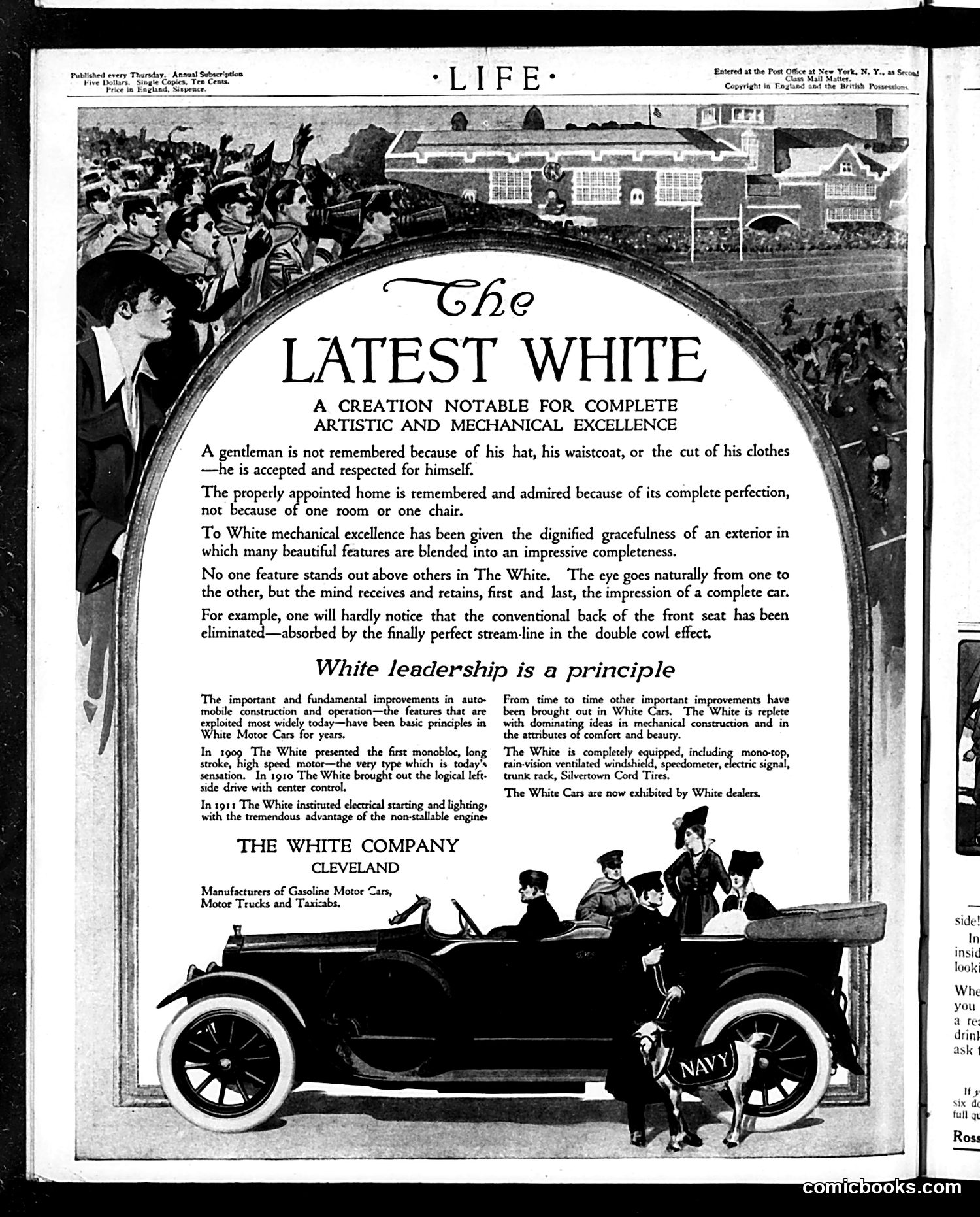
This is primarily **advertising content**, not satire or political commentary. It's a full-page advertisement for The White Company's automobiles, published in *Life* magazine. The ad uses aspirational messaging about gentlemen and homes to sell cars, arguing that mechanical excellence reflects character—similar to how a well-appointed home indicates a man's standing. The top illustration shows spectators at what appears to be a sporting event (possibly a baseball game, given the stadium architecture), establishing an upper-class context. The bottom illustration depicts a touring car with fashionably dressed passengers and a Navy sailor, emphasizing the vehicle's appeal to respectable society. The copy emphasizes "leadership" and "complete perfection" as selling points. This represents early automotive marketing strategy: positioning cars as status symbols reflecting personal refinement rather than mere transportation.
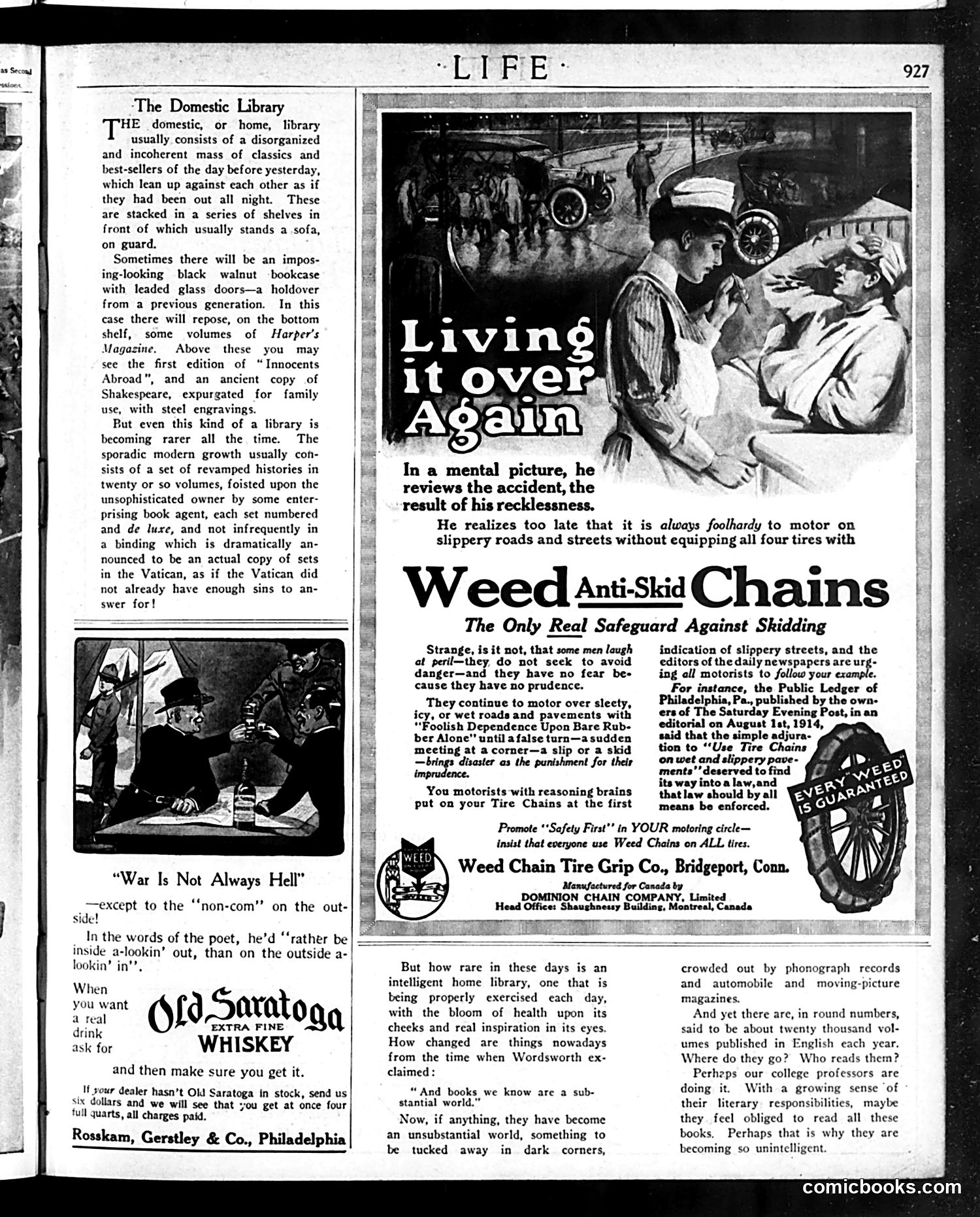
This page is primarily **advertising**, not satire or political commentary. The dominant advertisement promotes **Weed Anti-Skid Chains** for automobile tires. The visual shows a man in bed reviewing a car accident in his mind, with the tagline "Living it over Again." The ad argues that tire chains prevent dangerous skidding on wet roads—positioned as essential safety equipment for motorists. A secondary ad promotes **Old Saratoga Whiskey**, using the phrase "War Is Not Always Hell" with a small illustration of soldiers. The left column discusses **domestic libraries**—home book collections—noting their typically disorganized nature and the rarity of well-maintained personal libraries. The content reflects early 20th-century concerns: automobile safety and the cultural value of maintaining home libraries.
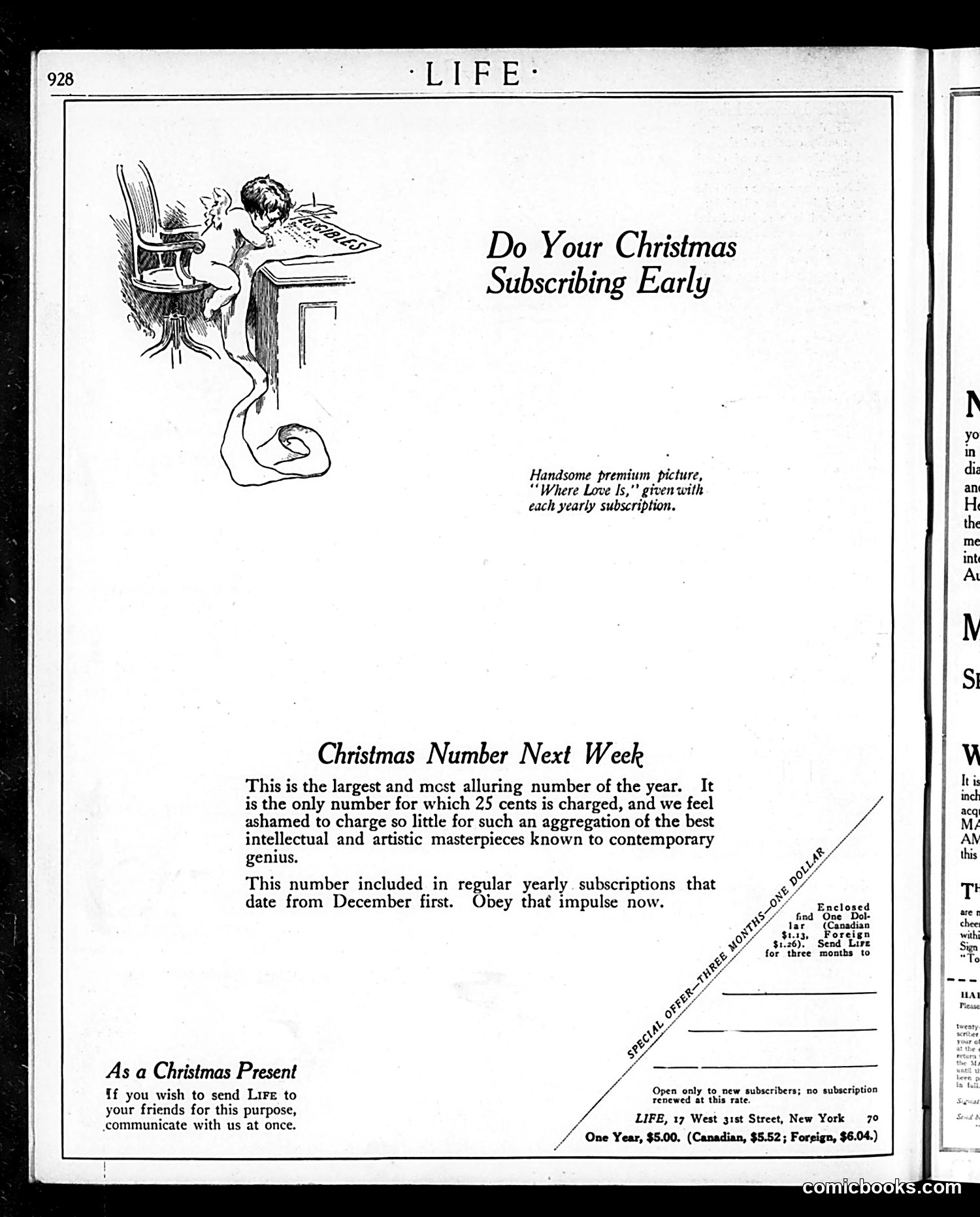
This page is primarily **advertising content** for *Life* magazine subscriptions, not political satire or editorial cartooning. The top illustration shows a cherub or cupid figure at a desk, promoting early Christmas subscriptions. The text emphasizes the upcoming "Christmas Number Next Week"—described as "the largest and most alluring number of the year"—priced at 25 cents. The advertisement highlights that yearly subscriptions (beginning December 1st) include this special issue, and encourages impulse purchases. A subscription form appears on the right side. The bottom section offers *Life* as a Christmas gift option, directing interested parties to contact the magazine directly. The entire page functions as promotional material rather than satirical content.
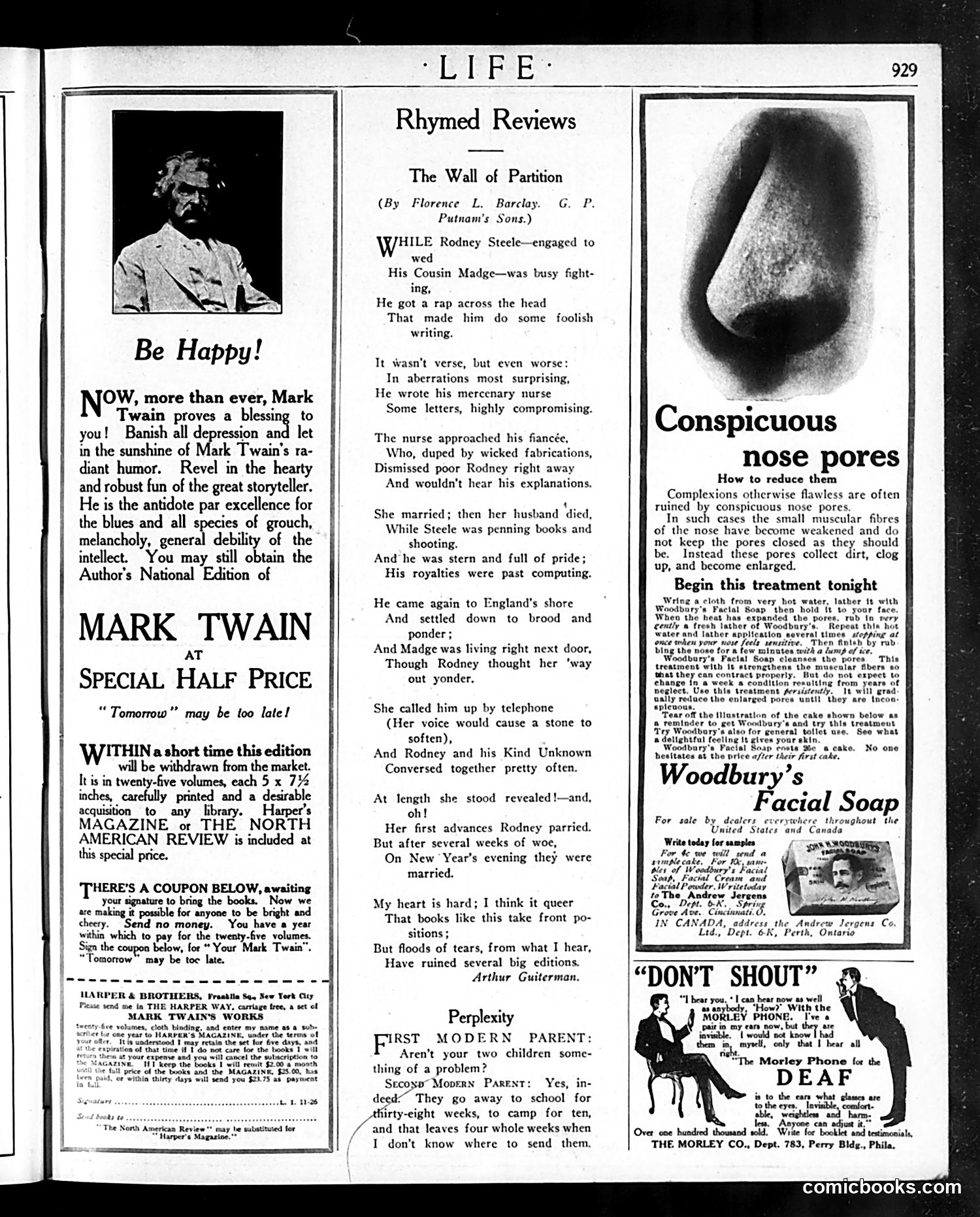
This page is primarily **advertising and light humor**, not political satire. **Left side:** An advertisement for Mark Twain's collected works at half price, emphasizing his value as entertainment during difficult times (likely Depression-era, given the economic reference). **Center:** "The Wall of Partition," a humorous poem by Florence L. Barclay about romantic misunderstandings between cousins Rodney and Madge—conventional domestic comedy with no political content. **Right side:** Advertisements for beauty products (nose pore treatment, Woodbury's Facial Soap) and a "Don't Shout" hearing aid advertisement featuring the Morley Deaf Company. The page reflects **1920s-30s consumer culture**: literature, beauty anxiety, and medical/hearing solutions marketed to readers. No political commentary or social satire is evident.
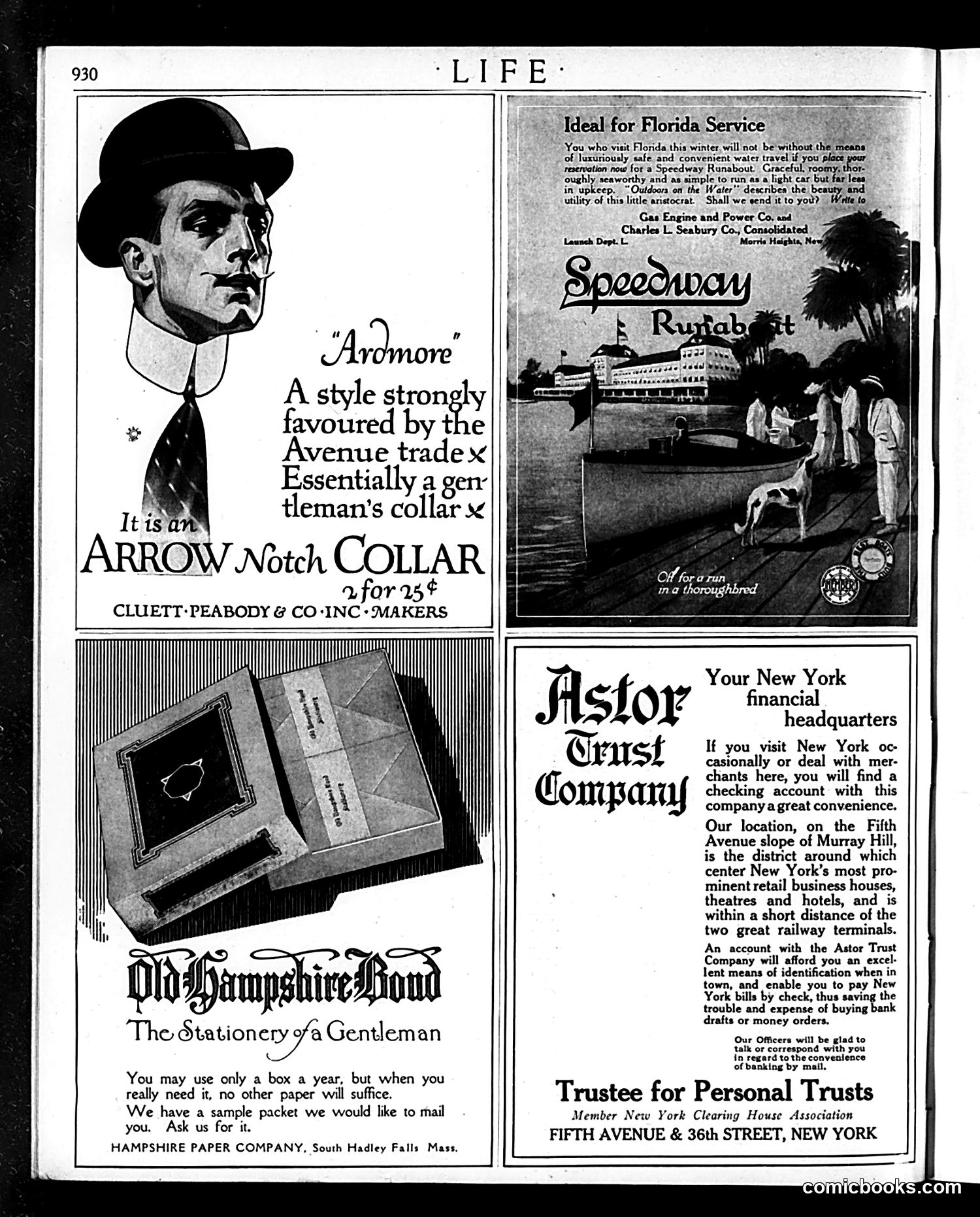
This page is primarily **advertisements** rather than editorial content or satire. The four ads are: 1. **Arrow Notch Collar** — promotes a gentlemen's collar style ("Ardmore") favored by Avenue trade, priced at 25¢ 2. **Speedway Runabout** — advertises a small automobile suited for Florida service 3. **Old Hampshire Bond** — stationery product emphasizing quality ("The Stationery of a Gentleman") 4. **Astor Trust Company** — New York financial institution advertising checking accounts and trust services There is **no political cartoon or satire present**. The illustrated male face in the collar ad and the Speedway vehicle illustration are commercial artwork, not caricatures of public figures. The page reflects early-20th-century luxury consumer marketing targeting affluent gentlemen.
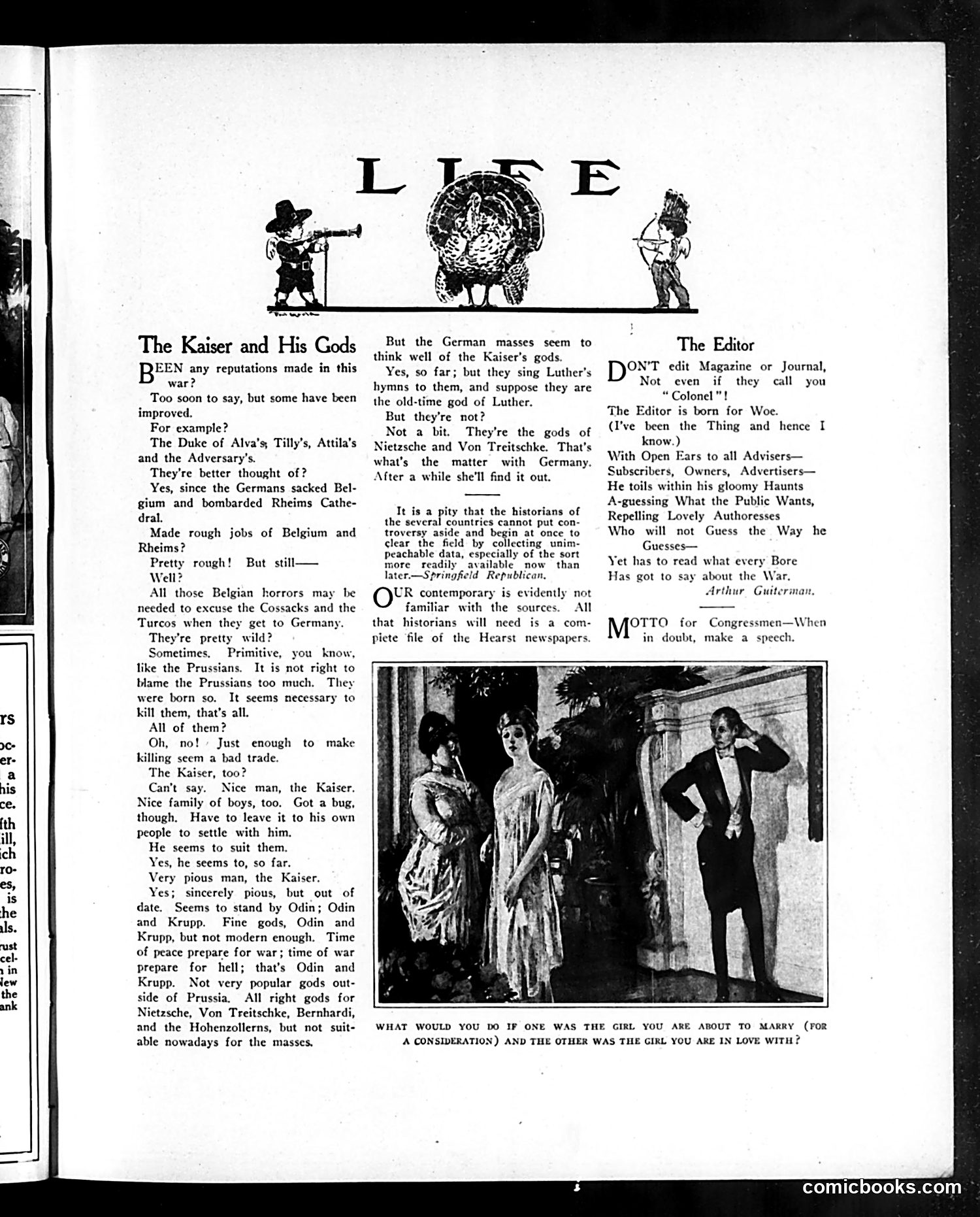
This page critiques **German militarism and Kaiser Wilhelm II** during World War I. The header illustration shows the Kaiser with military figures, labeled "The Kaiser and His Gods." The main article mocks German philosophy and leadership, sarcastically suggesting the Kaiser worships Nietzsche and Prussian military culture rather than traditional religion. It argues German masses follow these "gods" uncritically. The photograph below depicts three women in classical dress, captioned with a romantic dilemma: choosing between duty (marrying one woman) versus love (another). This appears unrelated satirically, likely addressing contemporary social attitudes about women and marriage. The sidebar from "The Editor" dismisses German intellectual justifications for warfare, representing American editorial skepticism toward German wartime propaganda.
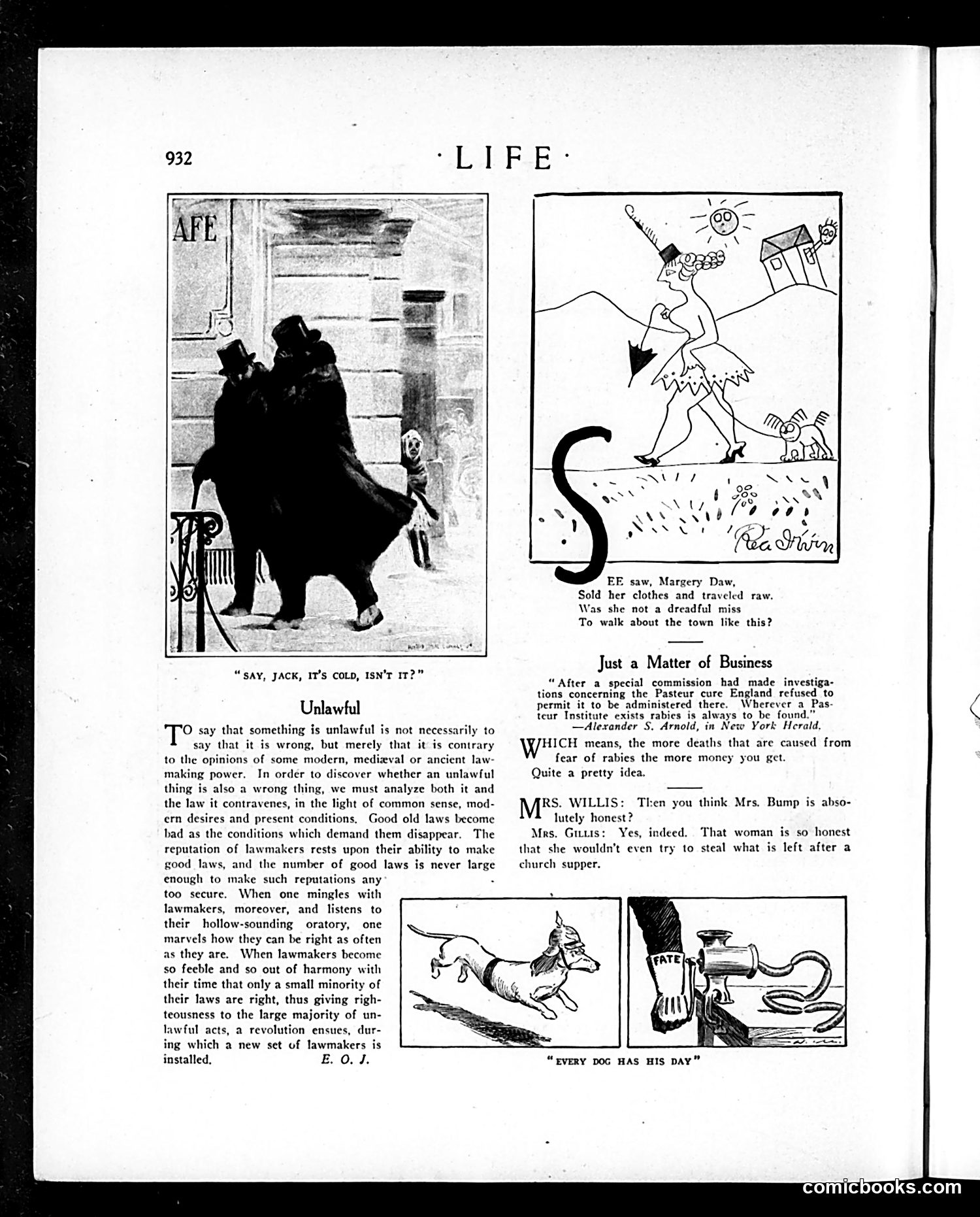
**Left photograph**: Titled "Say, Jack, It's Cold, Isn't It?" shows two figures in heavy coats and hats outside a building marked "AFE" (likely "CAFE"). The caption "Unlawful" and accompanying essay question whether calling something unlawful necessarily makes it wrong—a philosophical discussion about law versus morality. **Right cartoon**: "S" appears to reference "Margery Daw," a nursery rhyme character. The illustrated figure juggles various domestic demands (sun, house, child, umbrella) while a caption questions if she truly lived as the rhyme suggests—suggesting disconnect between romanticized depictions and real women's actual complicated lives. **Bottom section**: Contains a humorous dialogue about honesty and a cartoon titled "Every Dog Has His Day" depicting fate. The page mixes serious philosophical content with social satire about women and morality.
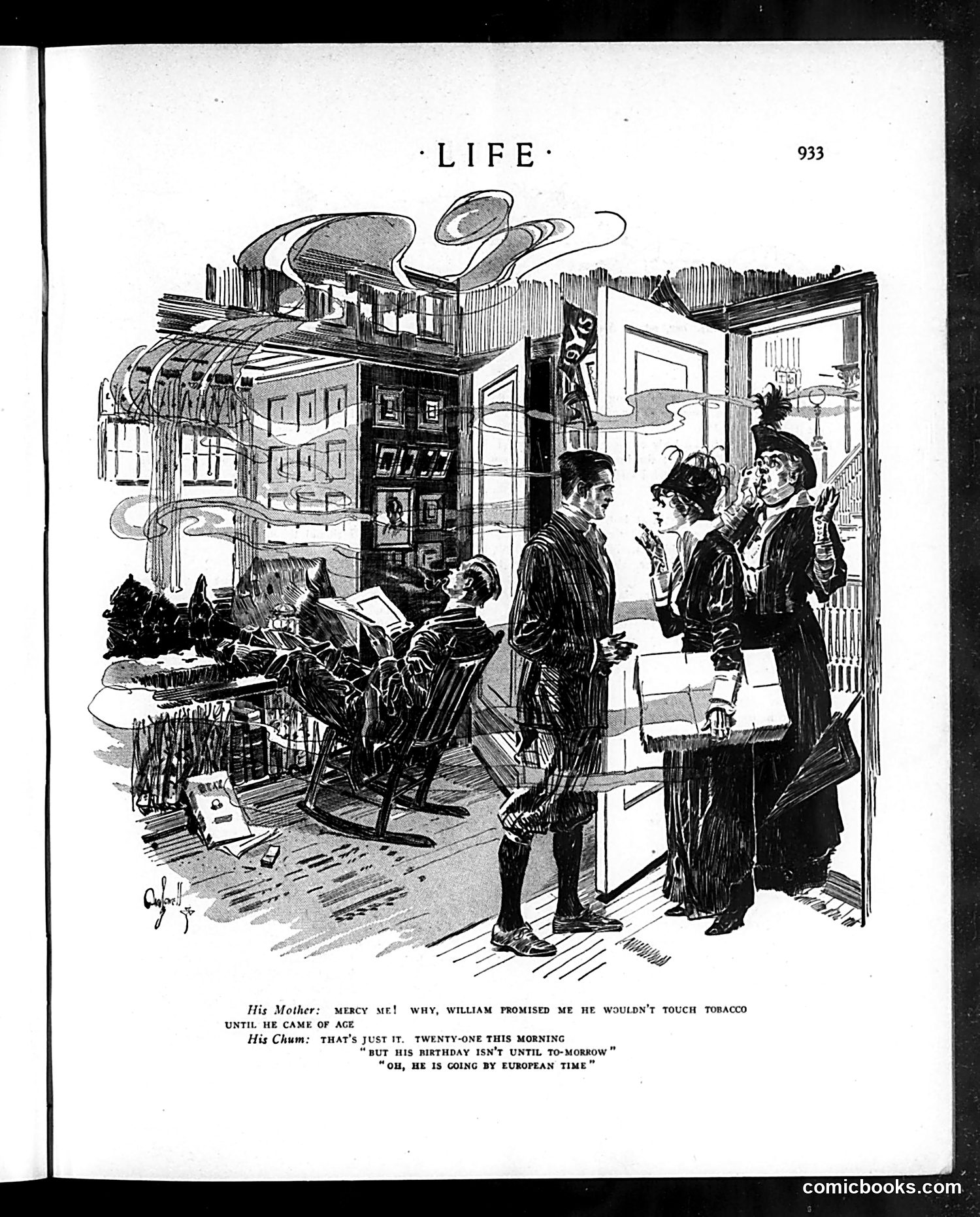
This is a satirical cartoon from *Life* magazine depicting a domestic scene where a young man arrives home on his twenty-first birthday. The mother expresses relief that William kept his promise not to touch tobacco until coming of age. The chum's response reveals the joke's punchline: William has turned twenty-one "this morning," so his birthday hasn't technically occurred yet by European time—allowing him to claim he hasn't violated his promise while already smoking. The humor plays on timezone differences and technical loopholes in keeping promises. The cartoon satirizes how literal interpretations of rules can be exploited, and perhaps mocks both parental naivety and youthful cleverness in circumventing restrictions through wordplay and international time standards.
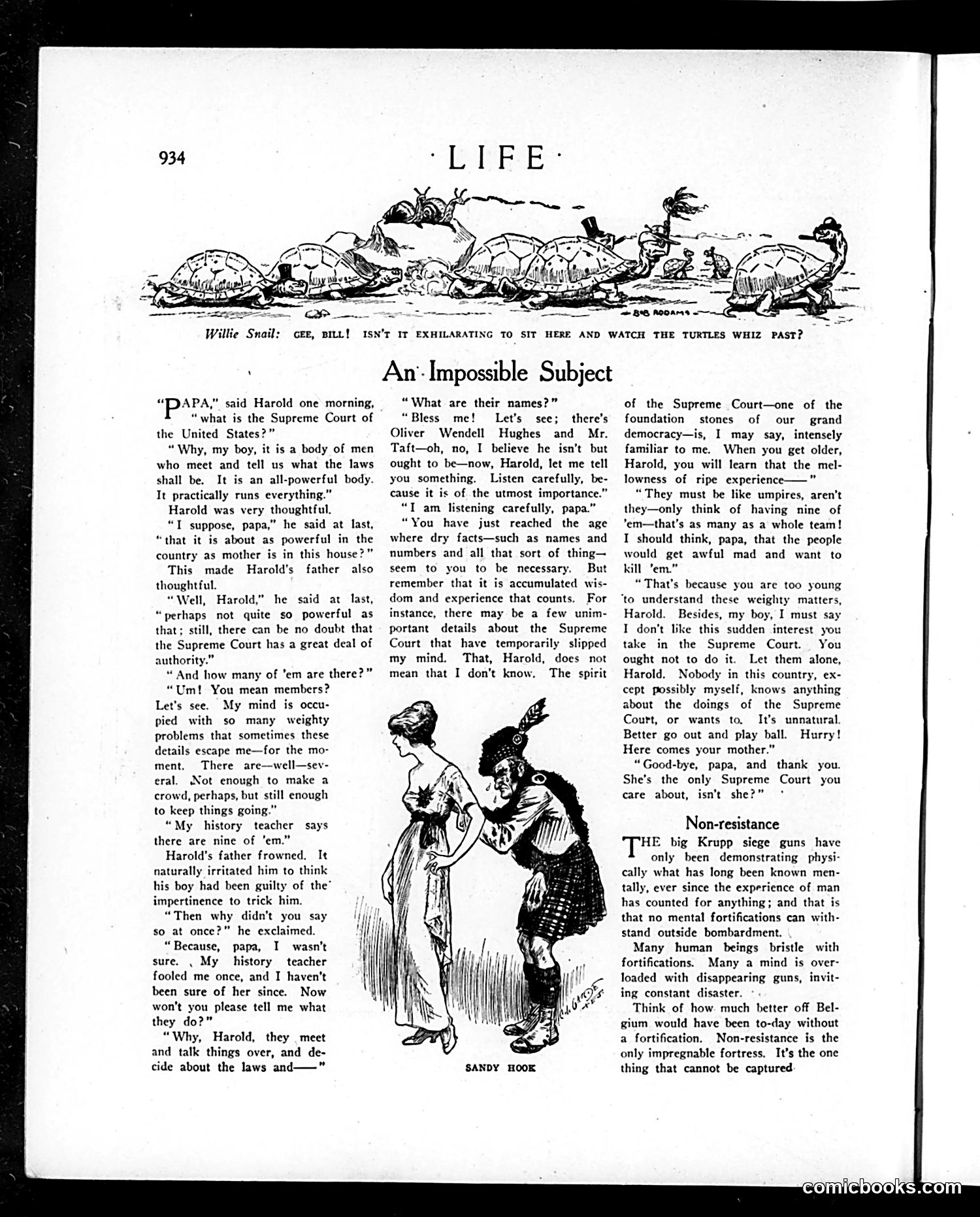
The page contains two distinct pieces: **"An Impossible Subject"** (left): A satirical dialogue where Harold's father explains the Supreme Court to his son. The humor stems from the father's admission that even he finds the Supreme Court's workings incomprehensible—it's "too powerful," involves obscure legal details, and operates beyond normal understanding. The satire suggests the institution is deliberately inscrutable, even to educated adults. **"Non-resistance"** (right): Commentary on the Krupp siege guns (German artillery) and fortifications. The passage argues that mental fortifications—non-resistance or psychological resilience—are more important than physical defenses. It suggests Belgium's vulnerable position during WWI could have been better protected through ideological strength than military fortifications. The "Sandy Hook" illustration shows a woman and child in period dress, likely supporting the text's themes.
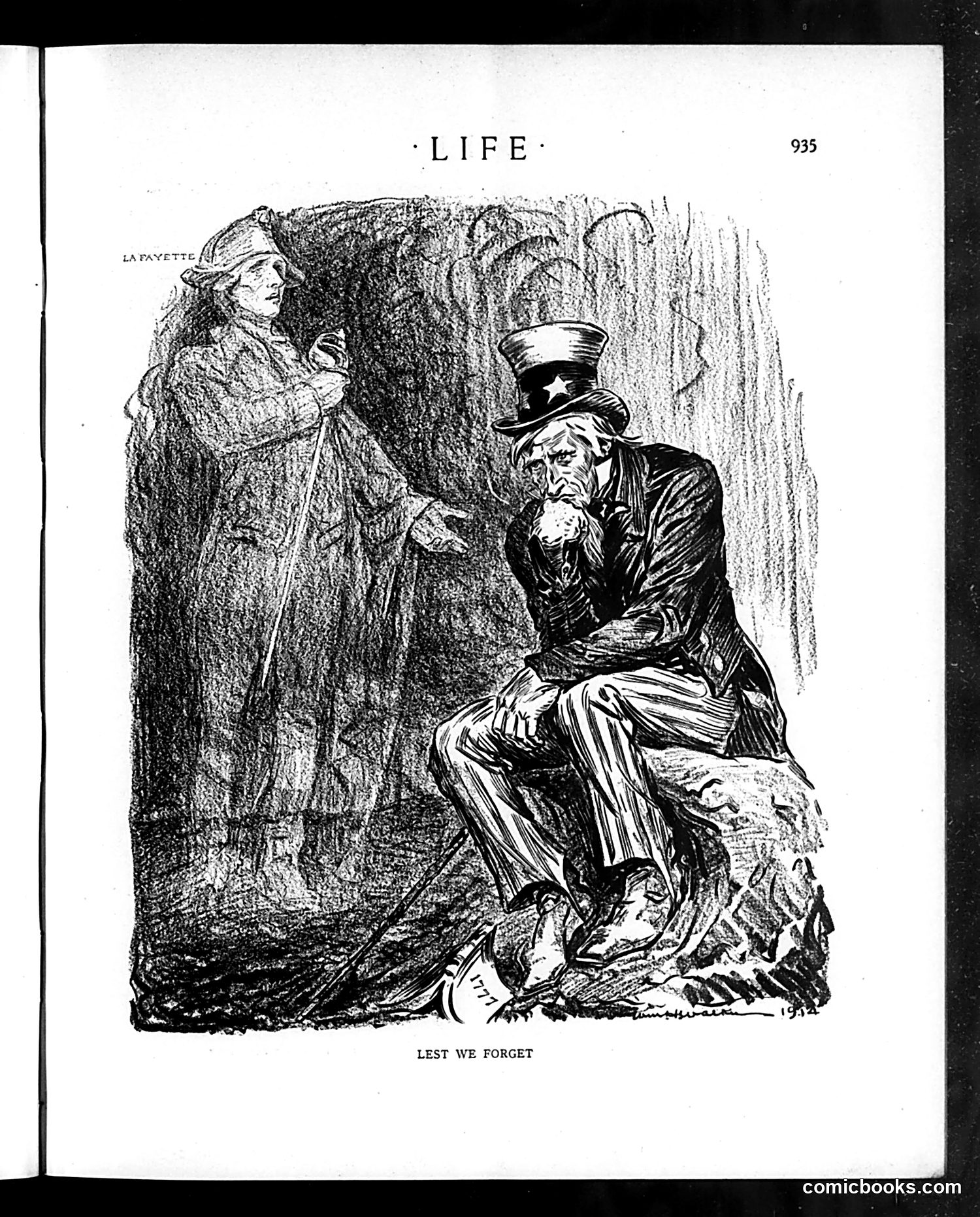
This Life magazine illustration, captioned "Lest We Forget," depicts Uncle Sam (the figure in the top hat with the star) sitting dejectedly on a rock, looking troubled. A ghostly or phantom female figure labeled "LA PAYETTE" stands behind him. The cartoon appears to reference France and Franco-American relations, likely during or after World War I. Lafayette was the French Revolutionary War hero who aided American independence. The melancholy pose and the caption "Lest We Forget" suggest the cartoon warns against forgetting past French-American alliances or obligations—possibly critiquing American foreign policy regarding France or indifference to French interests. The tone is nostalgic and mournful, invoking historical memory as a moral imperative.
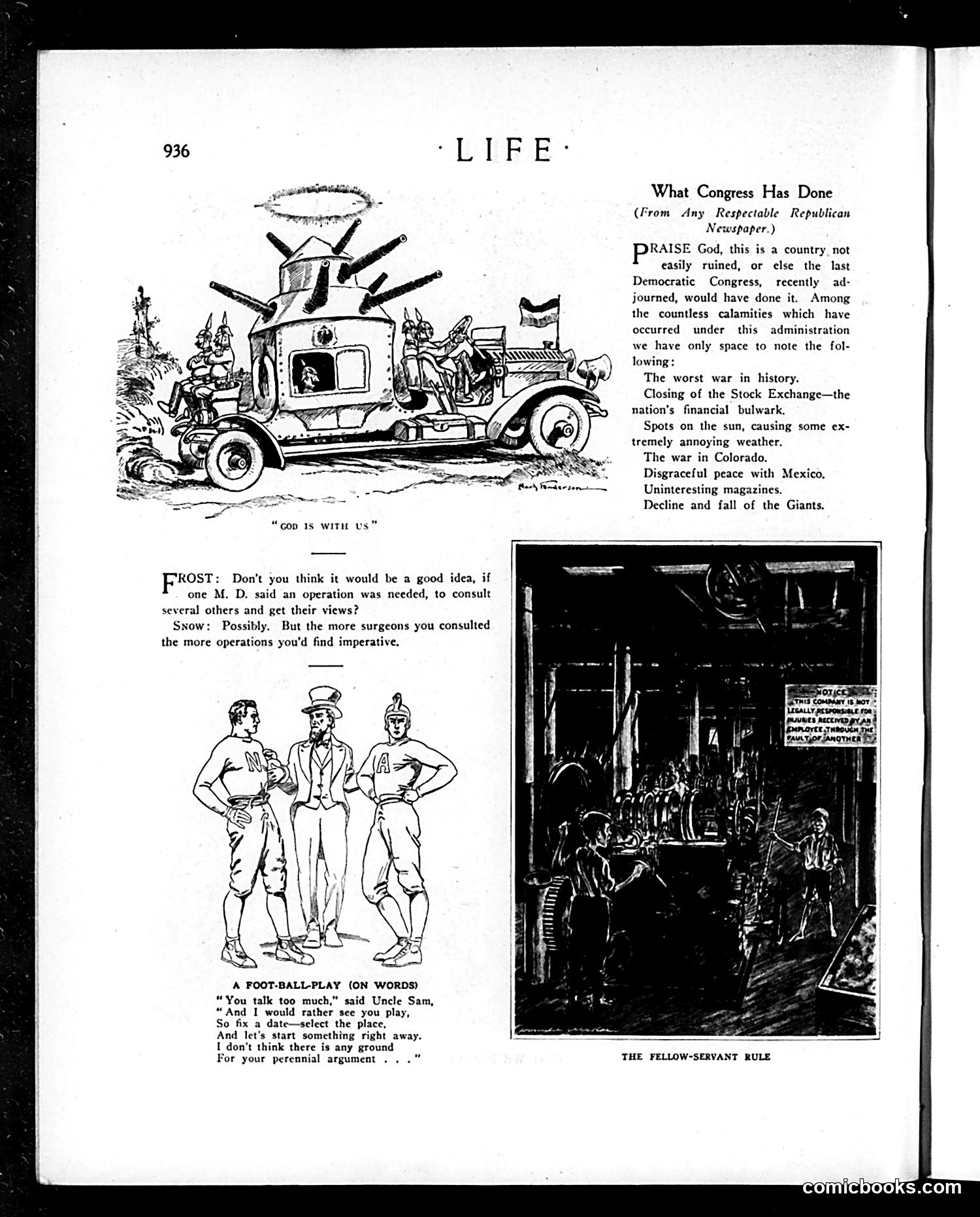
This page satirizes the Wilson administration's record, with a Republican newspaper critiquing Democratic Congress. The top cartoon shows a chaotic car labeled "God Is With Us"—likely mocking government incompetence—surrounded by destruction and chaos. Below, a dialogue between "Frost" and "Snow" (two doctors) jokes that consulting multiple surgeons leads to unnecessary operations, satirizing over-government intervention. The baseball cartoon parodies Uncle Sam urging Americans to "play" rather than "talk," suggesting the administration deflects serious issues with distraction. The dark photograph titled "The Fellow-Servant Rule" appears to document actual industrial conditions, contrasting photographic reality against the cartoons' satirical commentary on governance failures and social neglect during this period.
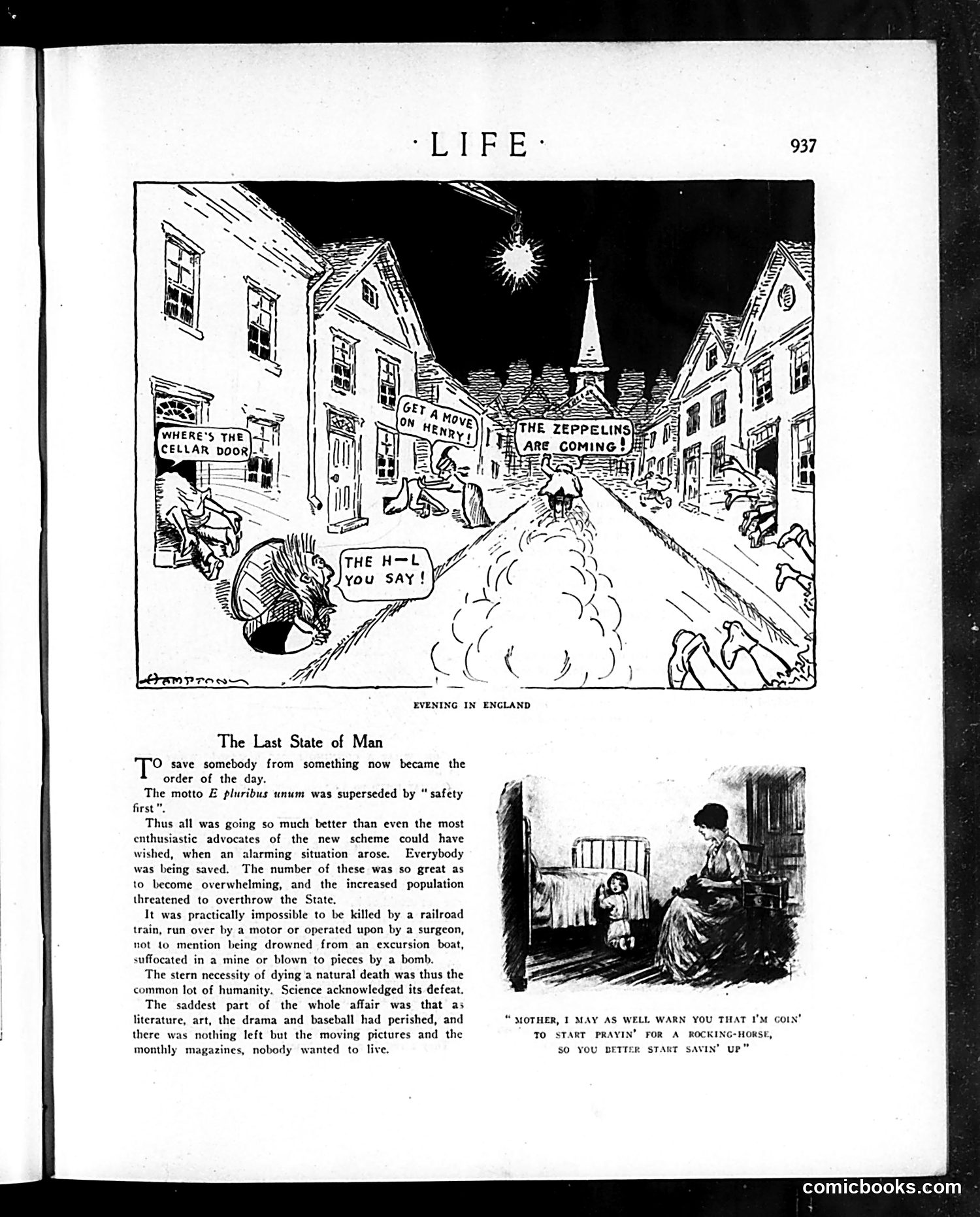
This satirical cartoon depicts a English village street in panic, with citizens fleeing and hiding from an approaching threat labeled "THE ZEPPELINS ARE COMING." Signs reading "GET A LOVE ON HENRY!" and "WHERE'S THE CELLAR DOOR?" indicate urgent evacuation. The satire targets WWI-era German zeppelin airship raids on Britain—a genuine terror that killed civilians. The accompanying text, "The Last State of Man," appears darkly ironic: citizens frantically trying to save themselves from aerial bombardment exemplifies humanity's desperate, often futile survival instincts. The accompanying sketch shows a mother sardonically telling her child to pray for "a rocking-horse" rather than actual safety, highlighting the grim helplessness of wartime civilian life.
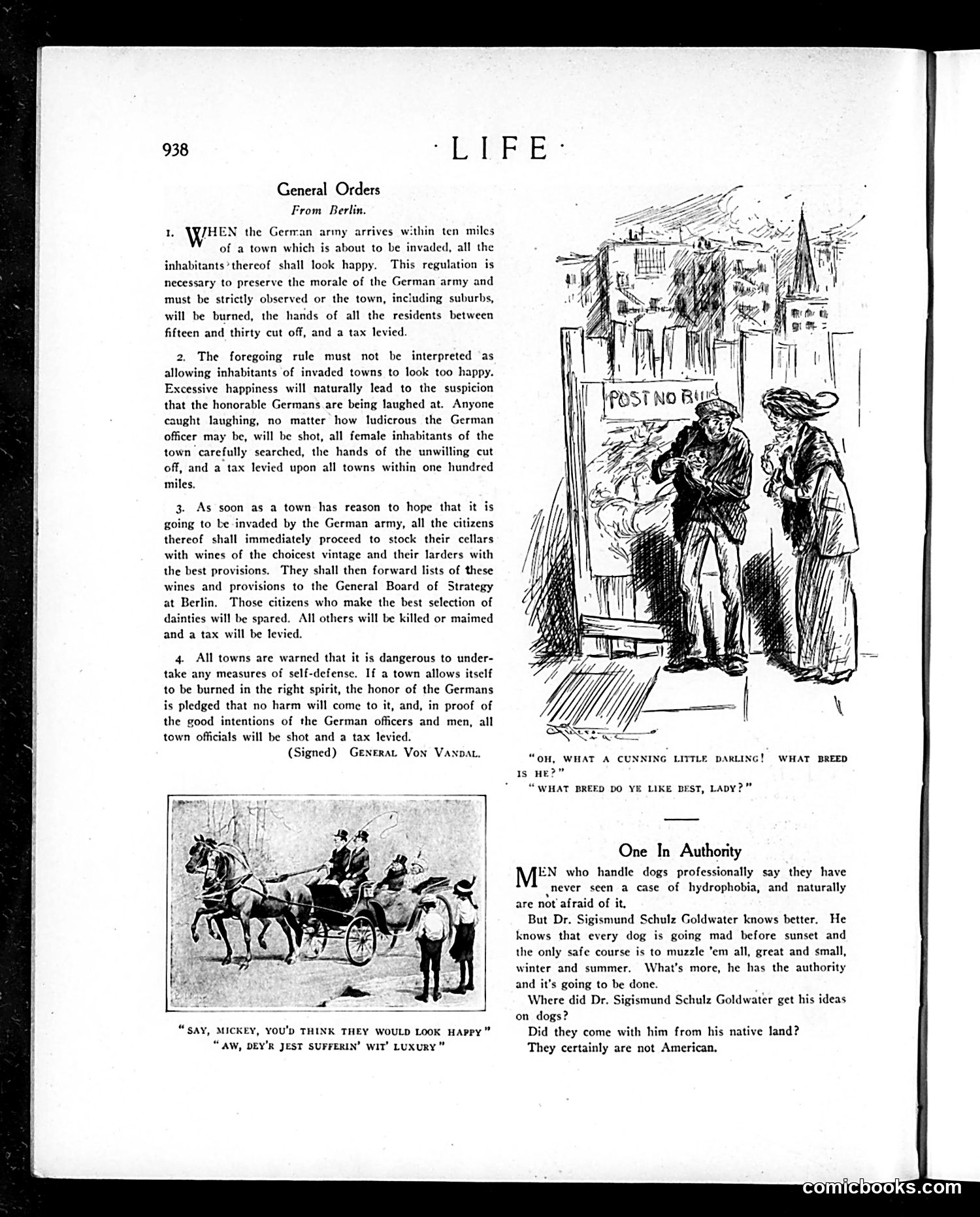
This page satirizes brutal German military directives allegedly issued by General von Vandal during WWI invasion planning. The "General Orders from Berlin" mock absurd regulations: occupants must "look happy" upon German arrival, hands of residents aged 15-30 will be "cut off," and towns must stock cellars with wine for German officers while promising to spare those who comply. The cartoons below ridicule these orders. The top sketch shows German soldiers interrogating townspeople about their "cunning little darling" — likely mocking German soldiers' supposed interest in looting. The bottom cartoon depicts German officers in a carriage, with the caption sarcastically contrasting their supposed luxury with common soldiers' hardship. The satire presents German military occupation as simultaneously brutal and absurdly mercenary.
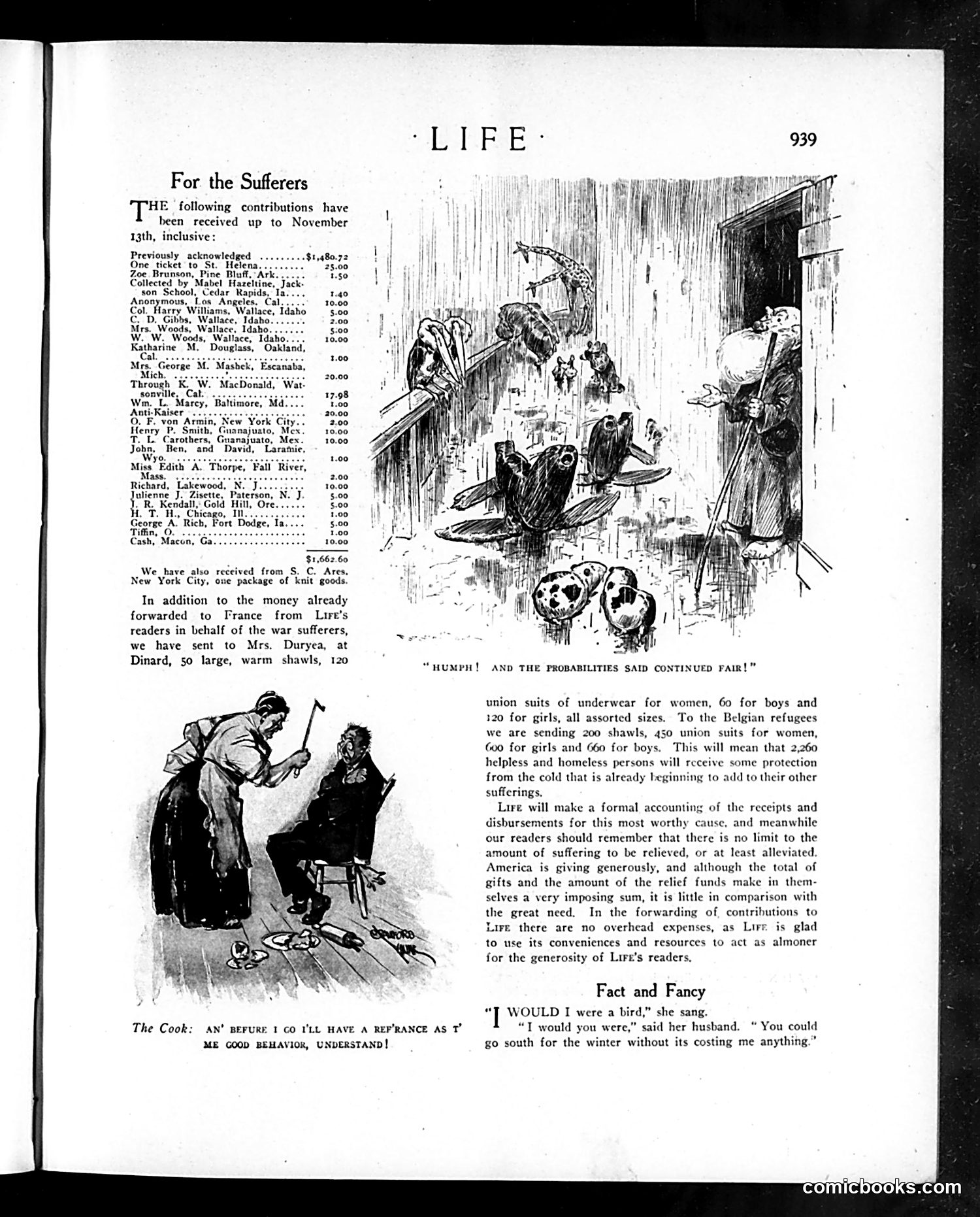
This page documents Life magazine's charitable campaign for war sufferers, likely during World War I (based on references to France and Belgian refugees). The left column lists monetary donations received from readers across America through November 13th. The upper cartoon depicts impoverished civilians—possibly Belgian or French refugees—in harsh conditions, illustrating the desperate need the relief efforts address. The caption "Humph! And the probabilities said continued fair!" suggests grim irony about their circumstances. The lower cartoon, titled "The Cook," shows a domestic servant demanding better behavior from an employer in exchange for continued service—a working-class assertion of dignity. The "Fact and Fancy" section presents a brief marital joke: a wife wishes to be a bird; her husband agrees, noting she could migrate south without expense to him—a quip about women's economic dependence and domestic costs. Together, these elements contrast serious wartime humanitarian concerns with lighthearted domestic humor typical of Life's satirical approach.
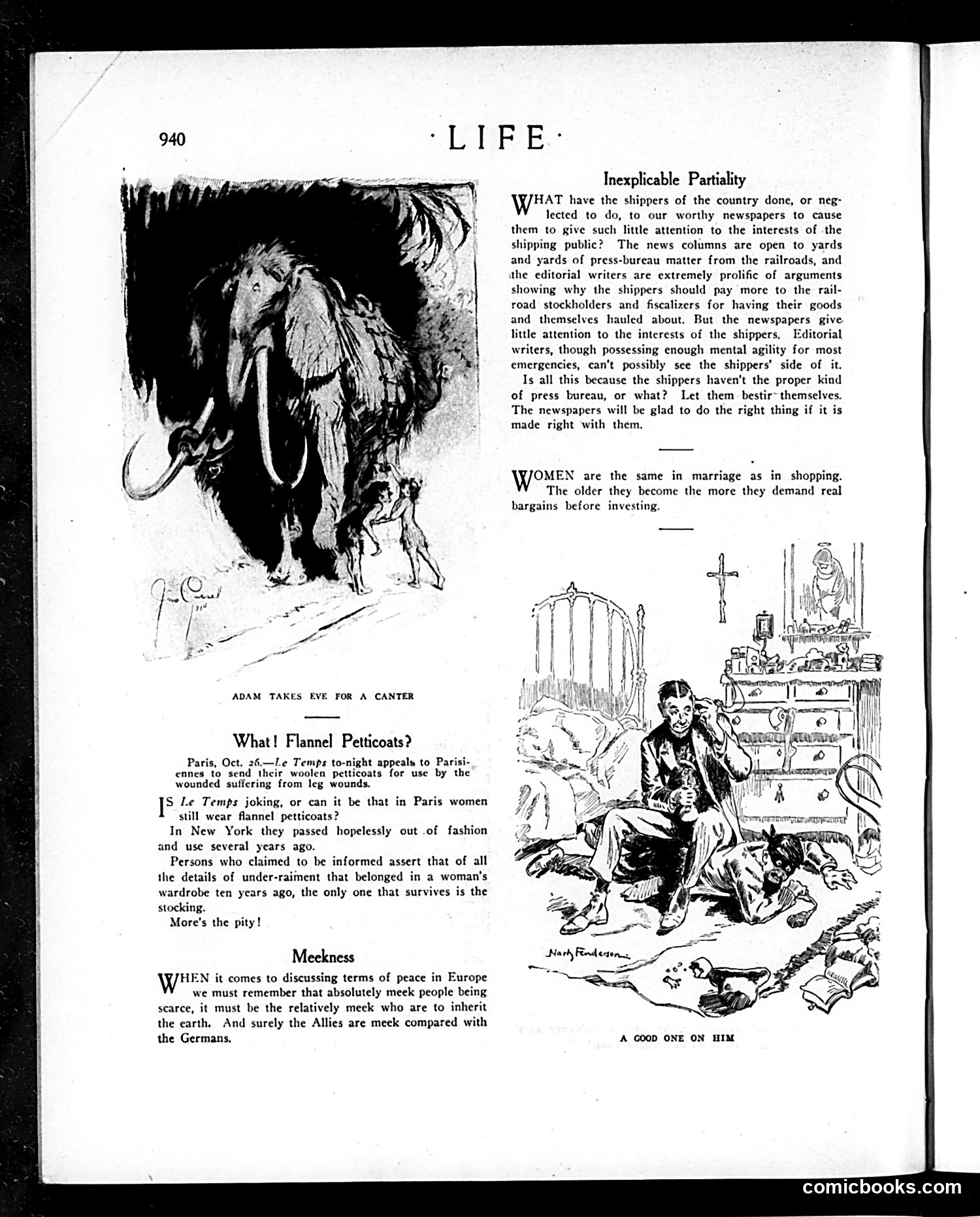
This page contains three satirical pieces: **"Inexplicable Partiality"** critiques newspapers' bias toward railroad interests over shipping companies. The text argues that papers give extensive coverage to railroad press releases while ignoring shippers' concerns, suggesting newspapers favor whoever pays for better publicity. **"What! Flannel Petticoats?"** mocks a French wartime appeal for women's wool petticoats for wounded soldiers' leg wounds. The joke: Paris women supposedly still wear old-fashioned flannel petticoats (outdated in New York), implying French fashion lags behind American modernity. **"Meekness"** is a darkly humorous commentary on World War I peace negotiations, arguing that since truly meek people are rare, only the "relatively meek" will inherit the earth—and sardonically suggests the Allies are meek *compared to* the Germans, implying the Germans are far more aggressive. The cartoon "A Good One on Him" (right) appears to depict a domestic scene but its specific reference is unclear from context alone.
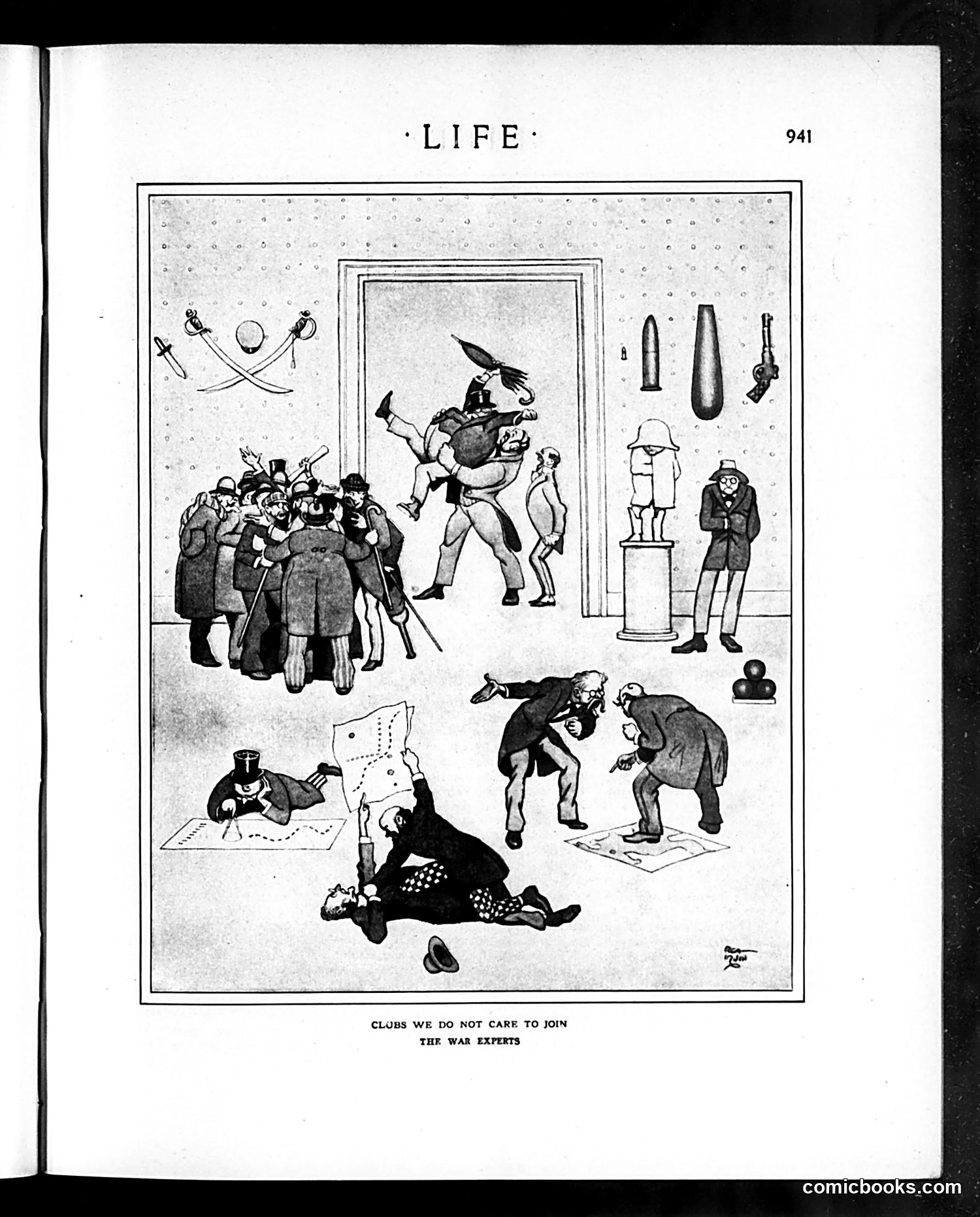
This satirical cartoon mocks self-proclaimed military "experts" who emerged during wartime (likely WWI era, given Life magazine's publication period). The central figure is a large, pompous man juggling weapons and military items, surrounded by smaller figures in formal dress examining maps and plans. The satire targets armchair strategists and civilians who positioned themselves as war authorities despite lacking genuine military experience—a common phenomenon during both World Wars. The exaggerated central character and the various "experts" studying blueprints suggest these individuals are more theatrical than competent. The title indicates the cartoonist's dismissal of such self-important war commentary. The weapons displayed at top right emphasize the serious subject matter being trivialized by these pretentious amateurs.
This page compares American and German governance systems. The main article argues that America's advantage lies in its ability to reverse failed policies by replacing leaders, whereas Germany's militarism became entrenched because the Kaiser and Junker aristocracy couldn't abandon it without losing power—forcing the system "to run its course to its natural finish." The article then applies this framework to railroad regulation. It describes the Interstate Commerce Commission as supervising railroad "reform" like "Torquemada" (referencing the Spanish Inquisition's brutality), observing the railroads' distress with indifference while the public grows uneasy. The implied criticism: America's regulatory "fit" of railroad reform has become excessive, starving the industry, yet the I.C.C. passively watches rather than adjusting course. The cartoons (appears to show trains/industrial scenes) reinforce the satire on government overreach during regulation. The publication date—November 1914—places this amid Progressive Era railroad regulation debates.
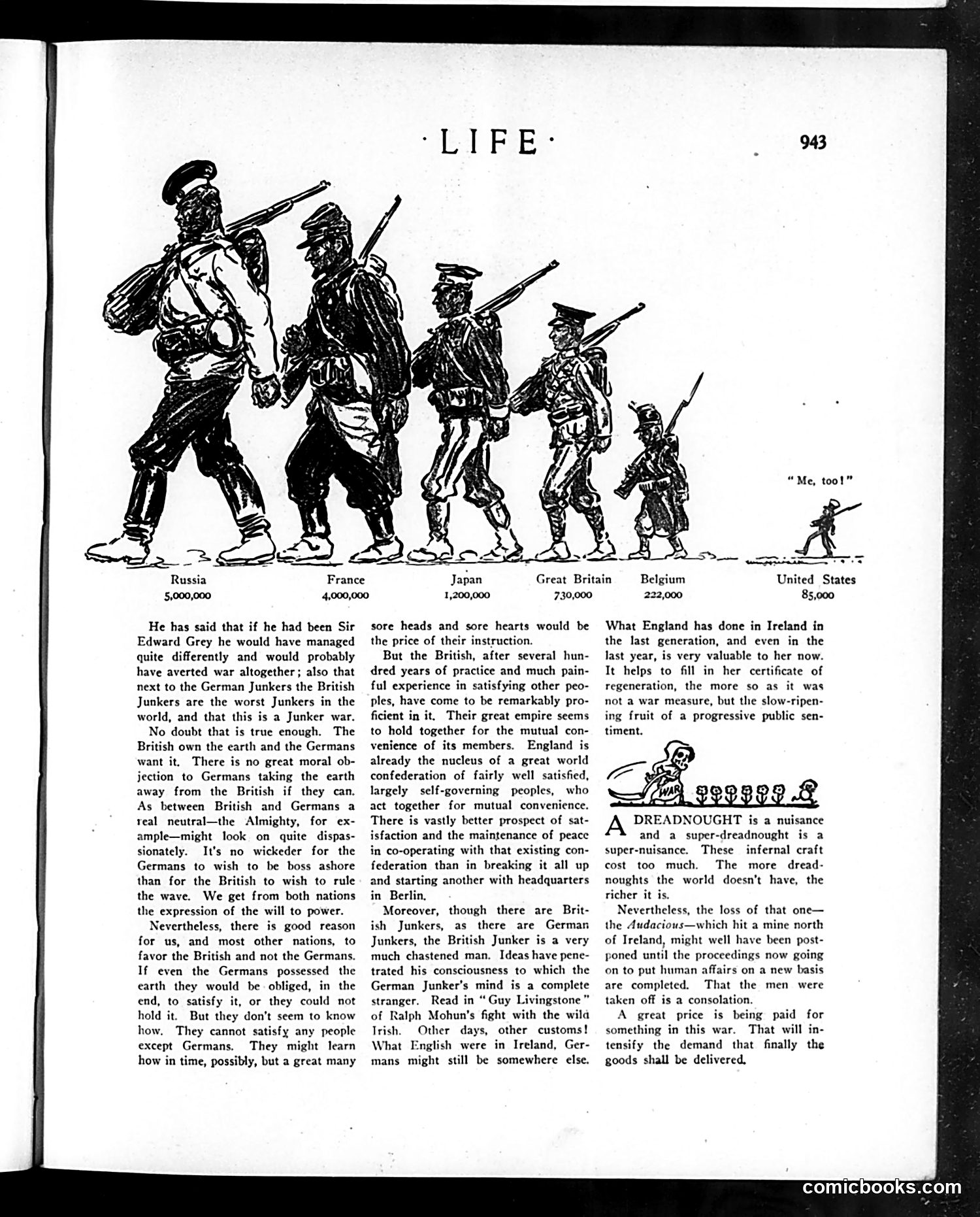
This page presents a WWI-era satirical argument defending the Allied cause. The prominent cartoon shows military figures from major combatants arranged by troop size: Russia (5M), France (4M), Japan (1.2M), Britain (730K), Belgium (222K), and a tiny United States (85K) saying "Me, too!"—humorously suggesting America's eventual entry into the war. The editorial argues Britain should be favored over Germany because the British Empire, despite its "Junkers" (militarist aristocrats), has learned through centuries of experience how to govern diverse peoples cooperatively. Germany's Junkers, by contrast, know only domination. The piece dismisses moral equivalence between the powers: while both desire power, only Britain can maintain a functional global confederation. The text also critiques dreadnought battleships as wasteful while regretfully noting the loss of HMS Audacious (sunk by mine in 1914). This reflects American intellectual circles debating intervention before 1917.
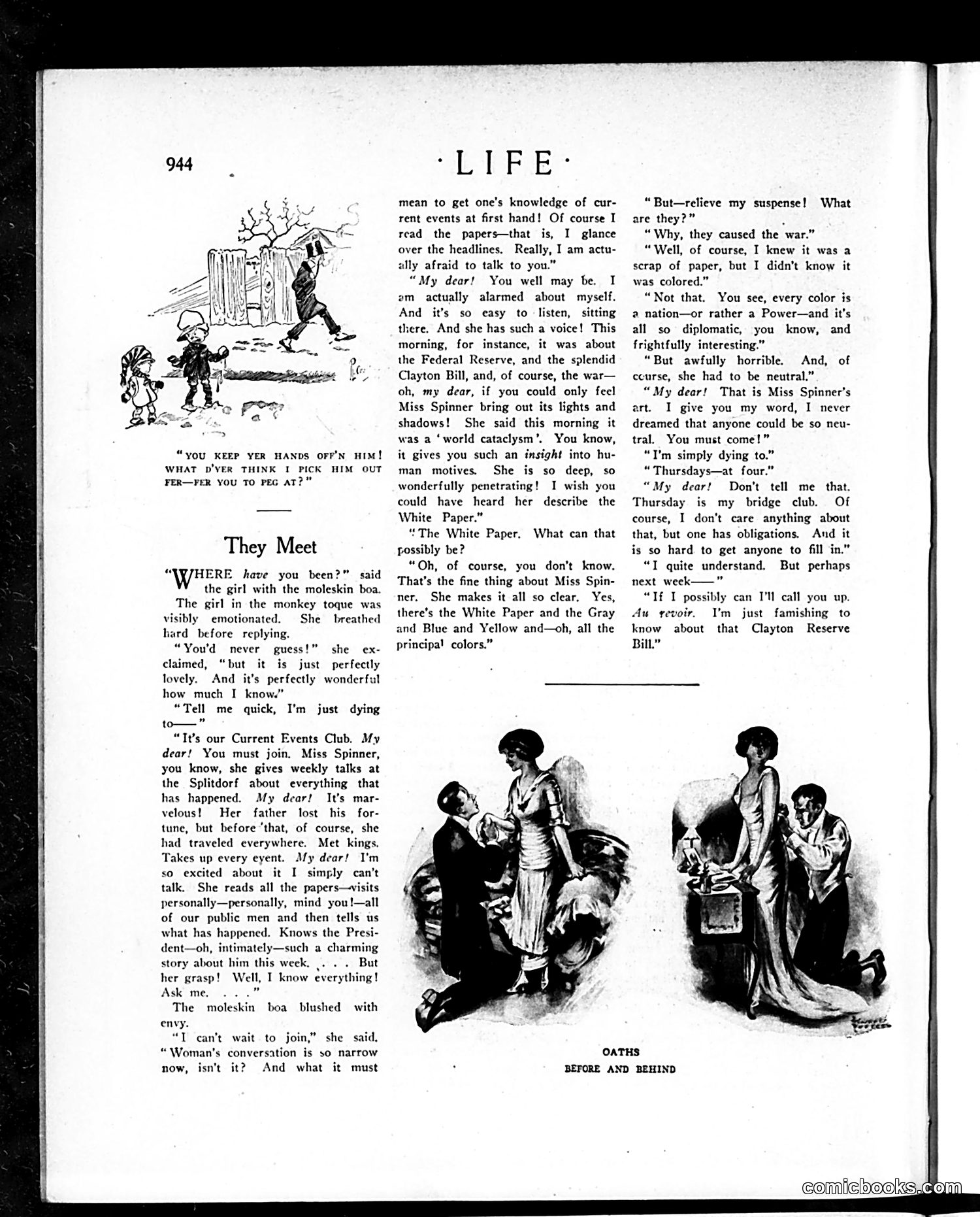
This satirical piece mocks upper-class women's superficial engagement with current events during World War I. Two fashionable women—identified by their elaborate hats (moleskin boa, monkey toque)—discuss Miss Spinner's "Current Events Club," where she lectures on serious matters like the Federal Reserve, the Clayton Bill, and the war. The satire targets how Miss Spinner presents complex geopolitical issues in oversimplified, dramatic language ("world cataclysm"), and how her listeners absorb this secondhand knowledge uncritically, then claim expertise. The joke deepens when they discuss colored "papers" (White, Gray, Blue, Yellow) allegedly causing the war—revealing profound confusion masquerading as informed discourse. The women prioritize bridge club over education, yet pretend intellectual sophistication. The lower illustration, "Oaths Before and Behind," likely contrasts public propriety with private behavior, reinforcing the theme of surface appearances masking shallow understanding.
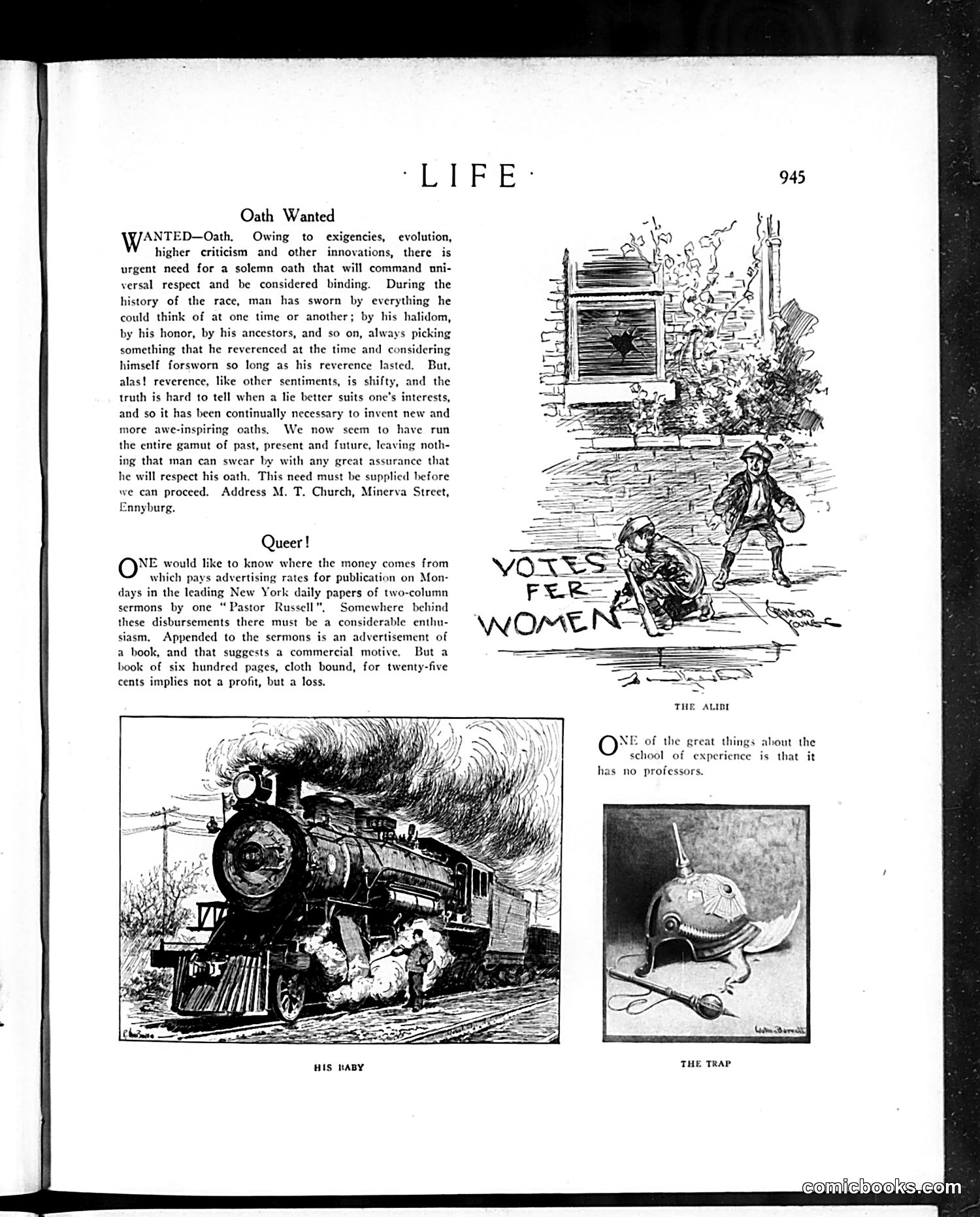
This page from *Life* magazine contains three satirical pieces: **"Oath Wanted"**: A mock want-ad lamenting that traditional oaths have lost meaning. The satire argues that as society modernizes ("evolution, higher criticism"), people no longer reverence the things they once swore by (honor, ancestors), making oaths unenforceable. It's commentary on declining moral authority in contemporary society. **"Queer!"**: Criticism of "Pastor Russell" (likely referring to Charles Taze Russell, founder of Jehovah's Witnesses), who published lengthy sermons in major newspapers. The satirist questions the funding source—noting that while ads promote his books, selling them at 25 cents at a loss suggests ulterior commercial or evangelical motives, not genuine publishing. **The cartoons** ("His Baby," "The Alibi," "The Trap," "Votes for Women") are separate satirical illustrations without visible captions explaining their specific references—likely contemporary political or social commentary typical of *Life*'s humor.
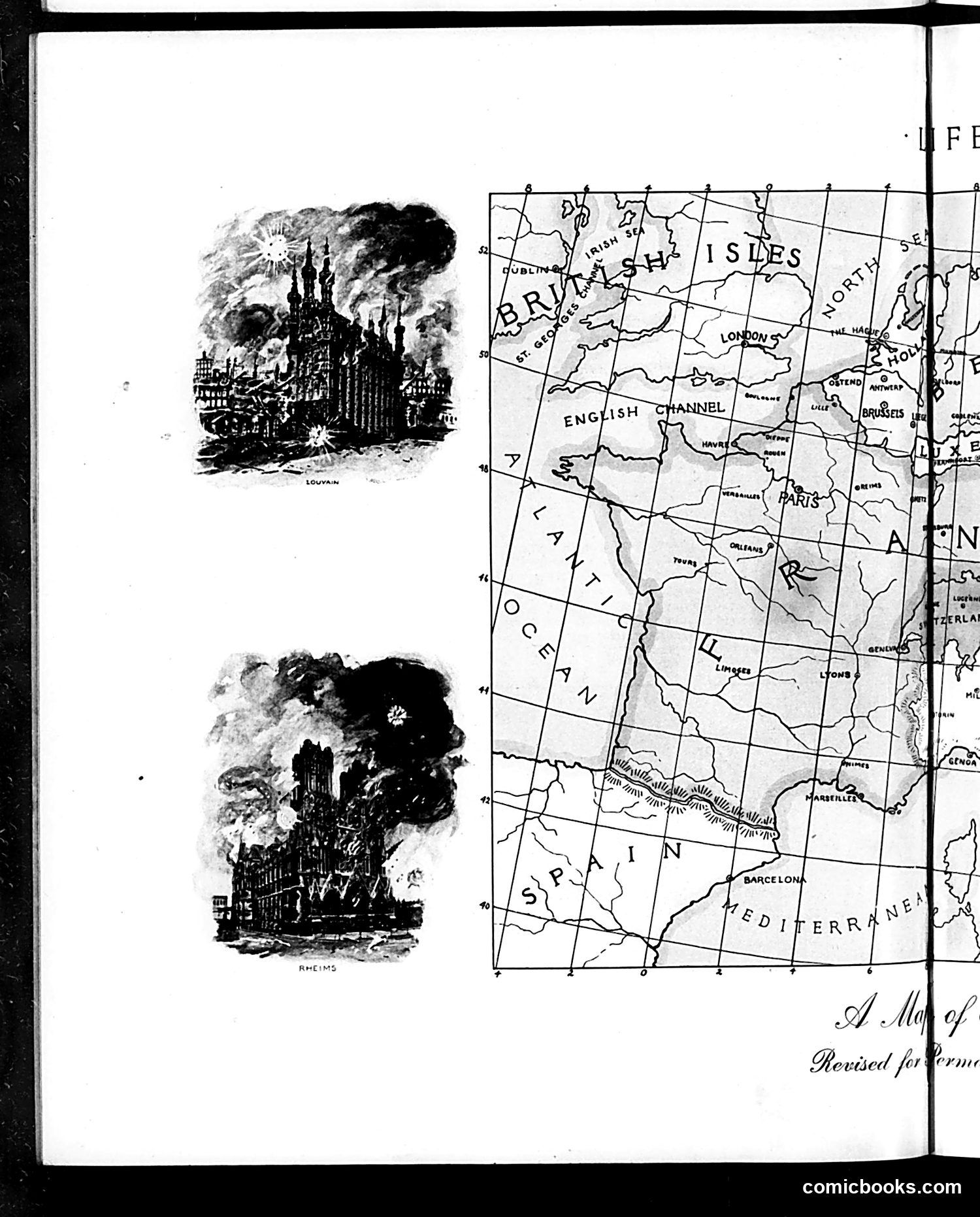
This page contains two architectural sketches labeled "LOUVAIN" (top) and "RHEIMS" (bottom), depicting Gothic cathedrals in flames. To the right is a map showing northern France, Belgium, and surrounding regions during what appears to be World War I era. The burning cathedrals are satirical commentary on German destruction of these historically significant French and Belgian landmarks during the war. Louvain's library and Rheims Cathedral were famously damaged during German occupation and bombardment (1914). The juxtaposition of these iconic structures destroyed against the geographic map suggests the artist is documenting or protesting German military conduct against civilian cultural heritage. The caption indicates this map was "Revised for" (text cut off), likely referring to wartime publication updates. This represents Life magazine's anti-German satirical stance during WWI.
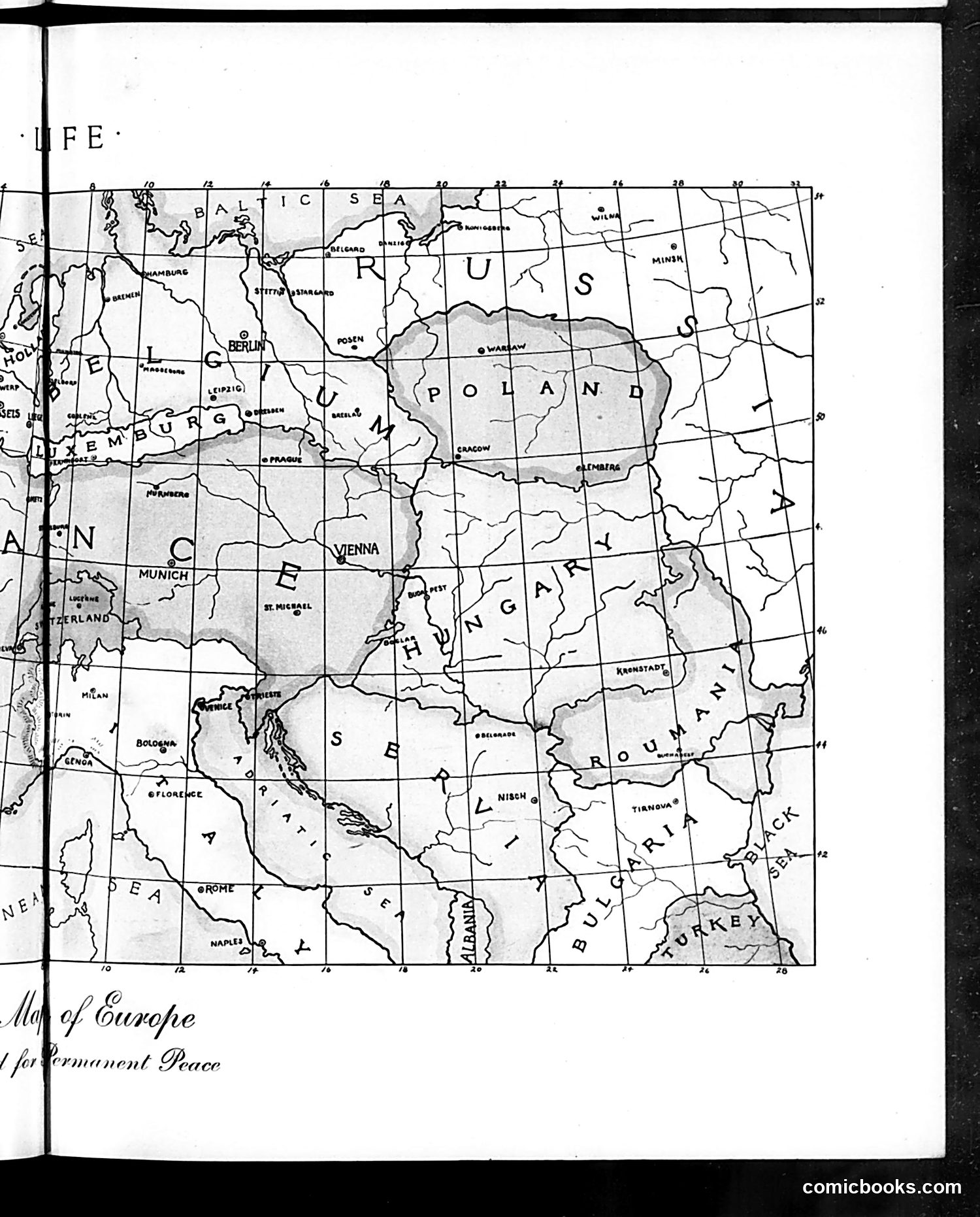
This page displays a political map of Europe with country boundaries clearly marked. The title indicates it's titled "Map of Europe for Permanent Peace," suggesting this relates to post-World War I peace negotiations and territorial reorganization. The map shows recognizable European nations including Poland, Austria, Hungary, Germany, France, Switzerland, and Italy. The gridded overlay and precise boundary demarcation suggest this represents proposed or newly-established borders—likely from the Treaty of Versailles (1919) era when Europe's political map was redrawn. Without visible satirical caricatures or commentary text on this particular page, it appears to function as a straightforward reference document rather than a satirical cartoon. *Life* magazine may have used such maps to inform readers about the complex territorial settlements reshaping Europe following WWI.
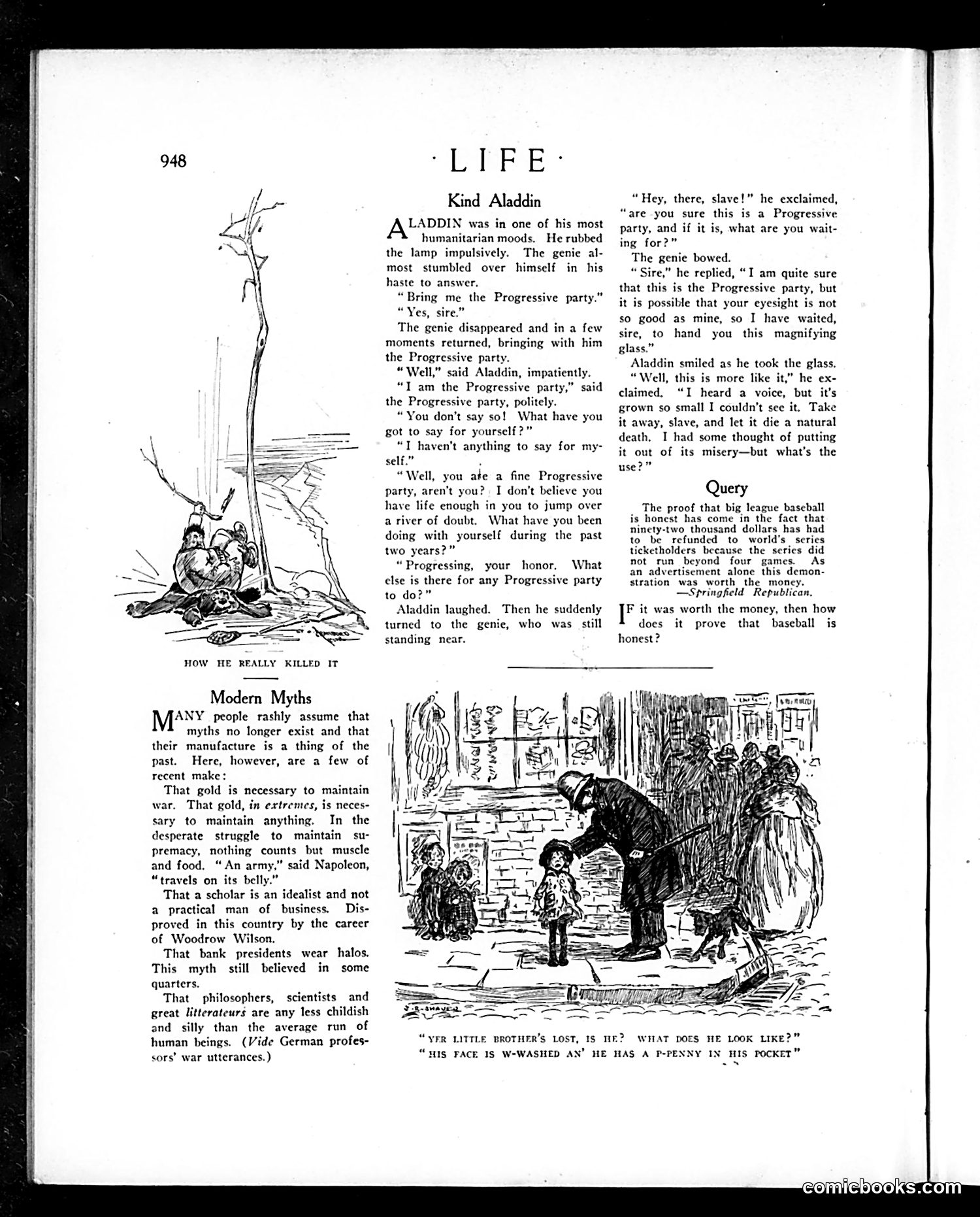
This *Life* magazine page contains two main satirical pieces: **"Kind Aladdin"** mocks the Progressive Party as ineffectual and invisible. Aladdin summons the Progressive Party via magic lamp, only to find it so weak and insubstantial that he needs a magnifying glass to see it—and ultimately orders it destroyed as a mercy. The satire suggests the Progressive Party had become politically irrelevant or impotent, lacking real substance or accomplishment. **"Modern Myths"** debunks contemporary falsehoods, including claims about gold's necessity in warfare and bank presidents' moral superiority. The piece appears to reference World War I-era debates and includes criticism of German academics' nationalist rhetoric. The bottom cartoon shows two children—one lost—with gentle, sentimental humor rather than political content. The "Query" section sarcastically questions whether a baseball refund truly proves the sport's honesty, suggesting the logic is flawed.
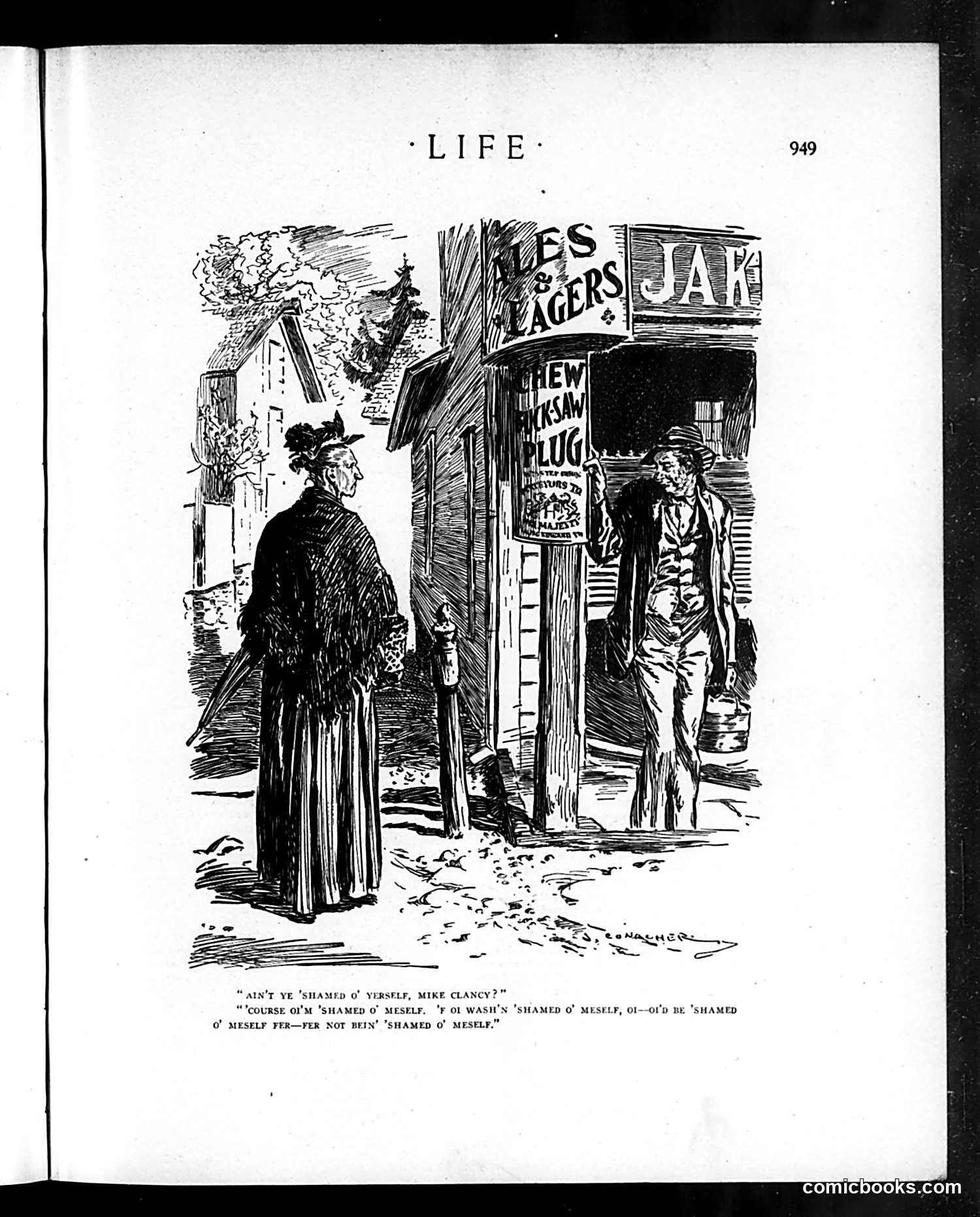
This cartoon depicts two working-class Irish-American men outside what appears to be a bar or shop advertising James Lagers and tobacco products. The dialogue plays on Irish dialect stereotypes popular in early 20th-century American satire. One man questions "Mike Clancy" about his shame, to which Clancy responds with circular logic: he's ashamed of himself because even George Washington would be ashamed of himself, so he'd be ashamed *not* to be ashamed. The joke mocks both Irish immigrants' speech patterns and their supposed moral reasoning, while invoking Washington as a standard of American virtue that contrasts with the depicted characters.
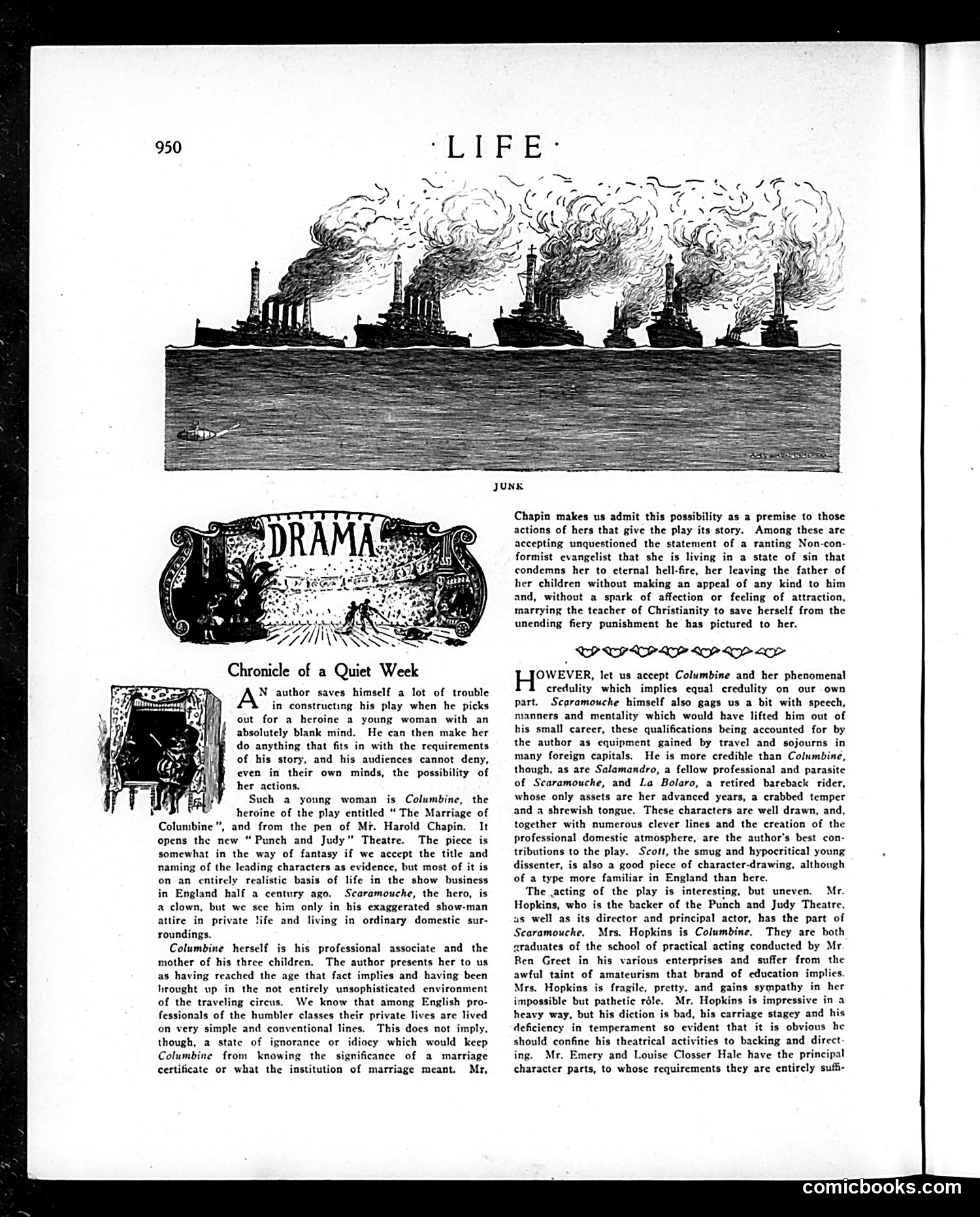
This page critiques Harold Chapin's new play at the "Punch and Judy" Theatre, which opens with a fantastical premise grounded in realistic circus-performer life. The reviewer argues the playwright exploits a female protagonist with an "absolutely blank mind" to justify her implausible actions. Columbine, a circus performer and mother of three, allegedly accepts a religious zealot's condemnation of her unmarried status and abandons her children's father (the clown Scaramouche) to marry a hypocritical Christian teacher—all to escape supposed damnation. The top illustration shows warships with smoke, likely referencing contemporary military/political tensions, though its connection to the drama review is unclear. The reviewer acknowledges this absurdity requires audience suspension of disbelief. While supporting characters are "well drawn," the leads suffer from amateurish training under Mr. Ben Greet's school of practical acting. Mrs. Hopkins is "fragile, pretty," but the improbable plot strains credibility.
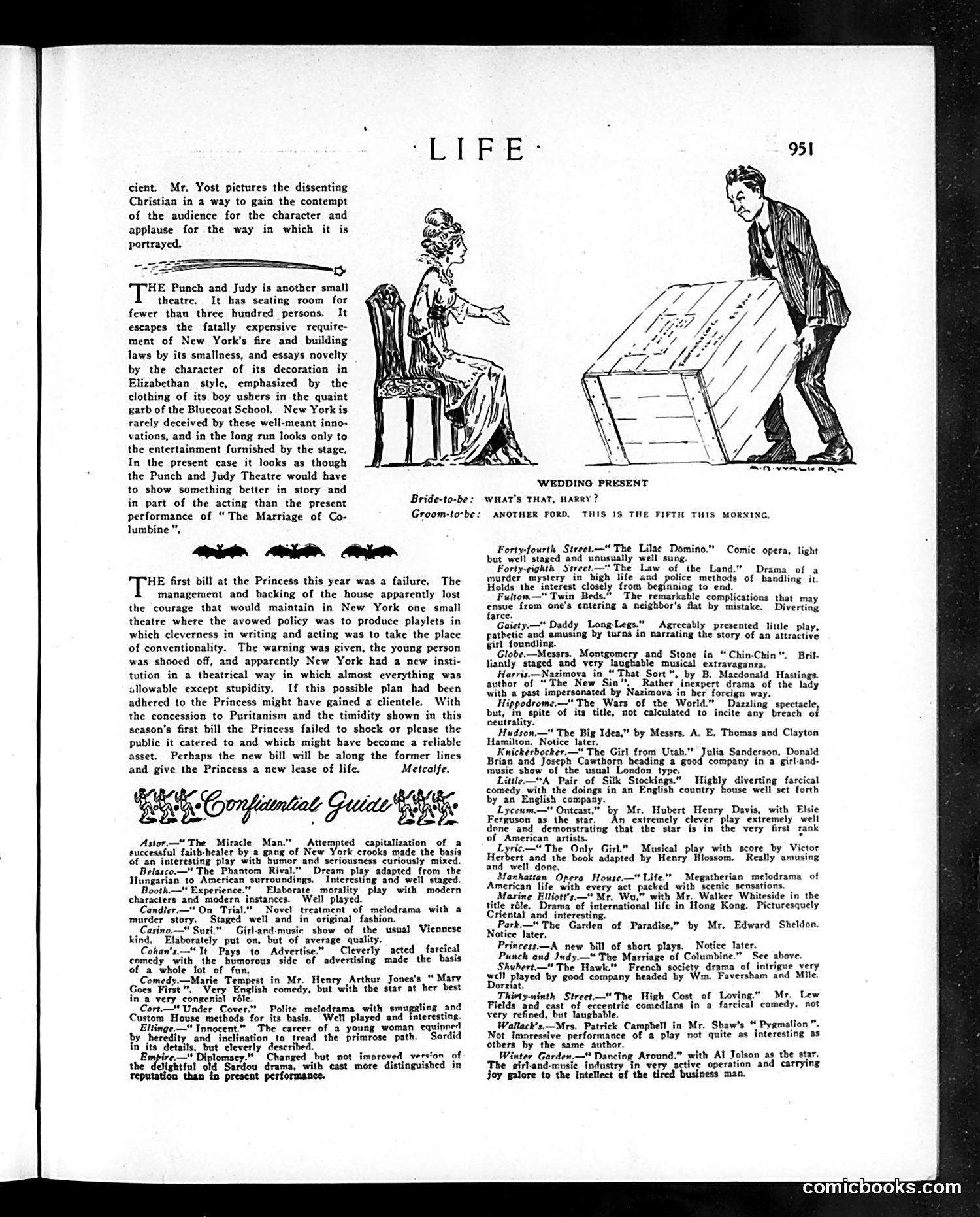
This cartoon satirizes the popularity of Ford automobiles in early 1910s America. The joke shows a bride-to-be receiving her fifth Ford motorcar as a wedding gift that same morning, which she finds noteworthy enough to remark upon to her groom. The humor operates on two levels: First, it mocks the Ford's ubiquity—so many people owned them that receiving multiple identical cars seemed inevitable. Second, it gently ridicules wealthy gift-givers' lack of imagination, defaulting to the same practical (if uninspired) present repeatedly. The cartoon reflects the Model T Ford's revolutionary affordability and market dominance following its 1908 introduction. What was once an exciting luxury gift had become so commonplace that receiving five in one morning was treated as an amusing inevitability rather than a remarkable occurrence. The cartoon's placement in *Life*'s theater review section suggests this was contemporary social commentary, capturing a specific moment when Ford's mass production had dramatically shifted American consumer culture and gift-giving conventions.
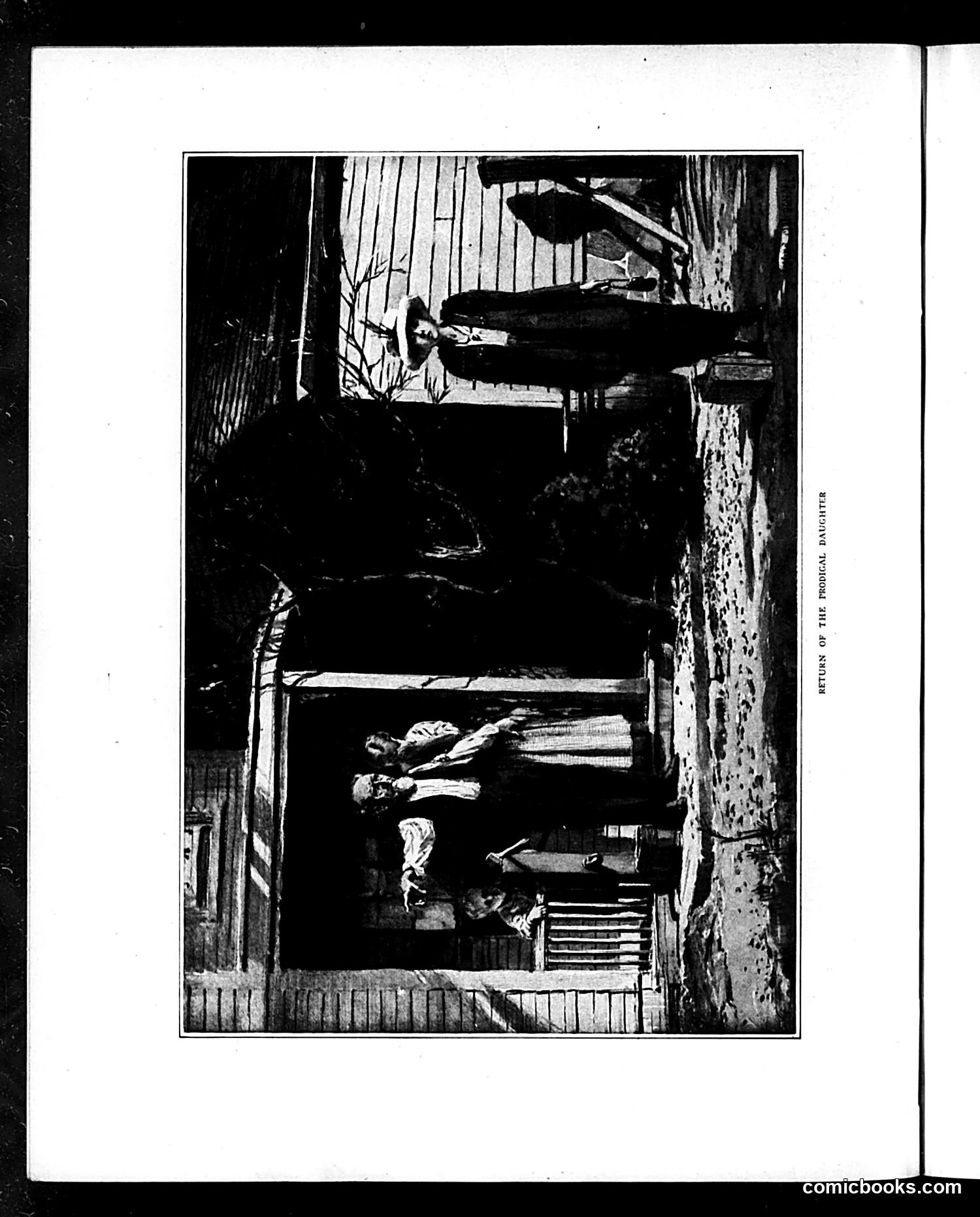
This appears to be a satirical illustration titled "Return of the Prodigal Daughter." The black-and-white photograph shows an interior domestic scene, likely staged for satirical effect. A figure reclines on a bed or couch while others occupy the modest room, which features wooden walls and sparse furnishings. The title references the biblical parable of the prodigal son, but inverts it with a female subject. This suggests the cartoon satirizes a woman's return home—possibly commenting on social expectations around women, family obligation, or domestic life. Without additional context about the publication date or specific cultural moment, the exact target of satire remains unclear, though it likely critiques either the woman's behavior or society's treatment of returning women.
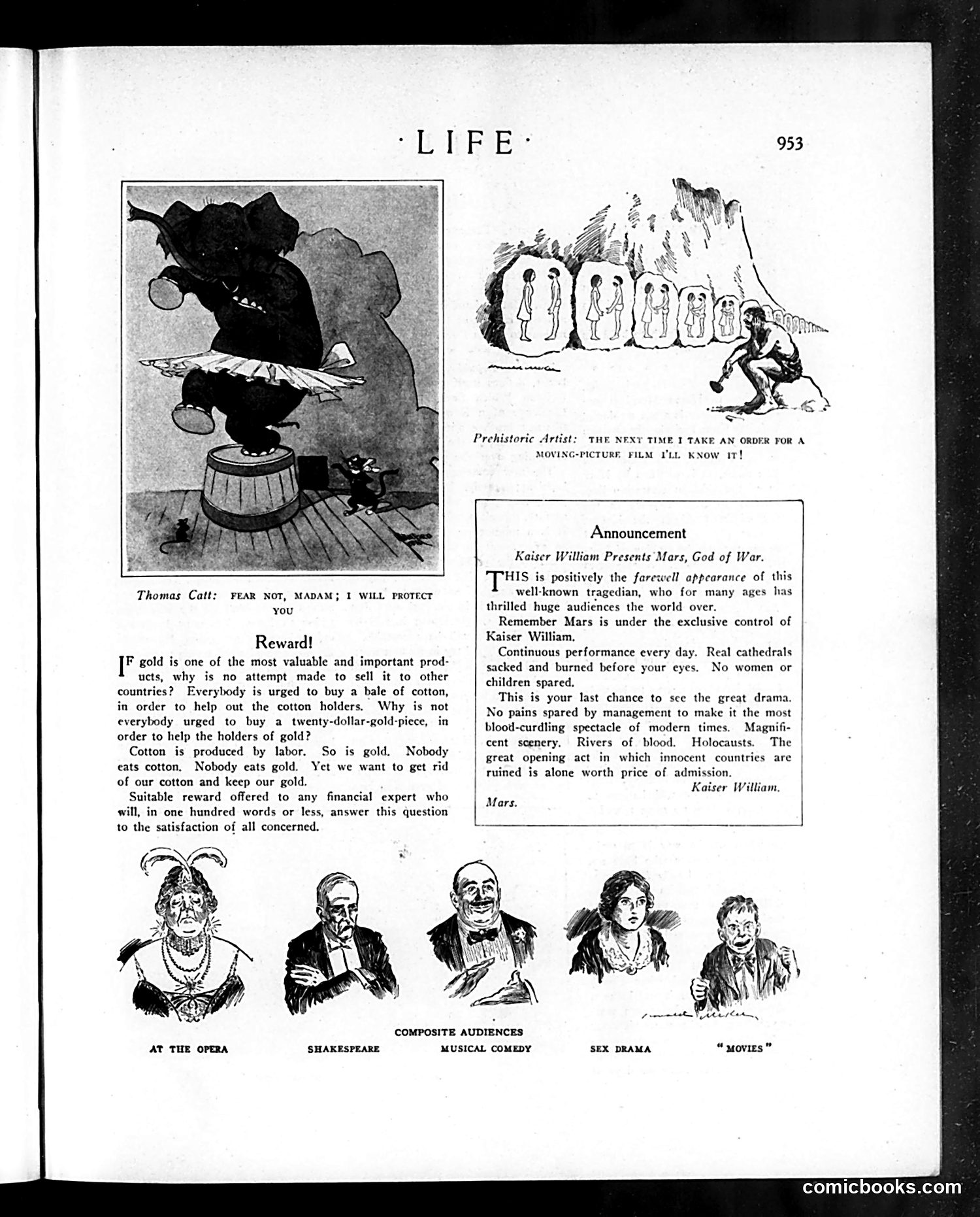
This page contains three distinct satirical pieces: 1. **"Thomas Catt" cartoon** (top left): References a labor/suffrage figure protecting a woman—likely mocking paternalistic rhetoric around women's rights. 2. **"Reward" article**: Critiques economic policy by highlighting a logical inconsistency: America promotes selling cotton abroad to help cotton producers, yet doesn't similarly promote gold exports. The satire exposes protectionist contradictions in post-WWI American commerce. 3. **"Kaiser William Presents Mars"**: A biting wartime satire (appears to be WWI-era) mocking German Emperor Wilhelm II. It presents him as theatrical impresario staging war as entertainment—complete with destroyed cathedrals and civilian casualties as "spectacle." This equates Wilhelm's military aggression with sensational theater, condemning both the violence and the callous attitude toward human suffering. 4. **Bottom illustration**: "Composite Audiences" caricatures showing different theatergoer types, offering social commentary on entertainment consumption across classes.
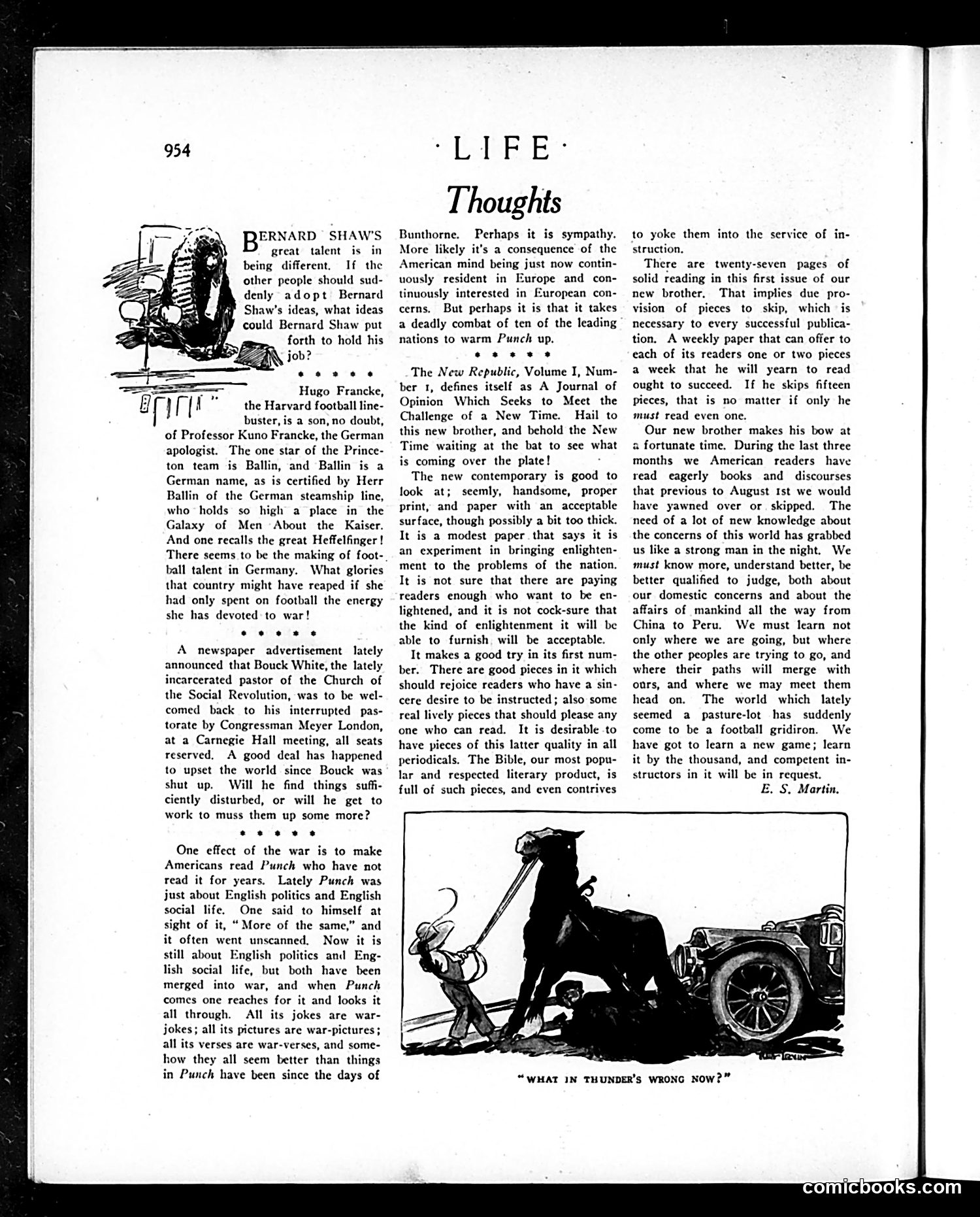
The single cartoon on this page depicts a figure (appearing to be a chauffeur or driver) struggling with a broken-down automobile while another figure gestures in frustration. The caption reads "WHAT IN THUNDER'S WRONG NOW?" **Context:** This appears to be WWI-era satire. The cartoon likely references mechanical or logistical failures during wartime—either military vehicle breakdowns or broader systemic failures on the home front or battlefield. The driver's exasperation and the other figure's angry gesture suggest frustration with incompetence or poor maintenance during a critical period. The surrounding text discusses how *Punch* magazine (the British satirical publication) has become war-focused, with all its content now centered on wartime concerns. This cartoon fits that wartime satirical tradition—mocking practical failures or bungling during the conflict. Without clearer identifying details, the specific target of the joke remains somewhat unclear, but it's definitely commenting on frustration with mechanical/operational failures in a wartime context.
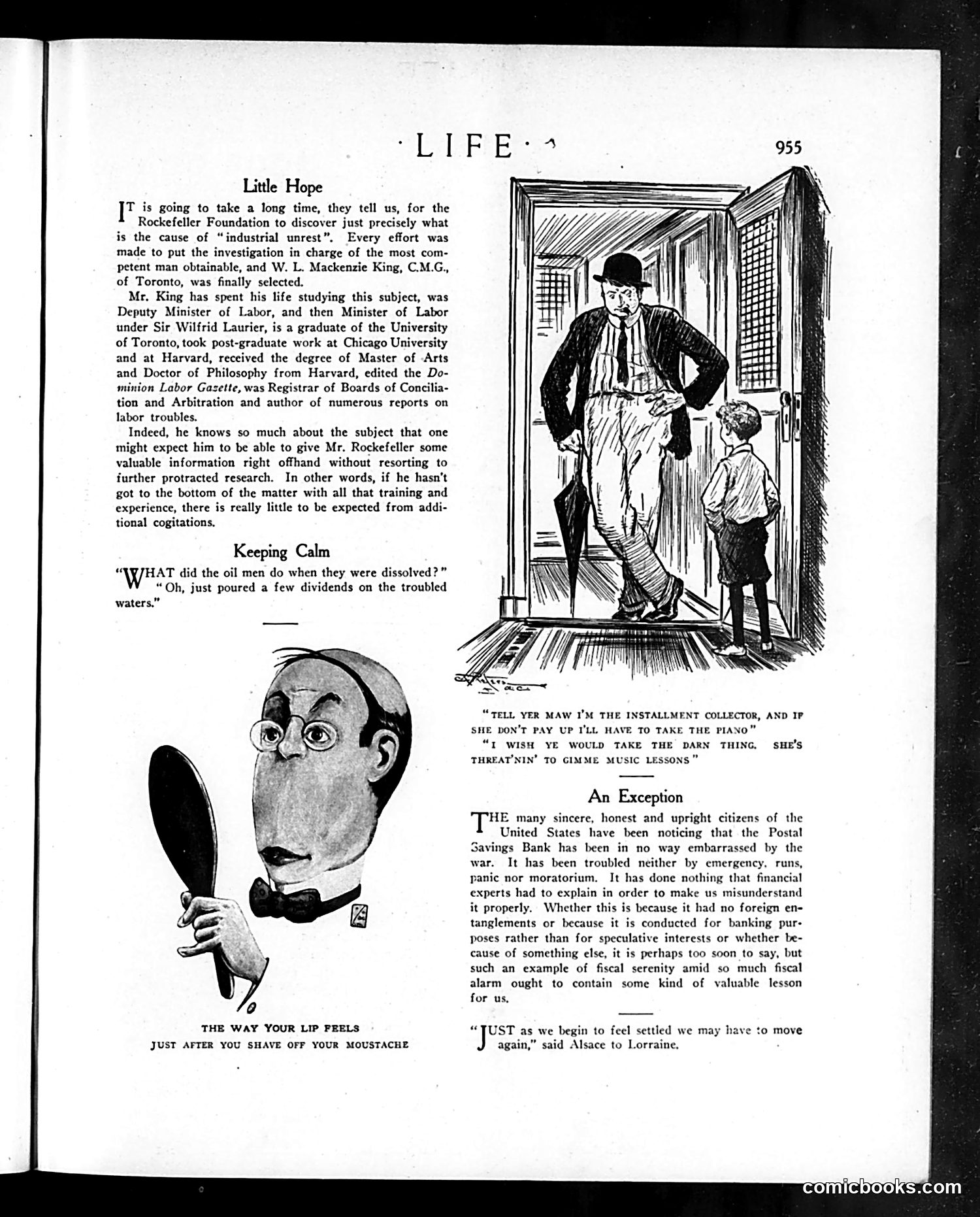
This page from *Life* contains three distinct satirical pieces: **"Little Hope"** sarcastically questions whether labor expert W.L. Mackenzie King—despite his extensive credentials as Canada's former Labor Minister and Harvard-educated scholar—can solve "industrial unrest" for the Rockefeller Foundation. The implication: if someone so thoroughly trained hasn't solved labor problems already, additional research seems pointless. **"Keeping Calm"** is a joke about oil industry dissolution during WWI: when oil companies were broken up, they simply "poured dividends on troubled waters"—mocking how financiers profited from crisis. **"An Exception"** praises the U.S. Postal Savings Bank for remaining stable during wartime financial panic, contrasting it with other institutions' failures. The final caption, with Alsace and Lorraine (French regions) discussing displacement, references WWI territorial warfare. The cartoons mock labor politics, corporate greed, and wartime financial instability while praising government fiscal responsibility.
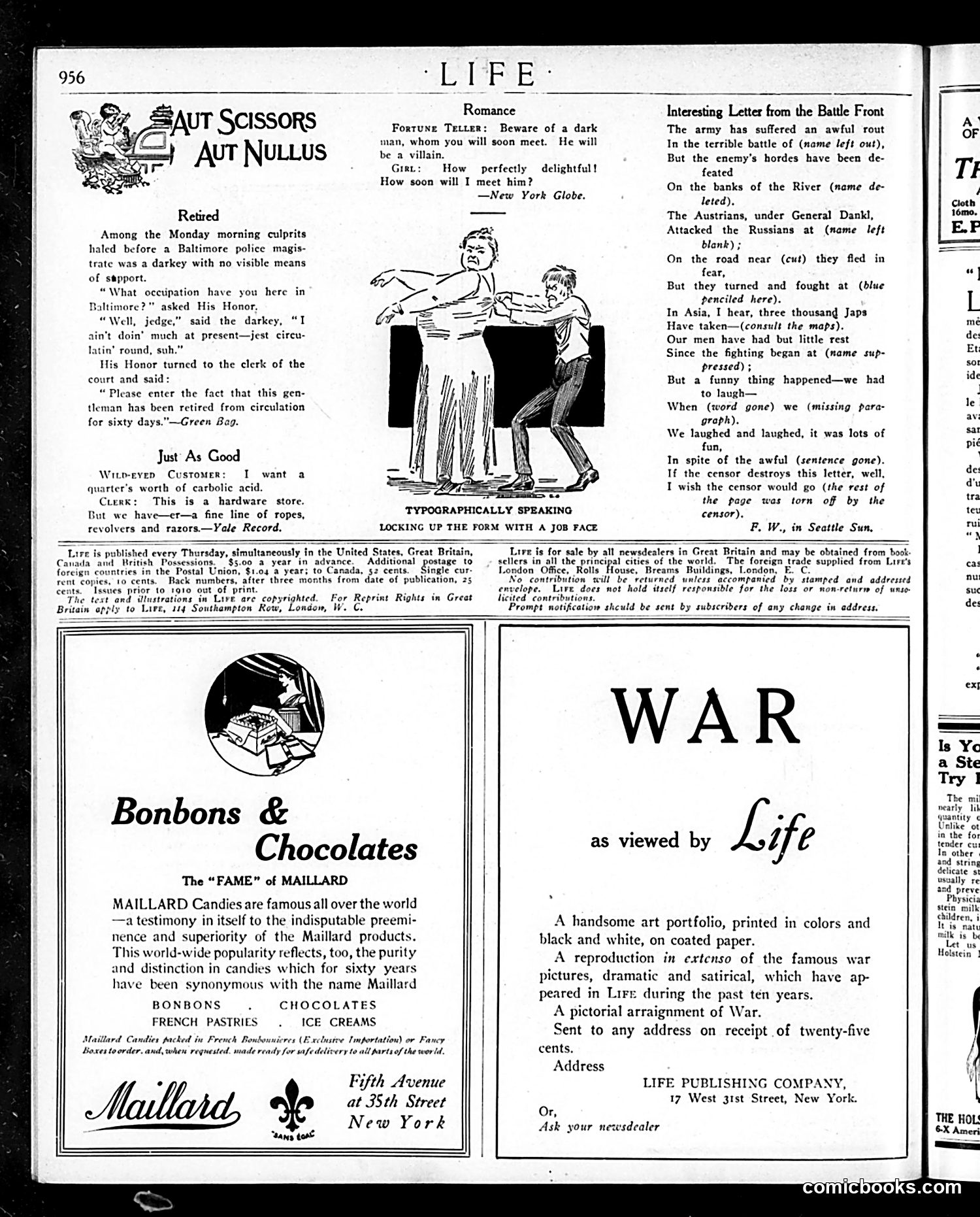
This page from *Life* magazine (likely 1914-1915, during World War I) showcases satirical commentary on the war through multiple pieces. The main cartoon, "Locking Up the Form with a Job Face," depicts a printer's forme being locked into place—a visual pun. It satirizes wartime censorship: a accompanying piece titled "Interesting Letter from the Battle Front" shows a soldier's letter so heavily censored that crucial details are redacted (names "left out," locations "deleted," passages "gone"), leaving only fragments. The joke mocks how military censorship renders war reporting meaningless—readers learn battles occurred but not where, who fought, or outcomes. The page also includes lighter satirical pieces: "Retired" mocks a lazy defendant, while "Romance" and "Just As Good" are brief joke items typical of the era's humor magazines. The advertisement for Maillard Chocolates and the "War as viewed by Life" portfolio announcement round out the page, which functioned as both satirical commentary and commercial enterprise.
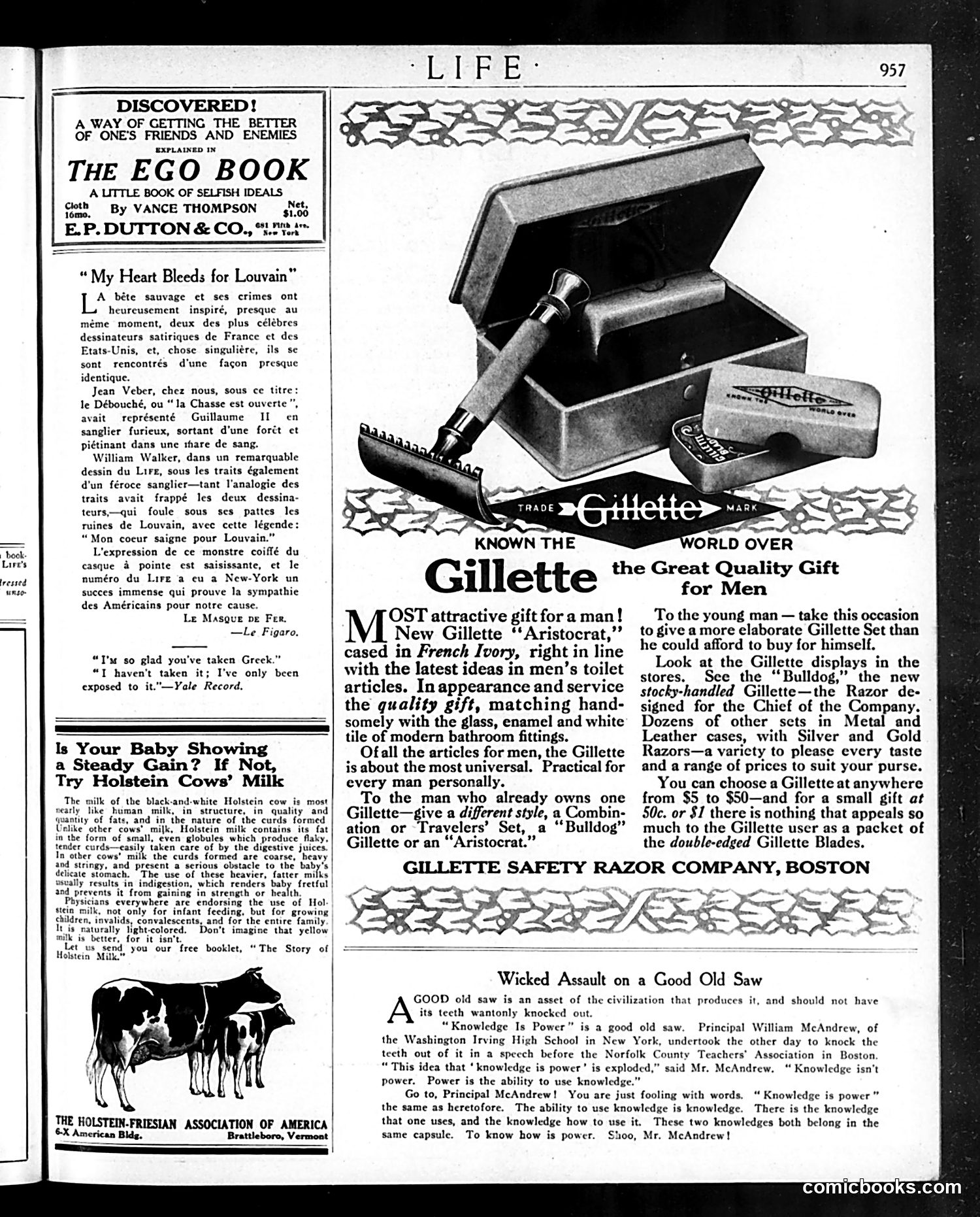
This page is primarily **advertising and book promotion** rather than political satire. The main content includes: 1. **Book advertisement** for "The Ego Book" by Vance Thompson—a satirical work on selfish ideals. 2. **French editorial commentary** ("My Heart Bleeds for Louvain") discussing wartime political cartoons. It references two satirists—Jean Veber (French) and William Walker (American)—who independently created nearly identical cartoons depicting **Kaiser Wilhelm II as a wild boar** destroying Louvain during World War I. The piece celebrates that American audiences sympathized with France's cause. 3. **Consumer advertisements** for Holstein milk (infant nutrition) and Gillette safety razors. 4. **A brief satirical exchange** at bottom about "knowledge is power"—mocking a principal's platitude. The Louvain reference is historically significant: the 1914 German invasion destroyed the Belgian city, becoming a symbol of German aggression. The cartoon comparison demonstrates how wartime propaganda spread across the Atlantic.
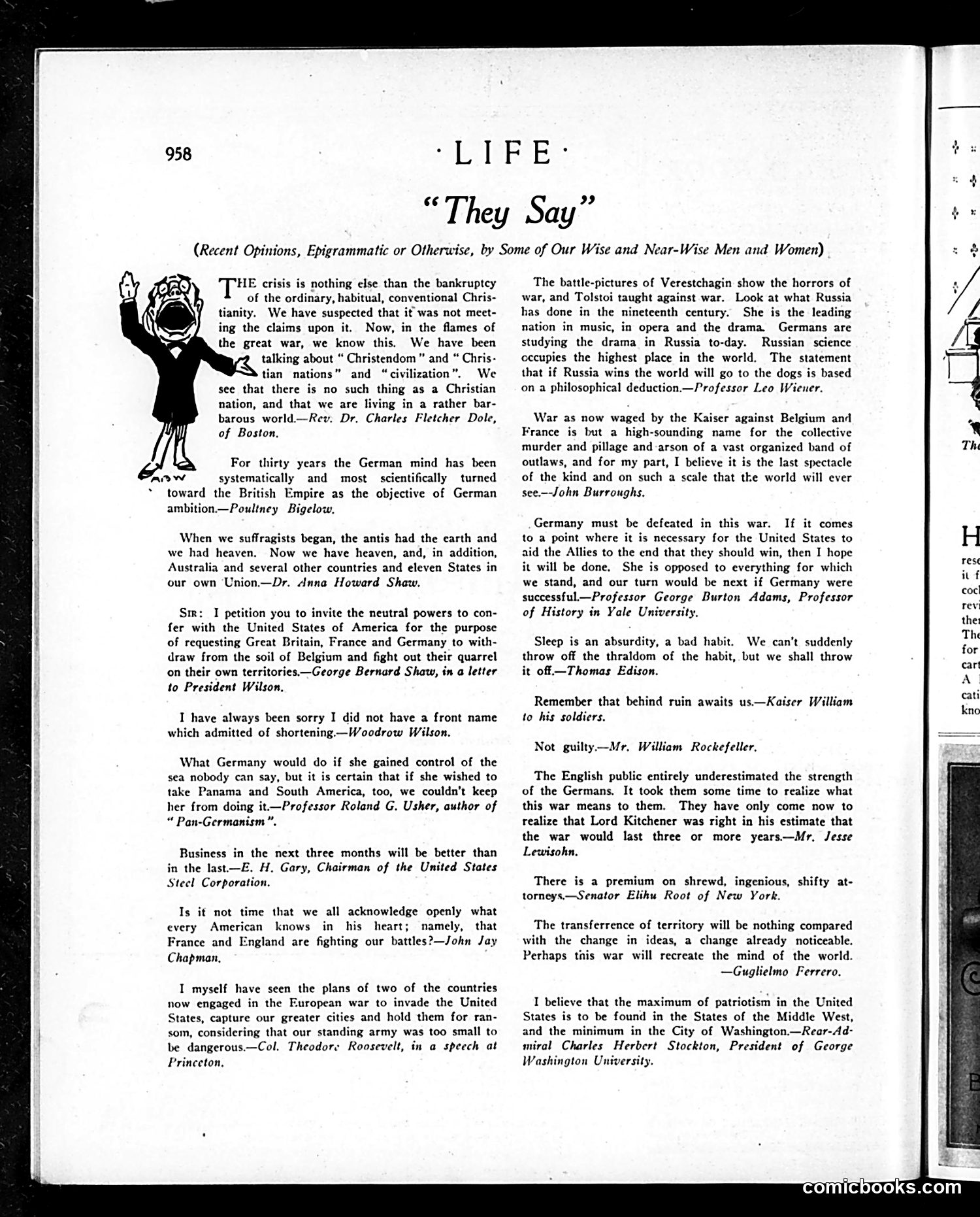
This page collects brief opinions on World War I from prominent American figures. The cartoon shows a caricatured figure (likely representing German militarism or Kaiser Wilhelm II) with an exaggerated facial expression, symbolizing the aggressive "German mind" discussed in the text. The quotes reflect American debate circa 1914-1917: some speakers (Roosevelt, Burroughs, Adams) argue for American intervention against Germany; others (George Bernard Shaw) propose neutral mediation; a suffragist (Dr. Shaw) sardonically notes women gained rights while war raged; Edison dismisses sleep as habit. The satire is gentle—"They Say" mocks pretentious pronouncements from both wise men and cranks equally. References to German invasion plans, Panama canal threats, and Kaiser Wilhelm's alleged fatalism about ruin reveal period anxieties. The juxtaposition of trivial opinions (Wilson regretting his first name) with grave war commentary creates ironic commentary on public discourse during wartime uncertainty.
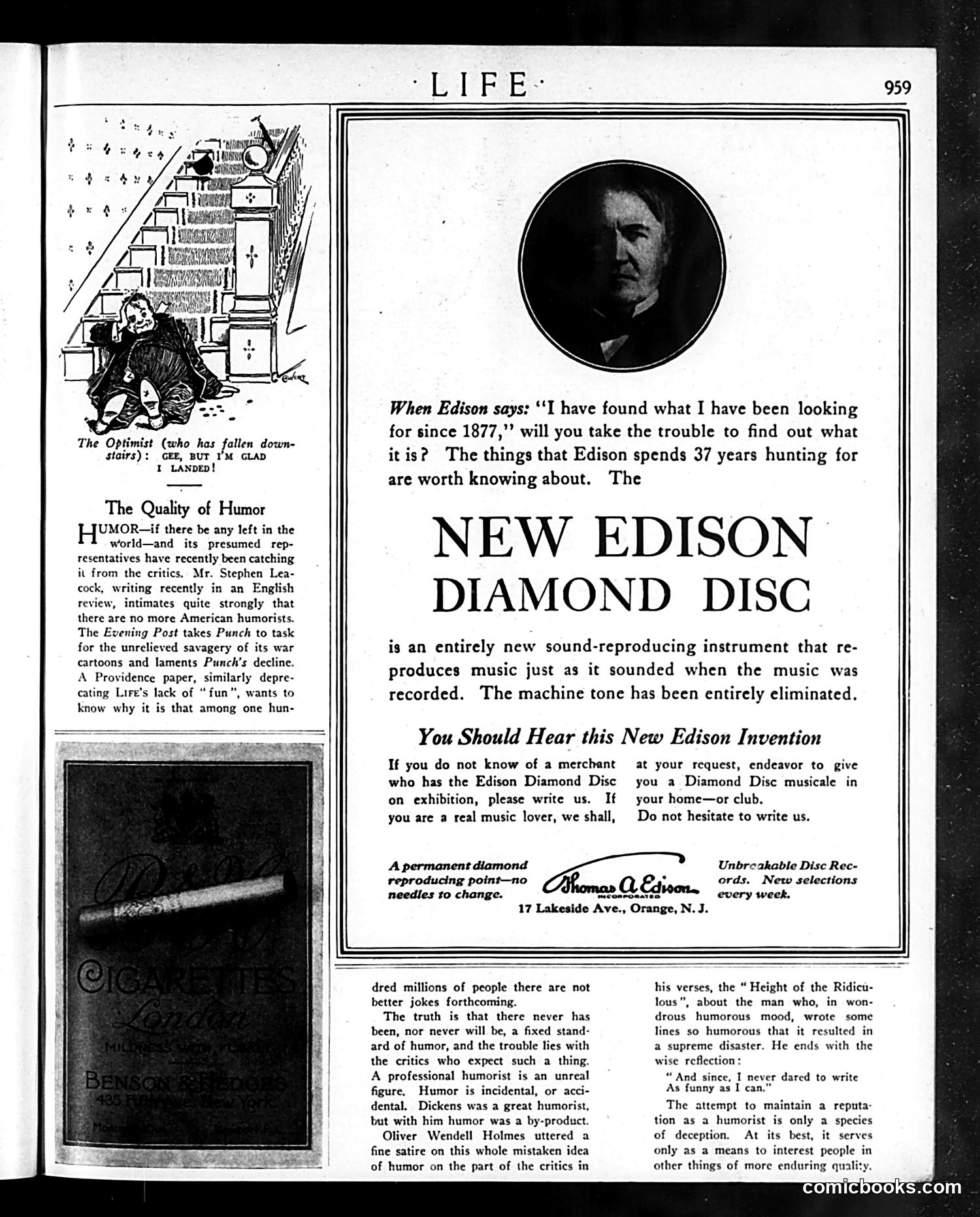
**The Cartoon:** The small sketch shows an optimist who has tumbled down stairs, cheerfully declaring "Gee, but I'm glad I landed!" — a joke about finding silver linings even in mishaps. **The Article:** This page primarily features an essay titled "The Quality of Humor" debating whether American humor is declining. Critics like Stephen Leacock and publications like the *Evening Post* have complained that humor is disappearing or becoming too harsh (particularly *Punch's* wartime cartoons). The author argues this misses the point: humor cannot be manufactured on demand. True humorists like Dickens and Oliver Wendell Holmes produced humor incidentally, as a byproduct of their work. Attempting to maintain a professional reputation as a humorist is inherently dishonest—humor's real value lies in serving as a vehicle for more meaningful ideas. **Advertisement:** The page also contains a substantial advertisement for Edison's new Diamond Disc phonograph, emphasizing its superior sound reproduction. The page reflects early-20th-century anxiety about cultural decline and changing entertainment standards.
This page collects humorous anecdotes mocking contemporary American life and logic. The "Moral of the Story" jokes on children's naive reasoning: a boy points out that if the lamb in Fables had been "good and sensible," humans would have eaten it anyway—undercutting the moral lesson itself. "No, Indeed!" mocks pretentious society women confusing Russian "Cassocks" (Cossacks) with German "Oolongs" (a tea type)—satirizing ignorant snobbery. The physiology and spelling sections ridicule both educational gaps and bureaucratic absurdity: a school commissioner, examining a spelling class performing "correctly," insists they're wrong, pointing triumphantly to "Egypt" as proof they misspelled "eggpit"—highlighting how authority figures can be both confidently wrong and immune to evidence. These vignettes collectively mock American institutional failures, class pretension, and the gap between appearances and reality—typical of *Life* magazine's satirical purpose.
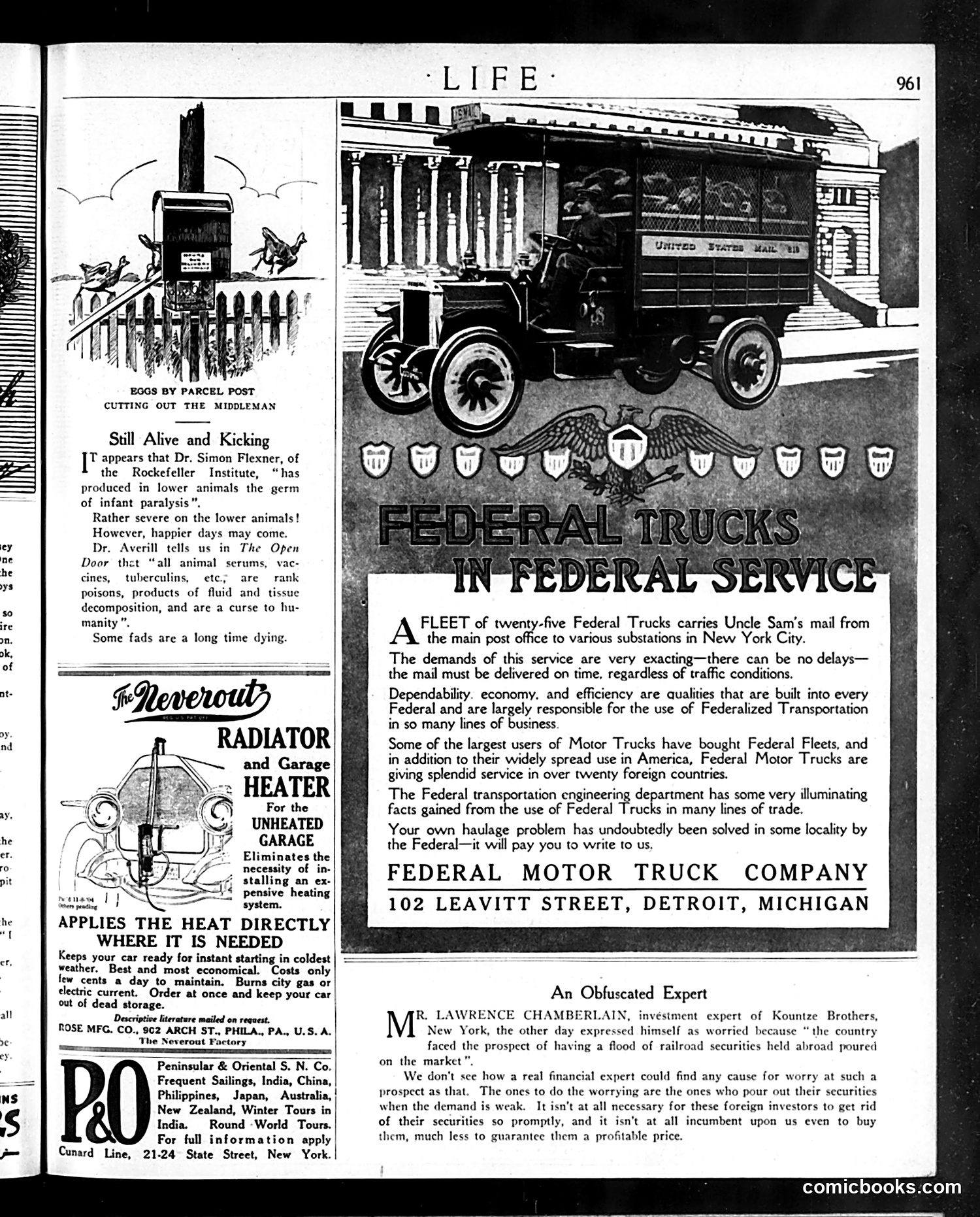
**Top Cartoon ("Eggs by Parcel Post"):** A satirical commentary on the U.S. postal service's expansion into parcel delivery. The cartoon depicts eggs being mailed, suggesting the absurdity of sending fragile items through the mail—a jab at the Post Office Department's ambitious new parcel post service (established 1913), which promised to eliminate middlemen but faced practical skepticism about reliability. **"Still Alive and Kicking" Section:** Satire of medical fads and contradictory scientific claims. It mocks Dr. Flexner's polio research while quoting Dr. Averill's claim that all animal serums are "rank poisons"—exposing the contradiction. The point: conflicting medical authorities confuse the public, and some health trends persist irrationally despite criticism. **"An Obfuscated Expert":** Criticizes investment expert Lawrence Chamberlain for feigning worry about foreign railroad securities flooding the market. Life argues his concern is illogical—if foreign investors want to sell, Americans aren't obligated to buy or subsidize them. The satire suggests Chamberlain obscures simple economic truths with expert jargon.
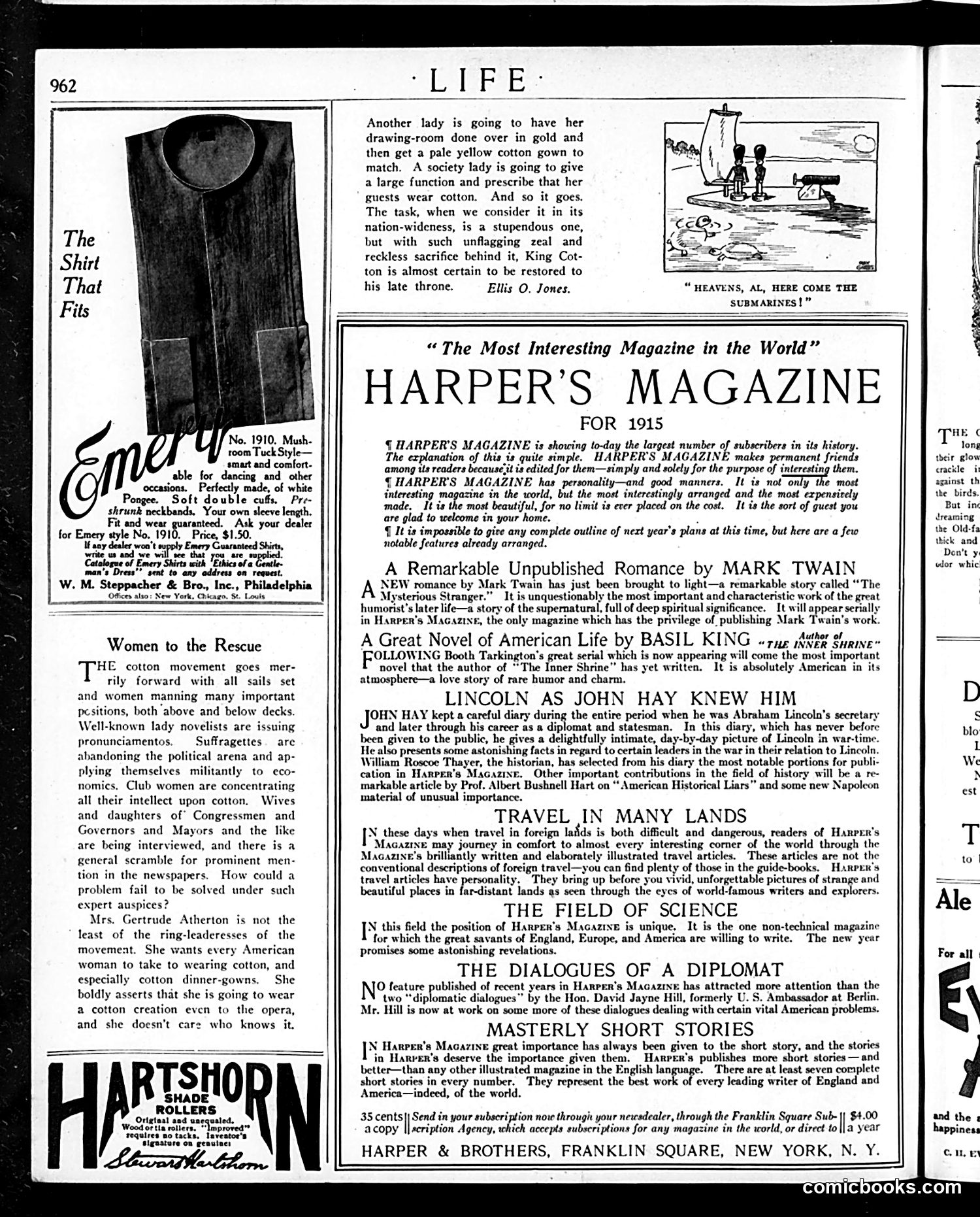
This page is primarily **advertising and editorial promotion** for Harper's Magazine, with minimal cartoonical content. The small cartoon in the upper right shows a submarine scene with the caption "HEAVENS, AL, HERE COME THE SUBMARINES!"—likely referencing **World War I anxieties** about German U-boats, a contemporary threat to American shipping. The main text promotes Harper's 1915 content, including: - An unpublished Mark Twain story ("The Mysterious Stranger") - A novel by Basil King - Lincoln articles based on John Hay's diaries The left column discusses a **"cotton movement"** where prominent women (including novelist Gertrude Atherton) pledge to wear cotton clothing to support American cotton production—likely addressing **economic concerns** about cotton markets or competing with foreign textiles during wartime disruption. The page also advertises Emery brand shirts, Hartshorn shade rollers, and other goods—this is essentially a **magazine back-page layout mixing ads with editorial content**, typical of early 20th-century publications.
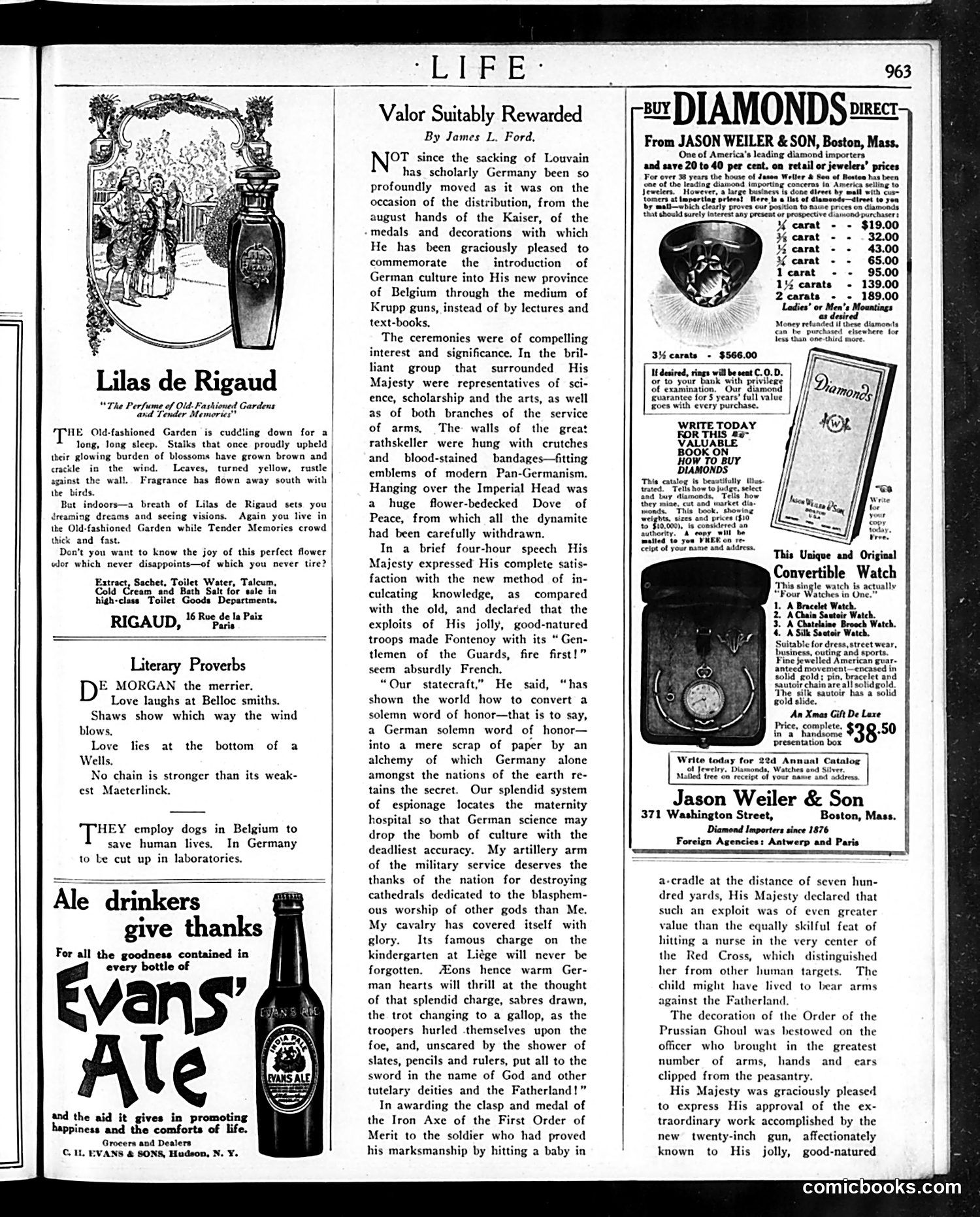
This is a bitter satirical piece by James L. Ford mocking the German Kaiser's distribution of military medals following Germany's invasion of Belgium in World War I. The satire targets Germany's justification of its brutal conquest as "culture" and "education." The fake Kaiser speech sarcastically celebrates atrocities: destroying cathedrals, charging cavalry against a kindergarten at Liège, and converting "solemn words of honor" (Belgium's neutrality) into "mere scraps of paper." The piece ridicules German claims of moral superiority by depicting their violence as worthy of official honor. References to "Krupp guns instead of lectures," dynamite hidden in a "Dove of Peace," and bombing maternity hospitals with "deadliest accuracy" emphasize the hypocrisy of calling destruction "culture." This reflects American outrage at German atrocities in Belgium (1914), which had shocked neutral observers and influenced anti-German sentiment before U.S. entry into WWI in 1917.
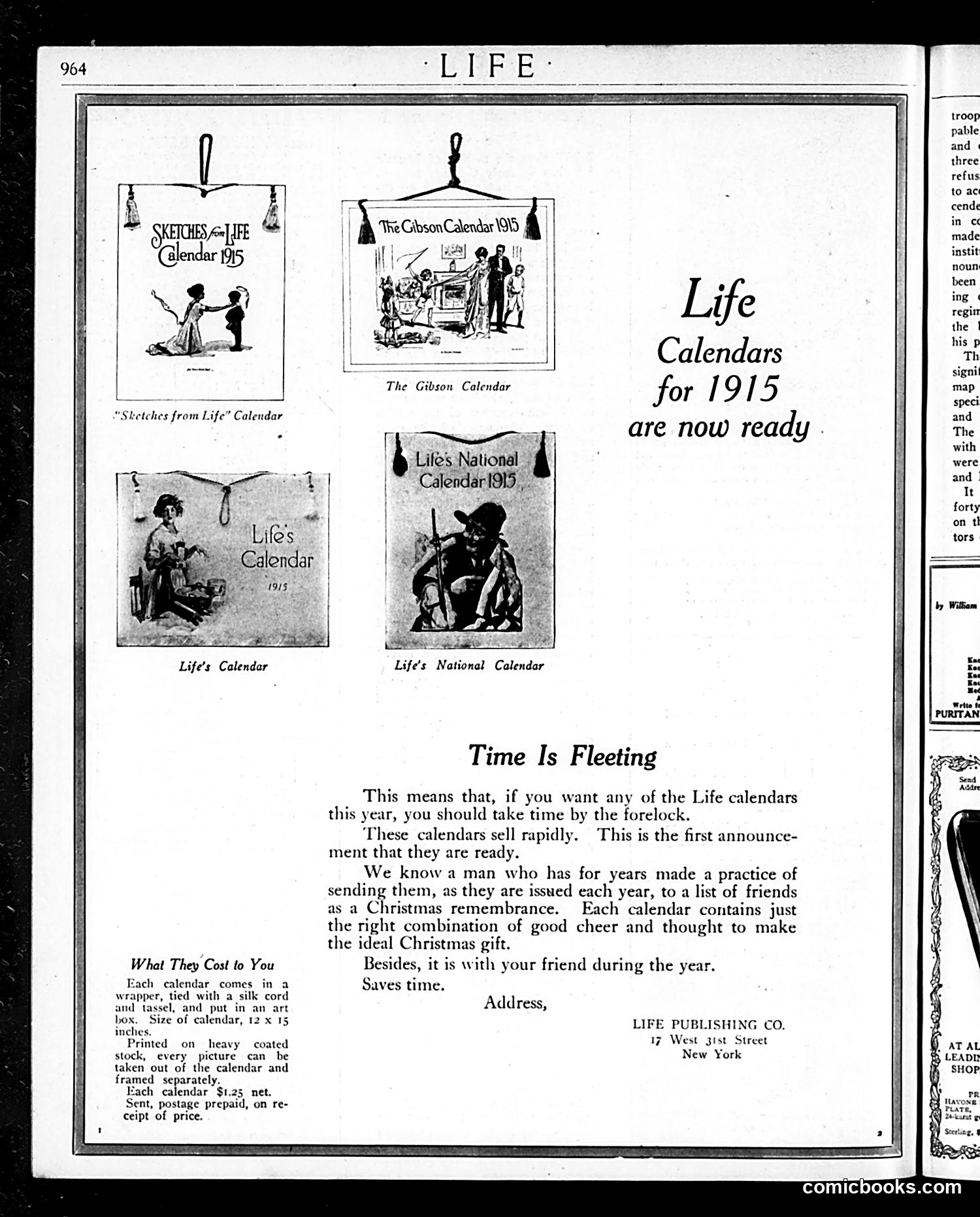
This is primarily a **product advertisement**, not political satire. Life Publishing Co. is promoting their 1915 calendar line featuring four designs: "Sketches from Life," "The Gibson Calendar" (by the famous illustrator Charles Dana Gibson), "Life's Calendar," and "Life's National Calendar." The text emphasizes the calendars' appeal as Christmas gifts—combining "good cheer and thought"—and notes they sell quickly. The copy playfully invokes the phrase "take time by the forelock" (an idiom meaning seize opportunity) while advertising time-saving benefits. The page shows no political commentary or satirical content. Instead, it represents typical early-20th-century magazine merchandising: Life magazine leveraging its brand and popular illustrators to sell premium calendars ($1.25, substantial money then) as luxury gift items.
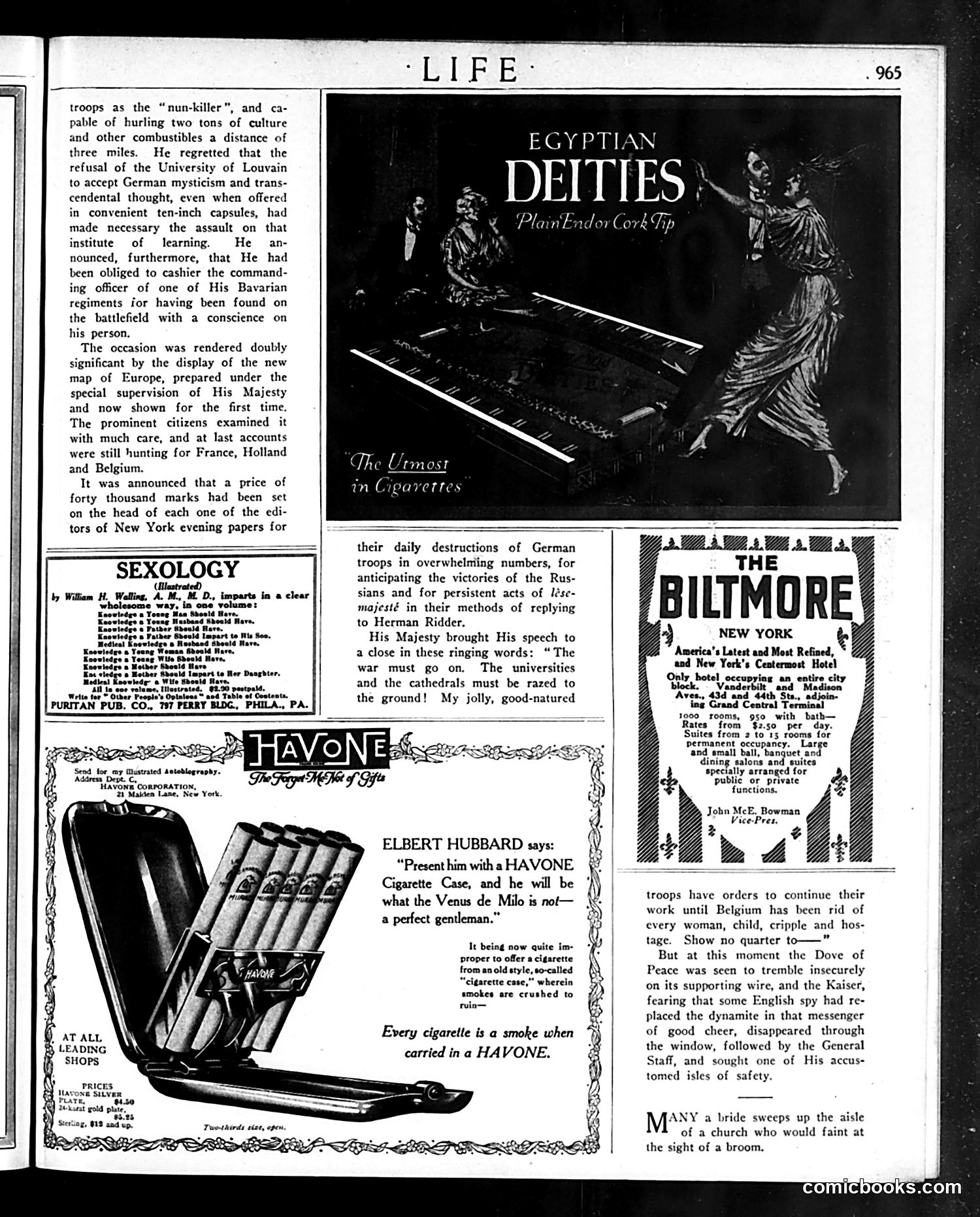
This page satirizes **Kaiser Wilhelm II of Germany** during World War I. The text describes a fictional speech where the Kaiser boasts of German military atrocities—destroying universities, cathedrals, and civilian populations in Belgium—while using absurd bureaucratic language ("ten-inch capsules," casually cashiering officers for having consciences). The satire's targets include: - **German militarism and war crimes**: The speech celebrates destruction of Belgian infrastructure and civilian massacres - **American newspaper editors**: A bounty is placed on their heads for reporting German defeats and mocking German authority - **The Kaiser's megalomania**: He announces a new map of Europe where France, Holland, and Belgium have disappeared The punchline mocks his cowardice: when a peace dove briefly frightens him (he thinks it might contain explosives), the Kaiser flees through a window like a terrified child. This reflects American attitudes circa 1914-1917, when U.S. media widely condemned German conduct in Belgium before America's entry into WWI.
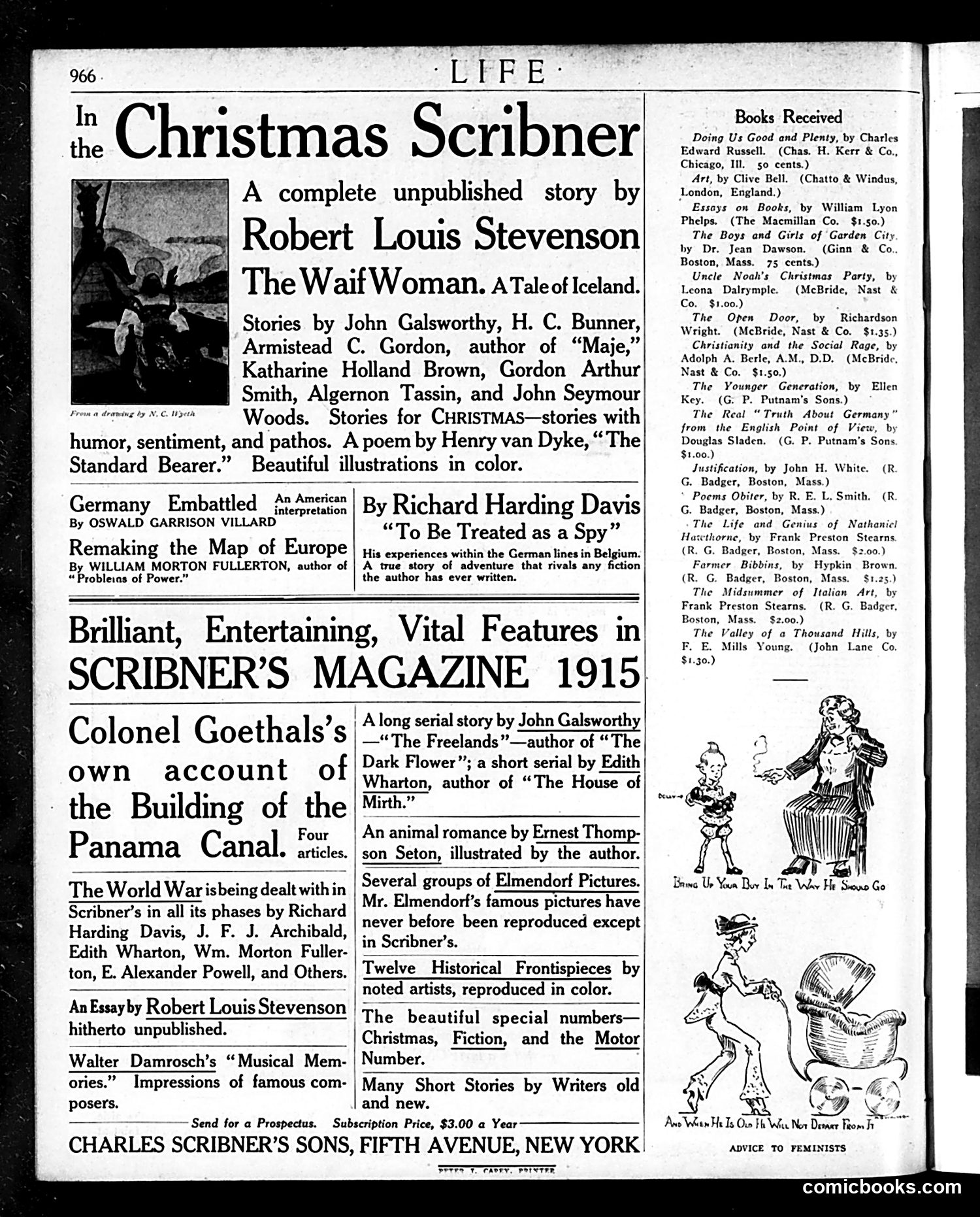
This page is primarily a **Scribner's Magazine advertisement** (1915), but the small cartoon in the bottom right corner offers social commentary. The cartoon depicts a woman attempting to manage multiple domestic tasks simultaneously—carrying a child, holding a basket, and juggling other objects—with the caption "Advice to Feminists: And When He Is Out In The Wide, Wide World, Nor Dinner From It." **The satire**: The cartoon mocks the feminist movement by suggesting that women advocating for equality outside the home are hypocrites or foolish, since they still bear sole responsibility for childcare and household duties. The implication is that feminists' aspirations for public roles are impractical given their "natural" domestic obligations. This reflects early 20th-century anti-feminist sentiment, portraying women's liberation efforts as naive or burdensome rather than justified. The joke assumes readers would find women's dual responsibilities inherently comic or deserving of ridicule.
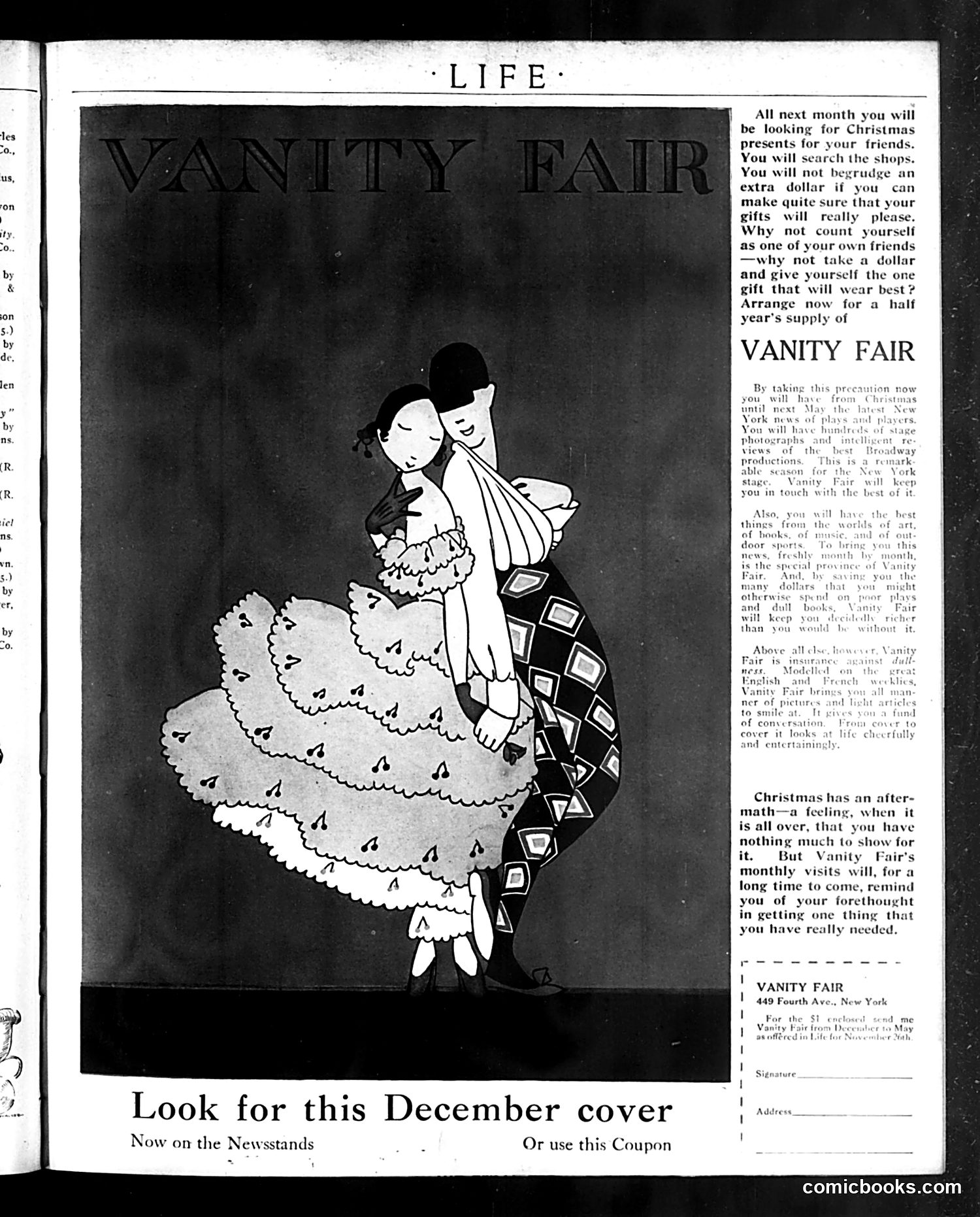
This is primarily a **magazine subscription advertisement**, not political satire. The illustration shows two elegantly dressed figures in 1920s-style clothing—one in an ornate feathered dress, the other in formal attire with a patterned coat—embodying the glamour and sophistication Vanity Fair represented. The ad targets Christmas gift-givers, proposing a **six-month subscription to Vanity Fair** as an alternative to traditional presents. The pitch emphasizes the magazine's cultural value: Broadway photography, art criticism, and witty commentary on contemporary life. The satirical element is subtle: it mocks the post-Christmas letdown ("nothing much to show for it") while positioning the magazine subscription as a practical, lasting gift that brings "intelligent" entertainment to readers for months afterward. This reflects **1920s consumer culture**, when magazine subscriptions were marketed as sophisticated, aspirational purchases for the educated middle class.
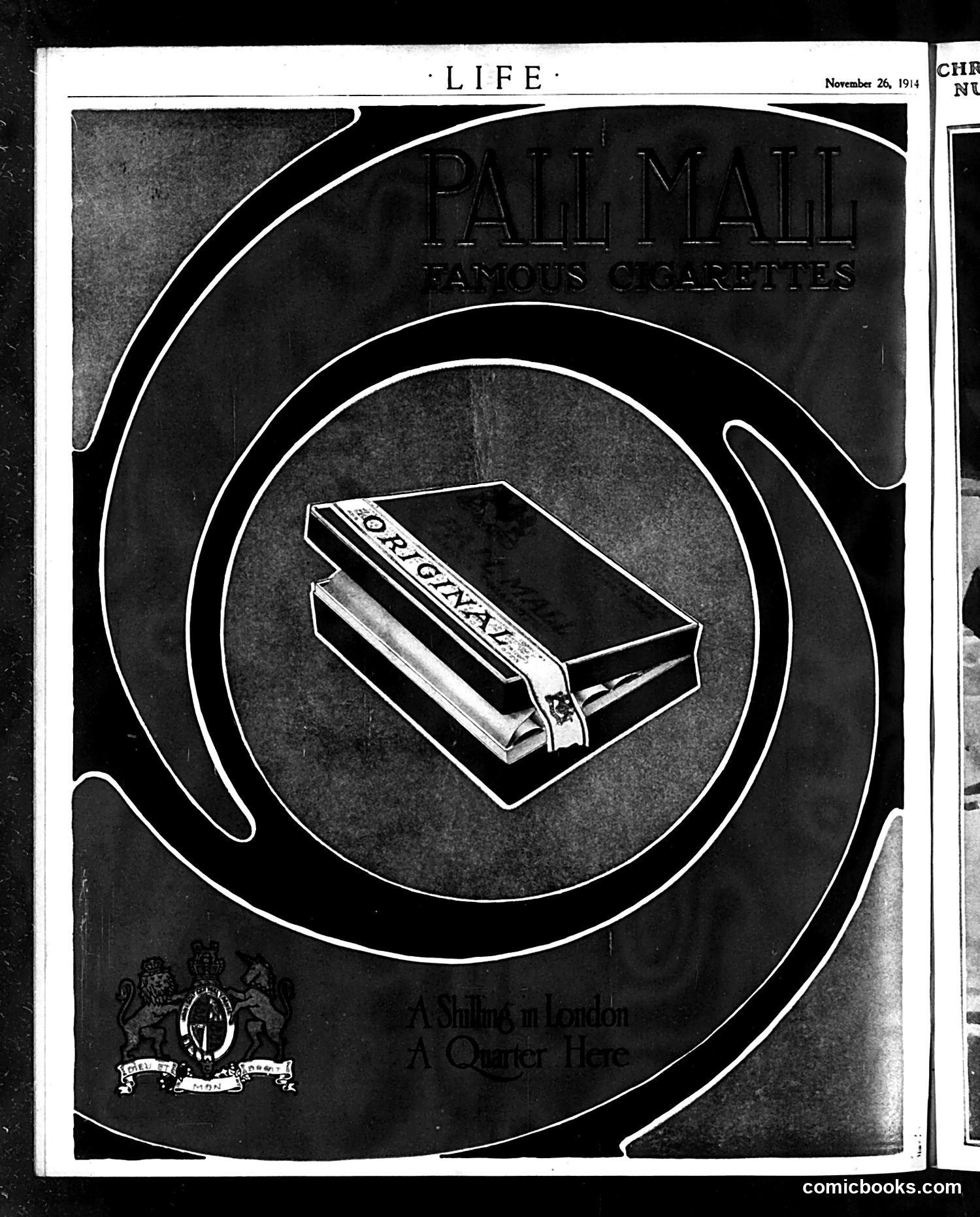
This is a **Pall Mall cigarette advertisement** from *Life* magazine (November 26, 1914). The page features a product-focused design rather than political satire or cartoon commentary. The ad displays a Pall Mall cigarette package centered within concentric circular frames, rendered in Art Deco or modernist style. The text promises "A Shilling in London / A Quarter Here," indicating the brand's international pricing and positioning as a premium product. A heraldic emblem (appears to be a coat of arms) at the bottom left suggests the cigarettes' British heritage and quality credentials—important marketing during an era when British products carried prestige among American consumers. This is pure commercial advertising with no satirical or political content.