
Life, 1914-11-26 · page 27 of 44
Life — November 26, 1914 — page 27: what you’re looking at
What you’re looking at
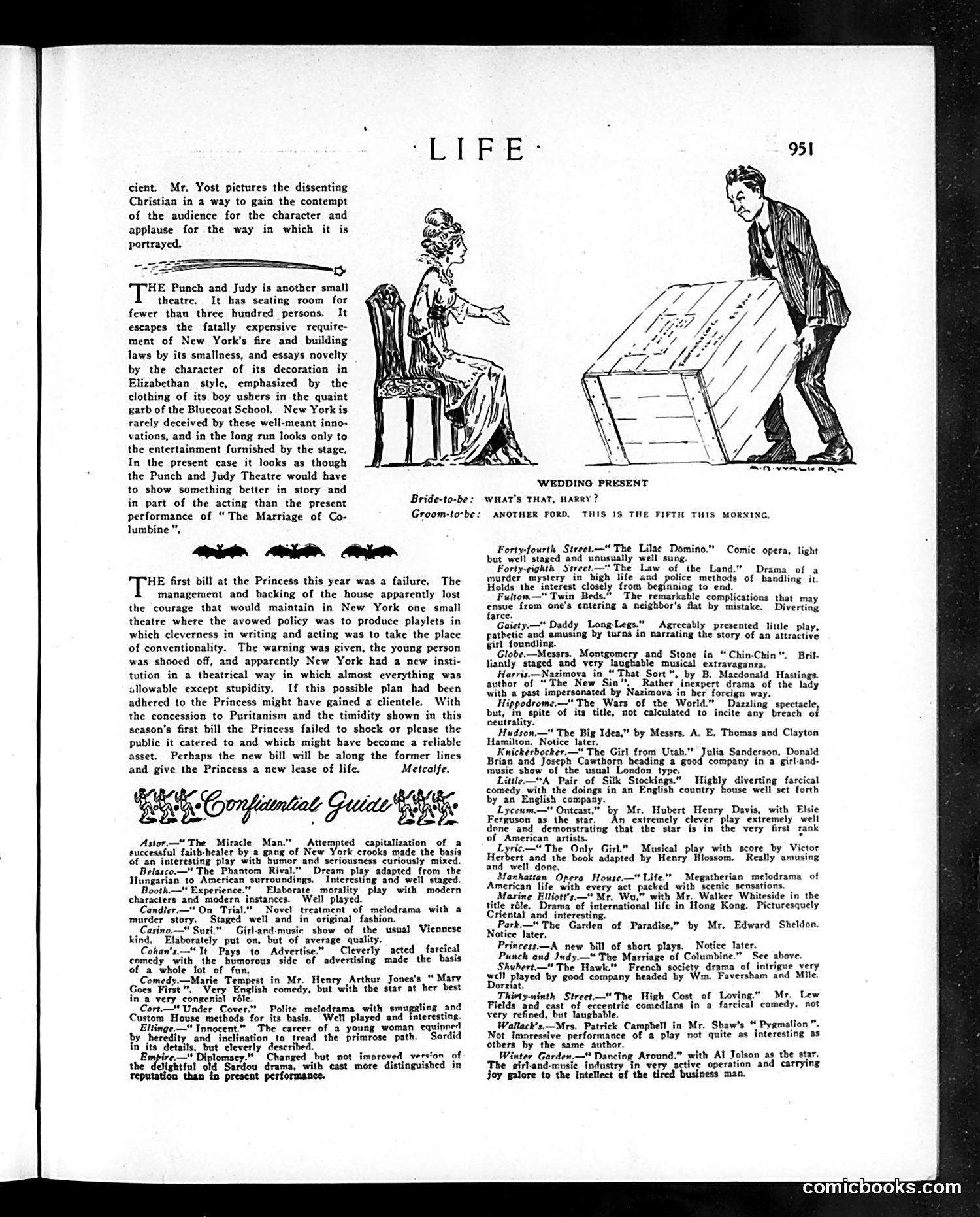
This cartoon satirizes the popularity of Ford automobiles in early 1910s America. The joke shows a bride-to-be receiving her fifth Ford motorcar as a wedding gift that same morning, which she finds noteworthy enough to remark upon to her groom. The humor operates on two levels: First, it mocks the Ford's ubiquity—so many people owned them that receiving multiple identical cars seemed inevitable. Second, it gently ridicules wealthy gift-givers' lack of imagination, defaulting to the same practical (if uninspired) present repeatedly. The cartoon reflects the Model T Ford's revolutionary affordability and market dominance following its 1908 introduction. What was once an exciting luxury gift had become so commonplace that receiving five in one morning was treated as an amusing inevitability rather than a remarkable occurrence. The cartoon's placement in *Life*'s theater review section suggests this was contemporary social commentary, capturing a specific moment when Ford's mass production had dramatically shifted American consumer culture and gift-giving conventions.
📄 Transcribed text from this page (OCR, searchable)
Machine-transcribed from the original scan — historical spelling and the odd misread are preserved.
cient. Mr. Yost pictures the dissenting Christian in a way to gain the contempt of the audience for the character and applause for the way in which it is portrayed. SSS yy HE Punch and Judy is another small theatre. It has seating room for fewer than three hundred persons. It escapes the fatally expensive require- ment of New York's fire and building laws by its smallness, and essays novelty by the character of its decoration in Elizabethan style, emphasized by the clothing of its boy ushers in the quaint garb of the Bluecoat School. New York is rarely deceived by these well-meant inno- vations, and in the long run looks only to the entertainment furnished by the stage. In the present case it looks as though the Punch and Judy Theatre would have to show something better in story and in part of the acting than the present performance of “The Marriage of Co- lumbine ", ee a Cee HE first bill at the Princess this year was a failure. The management and backing of the house apparently lost the courage that would maintain in New York one small theatre where the avowed policy was to produce playlets in which cleverness in writing and acting was to take the place of conventionality. The warning was given, the young person was shooed off, and apparently New York had a new insti- tution in a theatrical way in which almost everything was allowable except stupidity. If this possible plan had been adhered to the Princess might have gained a clientele. With the concession to Puritanism and the timidity shown in this season's first bill the Princess failed to shock or please the public it catered to and which might have become a reliable asset. Perhaps the new bill will be along the former lines and give the Princess a new lease of life. Metcalfe. Co pnt Gecia SO Astor.—" The Miracle Man.” Attempted capitalization of a successful faith-healer by a gang of New York crooks made the basis of an interesting play with humor and seriousness curiously mixed. Belasco.—" The Phantom Rival.” Dream play adapted from the Hungarian to American surroundings. Interesting and well staged. Booth.—" Experience.” Elaborate morality play with modern characters and modern instances. Well played. Candler —" On Trial.” Novel treatment of melodrama with a murder story. Staged’ well and in original fashion. _Casino.— Suzi.” Girl-and-musie show of the usual Viennese kind. Elaborately put on, but of average quality. ji Cohan’s.—“"Tt Pays to Advertise.” Cleverly acted farcical comedy with the humorous side of advertising made the basis of a whole lot of fun, Comedy.—Marie Tempest in Mr. Henry Arthur Jones's “ Mary Goes First”. Very English comedy, but with the star at her best in a very congenial réle. Cort.—" Under Cover.” Custom House methods for its basis. Eltinge.—“ Innocent.” The career of a young woman equinne: by heredity and inclination to tread the primrose path. Sordid in its details, but cleverly described. _ Empire —'" Diplomacy.” | Changed but not imorosed, version of the delightful old Sardou drama, with cast more distinguished in reputation than in present performance. Bride-to-be: Groom-to-be: ling and Polite melodrama with smu a interesting. ‘Well played and vec oR ‘WEDDING PRESENT WHAT'S THAT, HARRY? ANOTHER FORD, THIS 18 THE FIFTH THIS MORNING, Forty-fourth Street—" The Lilac Domino." but well staged and unusually well sung. Forty-eighth Street—" The Law of the Land.” Drama of a murder mystery in high life and police methods of handling it Holds the interest closely from beginning to end. Fultom—" Twin Beds.” The remarkable complications that may guise from one's entering a neighbor's fat by mistake. Diverting jarce. Gaiety.—" Daddy Long-Legs.” Agreeably presented little play, pathetic and amusing by turns in narrating the story of an attractive girl foundling. Globe.—Messrs.. Montgomery and Stone in “ Chin-Chi liantly staged and very laughable musical extravaganza. Harris.—Nazimova in“ That Sort”, by B. Macdonald Hastings. author of “The New Sin”. Rather’ inexpert drama of the lady with a past impersonated by Nazimova in her foreign way. Hippodrome.—" The Wars of the World.” Dazzling spectacle, but, im spite of its title, not calculated to incite any breach o} neutrality. Hudson.—" The Big Idea,” by Messrs. A. E. Thomas and Clayton Hamilton. Notice later. Knickerbocker.—"' The Girl from Utah." Julia Sanderson, Donald Brian and Joseph Cawthorn heading a good company in a girl-and- music show of the usual London type. Little —"A Pair of Silk Stockings.” Comic opera, light Bril- diverting farcical use well set forth Highly comedy with the doings in an English country hoi by an E: Lyceum.—" Onteast,” by Mr. Hubert Henry Davis, with Elsie Ferguson as the star. An extremely clever play extremely well done and demonstrating that the star is in the very first rank of American artists. i Lyric—" The Only Girl.” Musical play with score by Victor Herbert and the book adapted by Henry Blossom. Really amusing and well done. Marhattan Opera House—" Life.” Megatherian melodrama of American life with every act packed with scenic sensations. _ Maxine Elliott’s.— Mr. Wa,” with Mr. Walker Whiteside in the title réle. Drama of international life in Hong Kong. Picturesquely Criental and interesting. _Park.—" The Garden of Paradise,” by Mr. Edward Sheldon. Notice later. Princess.—A new bill of short plays. Notice later. Punch and Judy.— The Marriage of Columbine.” See above. Shubert“ The Hawk.” | French society, drama of intrigue very pall played by good company headed by Wm. Faversham and Mile jorziat. Thirty-ninth Street—“ The High Cost of Loving.” Mr. Lew Fields and cast of eccentric comedians in a farcical comedy, not very refined, but laughable. Walleck’s.—Mrs. Patrick Campbell in Mr. Shaw's “ Pygmalion ”. Not imoressive performance of a play not quite as interesting a3 others by the same author, Winter Garden.—" Dancing Around.” with Al Jolson as the star. The girl-and-music industry in very active operation and carrying Joy galore to the intellect of the tired business man. h company. comicbooks.com