
Life, 1914-11-26 · page 30 of 44
Life — November 26, 1914 — page 30: what you’re looking at
What you’re looking at
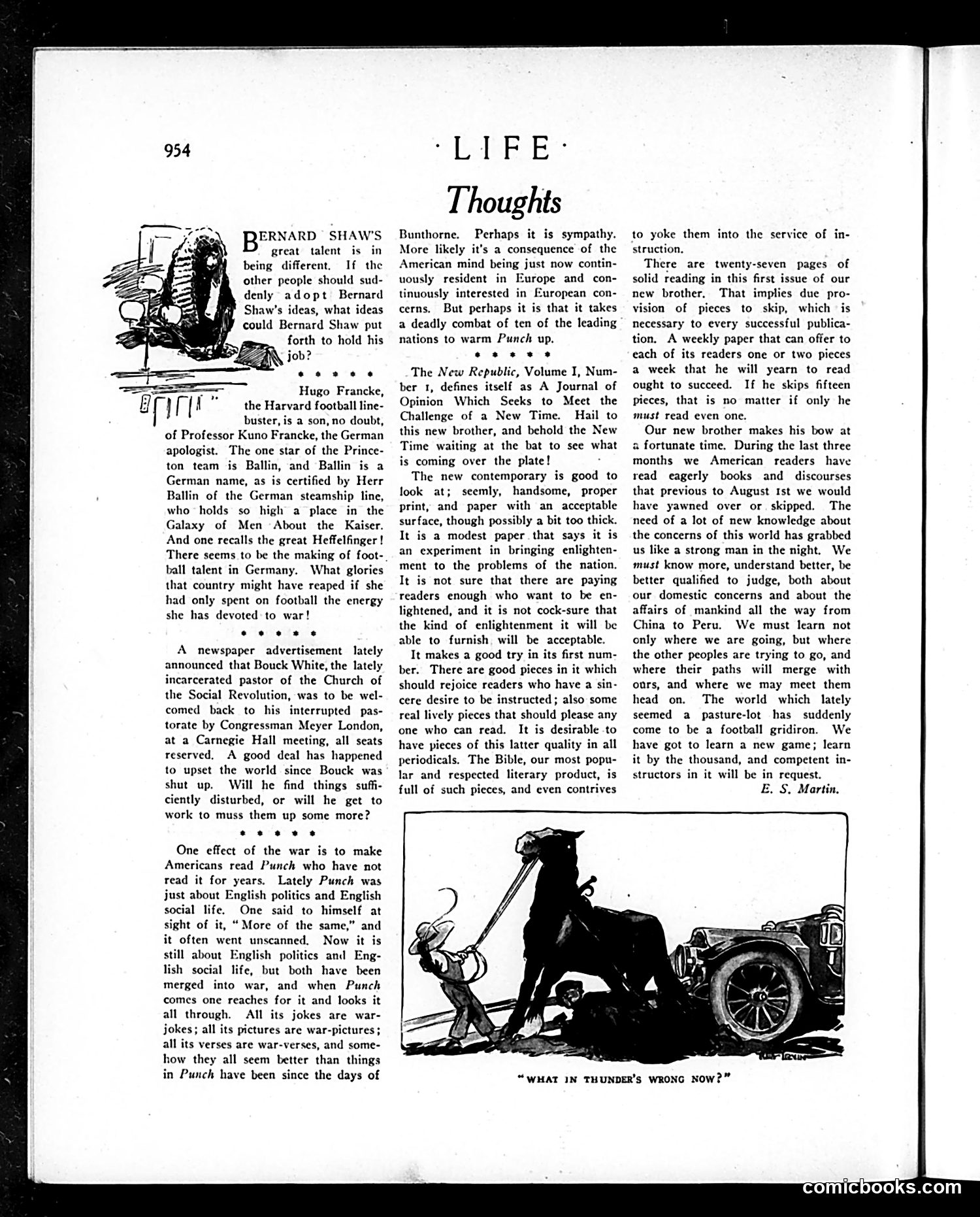
The single cartoon on this page depicts a figure (appearing to be a chauffeur or driver) struggling with a broken-down automobile while another figure gestures in frustration. The caption reads "WHAT IN THUNDER'S WRONG NOW?" **Context:** This appears to be WWI-era satire. The cartoon likely references mechanical or logistical failures during wartime—either military vehicle breakdowns or broader systemic failures on the home front or battlefield. The driver's exasperation and the other figure's angry gesture suggest frustration with incompetence or poor maintenance during a critical period. The surrounding text discusses how *Punch* magazine (the British satirical publication) has become war-focused, with all its content now centered on wartime concerns. This cartoon fits that wartime satirical tradition—mocking practical failures or bungling during the conflict. Without clearer identifying details, the specific target of the joke remains somewhat unclear, but it's definitely commenting on frustration with mechanical/operational failures in a wartime context.
📄 Transcribed text from this page (OCR, searchable)
Machine-transcribed from the original scan — historical spelling and the odd misread are preserved.
ERNARD SHAW'S great talent is in being different, If the other people should sud- denly adopt Bernard Shaw’s ideas, what ideas could Bernard Shaw put forth to hold his job? eeeee Hugo Francke, the Harvard football line- buster, is a son, no doubt, of Professor Kuno Francke, the German apologist. The one star of the Prince- ton team is Ballin, and Ballin is a German name, as is certified by Herr Ballin of the German steamship line, who holds so high a place in the Galaxy of Men About the Kaiser. And one recalls the great Heffelfinger ! There seems to be the making of foot- ball talent in Germany. What glories that country might have reaped if she had only spent on football the energy she has devoted to war! eeene A newspaper advertisement lately announced that Bouck White, the lately incarcerated pastor of the Church of the Social Revolution, was to be wel- comed back to his interrupted pas- torate by Congressman Meyer London, at a Carnegie Hall meeting, all seats reserved, A good deal has happened to upset the world since Bouck was shut up. Will he find things suffi- ciently disturbed, or will he get to work to muss them up some more? eeene One effect of the war is to make Americans read Punch who have not read it for years. Lately Punch was just about English politics and English social life. One said to himself at sight of it, “More of the same,” and it often went unscanned, Now it is still about English politics and Eng- lish social life, but both have been merged into war, and when Punch comes one reaches for it and looks it all through. All its jokes are war- jokes; all its pictures are war-pictures; all its verses are war-verses, and some- how they all seem better than things in Punch have been since the days of lee SE Thoughts Bunthorne. Perhaps it is sympathy, More likely it’s a consequence of the American mind being just now contin- uously resident in Europe and con- tinuously interested in European con- cerns. But perhaps it is that it takes a deadly combat of ten of the leading nations to warm Punch up. eee ees The New Republic, Volume I, Num- ber 1, defines itself as A Journal of Opinion Which Seeks to Meet the Challenge of a New Time. Hail to this new brother, and behold the New Time waiting at the bat to see what is coming over the plate! The new contemporary is good to look at; seemly, handsome, proper print, and paper with an acceptable surface, though possibly a bit too thick. It is a modest paper that says it is an experiment in bringing enlighten- ment to the problems of the nation. It is not sure that there are paying readers enough who want to be en- lightened, and it is not cock-sure that the kind of enlightenment it will be able to furnish. will be acceptable. It makes a good try in its first num- ber. There are good pieces in it which should rejoice readers who have a sin- cere desire to be instructed; also some real lively pieces that should please any one who can read. It is desirable to have pieces of this latter quality in all periodicals, The Bible, our most popu- lar and respected literary product, is full of such pieces, and even contrives to yoke them into the service of in- struction, There are twenty-seven pages of solid reading in this first issue of our new brother, That implies due pro- vision of pieces to skip, which is necessary to every successful publica- tion. A weekly paper that can offer to each of its readers one or two pieces a week that he will yearn to read ought to succeed. If he skips fifteen pieces, that is no matter if only he must read even one. Our new brother makes his bow at a fortunate time. During the last three months we American readers have read eagerly books and discourses that previous to August Ist we would have yawned over or. skipped. The need of a lot of new knowledge about the concerns of this world has grabbed us like a strong man in the night. We must know more, understand better, be better qualified to judge, both about our domestic concerns and about the affairs of mankind all the way from China to Peru, We must learn not only where we are going, but where the other peoples are trying to go, and where their paths will merge with ours, and where we may meet them head on. The world which lately seemed a pasture-lot has suddenly come to be a football gridiron. We have got to learn a new game; learn it by the thousand, and competent in- structors in it will be in request. E. S. Martin. “WHAT IN THUNDER’S WRONG Now?” comicbooks.com