
Life, 1914-11-26 · page 18 of 44
Life — November 26, 1914 — page 18: what you’re looking at
What you’re looking at
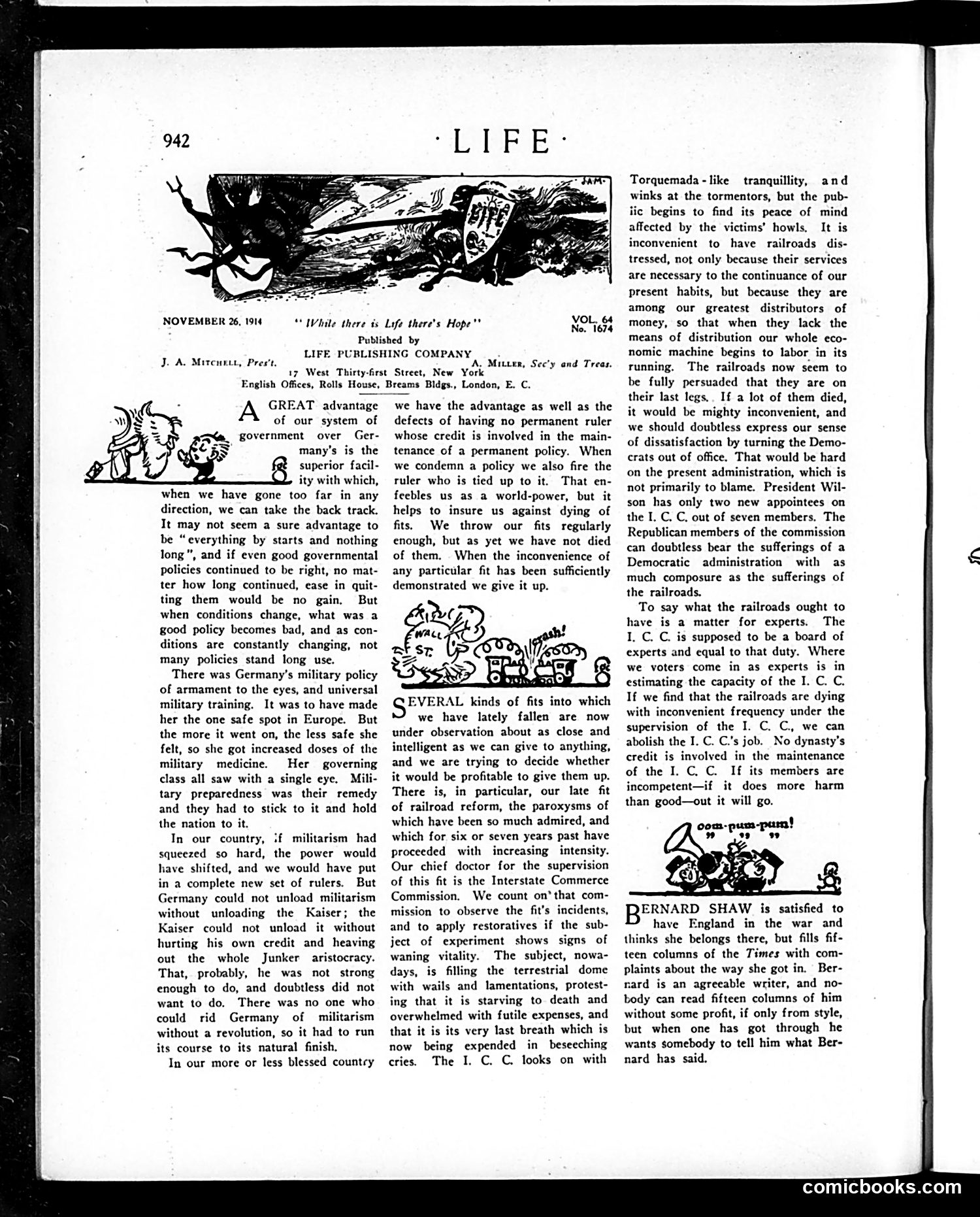
This page compares American and German governance systems. The main article argues that America's advantage lies in its ability to reverse failed policies by replacing leaders, whereas Germany's militarism became entrenched because the Kaiser and Junker aristocracy couldn't abandon it without losing power—forcing the system "to run its course to its natural finish." The article then applies this framework to railroad regulation. It describes the Interstate Commerce Commission as supervising railroad "reform" like "Torquemada" (referencing the Spanish Inquisition's brutality), observing the railroads' distress with indifference while the public grows uneasy. The implied criticism: America's regulatory "fit" of railroad reform has become excessive, starving the industry, yet the I.C.C. passively watches rather than adjusting course. The cartoons (appears to show trains/industrial scenes) reinforce the satire on government overreach during regulation. The publication date—November 1914—places this amid Progressive Era railroad regulation debates.
📄 Transcribed text from this page (OCR, searchable)
Machine-transcribed from the original scan — historical spelling and the odd misread are preserved.
NOVEMBER 26, 1914 “While there ts Life there's Hope" Published by LIFE PUBLISHING COMPANY 17 West Thirty-first Street, New York English Offices, Rolls House, Breams Bldgs., London, E. C. J. A. Mirennit, Pres't, A GREAT advantage of our system of government over Ger- many’s is the superior facil- ity with which, when we have gone too far in any direction, we can take the back track. It may not seem a sure advantage to be “everything by starts and nothing long”, and if even good governmental policies continued to be right, no mat- ter how long continued, ease in quit- ting them would be no gain. But when conditions change, what was a good policy becomes bad, and as con- ditions are constantly changing, not many policies stand long use. There was Germany’s military policy of armament to the eyes, and universal military training. It was to have made her the one safe spot in Europe. But the more it went on, the less safe she felt, so she got increased doses of the military medicine. Her governing class all saw with a single eye. Mii tary preparedness was their remedy and they had to stick to it and hold the nation to it. In our country, if militarism had squeezed so hard, the power would have shifted, and we would have put in a complete new set of rulers. But Germany could not unload militarism without unloading the Kaiser; the Kaiser could not unload it without hurting his own credit and heaving out the whole Junker aristocracy. That, probably, he was not strong enough to do, and doubtless did not want to do. There was no one who could rid Germany of militarism without a revolution, so it had to run its course to its natural finish, In our more or less blessed country A. Minter, Sec'y and Treas. we have the advantage as well as the defects of having no permanent ruler whose credit is involved in the main- tenance of a permanent policy. When we condemn a policy we also fire the ruler who is tied up to it. That en- feebles us as a world-power, but it helps to insure us against dying of fits. We throw our fits regularly enough, but as yet we have not died of them. When the inconvenience of any particular fit has been sufficiently demonstrated we give it up. EVERAL kinds of fits into which we have lately fallen are now under observation about as close and intelligent as we can give to anything, and we are trying to decide whether it would be profitable to give them up. There is, in particular, our late fit of railroad reform, the paroxysms of which have been so much admired, and which for six or seven years past have proceeded with increasing intensity. Our chief doctor for the supervision of this fit is the Interstate Commerce Commission. We count on’ that com- mission to observe the fit's incidents, and to apply restoratives if the sub- ject of experiment shows signs of waning vitality. The subject, nowa- days, is filling the terrestrial dome with wails and lamentations, protest- ing that it is starving to death and overwhelmed with futile expenses, and that it is its very last breath which is now being expended in beseeching cries. The I. C. C. looks on with Torquemada - like tranquillity, and winks at the tormentors, but the pub- jic begins to find its peace of mind affected by the victims’ howls, It is inconvenient to have railroads dis- tressed, not only because their services are necessary to the continuance of our present habits, but because they are among our greatest distributors of money, so that when they lack the means of distribution our whole eco- nomic machine begins to labor in its running. The railroads now seem to be fully persuaded that they are on their last legs,. If a lot of them died, it would be mighty inconvenient, and we should doubtless express our sense of dissatisfaction by turning the Demo- crats out of office. That would be hard on the present administration, which is not primarily to blame. President Wil- son has only two new appointees on the I. C. C, out of seven members, The Republican members of the commission can doubtless bear the sufferings of a Democratic administration with as much composure as the sufferings of the railroads. To say what the railroads ought to have is a matter for experts. The I. C. C. is supposed to be a board of experts and equal to that duty. Where we voters come in as experts is in estimating the capacity of the I. C. C. If we find that the railroads are dying with inconvenient frequency under the supervision of the I. C. C, we can abolish the I. C. C.’s job. No dynasty’s credit is involved in the maintenance of the I. C. C. If its members are incompetent—if it does more harm than good—out it will go. ERNARD SHAW is satisfied to have England in the war and thinks she belongs there, but fills fif- teen columns of the Times with com- plaints about the way she got in. Ber- nard is an agreeable writer, and no- body can read fifteen columns of him without some profit, if only from style, but when one has got through he wants somebody to tell him what Ber- nard has said. comicbooks.com