
Life, 1914-11-26 · page 34 of 44
Life — November 26, 1914 — page 34: what you’re looking at
What you’re looking at
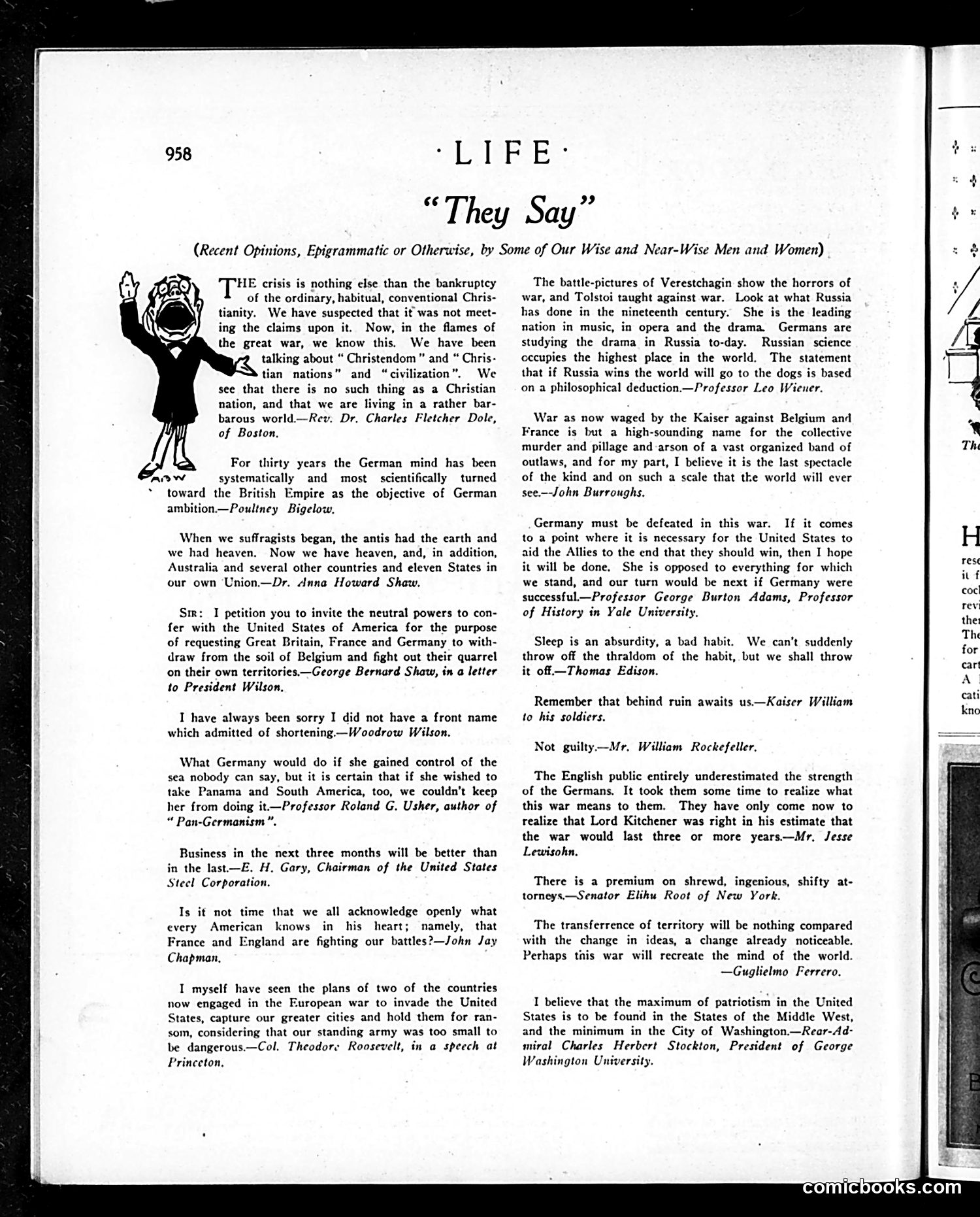
This page collects brief opinions on World War I from prominent American figures. The cartoon shows a caricatured figure (likely representing German militarism or Kaiser Wilhelm II) with an exaggerated facial expression, symbolizing the aggressive "German mind" discussed in the text. The quotes reflect American debate circa 1914-1917: some speakers (Roosevelt, Burroughs, Adams) argue for American intervention against Germany; others (George Bernard Shaw) propose neutral mediation; a suffragist (Dr. Shaw) sardonically notes women gained rights while war raged; Edison dismisses sleep as habit. The satire is gentle—"They Say" mocks pretentious pronouncements from both wise men and cranks equally. References to German invasion plans, Panama canal threats, and Kaiser Wilhelm's alleged fatalism about ruin reveal period anxieties. The juxtaposition of trivial opinions (Wilson regretting his first name) with grave war commentary creates ironic commentary on public discourse during wartime uncertainty.
📄 Transcribed text from this page (OCR, searchable)
Machine-transcribed from the original scan — historical spelling and the odd misread are preserved.
epg pebe: “They Say” (Recent Opinions, Epigrammatic or Otherwise, by Some of Our Wise and Near-Wise Men and Women) HE crisis is nothing else than the bankruptcy of the ordinary, habitual, conventional Chris- tianity. We have suspected that it was not meet- ing the claims upon it. Now, in the flames of the great war, we know this. We have been (r talking about “ Christendom ” and “ Chris- tian nations” and “civilization”. We see that there is no such thing as a Christian nation, and that we are living in a rather bar- barous world.—Rev. Dr. Charles Fletcher Dole, of Boston, For thirty years the German mind has been (tehod systematically and most scientifically turned toward the British Empire as the objective of German ambition.—Poultney Bigelow, When we suffragists began, the antis had the earth and we had heaven. Now we have heaven, and, in addition, Australia and several other countries and eleven States in our own Union—Dr. Anna Howard Shaw. Sm: I petition you to invite the neutral powers to con- fer with the United States of America for the purpose of requesting Great Britain, France and Germany to with- draw from the soil of Belgium and fight out their quarrel on their own territories.—George Bernard Shaw, in a letter to President Wilson, I have always been sorry I did not have a front name which admitted of shortening—Woodrow Wilson. What Germany would do if she gained control of the sea nobody can say, but it is certain that if she wished to take Panama and South America, too, we couldn't keep her from doing it—Professor Roland G. Usher, author of “ Pan-Germanism ”, Business in the next three months will be better than in the last—E. H. Gary, Chairman of the United States Steel Corporation. Is it not time that we all acknowledge openly what every American knows in his heart; namely, that France and England are fighting our battles?—John Jay Chapman, I myself have seen the plans of two of the countries now engaged in the European war to invade the United States, capture our greater cities and hold them for ran- som, considering that our standing army was too small to be dangerous.—Col. Theodore Roosevelt, in a speech at Princeton, The battle-pictures of Verestchagin show the horrors of war, and Tolstoi taught against war. Look at what Russia has done in the nineteenth century. She is the leading nation in music, in opera and the drama. Germans are studying the drama in Russia to-day. Russian science eccupies the highest place in the world. The statement that if Russia wins the world will go to the dogs is based on a philosophical deduction.—Professor Leo Wiener. War as now waged by the Kaiser against Belgium and France is but a high-sounding name for the collective murder and pillage and arson of a vast organized band of outlaws, and for my part, I believe it is the last spectacle of the kind and on such a scale that the world will ever see.—-John Burroughs. Germany must be defeated in this war. If it comes to a point where it is necessary for the United States to aid the Allies to the end that they should win, then I hope it will be done, She is opposed to everything for which we stand, and our turn would be next if Germany were successful—Professor George Burton Adams, Professor of History in Yale University, Sleep is an absurdity, a bad habit. We can't suddenly throw off the thraldom of the habit, but we shall throw it off.—Thomas Edison. Remember that behind ruin awaits us.—Kaiser William to his soldiers. Not guilty—Mr, William Rockefeller, The English public entirely underestimated the strength of the Germans. It took them some time to realize what this war means to them. They have only come now to realize that Lord Kitchener was right in his estimate that the war would last three or more years—Mr, Jesse Lewisohn, There is a premium on shrewd, ingenious, shifty at- torneys.—Senator Elihu Root of New York. The transferrence of territory will be nothing compared with the change in ideas, a change already noticeable. Perhaps tais war will recreate the mind of the world. —Guglielmo Ferrero. I believe that the maximum of patriotism in the United States is to be found in the States of the Middle West, and the minimum in the City of Washington.—Rear-Ad- miral Charles Herbert Stockton, President of George Washington University. res iu f coc! rev’ the: The for car cati kno Comicbooks.com