
Life, 1914-11-26 · page 10 of 44
Life — November 26, 1914 — page 10: what you’re looking at
What you’re looking at
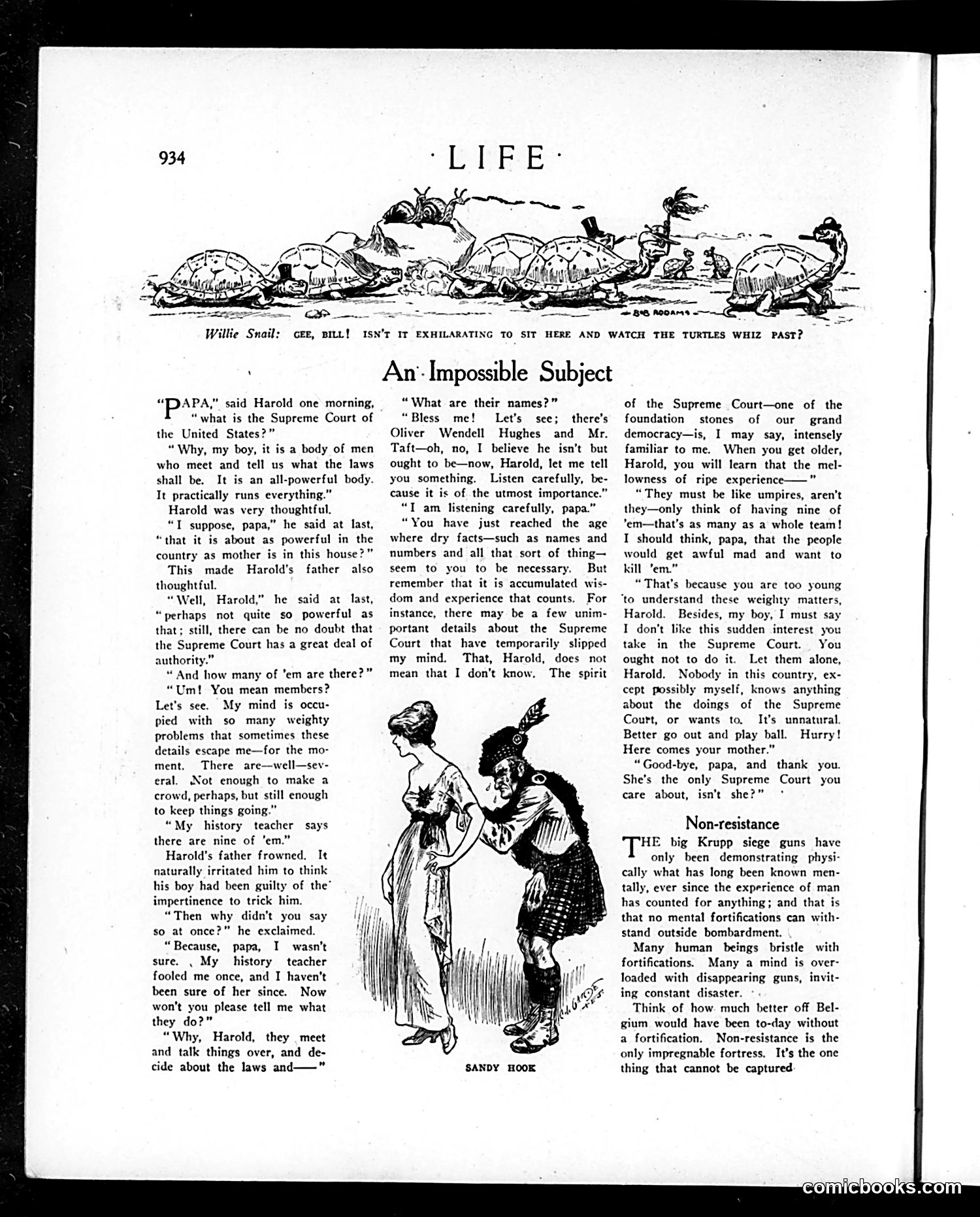
The page contains two distinct pieces: **"An Impossible Subject"** (left): A satirical dialogue where Harold's father explains the Supreme Court to his son. The humor stems from the father's admission that even he finds the Supreme Court's workings incomprehensible—it's "too powerful," involves obscure legal details, and operates beyond normal understanding. The satire suggests the institution is deliberately inscrutable, even to educated adults. **"Non-resistance"** (right): Commentary on the Krupp siege guns (German artillery) and fortifications. The passage argues that mental fortifications—non-resistance or psychological resilience—are more important than physical defenses. It suggests Belgium's vulnerable position during WWI could have been better protected through ideological strength than military fortifications. The "Sandy Hook" illustration shows a woman and child in period dress, likely supporting the text's themes.
📄 Transcribed text from this page (OCR, searchable)
Machine-transcribed from the original scan — historical spelling and the odd misread are preserved.
Willie Snail: GEE, BILL! “DAPA,” said Harold one morning, “what is the Supreme Court of the United States?” “Why, my boy, it is a body of men who meet and tell us what the laws shall be. It is an all-powerful body. It practically runs everything.” Harold was very thoughtful. “I suppose, papa,” he said at last, “that it is about as powerful in the country as mother is in this house?” This made Harold's father also thoughtful. “Well, Harold,” he said at last, “perhaps not quite so powerful as that; still, there can be no doubt that the Supreme Court has a great deal of authority.” “And how many of ‘em are there “Um! You mean members? Let's see. My mind is occu- pied with so many weighty problems that sometimes these details escape me—for the mo- ment, There are—well—sev- eral. Not enough to make a crowd, perhaps, but still enough to keep things going.” “My history teacher says there are nine of 'em.” Harold's father frowned. It naturally irritated him to think his boy had been guilty of the” impertinence to trick him. “Then why didn't you say so at once?” he exclaimed. “Because, papa, I wasn’t sure. , My history teacher fooled me once, and I haven't been sure of her since. Now won't you please tell me what they do?” “Why, Harold, they meet and talk things over, and de- cide about the laws and——” >” An‘ Impossible Subject “What are their names?” “Bless me! Let’s see; there's Oliver Wendell Hughes and Mr. Taft—oh, no, I believe he isn’t but ought to be—now, Harold, let me tell you something. Listen carefully, be- cause it is of the utmost importance.” “T am listening carefully, papa.” “You have just reached the age where dry facts—such as names and numbers and all that sort of thing— seem to you to be necessary. But remember that it is accumulated wis- dom and experience that counts. For instance, there may be a few unim- portant details about the Supreme Court that have temporarily slipped my mind. That, Harold, does not mean that I don’t know, The spirit SANDY HOOK ISN’T IT EXHILARATING TO SIT HERE AND WATCH THE TURTLES WHIZ PAST? of the Supreme Court—one of the foundation stones of our grand democracy—is, I may say, intensely familiar to me. When you get older, Harold, you will learn that the mel- lowness of ripe experience—” “They must be like umpires, aren't they—only think of having nine of "em—that’s as many as a whole team! I should think, papa, that the people would get awful mad and want to kill. ’em.” “That's because you are too young ‘to understand these weighty matters, Harold. Besides, my boy, I must say I don’t like this sudden interest you take in the Supreme Court. You ought not to do it. Let them alone, Harold. Nobody in this country, ex- cept possibly myself, knows anything about the doings of the Supreme Court, or wants to. It’s unnatural. Better go out and play ball. Hurry! Here comes your mother.” “Good-bye, papa, and thank you. She's the only Supreme Court you care about, isn’t she?” Non-resistance HE big Krupp siege guns have only been demonstrating physi- cally what has long been known men- tally, ever since the experience of man has counted for anything; and that is that no mental fortifications can with- stand outside bombardment. Many human beings bristle with fortifications. Many a mind is over- loaded with disappearing guns, invit- ing constant disaster. Think of how. much better off Bel- gium would have been to-day without a fortification. Non-resistance is the only impregnable fortress. It’s the one thing that cannot be captured