
Life, 1914-11-26 · page 26 of 44
Life — November 26, 1914 — page 26: what you’re looking at
What you’re looking at
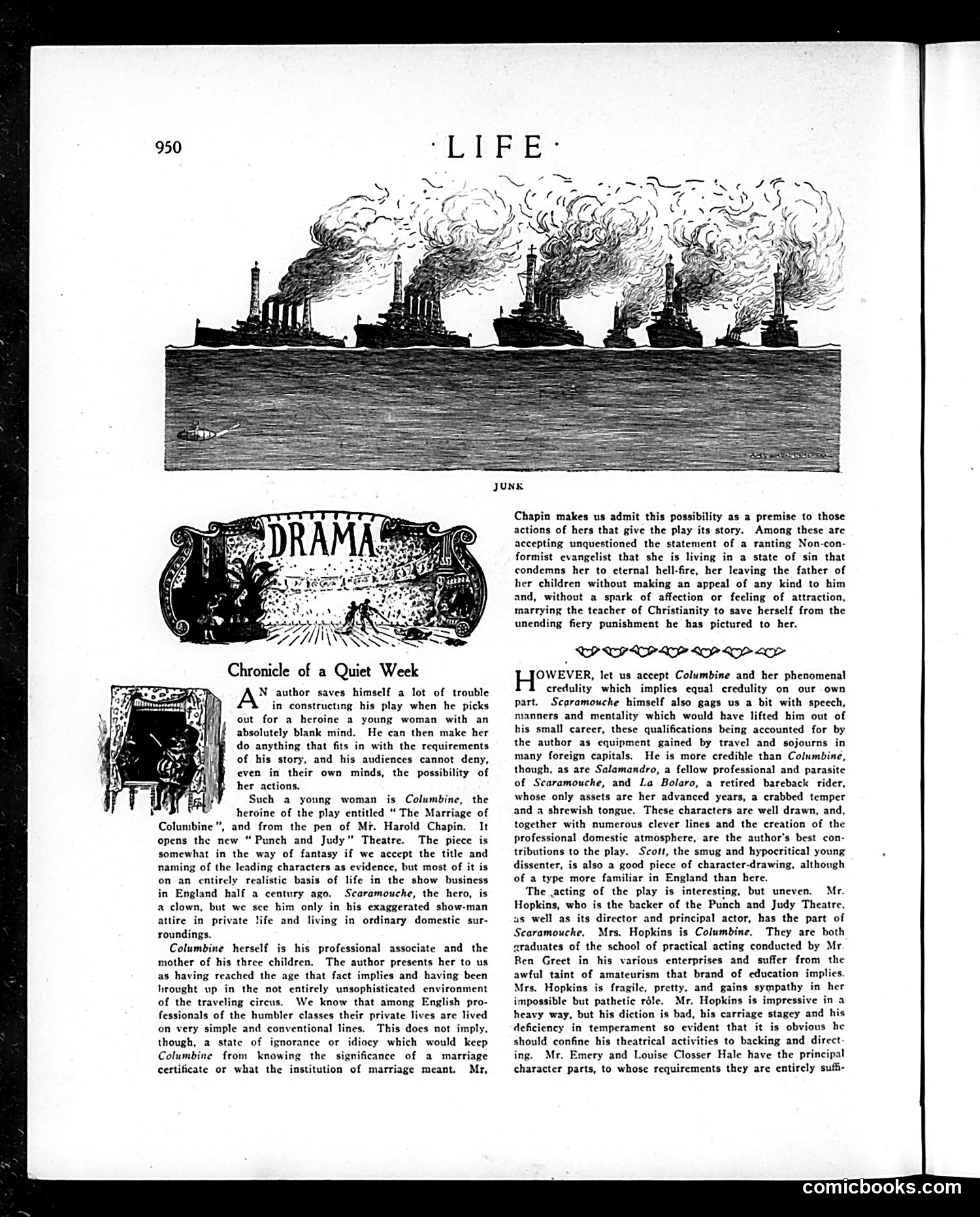
This page critiques Harold Chapin's new play at the "Punch and Judy" Theatre, which opens with a fantastical premise grounded in realistic circus-performer life. The reviewer argues the playwright exploits a female protagonist with an "absolutely blank mind" to justify her implausible actions. Columbine, a circus performer and mother of three, allegedly accepts a religious zealot's condemnation of her unmarried status and abandons her children's father (the clown Scaramouche) to marry a hypocritical Christian teacher—all to escape supposed damnation. The top illustration shows warships with smoke, likely referencing contemporary military/political tensions, though its connection to the drama review is unclear. The reviewer acknowledges this absurdity requires audience suspension of disbelief. While supporting characters are "well drawn," the leads suffer from amateurish training under Mr. Ben Greet's school of practical acting. Mrs. Hopkins is "fragile, pretty," but the improbable plot strains credibility.
📄 Transcribed text from this page (OCR, searchable)
Machine-transcribed from the original scan — historical spelling and the odd misread are preserved.
Chronicle of a Quiet Week N author saves himself a lot of trouble in constructing his play when he picks out for a heroine a young woman with an absolutely blank mind. He can then make her do anything that fits in with the requirements of his story, and his audiences cannot deny, even in their own minds, the possibility of her actions. Such a young woman is Columbine, the heroine of the play entitled “ The Marriage of Columbine", and from the pen of Mr. Harold Chapin. It opens the new “Punch and Judy” Theatre. The piece is somewhat in the way of fantasy if we accept the title and naming of the leading characters as evidence, but most of it is on an entirely realistic basis of life in the show business in England half a century ago. Scaramouche, the hero, is a clown, but we see him only in his exaggerated show-man attire in private life and living in ordinary domestic sur- roundings. Columbine herself is his professional associate and the mother of his three children. The author presents her to us as having reached the age that fact implies and having been Lrought up in the not entirely unsophisticated environment of the traveling circus. We know that among English pro- fessionals of the humbler classes their private lives are lived on very simple and conventional lines. This does not imply, though, a state of ignorance or idiocy which would keep Columbine from knowing the significance of a marriage certificate or what the institution of marriage meant. Mr, Chapin makes us admit this possibility as a premise to those actions of hers that give the play its story. Among these are accepting unquestioned the statement of a ranting Non-con- formist evangelist that she is living in a state of sin that condemns her to eternal hell-fire, her leaving the father of her children without making an appeal of any kind to him and, without a spark of affection or feeling of attraction, marrying the teacher of Christianity to save herself from the unending fiery punishment he has pictured to her. GIP LP RYE OY OWEVER, let us accept Columbine and her phenomenal credulity which implies equal credulity on our own part. Scaramouche himself also gags us a bit with speech, manners and mentality which would have lifted him out of bis small career, these qualifications being accounted for by the author as equipment gained by travel and sojourns in many foreign capitals. He is more credible than Columbine, though, as are Salamandro, a fellow professional and parasite of Scaramouche, and La Bolaro, a retired bareback rider, whose only assets are her advanced years, a crabbed temper and a shrewish tongue. These characters are well drawn, and, together with numerous clever lines and the creation of the professional domestic atmosphere, are the author's best con- tributions to the play. Scott, the smug and hypocritical young dissenter, is also a good piece of character-drawing, although of a type more familiar in England than here. The .acting of the play is interesting, but uneven. Mr. Hopkins, who is the backer of the Punch and Judy Theatre. us well as its director and principal actor, has the part of Scaramouche, Mrs. Hopkins is Columbine. They are both graduates of the school of practical acting conducted by Mr. Ren Greet in his various enterprises and suffer from the awful taint of amateurism that brand of education implies. Mrs. Hopkins is fragile, pretty, and gains sympathy in her impossible but pathetic réle. Mr. Hopkins is impressive in a heavy way, but his diction is bad, his carriage stagey and his deficiency in temperament so evident that it is obvious he should confine his theatrical activities to backing and direct- ing. Mr. Emery and Louise Closser Hale have the principal character parts, to whose requirements they are entirely suffi- comicbooks.com