
A complete issue · 44 pages · 1914
Life — June 18, 1914
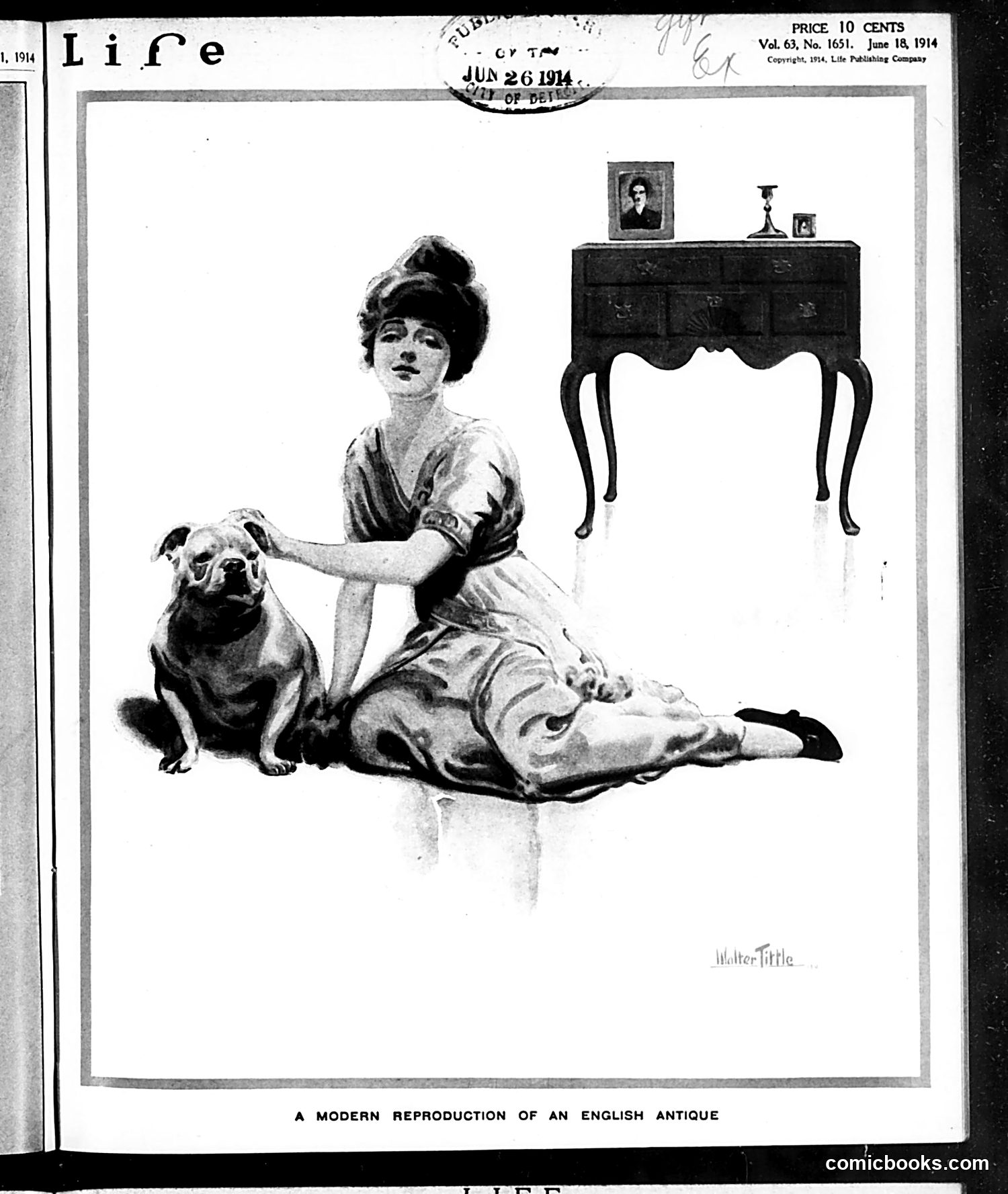
This cover by Walter Tittle depicts a woman in Edwardian dress reclining with a bulldog, positioned before an ornate console table. The caption reads "A Modern Reproduction of an English Antique." The satire appears to target early 20th-century society's fascination with collecting and displaying English antiques as status symbols. The joke likely plays on the double meaning: the woman herself represents a "modern reproduction" of an idealized English feminine aesthetic—refined, posed, decorative—rather than an authentic antique. Her posed reclining position mimics how one might display precious objects. The bulldog, a quintessentially English breed, reinforces the "English antique" theme while adding humorous irony to this commentary on artificial social pretension and imitation of British taste among American society.
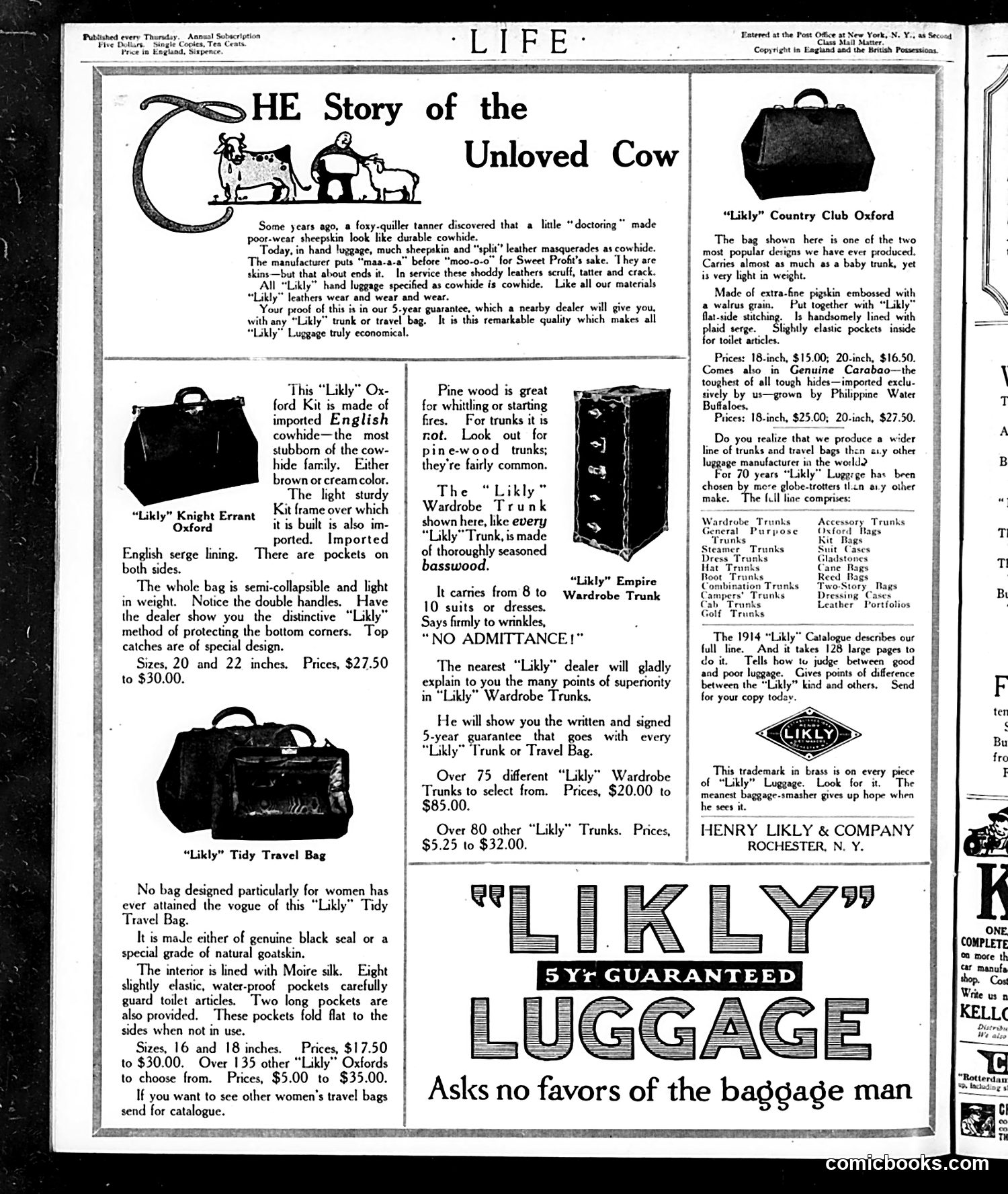
This page is **entirely advertising**, not satirical content. It promotes "Likly" brand luggage and travel bags made by Henry Likly & Company of Rochester, New York. The humorous header "The Story of the Unloved Cow" is a brand origin story explaining that cowhide leather was historically considered inferior ("maa-a-d" before "moo-a-d"), but Likly transformed it into quality material. The joke plays on the cow's low status to market the leather's durability. The advertisements showcase various luggage styles with prices, emphasizing the 5-year guarantee and superior craftsmanship. The tagline "Asks no favors of the baggage man" suggests the luggage's toughness can withstand rough handling during travel—a selling point in the early 20th century when baggage handling was notoriously careless. There is no political satire here; this is pure commercial promotion.
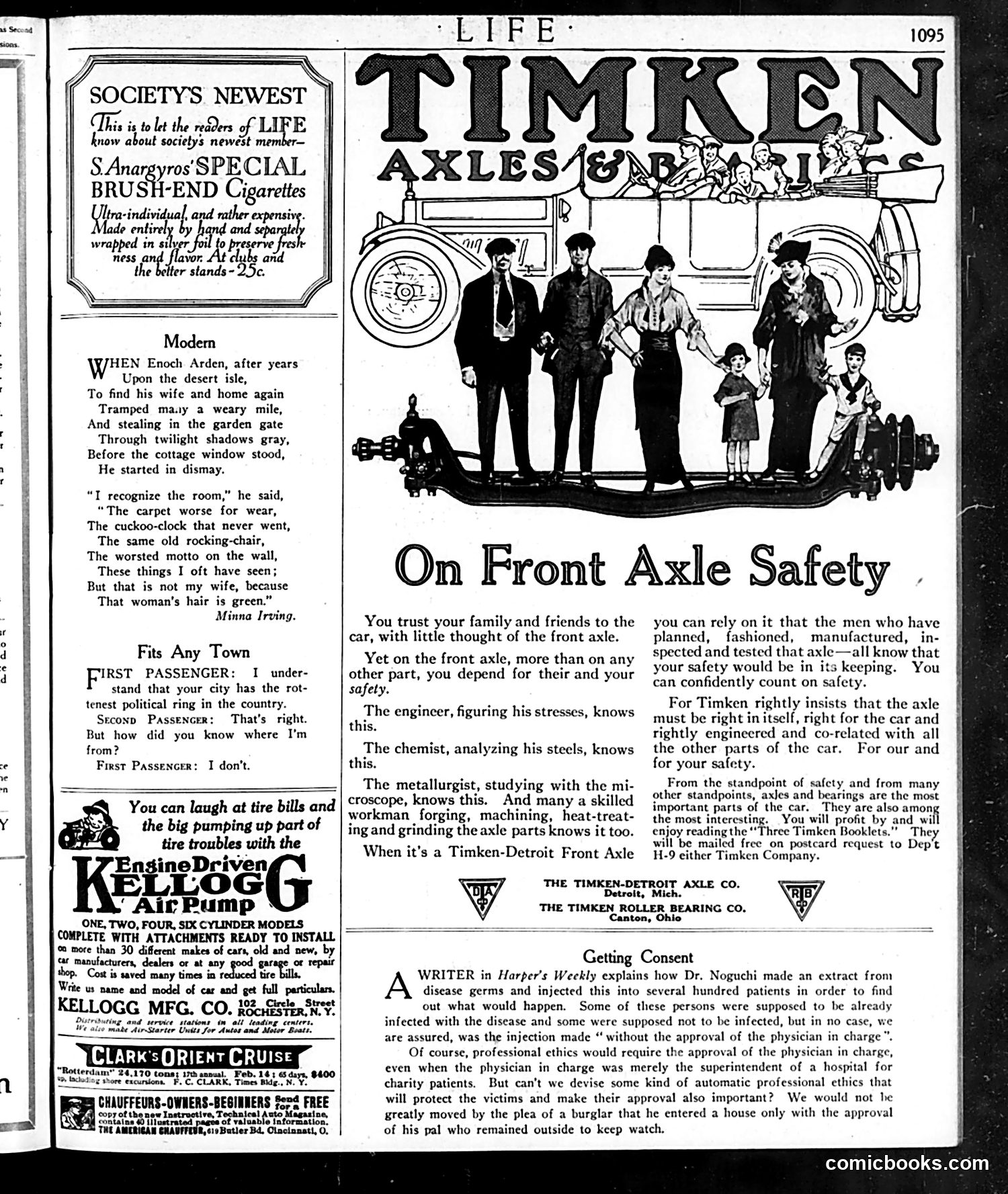
This page is primarily **advertising and promotional content** rather than political satire. The dominant feature is a large advertisement for Timken Axles and Bearings, illustrated with a family boarding an automobile. The image emphasizes automotive safety, a significant concern in the early automobile era. The small "Modern" poem by Minna Irving depicts a man returning home after years away, finding his house unchanged—a commentary on domestic stagnation rather than political satire. A brief joke about political rings appears, but it's generic humor without specific contemporary reference. The remaining content consists of various product advertisements (Kellogg air pumps, Clark Orient Cruise, etc.) and an article on medical ethics regarding disease injection experiments—a legitimate ethical concern of the period, not satire.
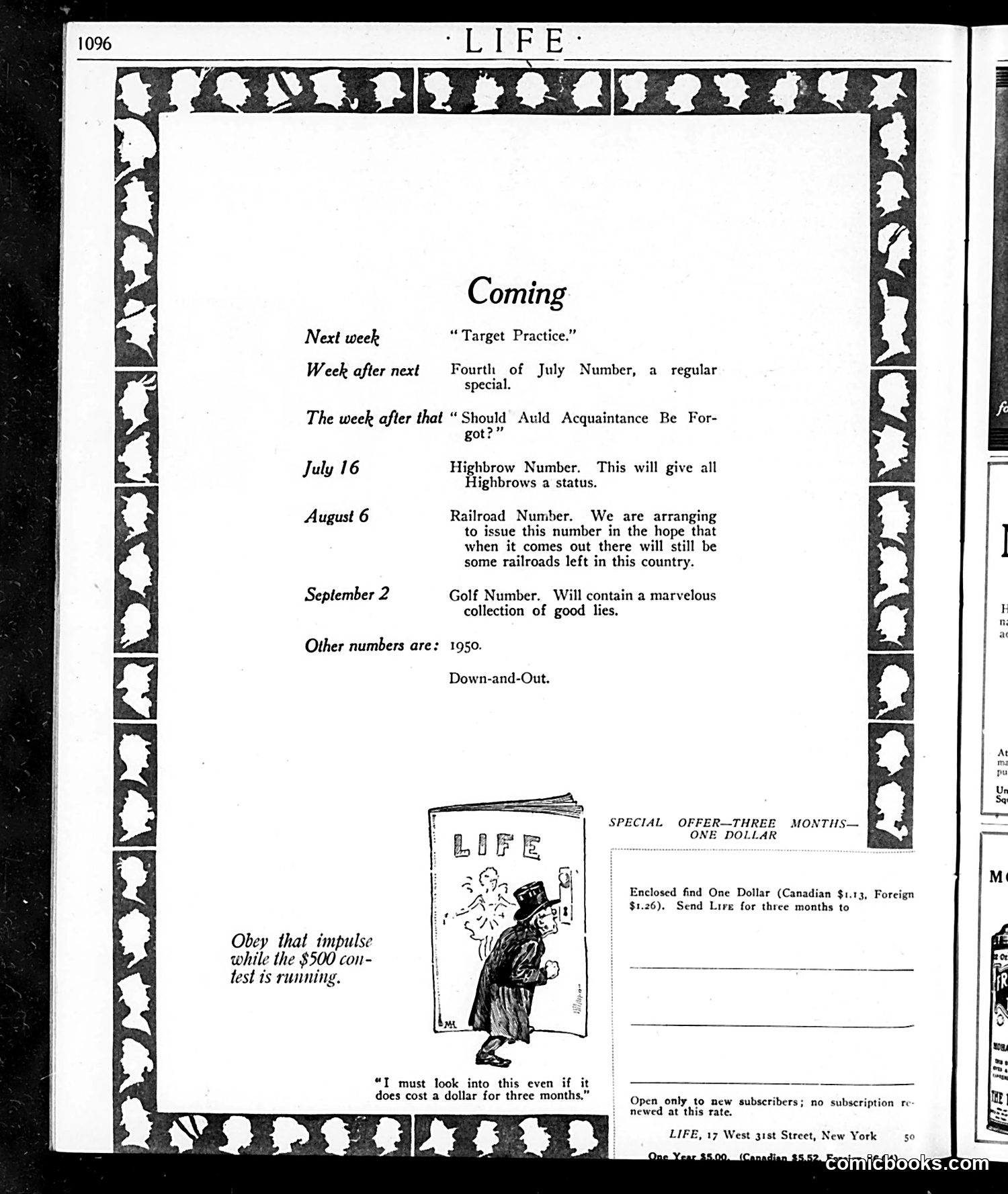
This page is primarily **advertising and subscription promotion** rather than political satire. The central cartoon shows a well-dressed man urgently examining a Life magazine, with the caption "I must look into this even if it does cost a dollar for three months." The accompanying text "Obey that impulse while the $500 contest is running" promotes Life's current contest and subscription offer. The page lists upcoming special issues: Target Practice, Fourth of July, a Highbrow Number, Railroad Number, and Golf Number. The specific reference to hoping "railroads left in this country" survive suggests this was written during an era of railroad decline or financial crisis, likely the 1930s-1950s. The subscription offer itself—three months for one dollar—was the primary message.
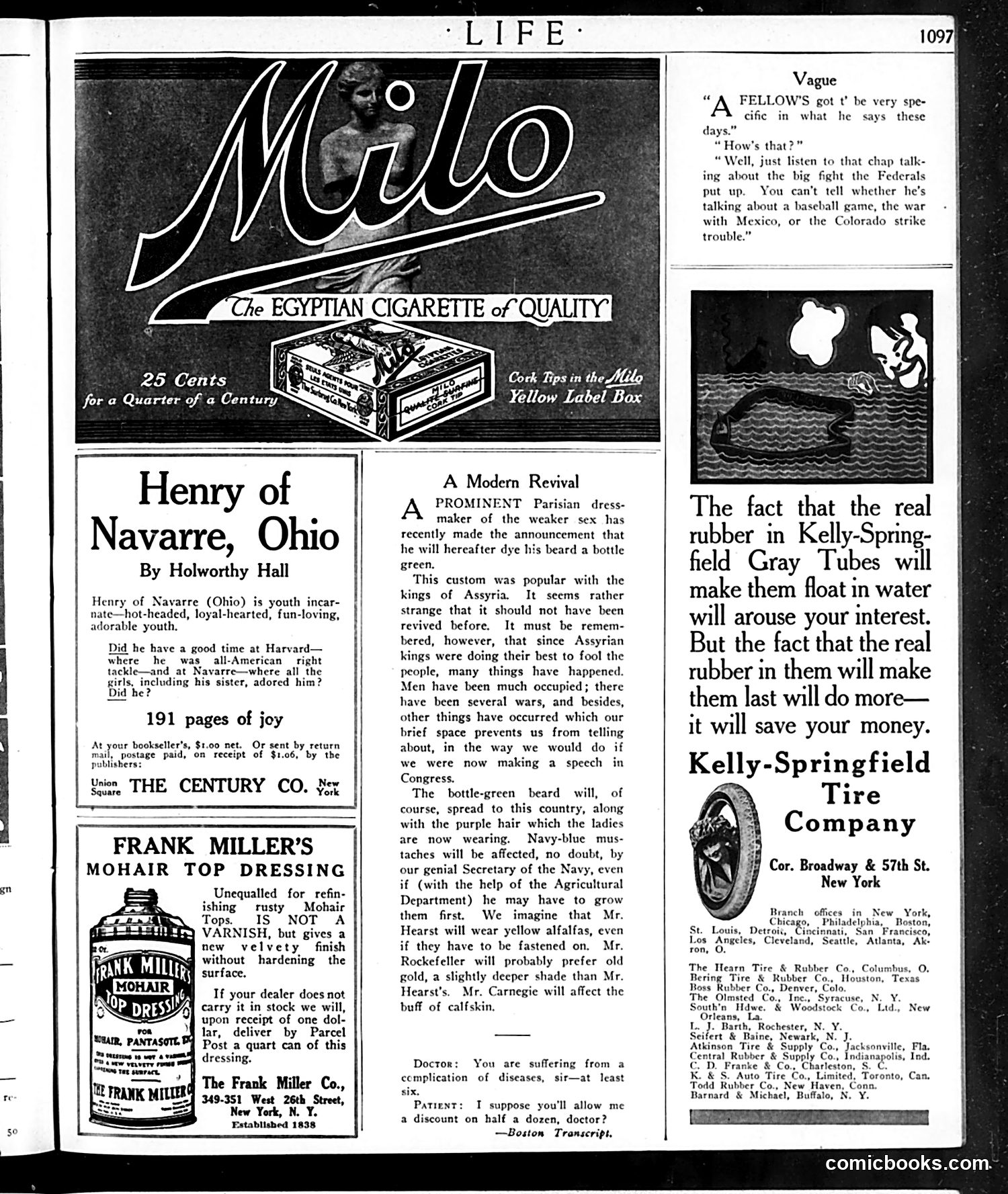
This page is **primarily advertising** (Milo cigarettes, Frank Miller's Mohair Top Dressing, Kelly-Springfield Tires) interspersed with editorial content. The one cartoon visible shows a small figure in turbulent water with what appears to be a moon or celestial object above. The accompanying text references "the real rubber in Kelly-Springfield Gray Tubes" as a selling point—the cartoon illustrates durability through a survival scenario. The editorial content includes "Henry of Navarre, Ohio" (a fictional story) and "A Modern Revival" discussing a Parisian dressmaker's announcement about bearded men returning to fashion, referencing historical kings of Assyria. The piece satirizes how fashion cycles repeat, with commentary on various professions potentially adopting beards. The humor relies on early 20th-century social observations about masculine fashion trends.
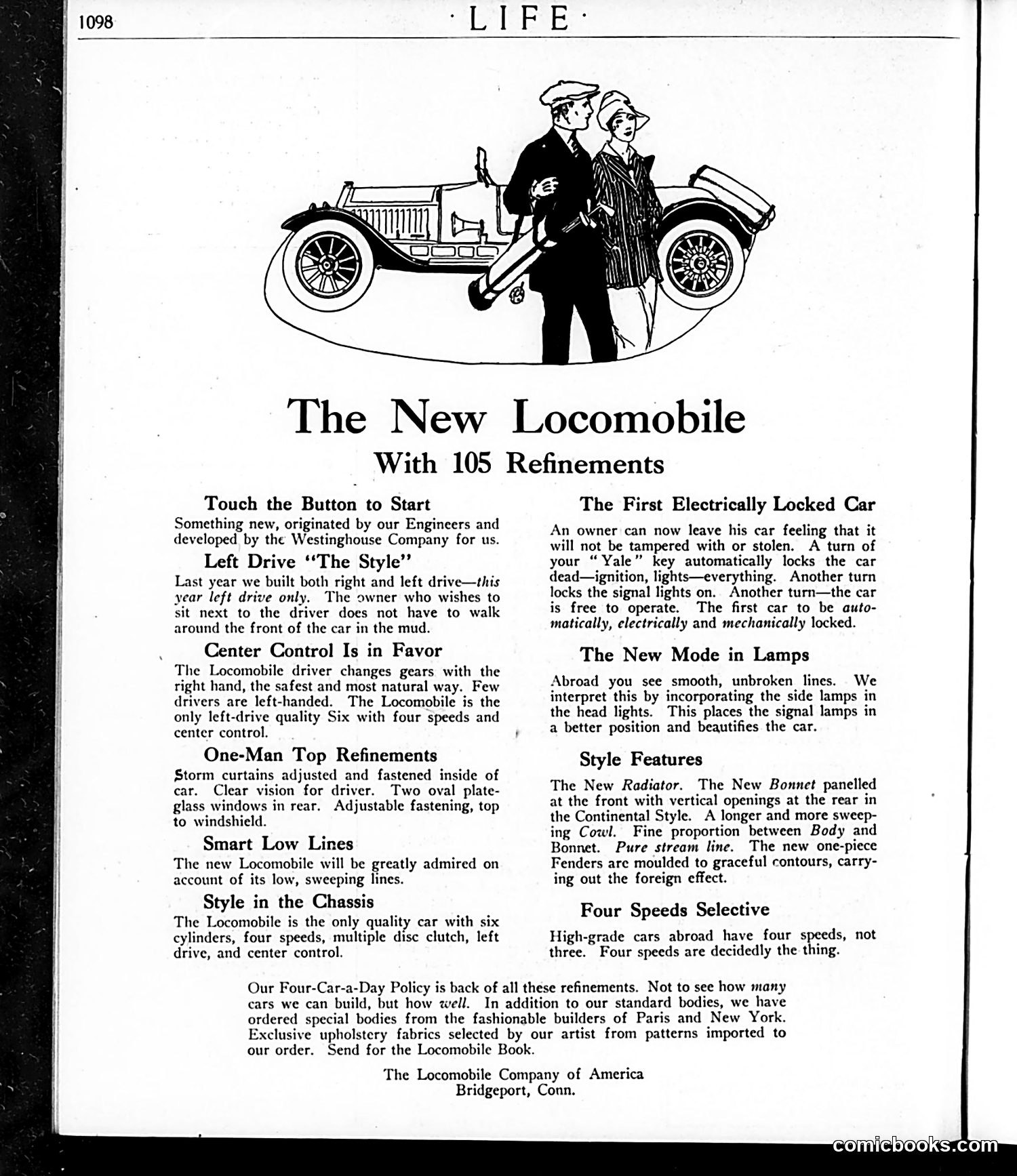
This is **not a political cartoon or satire**—it's a straightforward advertisement for the Locomotile automobile, appearing in *Life* magazine (page 1098). The illustration shows two well-dressed men with a luxury car, promoting "The New Locomotile" with "105 Refinements." The ad emphasizes technological innovations like left-hand drive, electrically locking doors, center control, and four-speed transmission—features that would have been cutting-edge novelties for early 1900s automobiles. The text uses hyperbolic marketing language ("Only left drive only," "Pure stream line") to position Locomotile as a premium, stylish vehicle for wealthy Americans. The mention of "fashionable builders of Paris and New York" appeals to upper-class sensibilities. This represents period automobile advertising rather than satirical content.
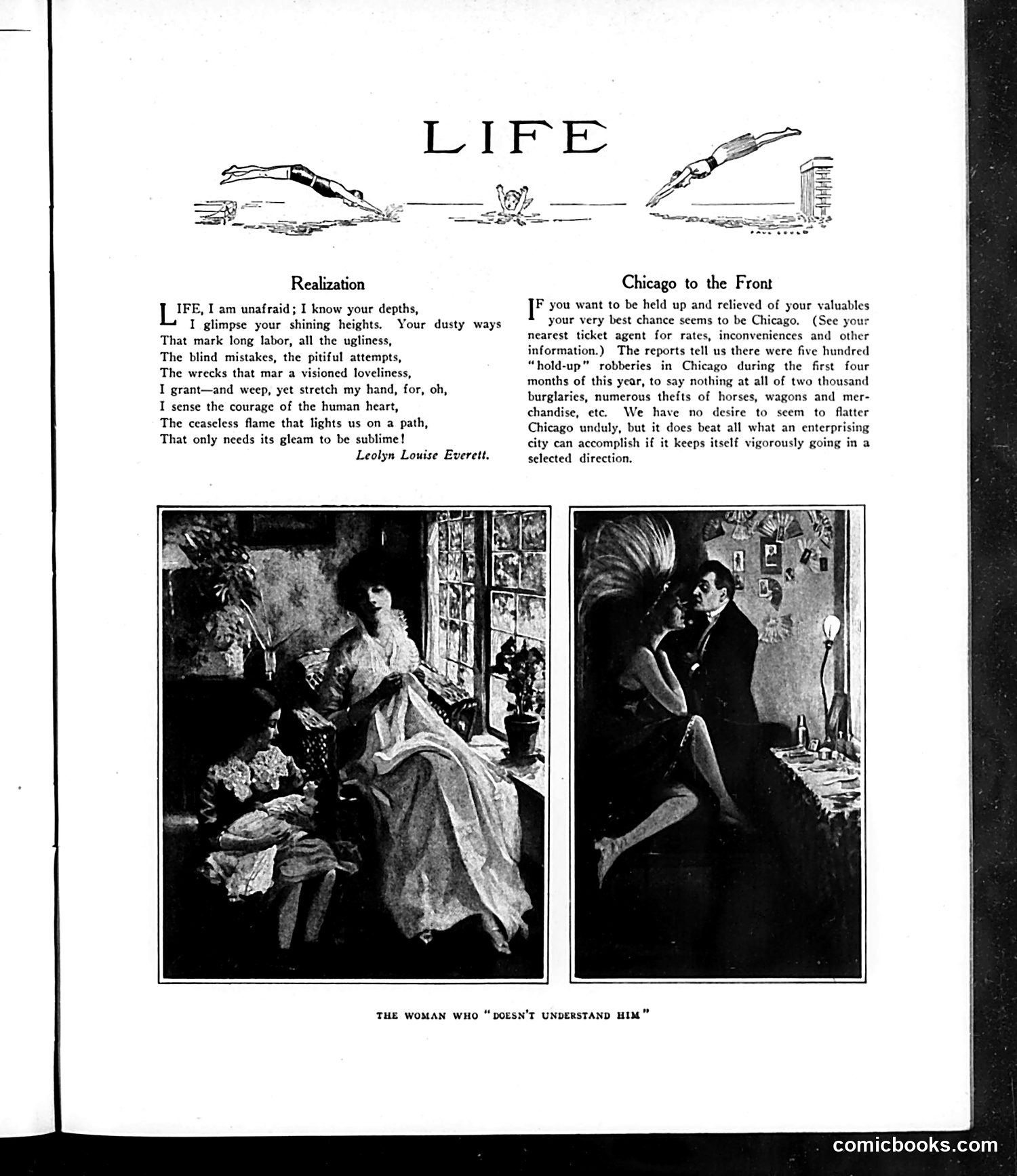
This page contains two distinct elements: **"Realization"** (left): A poem by Loelyn Louise Everett about embracing life's hardships and finding courage through adversity. It's inspirational rather than satirical. **"Chicago to the Front"** (right): A practical travel advisory addressing crime in Chicago. The text notes over 100 "hold-up" robberies occurred there in the first four months of the year, mentioning theft of horses, wagons, and merchandise. It recommends using Chicago ticket agents for safe travel arrangements, framing Chicago's crime problem as something an "enterprising city" can overcome with proper organization. **The photographs below** show scenes titled "The Woman Who 'Doesn't Understand Him'"—appearing to depict domestic relationship scenarios, though the connection to the text above is unclear without additional context. This reflects early-1900s concerns about urban crime and safety.
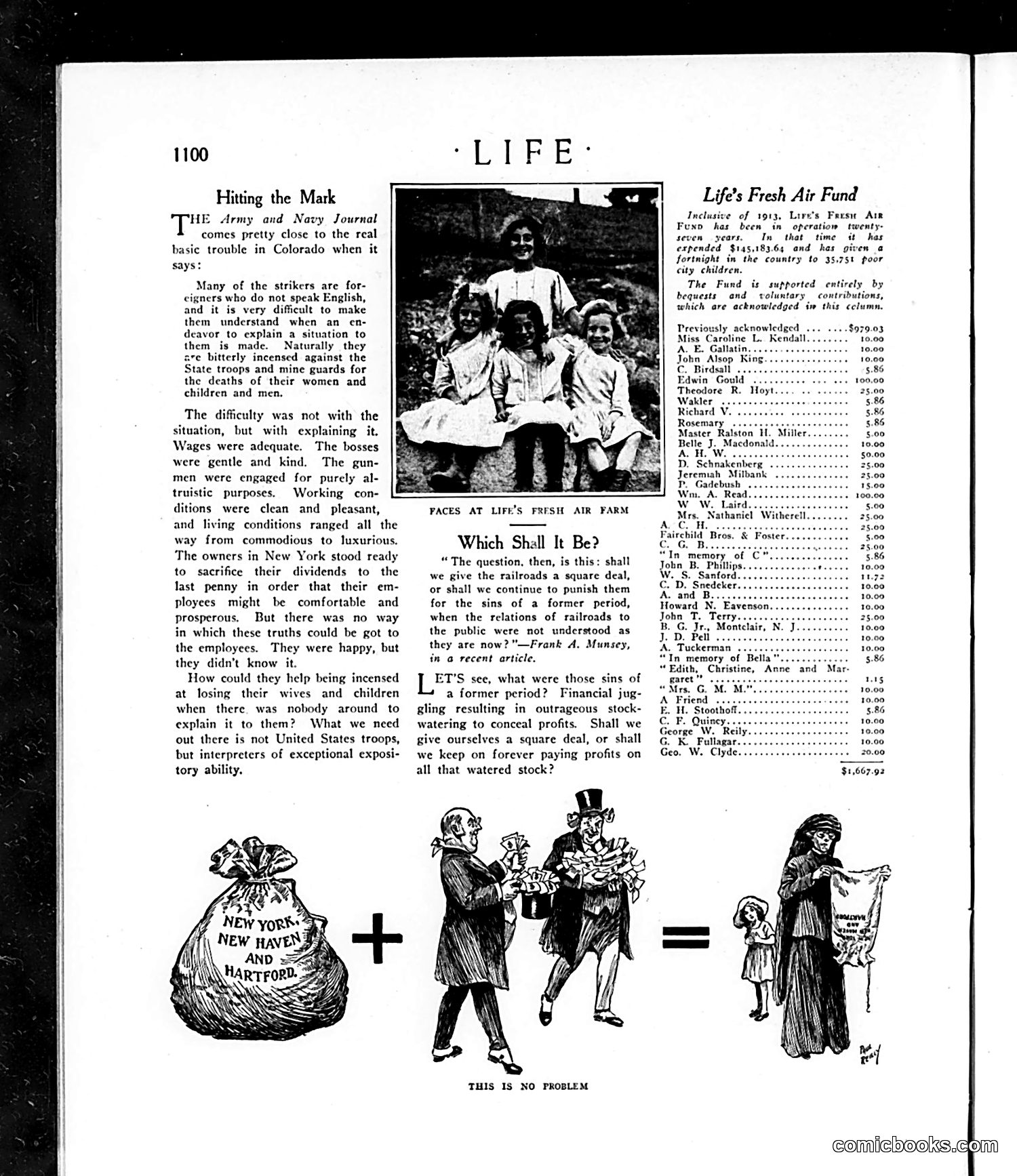
This page contains a serious article titled "Hitting the Mark" about labor strikes in Colorado, accompanied by a photograph of children at "Life's Fresh Air Farm." The accompanying cartoon at bottom, titled "THIS IS NO PROBLEM," uses a satirical equation: a money bag labeled "NEW YORK, NEW AND HARTFORD" plus two wealthy men exchanging money equals a poor woman with a child in ragged clothes holding an empty pocket. The cartoon critiques railroad company profits and wealth inequality during the labor dispute. It suggests that railroad owners' financial dealings and dividends come directly at the expense of poor workers and their families—implying that the strikers' hardship and children's poverty are the logical outcome of corporate greed and exploitation.
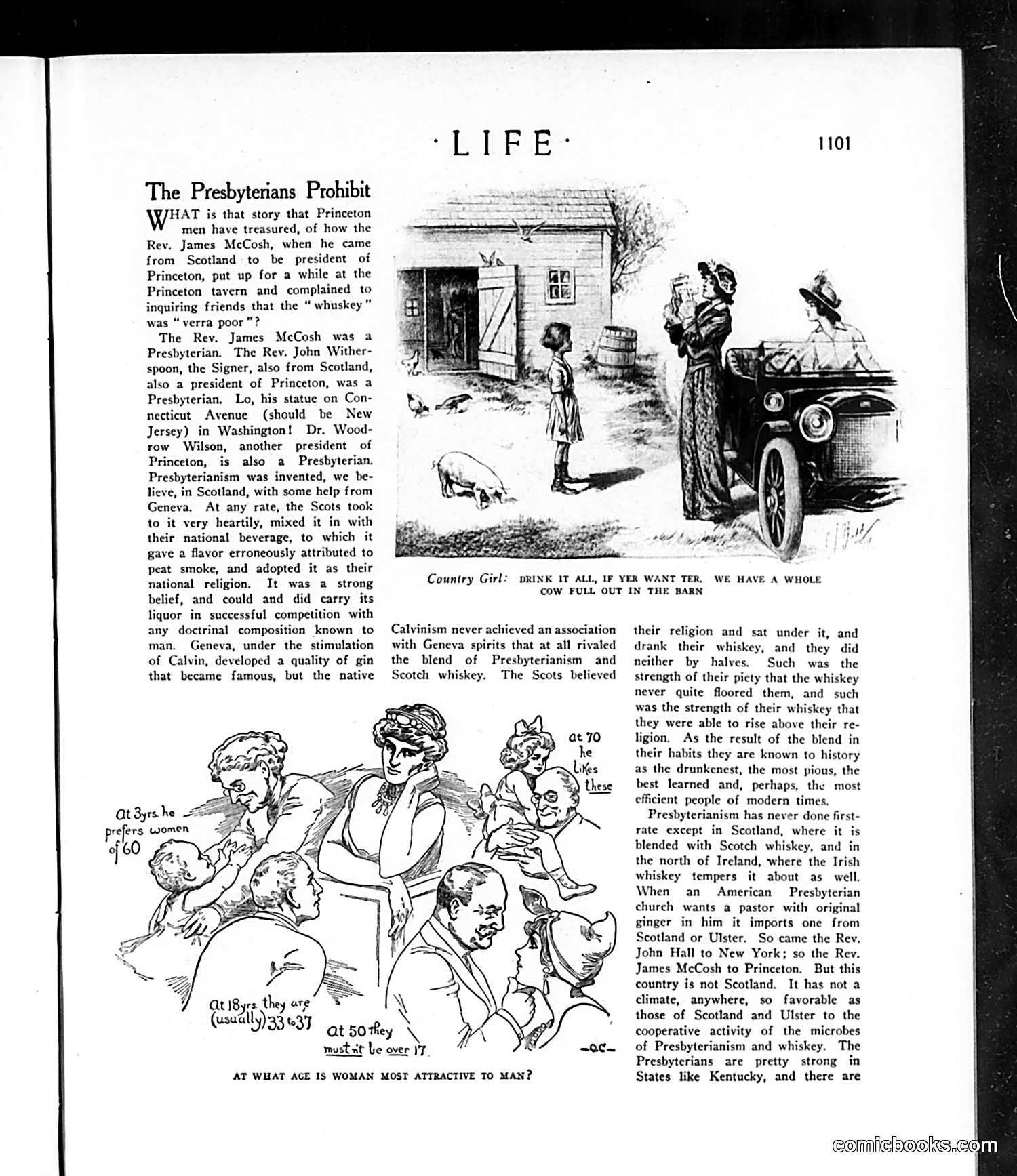
This satire mocks the association between Scottish Presbyterianism and whiskey consumption. The article playfully notes that prominent Princeton figures—Rev. James McCosh and Dr. Woodrow Wilson (later U.S. President)—were Presbyterians of Scottish descent, yet Presbyterianism is linked to temperance/prohibition ideology. The cartoon's joke centers on the contradiction: Scots developed whiskey and integrated it into their Presbyterian identity, yet American Presbyterianism championed prohibition. The lower illustration with age notations appears to comment on women's attractiveness across lifespans—unrelated context suggesting this was a general-interest humor magazine. The "Country Girl" dialogue references rural simplicity regarding alcohol availability, contrasting with urban prohibition debates of the era.
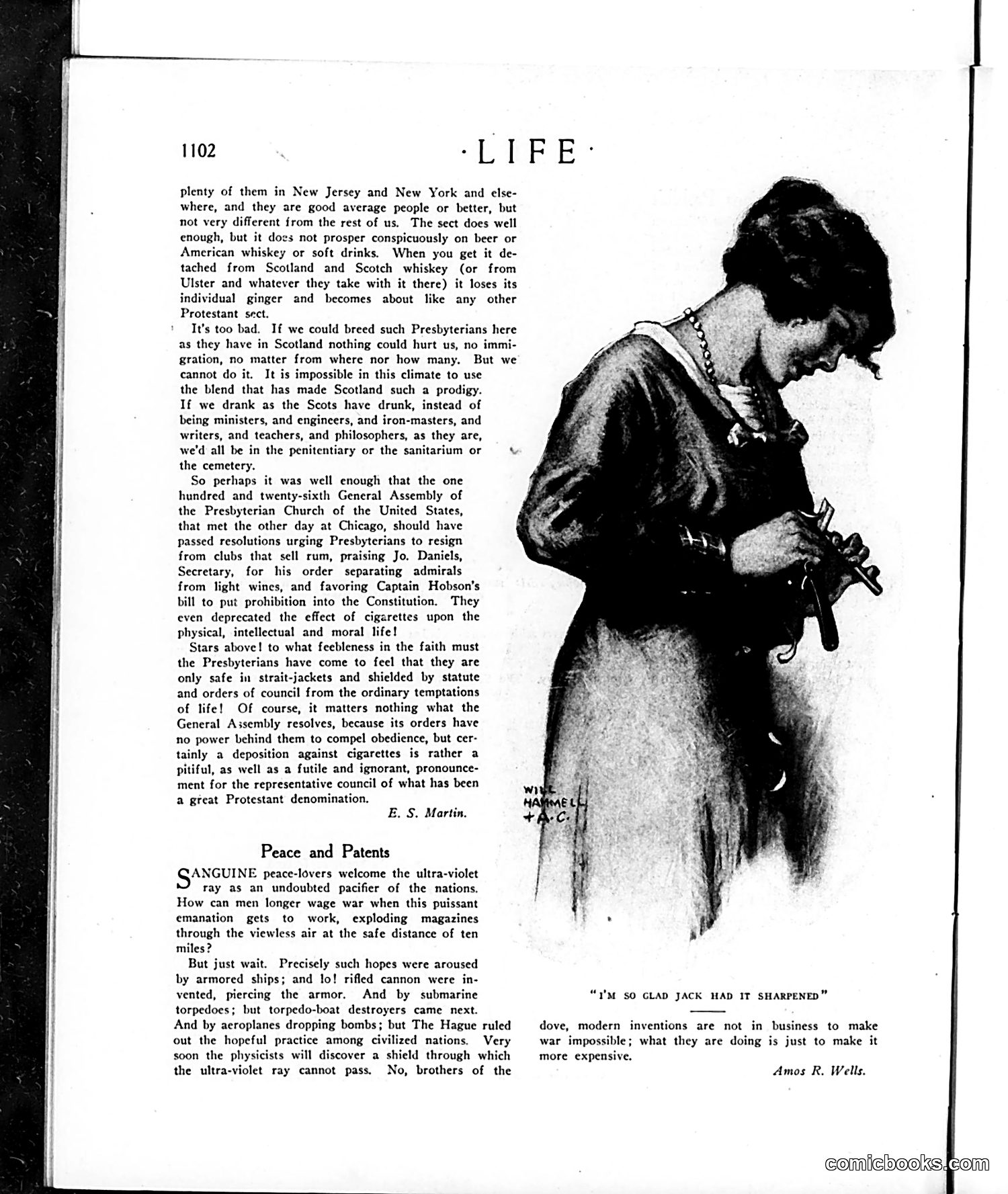
This page contains two opinion pieces. The first, signed E. S. Martin, discusses Presbyterian Church debates over alcohol and tobacco use, criticizing what he sees as naive prohibition efforts. He argues that climate and cultural factors make Scottish drinking habits unsuitable to import to America, and mocks church resolutions as ineffectual moral posturing. The second piece, "Peace and Patents" by Amos R. Wells, discusses military technology. It sarcastically notes that while peace advocates celebrate inventions like the ultraviolet ray as conflict-prevention tools, modern weapons (submarines, destroyers, aeroplanes) only make war more expensive rather than impossible. The illustration shows a woman examining or sharpening what appears to be a knife or blade, captioned "I'M SO GLAD JACK HAD IT SHARPENED"—likely a domestic humor cartoon, though its exact satirical point remains unclear without additional context.
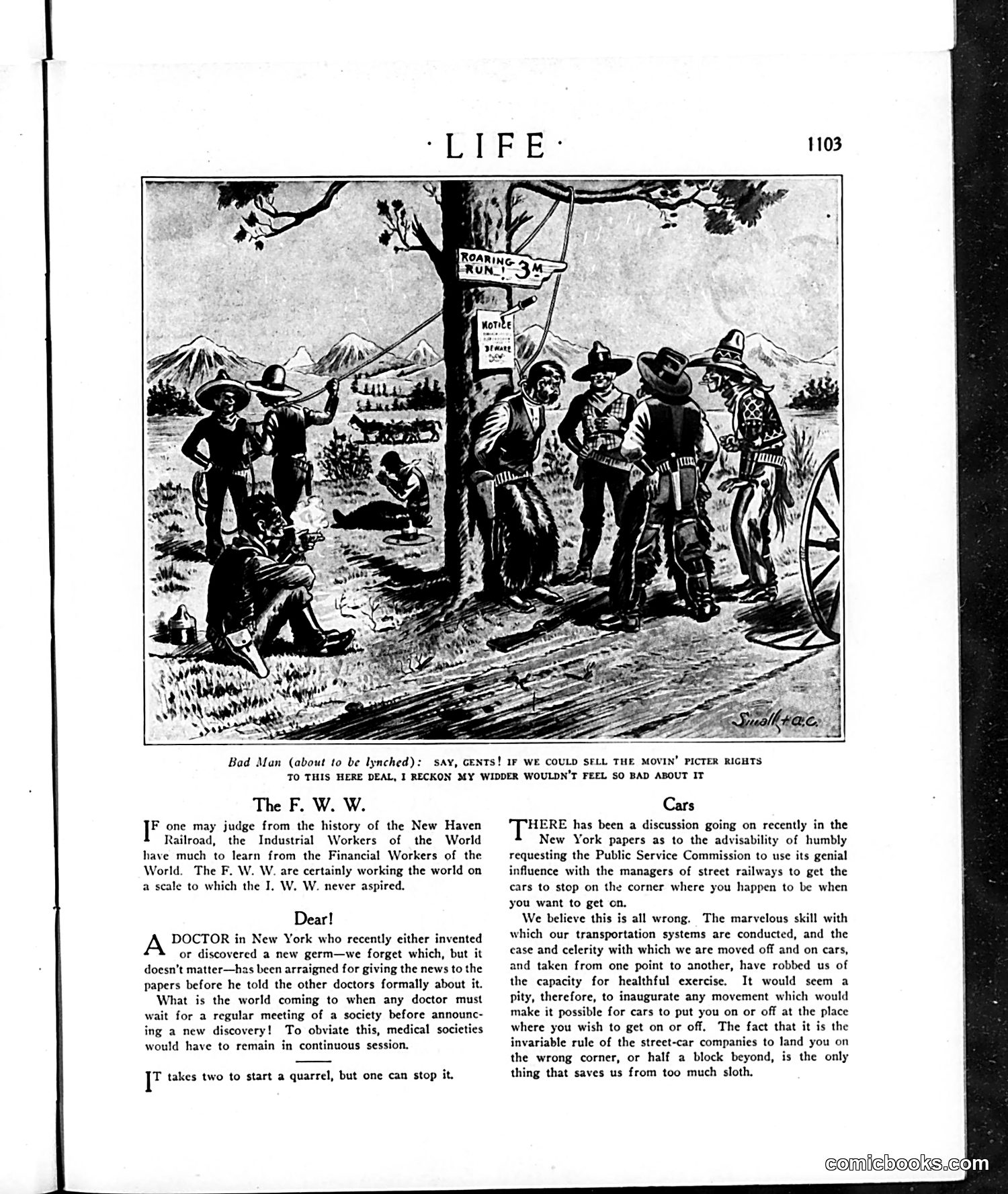
The cartoon depicts a lynching scene set in the American West. A group of armed cowboys has captured a man (labeled "Bad Man") beneath a "Roaring Run" sign, with one figure saying he'll accept a deal involving movie picture rights rather than proceed with execution. **The satire targets:** The film industry's exploitation of Western violence and outlaws for entertainment profit. The joke suggests that even imminent lynch mobs would negotiate—prioritizing commercial gain over frontier justice. **Historical context:** This reflects 1920s concerns about how Hollywood sensationalized violence and Western mythology for profit, turning real criminal justice (however brutal) into marketable spectacle. The cartoon critiques both Hollywood's opportunism and the absurdity of commercializing frontier brutality.
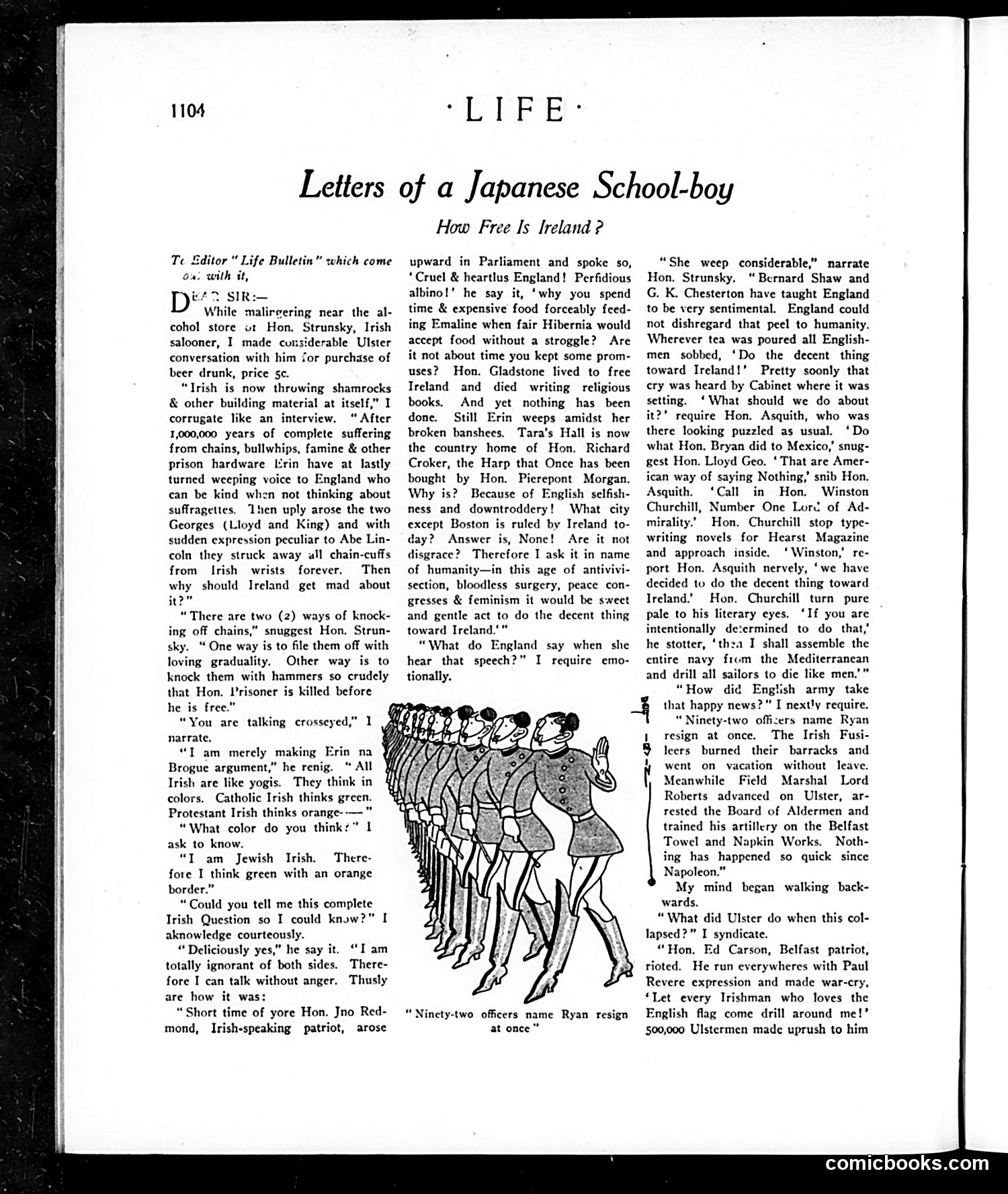
This page from *Life* magazine satirizes Irish-English political tensions through a fictional letter exchange. The illustration shows a line of soldiers in military formation, captioned "Ninety-two officers name Ryan resign at once." The satire mocks English attitudes toward Irish independence and identity. The text presents an Irish schoolboy's letter questioning English hypocrisy: England demands Ireland accept British rule while denying Irish self-determination. The writer highlights contradictions—England freed other nations but oppresses Ireland, and criticizes English stereotypes of Irish people. The cartoon illustrates the punchline: when 92 officers with the Irish surname "Ryan" resign simultaneously in protest, it demonstrates the absurdity of English political positions. The satire suggests that even within the British military establishment, Irish identity and nationalist sentiment persist, undercutting English claims to moral authority.
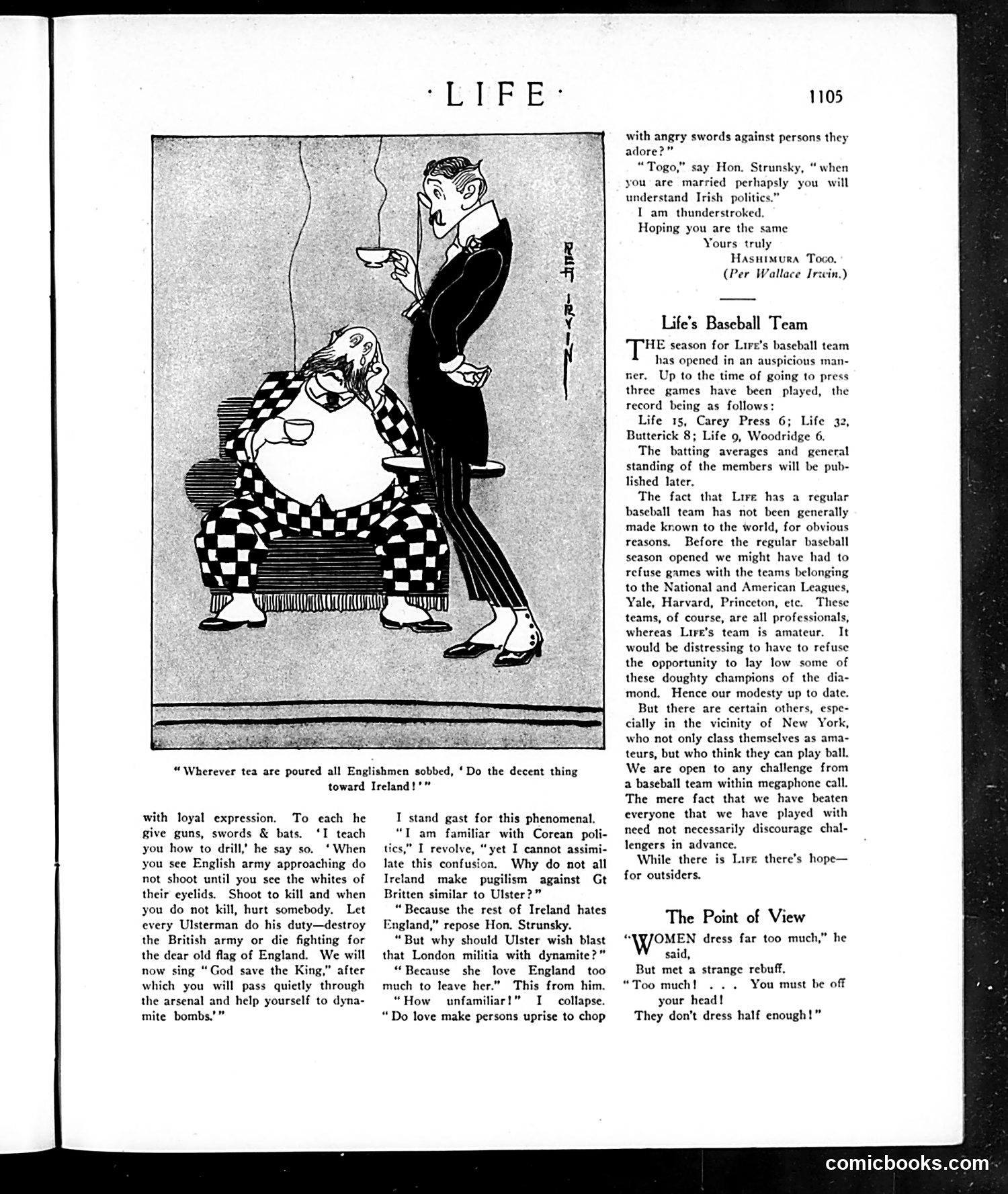
The cartoon depicts two figures in what appears to be a domestic scene: a rotund woman seated and a thin man standing, both holding cups. The caption references Irish politics and England, suggesting this is political satire rather than straightforward domestic humor. The accompanying text discusses Irish nationalism, with characters debating whether Ireland should attack England militarily ("with dynamite"). The dialogue satirizes Irish-English tensions, portraying an Irishman advocating aggressive action while another character questions the logic. The cartoon likely uses the domestic squabble as a metaphor for Anglo-Irish political conflict. The physical contrast between the figures—the robust woman versus thin man—may exaggerate stereotypes common in period satire about national characteristics or power dynamics between the nations.
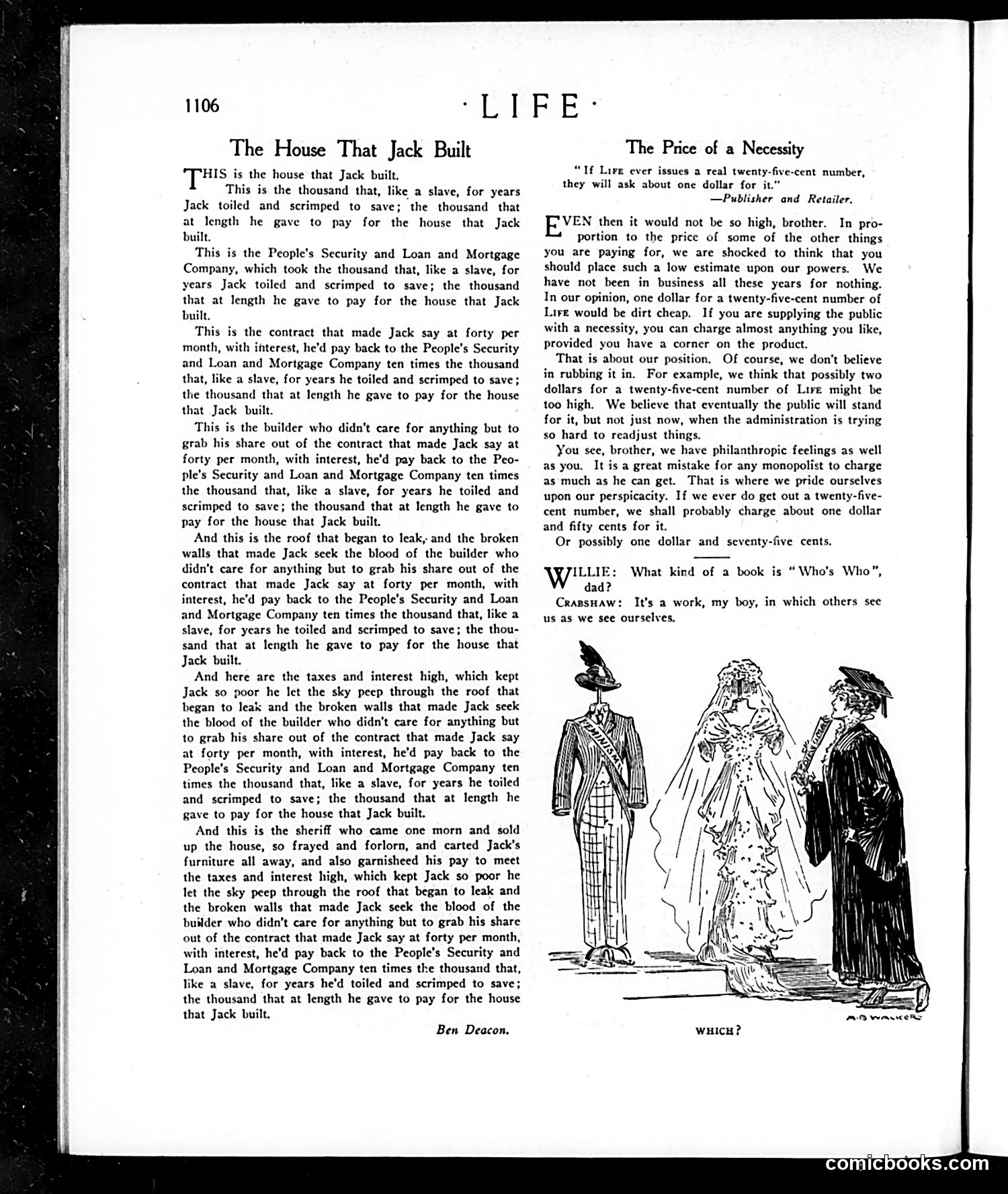
**"The House That Jack Built"** (left) is a cumulative poem satirizing predatory lending and mortgage practices. It repeatedly describes how Jack labors to pay the "People's Security and Loan and Mortgage Company," which charges him ten times the original debt through interest. The satire builds to show how taxes, interest, and contractor negligence leave Jack perpetually impoverished—enslaved to debt despite owning his home. **"The Price of a Necessity"** (right) discusses magazine pricing, likely responding to publisher complaints about pricing strategy. The dialogue between Willie and Carshaw about "Who's Who" suggests debate over what constitutes fair value. The bottom cartoon shows three female figures (unclear identification) captioned "WHICH?" by Ben Deacon, likely satirizing fashion or feminine aesthetics, though context is insufficient for precise interpretation.
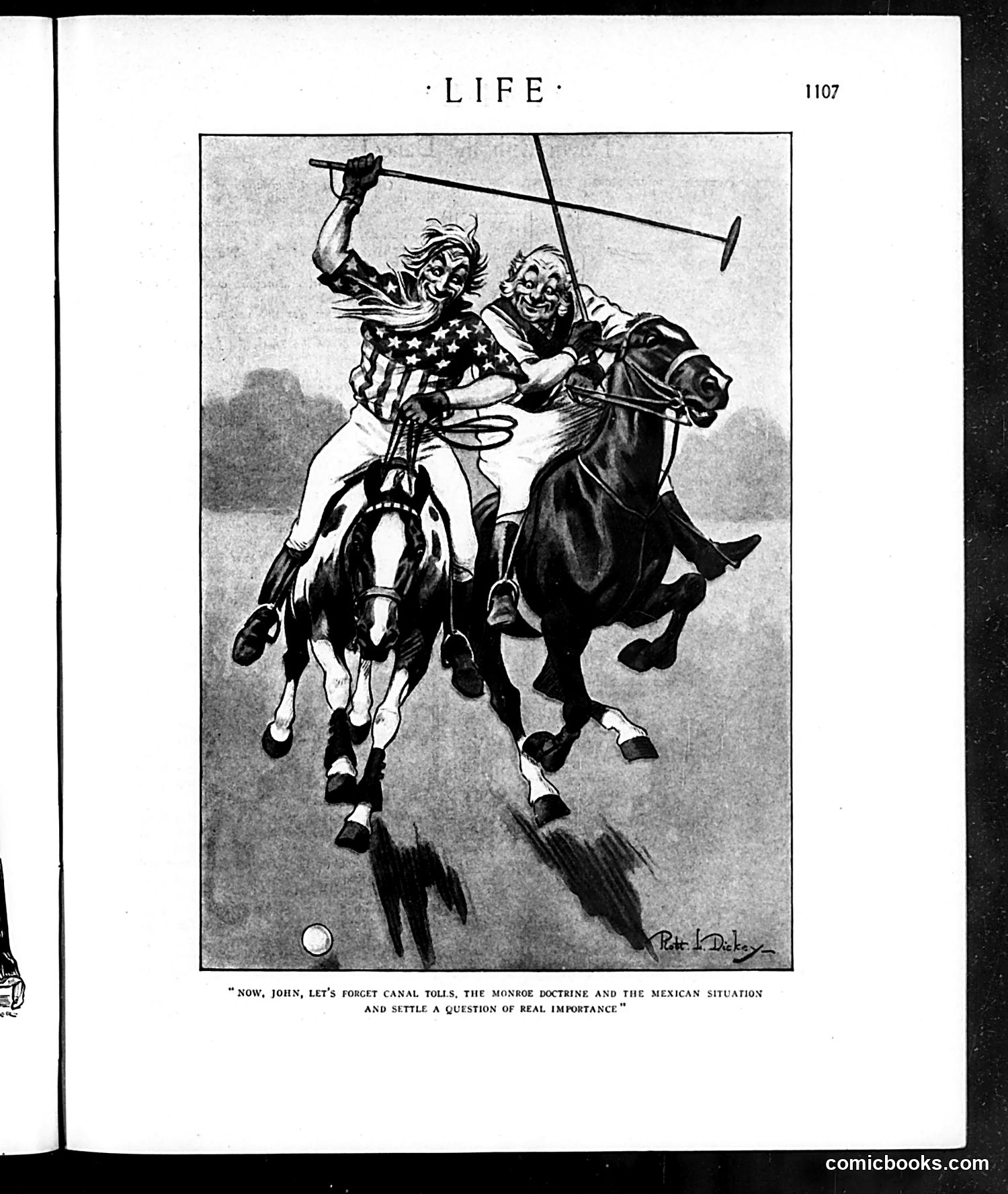
This political cartoon depicts two figures on horseback in an exaggerated, dynamic style. The figure on the left wears star-spangled clothing (representing America) and holds up a telescope or spyglass. The caption suggests a conversation dismissing major political issues—canal tolls, the Monroe Doctrine, and the Mexican situation—in favor of discussing something of "real importance." The satire likely mocks politicians for prioritizing trivial matters over substantive foreign policy concerns. The energetic, almost chaotic composition emphasizes the absurdity of this proposed discussion. The specific "question of real importance" remains unnamed, suggesting the cartoon critiques how political discourse trivializes serious national issues. Without knowing the exact publication date, the references to canal tolls and Mexican situations suggest early 20th-century American political debates.
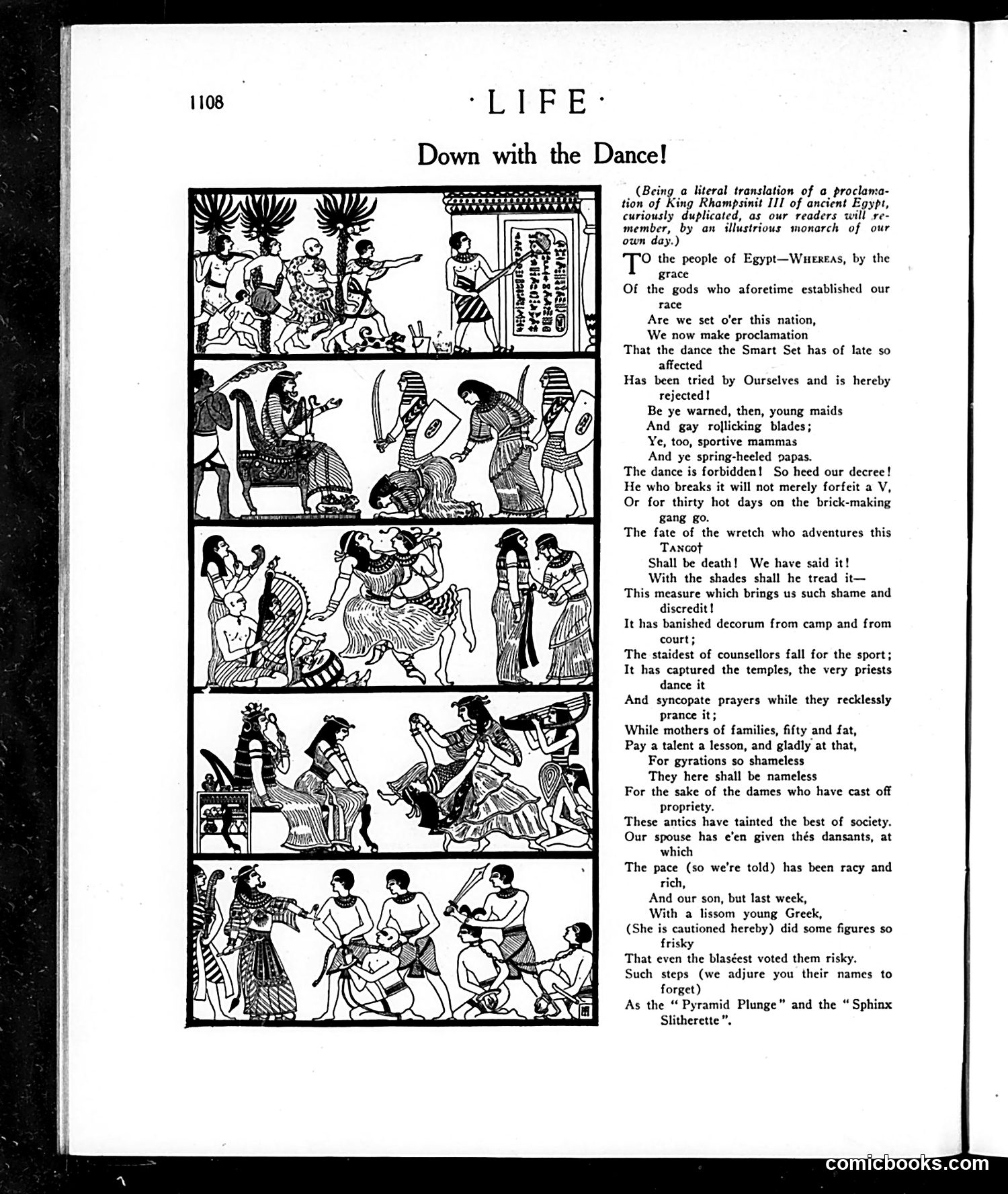
This satirical piece mocks contemporary dance crazes (circa 1910s-20s, likely the Tango) by presenting them as an ancient Egyptian royal proclamation. The humor works through **anachronistic comparison**: King Rhampsinit III supposedly forbids "the dance the Smart Set has of late so affected," mirroring a modern monarch's alleged similar edict. The satire targets multiple subjects: 1. **Upper-class hypocrisy**: The proclamation condemns dancing while revealing that the royal family itself participates—the king's wife hosts dance parties ("dansants"), their son dances with a young Greek woman. 2. **Moral panic over modern dance**: References to "shameless gyrations," "racy and rich" movements, and invented dance names like "Pyramid Plunge" and "Sphinx Slitherette" mock exaggerated concerns about dance's moral dangers. 3. **Social pretension**: The "Smart Set" adopts fashions that authorities officially condemn, yet society's most respectable members participate anyway. The Egyptian framing adds absurdist distance, allowing satirists to critique contemporary prudishness and elite inconsistency without direct confrontation.
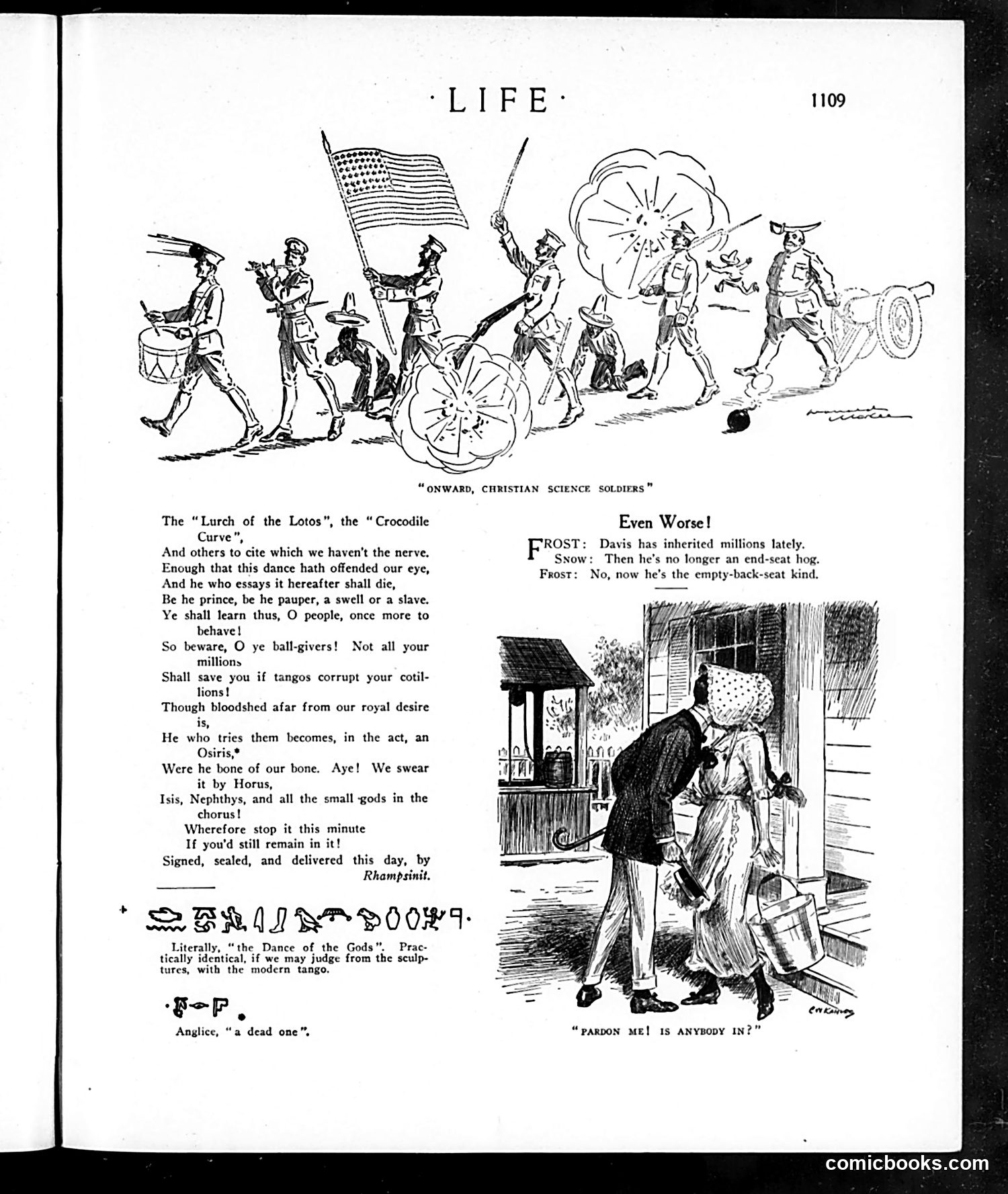
This Life magazine page satirizes the moral panic over the tango dance craze of the early 1900s. The top cartoon parodies Christian Science and Egyptian pharaohs, mocking those who viewed the tango as a serious moral threat. The mock-Egyptian decree (signed "Rhampsinit," an ancient pharaoh) humorously equates dancing the tango with death, suggesting the hysteria was absurdly overwrought. The bottom cartoon jokes about wealth and social behavior: a newly rich man (Davis) who inherited millions is still inconsiderate—now occupying empty train seats instead of sitting in them properly. The satire targets both the tango-panic moralizers and shallow wealthy behavior. Together, the page mocks both the era's prudish dance criticism and the pretensions of the nouveau riche, using exaggeration and anachronism for comedic effect.
This is a humorous short story satirizing **medical faddism and hypochondria** in the early 20th century. The narrator visits Dr. Northby, who delivers absurdly contradictory health advice using pseudo-scientific medical jargon ("opsonic index," "digitalis of the pelvic region"). The doctor forbids smoking, alcohol, bread, and coffee—but *demands* five glasses of milk daily, which the narrator abhors. The satire targets both **charlatan doctors** peddling dubious health regimens and **patients' gullible acceptance** of them. The story's humor lies in the doctor's self-important nonsense and the narrator's instant panic-driven compliance. The "narrow escape" appears to reference the narrator nearly resisting temptation to join a social engagement—suggesting the real danger isn't illness but the absurd tyranny of faddish medical obsession itself.
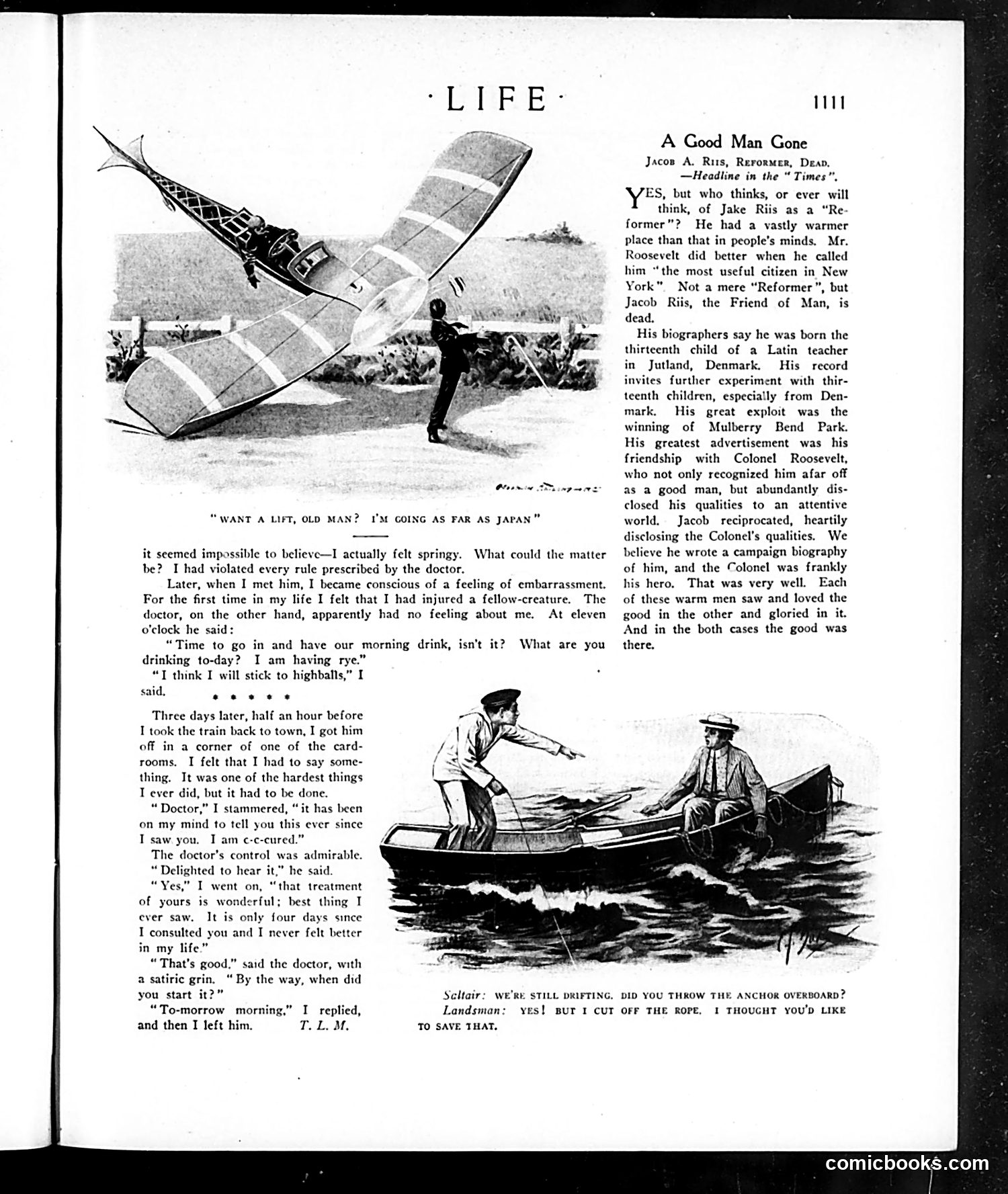
This Life magazine page contains two distinct pieces: **Main Story ("Want a Lift, Old Man?")**: A humorous narrative about a patient who violates his doctor's orders, then feels guilty confessing his "cure" to the physician. The joke hinges on the doctor's indifference—he cares nothing about the patient's wellbeing, only his morning drink routine. **Right Column (Obituary/Tribute)**: A memorial to Jacob Riis, a Danish-American social reformer and photographer known for documenting tenement life in New York. The piece emphasizes he was more than a mere "reformer"—he was a genuine humanitarian and friend to mankind. His closest association was with Theodore Roosevelt, who publicly praised him as "the most useful citizen in New York." The text celebrates their mutual respect and shared commitment to social good. **Bottom Cartoon**: A nautical joke about sailors adrift—one threw the anchor overboard to save it by cutting the rope, missing the point of anchoring entirely. It's absurdist humor unrelated to other page content.
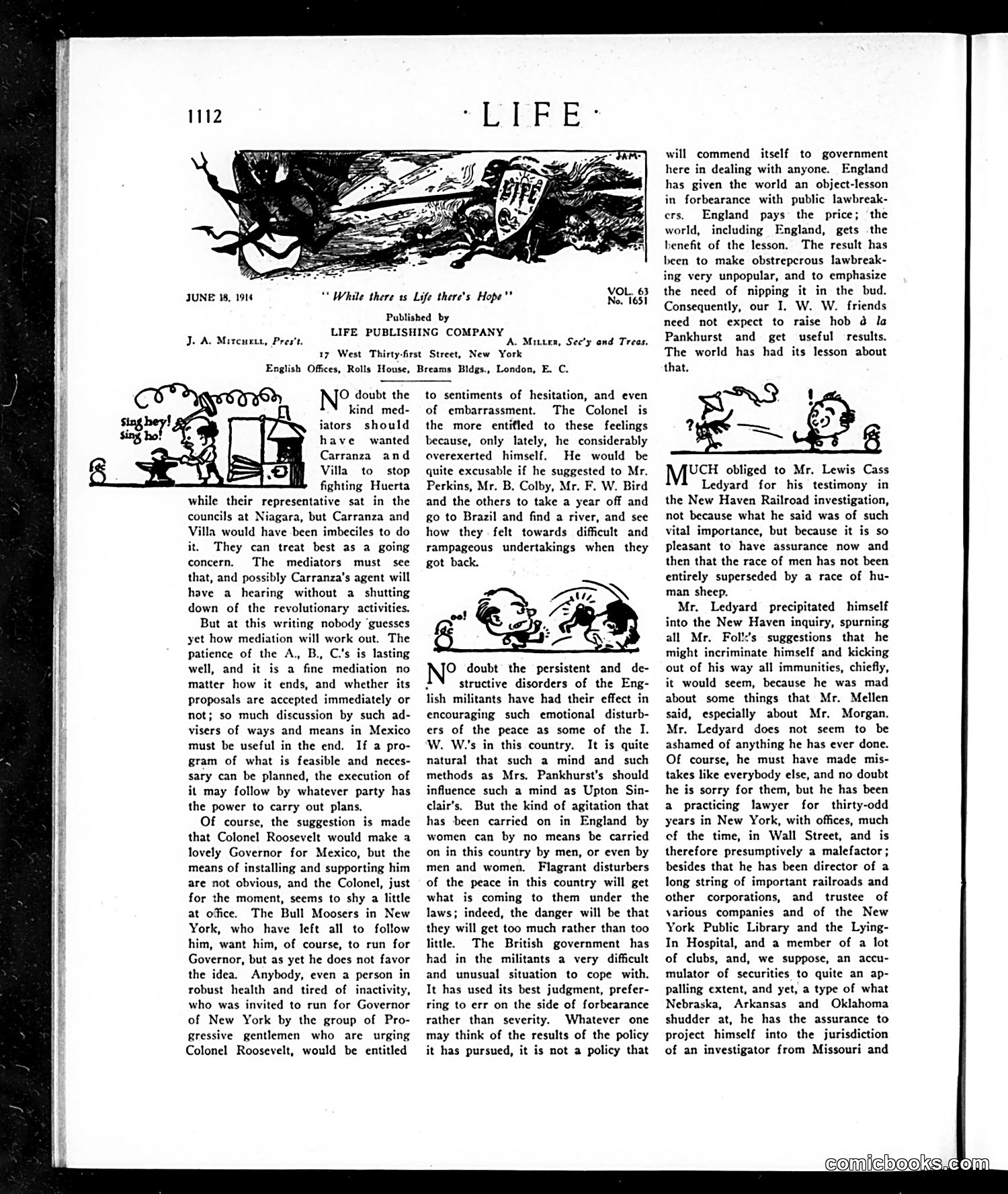
This page discusses three political topics: **Mexican Revolution**: The text debates whether mediators (the "A.B.C.'s"—Argentina, Brazil, Chile) should pressure revolutionary factions Carranza and Villa to cease fighting Huerta while negotiations proceed at Niagara. The author argues they wisely refused, as ongoing conflict gave mediators leverage. **Theodore Roosevelt for Governor**: Progressive Party supporters urge Roosevelt to run for New York governor. The piece humorously suggests he decline, jokingly proposing he and his backers instead take "a year off" to explore Brazil—a reference to Roosevelt's actual 1913-1914 South American expedition. **British Suffragettes vs. American Radicals**: The text compares English militant feminists (Mrs. Pankhurst and the suffrage movement) with American radical groups like the I.W.W. (Industrial Workers of the World) and Upton Sinclair. It argues Britain's lenient approach to lawbreaking suffragettes backfired by inspiring American radicals, but warns American authorities will respond more severely—discouraging such agitation here. The cartoons appear decorative rather than directly illustrative of these arguments.
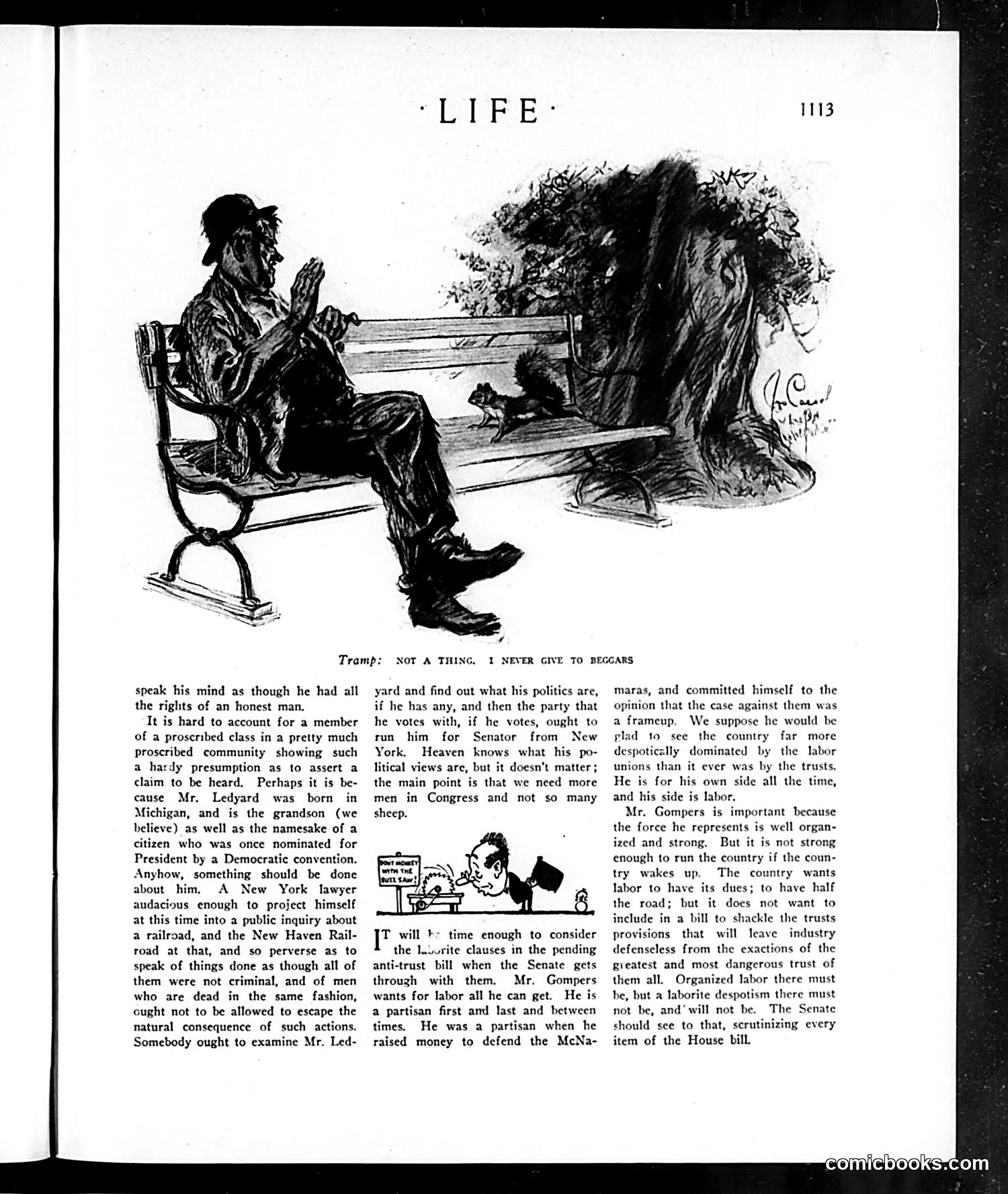
This page satirizes two prominent figures through written commentary rather than traditional cartooning. **The Main Cartoon** depicts a well-dressed man sitting on a park bench while a tramp approaches. The caption "NOT A THING. I NEVER GIVE TO BEGGARS" serves as bitter social commentary—the wealthy man refuses charity while the text criticizes the treatment of those who dare speak up. **The Written Targets:** 1. **Mr. Ledyard** (a New York lawyer): The text mocks his audacity in publicly questioning the New Haven Railroad during what appears to be an investigation. The article sarcastically suggests punishing him by making him a Senator, implying he's too principled for his own good. 2. **Samuel Gompers** (labor leader): The commentary attacks his partisanship, accusing him of defending the McNamara brothers and seeking excessive power for organized labor. The author argues labor deserves fair treatment but warns against "laborite despotism." The page reflects Progressive-era tensions between labor, corporate power, and reform—showing skepticism toward both unchecked business interests and aggressive union leadership.
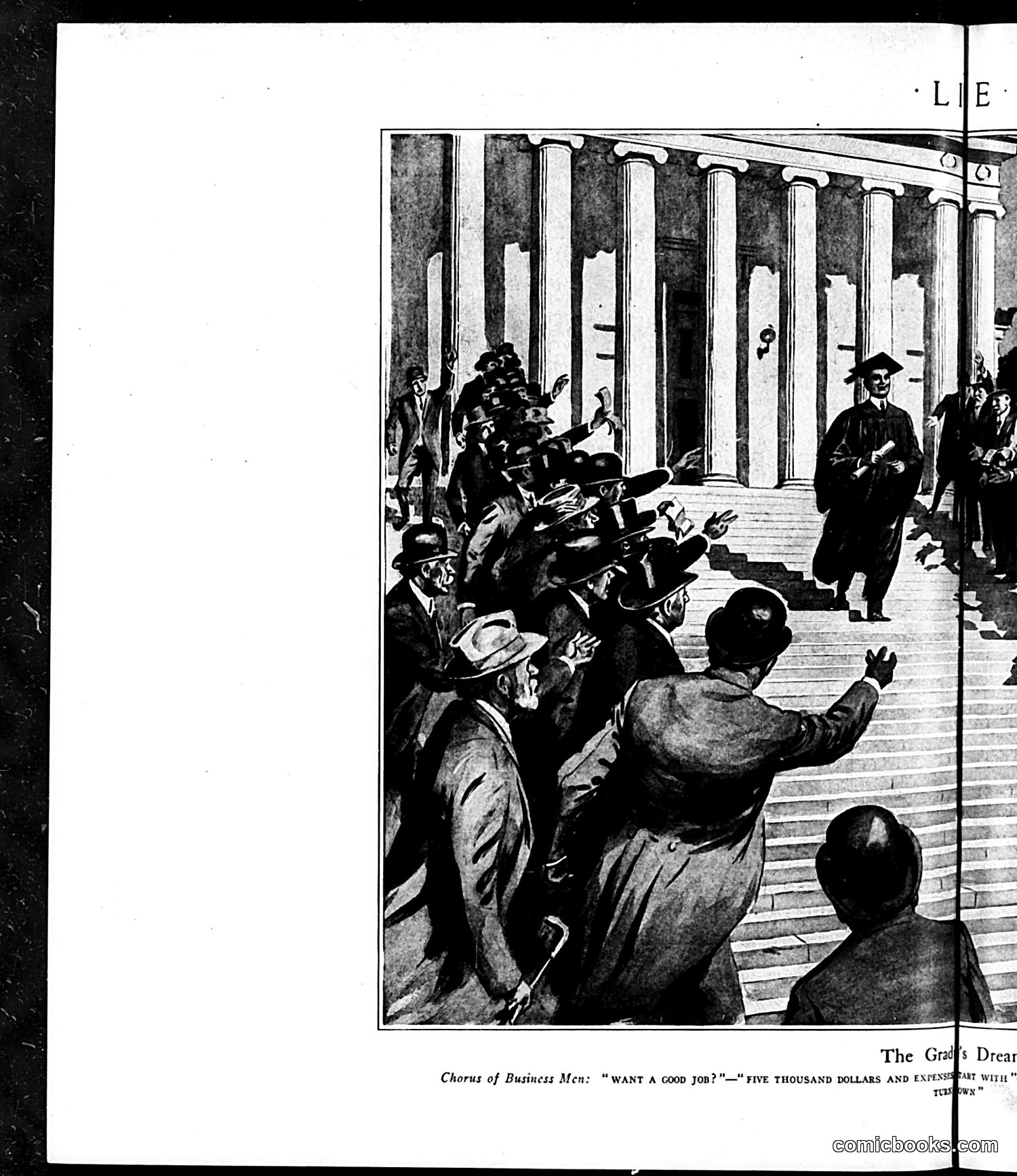
This cartoon satirizes the desperation of unemployed workers during what appears to be an economic crisis (likely the Great Depression era, given Life magazine's period). A group of "Business Men" (labeled in the caption) stand on the steps of what appears to be a grand government building with classical columns, discussing job opportunities. The cruel irony of their "chorus" is evident: they're offering positions requiring "$5,000 and expenses" as payment upfront—clearly exploitative or fraudulent schemes targeting desperate job-seekers who would ask "want a good job?" The cartoon mocks both the desperation of the unemployed masses (shown below) and the predatory nature of wealthy businessmen exploiting economic hardship. The title "The Graf's Drear" remains unclear without additional context, though it may reference a specific public figure or incident of the period.
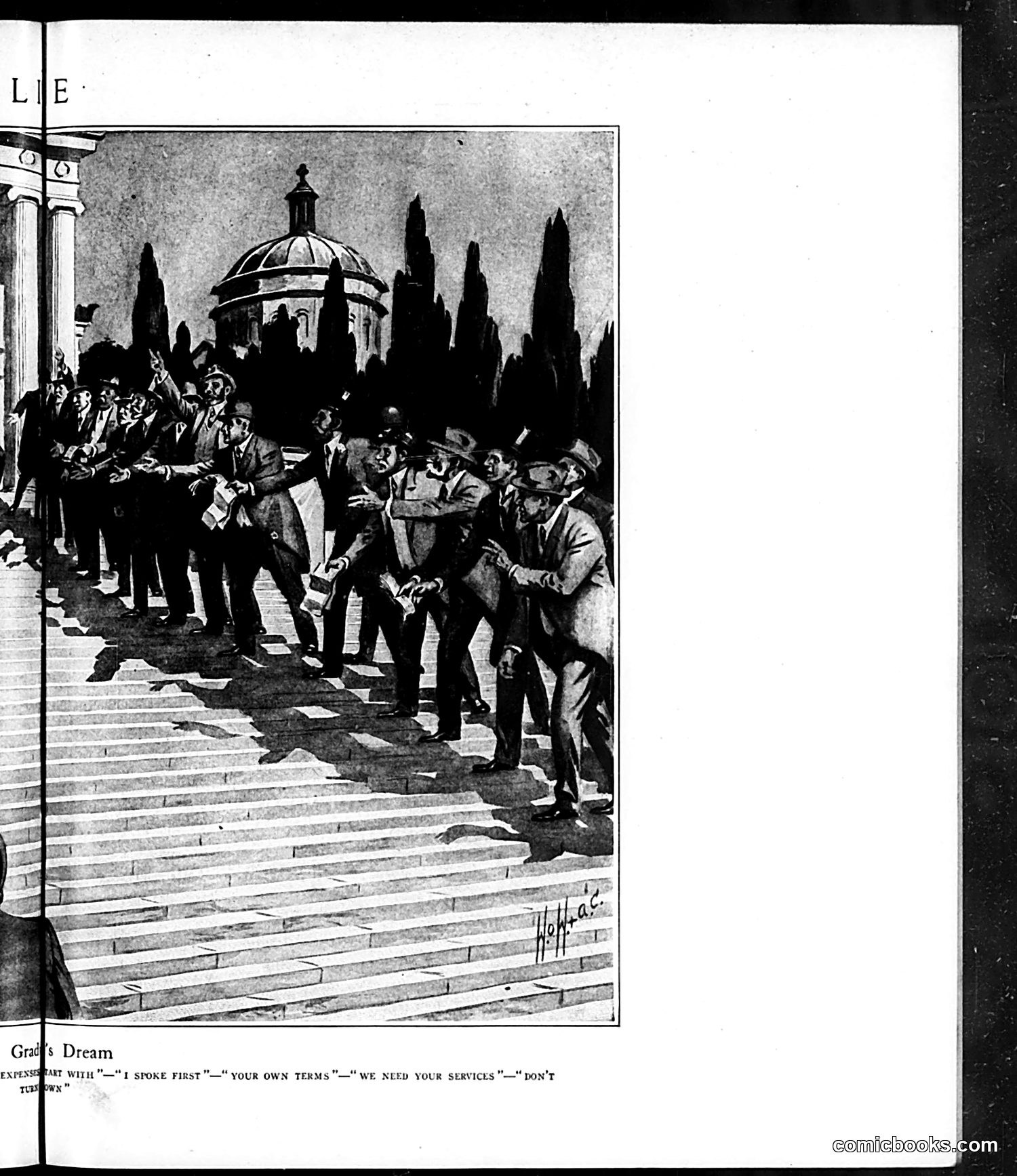
This political cartoon depicts a figure labeled "Graf" imagining a hierarchical scene on Capitol Hill steps. The dream shows subordinates approaching Graf with increasingly deferential language ("I spoke first," "your own terms," "we need your services"), suggesting Graf fantasizes about political power and influence. The cartoon satirizes political ambition and the desire for deference from government officials. Without additional context, the specific identity of "Graf" remains unclear—the name suggests possible German heritage, which may indicate this references a particular political figure or immigrant involved in American politics. The Capitol building's prominence emphasizes this concerns national political power. The satirical point targets the ego and unrealistic expectations of someone seeking political influence or office.
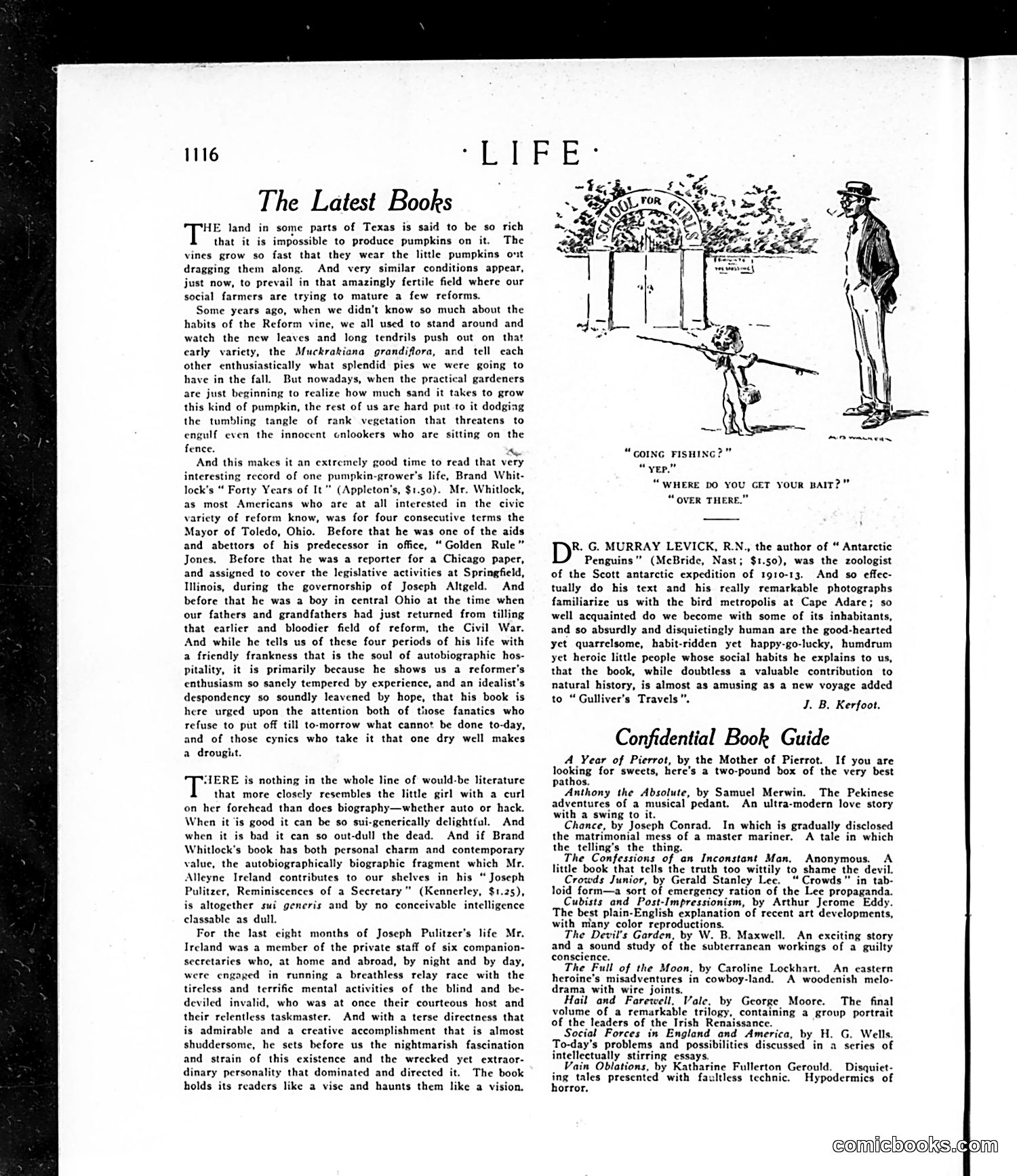
This page satirizes the Progressive Era's reform movement through agricultural metaphor. The opening essay compares social reform to growing pumpkins in Texas—where vines grow so wildly they destroy their own fruit. The author argues that early reformers (the "Muckrakiana grandifiora" variety) promised grand results, but practical experience shows reform efforts have become chaotic and counterproductive, threatening even innocent bystanders. The cartoon depicts a simple fishing scene with dialogue ("Going fishing?" / "Yep" / "Where do you get your bait?" / "Over there"), which appears unrelated to the text—a common Life magazine technique where cartoons stood independently. The book reviews discuss Brand Whitlock's reform autobiography and Joseph Pulitzer's life, treating these as exemplars of idealism tempered by harsh reality. The satire's point: reformers' good intentions produce tangled, wild results that don't match their promises.
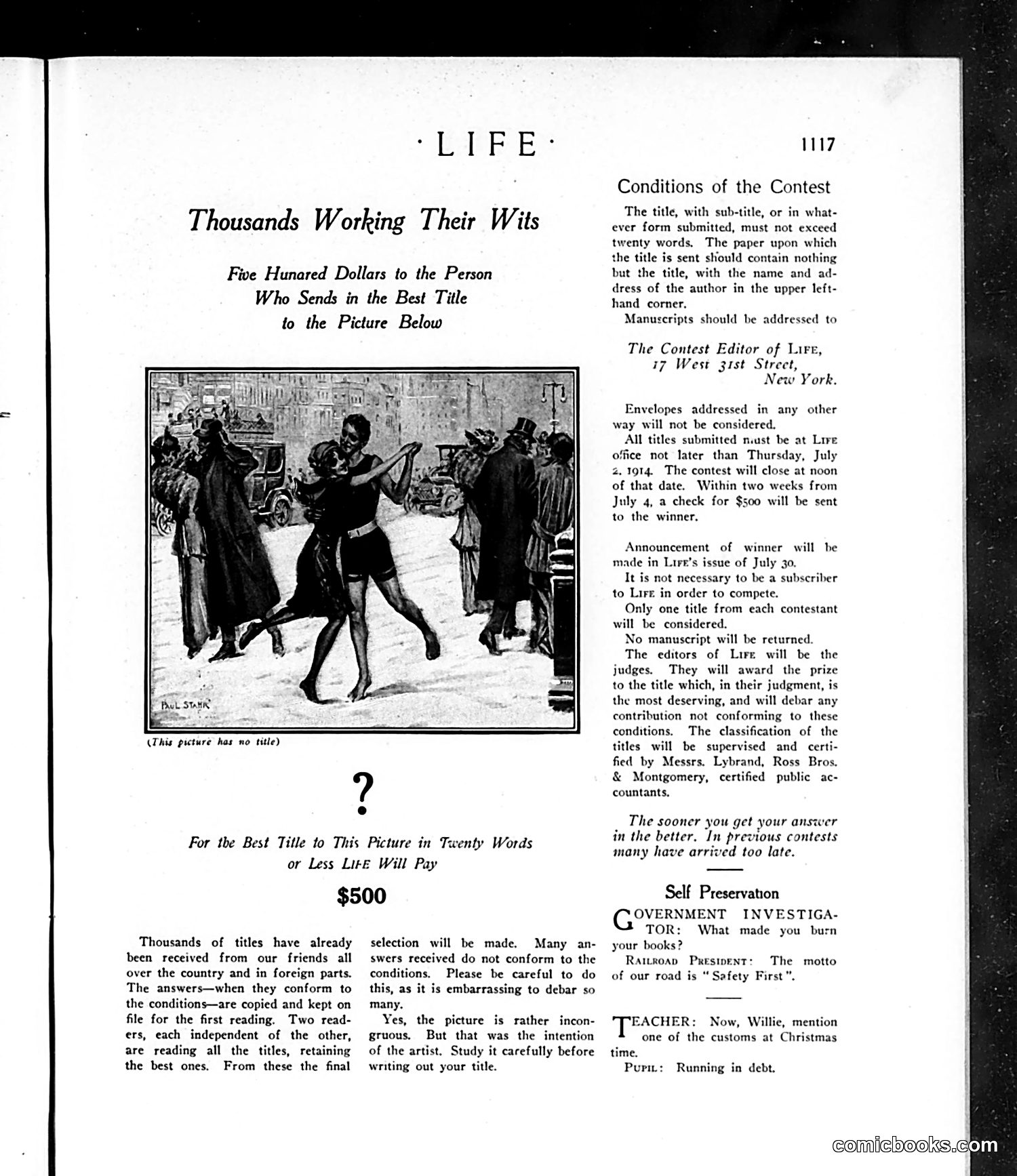
This page announces a $500 contest for the best caption to an untitled cartoon. The cartoon depicts a chaotic street scene with figures in formal dress appearing startled or engaged in some kind of altercation or unusual activity—the image is intentionally "incongruous," as the text notes, to challenge contestants' wit. The page is primarily a **contest announcement** rather than editorial content. It details submission rules (twenty words maximum, deadline July 2, 1914) and emphasizes proper formatting to avoid disqualification. Below are three brief joke items: "Self Preservation" satirizes a railroad president burning books as "safety"; another mocks a teacher asking about Christmas customs, with a student answering "running in debt"—contemporary satire about holiday overspending. The contest format itself reflects *Life*'s role as a humor magazine inviting reader participation and crowdsourced comedy.
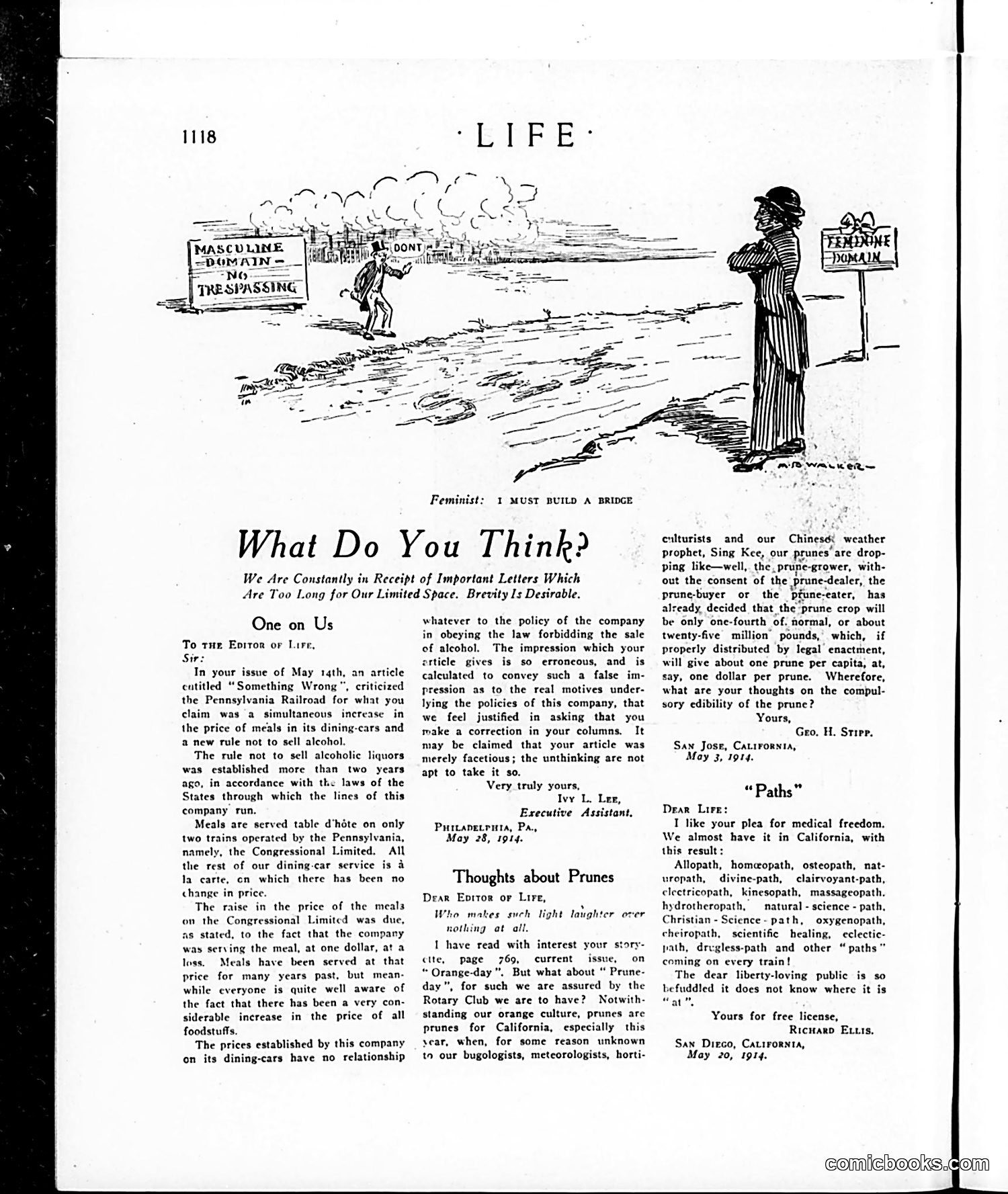
The cartoon "Feminist: I Must Build a Bridge" satirizes early feminism through a visual pun. It shows a woman in a long dress standing at the boundary between two domains—one labeled "Masculine Domain—No Trespassing" (left, showing an industrial city) and one labeled "Feminine Domain" (right). The joke conflates feminist demands for access to male-dominated spaces with literal bridge-building, mocking the suffrage and women's rights movement as absurdly transgressive. The page consists primarily of a "Letters to the Editor" section addressing recent Life articles. Topics include a railroad's simultaneous alcohol ban and meal-price increase (the railroad responds claiming these are unrelated), California's problematic prune crop, and critiques of unregulated medical practitioners. These letters suggest Life published satirical pieces that drew serious reader responses demanding corrections or further discussion of social/economic issues.
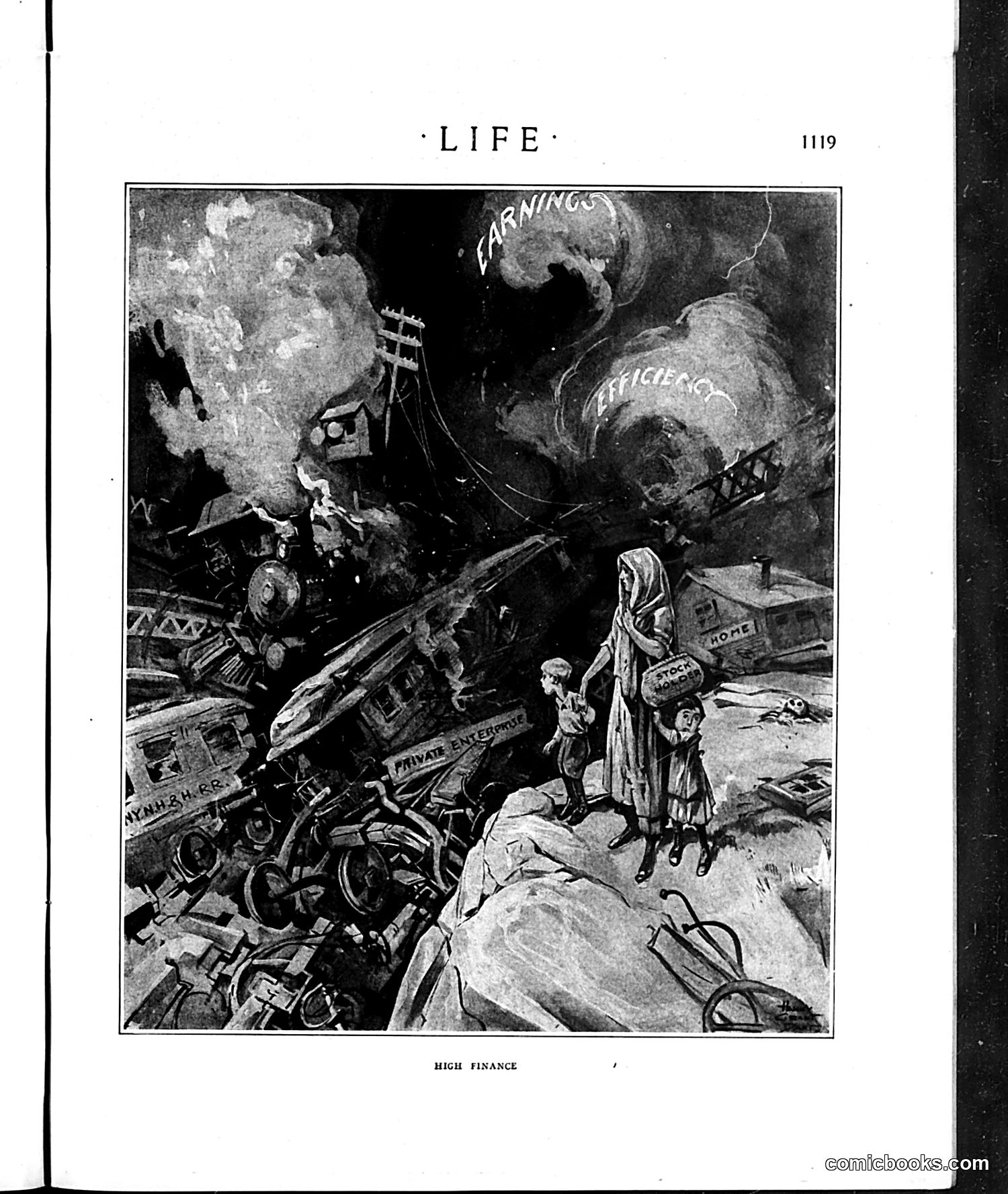
This cartoon satirizes excessive corporate and financial excess, likely from the early 20th century. The image depicts giant, grotesque figures labeled "WARNING" and "EFFICIENCY" looming over a chaotic landscape of industrial machinery, factories, and small human figures. The juxtaposition suggests that corporate efficiency drives and capitalist ambitions ("high finance") have become monstrous, dominating and threatening ordinary people below. The detailed mechanical equipment and factory imagery, combined with the ominous warning balloons, critique how industrial capitalism and financial speculation were perceived as destructive forces. The tiny human figures appear vulnerable amid the enormous machinery, emphasizing the power imbalance between financial institutions and common workers. This reflects Progressive Era anxieties about corporate monopolies and unchecked capitalism.
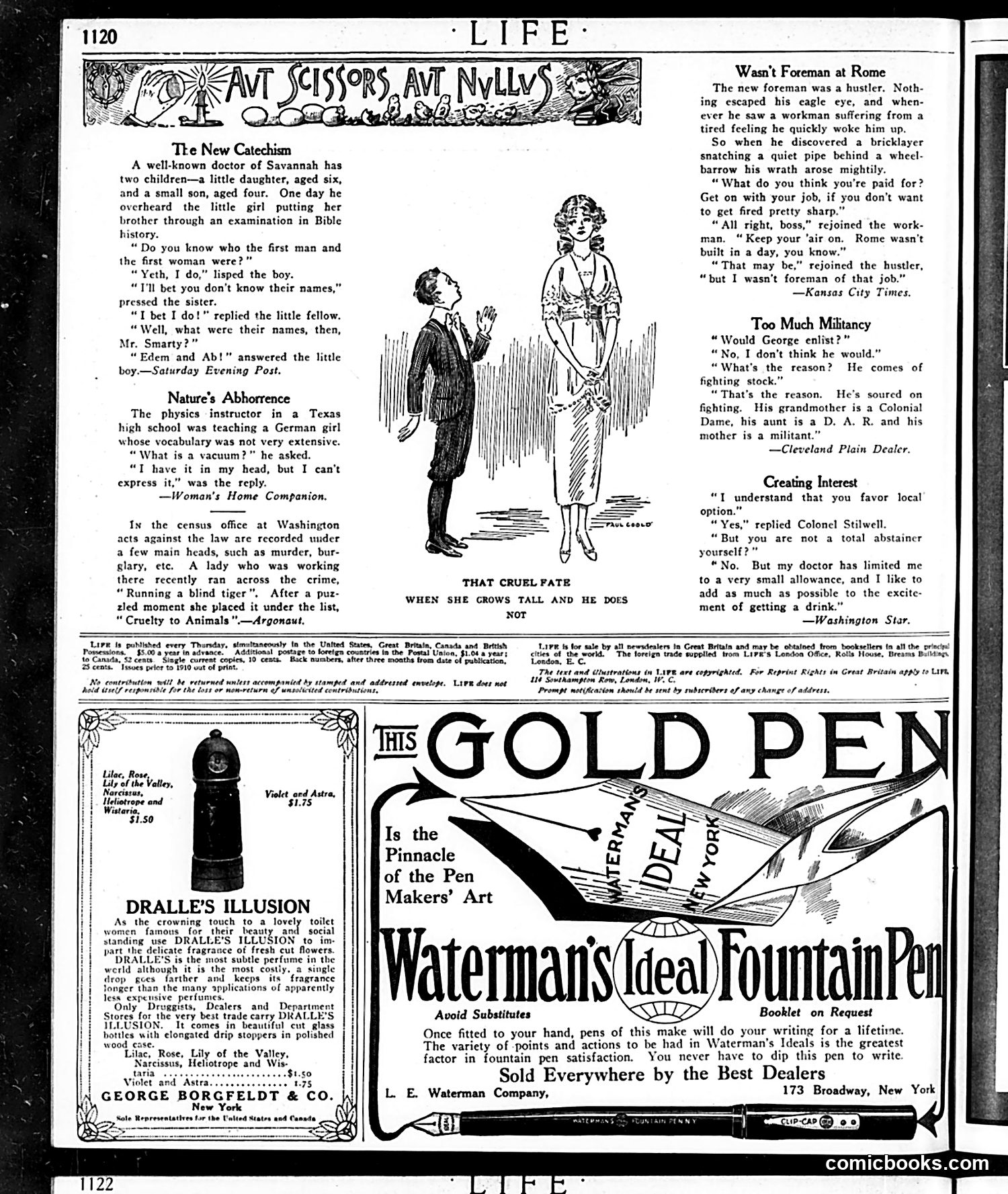
This page contains six brief humorous anecdotes typical of early 20th-century Life magazine, plus advertisements. **The humor pieces** are gentle, family-friendly jokes about: - A child's Bible misunderstanding ("Edem and Ab" for Adam and Eve) - A German girl's vocabulary limitation with "vacuum" - A census worker misclassifying "running a blind tiger" (illegal alcohol sales) as animal cruelty - Height differences in romantic relationships - A stern new foreman unaware Rome wasn't built in a day - A man whose relatives' militant patriotism discourages his military service - A politician's doctor-sanctioned drinking to create "excitement" **The illustration** shows a height-mismatched couple—a tall woman towering over a short man—captioned to suggest romantic incompatibility when physical disparities grow too extreme. The jokes rely on wordplay, mild social observation, and situational irony rather than sharp satire. They represent Life's role as a middlebrow humor publication for general audiences, alongside advertisements for Dralle's perfume and Waterman fountain pens.
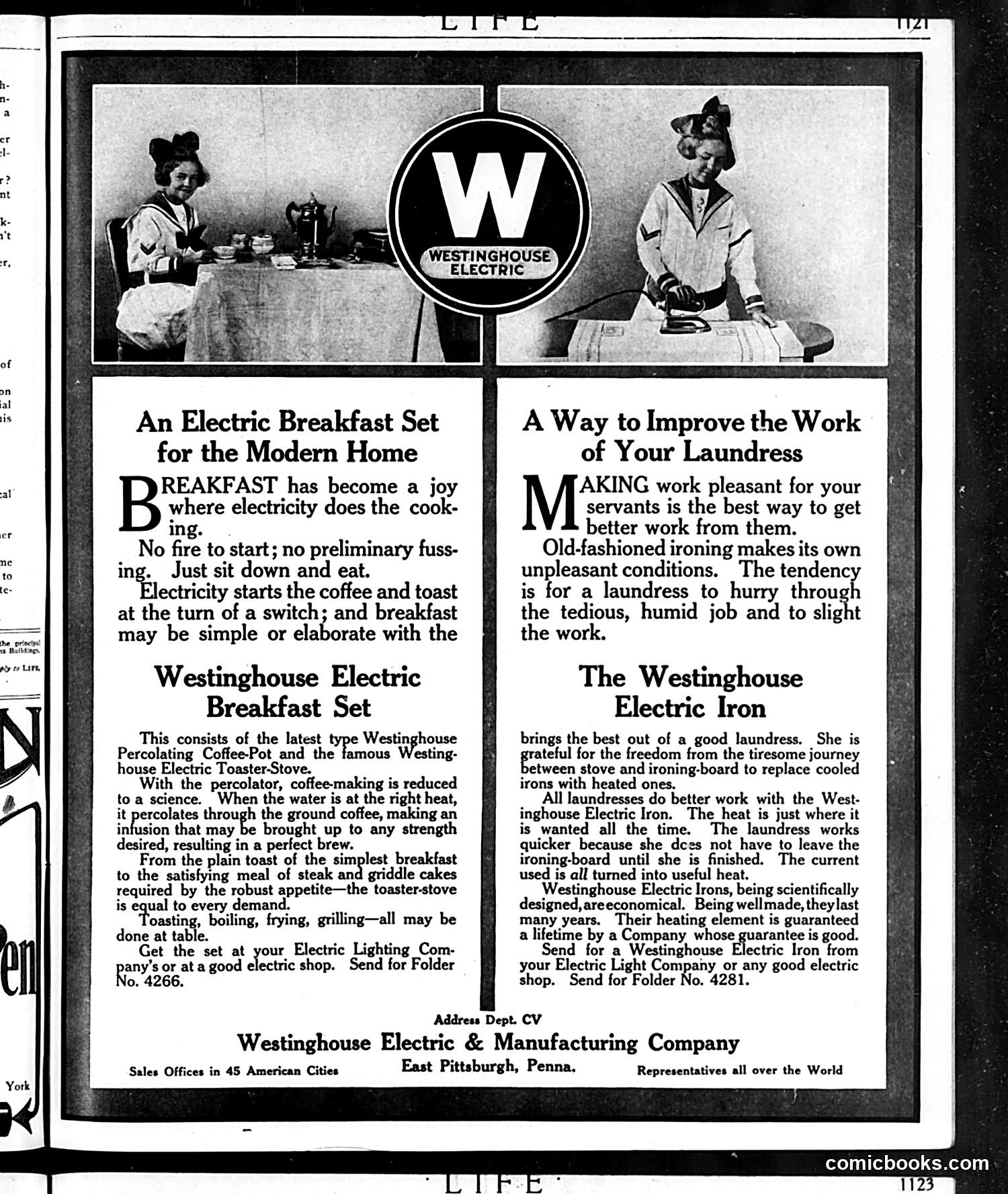
This is a **Westinghouse Electric advertisement**, not satire—it's a straightforward 1920s promotional campaign for electrical household appliances. The page shows two products aimed at different household tasks: an electric breakfast set (percolator and toaster) and an electric iron. Each includes a photograph of a woman using the appliance. The implicit social message, unremarkable for the era, reveals class assumptions typical of the period. The breakfast ad targets the housewife directly ("just sit down and eat"), while the iron ad explicitly addresses *employers* of servants ("making work pleasant for your servants is the best way to get better work from them"). This reflects early-20th-century domesticity where electricity promised to modernize household labor—either eliminating drudgery for middle-class women or making servants more efficient and content in their work. The assumption that servants exist and require management is presented matter-of-factly, illustrating period attitudes toward class and domestic work.
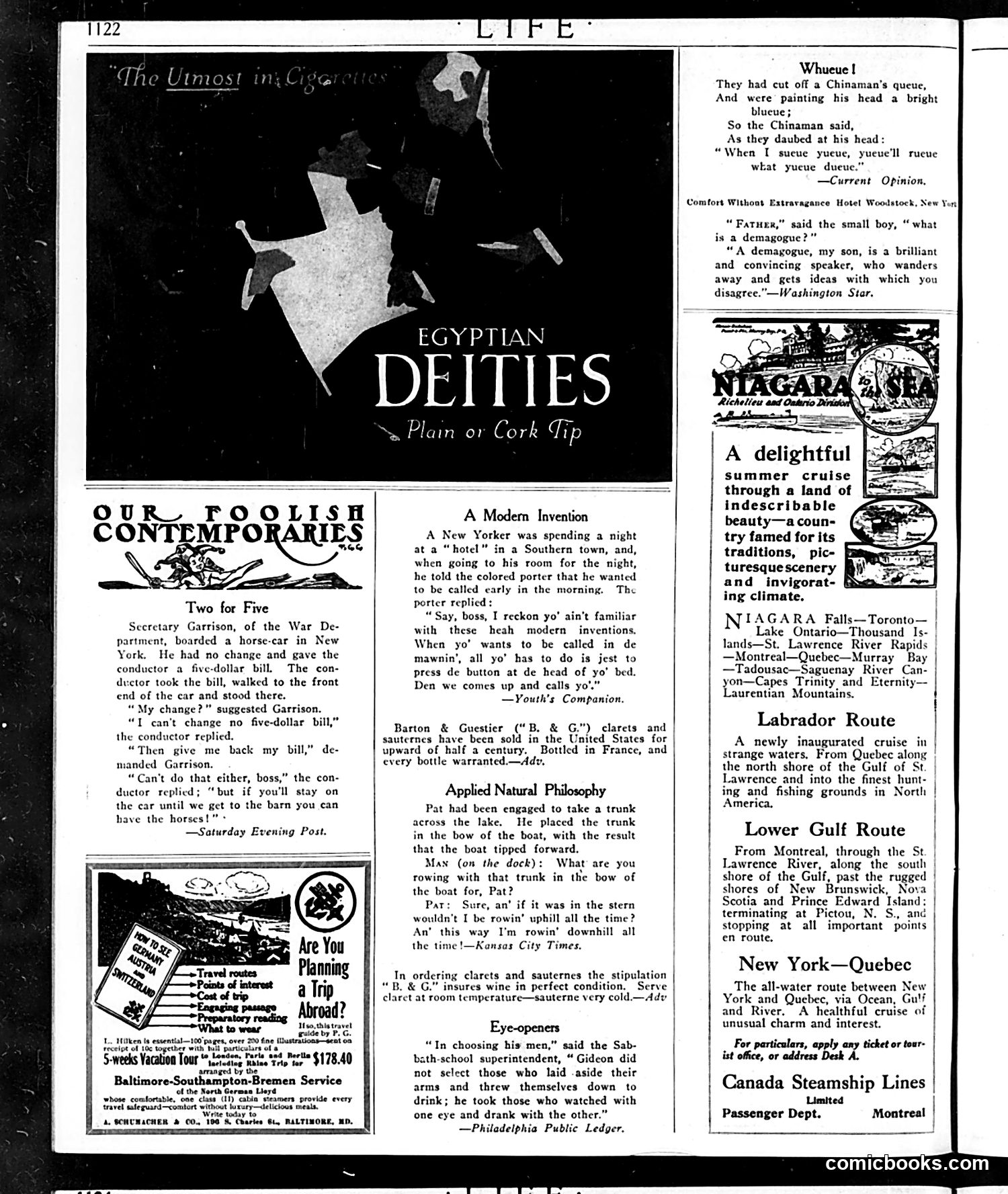
This page from *Life* magazine contains several brief humorous anecdotes satirizing American social types and situations circa early 1900s. **"Two for Five"** mocks bureaucratic incompetence: Secretary of War Garrison boards a streetcar, gives a five-dollar bill for a fare, and the conductor—unable or unwilling to make change—offers him the horses instead. The joke targets inflexible bureaucrats who create absurd situations rather than solve problems. **"A Modern Invention"** satirizes racial stereotypes through a porter's explanation of electric call buttons, framed in exaggerated dialect to suggest Black Southern workers' supposed unfamiliarity with modern technology—a common prejudicial trope of the era. **"Applied Natural Philosophy"** ridicules Irish immigrant logic, with "Pat" reasoning that placing a trunk in the boat's bow makes rowing "downhill," displaying comical ignorance of physics. **"Eye-openers"** uses Biblical reference (Gideon selecting vigilant soldiers) to joke about selective morality—choosing people who drink while maintaining awareness rather than those who abstain entirely. The advertisements and other content are straightforward period promotions for travel, wine, and hotels.
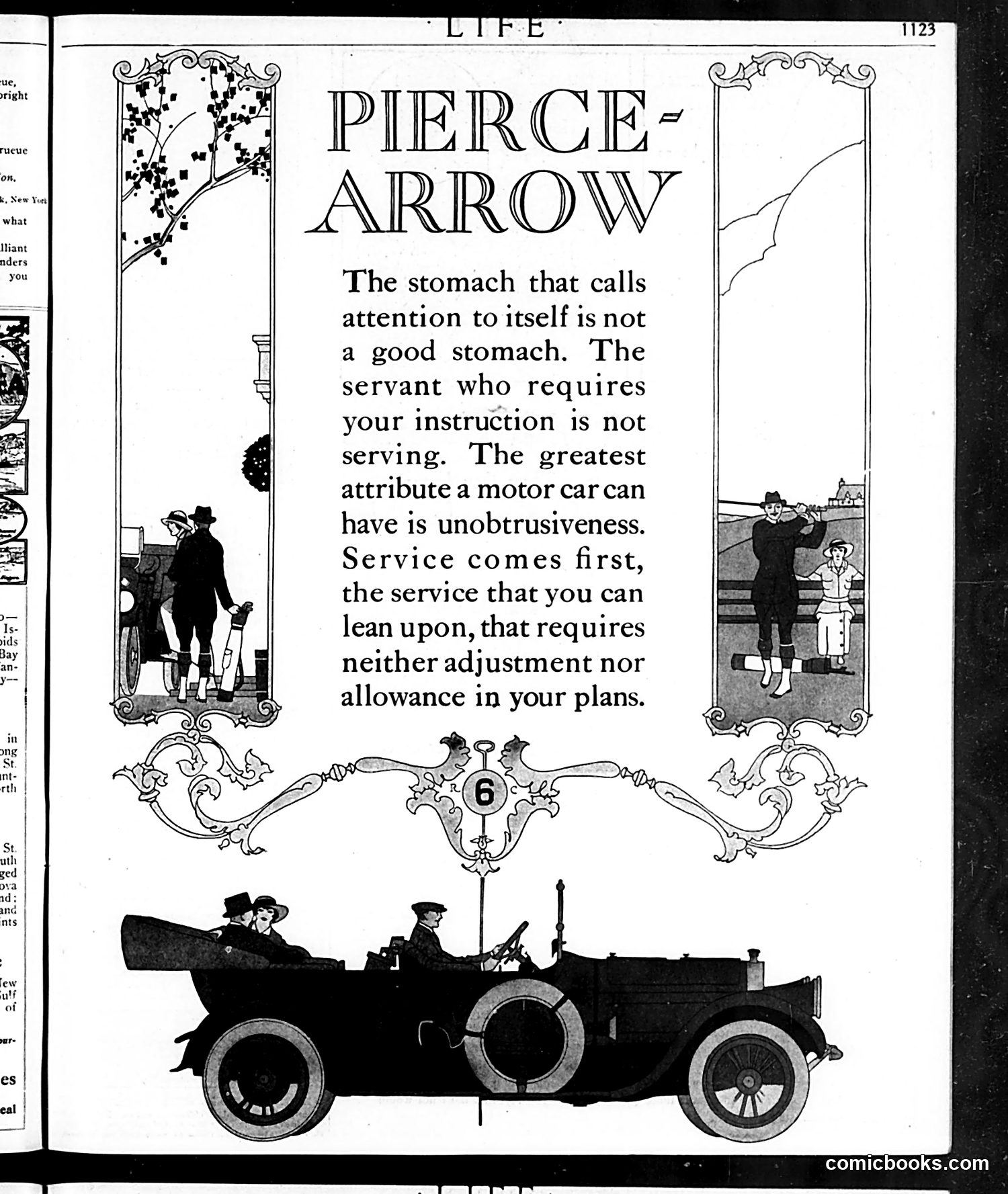
This is a Pierce-Arrow automobile advertisement from Life magazine. The ad uses metaphorical language comparing a good car to a good stomach or servant—things that work invisibly without requiring attention or adjustment. The accompanying illustrations show the car in various scenarios with well-dressed passengers, emphasizing reliability and seamless operation. The central image depicts an elegant open-air motorcar with formally dressed occupants. Pierce-Arrow was a luxury American automobile manufacturer, and this ad targets wealthy readers by suggesting their vehicle provides dependable, unobtrusive service—you can trust it to work without demanding constant maintenance or ruining your plans. The messaging reflects early 20th-century advertising values emphasizing mechanical reliability as a mark of quality and prestige.
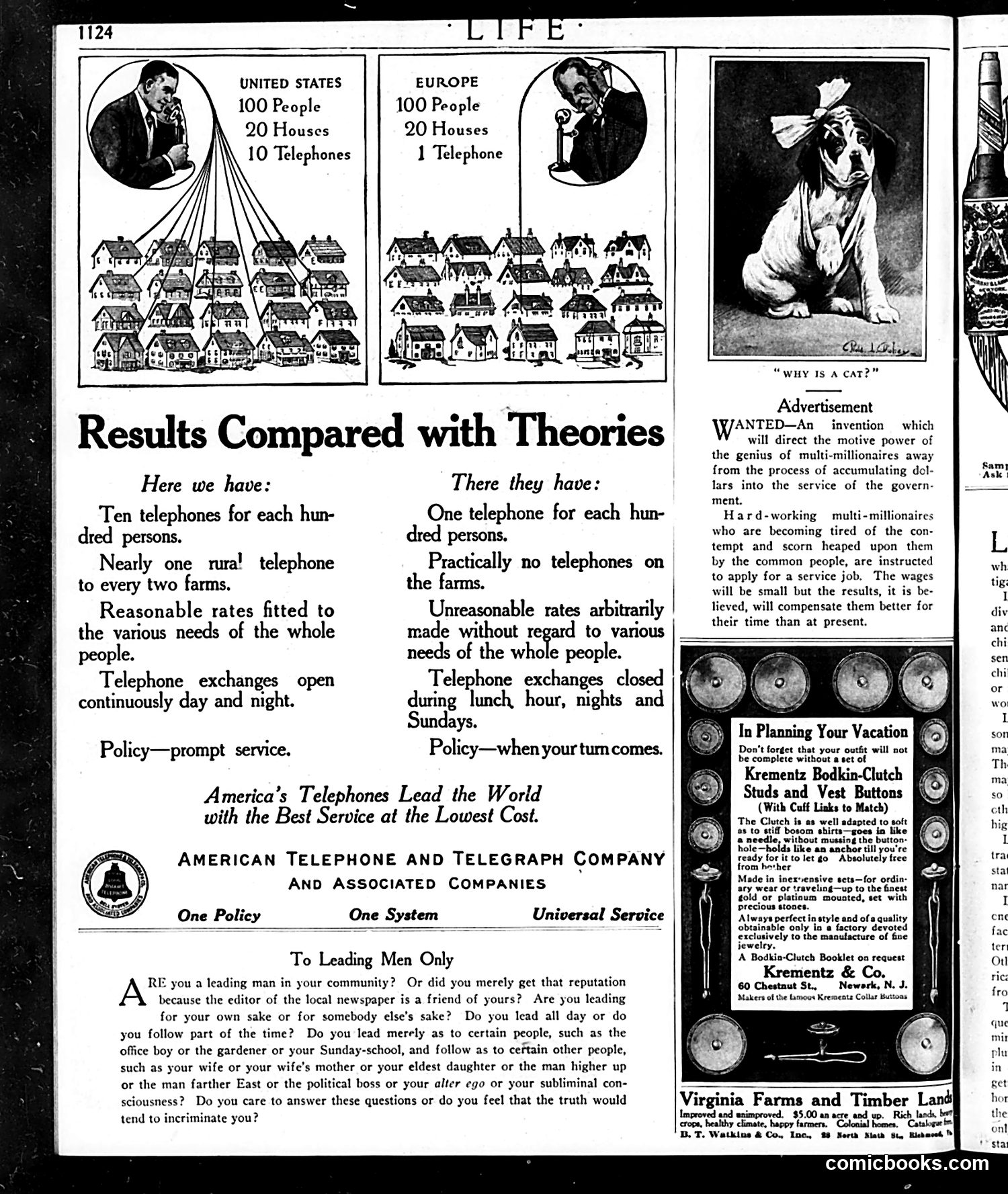
This page is primarily **AT&T corporate advertising** disguised as social commentary, dated to the early 20th century (likely 1910s-1920s based on style). ## The Main Cartoon/Comparison The top illustration compares American versus European telephone infrastructure using symbolic house diagrams. It claims America has 10 telephones per 100 people with rural access and 24/7 service, while Europe has only 1 telephone per 100 people with limited hours. The message: American capitalism delivers superior service at lower cost. ## The Satire Ironically, the page itself contains **internal satire** attacking wealthy industrialists. The lower advertisement mockingly "wants" inventors to redirect millionaires' profit-seeking energy toward government service instead—clearly sarcastic commentary on the robber baron era. The closing section's rhetorical questions challenge readers about whether they're genuine community leaders or merely self-serving. ## Modern Context This represents aggressive corporate propaganda promoting American telephone monopoly dominance while the page's smaller satirical sections critique the very wealthy interests that AT&T represented—a contradictory message reflecting Progressive Era tensions between celebrating industrial achievement and condemning capitalist excess.
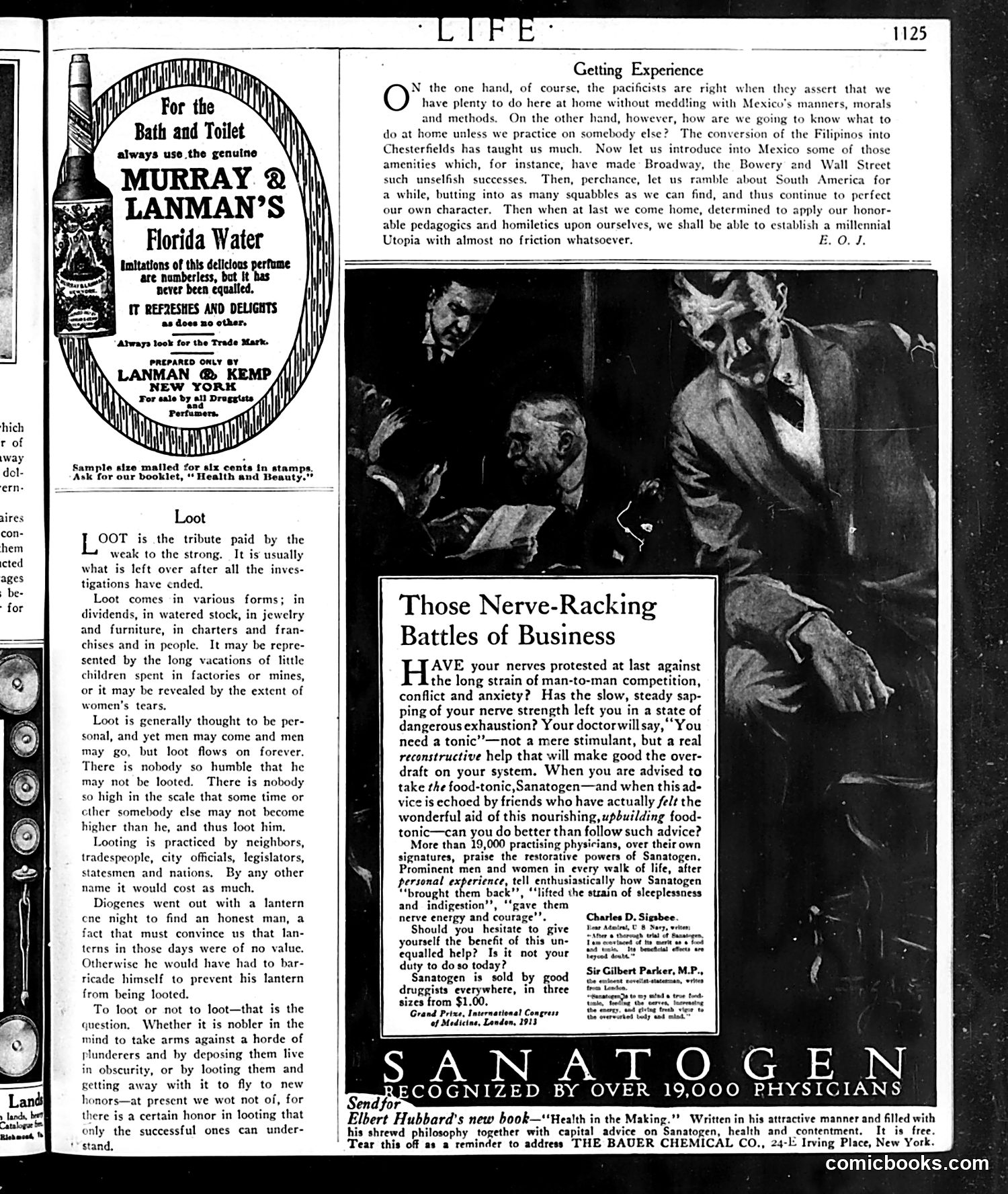
This page contains three distinct elements: **Advertisement (left):** Murray & Lanman's Florida Water perfume—a period beauty product claiming superiority over imitations. **Essay: "Loot" (center-left):** A satirical piece defining "loot" as the tribute the weak pay the strong through various means (watered stock, corporate dividends, child factory labor, women's exploitation). It's a critique of systemic exploitation across business and government, suggesting that plundering is universal and inescapable—even Diogenes's honesty-seeking lantern would be stolen. **Essay & Advertisement: "Getting Experience" and "Sanatogen" (right):** The essay sarcastically defends American military intervention in Mexico and South America as "practice" for perfecting American character—mocking the paternalistic, interventionist foreign policy of the era. Below it, a Sanatogen tonic advertisement exploits anxiety about modern business competition, claiming 19,000 physicians endorse this "food-tonic" for nerve exhaustion caused by capitalism's strains. Together, the page ironically juxtaposes capitalist exploitation (loot), imperial meddling, and commercial solutions marketed to anxious workers—all presented as normal features of American life.
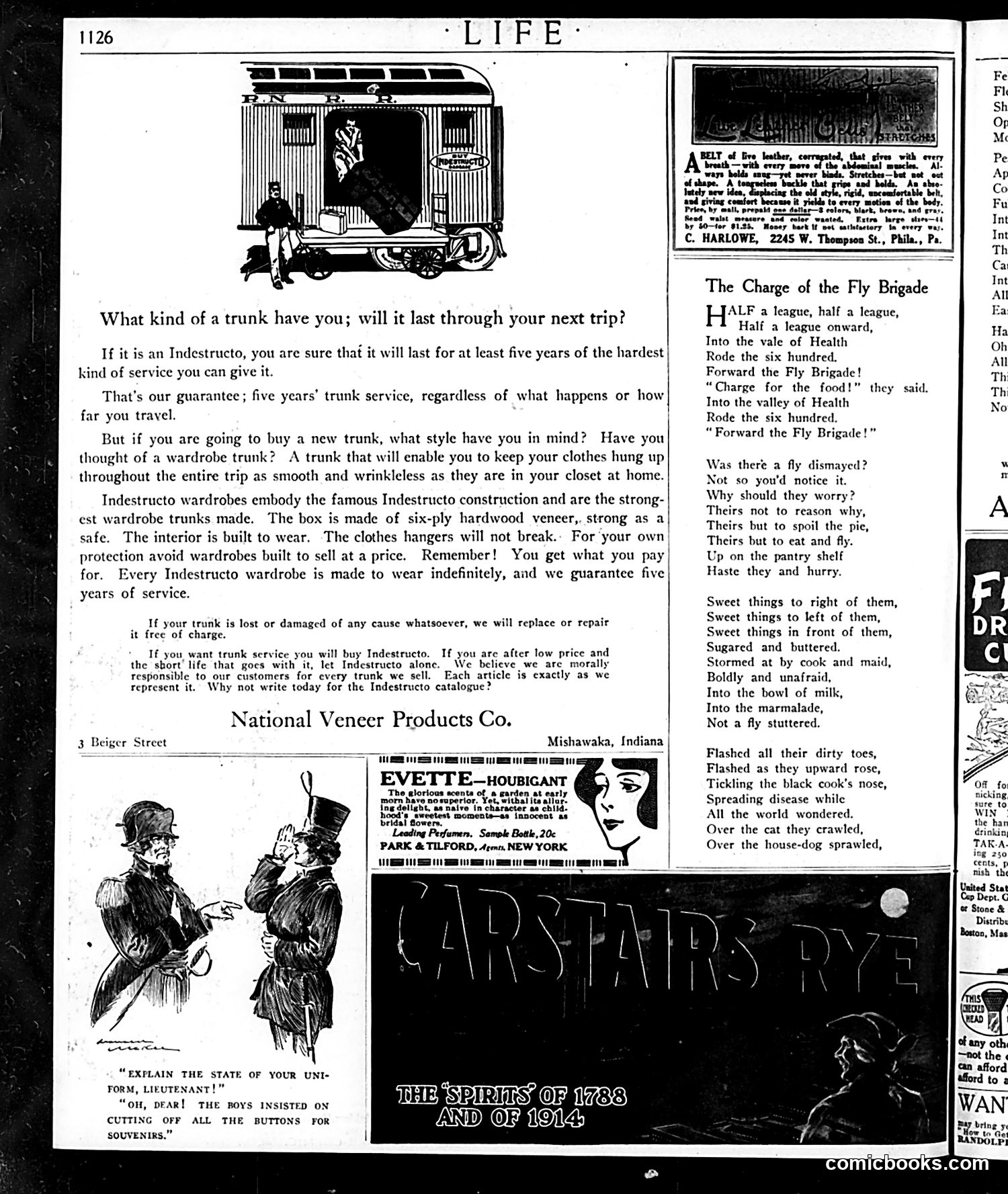
This page contains three distinct elements: **Left side:** An advertisement for Indestructo brand trunks/suitcases, emphasizing durability and a five-year guarantee—standard product marketing of the era. **Bottom left:** A satirical cartoon showing a disheveled military officer explaining to a superior that soldiers removed all his uniform buttons as souvenirs. This mocks both undisciplined troops and the casual destruction of military property. **Right side:** "The Charge of the Fly Brigade" is a humorous parody of Tennyson's famous 1854 poem "The Charge of the Light Brigade" (about a disastrous cavalry charge). Here, instead of soldiers charging in battle, flies invade a kitchen, raiding food and spreading disease. The joke lies in applying epic, heroic language to trivial domestic pests—deflating grandiose military poetry through absurdist humor about household nuisances.
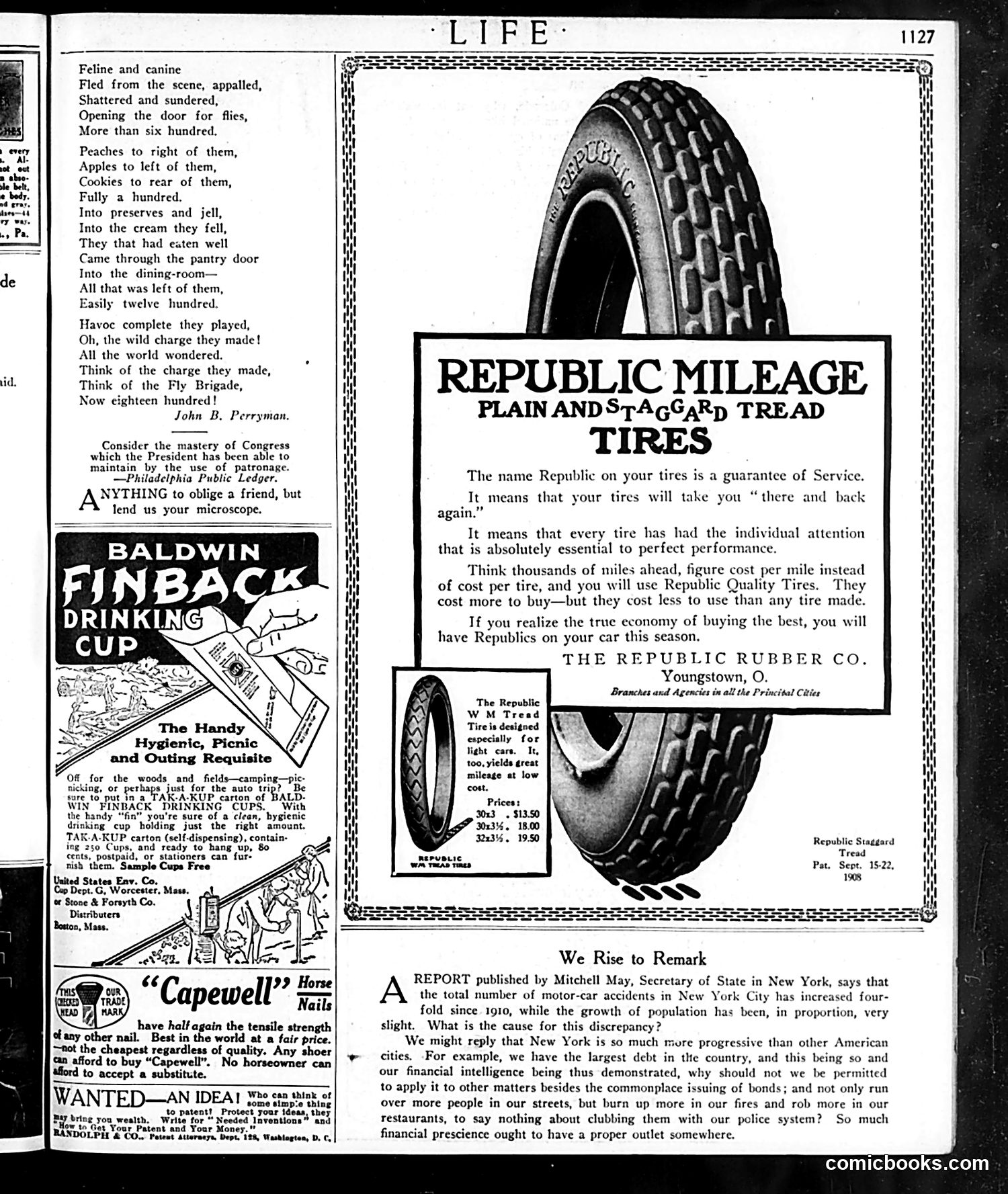
This page mixes advertisements with editorial satire. The main poem "Feline and Canine" parodies Tennyson's "Charge of the Light Brigade," describing household pests (flies, presumably) invading a pantry in mock-heroic language. The humor lies in treating a mundane domestic disaster with the grandiose language of military epic. The editorial section "We Rise to Remark" criticizes New York City's progressivism as hollow. It notes motor-car accident deaths quadrupled since 1910 despite proportionally smaller population growth. The satirist sarcastically argues that if New York can mismanage finances, debt, and police brutality, why should anyone expect better traffic safety? The point: progressive cities' failures undermine claims of progress itself. The advertisements (Republic Tires, Baldwin cups, Capewell nails) are period products unrelated to the satire.
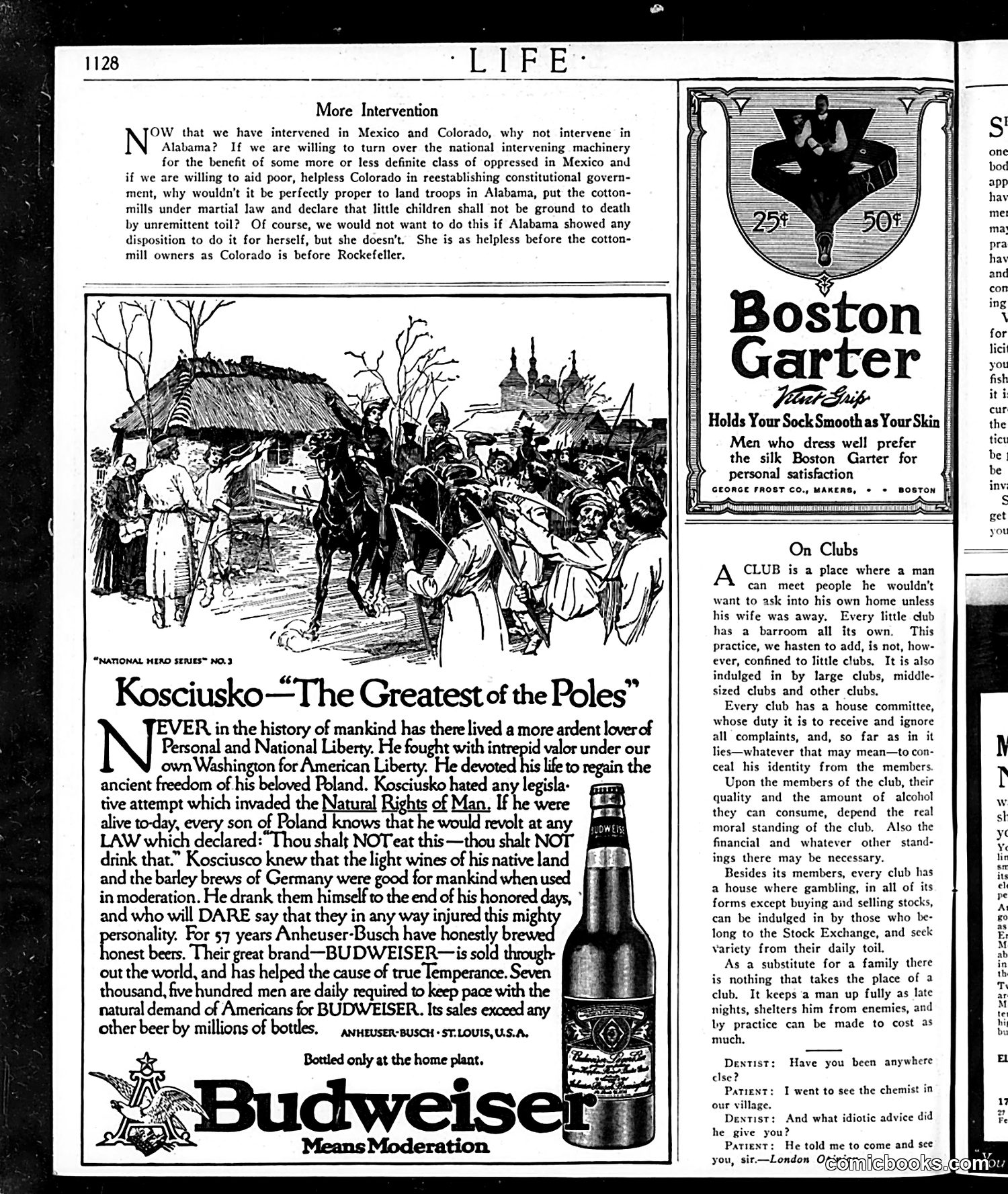
**"More Intervention" Editorial:** This piece satirizes U.S. military intervention policy. Life argues that if the government intervenes in Mexico and Colorado (referencing actual 1914 interventions and labor disputes involving Rockefeller's Colorado mining interests), logical consistency demands intervention in Alabama to protect child laborers in cotton mills. The satire exposes the hypocrisy: the U.S. claims moral authority to intervene abroad while ignoring comparable domestic abuses by powerful industrialists. **Kosciusko Advertisement:** This Budweiser ad exploits Polish nationalist sentiment by invoking Thaddeus Kosciusko, the Revolutionary War hero who fought for liberty. The ad absurdly claims Kosciusko would support moderate beer consumption, using his legacy to market alcohol under the guise of "temperance." It's propaganda disguised as patriotic advertising—appearing during Prohibition-era debates. **Other Content:** The page includes a Boston Garter sock ad and a humor piece on men's clubs (satirizing their gambling and drinking culture as substitutes for family life).
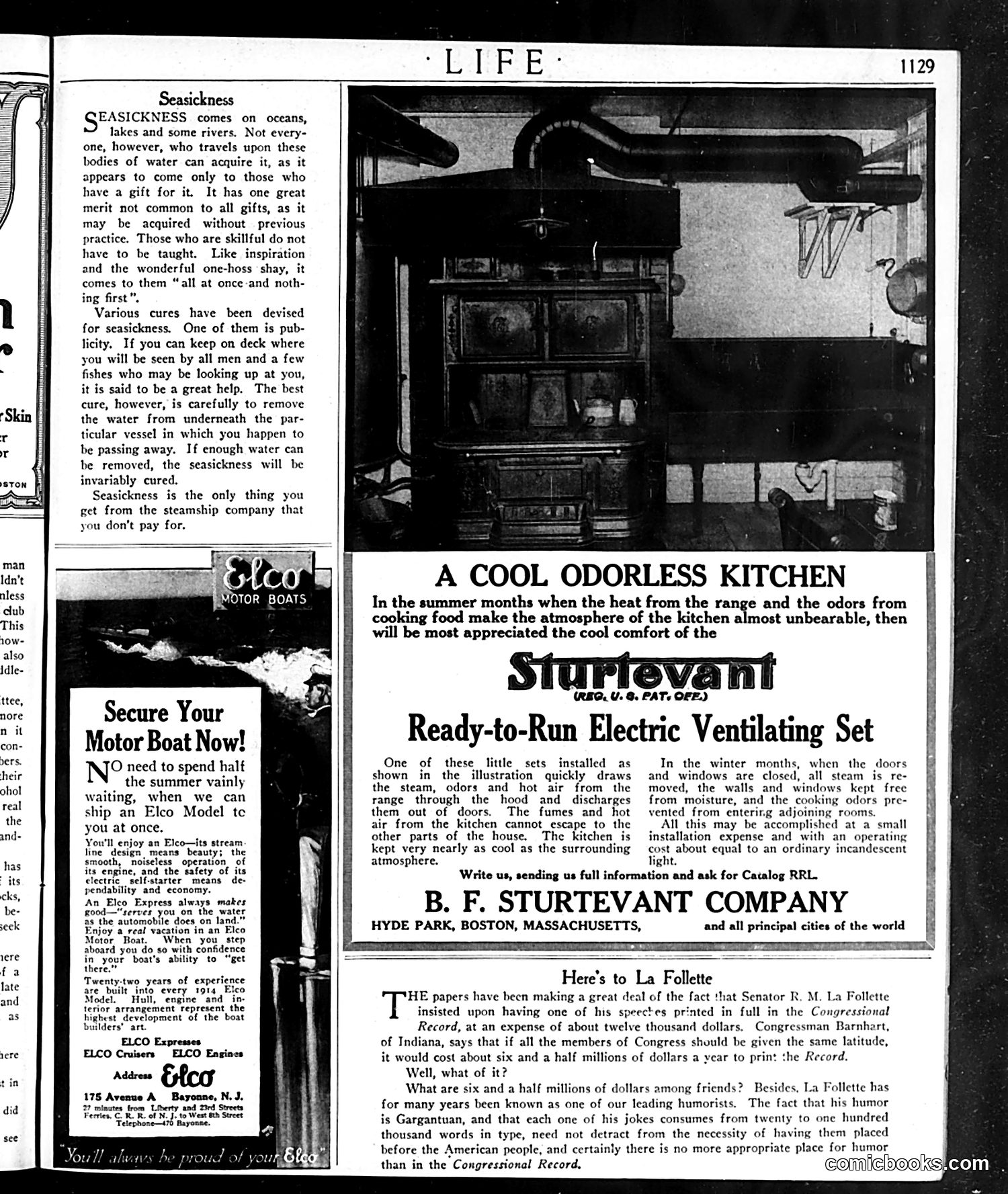
This page contains humor and advertisements from an early 1900s American magazine. **Main Content:** The lead article humorously addresses seasickness, offering mock-serious "cures" including the absurd suggestion to "carefully remove the water from underneath the particular vessel." The joke culminates in the sharp observation that seasickness is "the only thing you get from the steamship company that you don't pay for"—satirizing steamship companies' indifference to passenger suffering. **The La Follette Item:** A brief satirical piece mocks Senator Robert M. La Follette for insisting Congress print his full speech in the *Congressional Record* at $12,000 expense. The author sarcastically defends this by noting La Follette is a known humorist whose jokes are worth printing, and rhetorically asks "what are six and a half millions of dollars among friends?"—lampooning both La Follette's extravagance and Congressional waste. **Advertisements:** The page is dominated by product ads for motor boats and kitchen ventilation systems, typical of the era's commercial content.
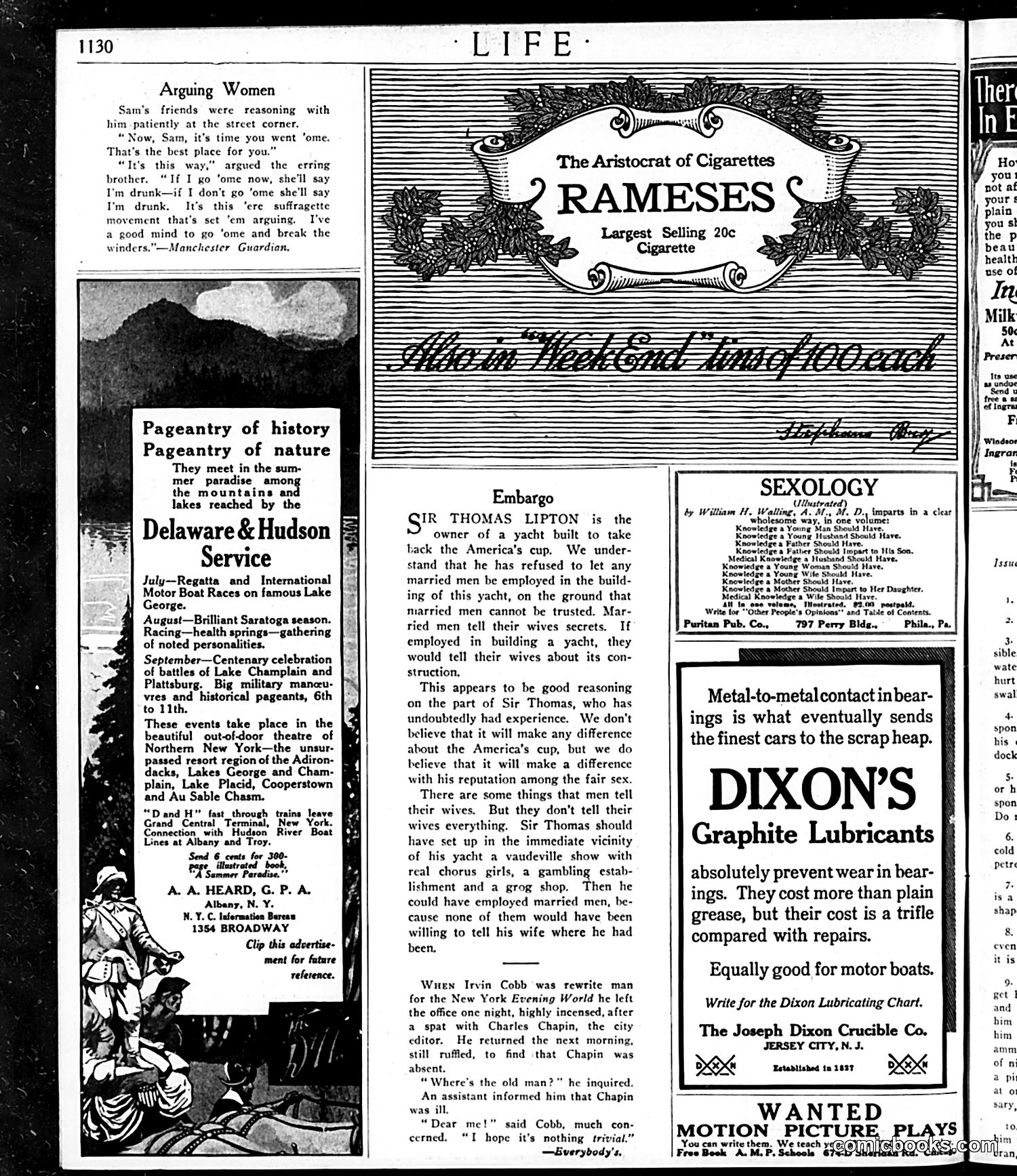
This page is primarily **advertisements and filler content** rather than political satire. However, the opening humor piece "Arguing Women" does contain social commentary: **The joke**: A drunk man argues with friends about going home, reasoning that his wife will call him drunk either way—so he might as well stay out and "break the winders." He blames the "suffragette movement" for setting women to arguing. **The satire**: This reflects early-1900s anti-feminist sentiment. The humor assumes women are inherently argumentative and unreasonable, and conflates the women's suffrage movement with domestic nagging. The joke stereotypes both drunk men and demanding wives while dismissing suffragettes as a frivolous nuisance rather than addressing their actual political claims. **The other content** consists of travel advertisements (Delaware & Hudson railways), cigarette ads (Rameses), and a humorous anecdote about journalist Irvin Cobb, plus product advertisements. Nothing here constitutes political cartooning; the page is mostly commercial.
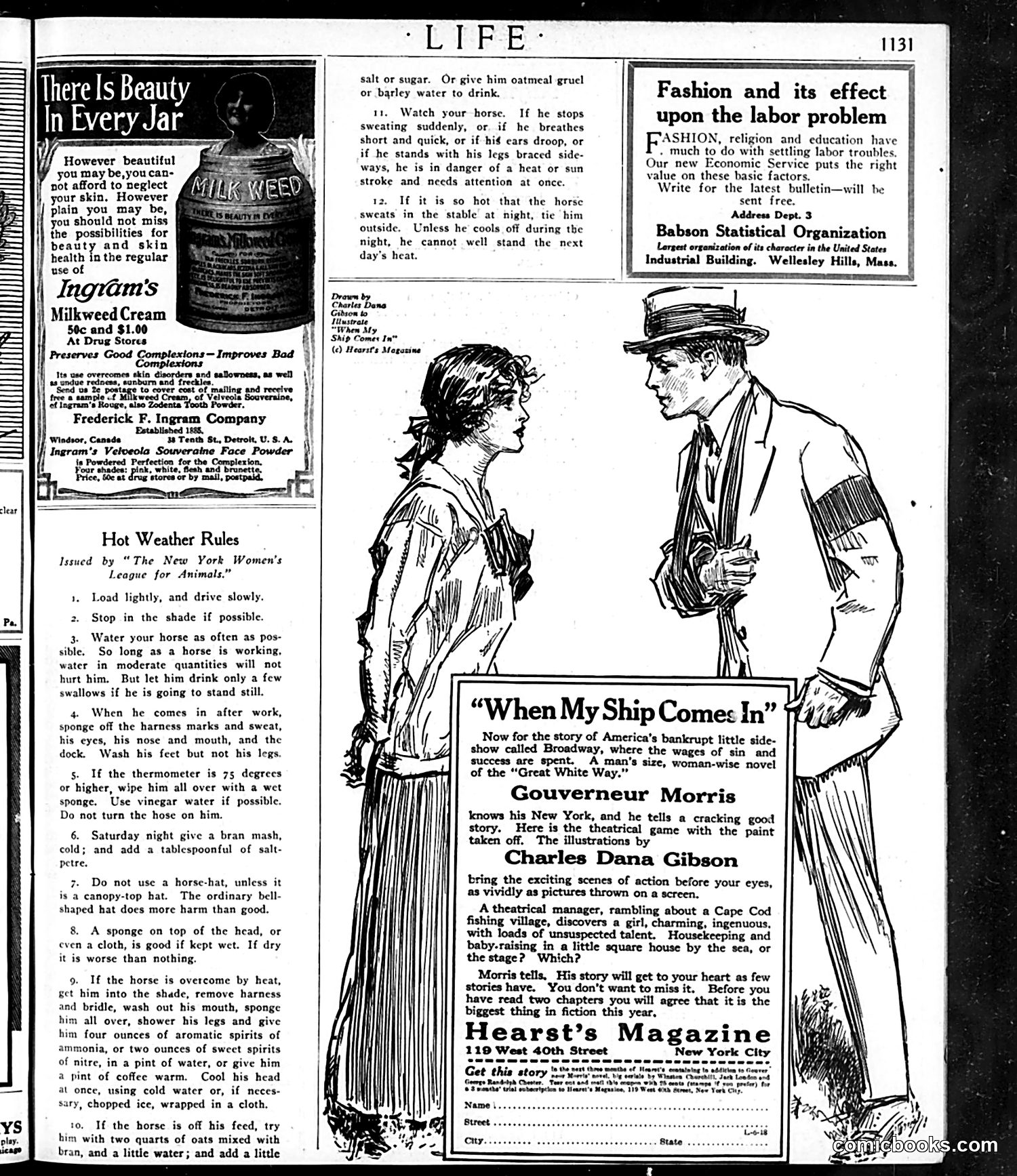
This page contains mostly **advertisements and advice columns**, not political satire. The main content includes: 1. **"Hot Weather Rules"** — practical guidance from the New York Women's League for Animals on caring for horses in summer heat (watering, cooling, monitoring for heat stroke). 2. **Beauty/cosmetic ads** — Ingram's Milkweed Cream promoting skincare products. 3. **A labor/economics advertisement** from Babson Statistical Organization discussing how "fashion, religion and education" affect labor disputes. 4. **A serialized fiction advertisement** for Gouverneur Morris's story "When My Ship Comes In," illustrated by Charles Dana Gibson, about a theatrical manager discovering talent on Cape Cod. The Gibson illustration shows two figures in period dress (likely early 1900s) in conversation—appears to be promotional art for the serialized narrative. **No political satire is present.** The page reflects early 20th-century concerns: animal welfare, beauty standards, labor economics, and popular entertainment serialization in magazines.
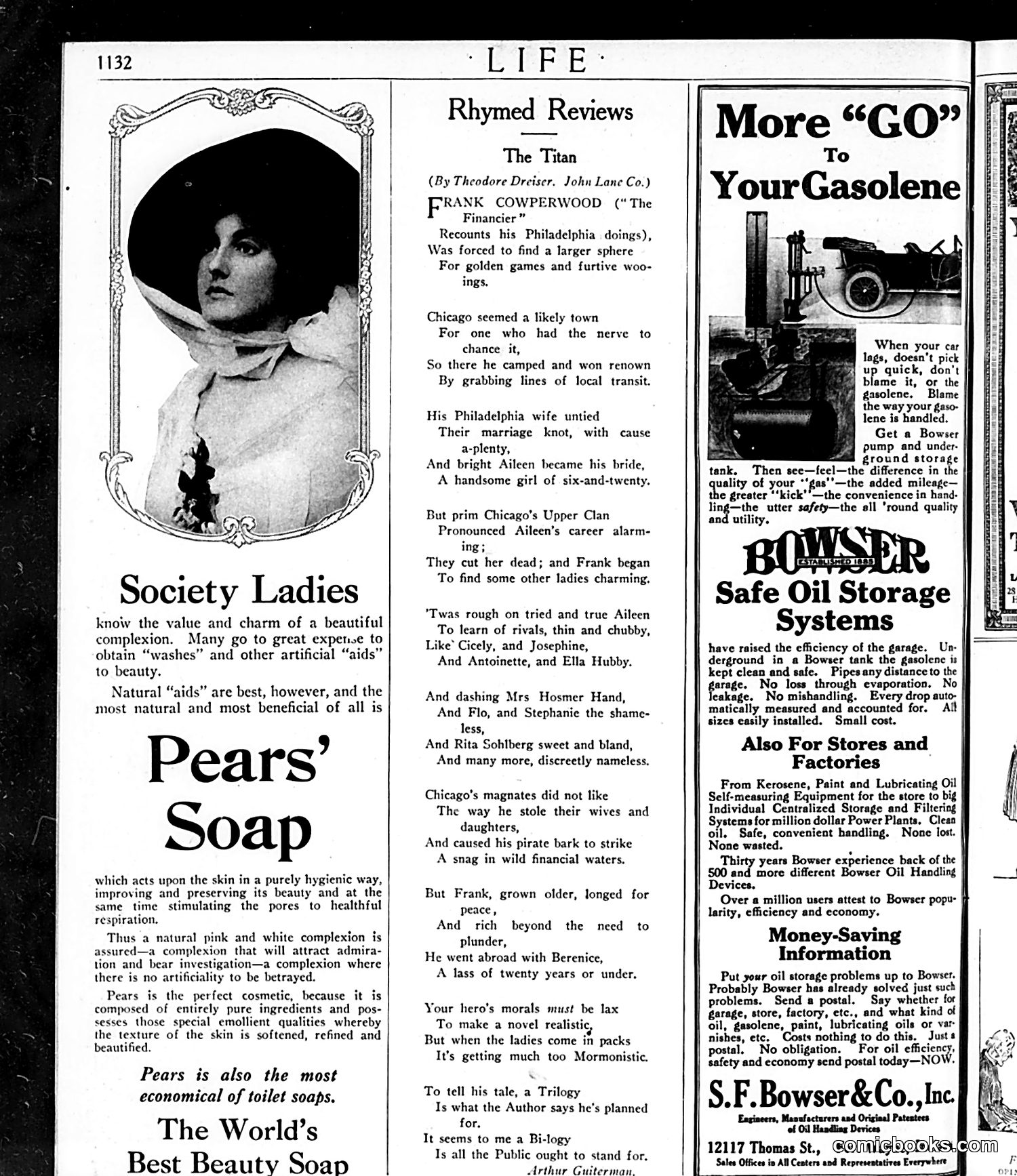
This page from *Life* magazine combines advertisements with a satirical book review. The main content is a rhymed review of Theodore Dreiser's novel *The Titan*, mocking its protagonist Frank Cowperwood—a wealthy financier based on real robber barons of the Gilded Age. The satire targets Cowperwood's serial infidelities and moral corruption. The reviewer, Arthur Guiterman, catalogs his numerous affairs with named and "discreetly nameless" society women, suggesting the behavior is becoming absurdly excessive ("Mormonistic"). The final stanza critiques Dreiser's plan for a trilogy about this character, suggesting one book is already too much for the public to endure. The surrounding advertisements—for Pears' Soap and Bowser oil storage systems—are period typical and unrelated to the satire. The page reflects *Life*'s tradition of mixing commercial content with literary and social commentary.
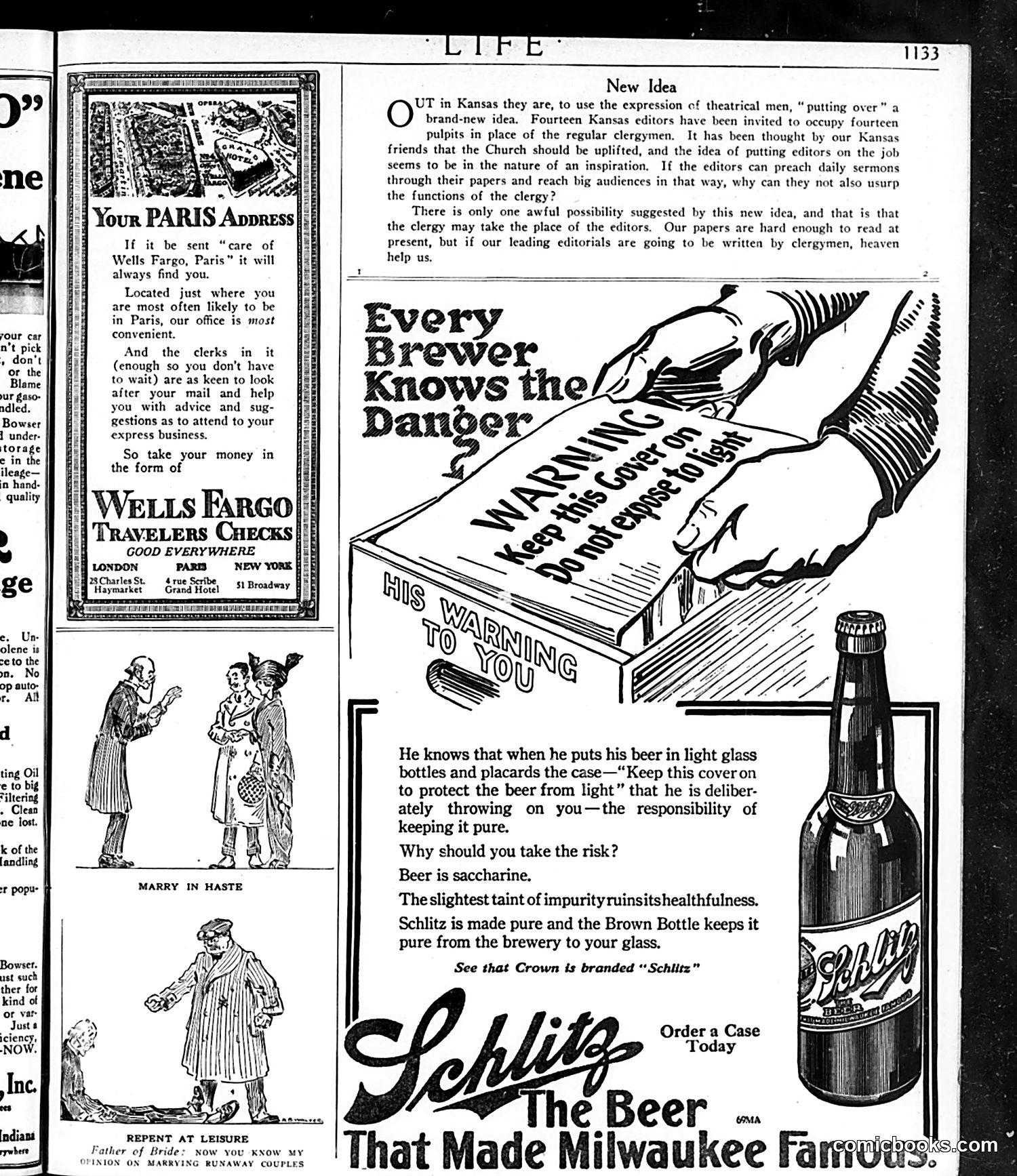
This page contains two distinct sections: **Upper content:** A satirical piece mocking a Kansas proposal to have newspaper editors substitute for clergy in pulpits. The joke suggests this would improve sermons (editors can reach audiences), but warns of an awful possibility: clergy might then become newspaper editors, making papers even harder to read. It's lighthearted satire on both institutional roles. **Lower content:** A Schlitz beer advertisement disguised as public health messaging. The ad warns that brewers deliberately place beer in clear bottles with warnings about light exposure—shifting responsibility to consumers. It then pivots to promote Schlitz's "brown bottle" as superior, claiming purity while subtly mocking competitors' practices. This uses fear-mongering about beverage safety to sell product. **Context:** Both reflect early 20th-century American attitudes toward institutions (church, press) and pre-Prohibition beer marketing tactics.
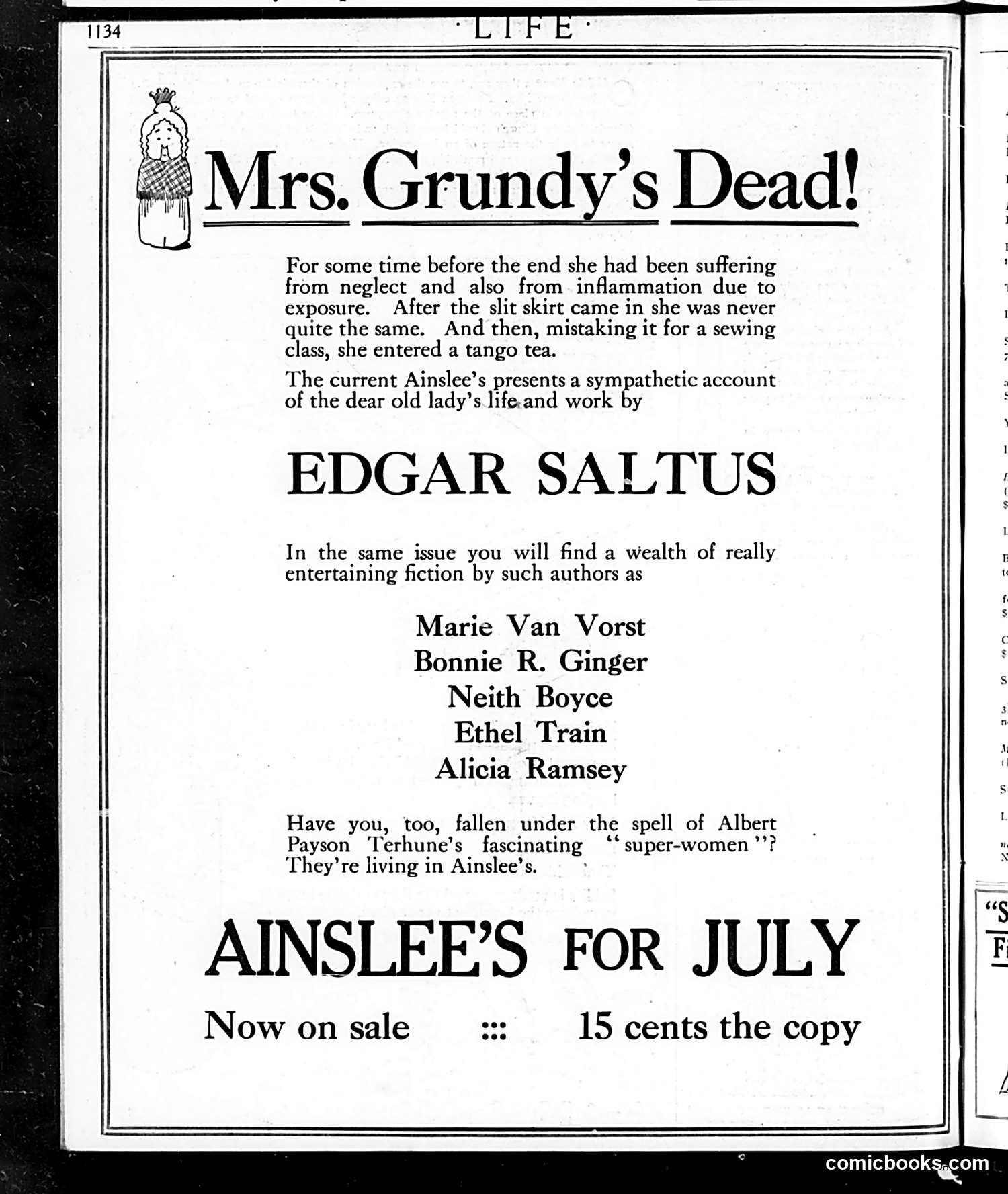
This is a satirical advertisement announcing the death of "Mrs. Grundy," a literary figure representing old-fashioned propriety and moral strictness. The joke mocks conservative social standards that were rapidly disappearing in the early 20th century. Specific references: "slit skirts" were scandalously revealing women's fashions of the era; "tango tea" satirizes morally questionable modern social gatherings. Mrs. Grundy "died" from exposure to these new, liberated behaviors—a commentary on changing social mores. The ad promises readers Edgar Saltus's sympathetic account of this outdated morality figure, alongside fiction by several female authors (likely featuring the "super-women" mentioned), promoting Ainslee's magazine as capturing modern, progressive culture. At 15 cents, this was positioned as contemporary, exciting reading for the evolving American public.
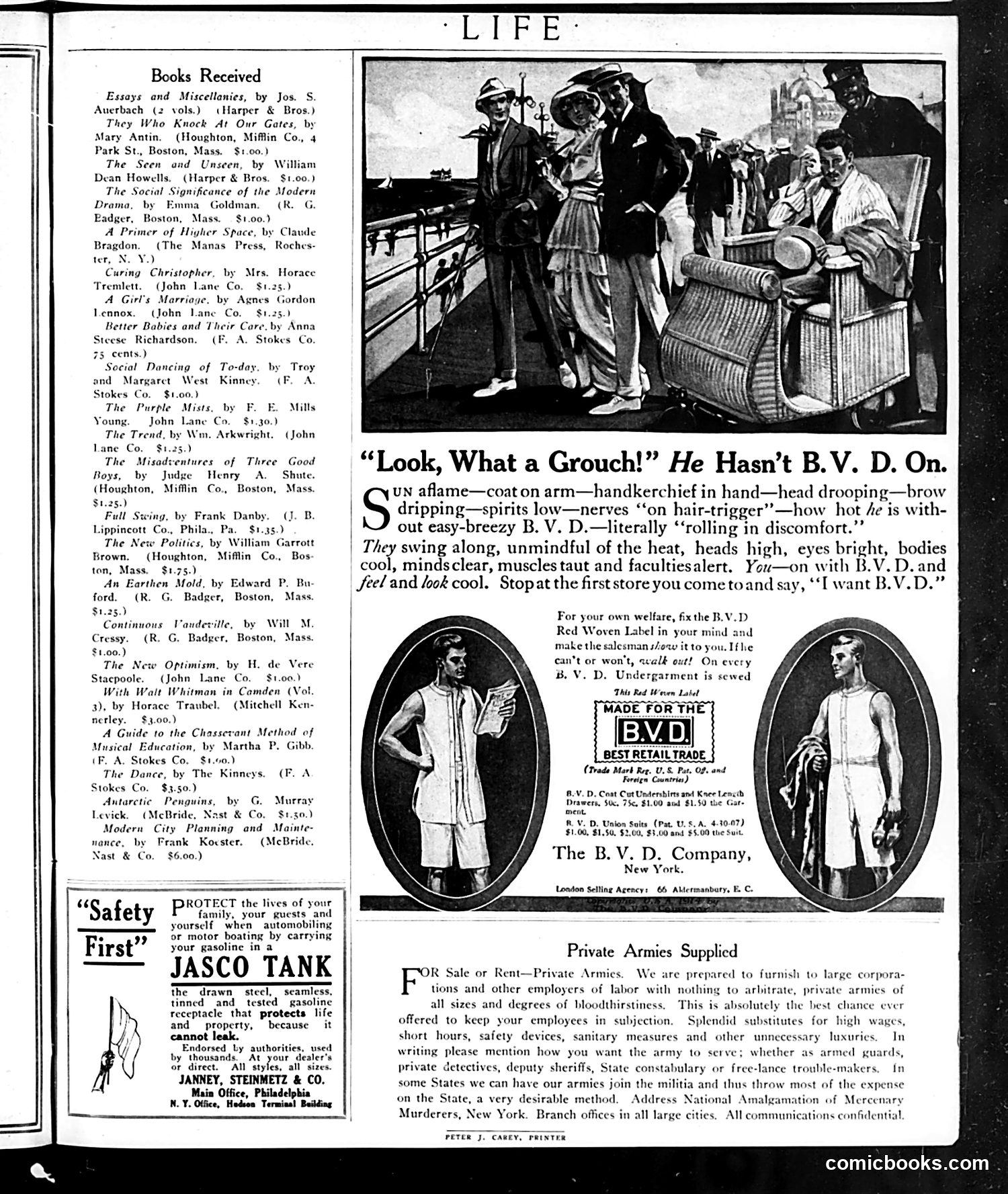
This page combines book reviews, advertisements, and satirical content typical of Life magazine's format. **Main Content - "Look, What a Grouch!"** The central cartoon advertises B.V.D. (brand) underwear through contrast. It depicts two men in summer heat: one miserable without B.V.D. undergarments (drooping, uncomfortable, spirits low), the other cool and composed wearing them. The satire is straightforward product messaging dressed as humor—the "grouch" lacks proper underwear, creating discomfort. This reflects early 20th-century advertising techniques using exaggerated emotional states to sell basics. **Secondary Satire - "Private Armies Supplied"** Below sits darker satire: an advertisement offering to supply "private armies" to corporations as strikebreaking alternatives to paying "high wages, short hours, safety devices, sanitary measures." This mocks real labor conflicts of the era, sardonically suggesting violent suppression beats worker accommodations. Life's editors are critiquing corporate union-busting through mock advertisement—exposing the brutality beneath sanitized business language. The page juxtaposes trivial consumer concerns with serious labor violence, highlighting period class tensions.
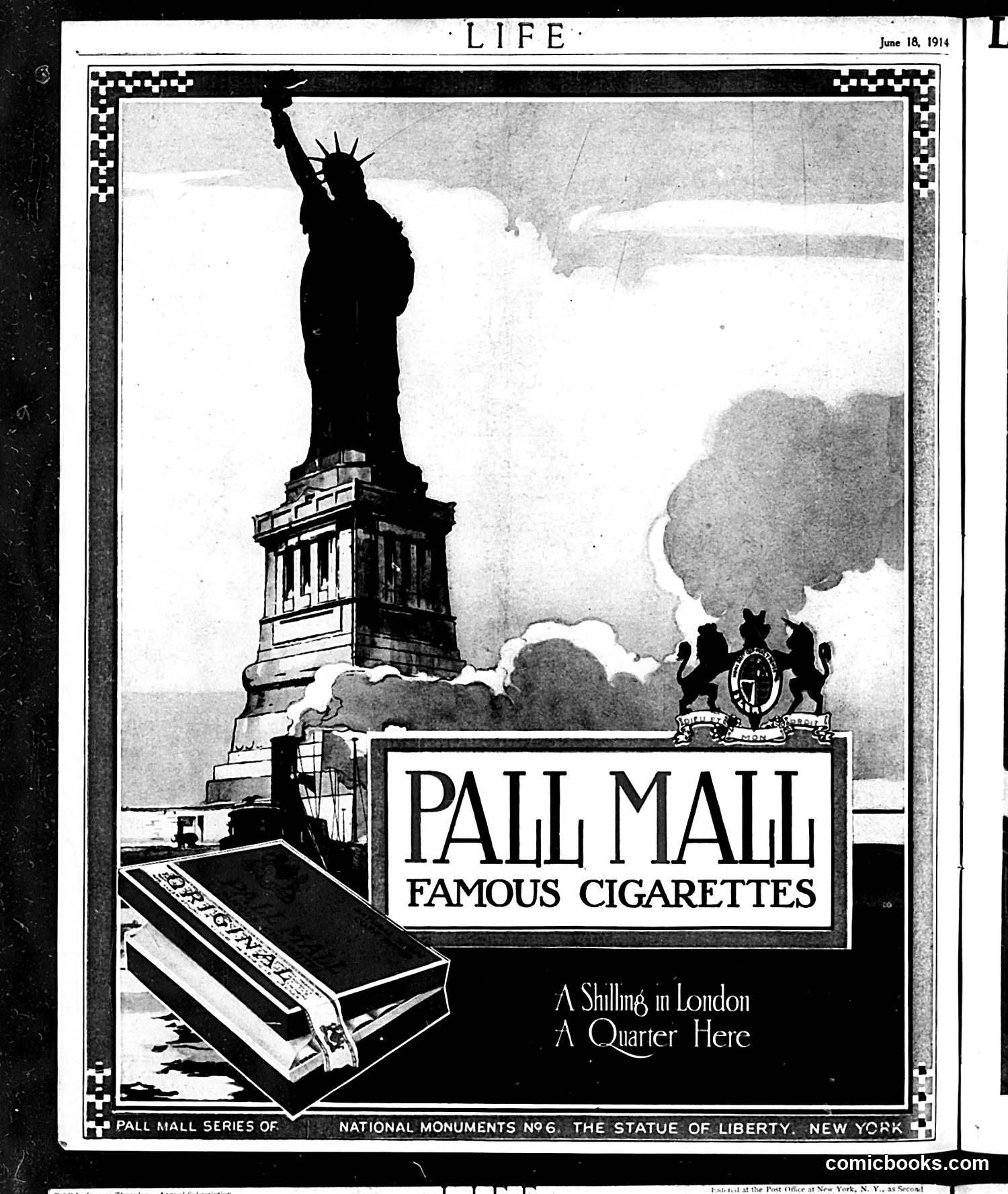
This is a commercial advertisement, not political satire. It promotes Pall Mall cigarettes by featuring the Statue of Liberty as a symbol of American prestige and quality. The ad references the statue as part of a "National Monuments" series (#6), positioning the product as distinctly American. The pricing—"A Shilling in London / A Quarter Here"—suggests the brand was marketed internationally, with British pricing listed first. The elegant Art Deco design and prominent placement in *Life* magazine indicate Pall Mall targeted upscale consumers. The apparent British association of the product made American iconography a selling point for differentiating the brand in both markets during this pre-WWI era.