
Life, 1914-06-18 · page 11 of 44
Life — June 18, 1914 — page 11: what you’re looking at
What you’re looking at
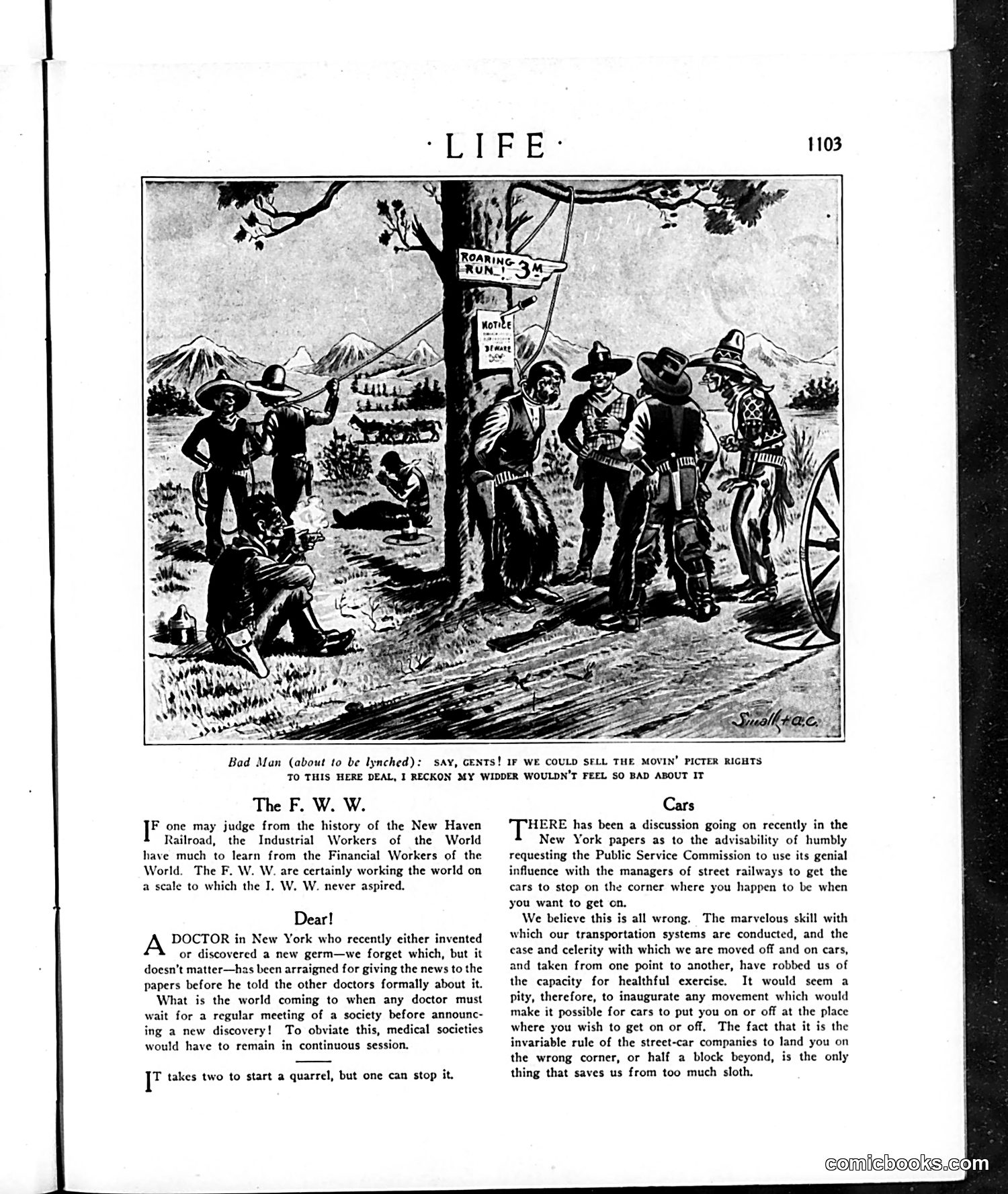
The cartoon depicts a lynching scene set in the American West. A group of armed cowboys has captured a man (labeled "Bad Man") beneath a "Roaring Run" sign, with one figure saying he'll accept a deal involving movie picture rights rather than proceed with execution. **The satire targets:** The film industry's exploitation of Western violence and outlaws for entertainment profit. The joke suggests that even imminent lynch mobs would negotiate—prioritizing commercial gain over frontier justice. **Historical context:** This reflects 1920s concerns about how Hollywood sensationalized violence and Western mythology for profit, turning real criminal justice (however brutal) into marketable spectacle. The cartoon critiques both Hollywood's opportunism and the absurdity of commercializing frontier brutality.
📄 Transcribed text from this page (OCR, searchable)
Machine-transcribed from the original scan — historical spelling and the odd misread are preserved.
1103 Bad Man (about to be lynched): SAY, GENTS! IF WE COULD SELL THE MOVIN’ PICTER RIGHTS TO THIS HERE DEAL, I RECKON MY WIDDER WOULDN'T FEEL SO BAD ABOUT IT The F. W. W. F one may judge from the history of the New Haven Railroad, the Industrial Workers of the World have much to learn from the Financial Workers of the World. The F. W. W. are certainly working the world on a scale to which the I, W, W. never aspired. Dear! DOCTOR in New York who recently either invented or discovered a new germ—we forget which, but it doesn’t matter—has been arraigned for giving the news to the papers before he told the other doctors formally about it. What is the world coming to when any doctor must wait for a regular meeting of a society before announc- ing a new discovery! To obviate this, medical societies would have to remain in continuous session. r takes two to start a quarrel, but one can stop it. Cars "TREE has been a discussion going on recently in the New York papers as to the advisability of humbly requesting the Public Service Commission to use its genial influence with the managers of street railways to get the cars to stop on the corner where you happen to be when you want to get on. We believe this is all wrong. The marvelous skill with which our transportation systems are conducted, and the case and celerity with which we are moved off and on cars, and taken from one point to another, have robbed us of the capacity for healthful exercise. It would seem a pity, therefore, to inaugurate any movement which would make it possible for cars to put you on or off at the place where you wish to get on or off. The fact that it is the invariable rule of the street-car companies to land you on the wrong corner, or half a block beyond, is the only thing that saves us from too much sloth. comichooks.coly)