
Life, 1914-06-18 · page 9 of 44
Life — June 18, 1914 — page 9: what you’re looking at
What you’re looking at
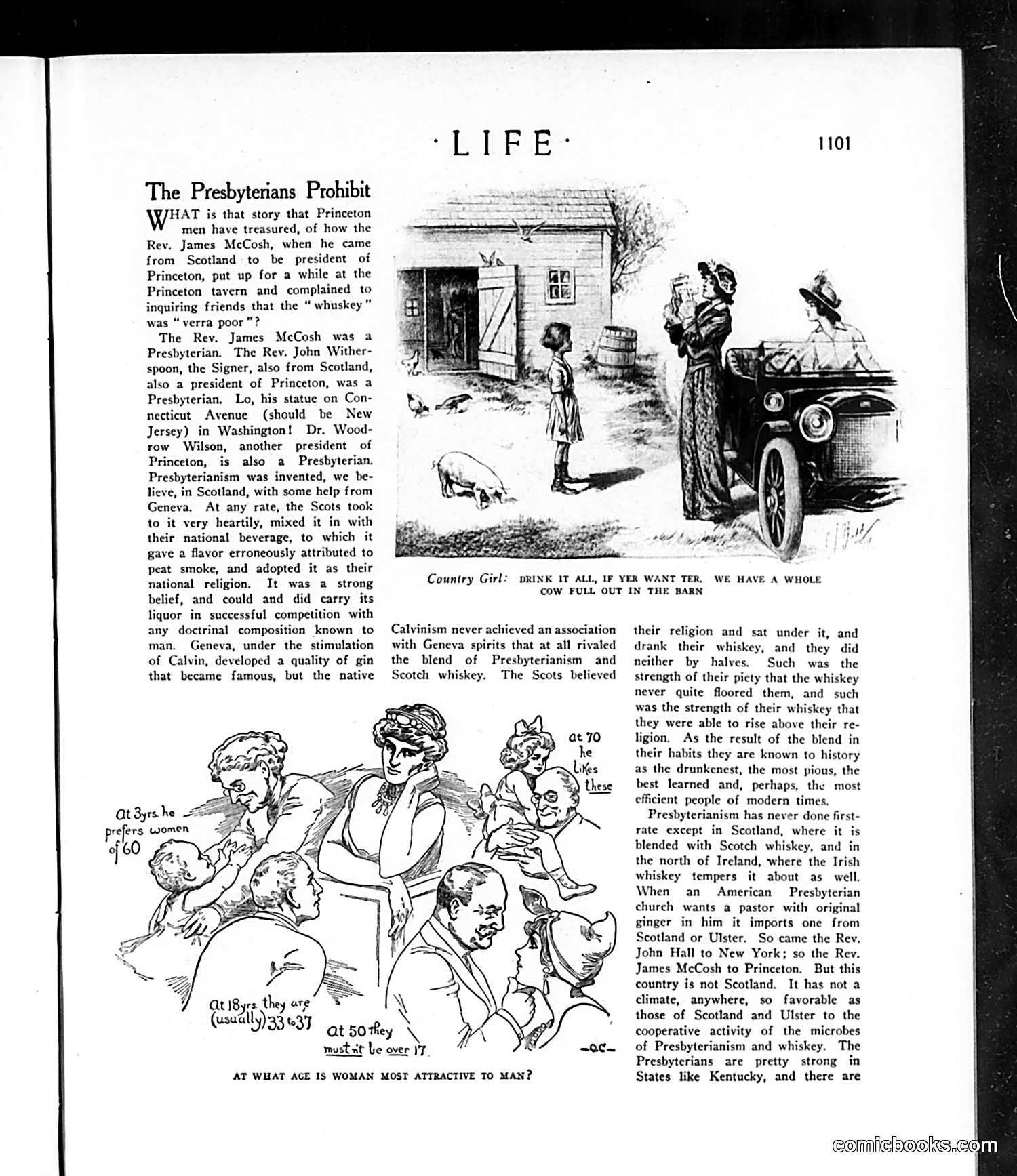
This satire mocks the association between Scottish Presbyterianism and whiskey consumption. The article playfully notes that prominent Princeton figures—Rev. James McCosh and Dr. Woodrow Wilson (later U.S. President)—were Presbyterians of Scottish descent, yet Presbyterianism is linked to temperance/prohibition ideology. The cartoon's joke centers on the contradiction: Scots developed whiskey and integrated it into their Presbyterian identity, yet American Presbyterianism championed prohibition. The lower illustration with age notations appears to comment on women's attractiveness across lifespans—unrelated context suggesting this was a general-interest humor magazine. The "Country Girl" dialogue references rural simplicity regarding alcohol availability, contrasting with urban prohibition debates of the era.
📄 Transcribed text from this page (OCR, searchable)
Machine-transcribed from the original scan — historical spelling and the odd misread are preserved.
The Presbyterians Prohibit wat is that story that Princeton men have treasured, of how the Rev. James McCosh, when he came from Scotland to be president of Princeton, put up for a while at the Princeton tavern and complained to inquiring friends that the “ whuskey ” was “verra poor”? The Rev. James McCosh was a Presbyterian. The Rev. John Wither- spoon, the Signer, also from Scotland, also a president of Princeton, was a Presbyterian. Lo, his statue on Con- necticut Avenue (should be New Jersey) in Washington! Dr. Wood- row Wilson, another president of Princeton, is also a Presbyterian. Presbyterianism was invented, we be- lieve, in Scotland, with some help from Geneva. At any rate, the Scots took to it very heartily, mixed it in with their national beverage, to which it gave a flavor erroneously attributed to peat smoke, and adopted it as their national religion. It was a strong belief, and could and did carry its liquor in successful competition with any doctrinal composition known to man. Geneva, under the stimulation of Calvin, developed a quality of gin that became famous, but the native prefers women of 60 és tt Byes they are (usually) 33637 oy 50tRey mustxt be over 17 Country Girl: DRINK IT ALL, IF YER WAN’ TER. WE HAVE A WHOLE COW FULL OUT IN THE BARN Calvinism never achieved an association with Geneva spirits that at all rivaled the blend of Presbyterianism and Scotch whiskey. The Scots believed \ \ AT WHAT AGE IS WOMAN MOST ATTRACTIVE TO MAN? their religion and sat under it, and drank their whiskey, and they did neither by halves. Such was the strength of their piety that the whiskey never quite floored them, and such was the strength of their whiskey that they were able to rise above their re- ligion. As the result of the blend in their habits they are known to history as the drunkenest, the most pious, the best learned and, perhaps, the most efficient people of modern times, Presbyterianism has never done first- rate except in Scotland, where it is blended with Scotch whiskey, and in the north of Ireland, where the Irish whiskey tempers it about as well. When an American Presbyterian church wants a pastor with original ginger in him it imports one from Scotland or Ulster. So came the Rev. John Hall to New York; so the Rev. James McCosh to Princeton. But this country is not Scotland. It has not a climate, anywhere, so favorable as those of Scotland and Ulster to the cooperative activity of the microbes of Presbyterianism and whiskey. The Presbyterians are pretty strong in States like Kentucky, and there are comichooks.