
Life, 1914-06-18 · page 19 of 44
Life — June 18, 1914 — page 19: what you’re looking at
What you’re looking at
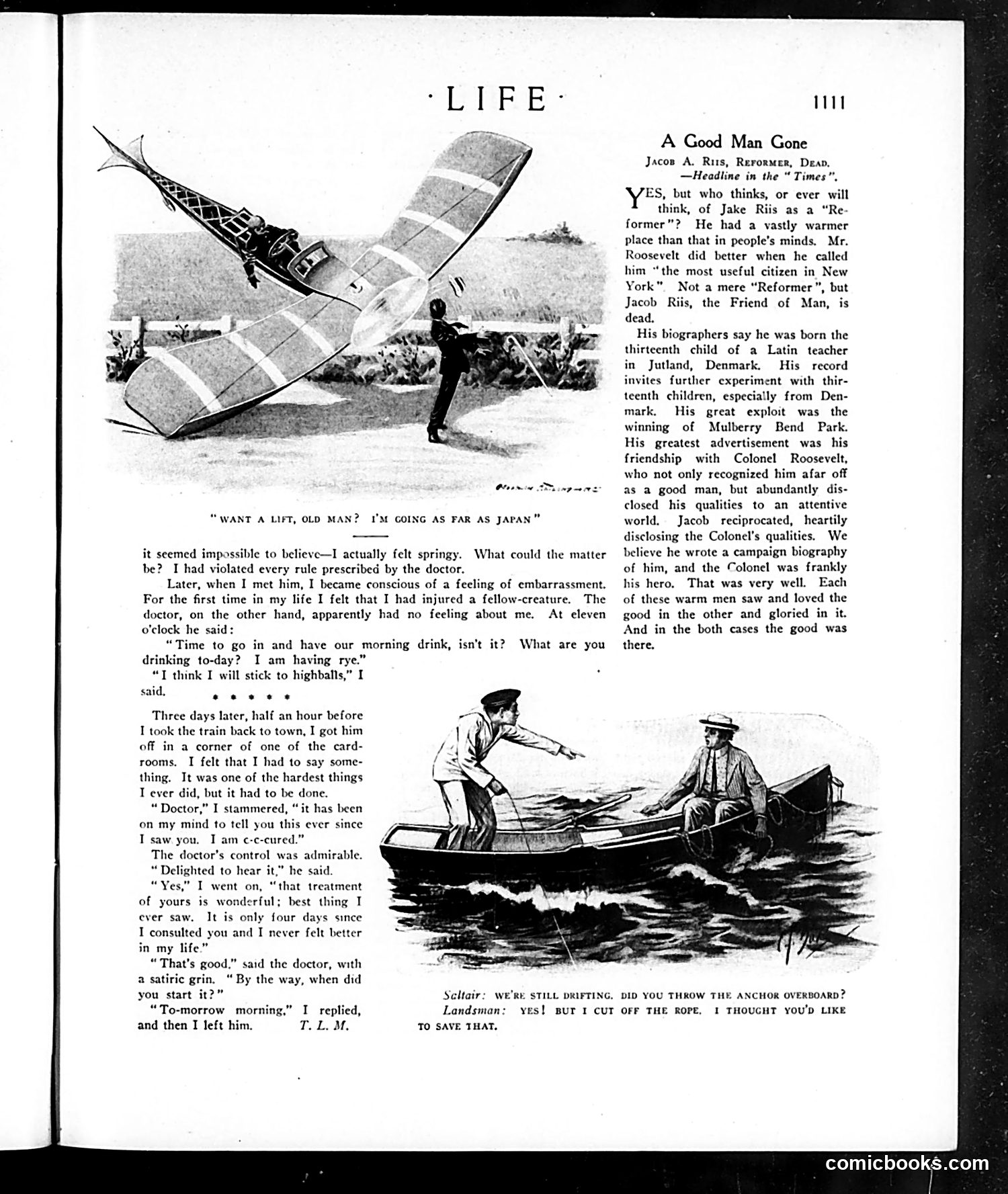
This Life magazine page contains two distinct pieces: **Main Story ("Want a Lift, Old Man?")**: A humorous narrative about a patient who violates his doctor's orders, then feels guilty confessing his "cure" to the physician. The joke hinges on the doctor's indifference—he cares nothing about the patient's wellbeing, only his morning drink routine. **Right Column (Obituary/Tribute)**: A memorial to Jacob Riis, a Danish-American social reformer and photographer known for documenting tenement life in New York. The piece emphasizes he was more than a mere "reformer"—he was a genuine humanitarian and friend to mankind. His closest association was with Theodore Roosevelt, who publicly praised him as "the most useful citizen in New York." The text celebrates their mutual respect and shared commitment to social good. **Bottom Cartoon**: A nautical joke about sailors adrift—one threw the anchor overboard to save it by cutting the rope, missing the point of anchoring entirely. It's absurdist humor unrelated to other page content.
📄 Transcribed text from this page (OCR, searchable)
Machine-transcribed from the original scan — historical spelling and the odd misread are preserved.
“WANT A LIFT, OLD MAN? I'M GOING AS FAR AS JAPAN” it seemed impossible to believe—I actually felt springy. What could the matter be? I had violated every rule prescribed by the doctor, Later, when I met him, I became conscious of a feeling of embarrassment. For the first time in my life I felt that I had injured a fellow-creature. The doctor, on the other hand, apparently had no feeling about me. At eleven o'clock he said: “Time to go in and have our morning drink, isn’t it? What are you drinking to-day? I am having rye.” “T think I will stick to highballs,” I said, eevee Three days later, half an hour before I took the train back to town, I got him off in a corner of one of the card- rooms. I felt that I had to say some- thing. It was one of the hardest things lever did, but it had to be done. “Doctor,” I stammered, “it has been on my mind to tell you this ever since I saw you. I am c-c-cured.” The doctor's control was admirable. “Delighted to hear it,” he said. I went on, “that treatment of yours is wonderful; best thing T ever saw. It is only four days since I consulted you and I never felt better in my life.” “That's good,” said the doctor, with a satiric grin. “By the way, when did Wi A Good Man Gone Jacos A. Rurs, Rerorwer, Dean. —Headline in the “Times”, YES. but who thinks, or ever will think, of Jake Riis as a “Re- former"? He had a vastly warmer place than that in people's minds. Mr. Roosevelt did better when he called him “the most useful citizen in New York" Not a mere “Reformer”, but Jacob Riis, the Friend of Man, is dead. His biographers say he was born the thirteenth child of a Latin teacher in Jutland, Denmark. His record invites further experiment with thir- teenth children, especially from Den- mark. His great exploit was the winning of Mulberry Bend Park. His greatest advertisement was his friendship with Colonel Roosevelt, who not only recognized him afar off as a good man, but abundantly dis- closed his qualities to an attentive world, Jacob reciprocated, heartily disclosing the Colonel's qualities. We believe he wrote a campaign biography of him, and the Colonel was frankly his hero. That was very well. Each of these warm men saw and loved the good in the other and gloried in it. And in the both cases the good was there, you start it?” Seltair: We'RE STILL DRIFTING. DID YOU THROW THE ANCHOR OVERBOARD? “To-morrow morning,” I replied, and then I left him. T. L. M. TO SAVE THAT. Landsman: yes! BUT I CUT OFF THE ROPE, 1 THOUGHT You'D LIKE comicbooks.com |