
Life, 1914-06-18 · page 20 of 44
Life — June 18, 1914 — page 20: what you’re looking at
What you’re looking at
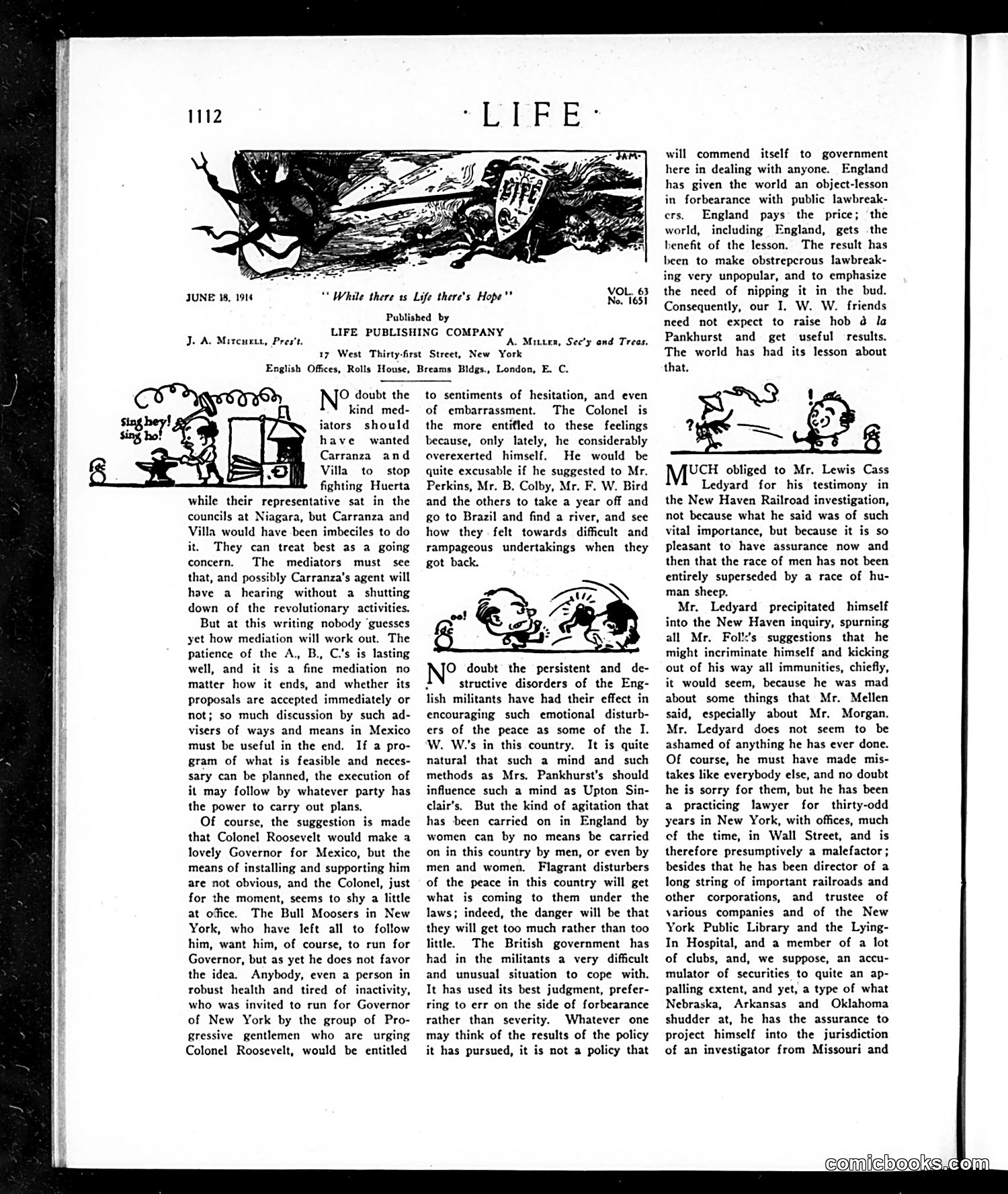
This page discusses three political topics: **Mexican Revolution**: The text debates whether mediators (the "A.B.C.'s"—Argentina, Brazil, Chile) should pressure revolutionary factions Carranza and Villa to cease fighting Huerta while negotiations proceed at Niagara. The author argues they wisely refused, as ongoing conflict gave mediators leverage. **Theodore Roosevelt for Governor**: Progressive Party supporters urge Roosevelt to run for New York governor. The piece humorously suggests he decline, jokingly proposing he and his backers instead take "a year off" to explore Brazil—a reference to Roosevelt's actual 1913-1914 South American expedition. **British Suffragettes vs. American Radicals**: The text compares English militant feminists (Mrs. Pankhurst and the suffrage movement) with American radical groups like the I.W.W. (Industrial Workers of the World) and Upton Sinclair. It argues Britain's lenient approach to lawbreaking suffragettes backfired by inspiring American radicals, but warns American authorities will respond more severely—discouraging such agitation here. The cartoons appear decorative rather than directly illustrative of these arguments.
📄 Transcribed text from this page (OCR, searchable)
Machine-transcribed from the original scan — historical spelling and the odd misread are preserved.
JUNE 18, 1914 ‘While there 1s Life there's Hope"* Published by LIFE PUBLISHING COMPANY J. A. Mircuntt, Pres't. O doubt the kind med- jators should have wanted Carranza and Villa to stop fighting Huerta while their representative sat in the councils at Niagara, but Carranza and Villa would have been imbeciles to do it. They can treat best as a going concern. The mediators must see that, and possibly Carranza’s agent will have a hearing without a shutting down of the revolutionary activities. But at this writing nobody ‘guesses yet how mediation will work out. The patience of the A., B., C.'s is lasting well, and it is a fine mediation no matter how it ends, and whether its Proposals are accepted immediately or not; so much discussion by such ad- visers of ways and means in Mexico must be useful in the end. If a pro- gram of what is feasible and neces- sary can be planned, the execution of it may follow by whatever party has the power to carry out plans. OF course, the suggestion is made that Colonel Roosevelt would make a lovely Governor for Mexico, but the means of installing and supporting him are not obvious, and the Colonel, just for the moment, seems to shy a little at office. The Bull Moosers in New York, who have left all to follow him, want him, of course, to run for Governor, but as yet he does not favor the idea. Anybody, even a person in robust health and tired of inactivity, who was invited to run for Governor of New York by the group of Pro- gressive gentlemen who are urging Colonel Roosevelt, would be entitled A. Minter, Sec’y and Treas. 17 West Thirty-first Street, New York English Offices, Rolls House, Breams Bldgs., London, E. C. to sentiments of hesitation, and even of embarrassment. The Colonel is the more entifled to these feelings because, only lately, he considerably overexerted himself. He would be quite excusable if he suggested to Mr. Perkins, Mr. B. Colby, Mr. F, W. Bird and the others to take a year off and go to Brazil and find a river, and see how they felt towards difficult and rampageous undertakings when they O doubt the persistent and de- Fs structive disorders of the Eng- lish militants have had their effect in encouraging such emotional disturb- ers of the peace as some of the I. W. W's in this country. It is quite natural that such a mind and such methods as Mrs, Pankhurst’s should influence such a mind as Upton Sin- clair’s. But the kind of agitation that has been carried on in England by women can by no means be carried on in this country by men, or even by men and women. Flagrant disturbers of the peace in this country will get what is coming to them under the laws; indeed, the danger will be that they will get too much rather than too little. The British government has had in the militants a very difficult and unusual situation to cope with. It has used its best judgment, prefer- ring to err on the side of forbearance rather than severity. Whatever one may think of the results of the policy it has pursued, it is not a policy that will commend itself to government here in dealing with anyone. England has given the world an object-lesson in forbearance with public lawbreak- ers, England pays the price; the world, including England, gets the benefit of the lesson, The result has been to make obstrepcrous lawbreak- ing very unpopular, and to emphasize the need of nipping it in the bud. Consequently, our I, W. W. friends need not expect to raise hob d la Pankhurst and get useful results. The world has had its lesson about that. Mu obliged to Mr. Lewis Cass Ledyard for his testimony in the New Haven Railroad investigation, not because what he said was of such vital importance, but because it is so pleasant to have assurance now and then that the race of men has not been entirely superseded by a race of hu- man sheep. Mr. Ledyard precipi into the New Haven inquiry, spurning all Mr, Fol!:’s suggestions that he might incriminate himself and kicking out of his way all immunities, chiefly, it would seem, because he was mad about some things that Mr. Mellen said, especially about Mr. Morgan. Mr. Ledyard does not seem to be ashamed of anything he has ever done. Of course, he must have made mis- takes like everybody else, and no doubt he is sorry for them, but he has been a practicing lawyer for thirty-odd years in New York, with offices, much ef the time, in Wall Street, and is therefore presumptively a malefactor; besides that he has been director of a long string of important railroads and other corporations, and trustee of various companies and of the New York Public Library and the Lying- In Hospital, and a member of a lot of clubs, and, we suppose, an accu- mulator of securities to quite an ap- palling extent, and yet, a type of what Nebraska, Arkansas and Oklahoma shudder at, he has the assurance to project himself into the jurisdiction of an investigator from Missouri and