
Life, 1914-06-18 · page 24 of 44
Life — June 18, 1914 — page 24: what you’re looking at
What you’re looking at
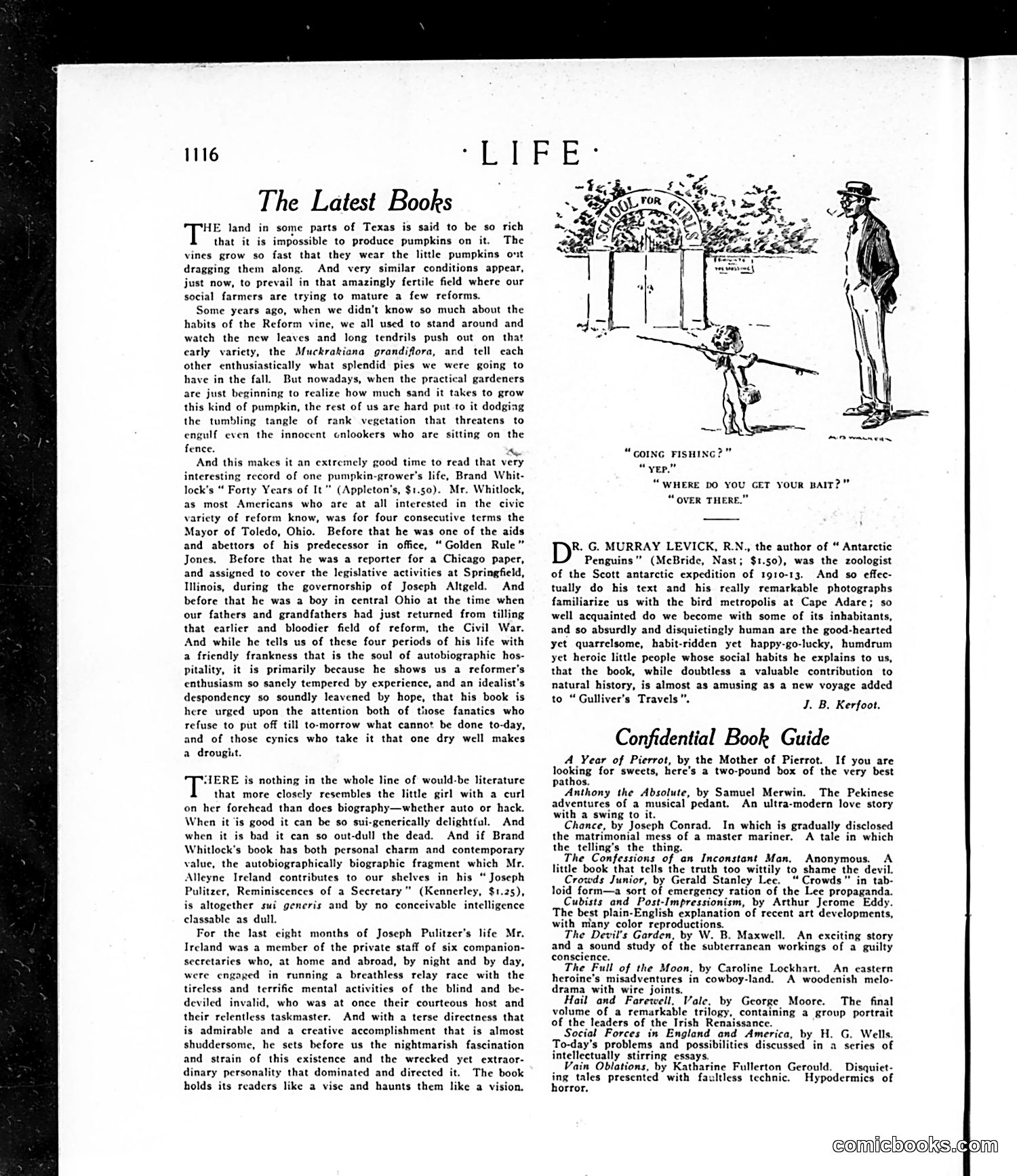
This page satirizes the Progressive Era's reform movement through agricultural metaphor. The opening essay compares social reform to growing pumpkins in Texas—where vines grow so wildly they destroy their own fruit. The author argues that early reformers (the "Muckrakiana grandifiora" variety) promised grand results, but practical experience shows reform efforts have become chaotic and counterproductive, threatening even innocent bystanders. The cartoon depicts a simple fishing scene with dialogue ("Going fishing?" / "Yep" / "Where do you get your bait?" / "Over there"), which appears unrelated to the text—a common Life magazine technique where cartoons stood independently. The book reviews discuss Brand Whitlock's reform autobiography and Joseph Pulitzer's life, treating these as exemplars of idealism tempered by harsh reality. The satire's point: reformers' good intentions produce tangled, wild results that don't match their promises.
📄 Transcribed text from this page (OCR, searchable)
Machine-transcribed from the original scan — historical spelling and the odd misread are preserved.
The Latest Books 'HE land in some parts of Texas is said to be so rich that it is impossible to produce pumpkins on it. The vines grow so fast that they wear the little pumpkins ont dragging them along. And very similar conditions appear, just now, to prevail in that amazingly fertile field where our social farmers are trying to mature a few reforms. Some years ago, when we didn’t know so much about the habits of the Reform vine, we all used to stand around and watch the new leaves and long tendrils push out on that carly variety, the Muckrakiana grandifiora, and tell each other enthusiastically what splendid pies we were going to have in the fall. But nowadays, when the practical gardeners are just beginning to realize how much sand it takes to grow this kind of pumpkin, the rest of us are hard put to it dodging the tumbling tangle of rank vegetation that threatens to engulf even the innocent onlookers who are sitting on the fence. ye And this makes it an extremely good time to read that very interesting record of one pumpkin-grower's life, Brand Whit- lock’s “ Forty Years of It" (Appleton’s, $1.50). Mr. Whitlock, as most Americans who are at all interested in the civic variety of reform know, was for four consecutive terms the Mayor of Toledo, Ohio. Before that he was one of the aids and abettors of his predecessor in office, “Golden Rule” Jones. Before that he was a reporter for a Chicago paper, and assigned to cover the legislative activities at Springfield, Mlinois, during the governorship of Joseph Altgeld. And before that he was a boy in central Ohio at the time when our fathers and grandfathers had just returned from tilling that earlier and bloodier field of reform, the Civil War. And while he tells us of these four periods of his life with a friendly frankness that is the soul of autobiographic hos- pitality, it is primarily because he shows us a reformer's enthusiasm so sanely tempered by experience, and an idealist's despondency so soundly leavened by hope, that his book is here urged upon the attention both of those fanatics who refuse to put off till to-morrow what cannot be done to-day, and of those cynics who take it that one dry well makes a drougit. ERE is nothing in the whole line of would-be literature that more closely resembles the little girl with a curl on her forehead than does biography—whether auto or hack. When it is good it can be so sui-generically delightful. And when it is bad it can so out-dull the dead. And if Brand Whitlock’s book has both personal charm and contemporary value, the autobiographically biographic fragment which Mr. Alleyne Ireland contributes to our shelves in his “ Joseph Pulitzer, Reminiscences of a Secretary” (Kennerley, $1.25), is altogether sui generis and by no conceivable intelligence classable as dull. For the last eight months of Joseph Pulitzer’s life Mr. Ireland was a member of the private staff of six companion- secretaries who, at home and abroad, by night and by day, were engaged in running a breathless relay race with the tireless and terrific mental activities of the blind and be- deviled invalid, who was at once their courteous host and their relentless taskmaster. And with a terse directness that is admirable and a creative accomplishment that is almost shuddersome, he sets before us the nightmarish fascination and strain of this existence and the wrecked yet extraor- dinary personality that dominated and directed it. The book holds its readers like a vise and haunts them like a vision. “WHERE DO YOU GET YOUR BAIT?” “OVER THERE.” R. G. MURRAY LEVICK, R.N,, the author of “ Antarctic Penguins” (McBride, Nast; $1.50), was the zoologist of the Scott antarctic expedition of 1910-13. And so effec- tually do his text and his really remarkable photographs familiarize us with the bird metropolis at Cape Adare; so well acquainted do we become with some of its inhabitants, and so absurdly and disquietingly human are the good-hearted yet quarrelsome, habit-ridden yet happy-go-lucky, humdrum yet heroic little people whose social habits he explains to us, that the book, while doubtless a valuable contribution to natural history, is almost as amusing as a new voyage added to “Gulliver's Travels”. 1. B. Kerfoot. Confidential Book Guide A Year of Pierrot, by the Mother of Pierrot. If you are iooking for sweets, here's a two-pound box of the very best pathos. Anthony the Absolute, by Samuel Merwin. The Pekinese adventures of a musical pedant. An ultra-modern love story with a swing to it. Chance, by Joseph Conrad. In which is gradually disclosed the matrimonial mess of a master mariner. A tale in which the telling’s the thing. The Confessions of an Inconstant Man. Anonymous. A little book that tells the truth too wittily to shame the devil. Crowds Junior, by Gerald Stanley Lee. “ Crowds” in tab- loid form—a sort of emergency ration of the Lee propaganda. Cubists and Post-Impressionism, by Arthur Jerome Eddy. The best plain-English explanation of recent art developments, with many color reproductions. The Devil's Garden, by W. B. Maxwell. An exciting story and a sound study of the subterranean workings of a guilty conscience. The Full of the Moon, by Caroline Lockhart. An eastern heroine's misadventures cowboy-land. A woodenish melo- drama with wire joints. Hail and Farewell, Vale. by George Moore. The final volume of a remarkable trilogy, containing a group portrait of the leaders of the Irish Renaissance. Social Forces in England and America, by H. G. Wells. To-day’s problems and possibilities discussed in a series of intellectually stirring essays. Vain Oblations, by Katharine Fullerton Gerould. ing tales presented with faultless technic. jorror. Disquiet- Hypodermics of comichooks.gom