
Life, 1914-06-18 · page 21 of 44
Life — June 18, 1914 — page 21: what you’re looking at
What you’re looking at
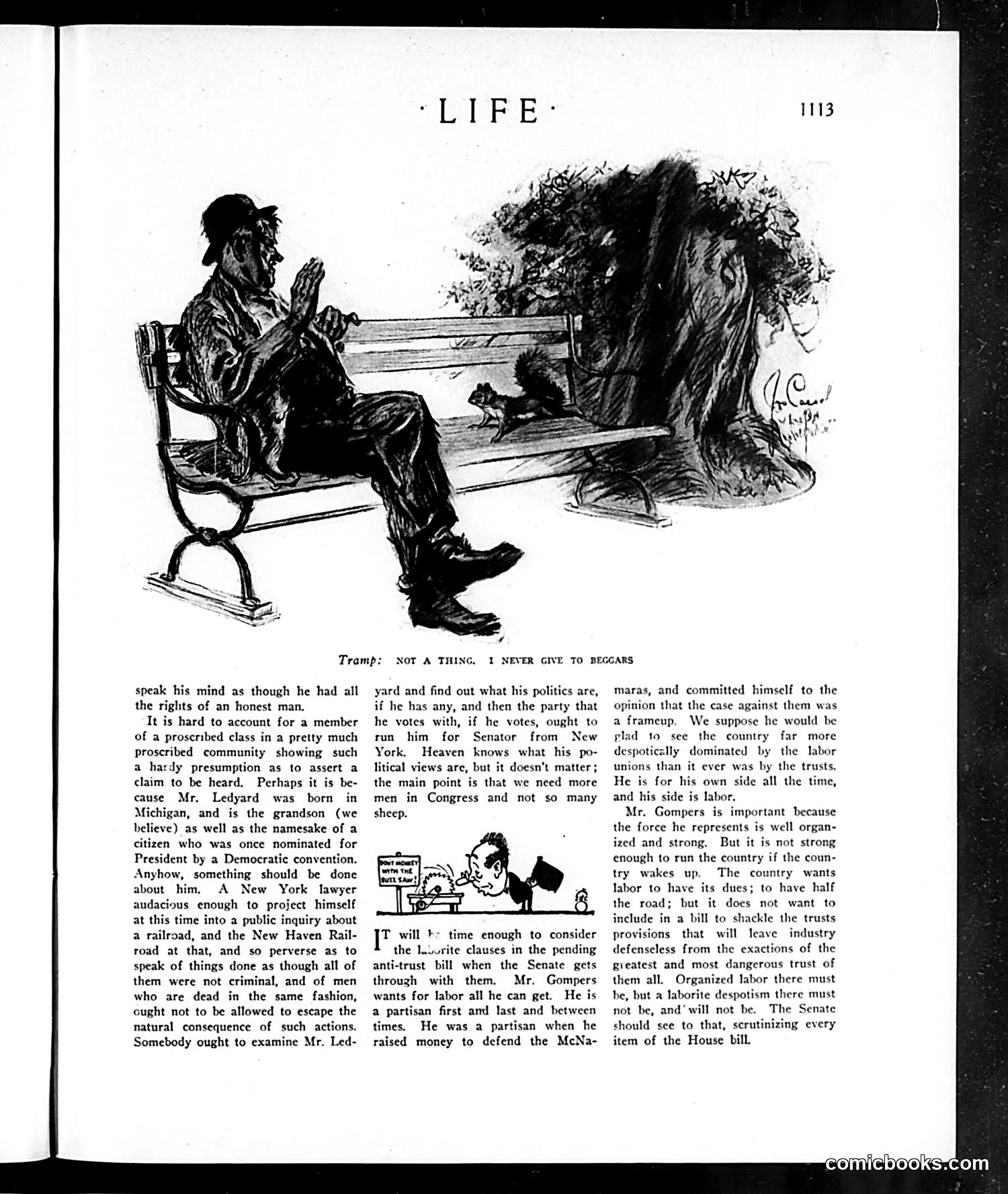
This page satirizes two prominent figures through written commentary rather than traditional cartooning. **The Main Cartoon** depicts a well-dressed man sitting on a park bench while a tramp approaches. The caption "NOT A THING. I NEVER GIVE TO BEGGARS" serves as bitter social commentary—the wealthy man refuses charity while the text criticizes the treatment of those who dare speak up. **The Written Targets:** 1. **Mr. Ledyard** (a New York lawyer): The text mocks his audacity in publicly questioning the New Haven Railroad during what appears to be an investigation. The article sarcastically suggests punishing him by making him a Senator, implying he's too principled for his own good. 2. **Samuel Gompers** (labor leader): The commentary attacks his partisanship, accusing him of defending the McNamara brothers and seeking excessive power for organized labor. The author argues labor deserves fair treatment but warns against "laborite despotism." The page reflects Progressive-era tensions between labor, corporate power, and reform—showing skepticism toward both unchecked business interests and aggressive union leadership.
📄 Transcribed text from this page (OCR, searchable)
Machine-transcribed from the original scan — historical spelling and the odd misread are preserved.
Tramp: speak his mind as though he had all the rights of an honest man. It is hard to account for a member of a proscribed class in a pretty much Proscribed community showing such a hardy presumption as to assert a claim to be heard, Perhaps it is be- cause Mr. Ledyard was born in Michigan, and is the grandson (we believe) as well as the namesake of a citizen who was once nominated for President by a Democratic convention. Anyhow, something should be done about him, A New York lawyer audacious enough to project himself at this time into a public inquiry about a railroad, and the New Haven Rail- road at that, and so perverse as to speak of things done as though all of them were not criminal, and of men who are dead in the same fashion, ought not to be allowed to escape the natural consequence of such actions. Somebody ought to examine Mr. Led- NOT A THING. yard and find out what his politics are, if he has any, and then the party that he votes with, if he votes, ought to run him for Senator from New York. Heaven knows what his po- litical views are, but it doesn't matter; the main point is that we need more men in Congress and not so many sheep. T will +> time enough to consider the l.uurite clauses in the pending anti-trust bill when the Senate gets through with them. Mr. Gompers wants for labor all he can get. He is a partisan first and last and between times, He was a partisan when he raised money to defend the McNa- 1 NEVER GIVE TO BEGGARS maras, and committed himself to the opinion that the case against them was a frameup. We suppose he would be glad to see the country far more despotically dominated by the labor unions than it ever was by the trusts. He is for his own side all the time, and his side is labor, Mr. Gompers is important because the force he represents is well organ- ized and strong. But it is not strong enough to run the country if the coun- try wakes up. The country wants labor to have its dues; to have half the road; but it does not want to include in a Dill to shackle the trusts provisions that will leave industry defenseless from the exactions of the greatest and most dangerous trust of them all. Organized labor there must be, but a laborite despotism there must not be, and‘ will not be. The Senate should sce to that, scrutinizing every item of the House bill.