
A complete issue · 44 pages · 1914
Life — May 14, 1914
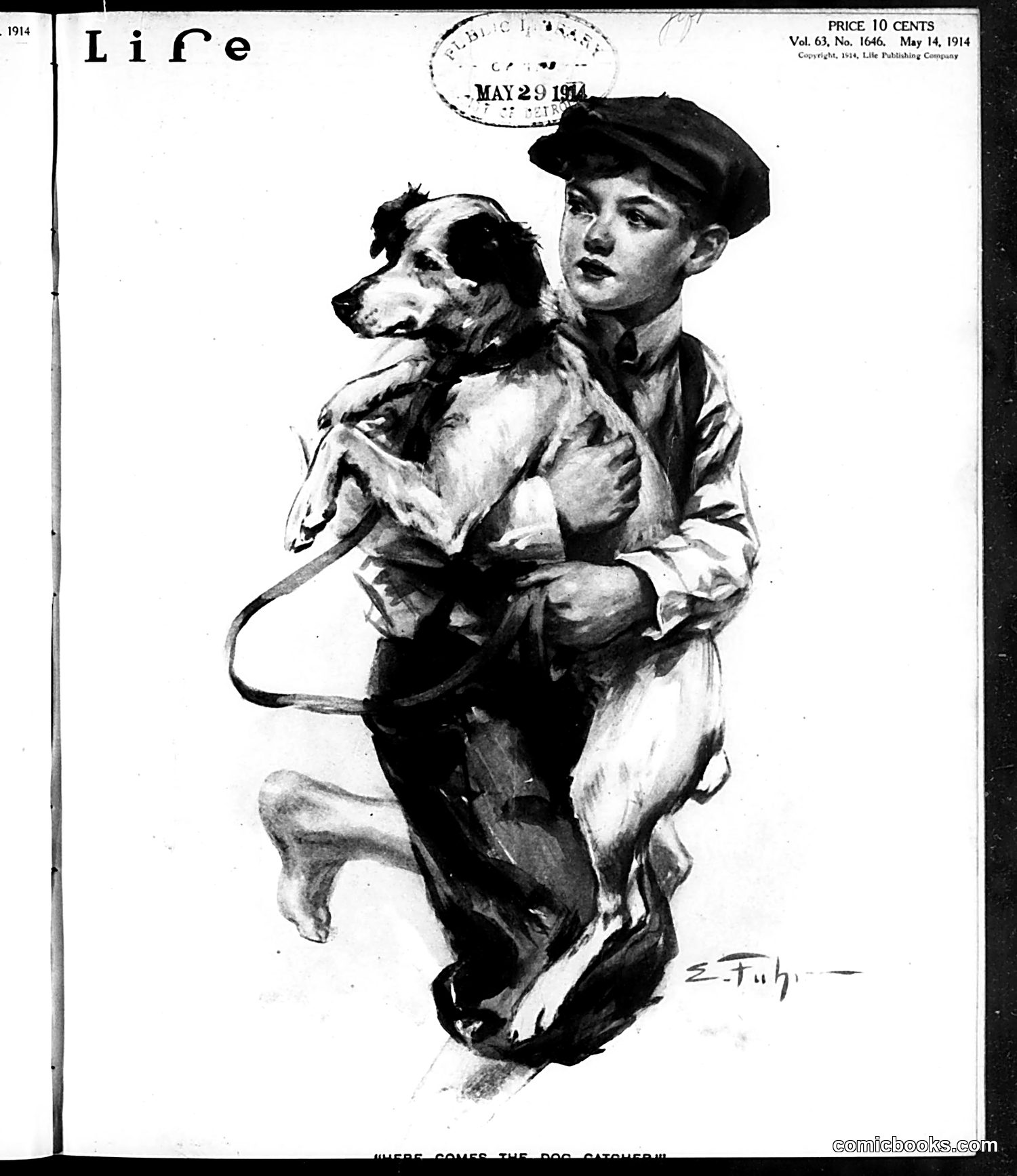
This is the cover of Life magazine from May 14, 1914. The illustration shows a young man in a cap carrying a small dog, with the caption "HERE COMES THE DOG CATCHER!!!" The satire appears to be a visual pun playing on the phrase "dog catcher"—a person who captures stray dogs. The young man is humorously depicted as fleeing from an unseen dog catcher while protectively holding his small dog, as if he himself were a "stray" needing capture. The specific social or political reference is unclear from the image alone, though Life magazine frequently used such visual wordplay for satirical commentary on contemporary figures or social situations. Without additional context about 1914 events, the precise target of the joke cannot be definitively identified.
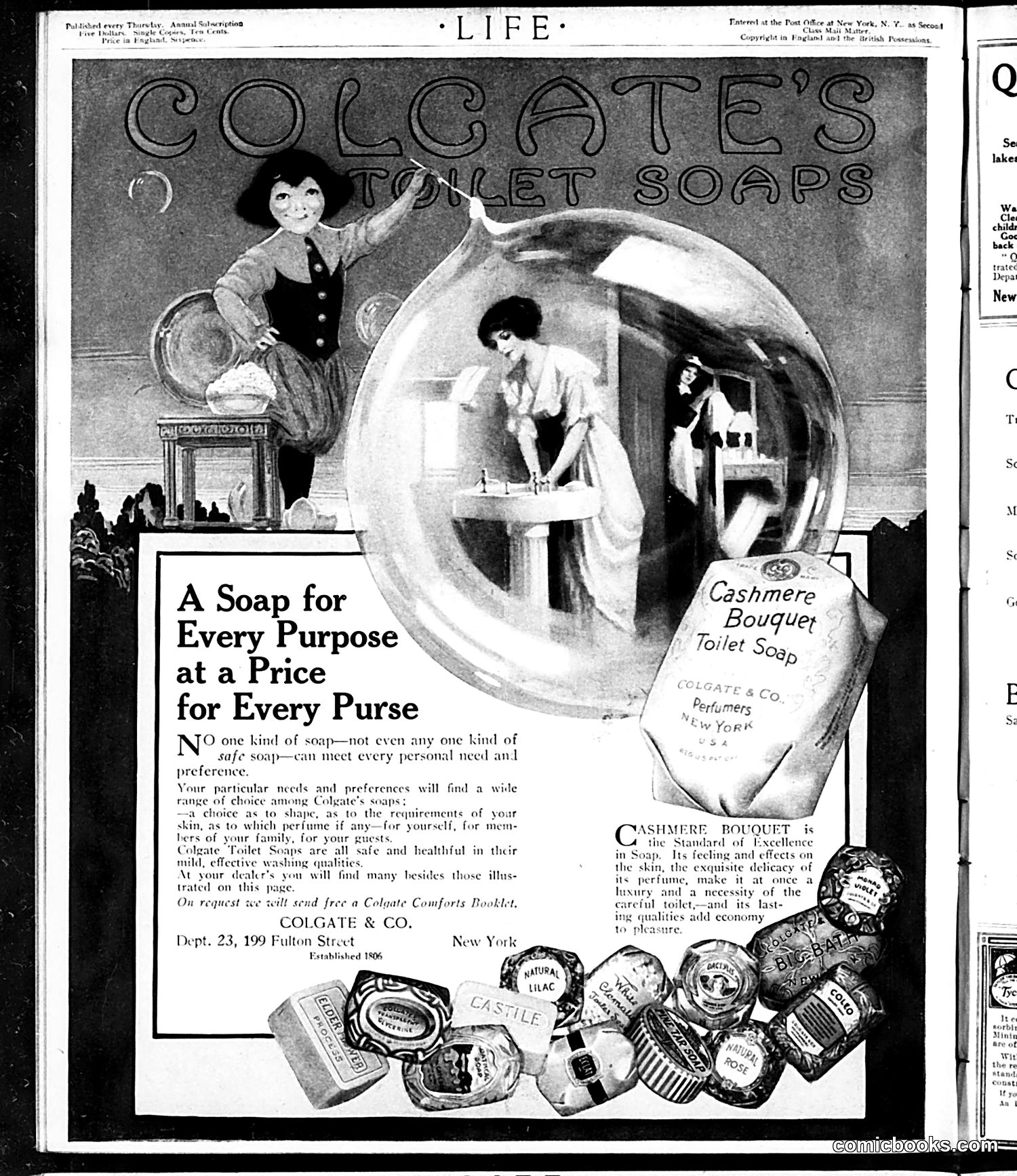
This page is **primarily an advertisement**, not satire or political commentary. It's a Colgate & Company soap advertisement from *Life* magazine. The ad features a large soap bubble containing scenes of women using toilet soap for various purposes. The headline promises "A Soap for Every Purpose at a Price for Every Purse"—marketing Colgate's range of soaps to different consumer needs and budgets. The "Cashmere Bouquet" toilet soap is highlighted as "the Standard of Excellence in Soap," emphasizing its delicacy and economy. Various soap products are displayed at the bottom. This reflects early 20th-century advertising strategy: using *Life*'s editorial credibility to reach affluent readers while positioning mass-market soap as a quality product accessible across economic classes.
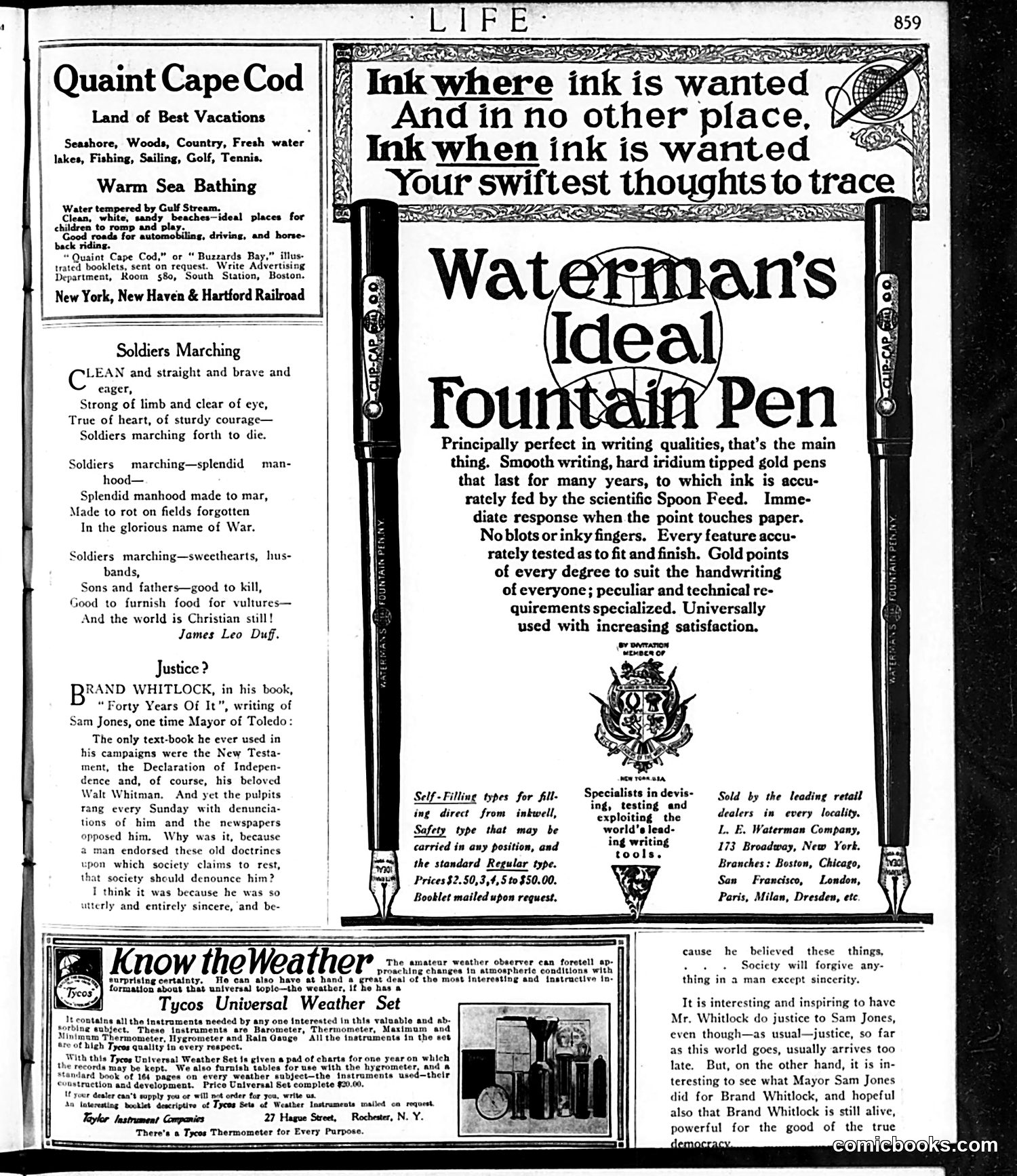
This page is **primarily advertising**, not political satire or comics. The dominant content is a large advertisement for Waterman's Ideal Fountain Pen, emphasizing its reliability and writing quality. The smaller left-side content includes: - A travel advertisement for "Quaint Cape Cod" - A poem titled "Soldiers Marching" by James Leo Duff (patriotic verse about WWI soldiers) - A brief section on "Justice" referencing Brand Whitlock's book "Forty Years Of It," discussing Sam Jones and historical injustices The "Know the Weather" section at bottom advertises a weather forecasting kit. There is **no political cartoon or satire** on this page—it's a standard early 20th-century magazine layout mixing editorial content with commercial advertisements.
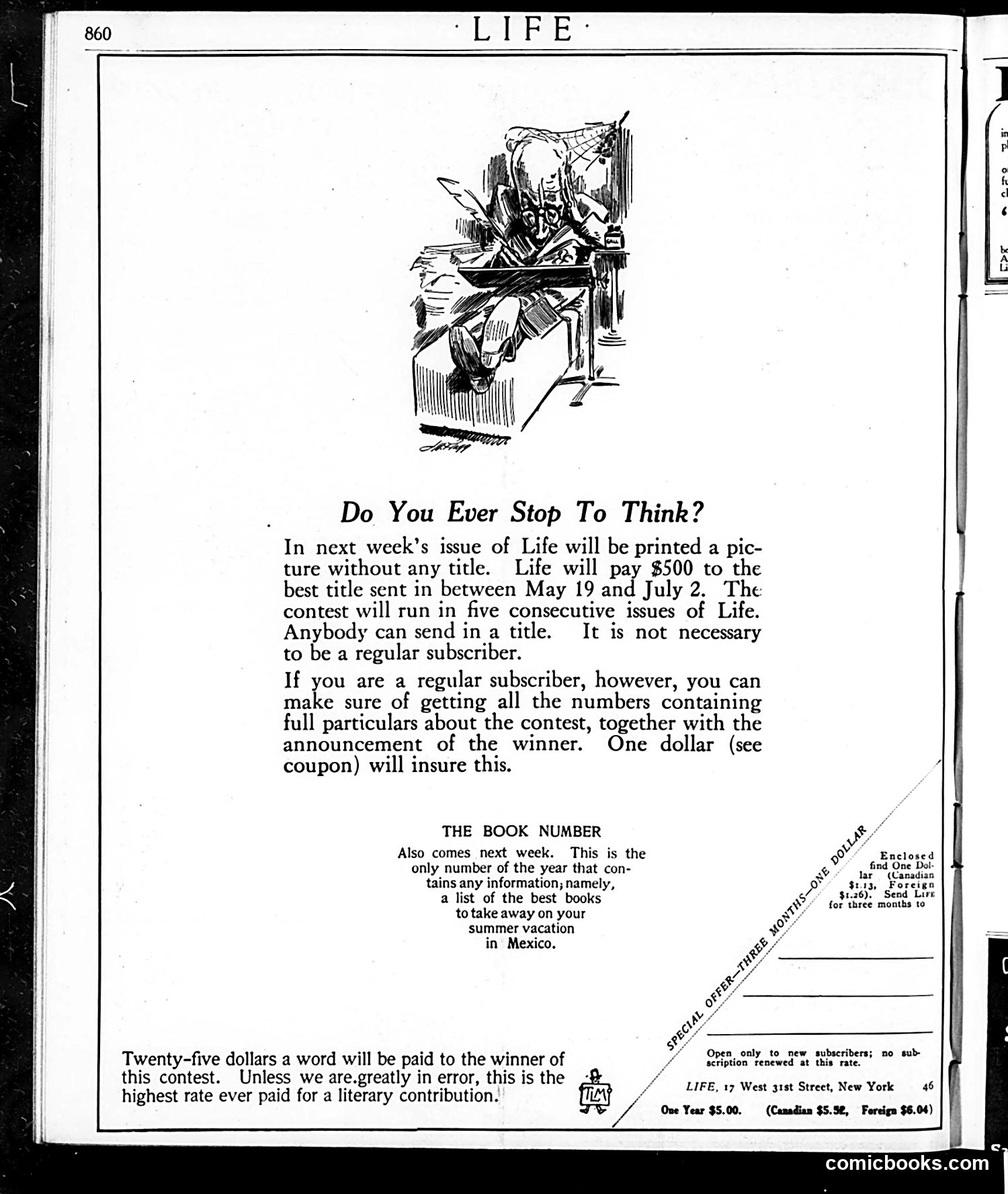
This page is primarily **advertising and contest announcements** rather than political satire. The main content announces two contests: 1. **"Do You Ever Stop To Think?"** - A $500 prize contest for the best title to accompany an untitled picture (shown as a sketch of a figure at a desk). 2. **"The Book Number"** - Announcement of an upcoming special issue featuring book recommendations for summer vacation in Mexico. The cartoon itself is minimal—just an illustration of someone at work, serving as the visual prompt for the titling contest. The page emphasizes that **$25 per word** will be paid to the contest winner, claiming this is "the highest rate ever paid for a literary contribution." This is primarily a **reader engagement mechanism** rather than satirical content.
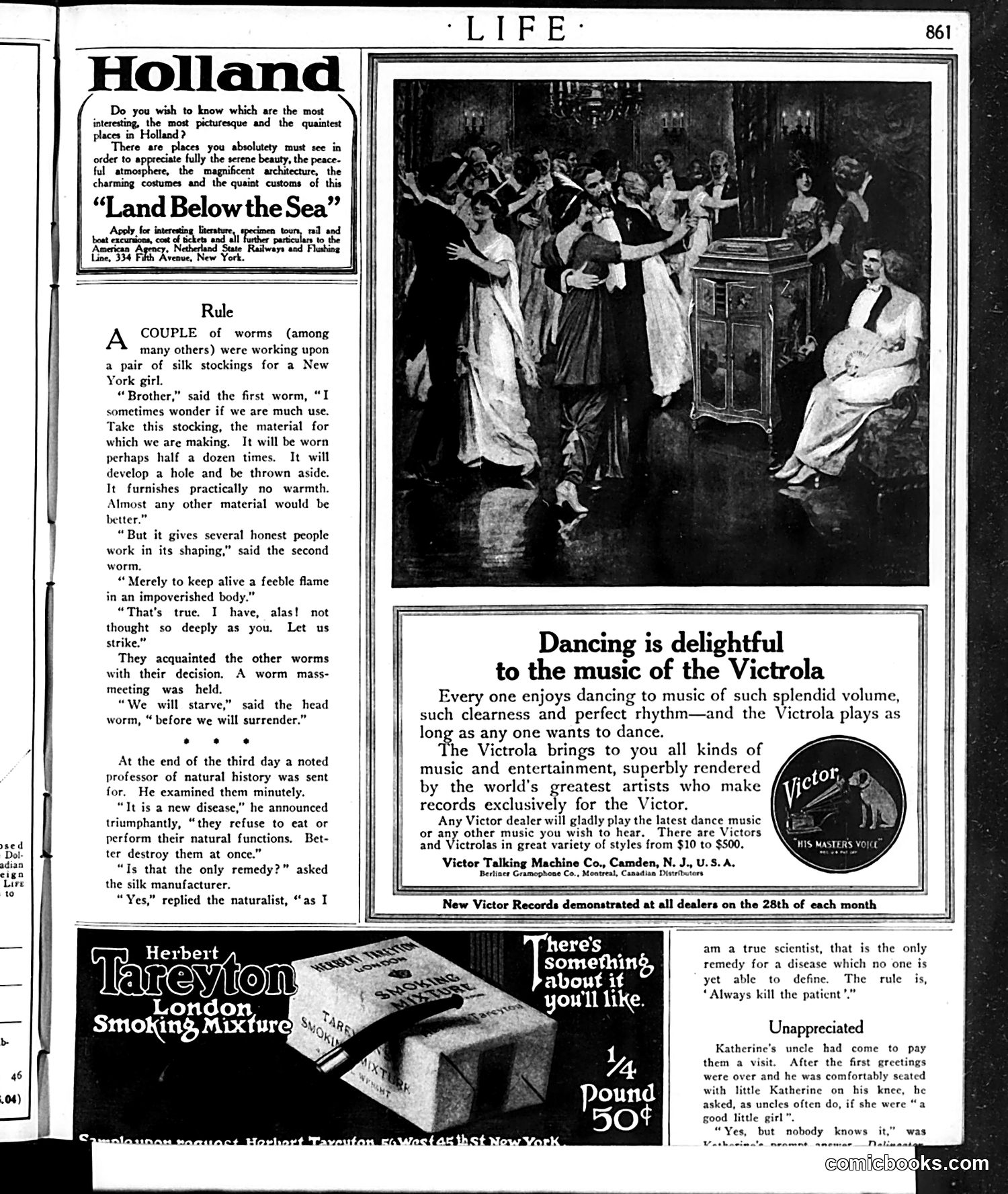
This page is primarily **advertising and light entertainment** rather than political satire. The main content includes: 1. **"A Rule"** - A humorous fable about worms debating whether to work on silk stockings for a New York girl, satirizing pointless philosophical arguments among workers. 2. **Advertisements** for: - Holland tourism ("Land Below the Sea") - Victrola phonographs (emphasizing dancing) - Herbert Tareyton/Gordon smoking mixture - Victor Records 3. **"Unappreciated"** - A brief domestic anecdote about a girl's uncle visiting and calling her "good" in a dismissive way. The page reflects early-20th-century consumer culture and light social humor rather than sharp political commentary. The worm fable may gently mock labor disputes of the era, but it's primarily whimsical rather than pointed satire.
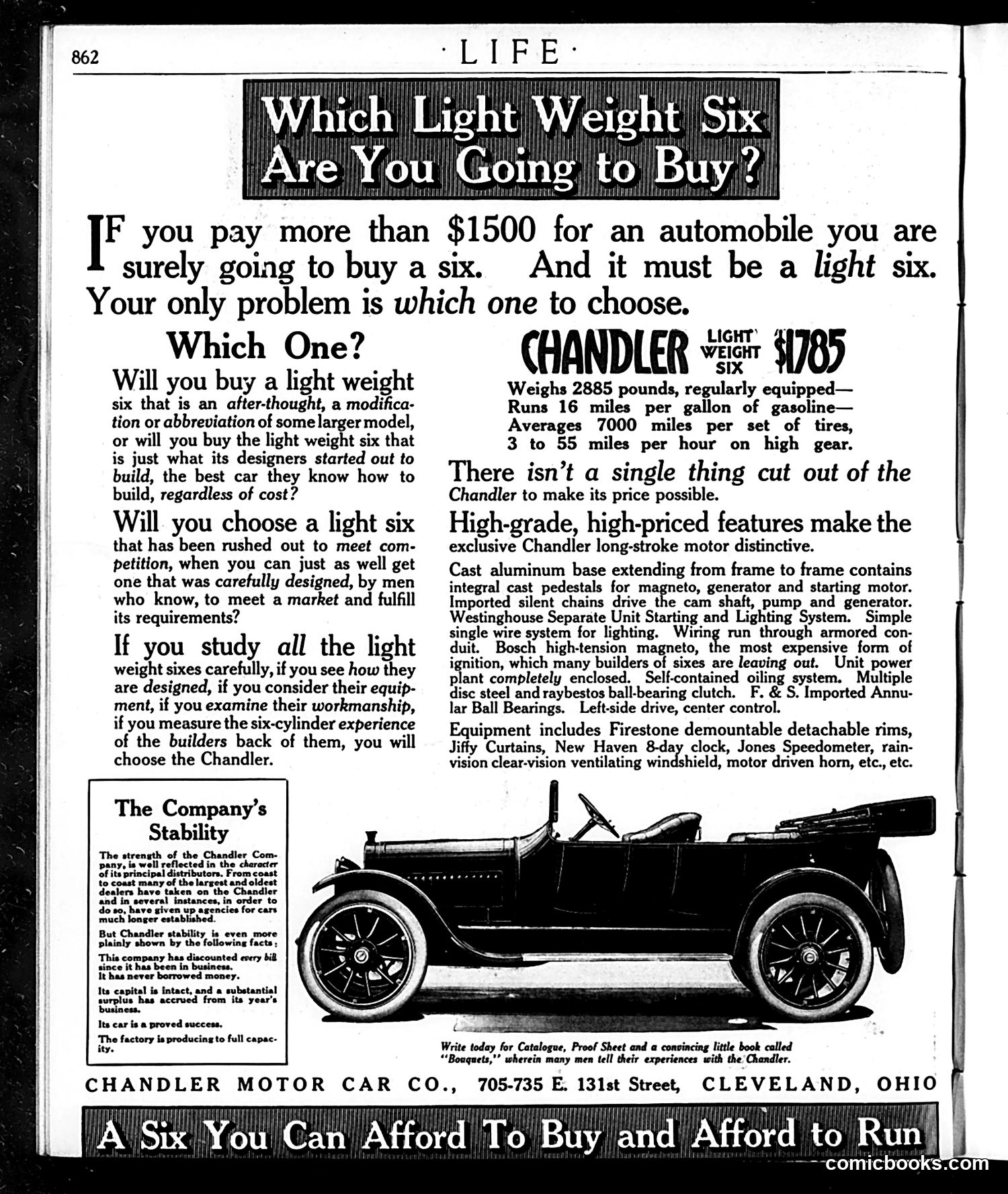
This is **primarily an advertisement**, not a political cartoon. It's a Chandler Motor Car Company ad from Life magazine (page 862) promoting their "Light Weight Six" automobile model priced at $1,785. The ad uses rhetorical questions to persuade potential buyers: if you're spending over $1,500 on a car, why not choose a Chandler? It argues their model is a purpose-built "light six" rather than a rushed competitor knockoff, highlighting features like cast aluminum construction, Westinghouse electrical systems, and Firestone tires. The accompanying illustration shows a side profile of an early 1920s automobile. The humor/satire is mild: the ad gently mocks cheaper competitors while positioning Chandler as the thoughtfully-engineered choice for serious buyers—typical early automotive advertising rhetoric.
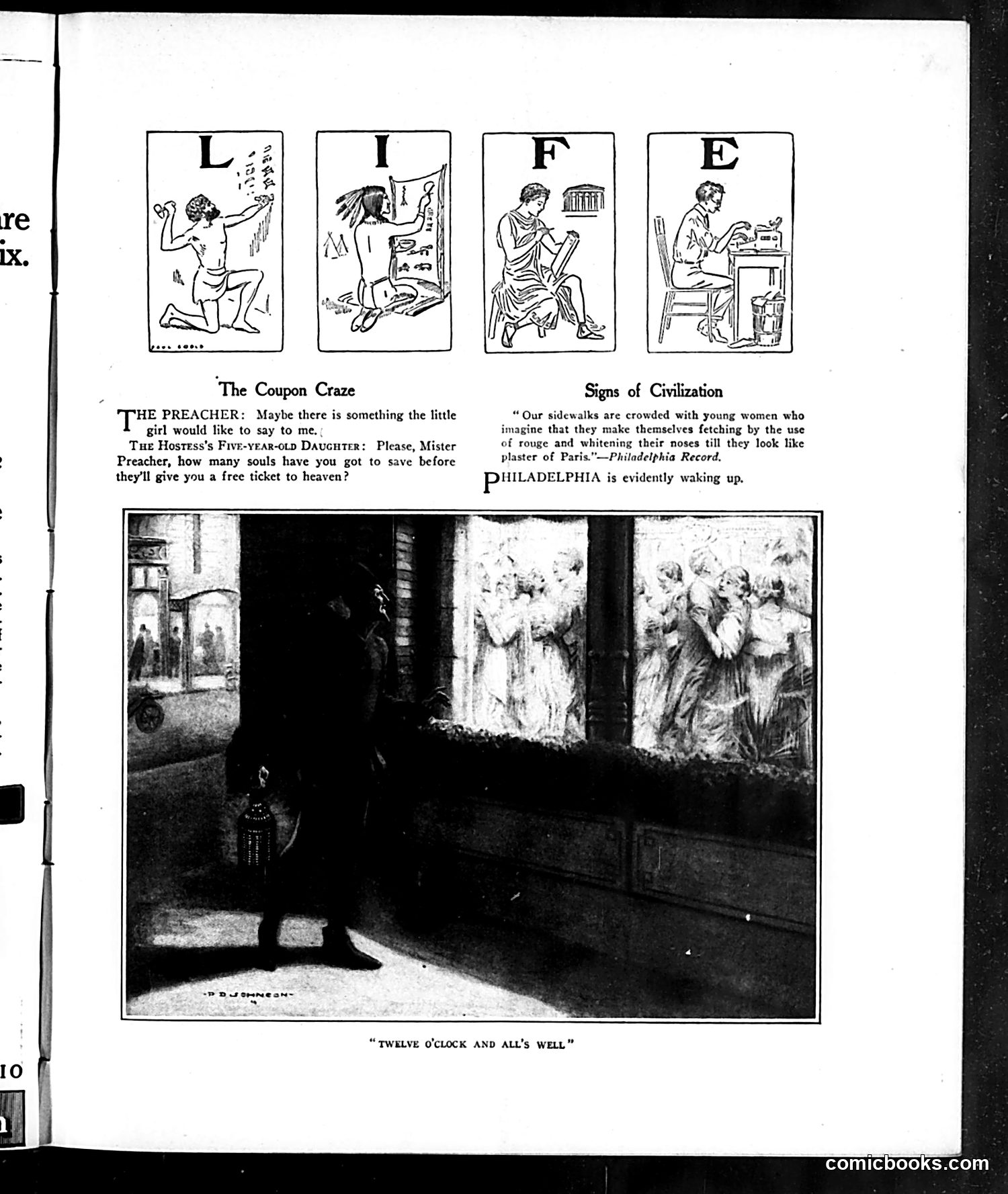
This page contains two separate satirical pieces from Life magazine: **"The Coupon Craze"** mocks evangelical preachers' promises of salvation. A five-year-old child naively asks a minister how many souls he must save to earn a "free ticket to heaven"—treating spiritual redemption like a commercial coupon promotion. The satire targets the commodification of religion and transactional approaches to faith. **"Signs of Civilization"** criticizes Philadelphia women's use of cosmetics. It quotes the *Philadelphia Record* mocking women who use rouge and whitening powder, claiming they're making themselves ridiculous. The four vignette illustrations (L, I, F, E) appear to show various vanity behaviors. The satire targets both women's beauty practices and the moralizing criticism they faced. Both pieces reflect early 20th-century social anxieties about commercialism and changing social norms.
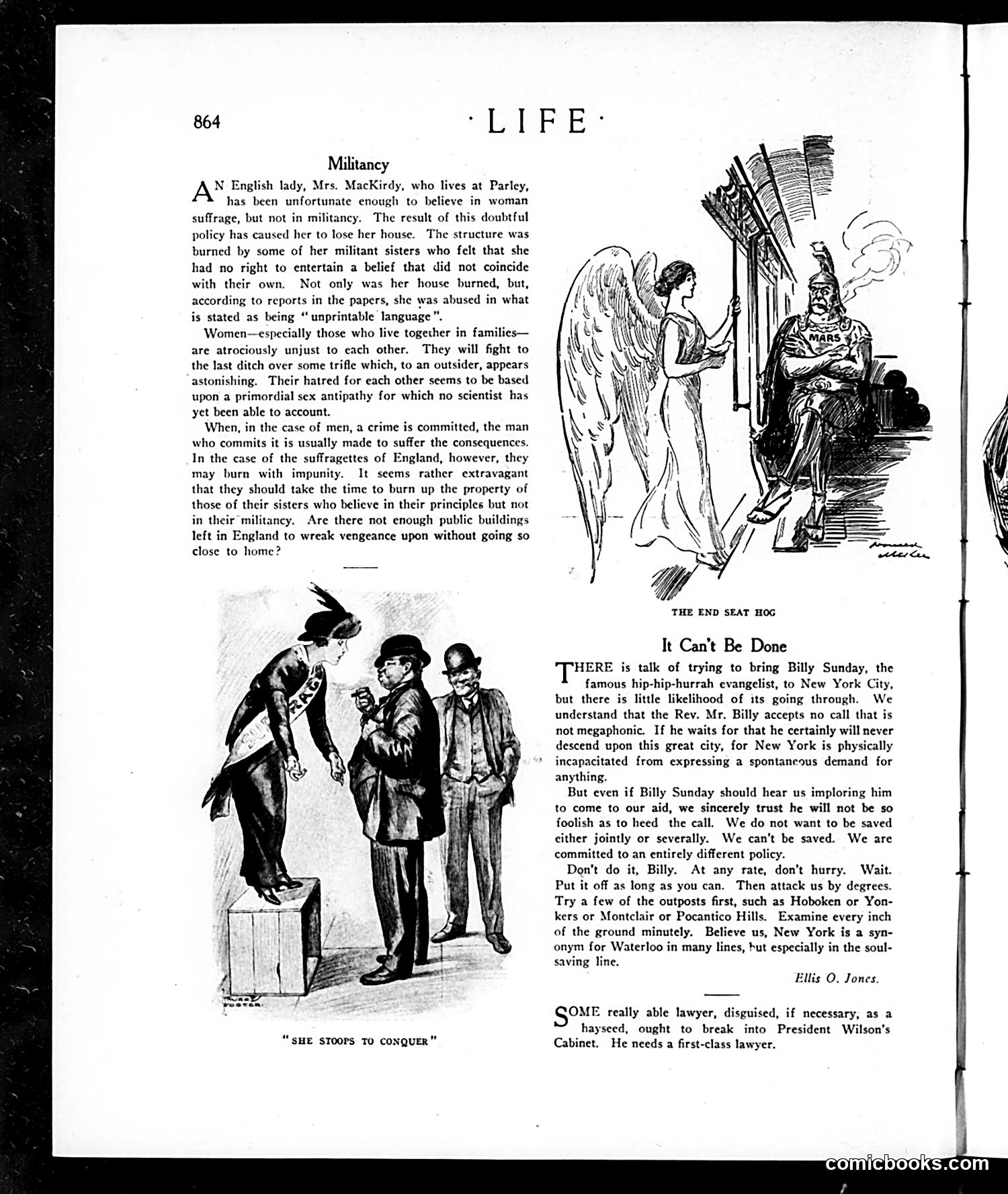
This page satirizes two contemporary issues: **"Militancy"** criticizes female suffragettes who use violent tactics. The text describes an English lady at Parley whose house was burned by militant suffragists. The accompanying cartoon "She Stoops to Conquer" depicts a woman literally standing on a pedestal before men, mocking suffragettes' methods as counterproductive and undignified. **"It Can't Be Done"** discusses efforts to bring evangelist Billy Sunday to New York City. The author (Ellis O. Jones) argues it's unlikely and advises against trying, suggesting New York is spiritually resistant to religious revival. Both pieces use satirical humor to critique what the magazine viewed as misguided contemporary movements—violent feminism and evangelical campaigns.
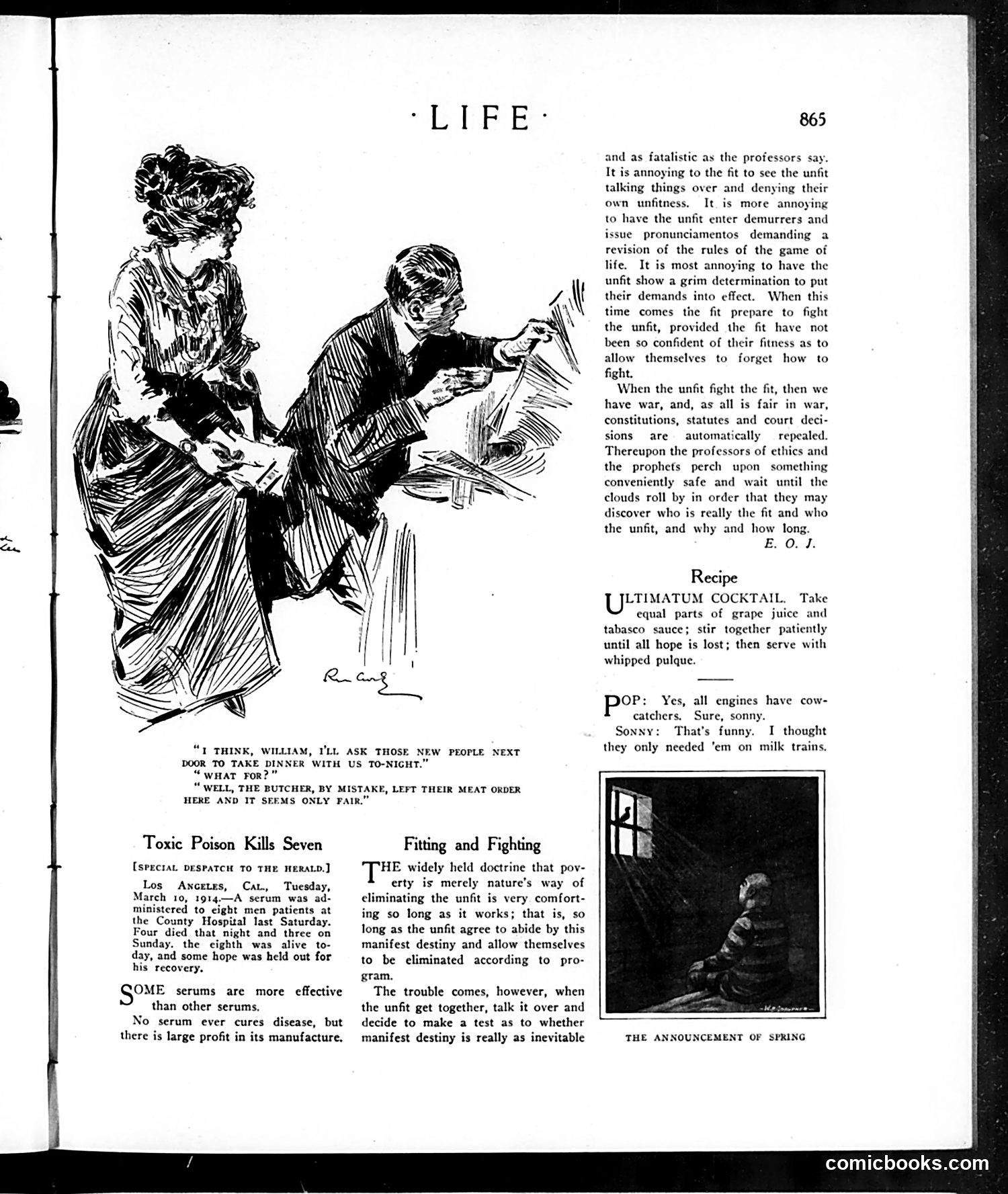
The main cartoon depicts a man and woman, with the caption suggesting they're inviting new neighbors to dinner, but the butcher mistakenly left only "fair" meat. This appears to be domestic humor about common household frustrations. The page's substantive content concerns "Toxic Poison Kills Seven" — a news dispatch from Los Angeles reporting a serum administered to fight disease that proved fatal to some patients. The accompanying article discusses whether poverty causes unfitness and debates "manifest destiny" as justification for eliminating the unfit. This reflects early 20th-century eugenics discussions prominent in American intellectual circles. The "Ultimatum Cocktail" recipe and "Pop/Sonny" dialogue are lighthearted filler content typical of Life's satirical format.
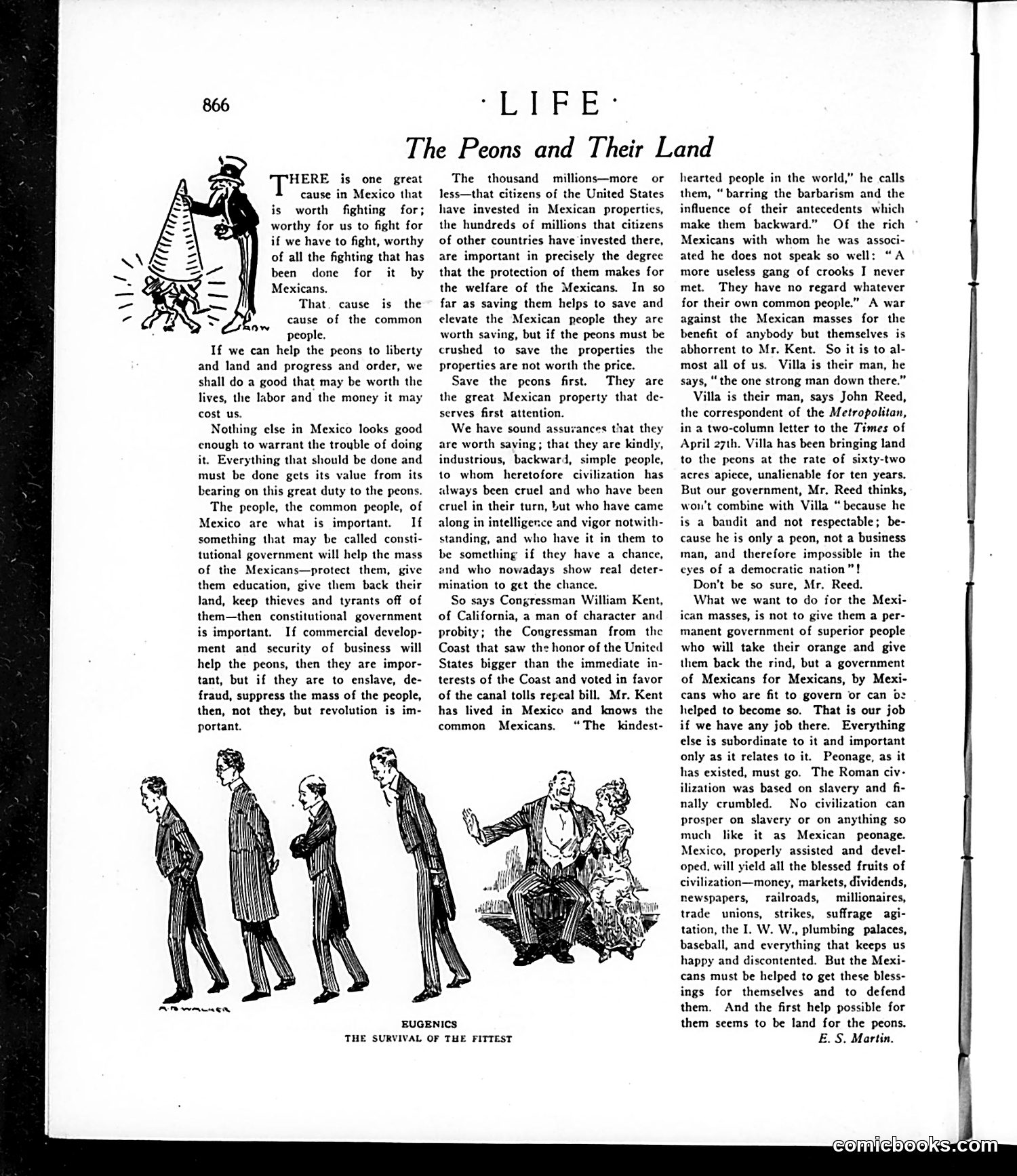
This page discusses Mexican land reform and U.S. interests in Mexico. The main article argues that protecting Mexican peasants (peons) and giving them land is essential—more important than protecting American business investments. The bottom cartoon, titled "Eugenics: The Survival of the Fittest," depicts four progressively taller, healthier-looking men, contrasted with a shorter, hunched figure on the right. This appears to critique Social Darwinist ideas popular in the early 20th century—the notion that some populations were inherently "superior" based on physical appearance. The cartoon likely satirizes how such pseudoscientific racism was being used to justify inequalities and discrimination, particularly regarding Mexican citizens.
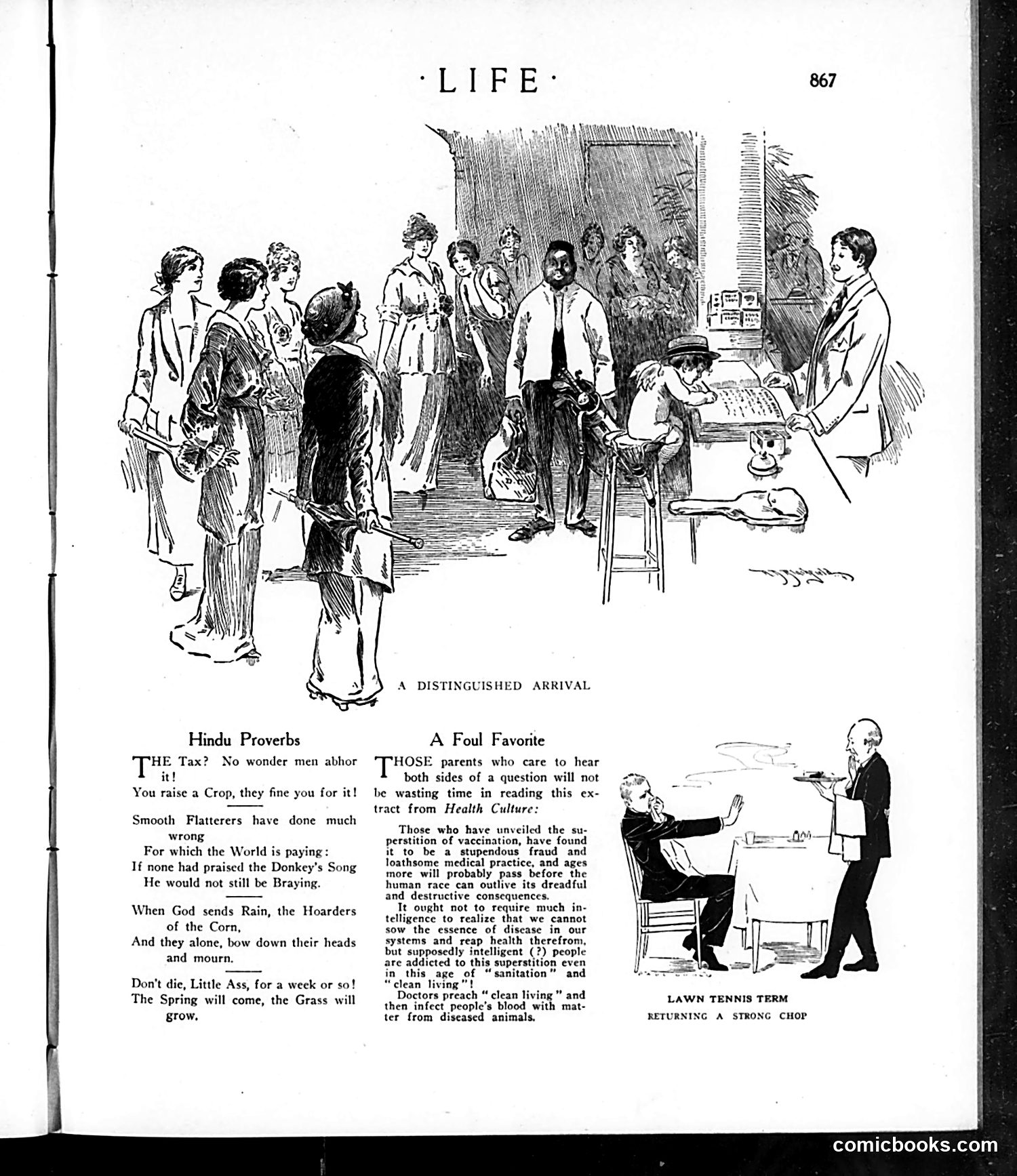
**Top Cartoon: "A Distinguished Arrival"** This sketch depicts a formal social gathering where a well-dressed man of color arrives at what appears to be an upper-class event. The title suggests satire about social acceptance—the "distinguished arrival" is presented ironically, as the gathered guests (drawn in various states of reaction) respond to his entrance. The humor relies on commentary about race and social hierarchy in early 20th-century America. **Text Sections:** The page includes "Hindu Proverbs" (satirizing folk wisdom) and "A Foul Favorite," which criticizes anti-vaccination superstition and "clean living" pseudoscience, arguing such beliefs prevent rational disease prevention. **Bottom Cartoon: "Lawn Tennis Term—Returning a Strong Chop"** A simple domestic scene showing a man at a desk rejecting a woman's request, likely marital satire about refusing wives' demands.
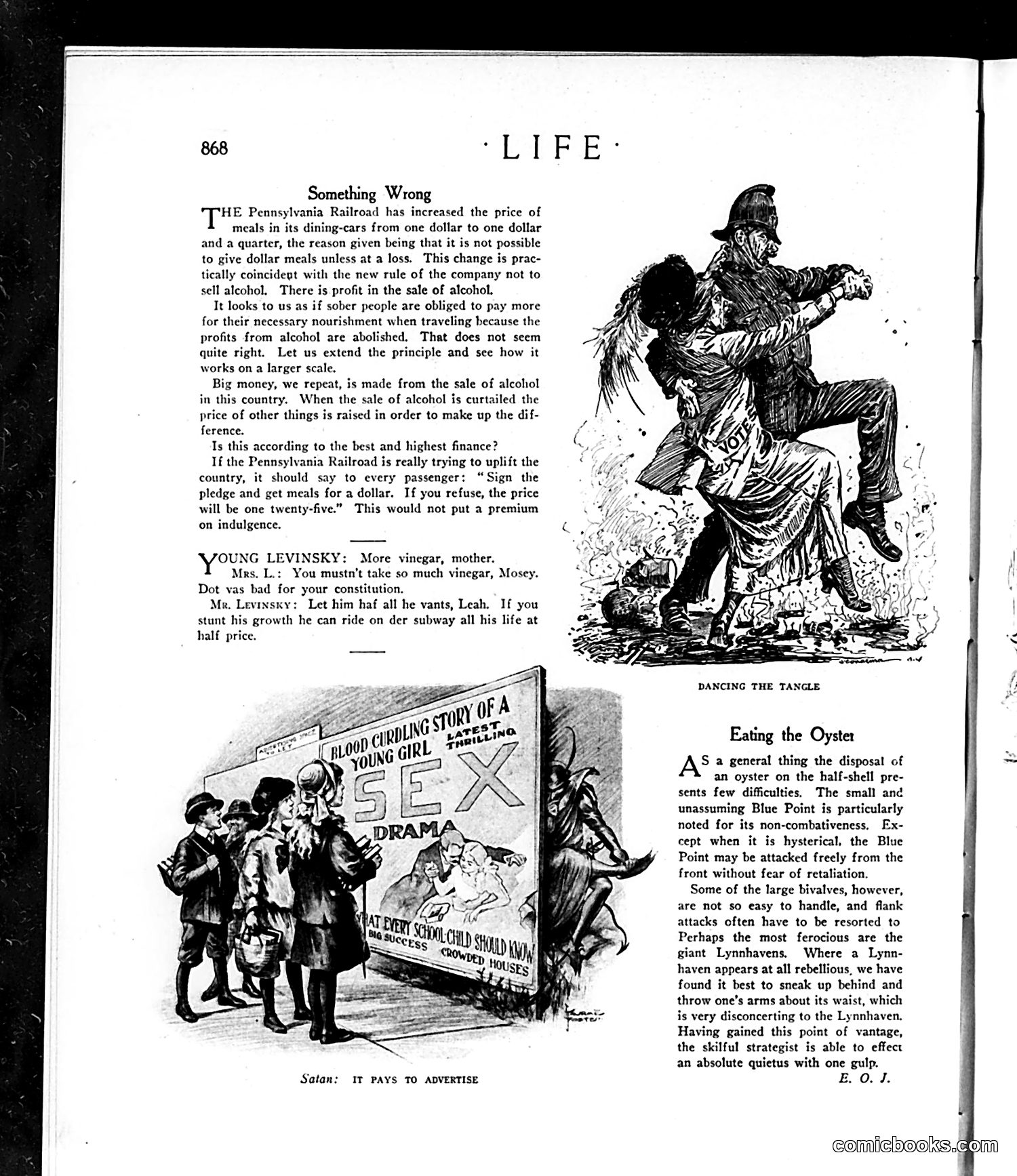
**"Something Wrong"** critiques the Pennsylvania Railroad's pricing logic: they raised dining-car meal prices from $1 to $1.25, claiming they can't profit otherwise—yet they're abolishing alcohol sales (which were apparently profitable). The article sarcastically suggests this penalizes sober passengers, forcing them to subsidize lost alcohol revenues. It questions whether this financial strategy is sound. **"Young Levinsky"** appears to be a humorous domestic exchange about vinegar consumption and health. **"Dancing the Tangle"** (illustration, right) shows a figure in motion—likely satirizing a contemporary dance craze. **"Eating the Oyster"** provides naturalist observations about oyster consumption and handling difficult bivalves, particularly the aggressive Lynnhaven variety. The page mixes satire, humor, and practical advice typical of Life magazine's format.
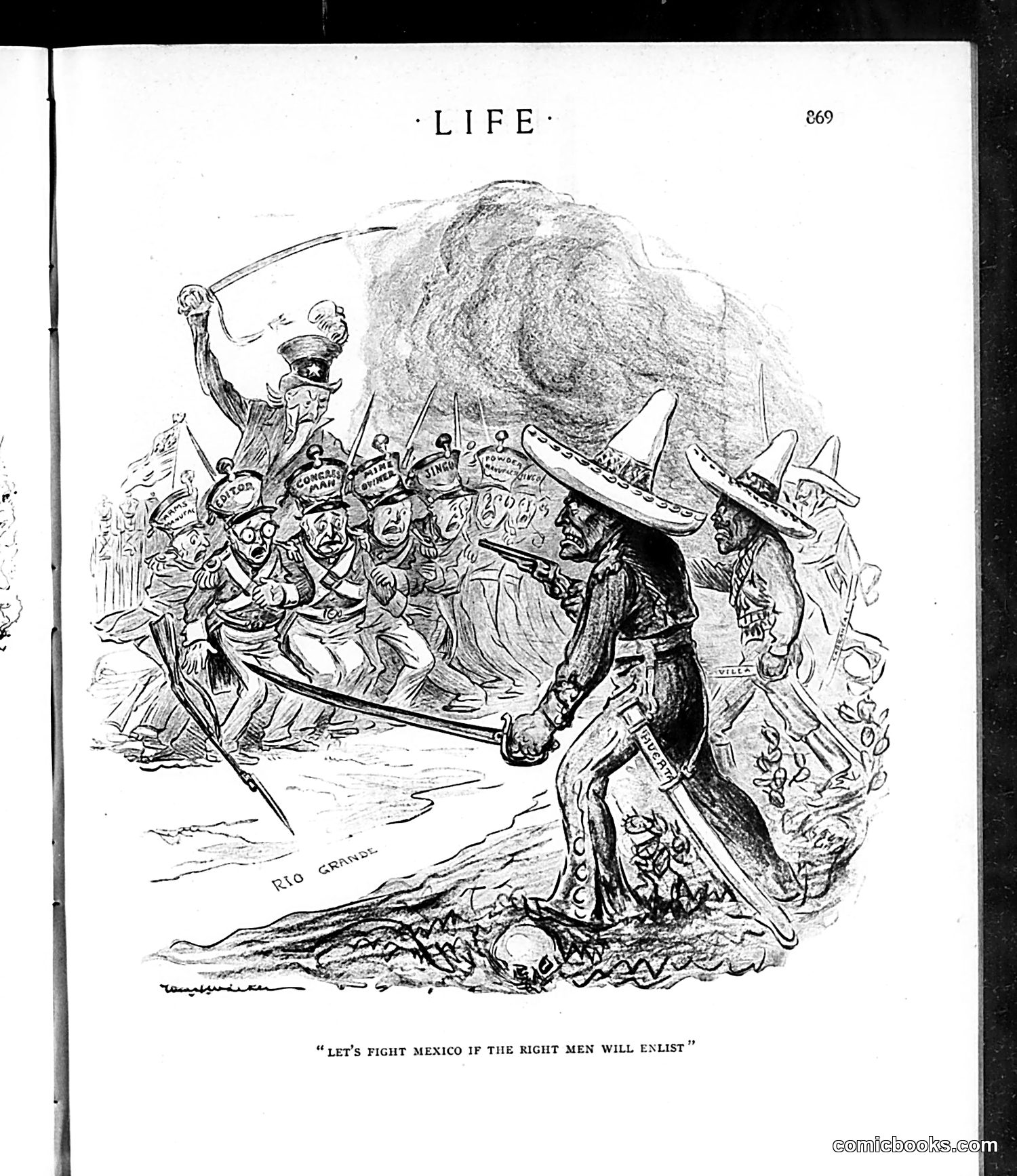
This satirical cartoon appears to reference American military intervention in Mexico. The caption reads: "LET'S FIGHT MEXICO IF THE RIGHT MEN WILL ENLIST." The cartoon depicts a large military figure in Mexican dress (wide-brimmed sombrero, ornate uniform) wielding a sword, confronting a group of smaller soldiers in military uniforms. The figure is labeled "RIO GRANDE," indicating the U.S.-Mexico border. The satire criticizes war recruitment rhetoric—specifically mocking the idea that military leaders propose fighting Mexico while being selective about who actually enlists to fight. The contrast between the imposing Mexican figure and the modest enlisted men suggests skepticism about the feasibility or wisdom of such military action. This likely references early 20th-century U.S.-Mexico tensions, though the specific historical moment remains unclear from the image alone.
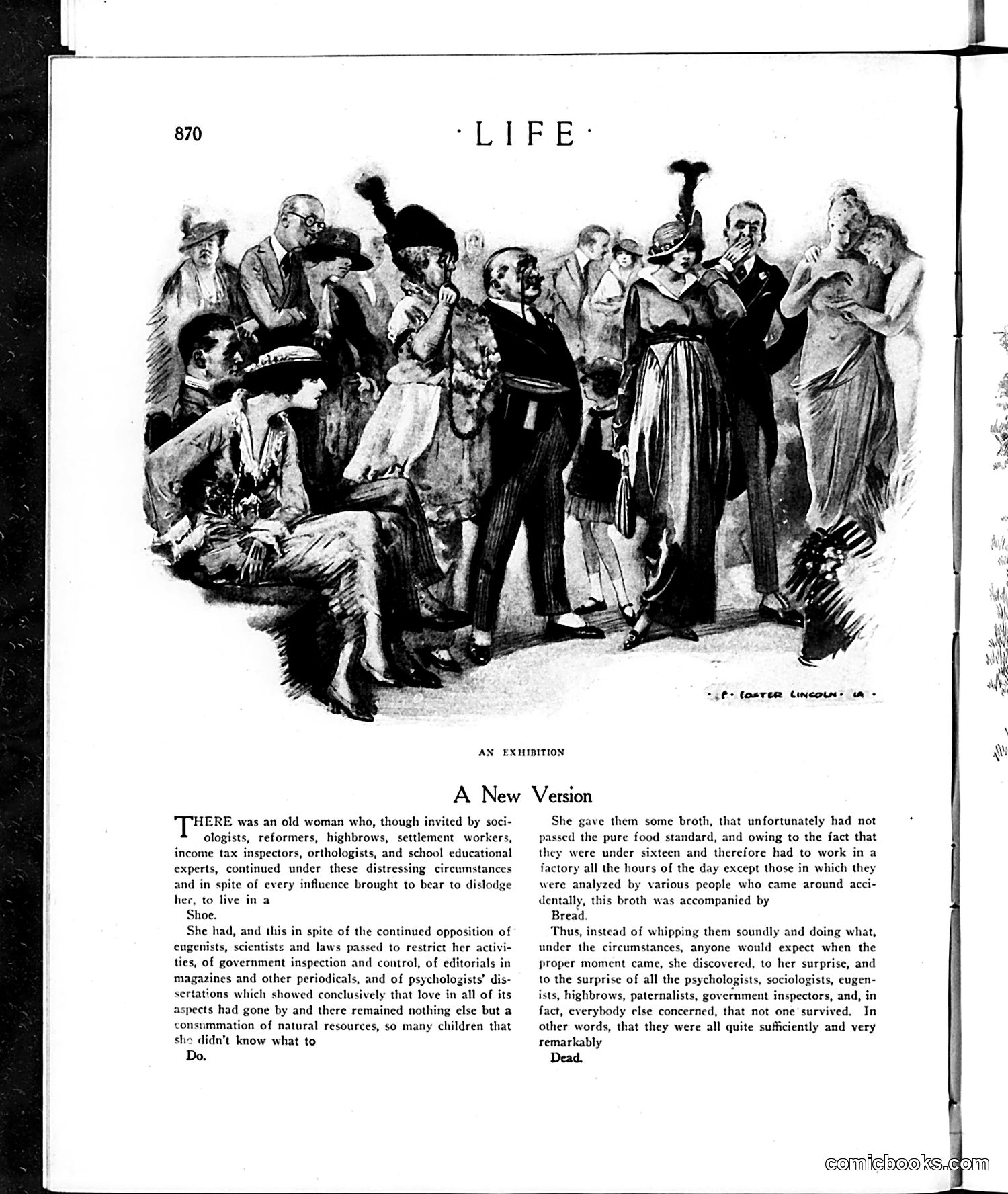
This satirical piece mocks progressive reformers of the early 20th century. The illustration shows various types of reformers—sociologists, settlement workers, government inspectors, and educational experts—gathered around an impoverished woman in a tenement ("Shoe"). The satire's point: despite all their interventions, inspections, regulations, and expertise, these well-intentioned reformers accomplish nothing. The woman remains in poverty, her children still malnourished. The story's dark conclusion—they all end up "remarkably Dead"—suggests the reformers' well-meaning but ineffective efforts are futile or even harmful. This reflects early skepticism about Progressive Era bureaucratic solutions to poverty and social problems, questioning whether expert intervention could truly address systemic poverty.
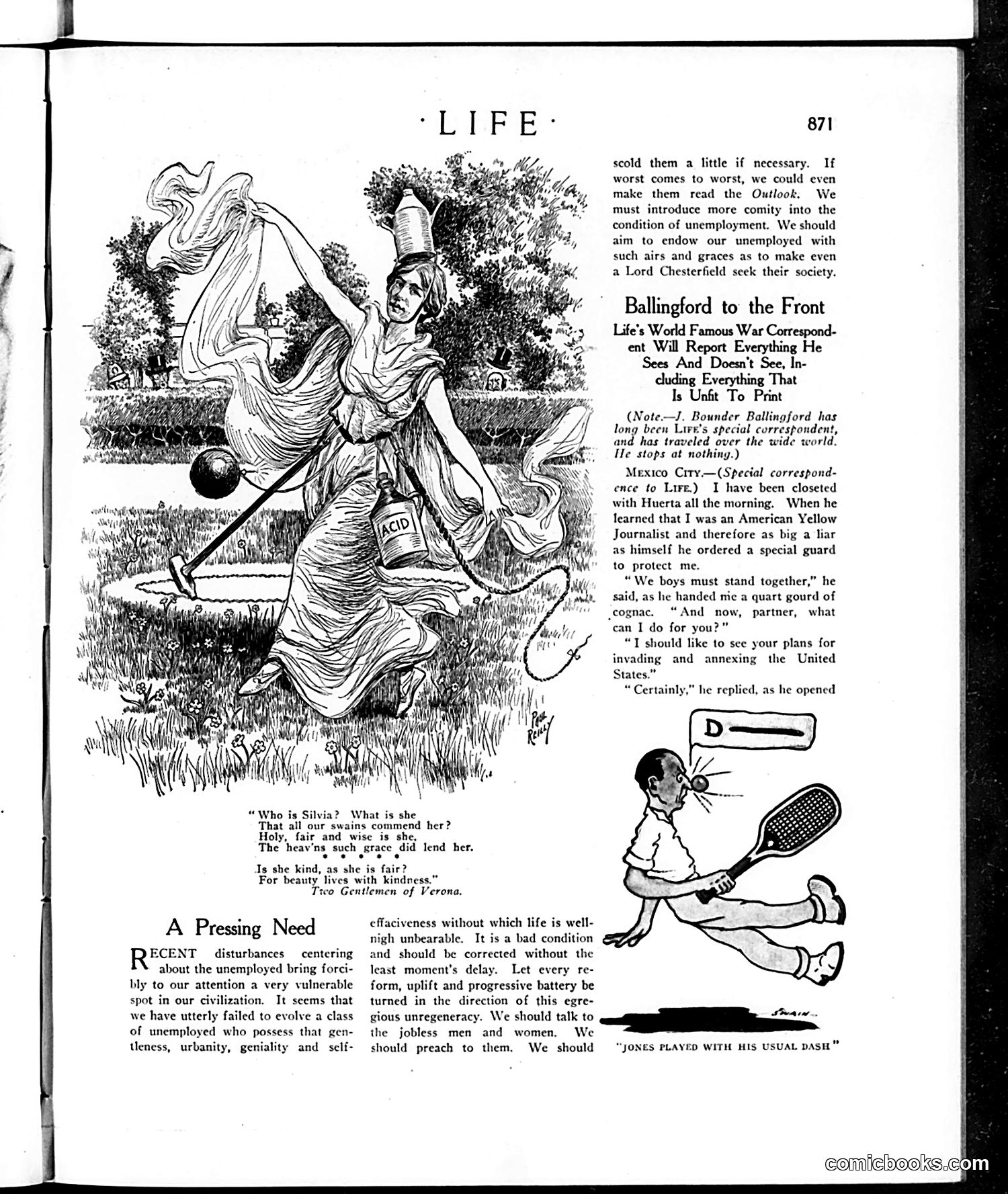
This page contains two distinct satirical pieces: **"A Pressing Need"** mocks upper-class attitudes toward unemployment. The author sarcastically suggests the real problem isn't lack of jobs, but that unemployed people lack "gentleness, urbanity, geniality"—refinement. The joke is that privileged commentators blame unemployed workers for being uncouth rather than addressing actual economic hardship. References to "Lord Chesterfield" (known for courtesy advice) and making them read *The Outlook* (a respectable magazine) amplify the absurdity. **"Ballingford to the Front"** satirizes sensationalist war journalism. The correspondent claims to report "Everything He Sees And Doesn't See"—admitting he fabricates news. The Mexico City scene parodies yellow journalism: a Mexican general (Huerta) and American journalist recognize each other as liars and allies, both willing to invent stories about invading the United States. This critiques how journalists and politicians manufacture war narratives for public consumption. Both pieces use exaggeration to expose hypocrisy and self-serving dishonesty among authority figures.
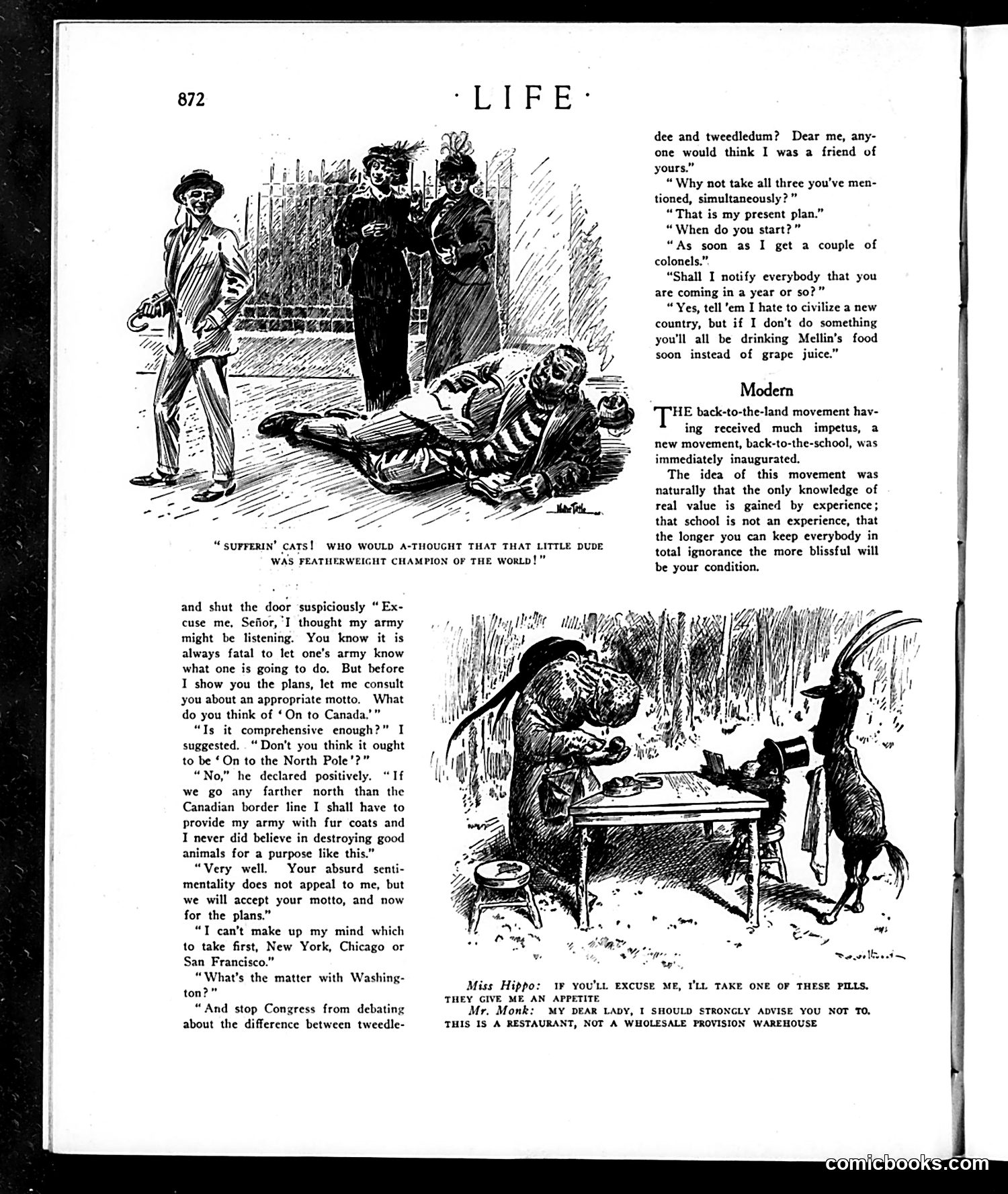
This page contains multiple cartoons satirizing early 20th-century American movements and social trends. The top cartoon mocks a military invasion plan, with a character debating which American city to "civilize" first—New York, Chicago, San Francisco, or Washington. The satire targets political incompetence and absurd imperial ambitions, suggesting Congress is so dysfunctional it barely merits conquering. The middle section ridicules the "back-to-the-land" and "back-to-the-school" movements—contemporary trends advocating rural living and experiential over formal education. Life sarcastically argues that keeping people ignorant makes them "blissful." The bottom cartoon shows a small boxer defeating larger opponents, captioned "featherweight champion"—likely referencing a real boxing upset that surprised observers. The final cartoon depicts a hippopotamus in a restaurant requesting diet pills to increase appetite, with a monk warning her the establishment isn't a "wholesale provision warehouse." This jokes about excessive consumption and gluttony.
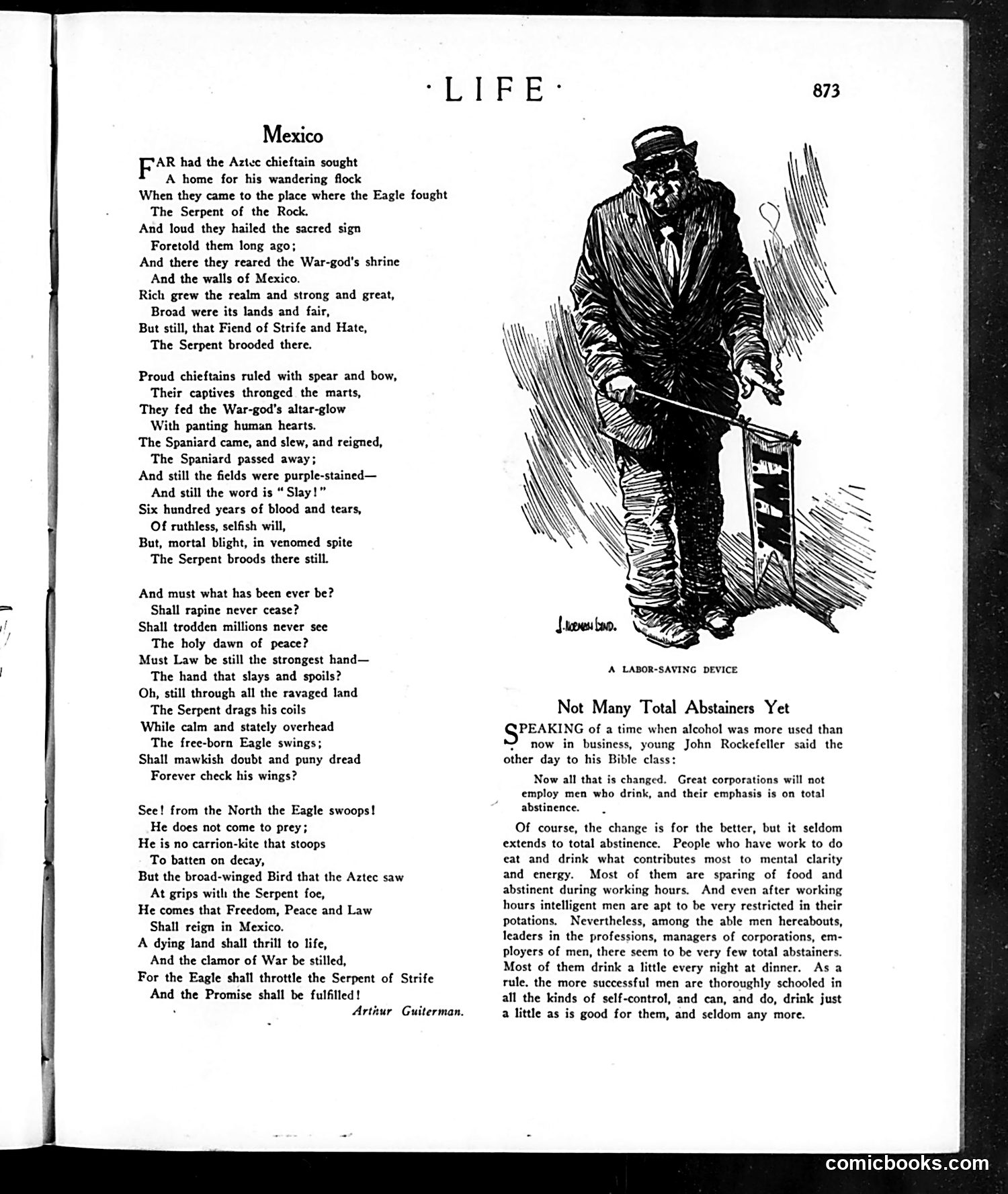
**The Poem "Mexico"** (left side): This allegorical poem uses Aztec mythology to comment on Mexico's history. The "Eagle" represents the United States, the "Serpent" symbolizes violence and strife plaguing Mexico. The poem traces Mexico from Aztec foundations through Spanish conquest to the present, suggesting six centuries of bloodshed. It concludes optimistically that the American Eagle will intervene to bring "Freedom, Peace and Law" to Mexico—reflecting American imperialist rhetoric of the early 20th century, likely referencing U.S. military interventions in Mexico. **The Illustration**: A caricatured figure (unclear who specifically) appears to be a labor-saving device, possibly satirizing industrial efficiency or mechanization. **"Not Many Total Abstainers Yet"** (right): References John D. Rockefeller's claims that corporations now prohibit drinking employees. The article counters this, noting successful businessmen actually drink moderately at dinner—satirizing the gap between prohibition rhetoric and actual practice during the temperance movement era.
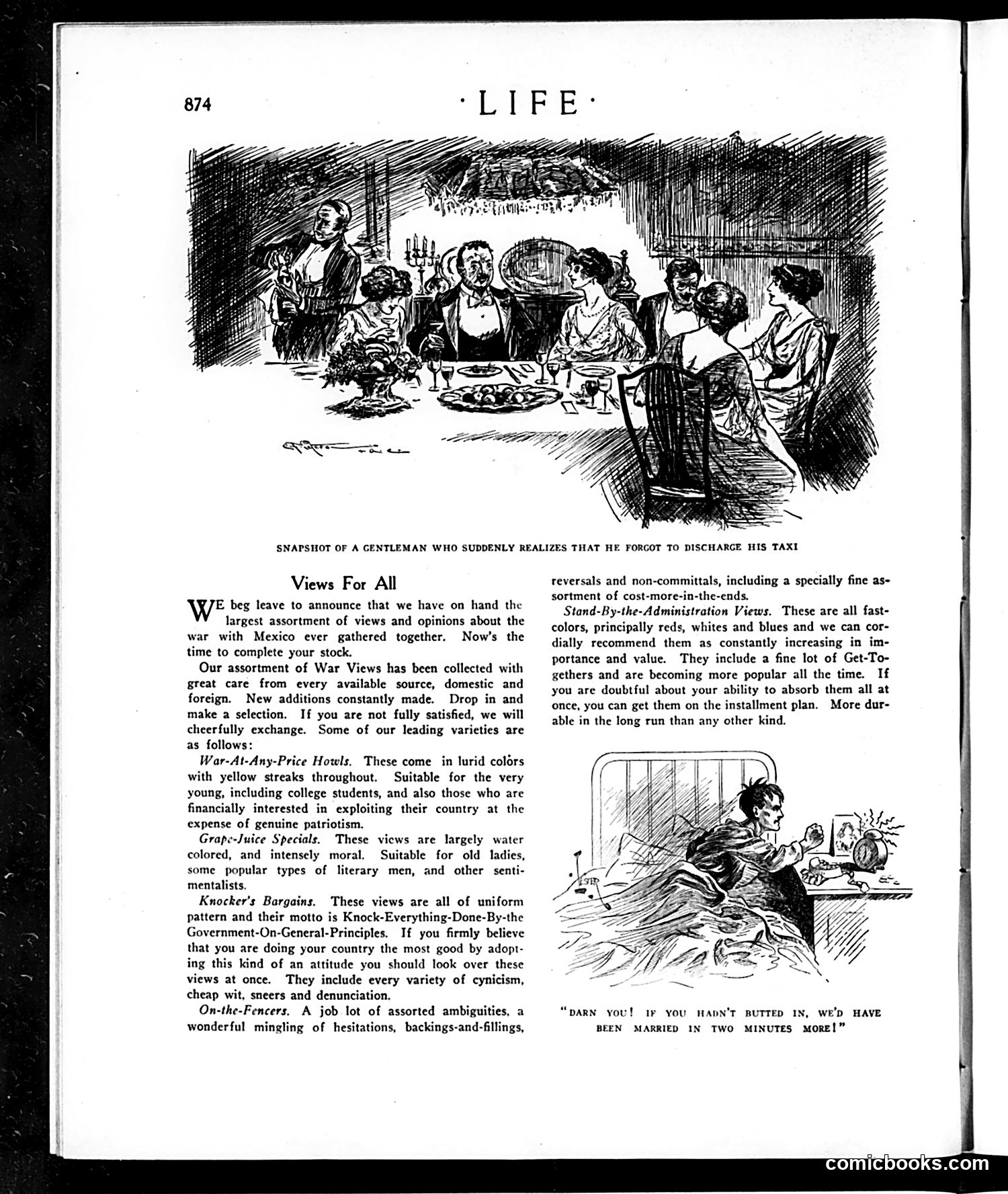
This Life magazine page satirizes American opinions about the **Mexican-American War** through a mock-catalog format. The text humorously categorizes different "types" of war views as products for sale: - **War-At-Any-Price Howls**: Hawkish, jingoistic views appealing to the young and profiteers - **Grape-Juice Specials**: Pacifist/moral positions for elderly and literary figures - **Knocker's Bargains**: Cynical anti-government criticism - **On-the-Fencers**: Wishy-washy non-committal stances - **Stand-By-the-Administration Views**: Pro-government patriotic support The satire mocks how Americans adopt pre-packaged political positions rather than thinking independently. The cartoons above and below illustrate embarrassing social moments—forgetting to pay a taxi, interrupting an engagement—suggesting the absurdity of people's contradictory or thoughtless behaviors, paralleling their adoption of convenient political opinions without genuine conviction.
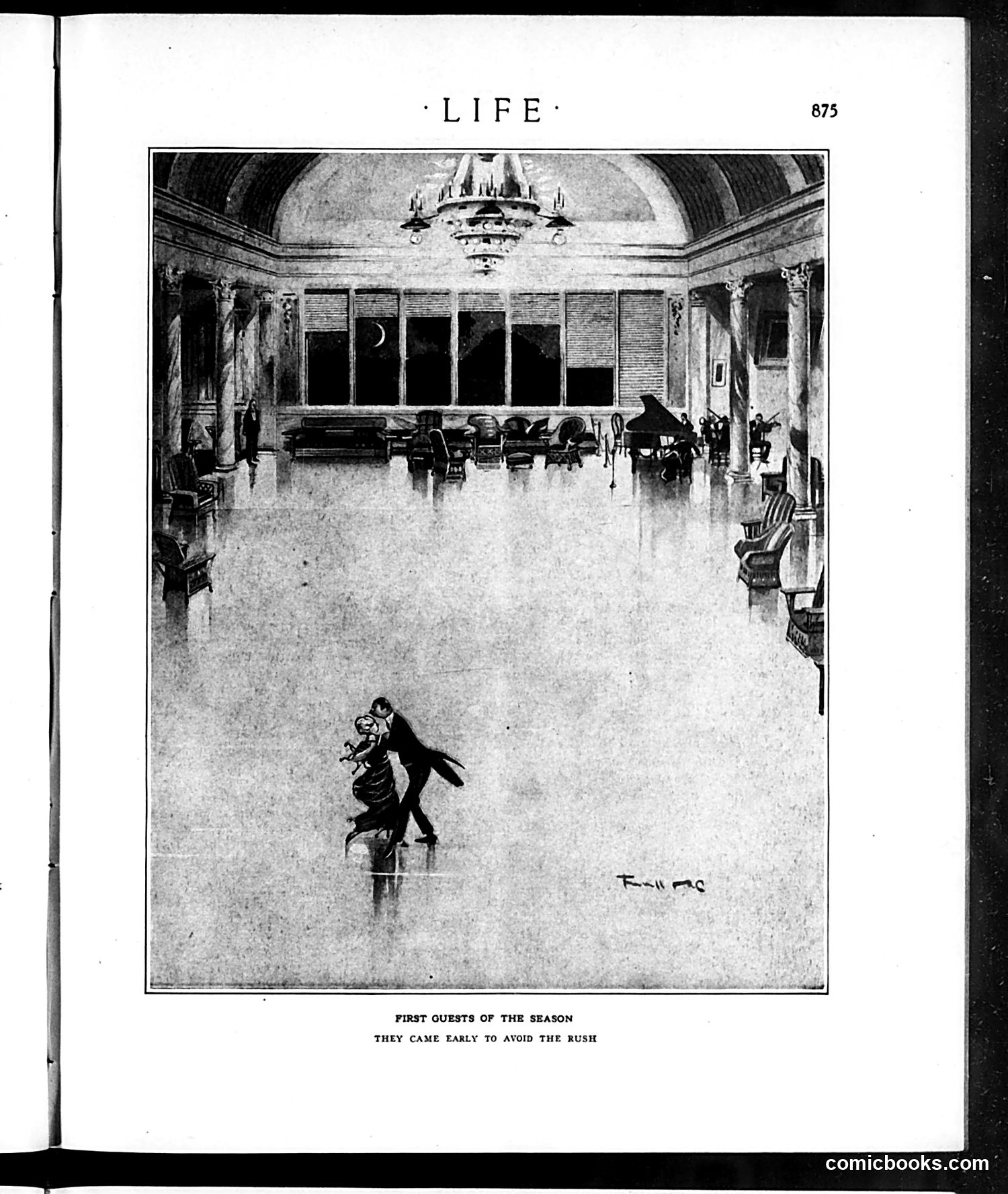
This is a satirical cartoon depicting an elegant ballroom or reception hall with a distinctive domed ceiling and chandelier. The caption reads "First Guests of the Season—They Came Early to Avoid the Rush." The joke appears to be about social anxiety or the awkwardness of arriving too early to a social event. Two figures are shown dancing alone in an otherwise empty grand hall, while other guests remain clustered on the periphery. The satire mocks the social contradiction: by arriving early to escape crowds, these guests have instead created the opposite problem—they're prematurely exposed in an empty space, making their early arrival conspicuous rather than convenient. This reflects early-20th-century upper-class social etiquette concerns about proper timing and behavior at formal events.
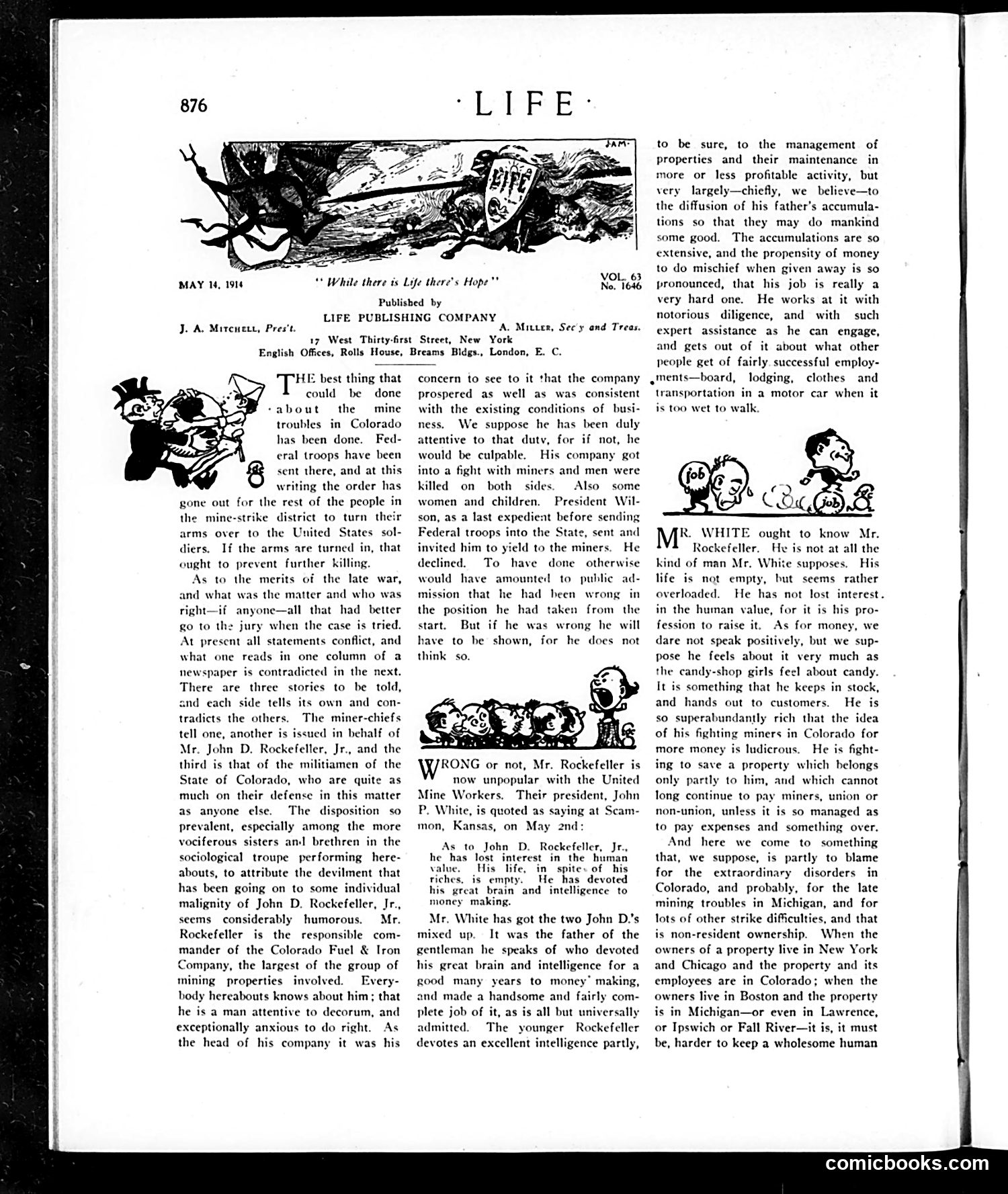
This page addresses the violent Colorado Fuel & Iron Company labor strikes—likely the "Ludlow Massacre" of April 1914, when militiamen killed miners, women, and children. The editorial defends John D. Rockefeller Jr., the company's head, against accusations of malice. Life argues that while the strike resulted in deaths, attributing all blame to Rockefeller personally is "considerably humorous." The magazine presents three competing narratives: miners' accounts, Rockefeller's defense, and the militia's perspective. Life also corrects union president John P. White's criticism of Rockefeller Jr., noting White confused him with his father (the original oil magnate). The younger Rockefeller, Life claims, devotes himself primarily to philanthropic distribution of his father's wealth—a "very hard" job—not mere money-making. The cartoons appear to satirize the competing claims and chaos of conflicting newspaper reports during the crisis.
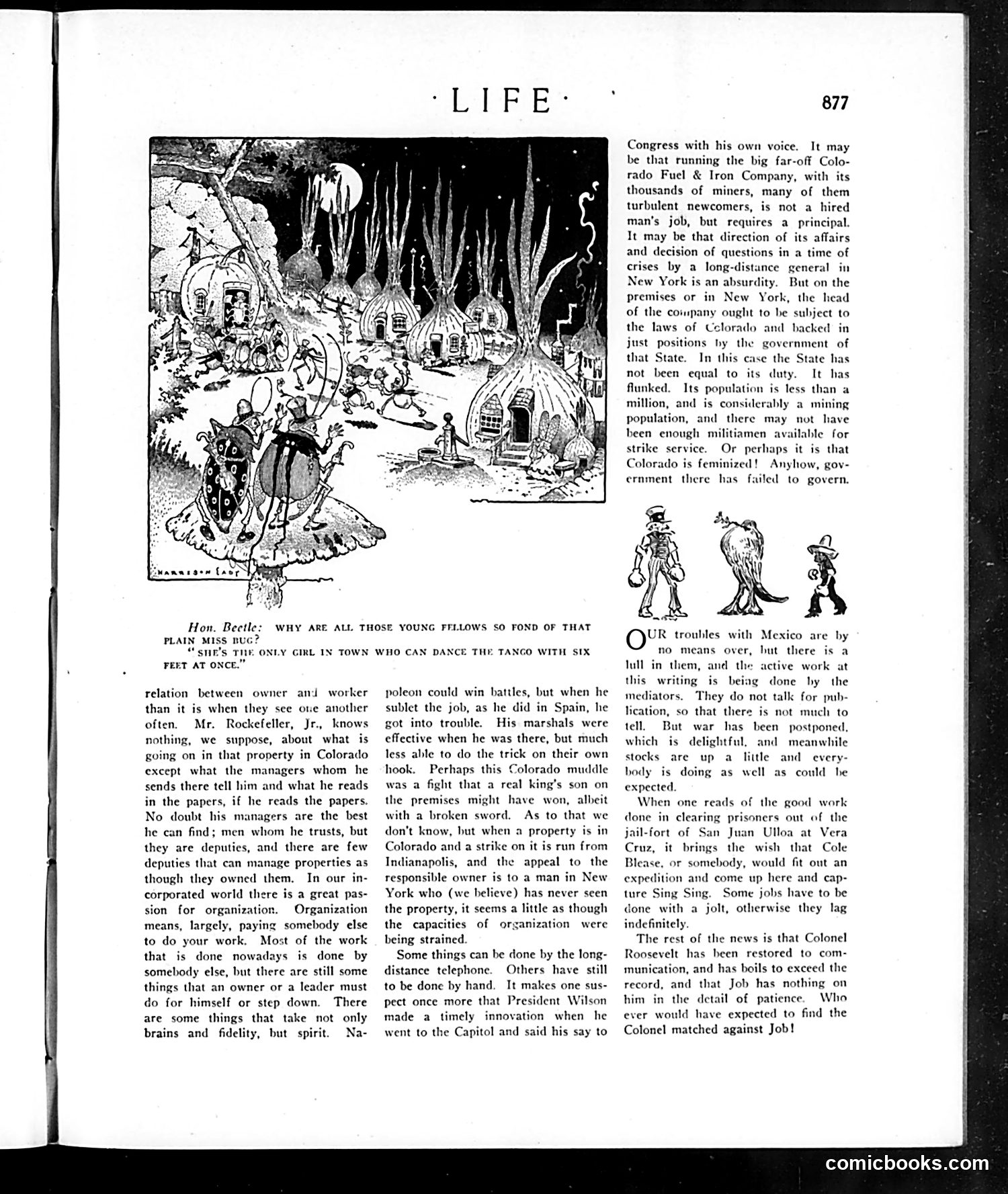
## The Cartoon The large illustration depicts an absurdist fantasy scene with onion-domed structures and fantastical creatures, accompanying a caption about "Hon. Beetle" and a girl who can "dance the tango with six feet at once"—a nonsensical visual joke typical of Life's satirical humor. ## The Main Text: Colorado Labor Crisis The editorial criticizes the Colorado Fuel & Iron Company's handling of a miners' strike. It argues that absentee ownership—with John D. Rockefeller Jr. in New York directing operations through distant managers—cannot effectively govern a turbulent mining population in crisis. The piece suggests that some situations require personal, on-site leadership ("a king's son on the premises"), not remote delegation. ## Historical Context This refers to the 1913-1914 Colorado coal miners' strike, a violent labor conflict. Life's satire critiques both corporate management failure and Colorado state government's inability to maintain order, sarcastically suggesting Colorado is "feminized" (implying weak). ## The Point The satire argues that organization and delegation have limits—personal leadership and presence matter, especially in crisis management.
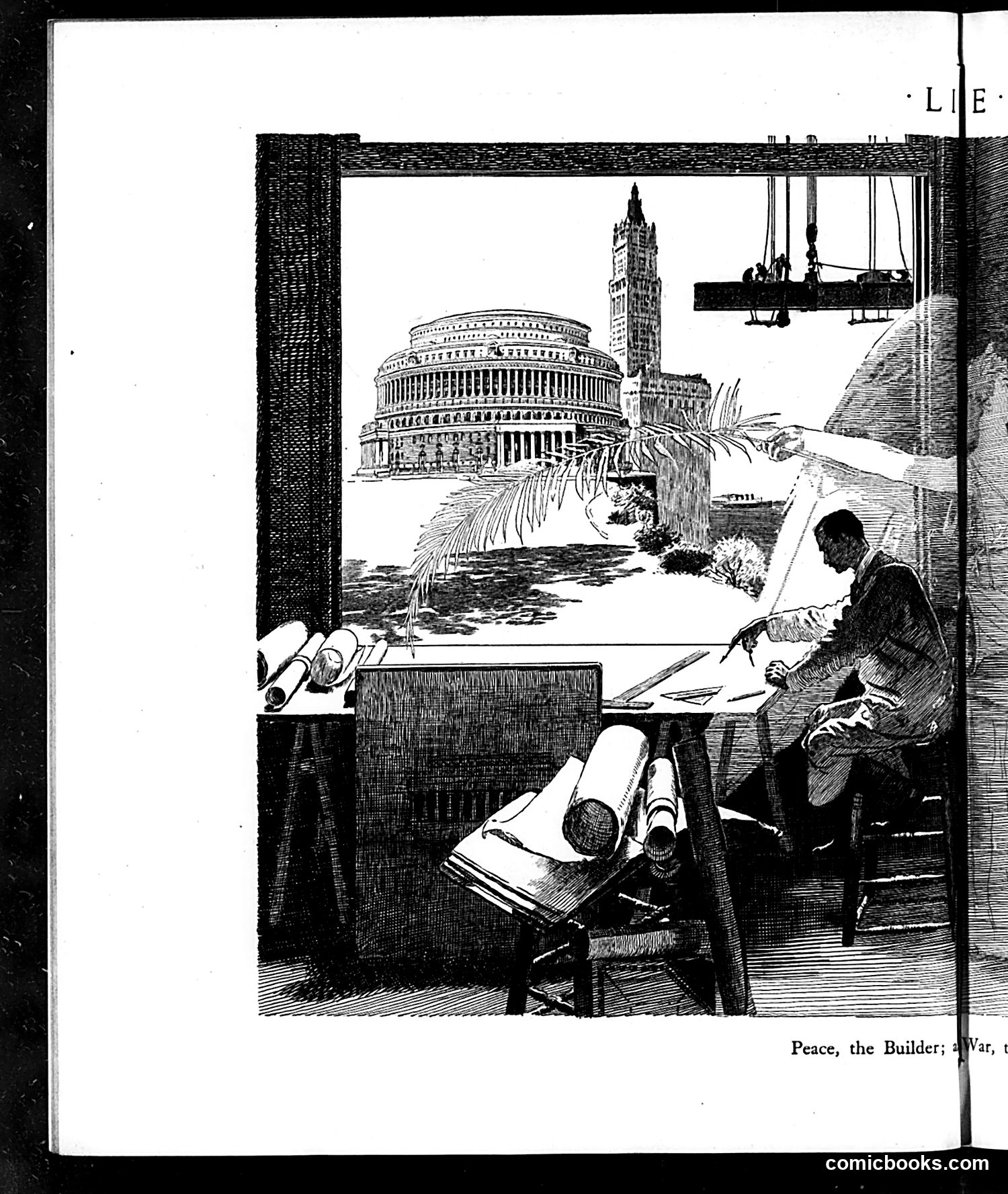
This political cartoon depicts an architect or planner at a drafting table overlooking a grand vision of American civic monuments—the Capitol dome and a tall tower (likely representing Washington, D.C. architecture). The figure works on blueprints while architectural plans and rolled documents surround him. The title "Peace, the Builder" suggests an allegorical message about peace as a constructive force. The contrast between the industrious designer indoors and the idealized government buildings visible through the window implies that peace enables civic development and national progress. This likely reflects early-20th-century optimism about peaceful governance supporting American institutional growth, or possibly commentary on post-war reconstruction and building initiatives. The specific historical context remains unclear without additional page information.
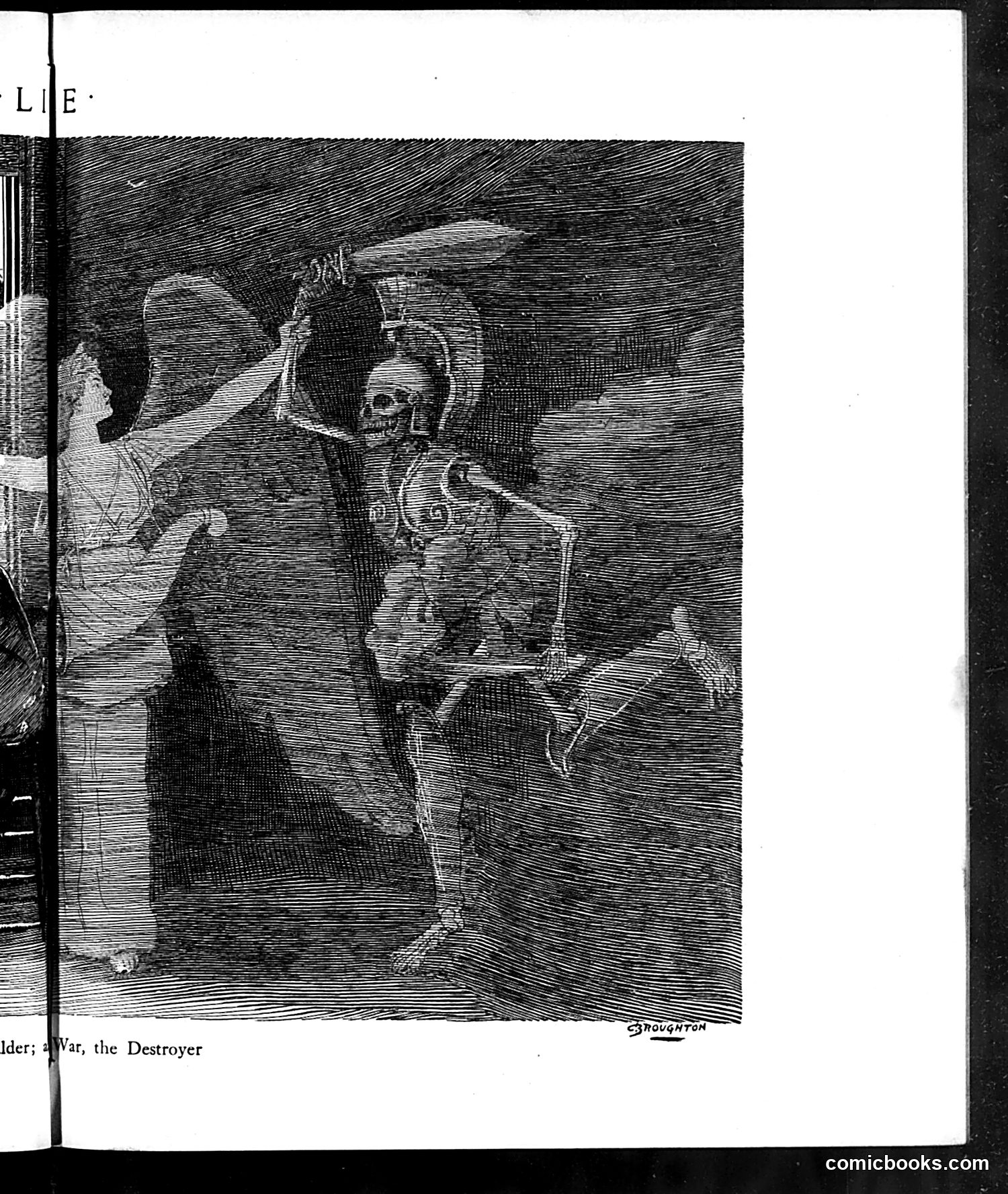
This engraving by Broughton depicts a skeletal figure of Death personified as War, wielding a sword and confronting a living woman (likely representing a nation or civilization). The allegorical composition is characteristic of early 20th-century satirical art in *Life* magazine. The skeleton-figure embodies the destructive nature of military conflict, while the woman's gesture suggests resistance or pleading. The imagery reflects anti-war sentiment common during periods of international tension or actual warfare. Without the publication date visible, the specific historical context remains unclear—this could reference WWI, earlier 19th-century conflicts, or general pacifist messaging. The artwork uses classical allegorical symbolism to critique war's dehumanizing effects on society.
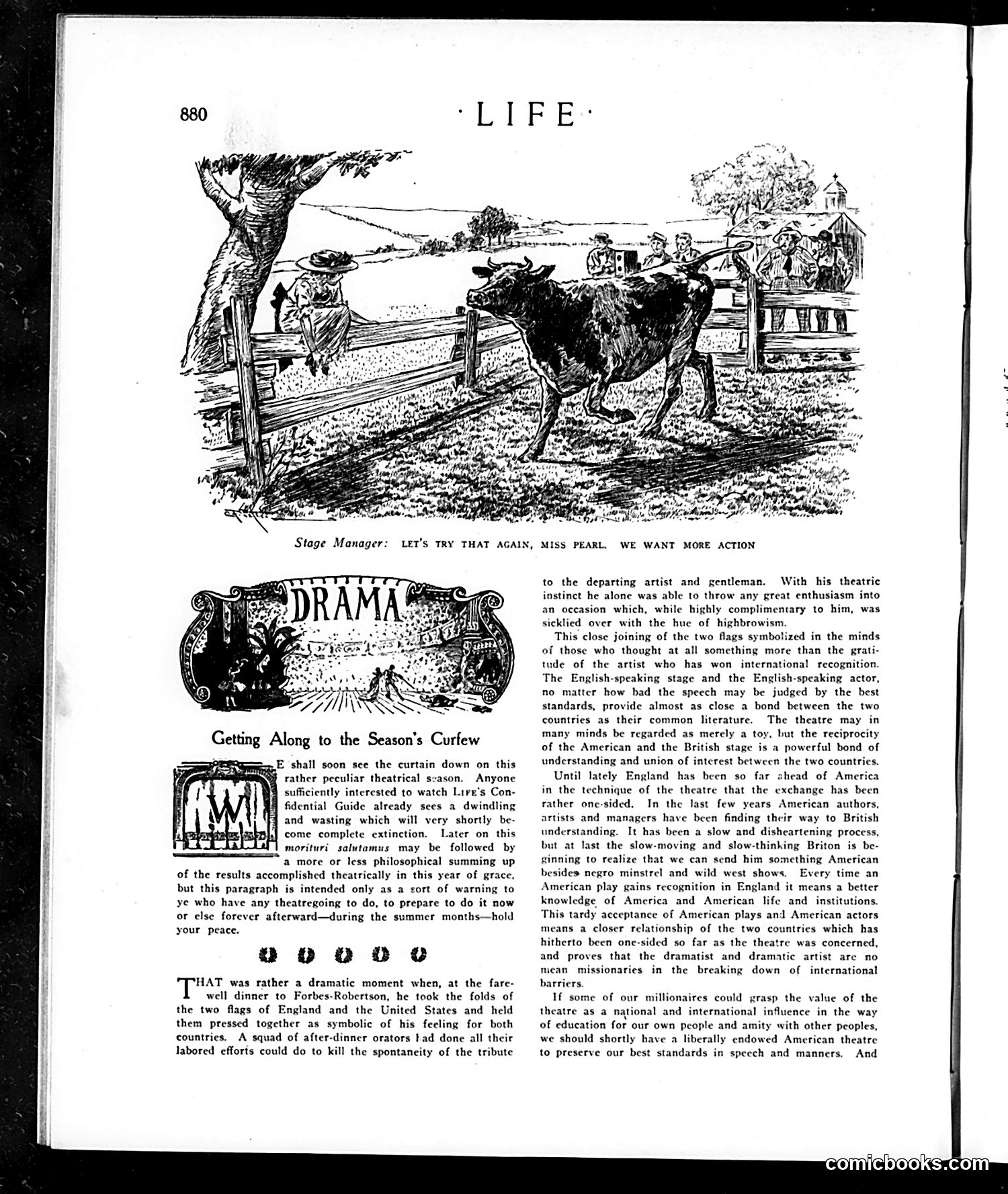
The cartoon depicts a theatrical stage manager demanding "more action" from actors performing a rural scene with a cow. The accompanying article celebrates actor Johnston Forbes-Robertson's farewell dinner, where he symbolically held together British and American flags. The satire criticizes the theatrical establishment: the stage manager represents producers demanding sensationalism over substance. Meanwhile, the serious article argues that theatre serves as genuine cultural diplomacy between nations. Forbes-Robertson's spontaneous gesture supposedly outshone stiff formal speeches—illustrating how authentic artistry transcends pretension. The broader point: American theatre was gaining respect abroad (previously dismissed as mere "wild west shows"), strengthening Anglo-American relations through shared dramatic culture. The author advocates wealthy Americans should fund national theatre to maintain speech standards and international goodwill. The contrast between the frivolous cartoon demand and the weighty cultural argument underscores Life's satirical editorial voice on theatrical and national concerns.
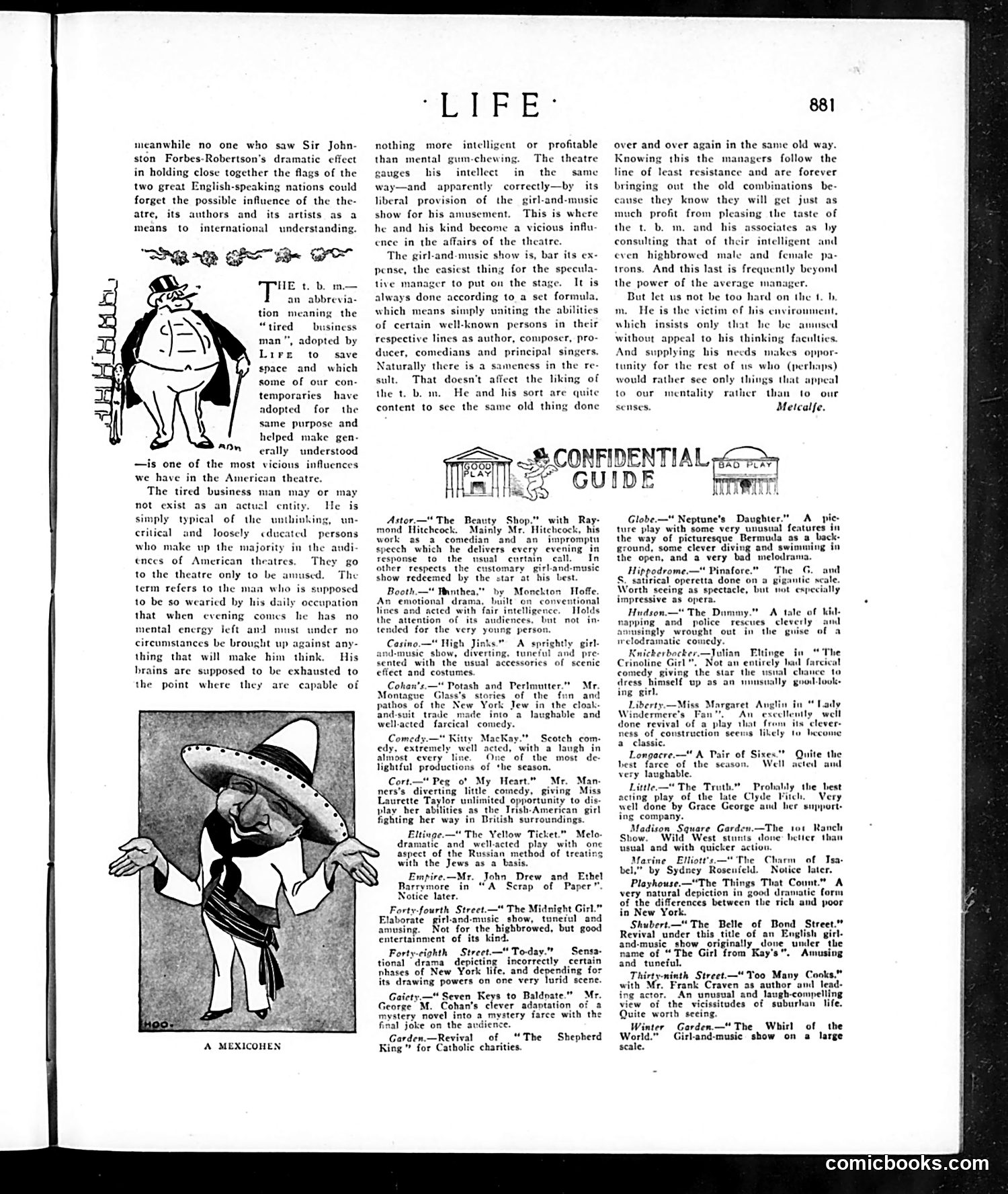
This page critiques American theater audiences and productions. The central essay attacks the "t.b.m." (tired business man)—Life's term for the average, exhausted urban worker whom theaters cater to with mindless entertainment. The author argues this demographic has become a "vicious influence," demanding only girl-and-music shows requiring no intellectual engagement, thus lowering theatrical standards across the industry. The two cartoons illustrate this concept: both depict portly, leisure-class men in Mexican and formal dress—visual embodiments of the audience member Life mocks as intellectually lazy. The accompanying "Confidential Guide" reviews current Broadway shows, categorizing them as either formulaic entertainment or more thoughtful drama. The satire targets commercialized theater's descent into lowest-common-denominator fare, blaming audiences' mental exhaustion and managers' profit motives equally.
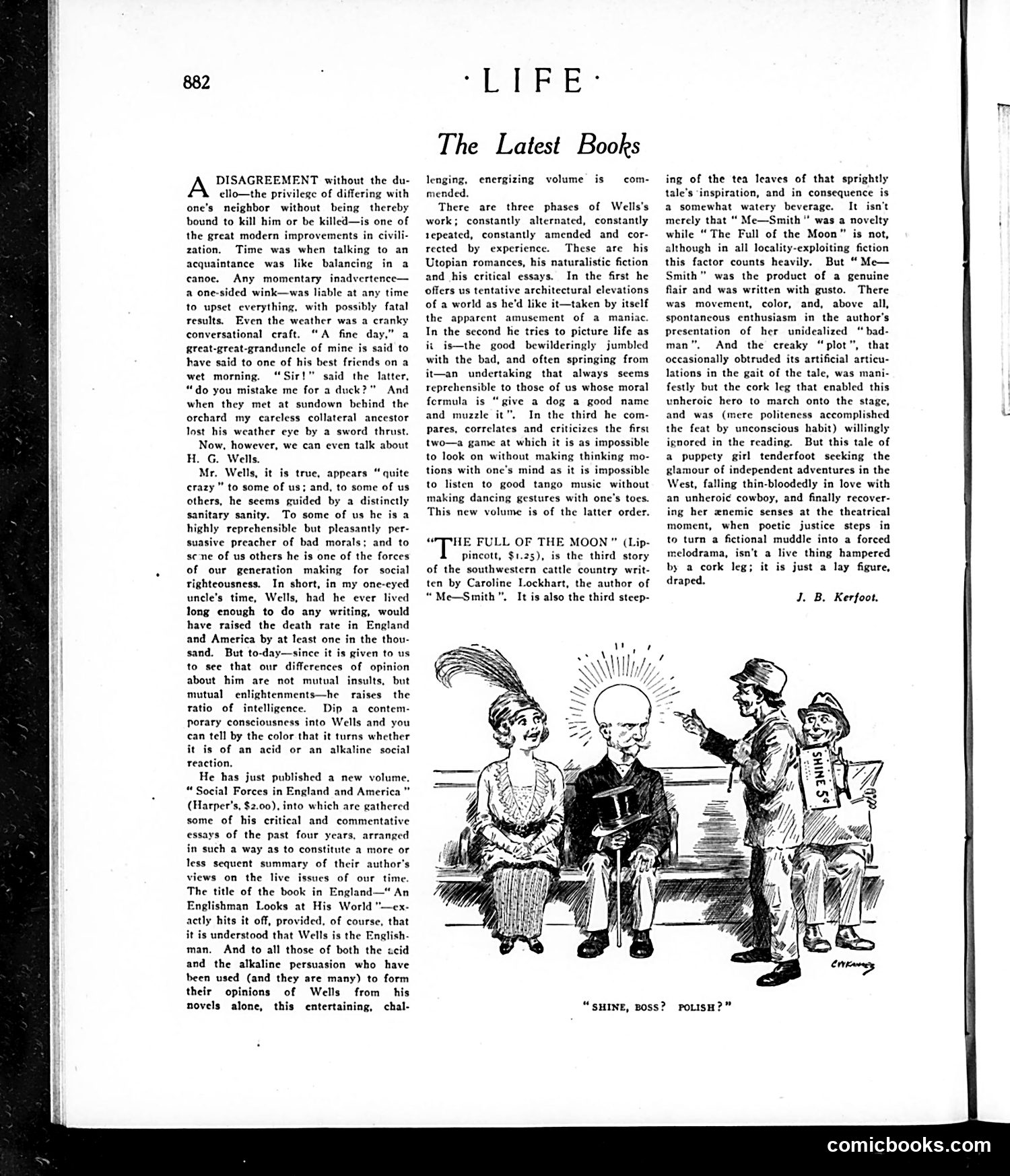
This page reviews H.G. Wells's new essay collection "Social Forces in England and America," framing him as a controversial but intellectually stimulating figure. The text argues that modern civilization allows disagreement without violence—a jab at older, honor-based cultures where casual conversational mistakes could provoke fatal duels. The cartoon below illustrates this point. It depicts a bald man (Wells, recognizable by his distinctive appearance) seated between a woman and two working-class men in heated discussion. One man gestures aggressively while another holds what appears to be a newspaper or publication labeled "WELLS'S." The caption—"SHINE, BOSS? POLISH?"—suggests these are street vendors or common laborers debating Wells's ideas. **The satire**: Wells's controversial ideas inspire passionate disagreement across all social classes, yet nobody kills anybody over it. This represents progress in civilization—intellectual engagement replacing violence.
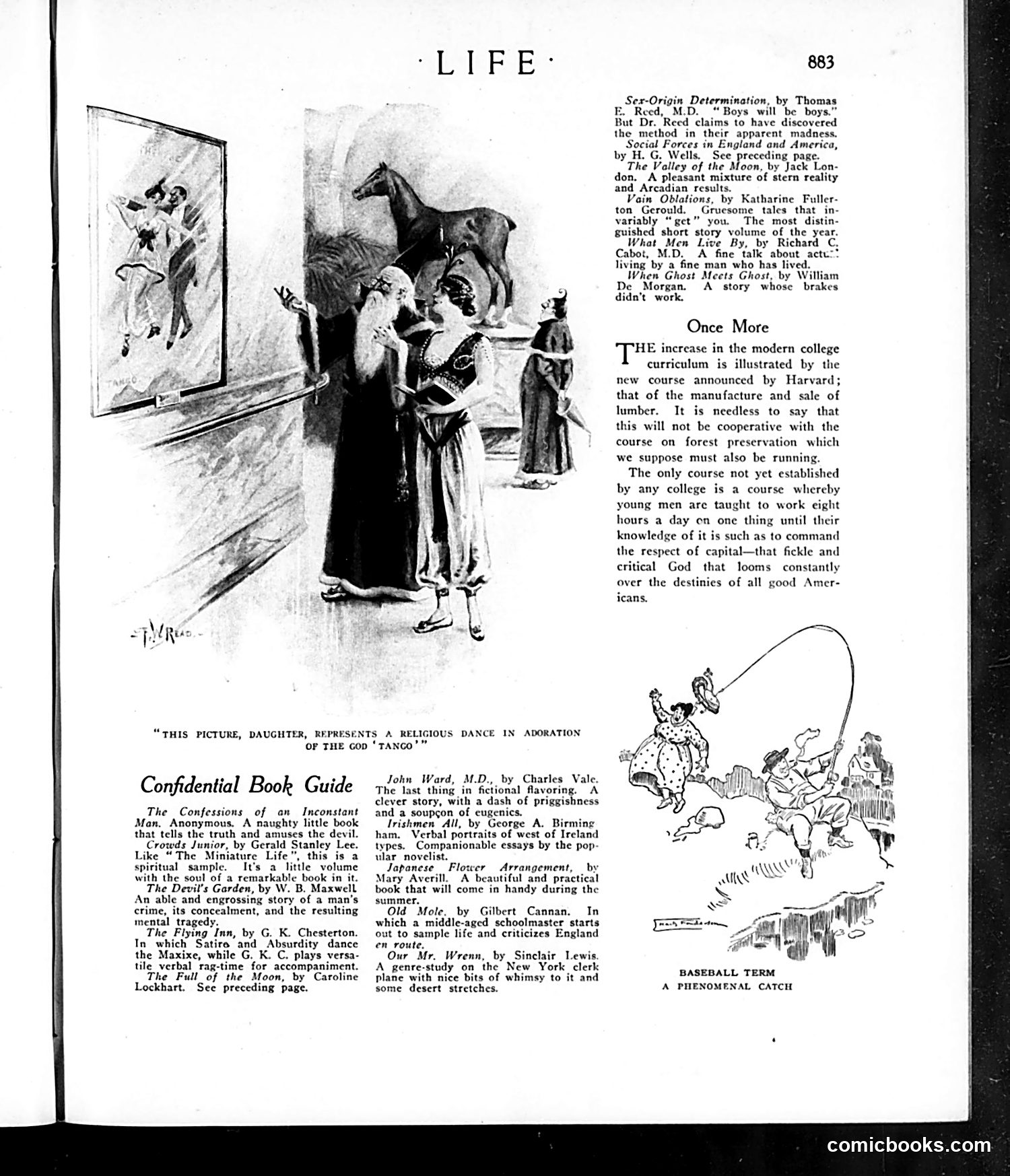
The top cartoon mocks the social craze over the tango dance, which was controversial in the early 1910s as sexually suggestive. A father shows his daughter a painting, claiming it depicts "a religious dance in adoration of the god 'Tango'"—sarcastically suggesting the dance has become quasi-religious in its fervent popularity, elevating it to deity status among modern society. The essay "Once More" satirizes Harvard's newly announced curriculum course on lumber manufacturing and sales. Life ridicules the proliferation of impractical college courses while noting the hypocrisy: Harvard simultaneously teaches forest *preservation*, contradicting the lumber sales course. The author further mocks modern education for failing to teach young men basic work discipline and respect for capital—suggesting colleges have lost sight of genuine practical education in favor of trendy, disconnected subjects. The baseball cartoon at bottom remains unclear without additional context.
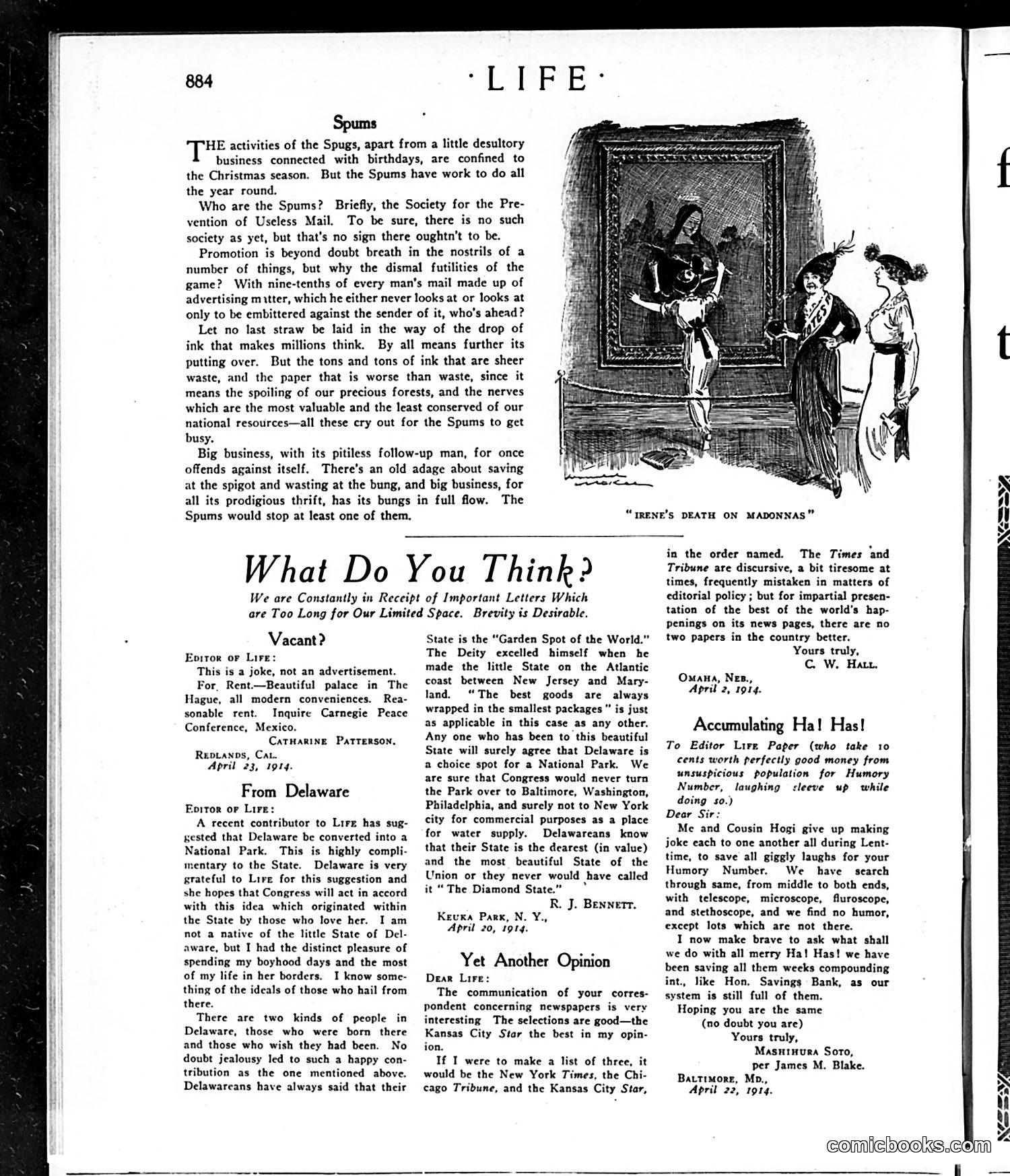
The page contains satirical editorial content typical of *Life* magazine's progressive-era social criticism. **Main Article "Spums"**: Proposes a fictional "Society for the Prevention of Useless Mail" to combat junk mail's waste. The piece criticizes excessive advertising mail, arguing it wastes paper (destroying forests) and people's nerves—national resources being squandered. The satire attacks big business for wasteful marketing practices despite claiming efficiency. **Cartoon "Irene's Death on Madonnas"**: The sketch appears to depict a dramatic scene, likely referencing a theatrical or artistic work, though the specific reference is unclear from the image alone. **"What Do You Think?" Section**: A letters column featuring reader responses on various topics—including a joke submission about renting a palace in The Hague (likely mocking diplomatic tensions), and earnest defenses of Delaware's natural beauty versus a proposed national park conversion. The overall tone reflects *Life's* muckraking sensibility, targeting corporate waste and environmental concerns while maintaining humor through satire and absurdist reader contributions.
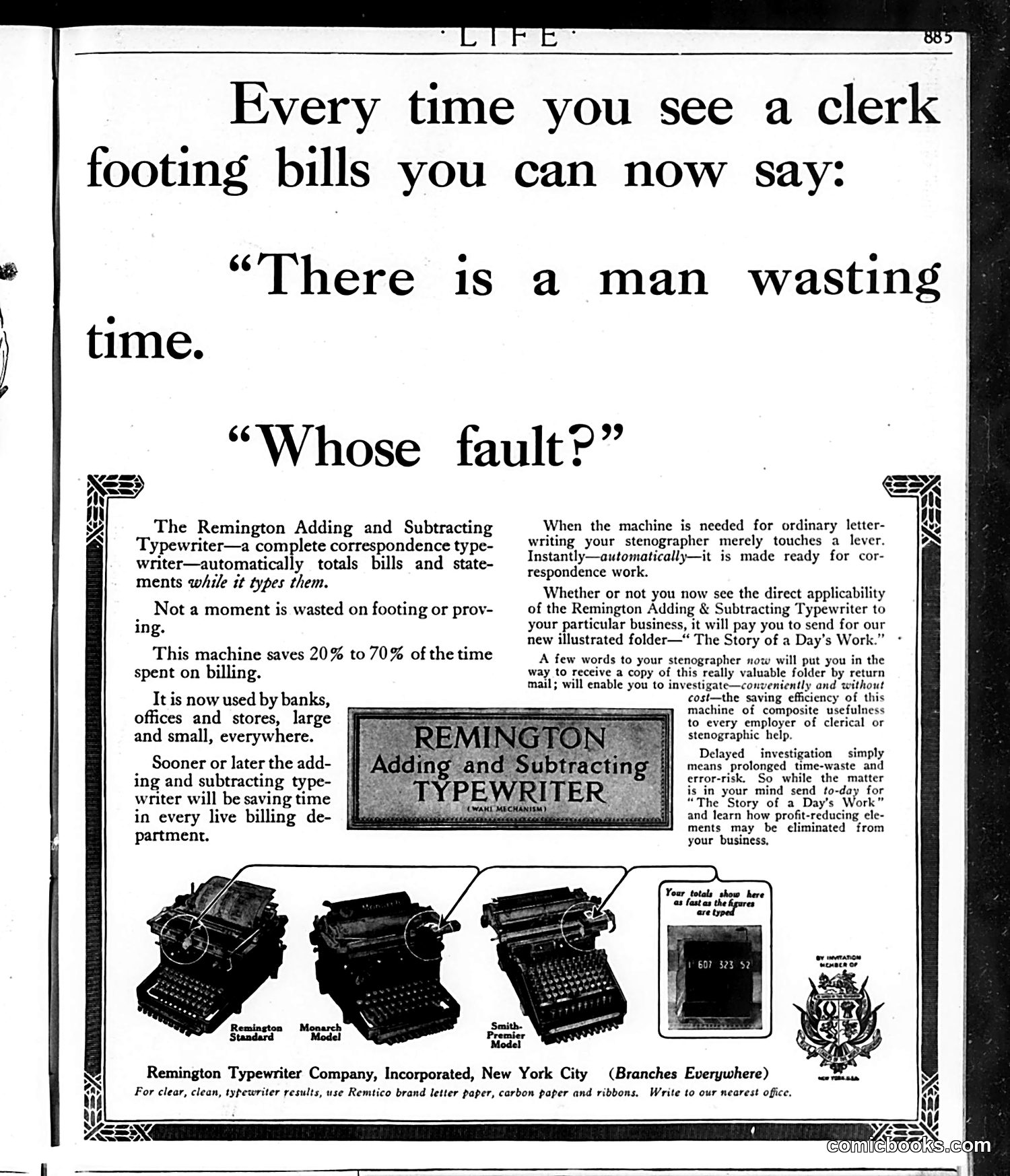
This is a **full-page advertisement**, not political satire. It promotes Remington's new typewriter model that automatically performs addition and subtraction while typing bills and financial statements. The opening joke ("There is a man wasting time. Whose fault?") targets clerks who manually add up bills—implying their employer is at fault for not purchasing this labor-saving technology. The ad argues the machine saves 20-70% of time spent on billing work. The page shows three typewriter models and emphasizes the machine's dual function: it switches instantly between accounting and regular correspondence. The ad targets business owners in banks, offices, and stores, encouraging them to request a promotional folder titled "The Story of a Day's Work." This reflects early-20th-century business anxiety about *efficiency*—the period's obsession with eliminating "time-waste" through mechanization. The pitch is fundamentally about profit: eliminate inefficient human labor.
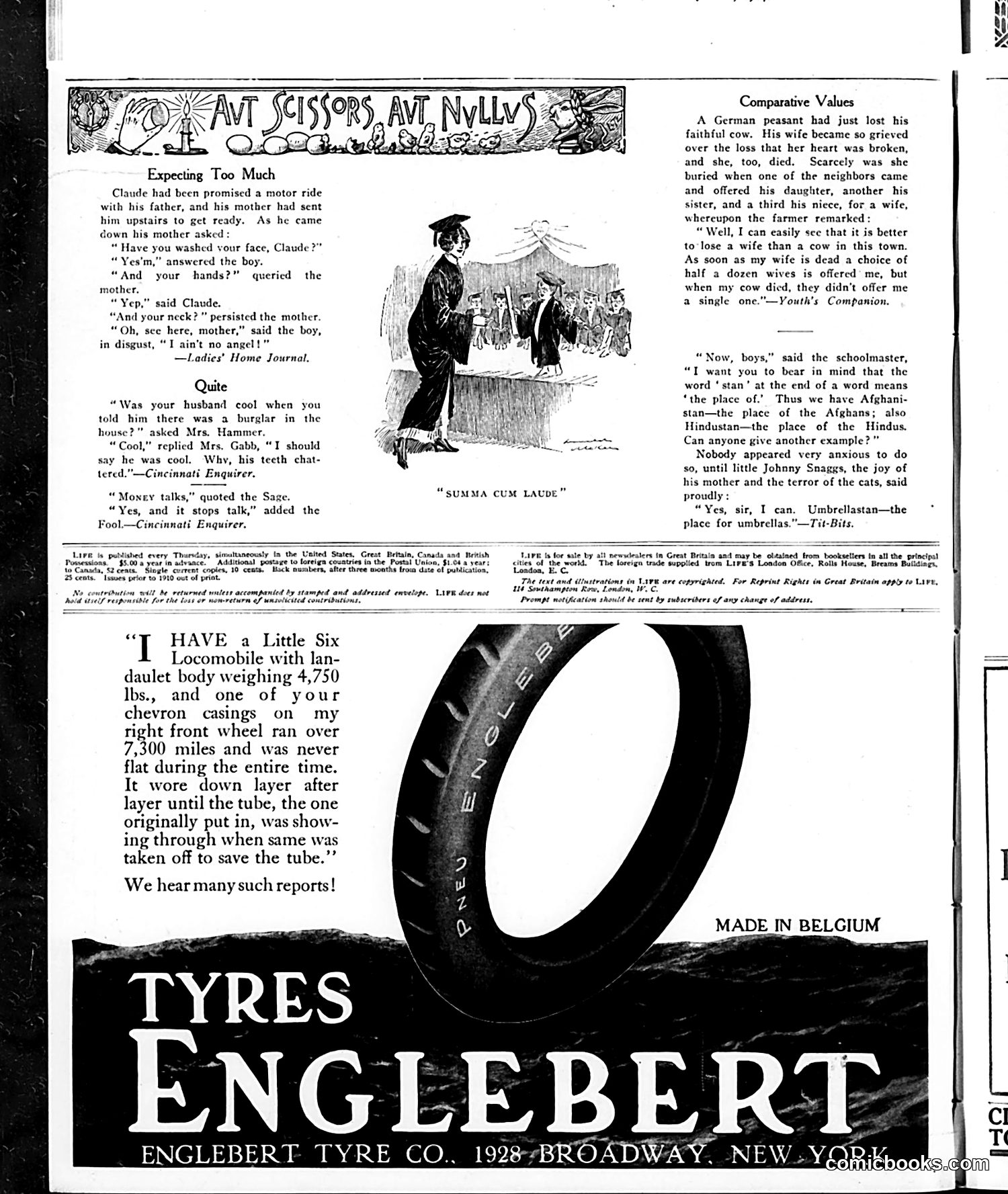
This page contains several short humorous anecdotes typical of early 20th-century American humor magazines, plus a tire advertisement. **The Cartoons/Text:** The three brief jokes satirize everyday domestic situations: a boy's impatience with maternal fussiness ("Expecting Too Much"), a husband's indifference during a crisis ("Quite"), and a schoolmaster's lesson where a student makes an absurd pun on "stan" (Umbrellastan = place for umbrellas). These target common social pretensions and language absurdities. **The Advertisement:** The Englebert tire ad (Belgium-made) uses a customer testimonial claiming exceptional durability—a wheel casing lasting 7,300 miles. The accompanying image shows a worn tire, emphasizing longevity as a selling point. For modern readers, this reflects an era when tire reliability was a major automotive concern and advertising relied heavily on user testimonials rather than technical specifications. The page is primarily entertainment and advertising rather than political satire.
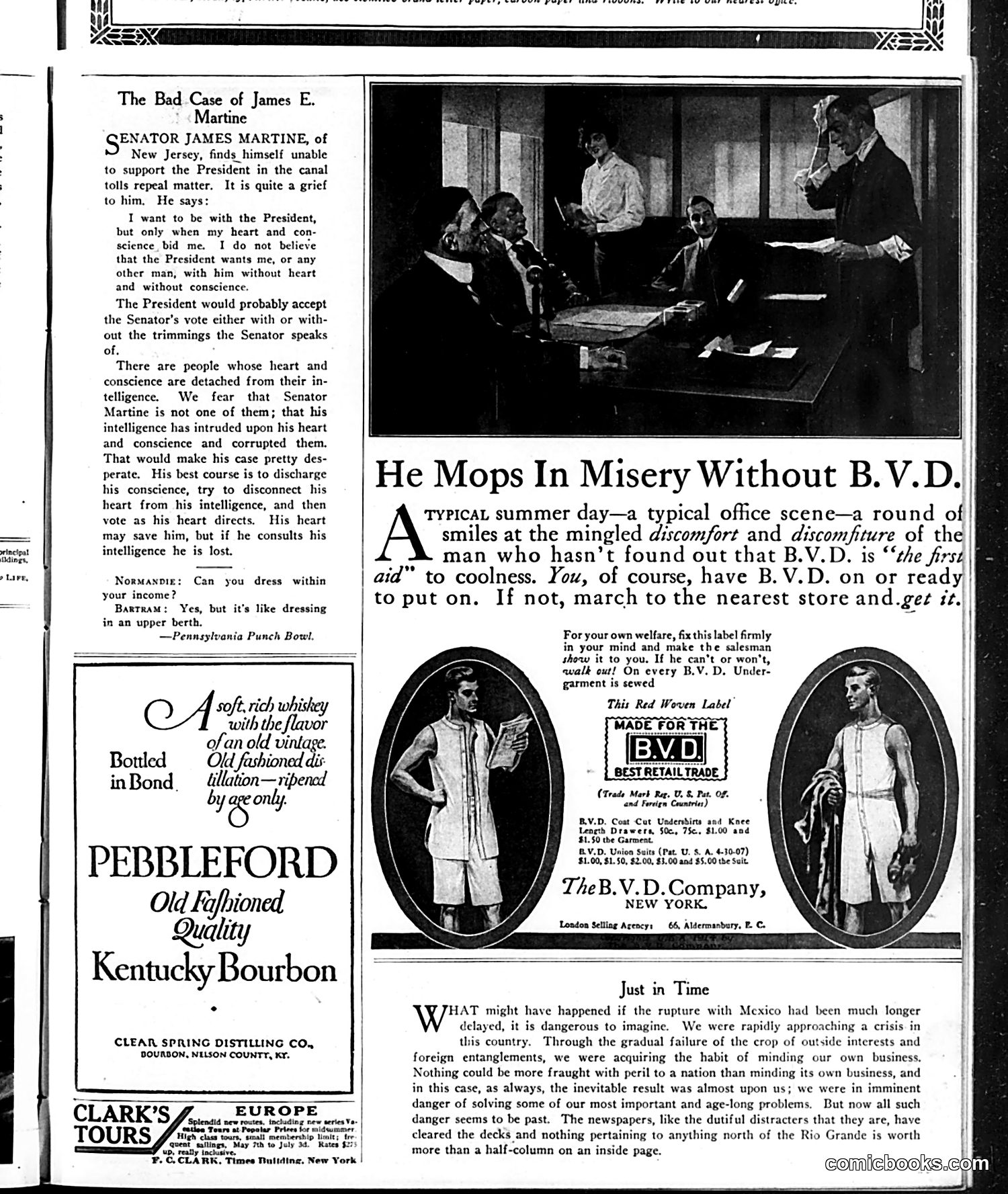
**"The Bad Case of James E. Martine"** mocks Senator James Martine of New Jersey for refusing to support the President's canal tolls repeal on conscience grounds. Life ridicules his claim that he must vote with his heart rather than intelligence, sarcastically suggesting his "intelligence has intruded upon his heart and conscience and corrupted them." The satire implies Martine is using moral posturing to mask political disagreement—that the President would accept his vote regardless of philosophical trimming. **"He Mops In Misery Without B.V.D."** is a humorous advertisement disguised as social commentary, depicting an office worker suffering discomfort without the advertised undergarment brand. The joke plays on the notion that a man without proper underclothing would visibly suffer in a professional setting. **"Just in Time"** sarcastically celebrates the end of Mexico tensions, ironically suggesting that avoiding the crisis prevented Americans from actually solving domestic problems—implying Americans were dangerously close to productive self-governance before newspapers distracted them with international news again.
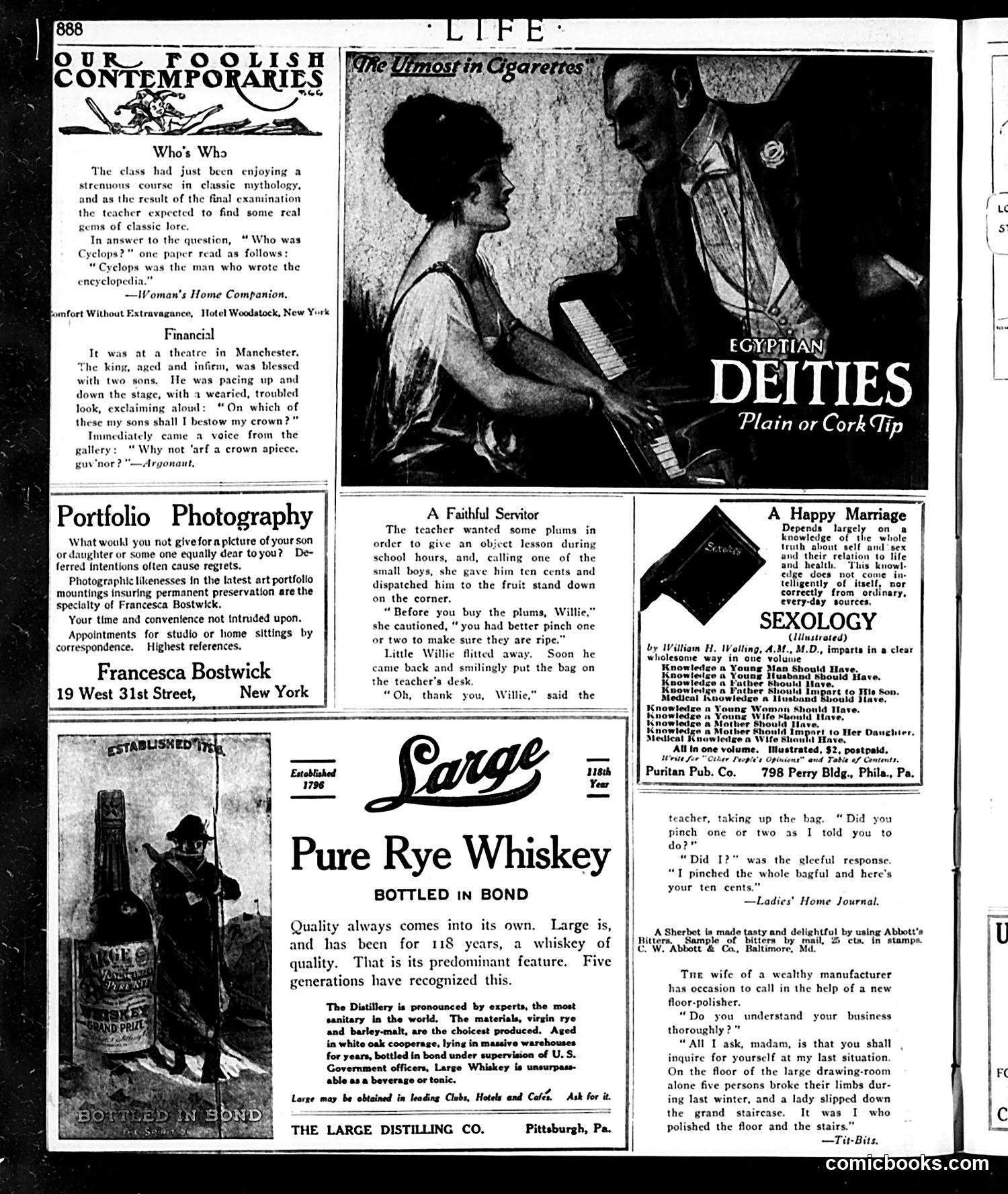
This page contains mostly **advertisements and humorous anecdotes** rather than political cartoons. The "**Our Foolish Contemporaries**" section presents three brief jokes satirizing common human foolishness: 1. **"Who's Who"**: A student mistakes Cyclops (the mythological one-eyed giant) for the encyclopedia's author—mocking educational gaps. 2. **"Financial"**: A heckler suggests splitting a crown among two sons, punning on "crown" (currency vs. monarchy)—satirizing class commentary on nobility. 3. **"A Faithful Servitor"**: A boy literally obeys instructions to "pinch" plums by pinching the entire bagful—humor based on naive literalism. These are gentle, **non-political satire** targeting human stupidity and miscommunication rather than specific public figures or events. The page is dominated by period **advertisements** (whiskey, photography, sexology books) and anecdotes from other publications, typical of Life's miscellaneous content approach.
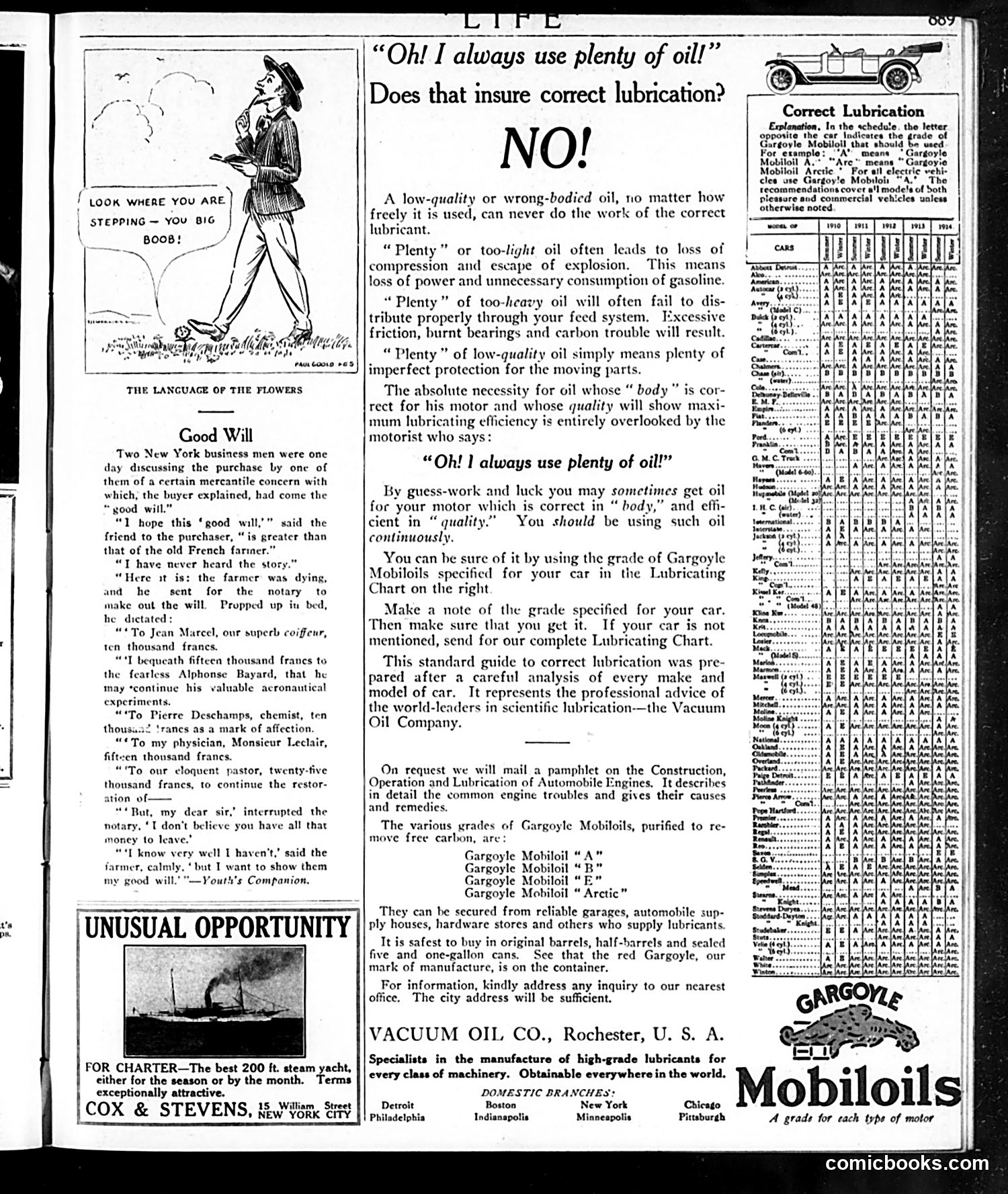
This page combines satirical content with early automotive advertising. **The Cartoons:** The left side features two humorous pieces. "The Language of the Flowers" shows a figure stepping carelessly, warned "Look where you are stepping—you big boob!" Below it, "Good Will" tells a French farmer's joke about bequeathing money he doesn't actually possess to show goodwill to various professionals—satirizing the concept of "good will" in business transactions. **The Advertisement:** The dominant content is a Gargoyle Mobiloils advertisement (Vacuum Oil Company) directly addressing a common automotive misconception. The headline "'Oh! I always use plenty of oil!' Does that insure correct lubrication? NO!" targets motorists who believed excessive oil quantity guaranteed engine protection. The ad argues that oil *quality* and correct viscosity ("body") matter more than quantity—too much or wrong-grade oil causes compression loss, excessive friction, and burned bearings. It references a lubrication chart for proper oil grades by automobile model, positioning Gargoyle as scientifically superior to guesswork. This reflects 1910s-1920s automotive development when standardized lubricants became competitive advantages.
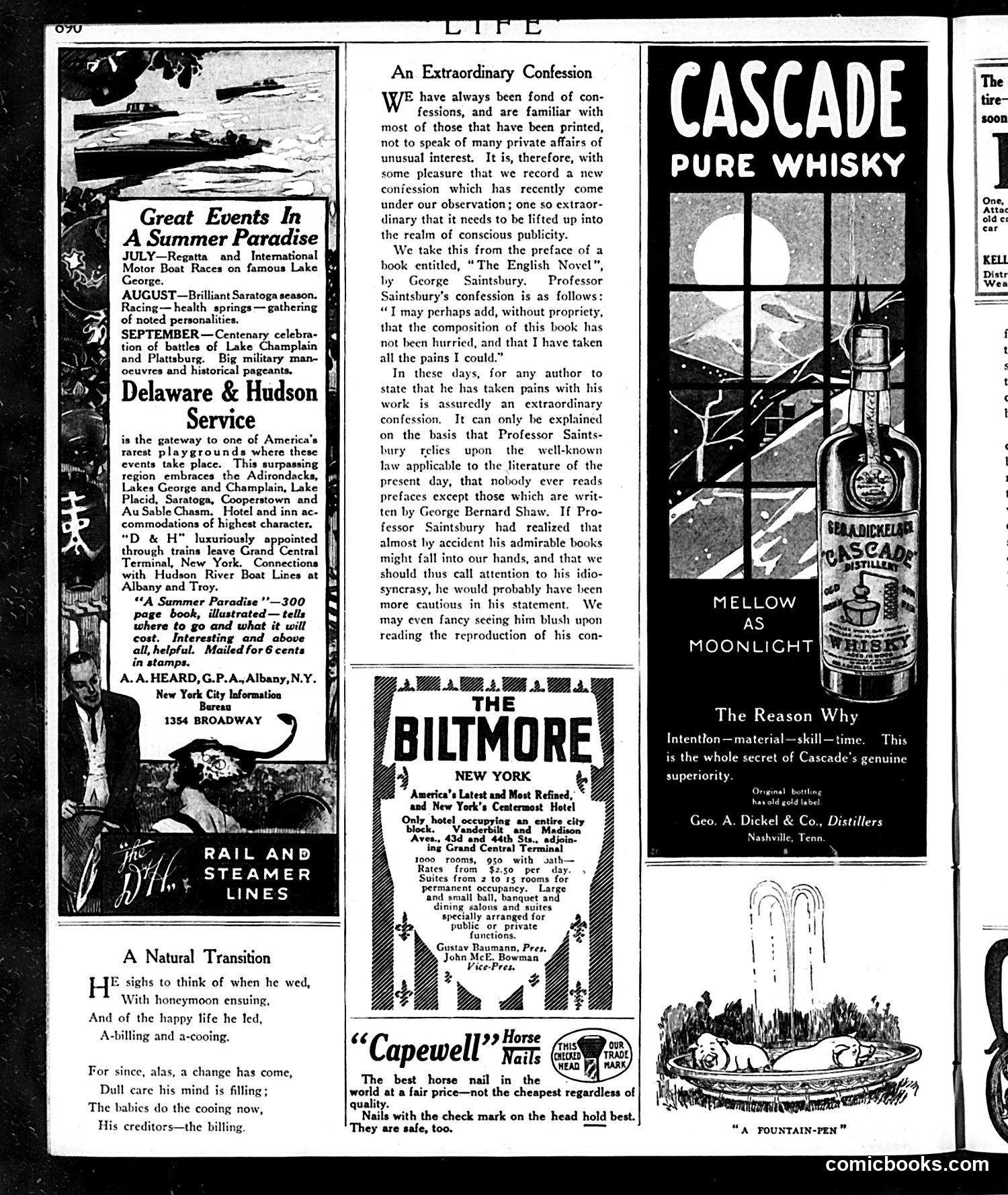
This page mixes advertisements with satirical editorial content typical of Life magazine's format. **"An Extraordinary Confession"** satirizes Professor George Saintsbury's preface to "The English Novel," where he claims to have taken care writing the book. Life's editors mock this as absurd—in modern times, authors allegedly never take pains with their work. The joke hinges on Saintsbury being naive enough to confess such unusual diligence in print, and the editors sardonically suggest he'd have been embarrassed had he realized anyone would actually read his preface (a jab at how few people read prefaces, except those by George Bernard Shaw). **"A Natural Transition"** is a humorous poem about marriage: the honeymoon phase of "billing and cooing" gives way to the husband's dull mind filling with care while babies coo and creditors demand billing—a common satirical trope about marital disillusionment. The page otherwise contains travel and luxury advertisements (Delaware & Hudson railroad, Biltmore Hotel, Cascade Whisky, Capewell horse nails) typical of Life's revenue model.
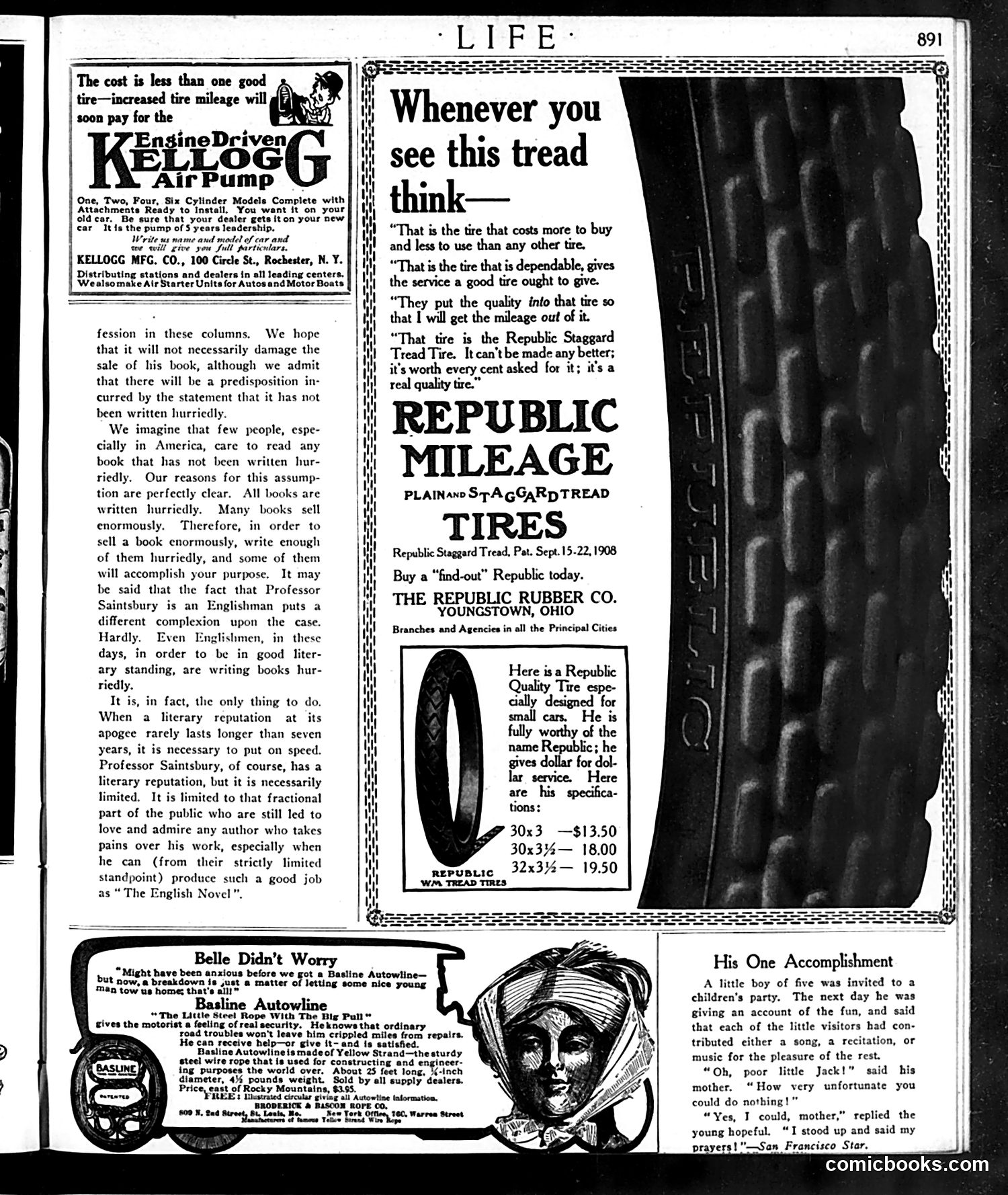
This page is primarily **advertising**, not political satire. It contains three commercial ads and two short humorous anecdotes. The main advertisements promote: - **Kellogg Engine Driven Air Pump** (left) - **Republic Mileage Tires** (center-right, large) - **Basline Autowline** (bottom-left, for automobiles) The editorial text discusses Professor Saintsbury's book "The English Novel," arguing that modern literary reputations require hurried productivity—a satirical jab at contemporary publishing standards rather than political commentary. The two cartoons below are lighthearted domestic humor: - "Belle Didn't Worry" jokes about automotive reliability - "His One Accomplishment" is a joke about a shy child at a party who could only contribute prayers **Context for modern readers:** This reflects early 1900s America's automotive boom, when tire quality and reliability were novel selling points. The page's tone is satirical about American culture and publishing, not political.
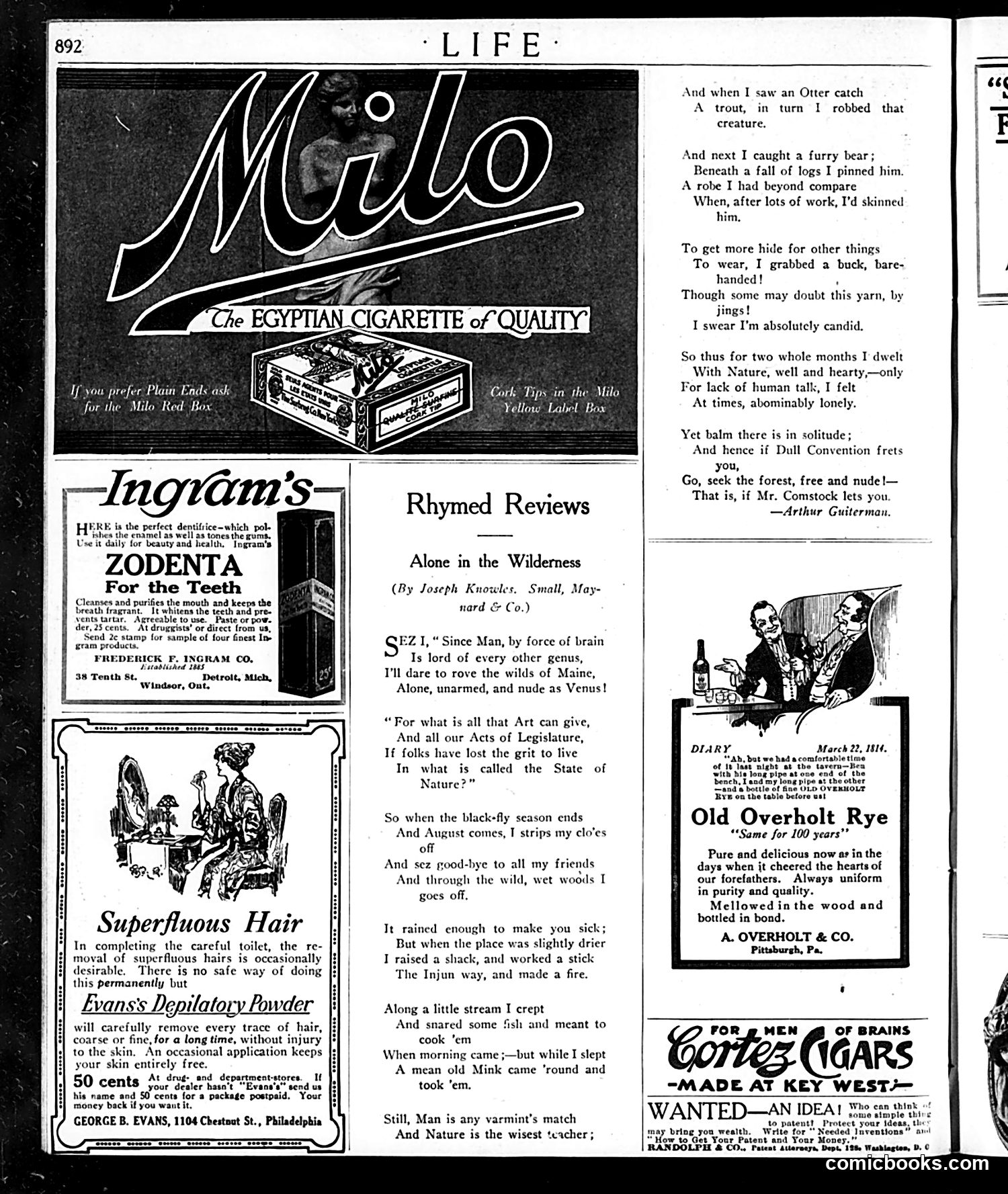
This page contains a humorous poem reviewing Joseph Knowles's book about living naked in the Maine wilderness for two months. The satire mocks Knowles's philosophical claims about returning to nature and man's superiority over animals. The poem ridicules Knowles's grandiose opening—that civilized man should abandon society to live "nude as Venus" in nature—by showing him constantly struggling: rained on, catching fish only to have a mink steal them, then stealing from the otter in turn. The verse suggests Knowles is neither noble nor superior to animals, but merely another creature competing for survival. The final couplet delivers the sharpest jab: Knowles can only pursue this "natural" freedom because "Mr. Comstock lets you"—referencing Anthony Comstock, the famous censor. The poem implies Knowles's wilderness adventure is merely a publicity stunt permitted by society, not genuine escape from civilization.
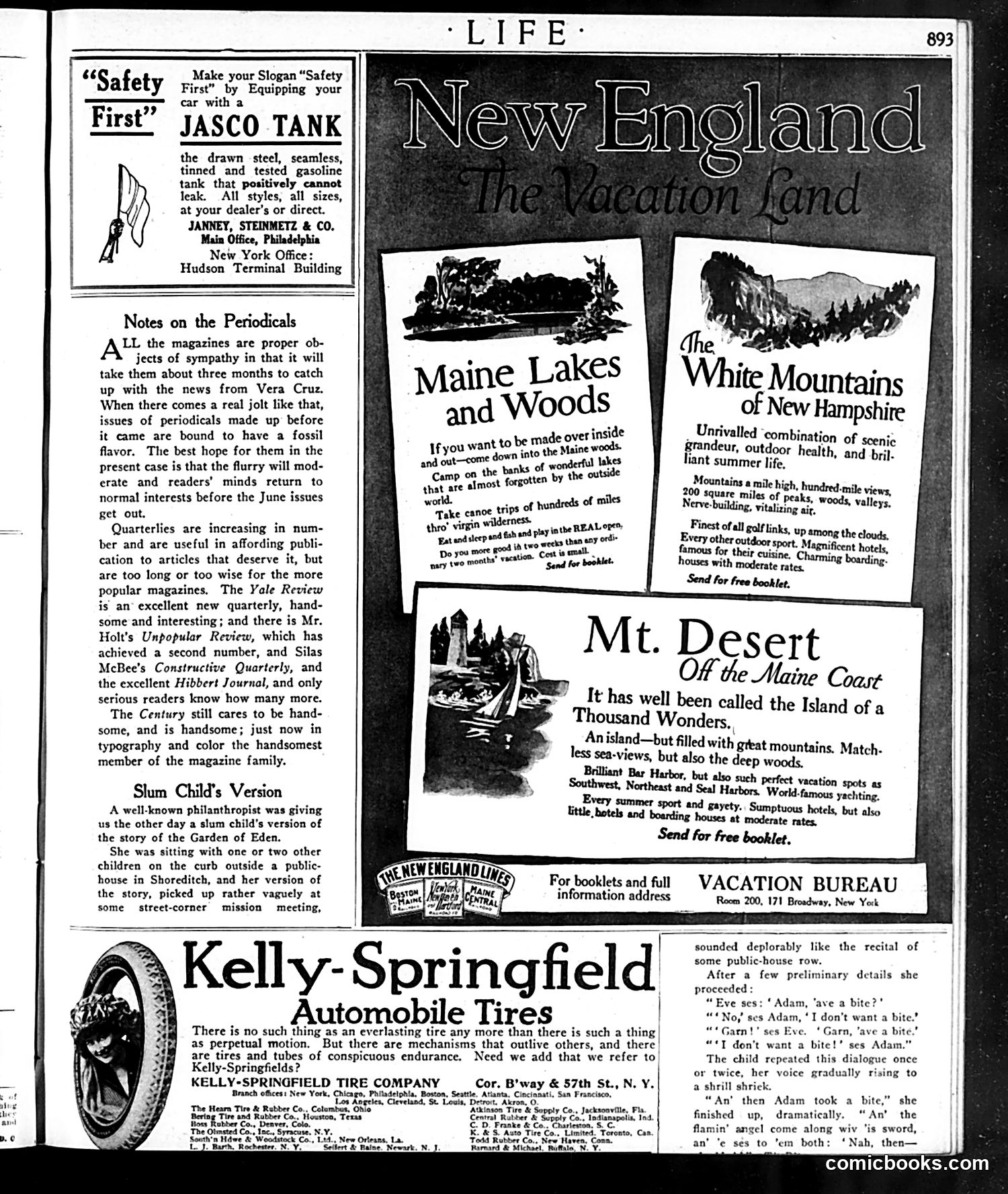
This page is primarily **advertising and editorial content** rather than political satire. The main elements are: **Advertisements:** Jasco Tank (gasoline containers), Kelly-Springfield Tires, and New England vacation destinations dominate the layout. **Editorial Content:** The "Notes on the Periodicals" section discusses magazine publishing lag times—specifically referencing the Mexican crisis at Vera Cruz, which delayed news reaching print publications. This reflects early 20th-century concerns about journalism's inability to keep pace with events. **"Slum Child's Version":** A brief social commentary piece recounting how a poor London child in Shoreditch retold the Garden of Eden story in working-class dialect ("'ave a bite," "Garn"). The humor derives from contrasting elevated biblical narrative with crude East End speech patterns—a common Edwardian-era way to depict poverty and class difference. It's gentle satire on class and childhood innocence rather than political commentary. The page reflects typical early-1900s Life magazine content: consumer advertising mixed with light social observation.
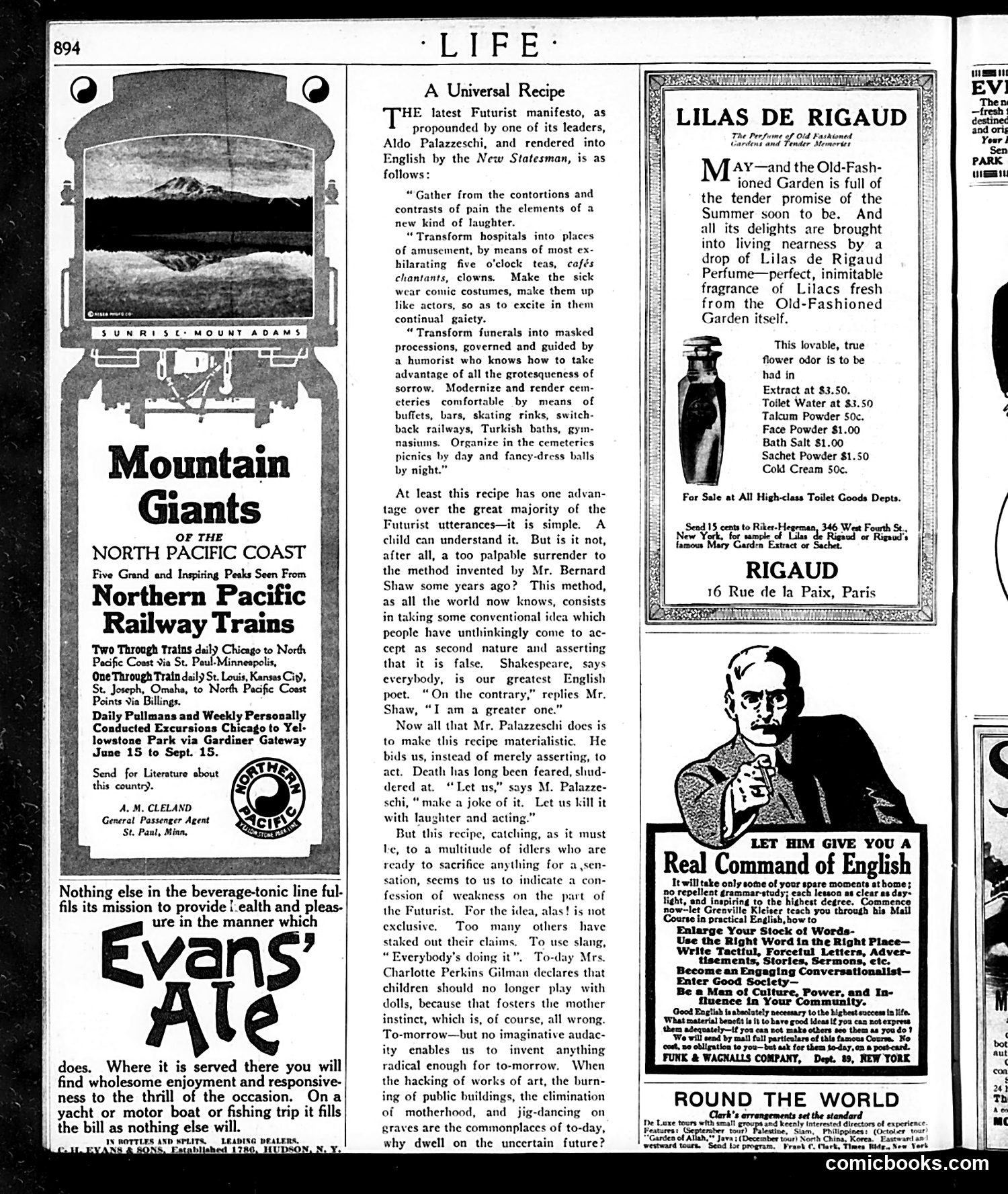
This page contains **advertisements and social commentary**, not political cartoons. The main content satirizes the Italian Futurist movement. Life mocks a manifesto by Aldo Palazzeschi (a real Futurist leader) proposing to transform society by making death, hospitals, and funerals into entertainment through comedy and theatricality. The author criticizes this as derivative of Bernard Shaw's rhetorical method—taking conventional wisdom and inverting it for shock value. The satire suggests Futurism offers nothing genuinely radical; other reformers (like Charlotte Perkins Gilman, mentioned by name) are equally bold in attacking traditions. The subtext: **American progressives and European avant-gardists are competing to be most shocking**, but their provocations are becoming predictable and shallow. The page also features period advertisements: Northern Pacific Railway (tourism), Evans Ale (beverages), Lilas de Rigaud perfume, and a book promotion for "Real Command of English."
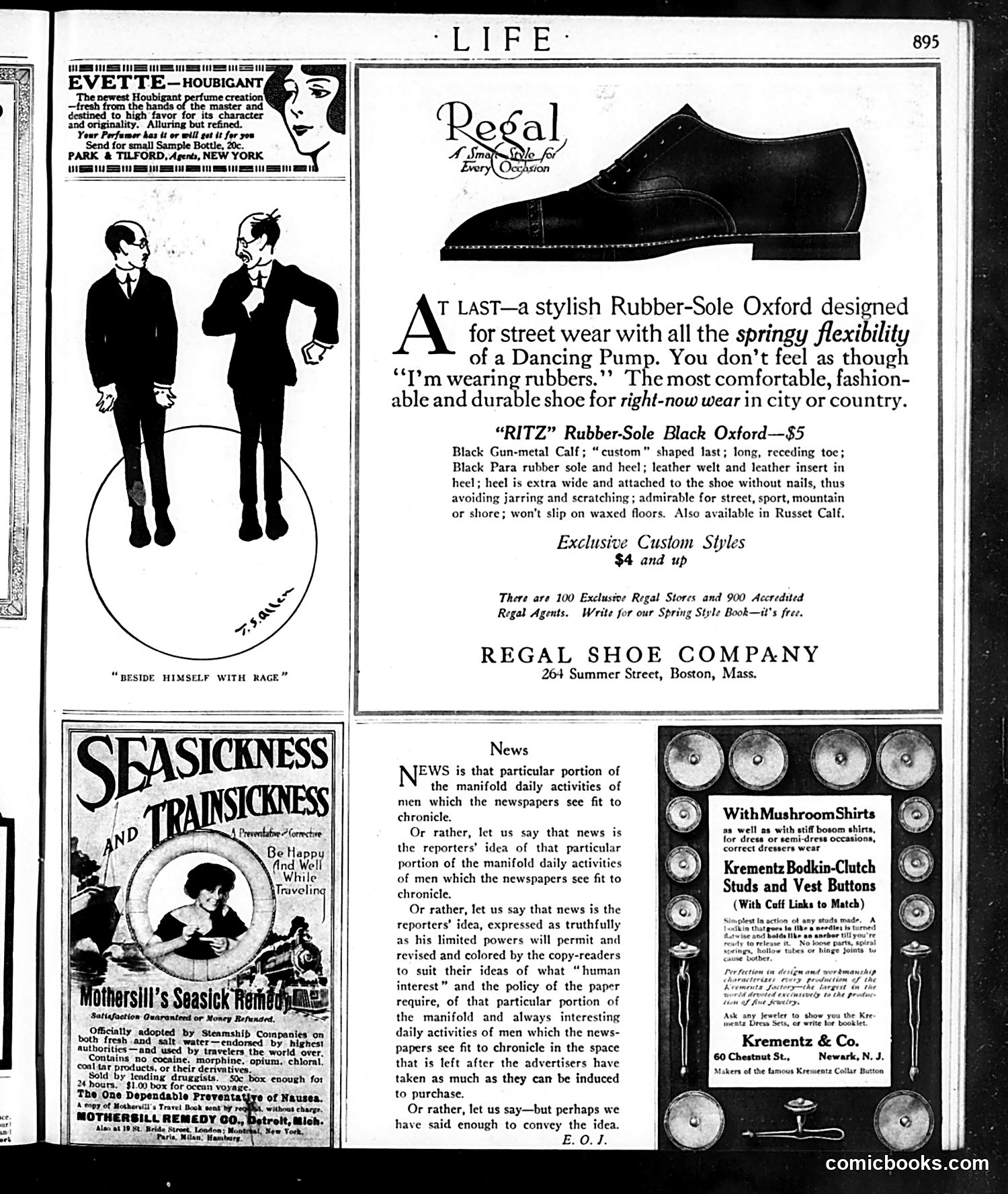
The small cartoon depicts two men in suits standing within a circle, labeled "Beside Himself with Rage." The crude drawing—showing one man appearing agitated while the other observes—uses visual repetition (the two figures appear nearly identical) to satirize the expression "beside himself." It literally illustrates the idiom by depicting a man positioned *beside* another version of himself, suggesting uncontrolled emotional state. This is gentle, visual wordplay typical of Life magazine's satirical humor. The joke relies on taking a common English phrase literally rather than figuratively—a form of absurdist comedy that was popular in early 20th-century American humor. The page itself is primarily advertising (perfume, seasickness remedies, shoes, buttons), with an editorial piece on "News" discussing how newspapers filter and color reality.
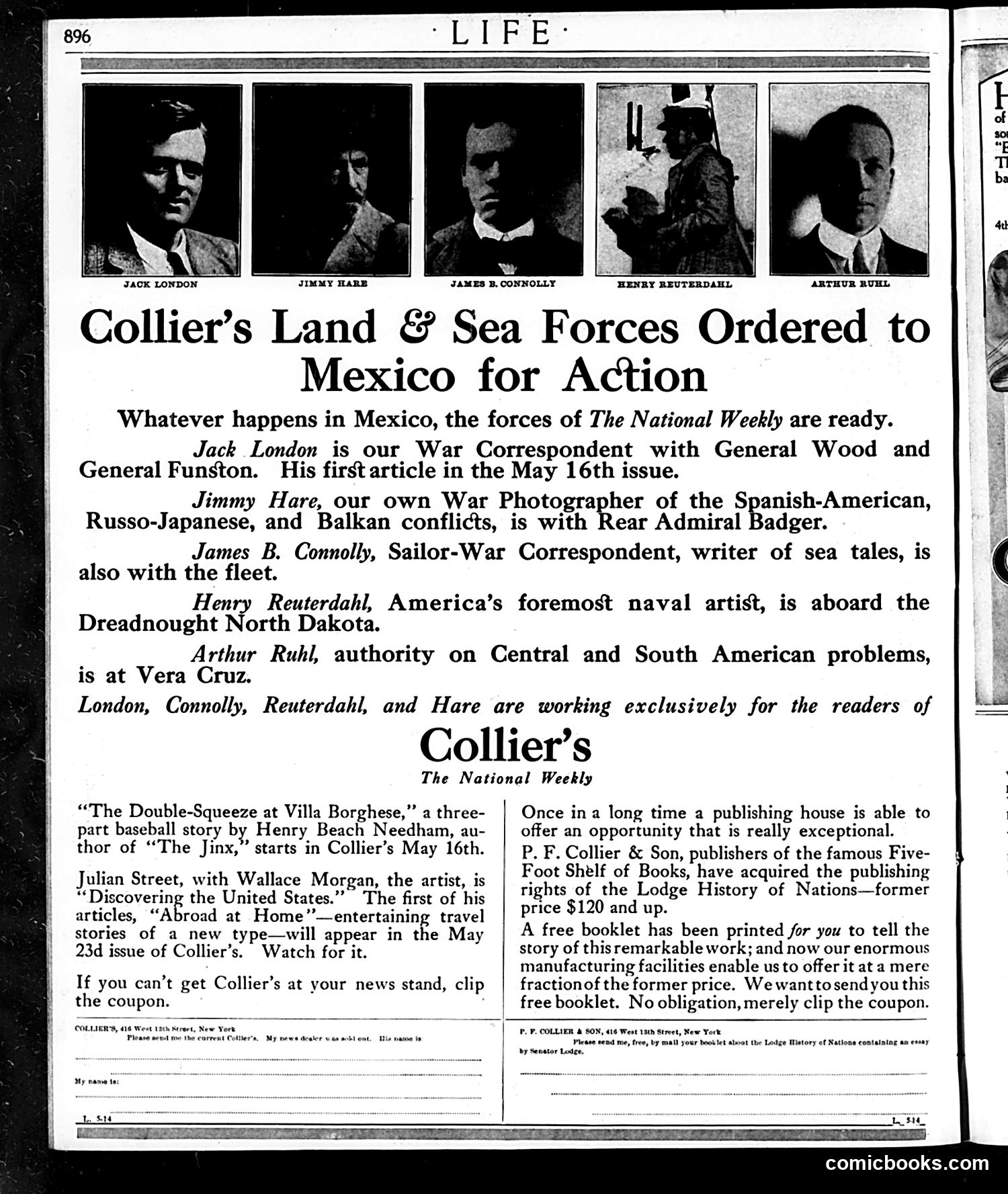
This is a **promotional page**, not a cartoon. It announces that *Collier's* magazine has deployed prominent journalists and artists to cover a military conflict in Mexico—likely the Mexican Revolution or U.S. intervention around 1914. The five portraits show: - **Jack London** (famous author) as War Correspondent - **Jimmy Hare** (photographer who covered Spanish-American and Russo-Japanese wars) - **James B. Connolly** (sailor and writer) - **Henry Reuterdahl** (naval artist) - **Arthur Ruhl** (Central/South American expert) The headline's quasi-military language ("Land & Sea Forces") humorously frames *Collier's* magazine itself as mobilizing for combat coverage—a satire of jingoistic war enthusiasm. The implicit joke: *Collier's* is "ready for action" in Mexico through star journalists, positioning the magazine as serious war correspondent, not just a satirical weekly. The page also advertises a discounted Lodge History of Nations book set.
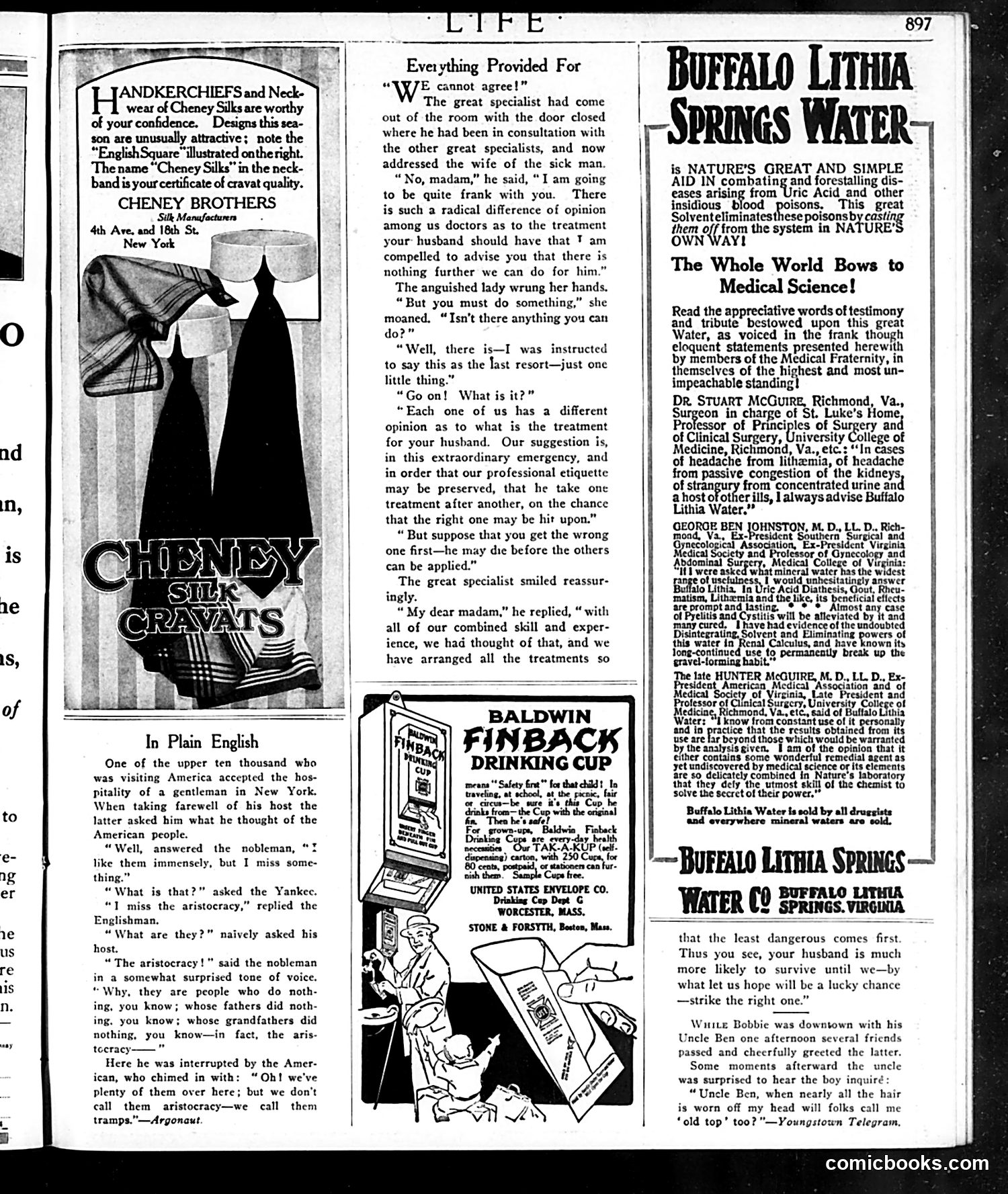
This page contains two distinct humorous pieces satirizing American society circa early 1900s: **"Everything Provided For"** (center story) mocks medical incompetence. When multiple specialist doctors cannot agree on treatment for a sick man, their "solution" is to try each treatment randomly, hoping one works before the patient dies. The satire targets the pretension of medical authority—these credentialed experts essentially admit they're guessing while maintaining professional dignity. **"In Plain English"** (bottom left) presents a joke about American vs. British class systems. A visiting English nobleman says he "misses the aristocracy" in America. When asked what aristocrats do, he explains they're people (and their ancestors) who do nothing. The American cheerfully responds: "We have plenty of them—we call them tramps." The satire equates idle wealthy Europeans with American vagrants, suggesting both are equally useless to society. The remainder comprises advertisements (Cheney silk neckwear, Baldwin drinking cups, Buffalo Lithia Springs Water) with endorsements from doctors—ironically placed alongside the satire mocking medical authority.
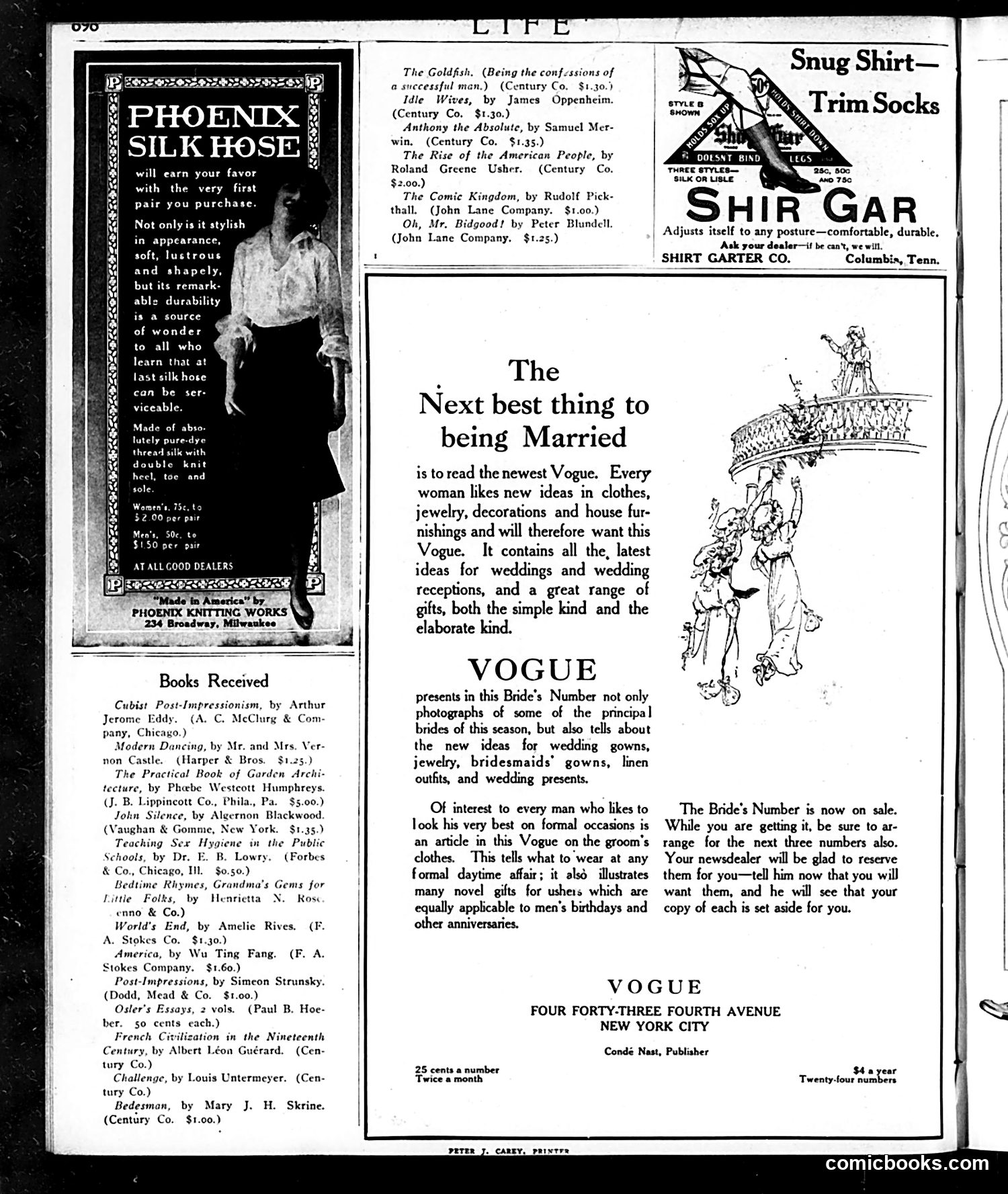
This page is primarily **advertising and publishing notices**, not satire or political cartoons. **Left side:** Phoenix Silk Hose advertisement emphasizes durability and elegance—marketing silk hosiery as both stylish and practical for women. **Top right:** Small ads for Snug Shirt and Shir Gar (a shirt garter/suspender device) promise comfort and adjustability. **Center:** A Vogue magazine advertisement uses humor in its headline: "The Next best thing to being Married is to read the newest Vogue." This playfully suggests that reading Vogue offers unmarried women similar satisfaction to matrimony—implying the magazine provides ideas about weddings, fashion, and household management that married women would value. **Bottom:** Book reviews list recently published titles spanning literary fiction, art criticism, and practical guides on topics like dancing and sex education. The page reflects early-20th-century consumer culture targeting women, with light humor rather than political commentary.
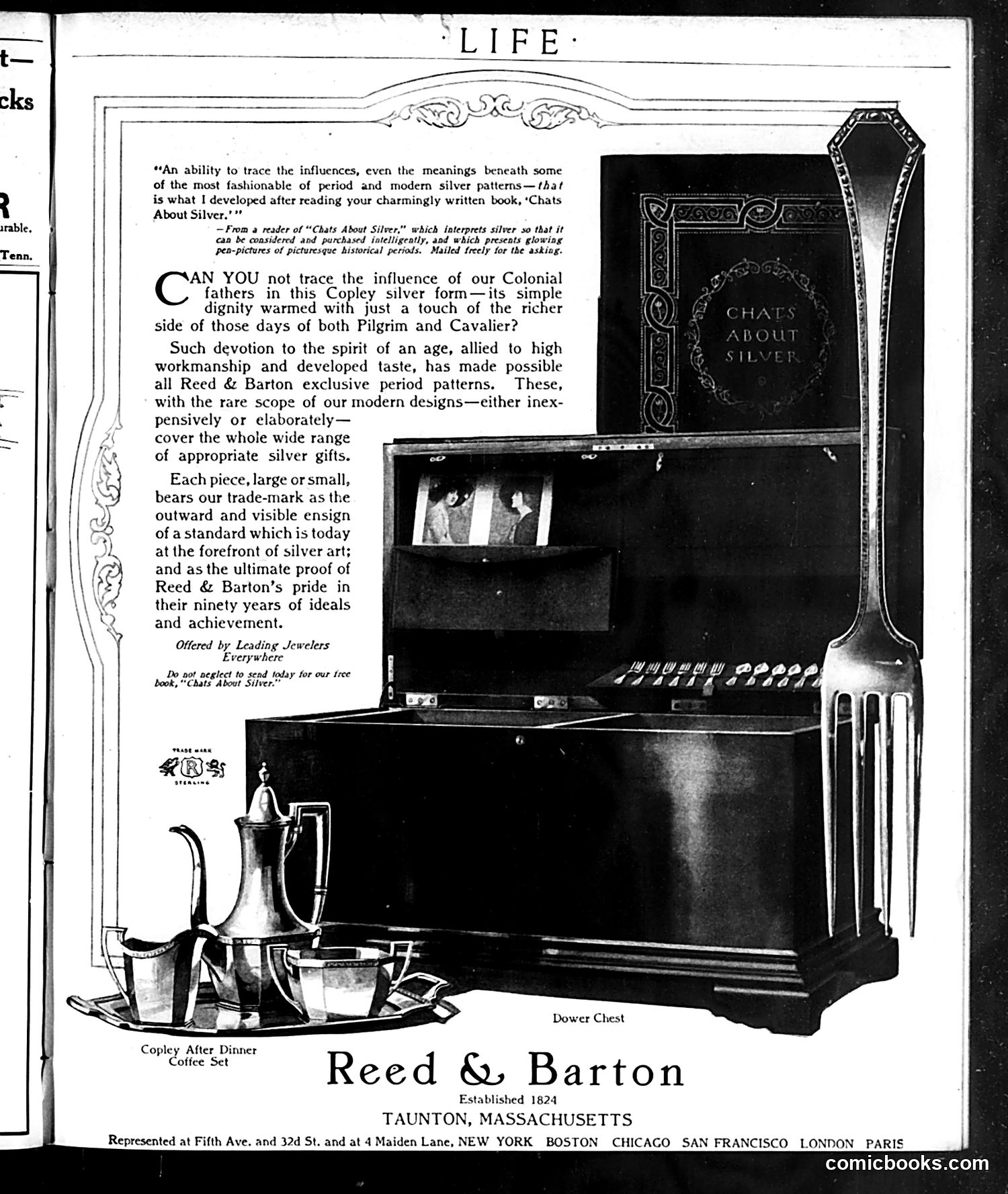
This page is primarily a **commercial advertisement for Reed & Barton silverware**, not a political cartoon or satire. The company, established 1824 in Taunton, Massachusetts, promotes their silver goods by invoking American colonial heritage and craftsmanship. The ad emphasizes that their "Copley" silver pattern and "Dower Chest" reflect Colonial and Pilgrim-era design values — "simple dignity" combined with "richer" Cavalier influences. The appeal is to educated, affluent consumers who appreciate historical authenticity and quality workmanship. A testimonial quotes a reader praising the company's book "Chats About Silver" for teaching people to understand and intelligently purchase silver based on its historical and cultural significance. **No satire or caricature is present.** This reflects early 20th-century advertising strategy: marketing luxury goods by associating them with American patriotic heritage and refined taste.
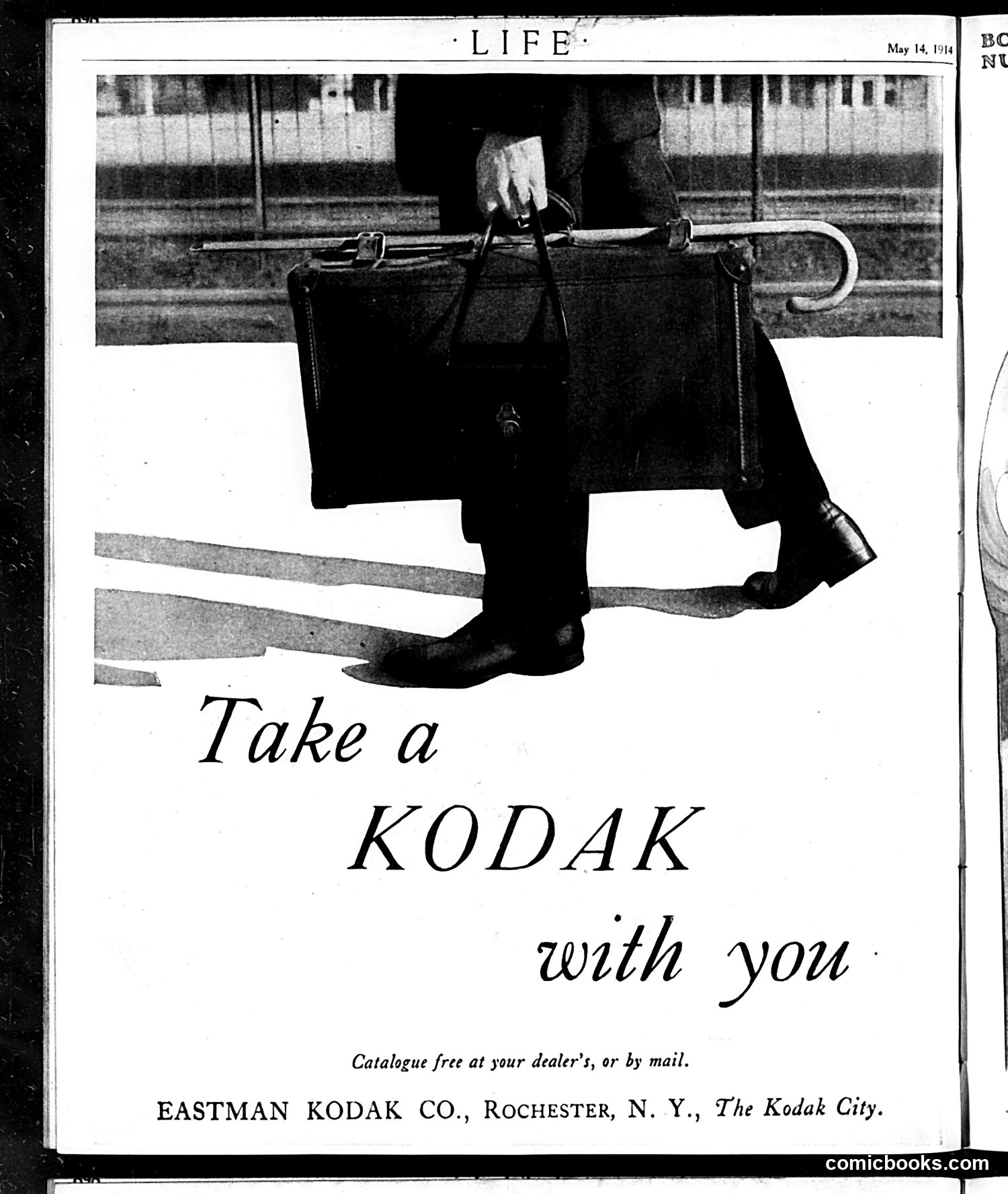
This is a straightforward **Kodak camera advertisement** from *Life* magazine (May 14, 1914), not political satire. The image shows a woman's legs and feet visible beneath a large camera/tripod that she's holding, with her hand adjusting the device at the top. The composition creates a visual joke: the camera is so large it dominates the frame, nearly obscuring the photographer. The slogan "Take a KODAK with you" encourages portable photography. The ad promotes accessibility—offering free catalogues through dealers or mail—positioning Kodak cameras as convenient travel companions for consumers. This reflects early 20th-century marketing emphasizing consumer leisure and personal documentation through photography.