
Life, 1914-05-14 · page 10 of 44
Life — May 14, 1914 — page 10: what you’re looking at
What you’re looking at
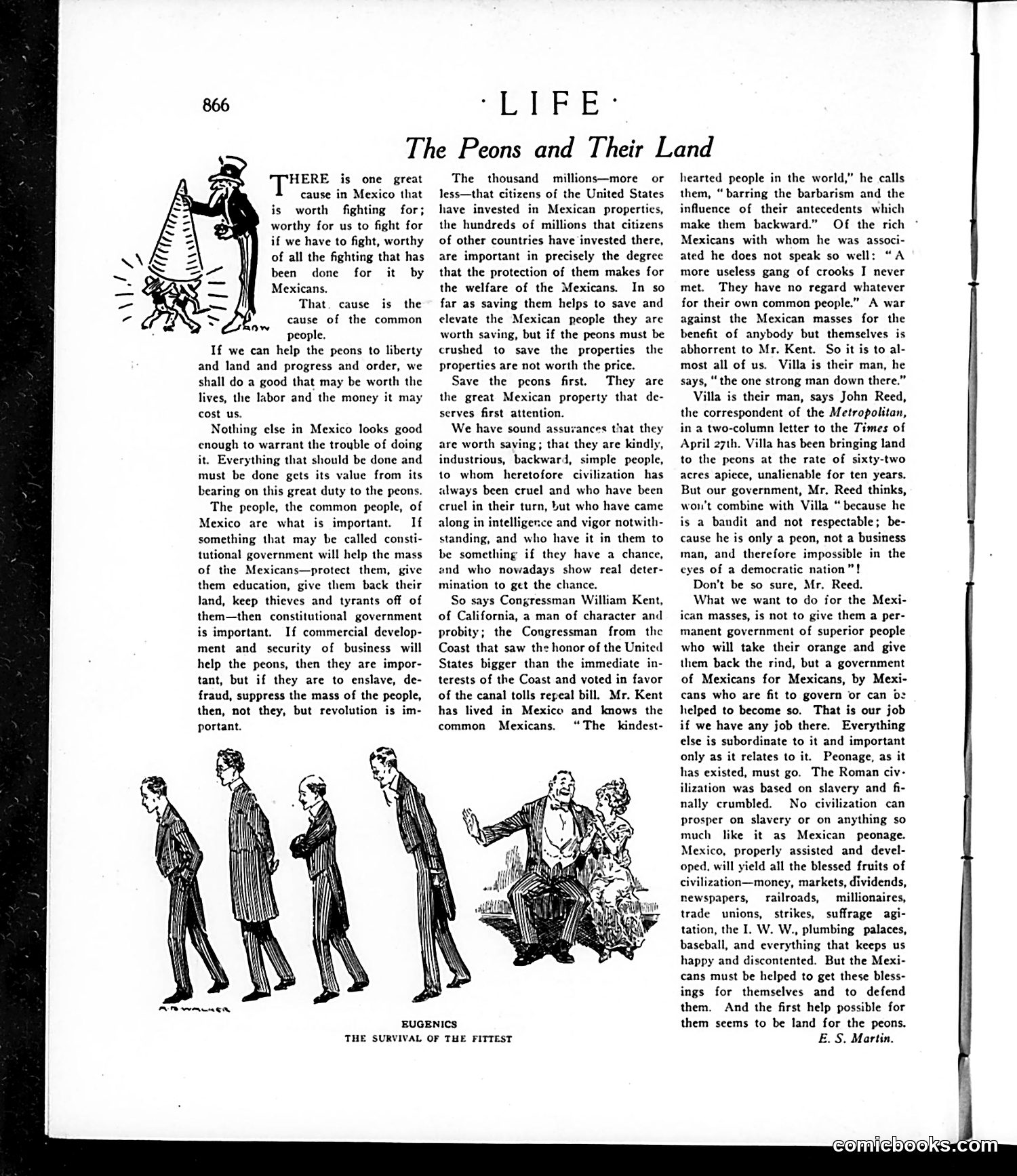
This page discusses Mexican land reform and U.S. interests in Mexico. The main article argues that protecting Mexican peasants (peons) and giving them land is essential—more important than protecting American business investments. The bottom cartoon, titled "Eugenics: The Survival of the Fittest," depicts four progressively taller, healthier-looking men, contrasted with a shorter, hunched figure on the right. This appears to critique Social Darwinist ideas popular in the early 20th century—the notion that some populations were inherently "superior" based on physical appearance. The cartoon likely satirizes how such pseudoscientific racism was being used to justify inequalities and discrimination, particularly regarding Mexican citizens.
📄 Transcribed text from this page (OCR, searchable)
Machine-transcribed from the original scan — historical spelling and the odd misread are preserved.
“ERE The Peons and Their Land HERE is one great cause in Mexico that is worth fighting for; worthy for us to fight for if we have to fight, worthy of all the fighting that has been done for it by Mexicans. That. cause is the cause of the common people. If we can help the peons to liberty and land and progress and order, we shall do a good that may be worth the lives, the labor and the money it may cost us. Nothing else in Mexico looks good enough to warrant the trouble of doing it. Everything that should be done and must be done gets its value from its bearing on this great duty to the peons. The people, the common people, of Mexico are what is important. If something that may be called consti- tutional government will help the mass of the Mexicans—protect them, give them education, give them back their land, keep thieves and tyrants off of them—then constitutional government is important. If commercial develop- ment and security of business will help the peons, then they are impor- tant, but if they are to enslave, de- fraud, suppress the mass of the people, then, not they, but revolution is im- portant. The thousand millions—more or less—that citizens of the United States have invested in Mexican properties, the hundreds of millions that citizens of other countries have invested there, are important in precisely the degree that the protection of them makes for the welfare of the Mexicans. In so far as saving them helps to save and elevate the Mexican people they are worth saving, but if the peons must be crushed to save the properties the properties are not worth the price. Save the pcons first. They are the great Mexican property that de- serves first attention. We have sound assurances that they are worth saving; that they are kindly, industrious, backward, simple people, to whom heretofore civilization has always been cruel and who have been cruel in their turn, but who have came along in intelligence and vigor notwith- standing, and who have it in them to be something if they have a chance, and who nowadays show real deter- mination to get the chance. So says Congressman William Kent, of California, a man of character and probity; the Congressman from the Coast that saw the honor of the United States bigger than the immediate in- terests of the Coast and voted in favor of the canal tolls repeal bill. Mr. Kent has lived in Mexico and knows the common Mexicans. “The kindest- EUGENICS THE SURVIVAL OF THE FITTEST hearted people in the world,” he calls them, “barring the barbarism and the influence of their antecedents w make them backward.” Of the rich Mexicans with whom he was associ- ated he does not speak so well: “A more useless gang of crooks I never met. They have no regard whatever for their own common people.” A war against the Mexican masses for the benefit of anybody but themselves is abhorrent to Mr. Kent. So it is to al- most all of us. Villa is their man, he says, “the one strong man down there.” Villa is their man, says John Reed, the correspondent of the Metropolitan, in a two-column letter to the Times of April 27th. Villa has been bringing land to the peons at the rate of sixty-two acres apiece, unalienable for ten years. But our government, Mr. Reed thinks, won't combine with Villa “ because he is a bandit and not respectable; be- cause he is only a peon, not a business man, and therefore impossible in the eyes of a democratic nation”! Don't be so sure, Mr. Reed. What we want to do for the Mexi- ican masses, is not to give them a per- manent government of superior people who will take their orange and give them back the rind, but a government of Mexicans for Mexicans, by Mexi- cans who are fit to govern or can bd: helped to become so. That is our job if we have any job there. Everything else is subordinate to it and important only as it relates to it. Peonage, as it has existed, must go. The Roman civ- ilization was based on slavery and fi- nally crumbled. No civilization can prosper on slavery or on anything so much like it as Mexican peonage. Mexico, properly assisted and devel- oped, will yield all the blessed fruits of civilization—money, markets, dividends, newspapers, railroads, _ millionaires, trade unions, strikes, suffrage agi- tation, the I. W. W., plumbing palaces, baseball, and everything that keeps us happy and discontented. But the Mexi- cans must be helped to get these bless- ings for themselves and to defend them. And the first help possible for them seems to be land for the peons. E. S. Martin.