
Life, 1914-05-14 · page 25 of 44
Life — May 14, 1914 — page 25: what you’re looking at
What you’re looking at
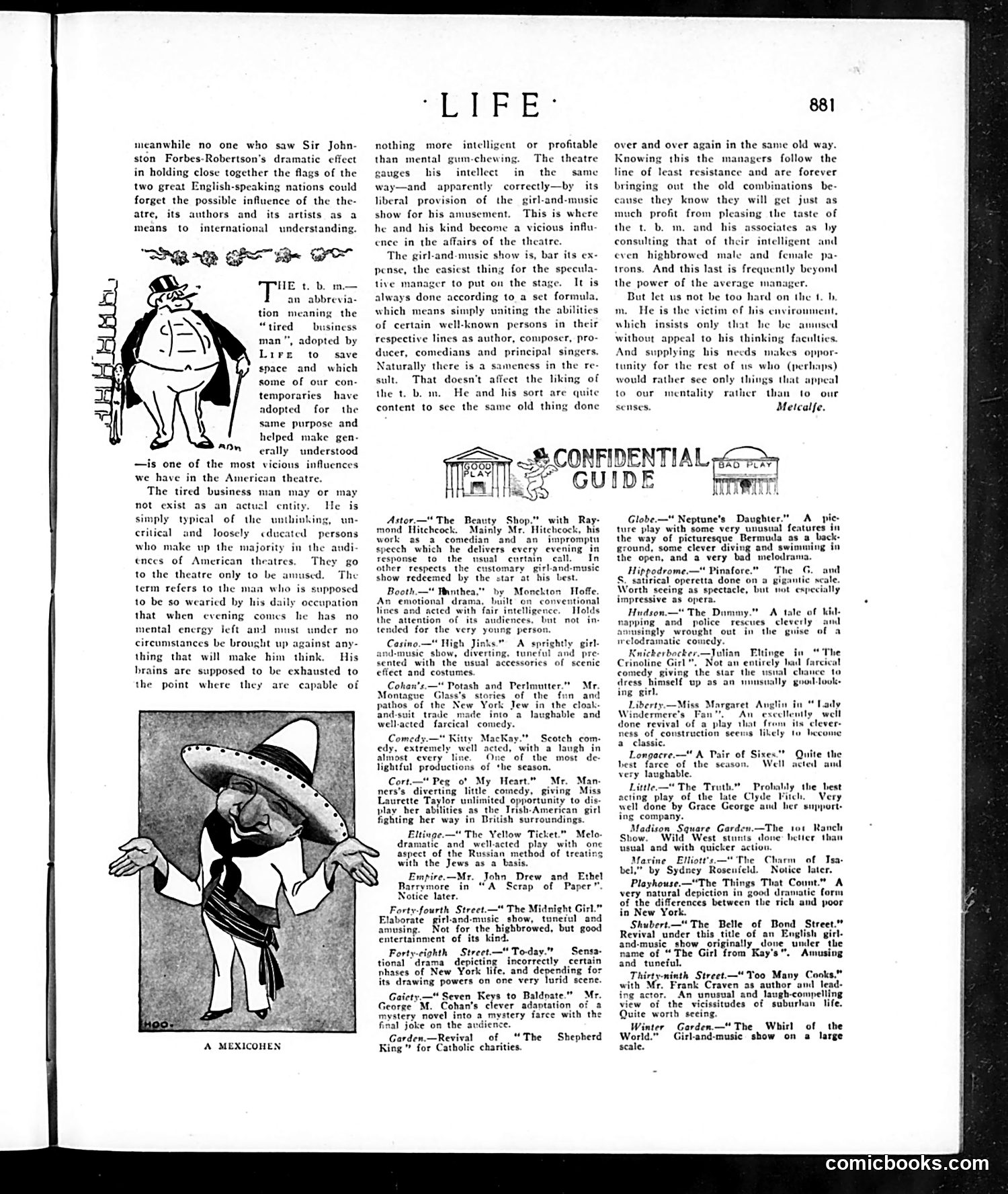
This page critiques American theater audiences and productions. The central essay attacks the "t.b.m." (tired business man)—Life's term for the average, exhausted urban worker whom theaters cater to with mindless entertainment. The author argues this demographic has become a "vicious influence," demanding only girl-and-music shows requiring no intellectual engagement, thus lowering theatrical standards across the industry. The two cartoons illustrate this concept: both depict portly, leisure-class men in Mexican and formal dress—visual embodiments of the audience member Life mocks as intellectually lazy. The accompanying "Confidential Guide" reviews current Broadway shows, categorizing them as either formulaic entertainment or more thoughtful drama. The satire targets commercialized theater's descent into lowest-common-denominator fare, blaming audiences' mental exhaustion and managers' profit motives equally.
📄 Transcribed text from this page (OCR, searchable)
Machine-transcribed from the original scan — historical spelling and the odd misread are preserved.
jeanwhile no one who saw Sir Jobn- ston Forbes-Robertson’s dramatic effect in holding close together the flags of the two great English-speaking nations could forget the possible influence of the the- atre, its authors and its artists as a means to international understanding. HE t. b. m— an abbrevia- tion meaning the “tired business man", adopted by Lire to save space and which some of our con- temporaries have adopted for the same purpose and helped make gen- erally understood —is one of the most vicious influences we have in the American theatre. The tired business man may or may not exist as an actus! enti Ne is simply typical of the unthinking, un- critical and loosely cducated persons who make up the majority in the andi ences of American theatre: They go to the theatre only to be amused. The term refers to the maa who is supposed to be so wearied by his daily occupation that when evening comes he has no mental energy left and must under no circumstances be brought up against any- thing that will make think. His brains are supposed to be exhausted to the point where they are capable of ADH him A MEXICOHEN *EEPIES nothing more intelligent or profitable than mental gum-chewing. The theatre gauges his intellect’ in the same way—and apparently correctly—by its liberal provision of the girl-and-music show for his amusement. This is where he and his kind become a vicious influ- ence in the affairs of the theatre. The girl-and-music show is, bar its ex- pense, the easiest thing for the specula- tive manager to put on the stage. It is always done according to a set formula, which means simply uniting the a 3 of certain well-known persons in their respective lines as author, composer, pro- ducer, comedians and principal singers. Naturally there is a sameness in the re- sult, That doesn't affect the liking of the t. b. m. He and his sort are quite content to sce the same old thing done Sr CONFIDENTIAL ex GUIDE LAY m Astor.—" The Beauty Shop. mond Hitchcock. Mainly Mr. Hitchcock, his work asa comedian and an impromptn specch which he delivers every evening in response to the wsual curtain call. In other respects the enstomary girl-and-music show redeemed by the star at his Lest. Booth.— Wanthea,”” by Monckton Hoffe. An emotional drama, built on conventional lines and acted with fair intelligence. Holds the attention of its audiences, but not in- tended for the very young person. Casino. —" High Jinks.” A sprightly girl. -music show, diverting, tuneful and pre: sented with the usual accessories of scenic effect and costumes. Cohan’s.—“ Potash and Perlmutter.” Mr. Montague Glass’s stories of the fun and pathos of the New York Jew in the cloak- and-suit trade made into a laughable and well-acted farcical comedy. Comedy.—" Kitty MacKay." Scotch com: edy, extremely well acted, with a laugh in almost every line. One of the most de- lightful productions of ‘he season. Cort.—" Peg ot My Heart.” Mr. Man: ners's diverting little comedy, giving Miss Laurette Taylor unlimited opportunity to dis- play her abilities as the Irish-American girl fighting her way in British surroundings. Ettinge.—" The Yellow Ticket.” Meto- dramatic and well-acted play with one aspect of the Russian method of treating with the Jews as a basis. Empire.—Mr. John_ Drew and Ethel Rarrymore in “A Scrap of Paper”. Notice later. Forty-fourth Street.—" The Midnight Girl.” Elaborate girl-and-music show, tunerul and amusing. Not for the highbrowed, but good entertainment of its kind. Forty-cighth Street—" To-day.” Sensa- tional drama depicting incorrectly certain phases of New York life, and depending for its drawing powers on one very lurid scene. Gaiety.— Seven, Keys to Baldnate.” Mr. George M. Cohan’s clever adaptation of a mystery novel into a mystery farce with the final joke on the avdien Garden.—Revival of King with Ray- “The Shepherd for Catholic charities. 881 over and over again in the same old way. Knowing this the managers follow the line of least resistance and are forever bringing out the old combinations be- cause they know they will get just as much profit from pleasing the taste of the t. b. m, and his associates as hy consulting that of their intelligent and even highbrowed male and female pa- trons. And this last is frequently beyond the power of the average manager. But let us not be too hard on the t. b m. He is the victim of his environment, which insists only that he be amused without appeal to his thinking faculties. And supplying his necds makes oppor- tunity for the rest of us who (perhaps) would rather see only things that appeal to our mentality rather than to our Metcalfe. senses. BAD Play Globe.—" Neptune's Daughter."| A _ pic: ture play with some very unusual features the way of picturesque Bermuda as a_ bac ground, some clever diving and 8: ng in the open, and a very bad melodrama. Hippodrome.—" Pinafore.” $, satirical operetta done on a Worth seeing as spectacle, but impressive as opera. Hndson.—"* The Dummy.” A tale of napping pd police rescues clew amusingly wrought out in the guise welodramatic comedy. Knickerbocker.—Tulian Eltinge in Crinoline Girl". Not an entirely hail farcical comedy giving the star the usnal chance to dress himself wp as an ninsually good-looke ing girl. ness of construction seems likely tv become a classic. Longacre.—" A Pair of Sixes.” Lest farce of the season, Well very laughable. Little —" The Truth.” Probatily the best acting play of the late Clyde Fitch. Very well done by Grace George and her support: § company. Madison Square Garde Show. Wild West stun usual and with quicker acti Marine Eltiott's—" The Ch: of Tsa- bel,” by Sydney Rosenfeld. Notice later. Playhouse.—"The Things That Cot very natural depiction in good dra of the differences between the rich and poor in New York. Shubert.—" The Belle of Bond Street.” Revival under this title of an English girl- and-music show originally done umler the name of “The Girl from Kay's”. Amusing and tuneful. Thirty-ninth Street—"“ Too Many Cooks,” with Mr. Frank Craven as author amd lead. ing actor. An unusual and laugh-compelling view of the vicissitudes of suburhan life. Quite worth seeing Winter Garden —“The Whirl of the Ward” Girland-music show on a large scale. Quite the acted and <The ror Ranch Jone: better than comicbooks.com