
Life, 1914-05-14 · page 26 of 44
Life — May 14, 1914 — page 26: what you’re looking at
What you’re looking at
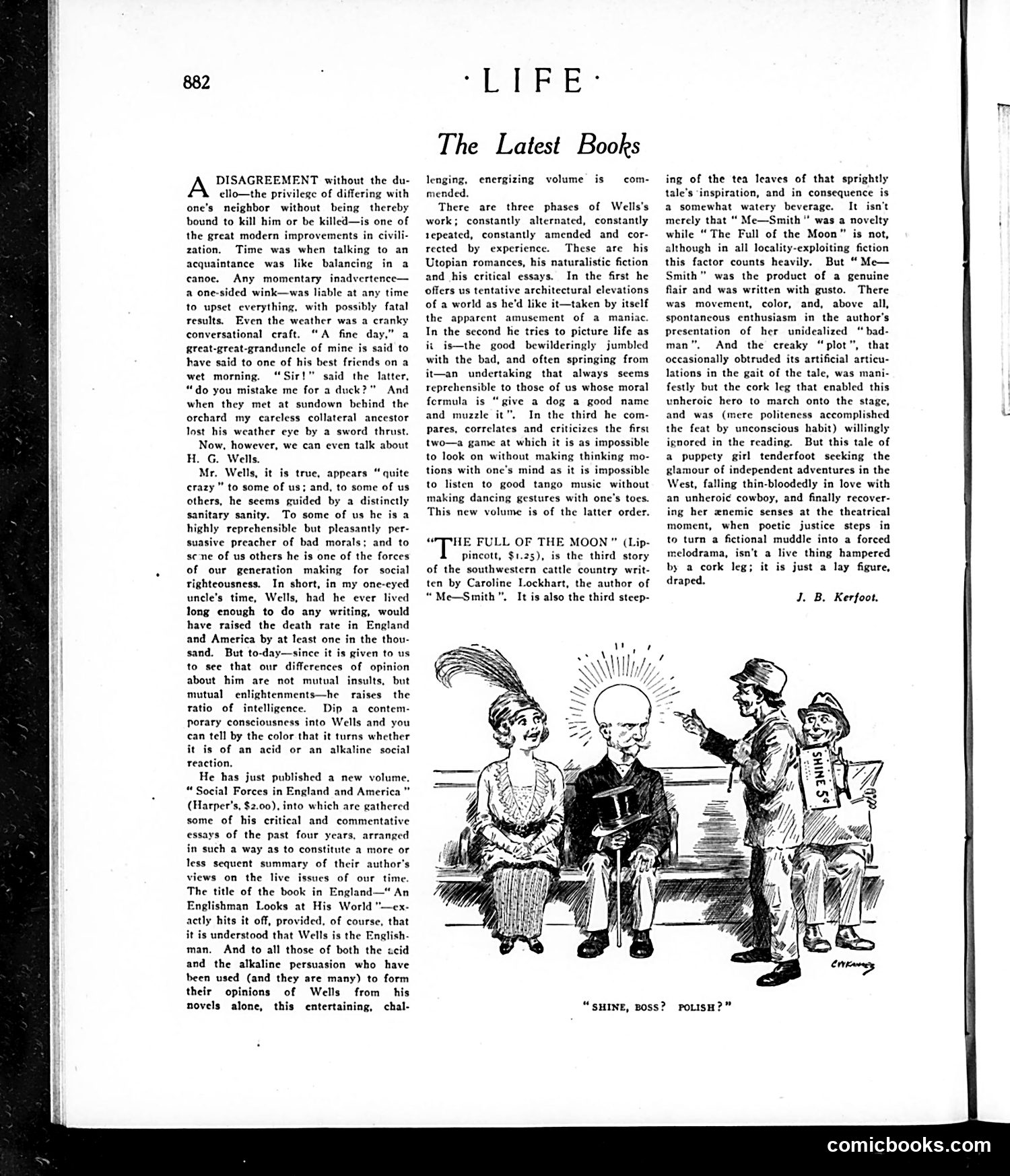
This page reviews H.G. Wells's new essay collection "Social Forces in England and America," framing him as a controversial but intellectually stimulating figure. The text argues that modern civilization allows disagreement without violence—a jab at older, honor-based cultures where casual conversational mistakes could provoke fatal duels. The cartoon below illustrates this point. It depicts a bald man (Wells, recognizable by his distinctive appearance) seated between a woman and two working-class men in heated discussion. One man gestures aggressively while another holds what appears to be a newspaper or publication labeled "WELLS'S." The caption—"SHINE, BOSS? POLISH?"—suggests these are street vendors or common laborers debating Wells's ideas. **The satire**: Wells's controversial ideas inspire passionate disagreement across all social classes, yet nobody kills anybody over it. This represents progress in civilization—intellectual engagement replacing violence.
📄 Transcribed text from this page (OCR, searchable)
Machine-transcribed from the original scan — historical spelling and the odd misread are preserved.
882 DISAGREEMENT without the du- ello—the privilege of differing with one’s neighbor without being thereby bound to kill him or be killed—is one of the great modern improvements in civili- zation. Time was when talking to an acquaintance was like balancing in a canoe. Any momentary inadvertence— a one-sided wink—was liable at any time to upset everything, with possibly fatal results. Even the weather was a cranky conversational craft. “A fine day,” a great-great-granduncle of mine is said to have said to one of his best friends on a wet morning. “Sir!” said the latter, “do you mistake me for a duck?" And when they met at sundown behind the orchard my careless collateral ancestor lost his weather eye by a sword thrust. Now, however, we can even talk about H. G. Wells. Mr. Wells, it is true, appears “ quite crazy” to some of us; and, to some of us others, he seems guided by a distinctly sanitary sanity. To some of us he is a highly reprehensible but pleasantly per- suasive preacher of bad morals; and to sene of us others he is one of the forces of our generation making for social righteousness. In short, in my one-cyed uncle's time, Wells, had he ever lived long enough to do any writing, would have raised the death rate in England and America by at least one in the thou- sand. But to-day—since it is given to us to see that our differences of opinion about him are not mutual insults, but mutual enlightenments—he raises the ratio of intelligence. Dip a contem- Porary consciousness into Wells and you can tell by the color that it turns whether it is of an acid or an alkaline social reaction, He has just published a new volume. “ Social Forces in England and America” (Harper's, $2.00), into which are gathered some of his critical and commentative essays of the past four years, arranged in such a way as to constitute a more or less sequent summary of their author's views on the live issues of our time. The title of the book in England—“ An Englishman Looks at His World "—ex- actly hits it off, provided, of course, that it is understood that Wells is the English- man. And to all those of both the acid and the alkaline persuasion who have been used (and they are many) to form their opinions of Wells from his novels alone, this entertaining, chal- “RPE The Latest Books lenging, energizing volume is com- mended. There are three phases of Wells's work; constantly alternated, constantly repeated, constantly amended and cor- rected by experience. These are his Utopian romances, his naturalistic fiction and his critical essays. In the first he offers us tentative architectural elevations of a world as he'd like it—taken by itself the apparent amusement of a maniac. In the second le tries to picture life as it isthe good bewilderingly jumbled with the bad, and often springing from it—an undertaking that always seems reprehensible to those of us whose moral fermula is “give a dog a good name and muzzle it”. In the third he com- pares, correlates and criticizes the first two—a game at which it is as impossible to look on without making thinking mo- tions with one’s mind as it is impossible to listen to good tango music without making dancing gestures with one’s toes. This new volume is of the latter order. “THE FULL OF THE MOON " (Lip- pincott, $1.25), is the third stor: of the southwestern cattle country writ- ten by Caroline Lockhart, the author of “Me—Smith”, It is also the third stcep- ing of the tea leaves of that sprightly tale’s ‘inspiration, and in consequence is a somewhat watery beverage. It isn't merely that “ Me—Smith “ was a novelty while “ The Full of the Moon” is not, although in all locality-exploiting fiction this factor counts heavily, But “ Me— Smith” was the product of a genuine flair and was written with gusto. There was movement, color, and, above all, spontaneous enthusiasm in the author's Presentation of her unidealized “ bad- man”. And the creaky “plot”, that occasionally obtruded its artificial articu- lations in the gait of the tale, was mani- festly but the cork leg that enabled this unheroic hero to march onto the stage, and was (mere politeness accomplished the feat by unconscious habit) willingly ignored in the reading. But this tale of a puppety girl tenderfoot seeking the glamour of independent adventures in the West, falling thin-bloodedly in love with an unheroi¢ cowboy, and finally recover- ing her znemic senses at the theatrical moment, when poetic justice steps in to turn a fictional muddle into a forced melodrama, isn't a live thing hampered by a cork leg; it is just a lay figure, draped. J. B. Kerfoot, “ SHINE, BOSS? POLISH?” comicbooks.com