
A complete issue · 41 pages · 1914
Life — March 26, 1914
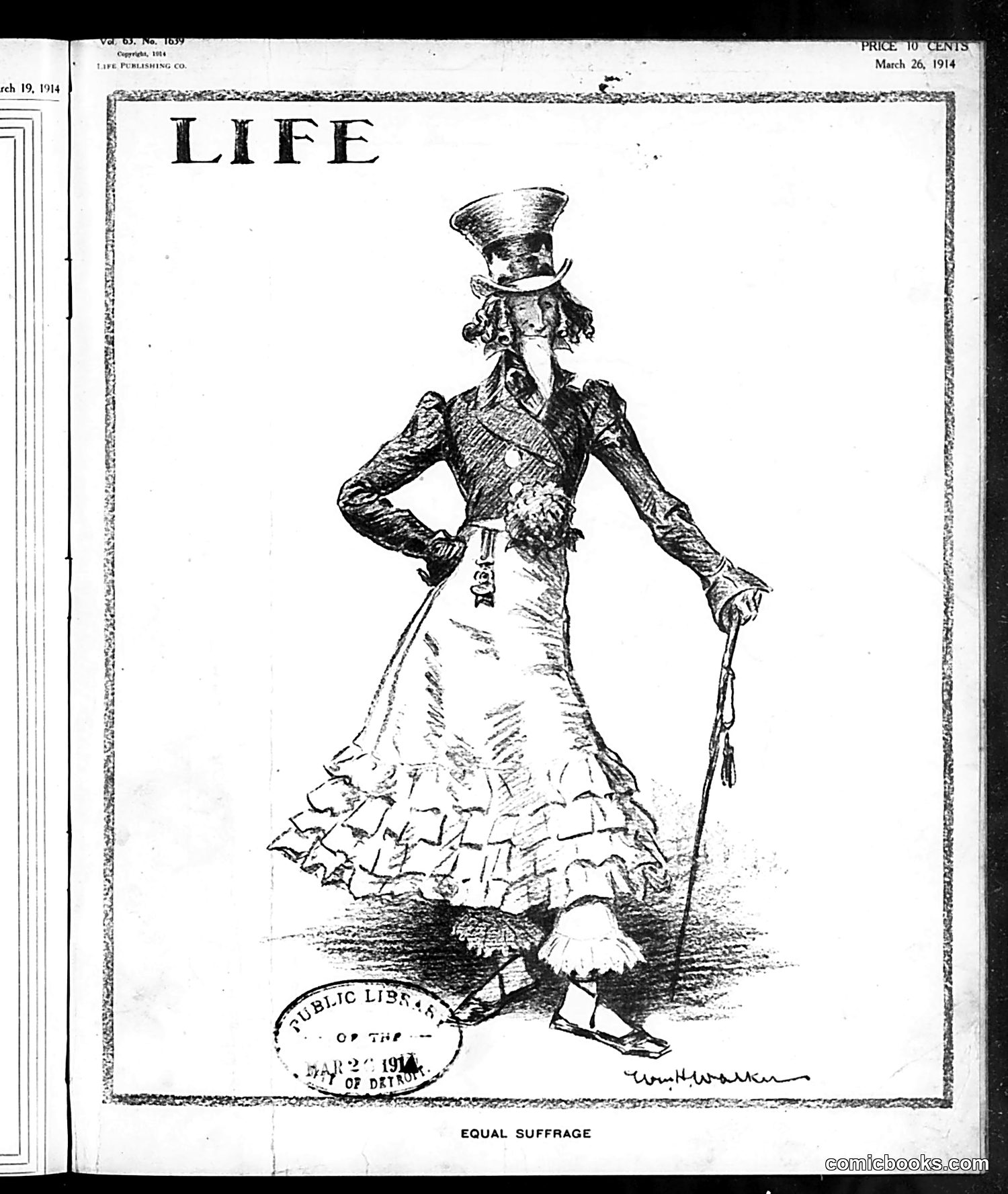
This cartoon depicts a elegantly dressed woman in early 20th-century fashion—ornate jacket, decorative hat, and ruffled skirt—holding a cane with confidence. The caption reads "EQUAL SUFFRAGE." The satire targets the women's suffrage movement, which was actively campaigning for voting rights in 1914. The cartoon appears to mock suffragists by portraying a woman in exaggerated finery, suggesting that advocates were superficial or absurdly fashionable rather than serious about equality. The dignified pose with the cane may ironically emphasize "equality" while the elaborate dress contradicts the point—implying that concern with appearance undermined credibility of the political movement. This represents typical anti-suffrage satire of the era, dismissing women's rights activism as vain or frivolous.
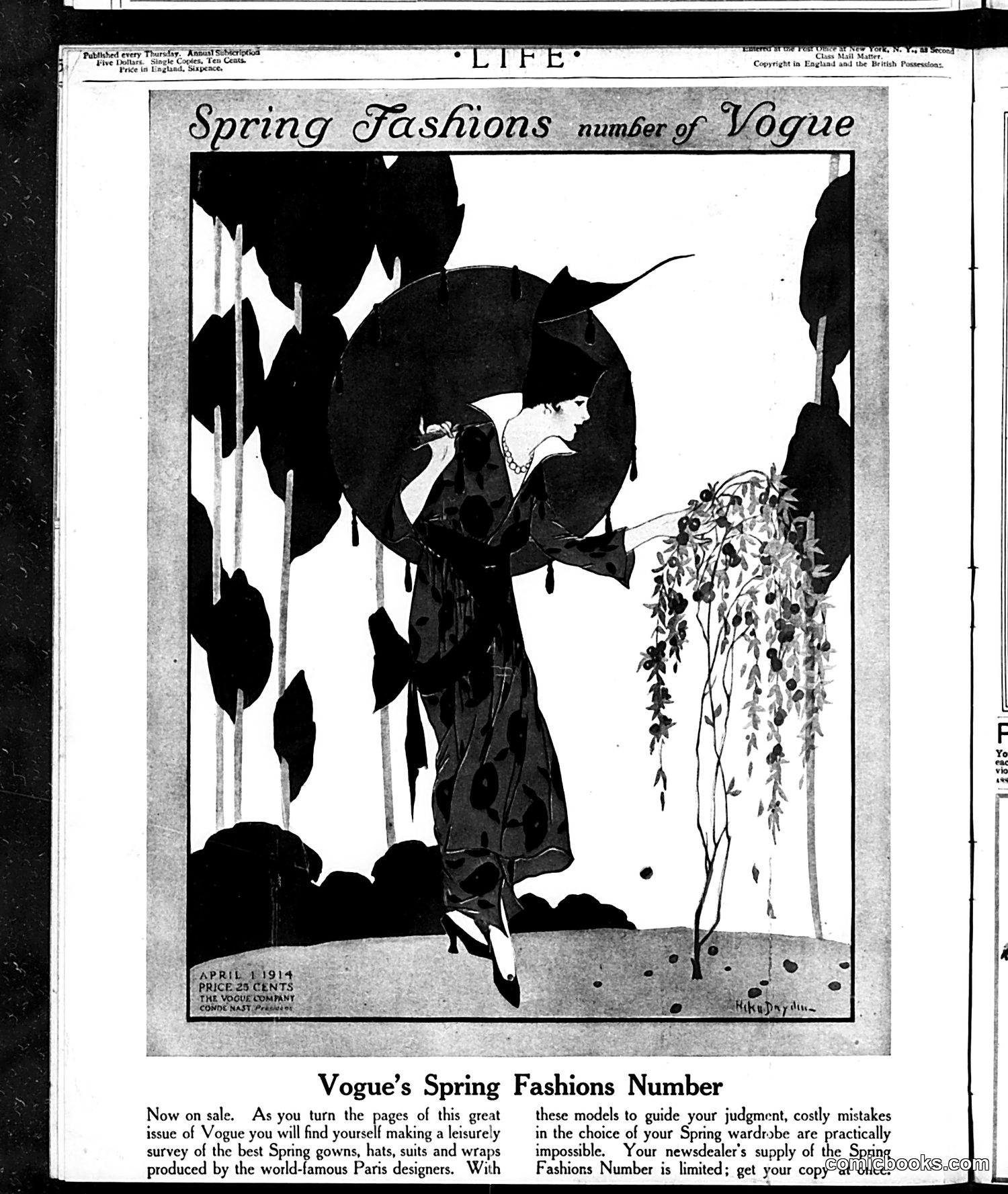
This is primarily **advertising content**, not satire or political commentary. The page promotes Vogue magazine's April 1, 1914 "Spring Fashions Number" (priced at 25 cents). The illustration depicts a fashionable woman in silhouette wearing a large decorative hat and an elegant spring coat or dress. She's shown in a garden setting with flowering plants and vines, a typical aesthetic choice for spring fashion promotion. The artistic style is characteristic of early 1900s fashion illustration—dramatic black silhouettes against white backgrounds. The accompanying text encourages readers to purchase this issue to survey "the best Spring gowns, hats, suits and wraps produced by the world-famous Paris designers." There is no political or social satire present; this is straightforward magazine marketing from the WWI era.
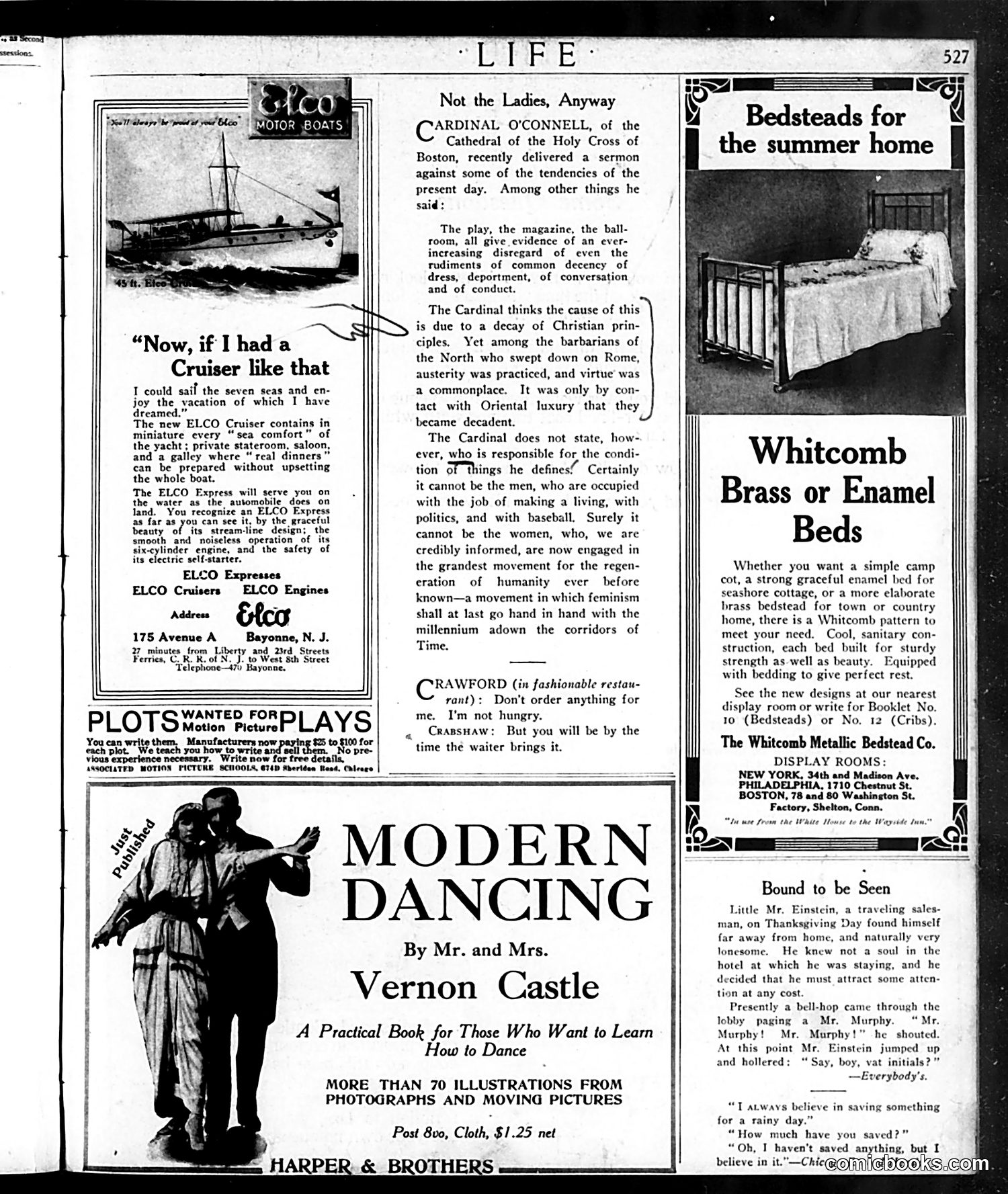
This page is primarily **advertising and commercial content** rather than political satire. It features: 1. **ELCO Motor Boats ad** (top left): Luxury boat advertisement with aspirational copy about cruising the seven seas. 2. **"Not the Ladies, Anyway"** (center): A brief editorial piece quoting Cardinal O'Connell criticizing modern social decay—declining dress standards, conversation, and decency. The Cardinal blames neither men (occupied with work/politics/baseball) nor women, but rather the broader cultural movement toward "regeneration" and feminism. 3. **Whitcomb Brass or Enamel Beds ad** (right): Furniture advertisement. 4. **Modern Dancing book advertisement** (bottom): Instructional dance manual by Vernon Castle. The Cardinal's commentary reflects conservative anxiety about 1920s social changes, particularly women's increasing public participation and changing social norms.
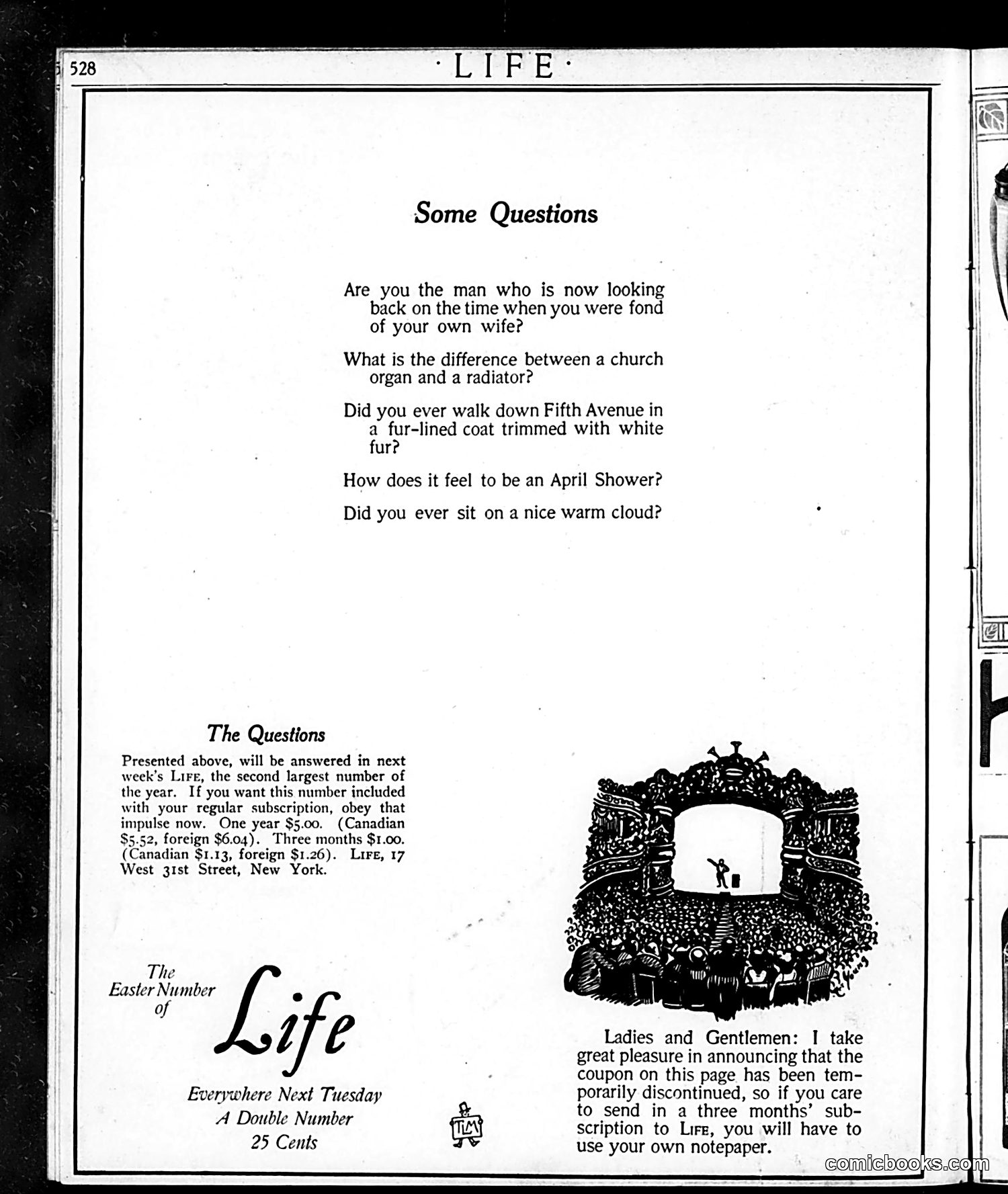
This page from *Life* magazine (page 528) features a section titled "Some Questions" that poses whimsical, philosophical inquiries to readers—asking about nostalgia, sensory experiences, and life's pleasures (Fifth Avenue fashion, April showers, warm clouds). Below is an announcement for *Life's* Easter Number, promoting a double issue at 25 cents. The central illustration depicts a large crowd gathered in what appears to be a theater or auditorium, with a solitary figure on stage—likely representing a performer or speaker addressing the masses. The image's meaning is unclear without additional context, though it may satirize mass entertainment or public spectacle common to the era. The page is primarily editorial/advertising content rather than political satire.
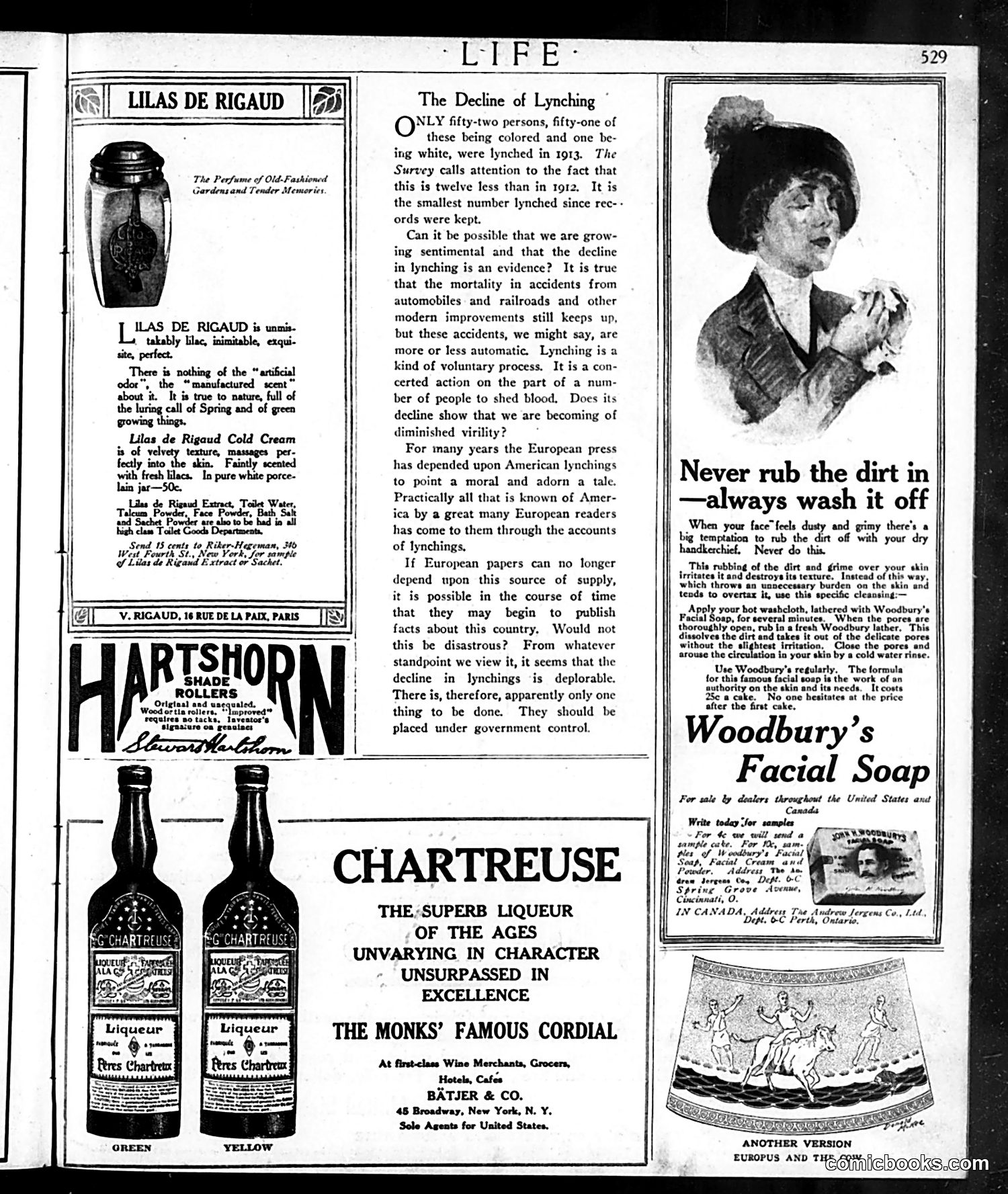
This page contains primarily **advertisements** rather than political cartoons. The main content is an article titled "The Decline of Lynching," which reports that only 52 people were lynched in 1913—the lowest number on record. The author discusses whether this decline represents growing moral sentiment or merely reflects changing circumstances. The piece concludes by advocating that lynchings "should be placed under government control." The page also features ads for Lilas de Rigaud perfume, Hartshorn shade rollers, Chartreuse liqueur, and Woodbury's Facial Soap. The lynching article represents serious commentary on American racial violence rather than satire—Life magazine's treatment of this brutal practice appears to be straightforward reportage for its educated readership.
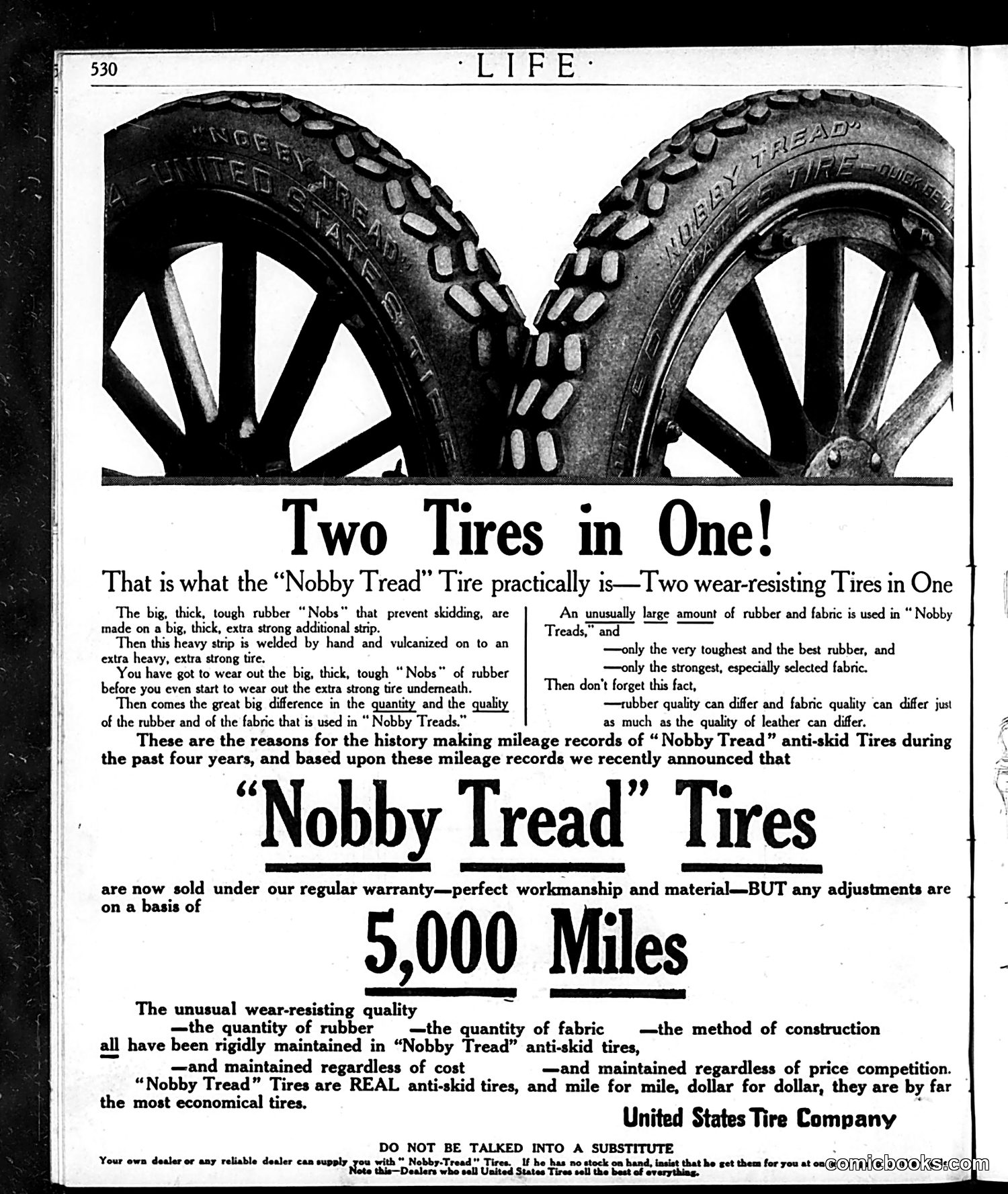
This is **not a cartoon or satire**—it's a straightforward **product advertisement** for "Nobby Tread" anti-skid tires by the United States Tire Company, published in *Life* magazine (which carried both humor and ads). The ad compares two tires visually and explains the product's construction: a thick rubber base layer plus extra reinforcing strips, creating "two tires in one." The key sales pitch emphasizes a **5,000-mile warranty**, positioning this as superior reliability. The ad's urgent tone ("DO NOT BE TALKED INTO A SUBSTITUTE") suggests competitive market pressure from rival tire manufacturers during this era. Without dating information visible, the specific time period is unclear, though the typography and design suggest early-to-mid 20th century automotive advertising.
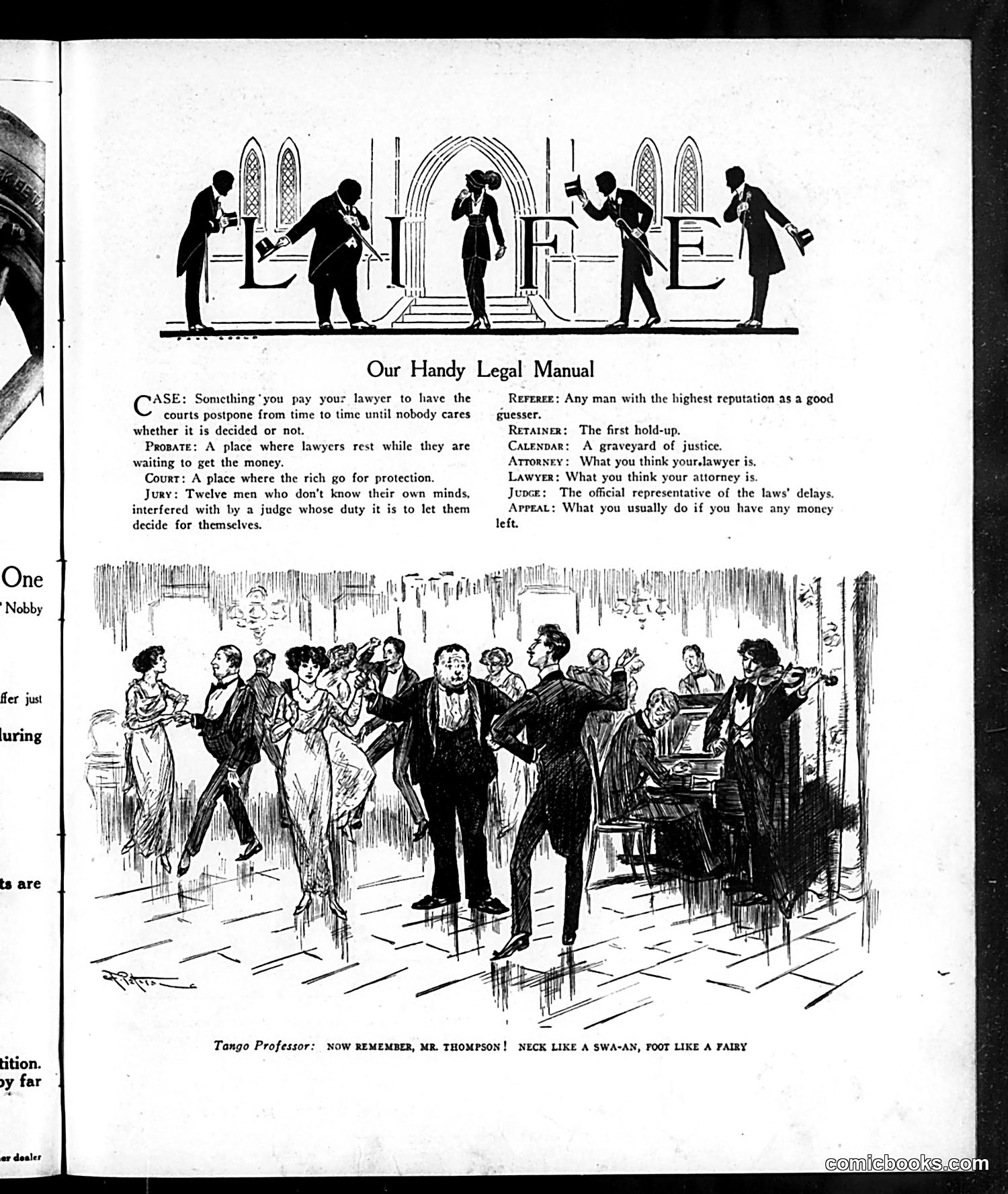
This page satirizes the legal profession through humorous definitions. The top panel shows silhouetted lawyers in a courthouse performing exaggerated gestures, illustrating terms like "Case," "Probate," "Court," and "Jury." The definitions mock legal jargon and practice: a "Case" is what you pay lawyers for repeatedly; "Probate" is where lawyers rest while waiting for money; "Court" protects the rich; "Jury" describes twelve people who don't understand what's happening. The bottom illustration shows a tango lesson, captioned "Tango Professor: Now remember, Mr. Thompson! Nick like a Swa-an, foot like a Fairy"—likely satirizing pretentious dance instruction or social climbing. The overall message critiques lawyers as parasitic, the legal system as class-biased, and the era's affectation toward European sophistication.
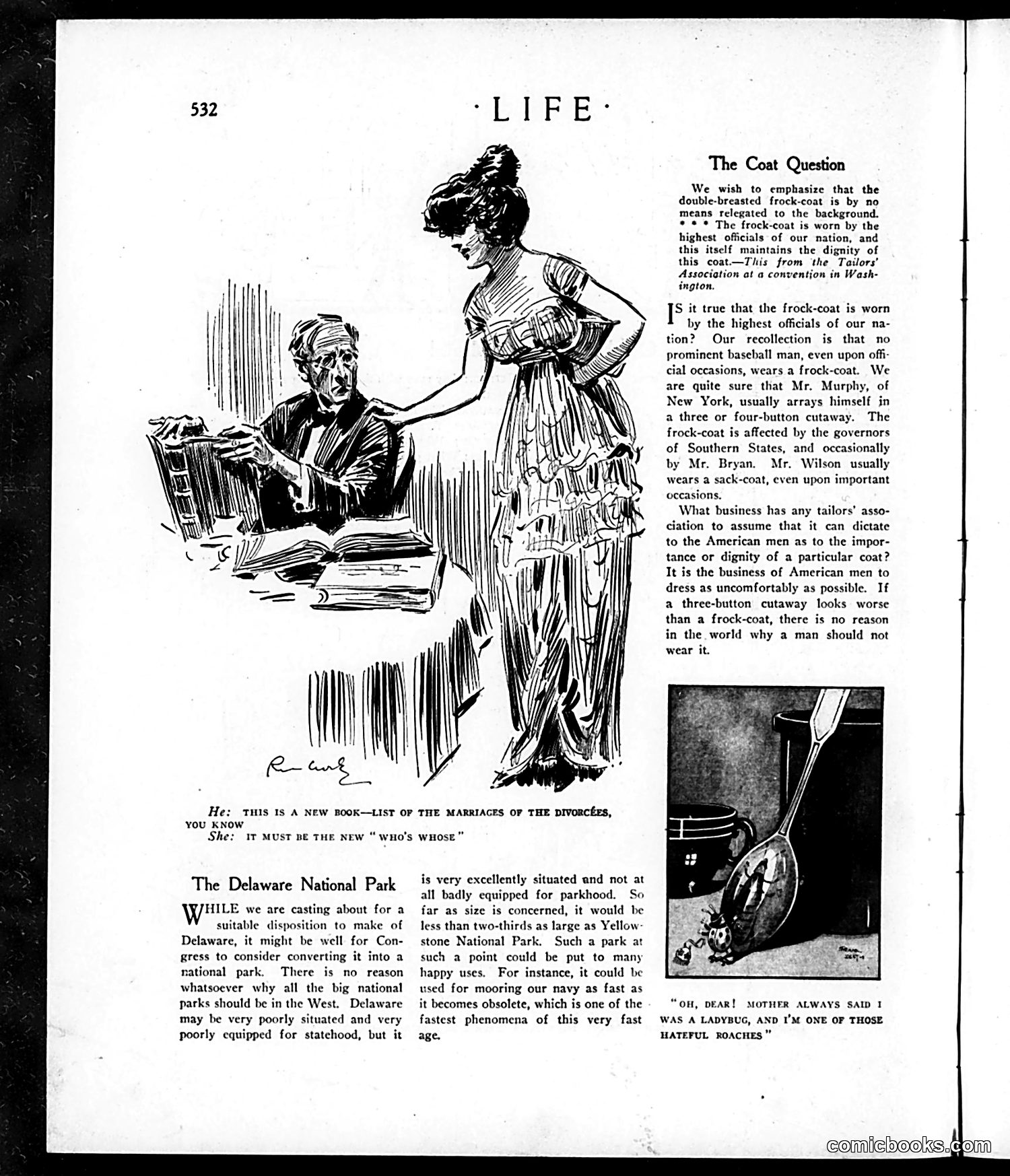
The main cartoon satirizes debate over formal dress codes. It shows a tailor presenting a double-breasted frock-coat to a woman, while depicting a man reading. The text argues the frock-coat remains appropriate formal wear worn by "highest officials" despite some Americans preferring sack-coats (like three-button cutaways). The joke caption has the man saying he's reading "a new book—list of the marriages of the divorcees" and the woman responding "it must be the new 'who's whose.'" This references high-society divorce scandals—a common satire subject in this era. The article defends tailors' expertise and American men's right to dress formally, implicitly critiquing those who reject traditional formal wear as undignified.
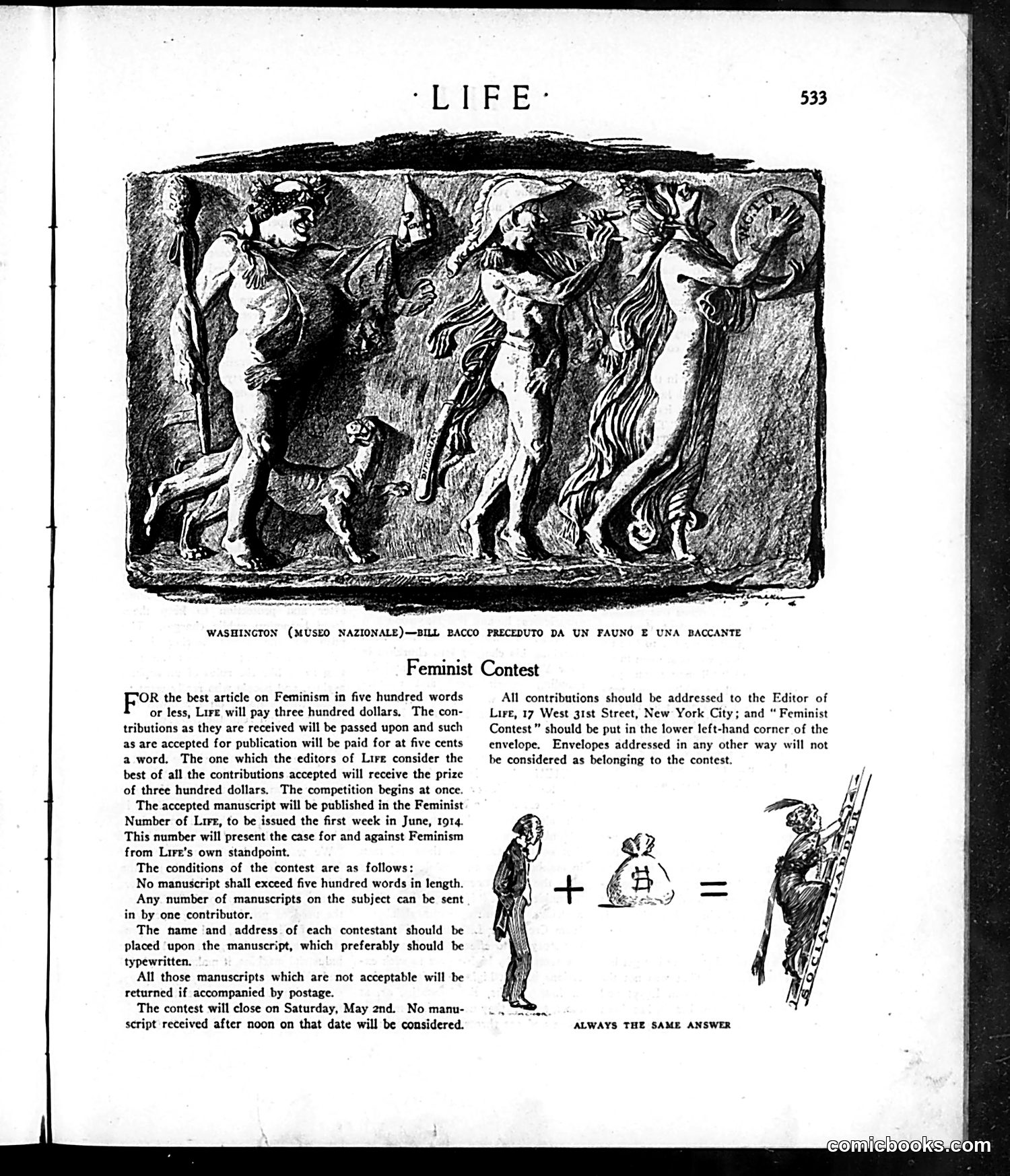
This page announces a satirical writing contest about feminism, offering $300 for the best article (five hundred words or less) on the subject. The contest closes May 2, 1914. The top illustration shows classical cherubs or putti in a bacchanalian scene—likely mocking feminism through association with excess or disorder. Below, a cartoon equation reads: woman + money/home = woman climbing a ladder, captioned "ALWAYS THE SAME ANSWER." This satirizes the feminist movement by suggesting that when women gain financial independence and household authority, the inevitable result is their social climbing or abandonment of traditional roles—presented as absurd or undesirable. The satire reflects early 20th-century resistance to women's suffrage and economic independence, treating feminist aspirations as ridiculous rather than legitimate.
This page contains editorial commentary on contemporary periodicals and social issues, not a political cartoon. The text discusses Mary Antin (a Jewish immigrant author) and her potential as a future political leader, arguing she embodies American democratic ideals better than native-born citizens. The piece critiques the American Magazine for its article on "Hunkeys" (a derogatory term for Eastern European Slavic laborers). It describes their exploitation in Detroit auto factories, where they work grueling shifts before being discarded. The commentary advocates for open immigration, arguing America's founding principles demand it. It defends poor immigrants against nativist rhetoric, suggesting society has a responsibility to protect vulnerable workers from industrial abuse and wage exploitation—a progressive position for the period.
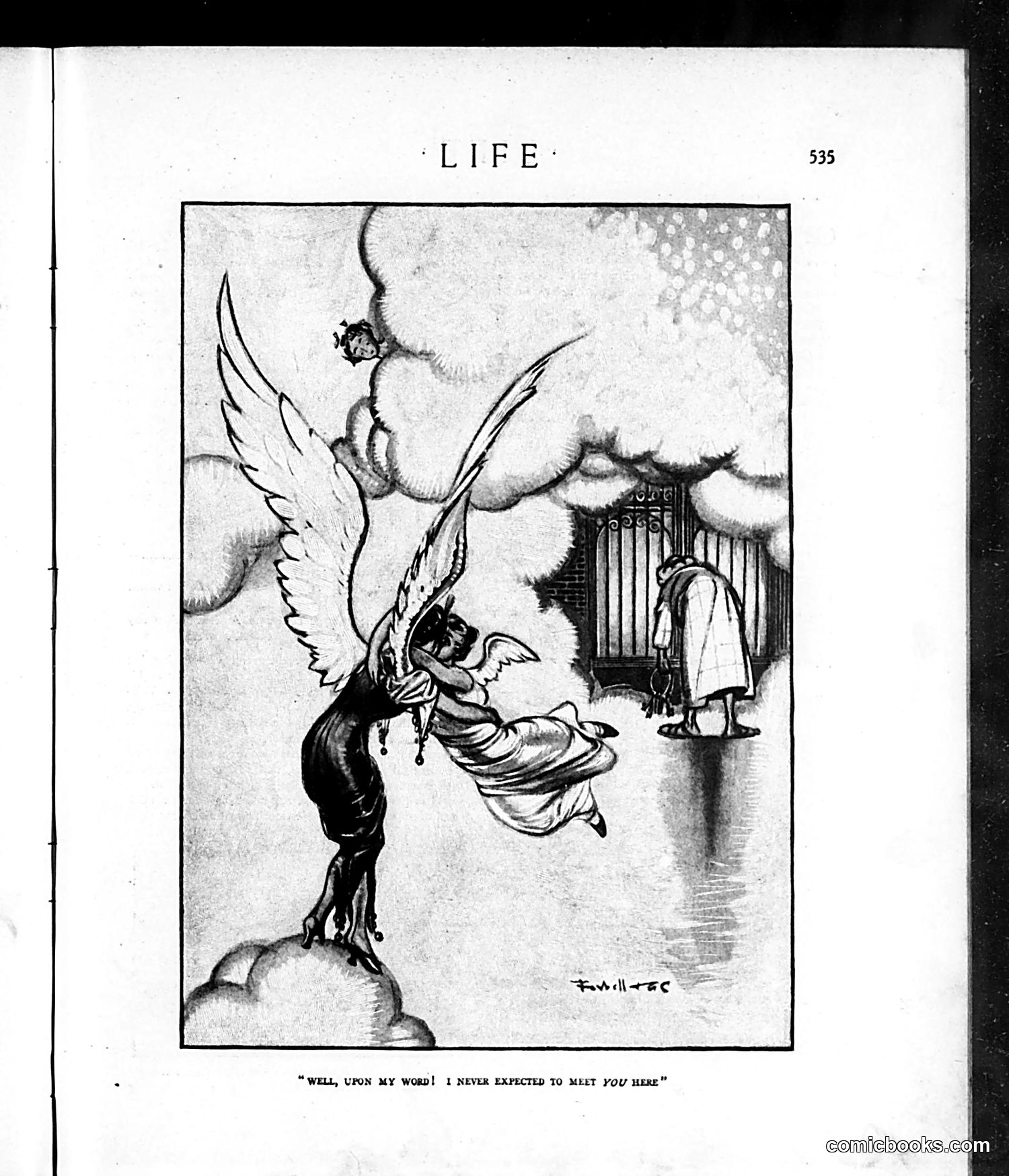
This single-panel cartoon depicts a winged demon or devil figure encountering what appears to be a person entering a church or religious building. The demon says: "Well, upon my word! I never expected to meet you here." The satire is straightforward: it suggests that the human character is so morally questionable or sinful that the devil himself is shocked to find them in a place of worship. The joke inverts the expected social dynamic—rather than the demon being out of place in a church, it's the *person* whose presence seems incongruous. This appears to be social commentary on hypocrisy or the questionable moral character of some church attendees, a common satirical theme in early 20th-century American humor magazines like *Life*.
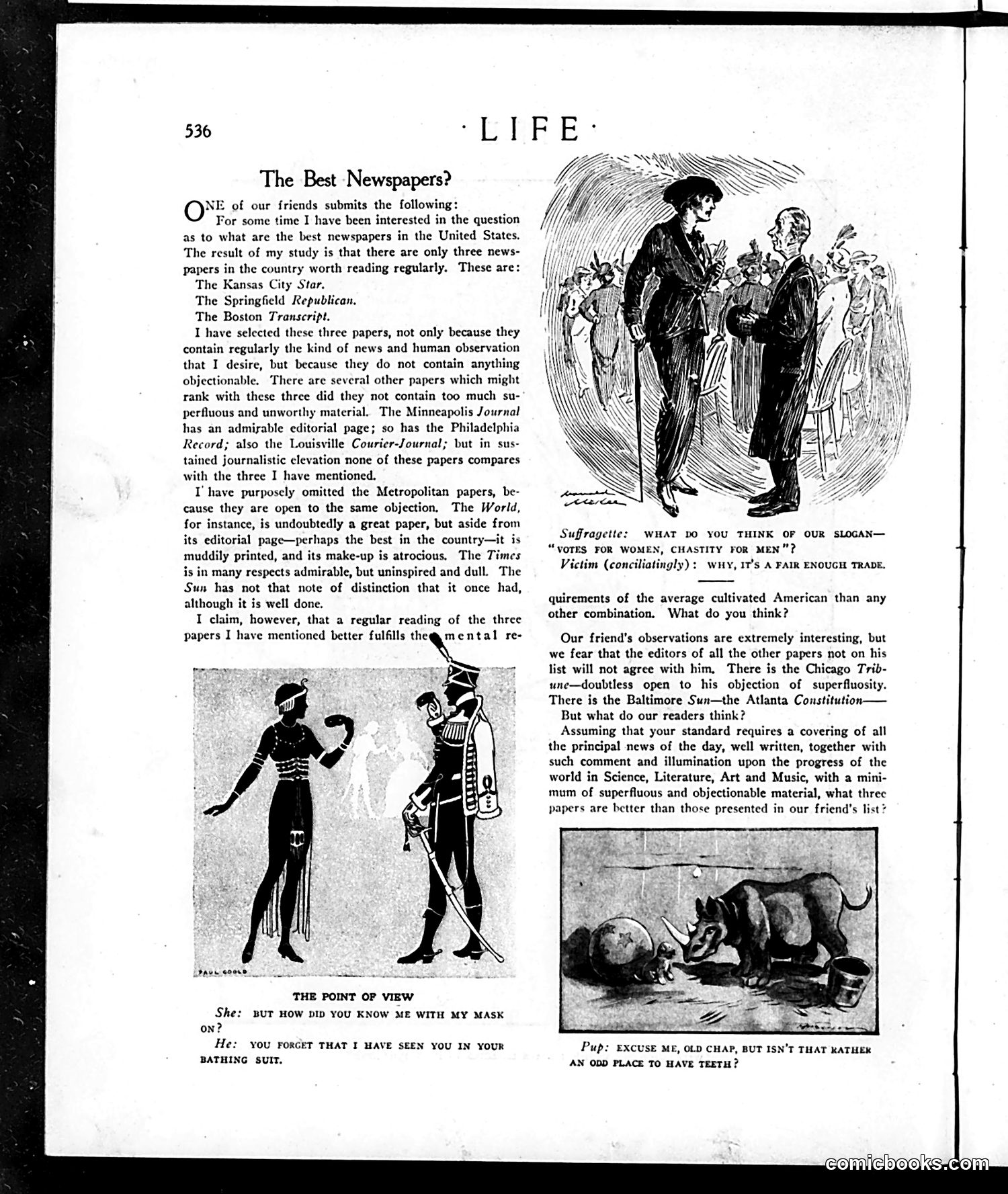
This page from *Life* magazine debates which American newspapers are "best." The main article argues only three papers merit regular reading: the *Kansas City Star*, *Springfield Republican*, and *Boston Transcript*. The author dismisses major metropolitan papers like the *World*, *Times*, and *Sun* as superficial or uninspired. The cartoons illustrate related social commentary: 1. **"The Point of View"** (top left): A masked woman and military officer recognize each other despite disguises—a joke about identity and deception. 2. **"Pup" cartoon** (bottom right): A dog questions why an old man lacks teeth, a crude gag about aging. The page reflects early 1900s elitism about journalism quality and intellectual standards—concerns about which institutions best served educated readers.
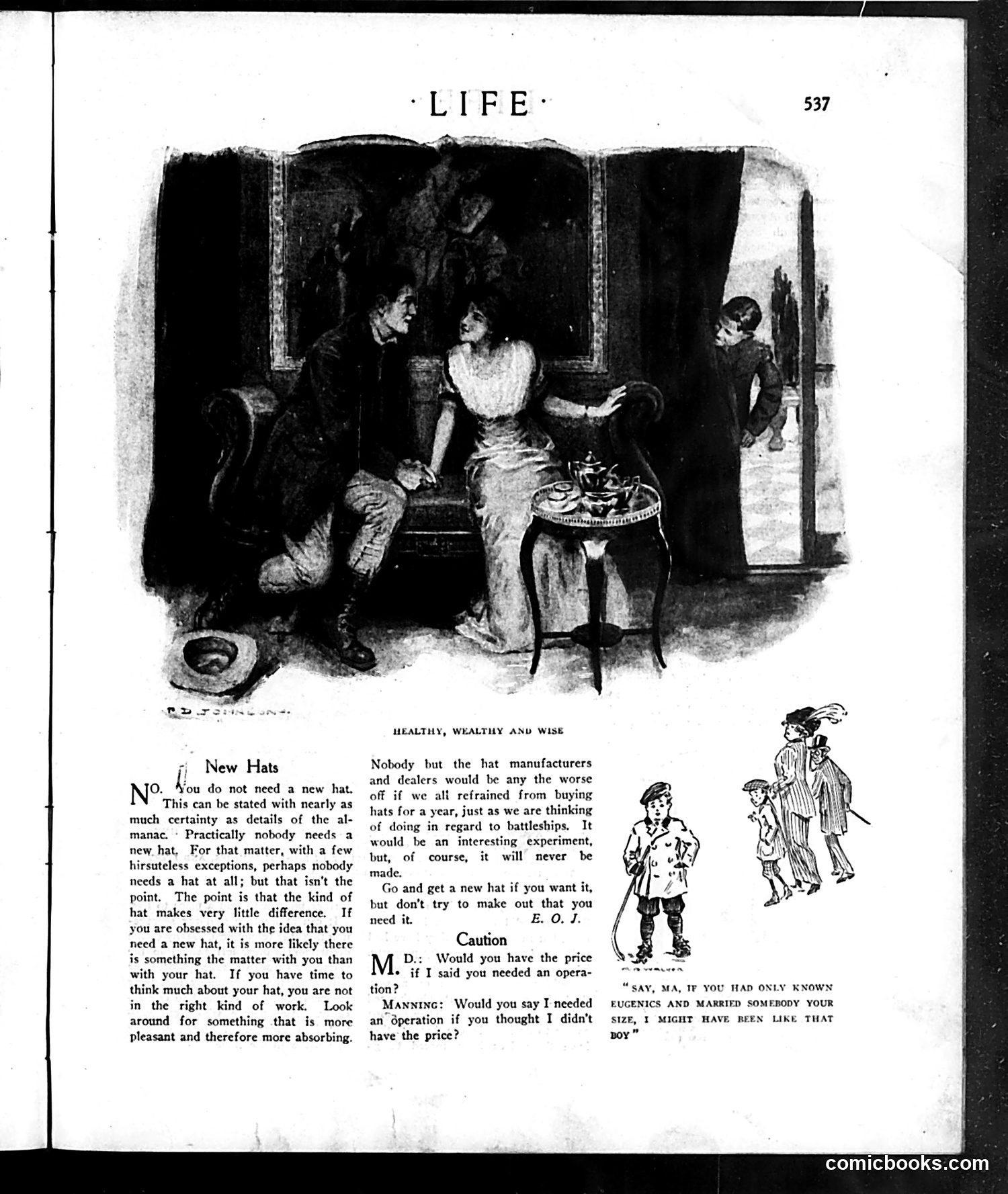
This page combines a satirical illustration with advice columns about hat-buying and wartime economics. The top illustration depicts an elegant interior scene where a well-dressed woman sits between two men in what appears to be a social or intimate setting, with a servant visible in the doorway. The caption reads "HEALTHY, WEALTHY AND WISE." Below, the "New Hats" section satirizes wartime consumer restraint, suggesting people should avoid buying new hats as part of broader sacrifice efforts (likely WWI-era austerity). The humor lies in treating trivial fashion purchases as morally equivalent to serious wartime privation. The "Caution" dialogue mocks affected speech and pretentious justifications for unnecessary purchases—a common Life satire target was conspicuous consumption and social pretense among the wealthy. The small illustrations on the right appear to be character sketches accompanying these social commentary pieces.
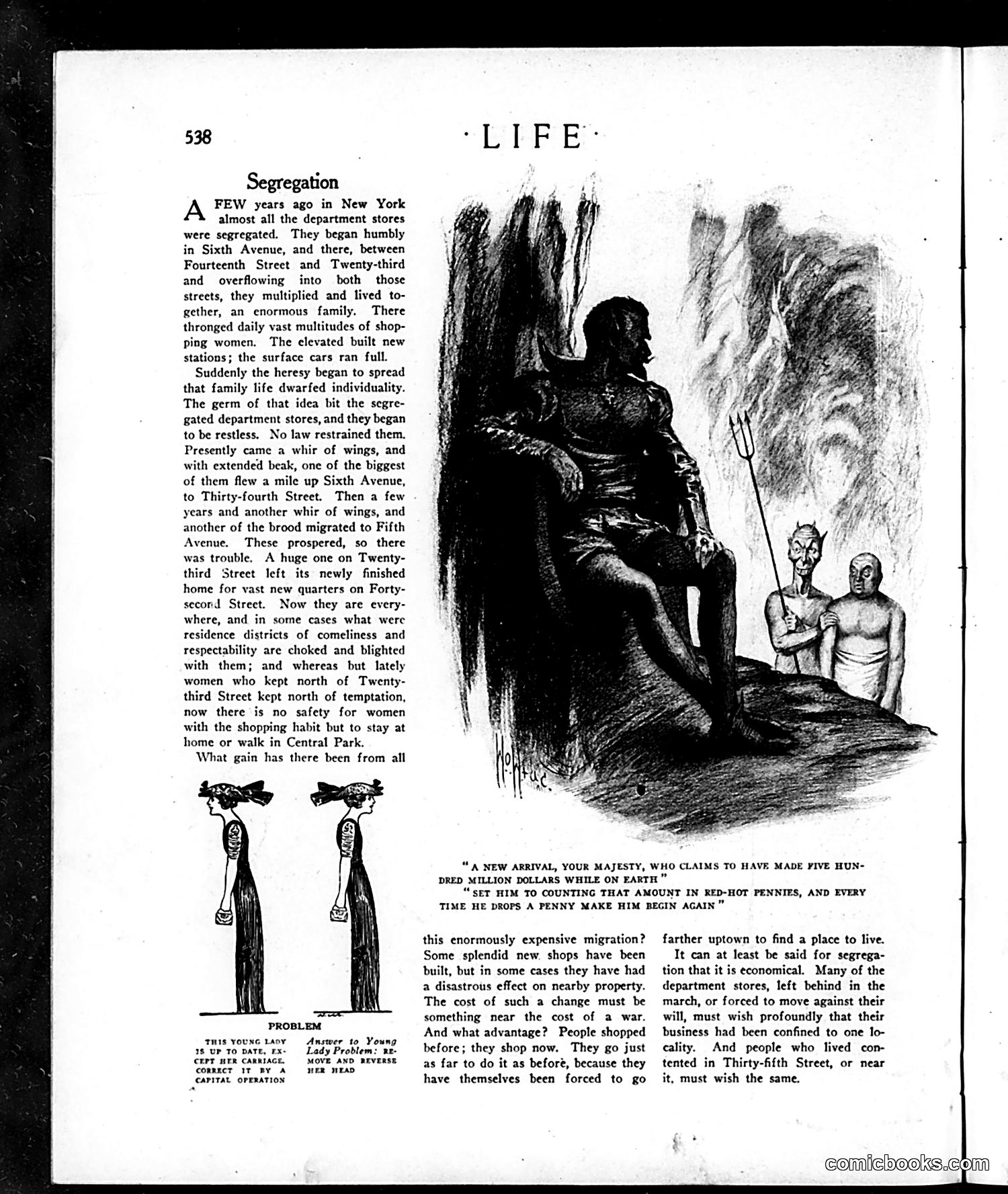
This article critiques the unintended consequences of New York City's residential segregation. The text describes how a wealthy family's arrival in the Sixth Avenue area sparked a migration pattern—other affluent residents followed, forcing working-class residents northward in a domino effect that eventually reaches the Upper West Side and beyond. The accompanying illustration depicts winged figures (appearing to represent wealthy migrants or perhaps symbolic of the idea's spread) displacing poorer residents. The cartoon captioned "A New Arrival" satirizes wealth's corrupting influence through a metaphorical figure literally dropping pennies—suggesting that money (and those who have it) create cycles of displacement and economic inequality that harm entire neighborhoods and force less-affluent residents into increasingly precarious situations.
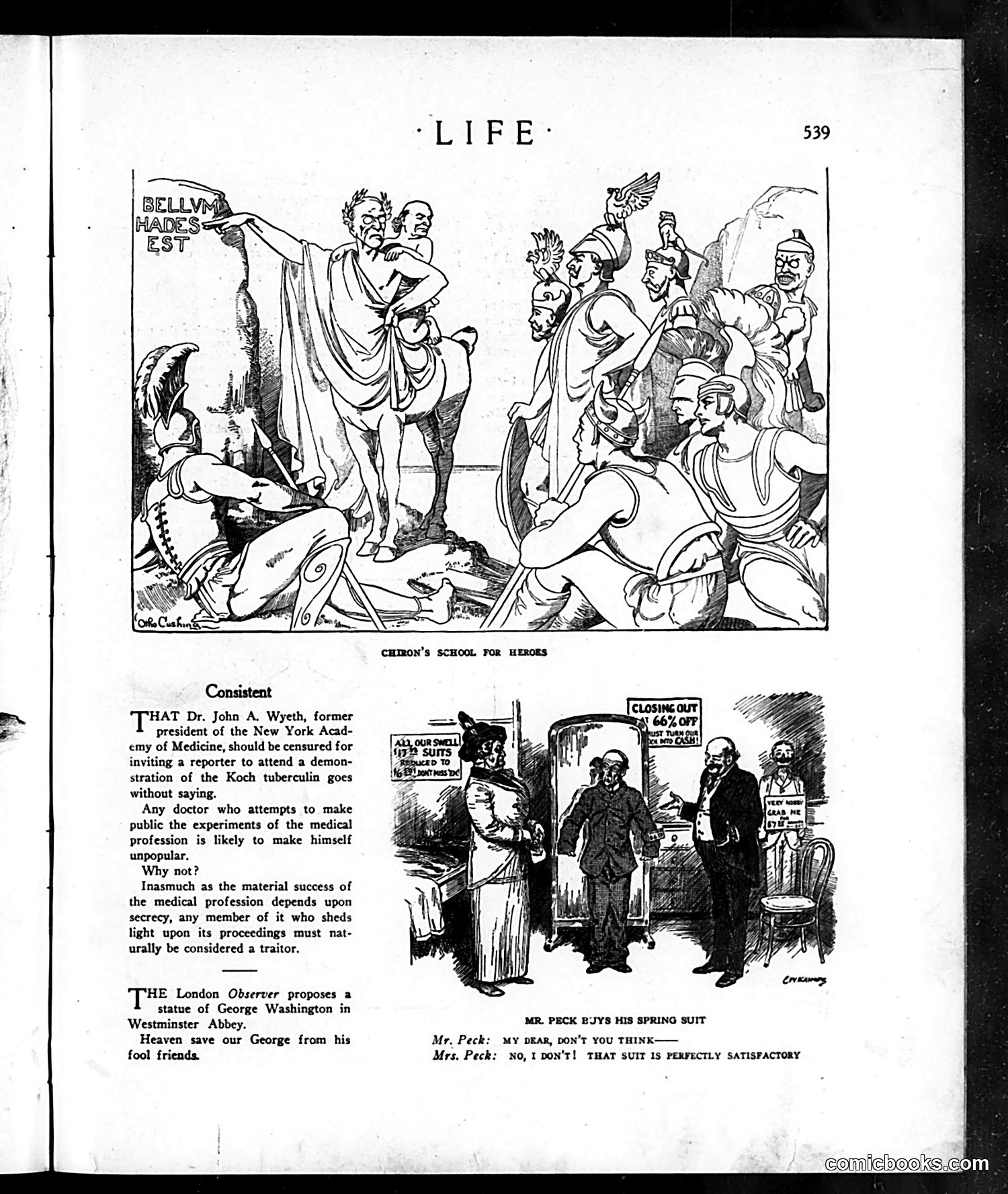
**Top Cartoon - "Chiron's School for Heroes":** A classical/mythological scene depicting various heroic figures in ancient dress, satirizing the medical profession's secrecy. The reference to "Bellum Hades Est" (War is Hell) suggests doctors are comparable to mythological heroes, yet their refusal to publicly demonstrate medical advances (like Koch's tuberculin for tuberculosis) is criticized as unethical gatekeeping. **Editorial Commentary:** The text sarcastically attacks Dr. John A. Wyeth for inviting press to a tuberculosis treatment demonstration. Life argues that doctors who maintain professional secrecy to protect their market dominance are essentially traitors to public health—a critique of medical profession self-interest over scientific transparency. **Bottom Cartoon - "Mr. Peck Buys His Spring Suit":** A domestic comedy where Mr. Peck seeks his wife's approval for a new suit, but she dismisses it as satisfactory enough. The joke satirizes marital dynamics and consumer culture—wives controlling household spending decisions.
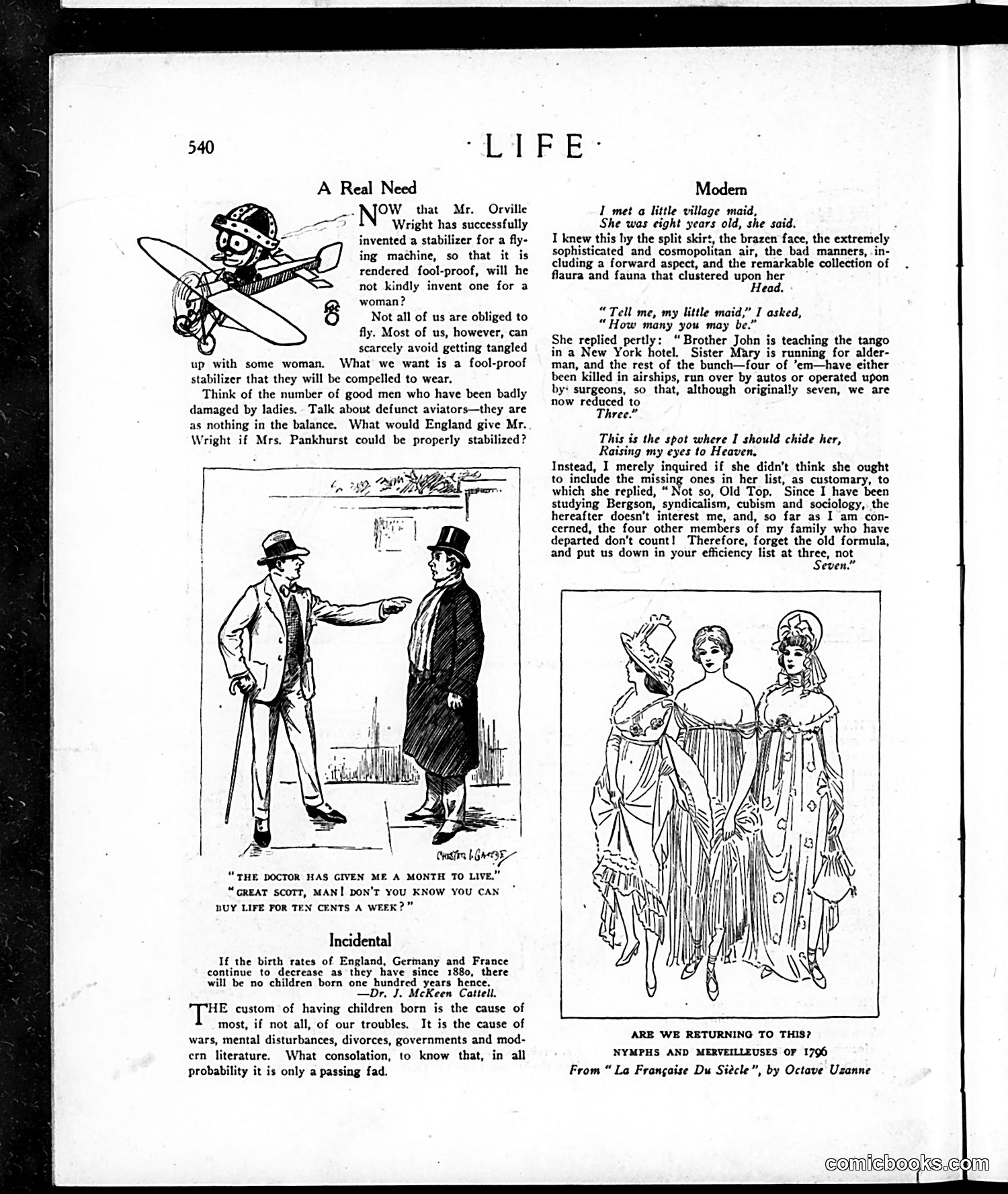
**"A Real Need"** satirizes women's suffrage and the feminist movement, specifically targeting Emmeline Pankhurst, the prominent British suffragette leader. The piece jokes that now that Orville Wright has invented a stabilizer for flying machines, he should invent one to "stabilize" women—implying they're dangerously unstable. The reference to "Mrs. Pankhurst" being "stabilized" mocks suffragettes as chaotic threats to society. **The cartoon below** shows two men discussing life insurance, a straightforward joke about cheap weekly premiums. **"Incidental"** darkly satirizes modern concerns about declining birth rates, suggesting that stopping childbirth might be civilization's solution to its problems—wars, divorces, bad government—presenting this as grim "consolation." **"Modern"** mocks contemporary youth culture: an eight-year-old girl displays sophisticated, cynical attitudes (studying Bergson, cubism, syndicalism) and casually dismisses dead siblings as unworthy of remembrance. The satire critiques modern philosophy and materialism corrupting childhood innocence. The page reflects early 20th-century anxieties about women's rights, modernism, and social change.
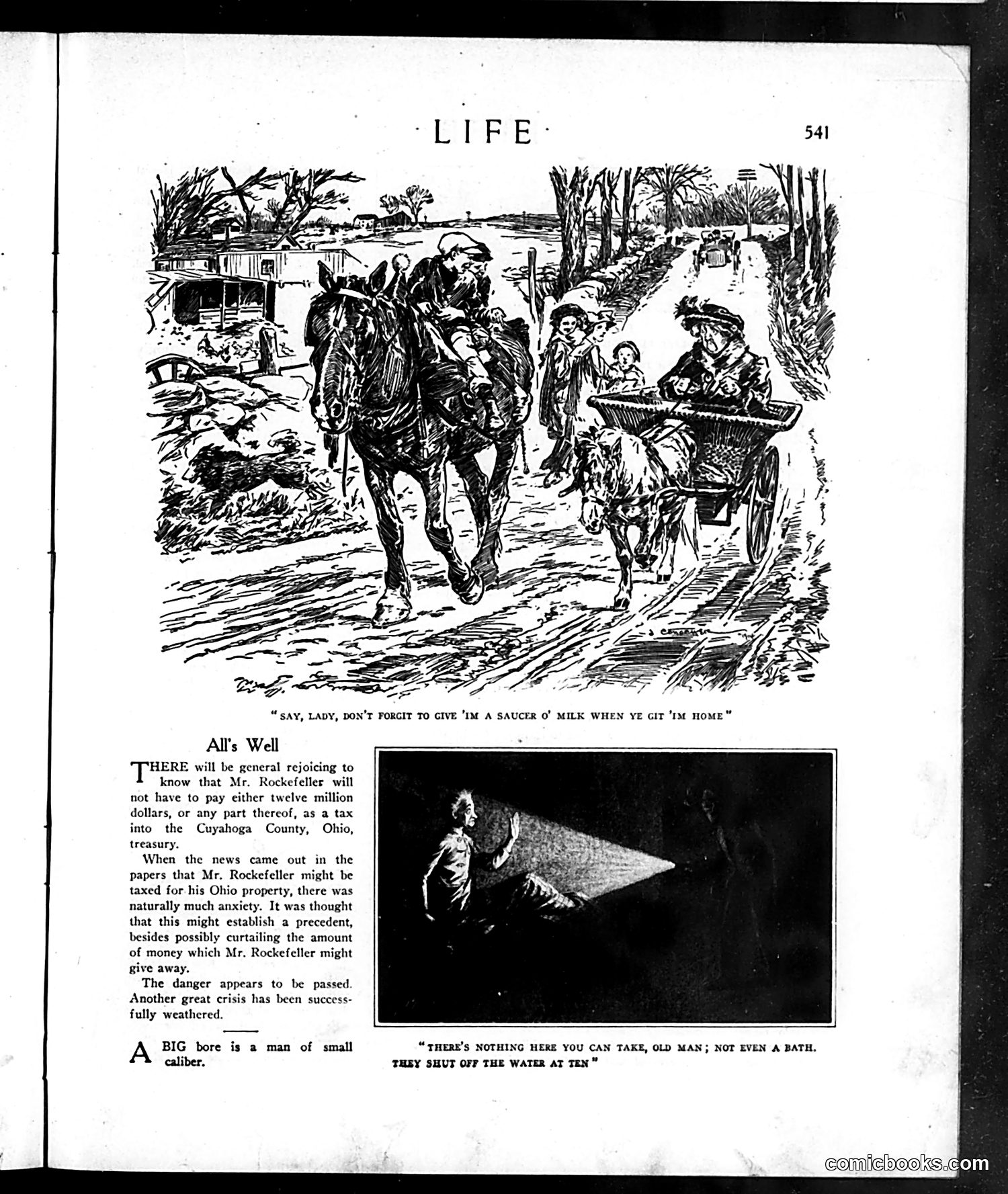
**Top Cartoon:** A rural scene showing a farmer handing over a horse to a lady, with the caption about giving the horse "a saucer o' milk" when home. This appears to be a humorous rural joke playing on class differences—the farmer's unsophisticated dialect contrasts with the lady's refined manner. **"All's Well" Article:** This is satirical commentary on John D. Rockefeller avoiding a twelve-million-dollar tax assessment on his Ohio property. The piece mocks the relief that Rockefeller escaped taxation, sarcastically suggesting this prevents a dangerous precedent that might limit his charitable giving. The satire criticizes how wealthy industrialists could evade taxes while ordinary citizens couldn't. **Bottom Image & Caption:** Depicts a poor man in a sparse room. The caption about no bath water available after 10 p.m. contrasts sharply with the Rockefeller piece above—while the ultra-wealthy avoided millions in taxes, working-class people lacked basic utilities. The page juxtaposes these elements to critique wealth inequality and tax evasion by the ultra-rich during the Progressive Era.
This editorial page satirizes West Coast politicians as erratic and disruptive compared to the calm East. The author mocks California and Oregon senators—likely Governor Hiram Johnson (who campaigned for Roosevelt), Harry Lane, and others—for their aggressive, undiplomatic behavior on national issues like Panama canal tolls and Mexican policy. The satire equates the West Coast's geological instability (prone to earthquakes) with its political volatility. The author suggests West Coast politicians behave as though "the whole world was newly made," treating established social order with contempt and embracing radical experiments. The piece concludes that William Randolph Hearst, the Coast's "most conspicuous exponent" in the East, exemplifies this recklessness. The underlying joke: these unpredictable Westerners should "be civil" while the Panama Fair occurs, implying they might otherwise embarrass the nation.
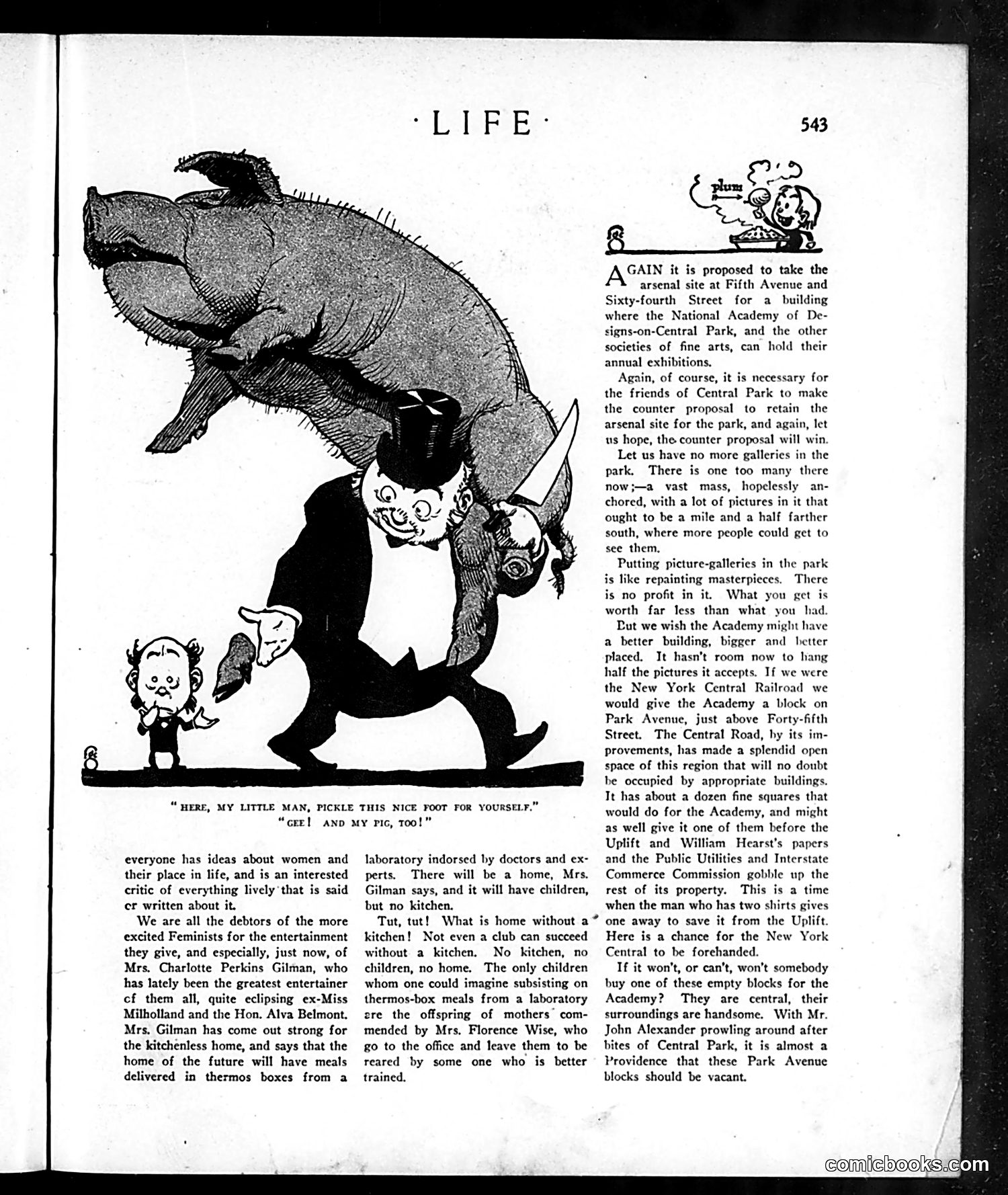
**The Cartoon:** A large, menacing pig looms over two small, caricatured figures (appearing to be children or dwarfish characters). The pig's caption reads: "Here, my little man, pickle this nice foot for yourself" / "Cry! And my pig, too!"—a darkly humorous reference to the nursery rhyme "Jack and the Beanstalk," suggesting the pig will consume the figures. **The Social Satire:** The cartoon mocks Charlotte Perkins Gilman's proposal for "kitchenless homes" where meals arrive from centralized laboratories, eliminating domestic cooking. The pig represents the absurd, dystopian outcome: children raised on laboratory food become so inhuman they're barely distinguishable from animals—fit only to be consumed themselves. The satirist implies Gilman's vision destroys childhood, family, and humanity. **Context:** This reflects early-1900s anxieties about feminism and women's liberation. Though supporting women's rights generally, Life ridicules Gilman's radical domestic reforms as unnatural and dehumanizing. The secondary editorial discusses Central Park development issues, unrelated to the cartoon's main thrust.
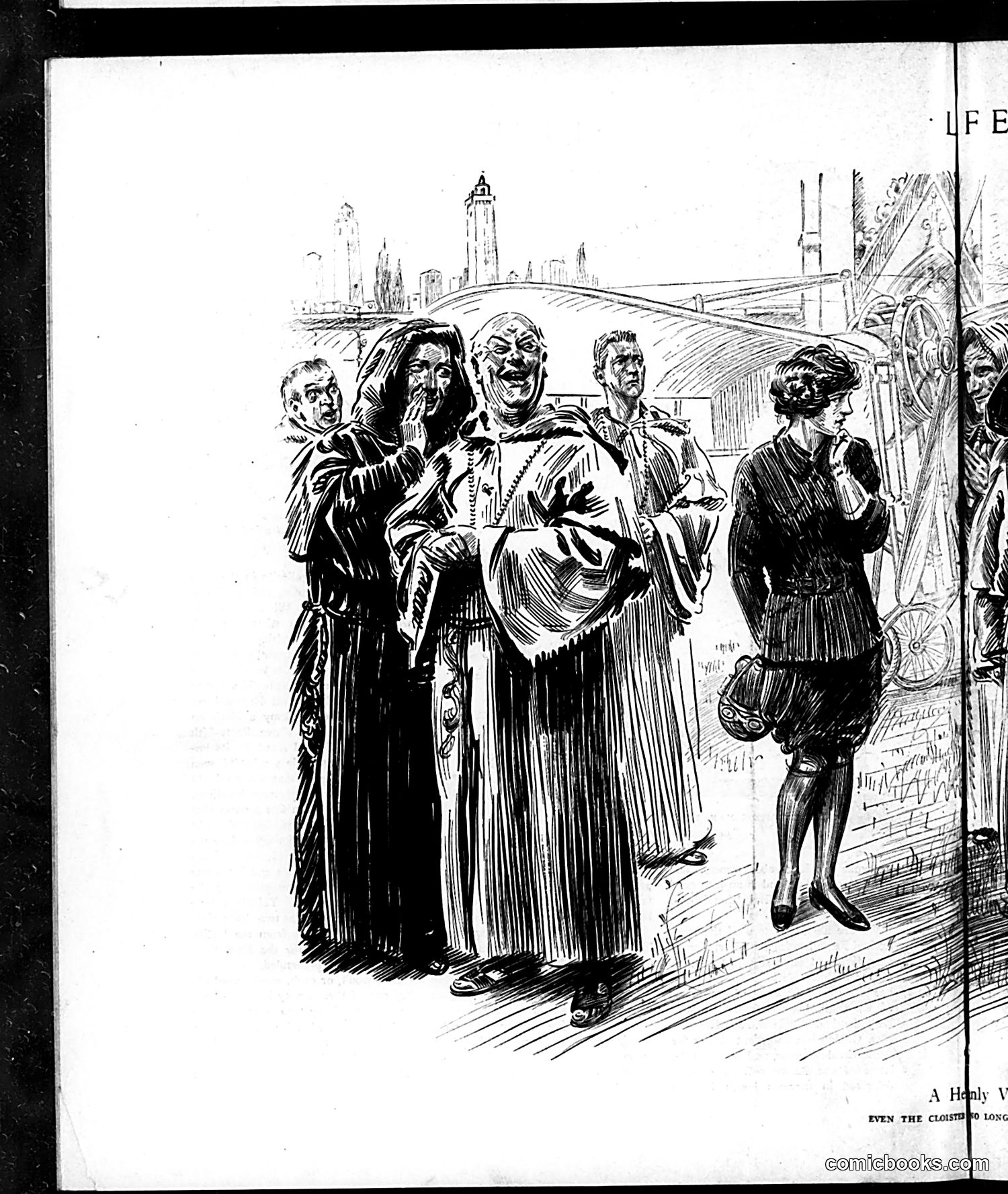
This is a sketch-style illustration showing several figures in what appears to be an urban setting with a cityscape in the background. The central figure is a heavyset man in light-colored robes or clothing, surrounded by other people in darker clothing. The partial caption at bottom reads "EVEN THE CLOISTERED LOC[?]" (text cut off). Without the complete caption and given the fragmentary OCR text, I cannot definitively identify the specific figures or the intended satirical target. The style suggests early-to-mid 20th century Life magazine satire. The contrast between the central figure's appearance and lighter dress versus others' darker clothing may suggest social commentary, but I cannot determine the specific political or social reference intended without more context. The incomplete text prevents confident interpretation of the joke or point being made.
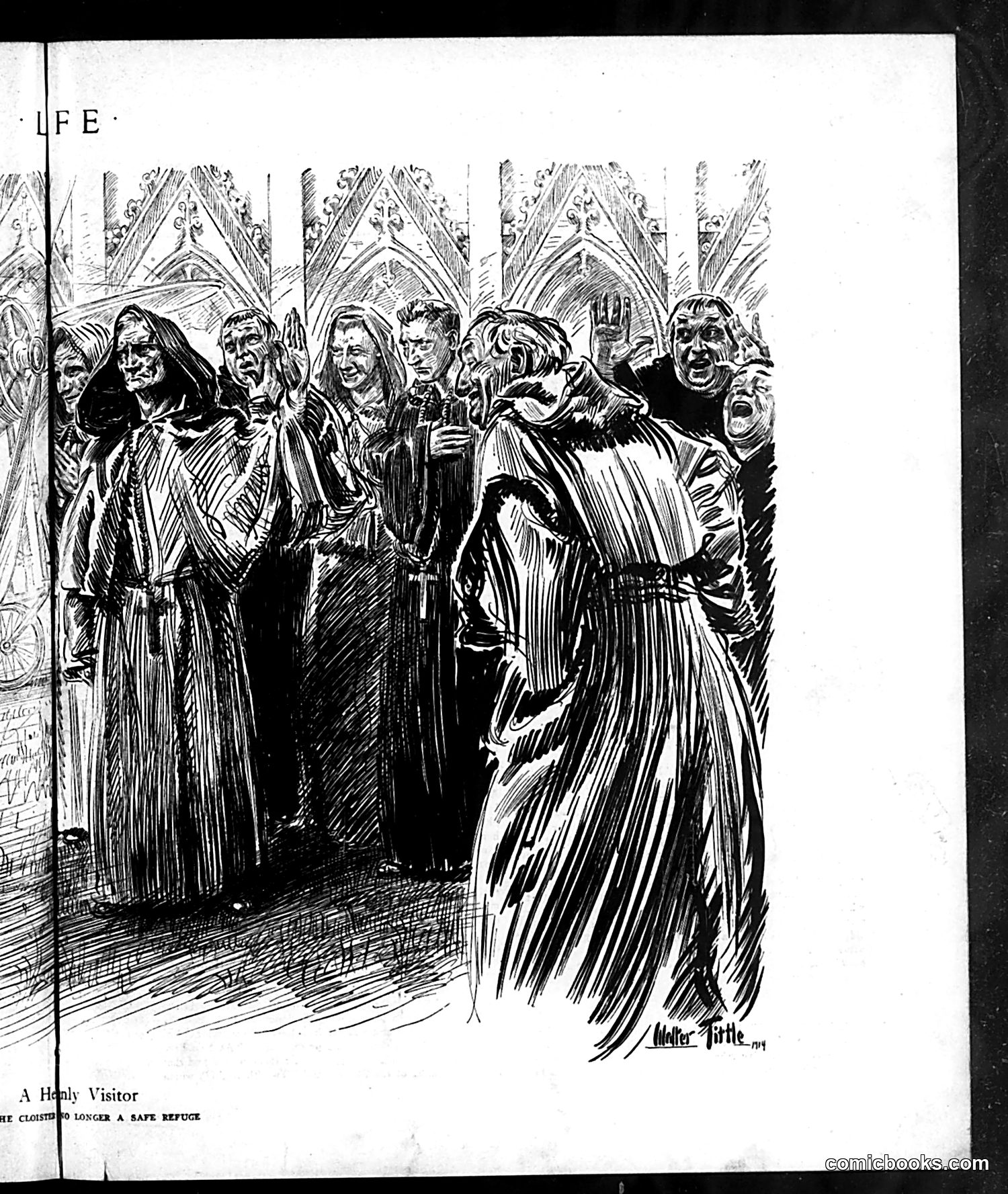
This political cartoon depicts a group of religious figures (monks or clergy, identifiable by their robes and the Gothic cathedral architecture behind them) encountering what appears to be a skeletal or death-like figure approaching from the right. The caption "The Cloister No Longer a Safe Refuge" suggests the satire concerns threats to religious institutions or sanctuary. The "hardly visitor" (likely "hardly" in the sense of "rough" or "unwelcome") represents some form of danger—possibly disease, war, or social upheaval—penetrating spaces traditionally considered protected or isolated from worldly threats. Without additional context about the publication date, the specific historical moment remains unclear, but the work critiques the vulnerability of religious institutions to external forces.
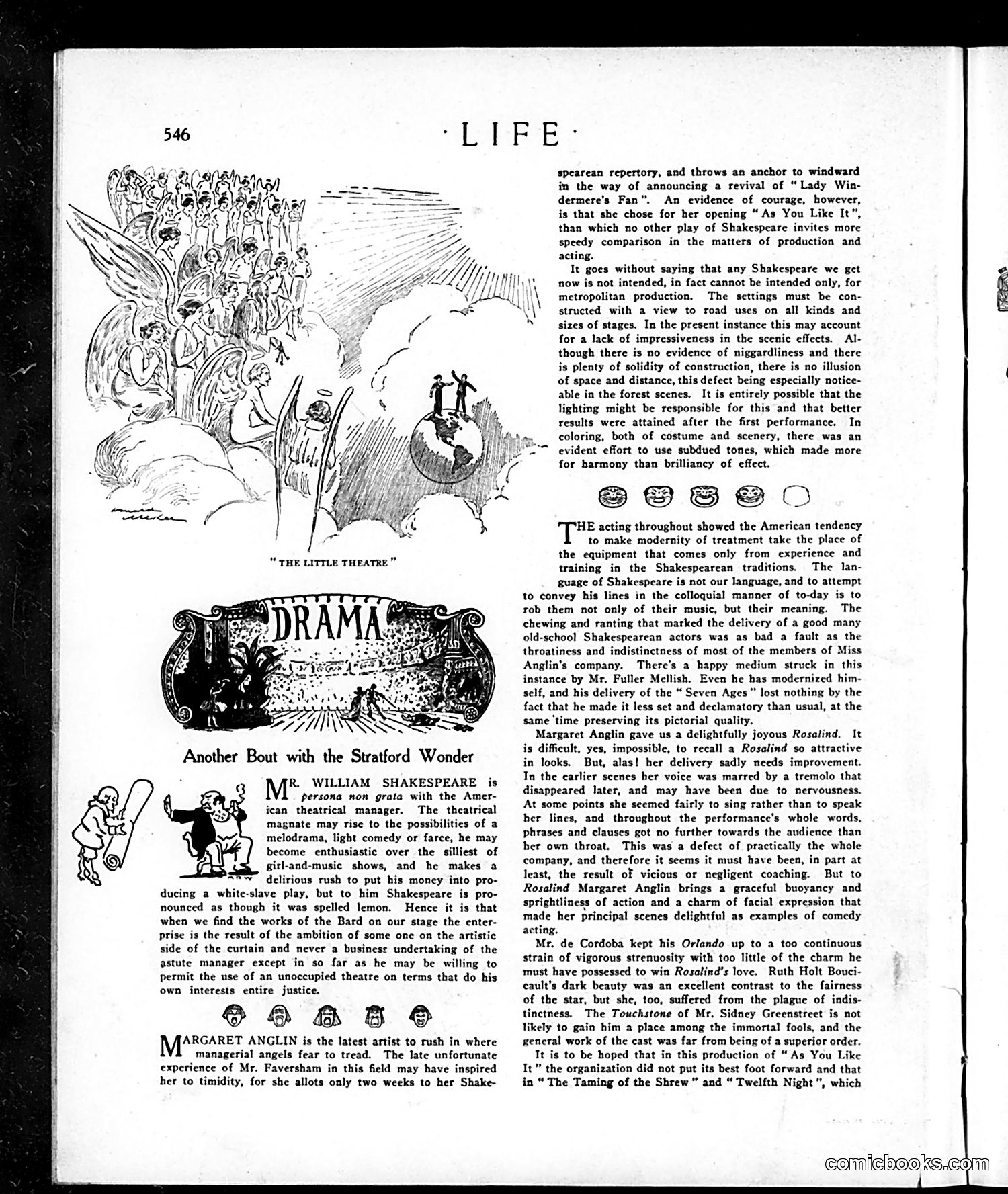
This page reviews actress Margaret Anglin's production of Shakespeare's *As You Like It*. The cartoon at top—"The Little Theatre"—appears to show figures on a tiny stage dwarfed by forest scenery, satirizing the challenge of staging Shakespeare affordably for touring productions. The text's central complaint: American theatrical managers dismiss Shakespeare as commercially unviable ("pronounced as though it was spelled lemon"), forcing Shakespeare productions to rely on artists' ambition rather than business investment. Anglin's gambit—allocating only two weeks to Shakespeare while hedging with a revival of the commercial *Lady Windermere's Fan*—illustrates this reluctance. The review criticizes the cast for "modernizing" Shakespeare's language into colloquial delivery, losing the music of his verse. Margaret Anglin's Rosalind is praised for beauty but faulted for vocal tremolo and unclear diction. The piece laments that American actors lack proper Shakespearean training, offering a technical rather than artistic critique of contemporary theater practice.
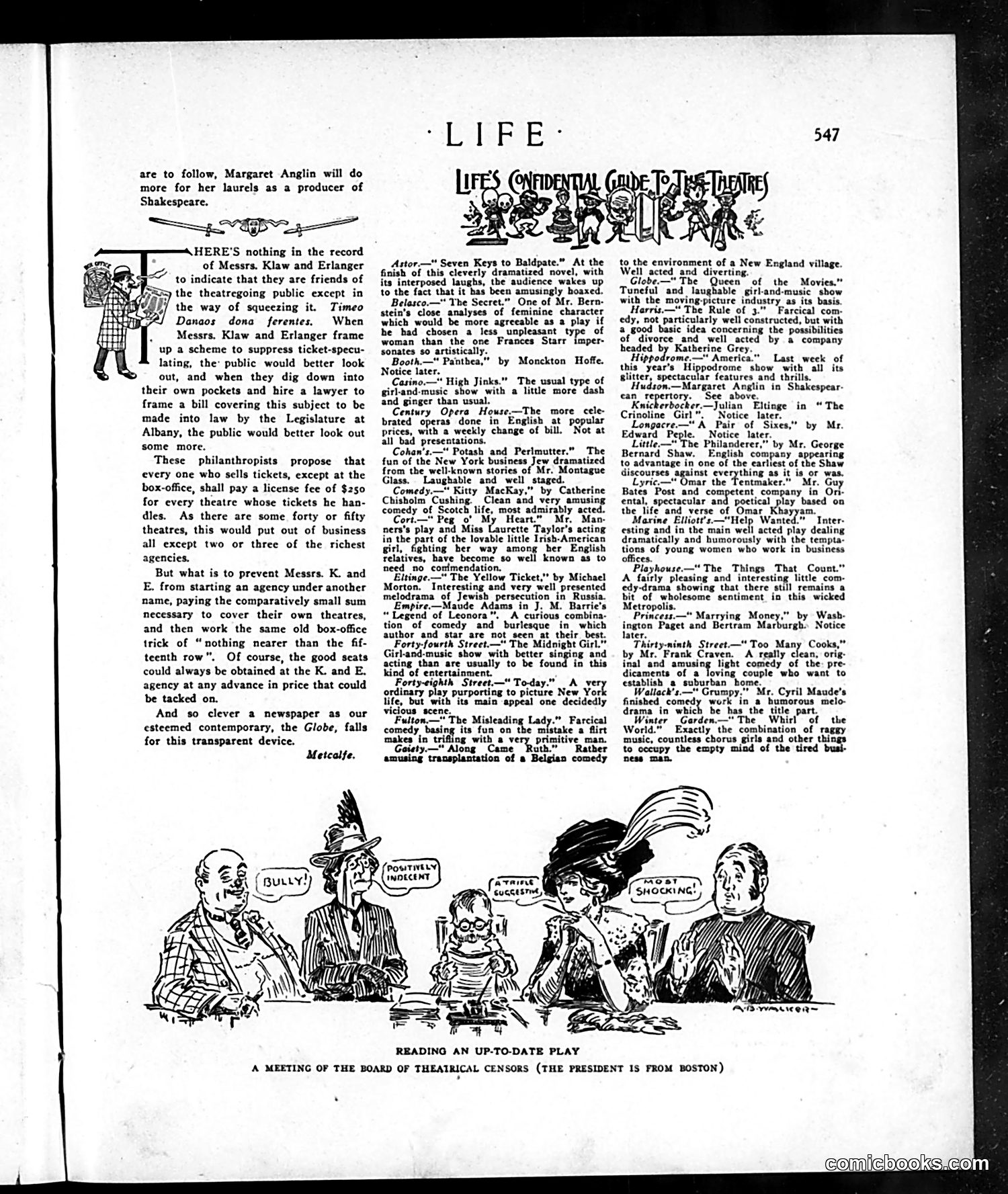
This page from *Life* magazine contains two distinct satirical pieces: **Top Article:** A scathing critique of theatrical producers **Klaw and Erlanger**, prominent Broadway monopolists of the early 1900s. The author accuses them of claiming to combat ticket speculation through a proposed $250 licensing fee for ticket sellers—a scheme that would actually eliminate competition and benefit only their own ticket agency. The satire highlights their hypocrisy: they pose as consumer advocates while actually scheming to consolidate their market power and maintain control over seat allocation (the reference to "nothing nearer than the fifteenth row" means average customers get poor seats while premium seats go to their agency). **Bottom Cartoon:** Depicts a "Board of Theatrical Censors" meeting to review an "up-to-date play." The board members' shocked reactions ("BULLY!", "POSITIVELY INDECENT!", "AWFUL!", "SHOCKING!") satirize theatrical censorship boards of the era, which frequently banned or heavily edited plays deemed morally inappropriate—a common practice in early 20th-century America. Both pieces mock theatrical industry corruption and censorship.
This page satirizes pseudoscientific theories by presenting Dr. Thomas E. Reed's book "Sex-Origin Determination," which claims to predict a baby's sex based on tidal cycles during conception and birth. The satire works through extended metaphor: scientists are compared to safecrackers and criminals ("gang," "caught with the goods"), suggesting they operate outside normal bounds. Reed's theory—that tides govern vitality in our cells, determining maleness or femaleness, and can even predict illness outcomes—is presented as simultaneously ridiculous and oddly compelling to its author after twenty years of practice. The humor lies in mocking the era's obsession with pseudo-scientific "systems" that promise certainty through arbitrary mechanisms. By calling it a "Side-Trip Into Science," Life suggests readers have wandered into speculative territory masquerading as legitimate medical knowledge. The comparison to popular psychology concepts like "Bromides" and "Sulphites" reinforces that this represents fashionable but dubious thinking.
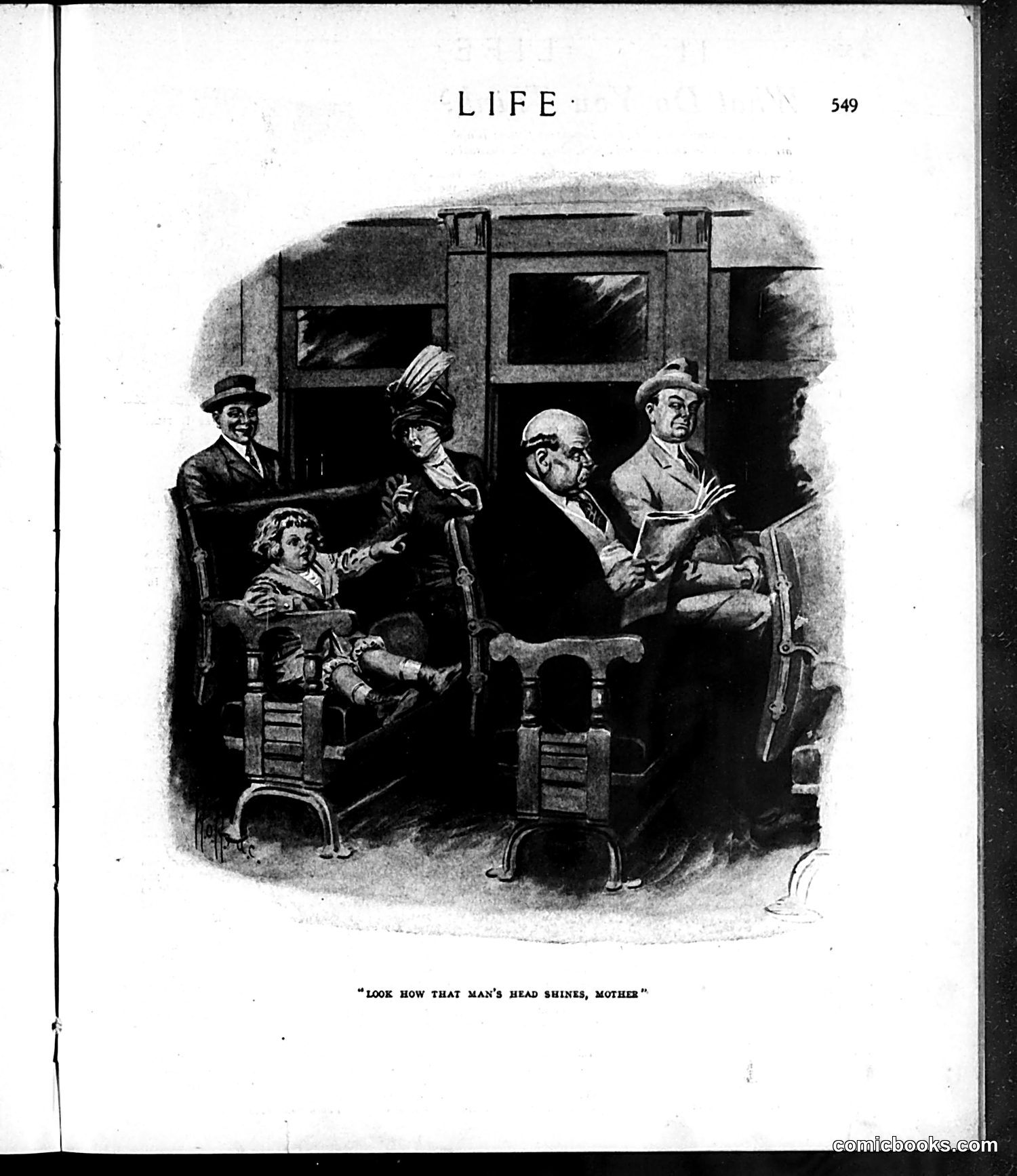
This is a satirical cartoon from *Life* magazine depicting a scene inside what appears to be a public transportation vehicle (likely a streetcar or train). The joke centers on a bald man seated among other passengers. A young child points out to his mother that "that man's head shines," making an innocent observation about the man's baldness. The humor derives from the child's unfiltered candor—a common comedic trope in which children say socially awkward truths that adults usually suppress. The other adult passengers' reactions suggest varying degrees of amusement or discomfort at this public embarrassment. The cartoon satirizes both childhood innocence and the awkwardness such honest remarks create in polite society. No specific political figures appear to be targeted here; rather, it's gentle social satire about everyday human interactions.
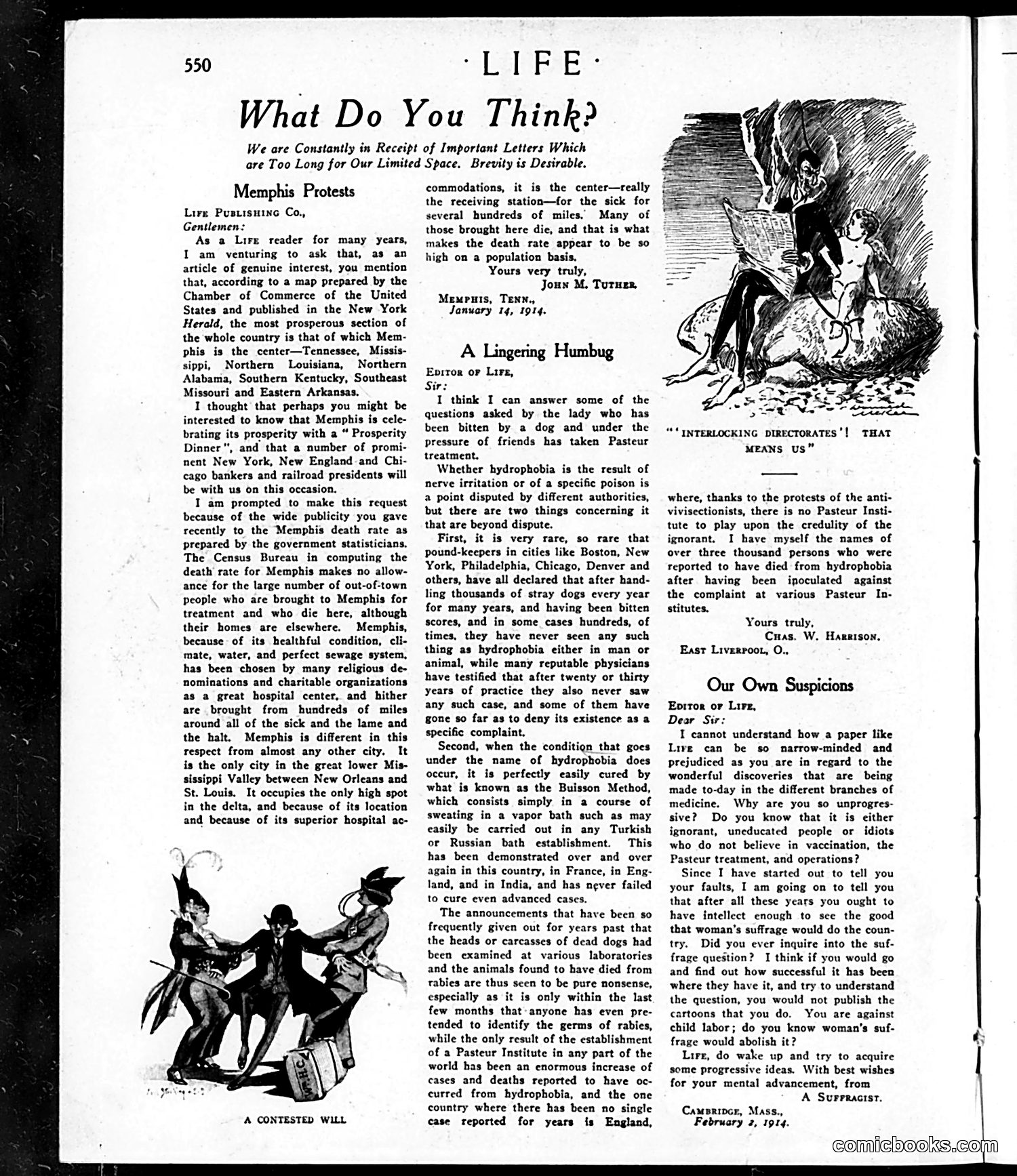
This page contains reader letters to *Life* magazine's opinion section, not political cartoons. The content addresses two contemporary controversies: **"Memphis Protests"** defends Memphis's reputation against high mortality statistics, arguing the city's death rate appears inflated because it functions as a regional hospital center treating desperately ill patients from hundreds of miles away—skewing per-capita mortality figures. **"A Lingering Humbug"** challenges the scientific validity of rabies (hydrophobia) treatment. The writer claims animal control workers bitten repeatedly by dogs never contracted the disease, and that reputable physicians deny rabies exists as a specific complaint. He argues the Buisson Method (vapor baths) supposedly cures it, suggesting the Pasteur treatment (mentioned in the letter) is unnecessary—a now-debunked position, as rabies is actually nearly 100% fatal without treatment. The small illustrations ("A Contested Will," bottom left) are unrelated cartoon vignettes typical of magazine filler.
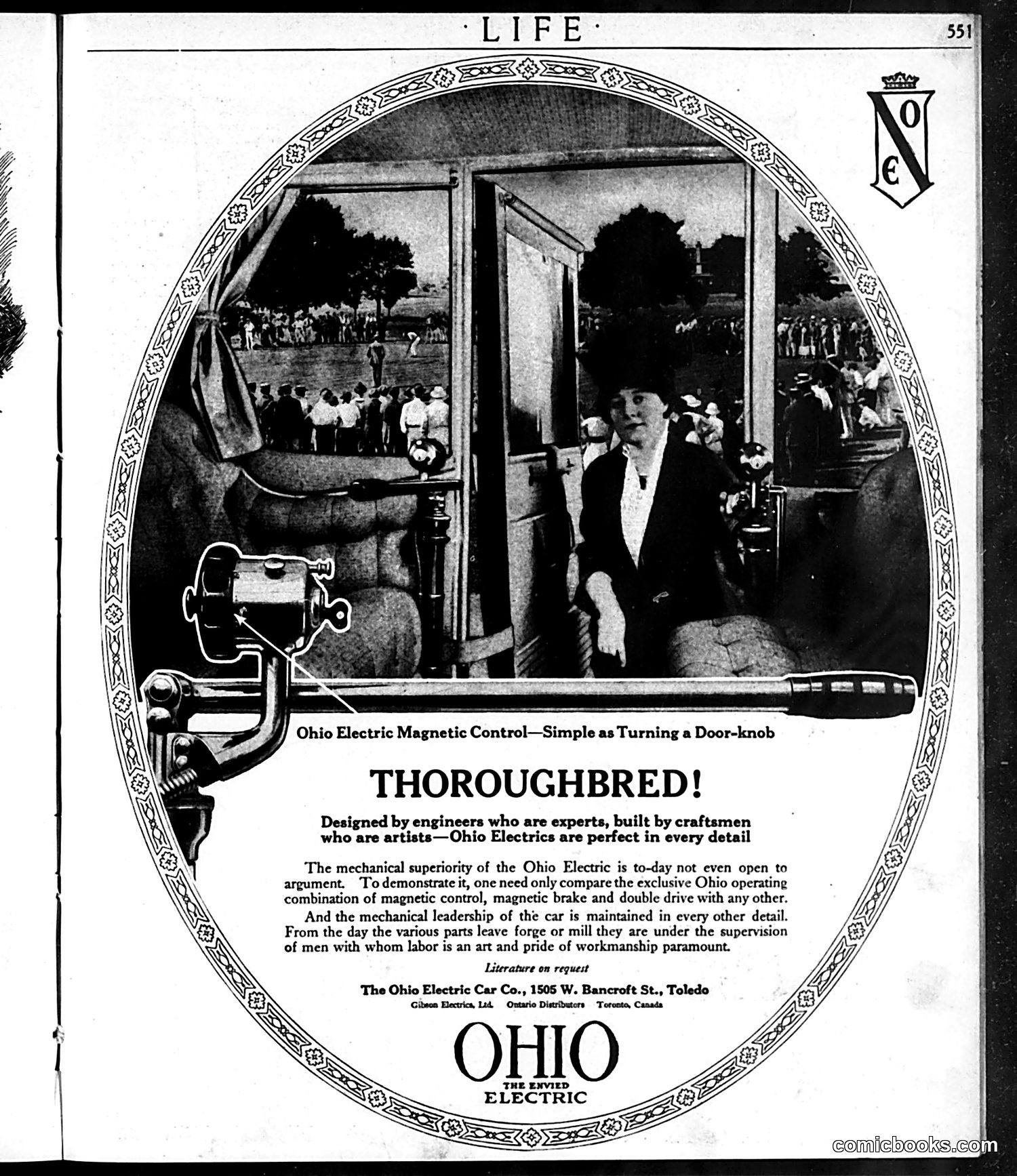
This is a **straight advertisement**, not satire or political commentary. It's a genuine product ad for the Ohio Electric Car Company, promoting their electric automobiles. The image shows a well-dressed woman operating an Ohio Electric vehicle with the headline "THOROUGHBRED!"—positioning electric cars as refined, sophisticated machines. The ad emphasizes that these vehicles are "designed by engineers who are experts, built by craftsmen who are artists," stressing precision engineering and quality craftsmanship. For a modern reader, the key context is that **electric cars were a serious, luxury automotive option in the early 1900s**, before gasoline engines dominated. This ad appeared in *Life* magazine, which had affluent readers—the target market for such vehicles. The "magnetic control" and "magnetic brake" features were highlighted as cutting-edge technology. There is no political commentary or satire here; it's simply period advertising targeting wealthy consumers interested in advanced automotive technology.
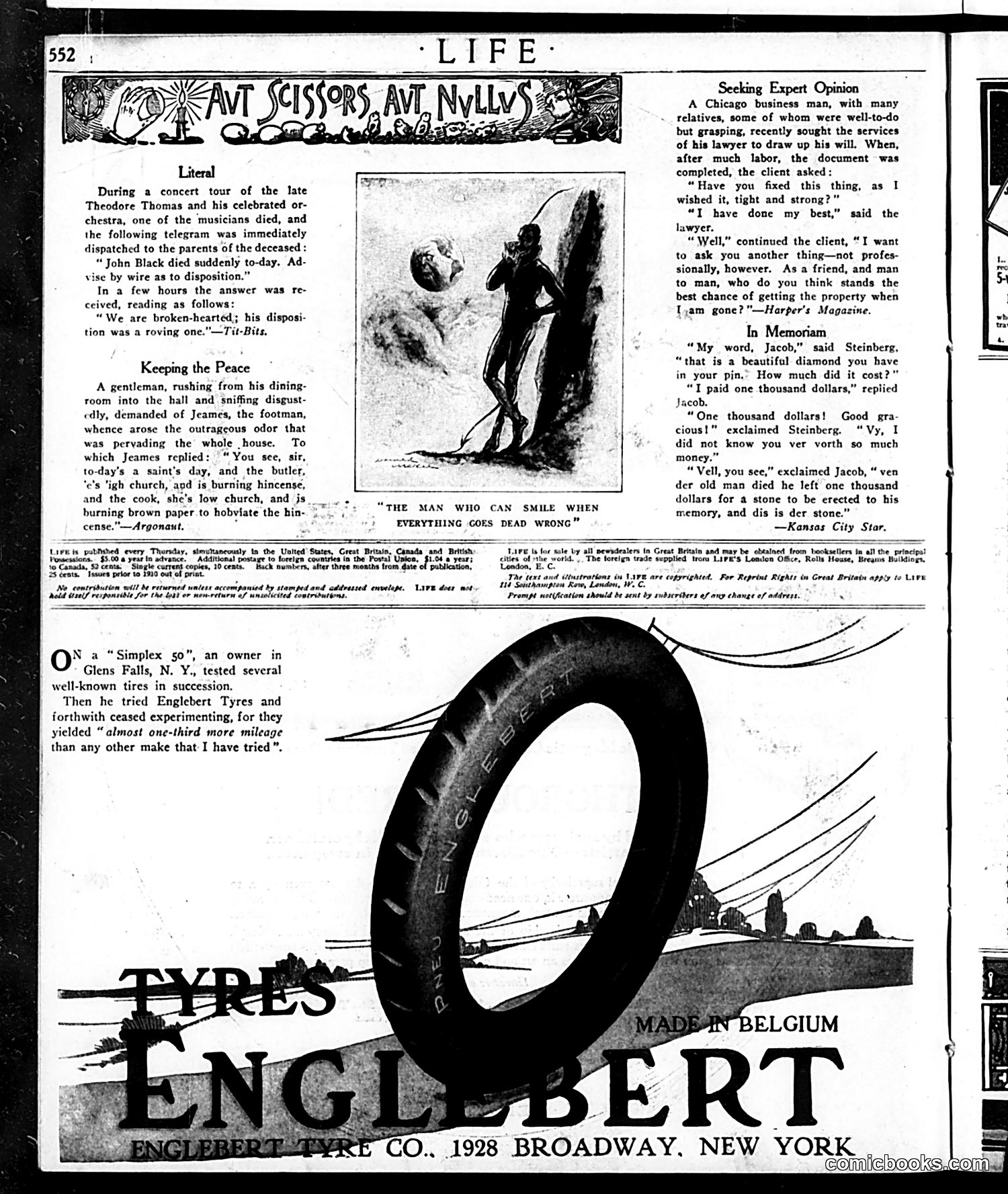
This page contains **humorous anecdotes** (short joke stories) in the upper section, followed by a **tire advertisement** below. The anecdotes exploit verbal misunderstandings and ethnic stereotypes common to early 20th-century humor: 1. **"John Black" telegram**: A pun on "disposition"—the family misinterprets a question about funeral arrangements as a comment about the deceased's personality. 2. **"Keeping the Peace"**: A joke about competing religious rituals (incense-burning vs. burning brown paper) creating household chaos. 3. **The diamond story**: Features Jewish characters (Steinberg, Jacob) in a stereotype-heavy dialogue where a man claims his expensive memorial stone *is* his wealth—a joke implying immigrant unfamiliarity with financial concepts. The bottom half is a straightforward **Englebert Tyres advertisement** claiming superior mileage, featuring a testimonial from a Glen Falls, New York automobile owner. The page represents typical 1920s *Life* magazine content: satirical humor relying on ethnic caricature, wordplay, and domestic comedy, paired with period advertising.
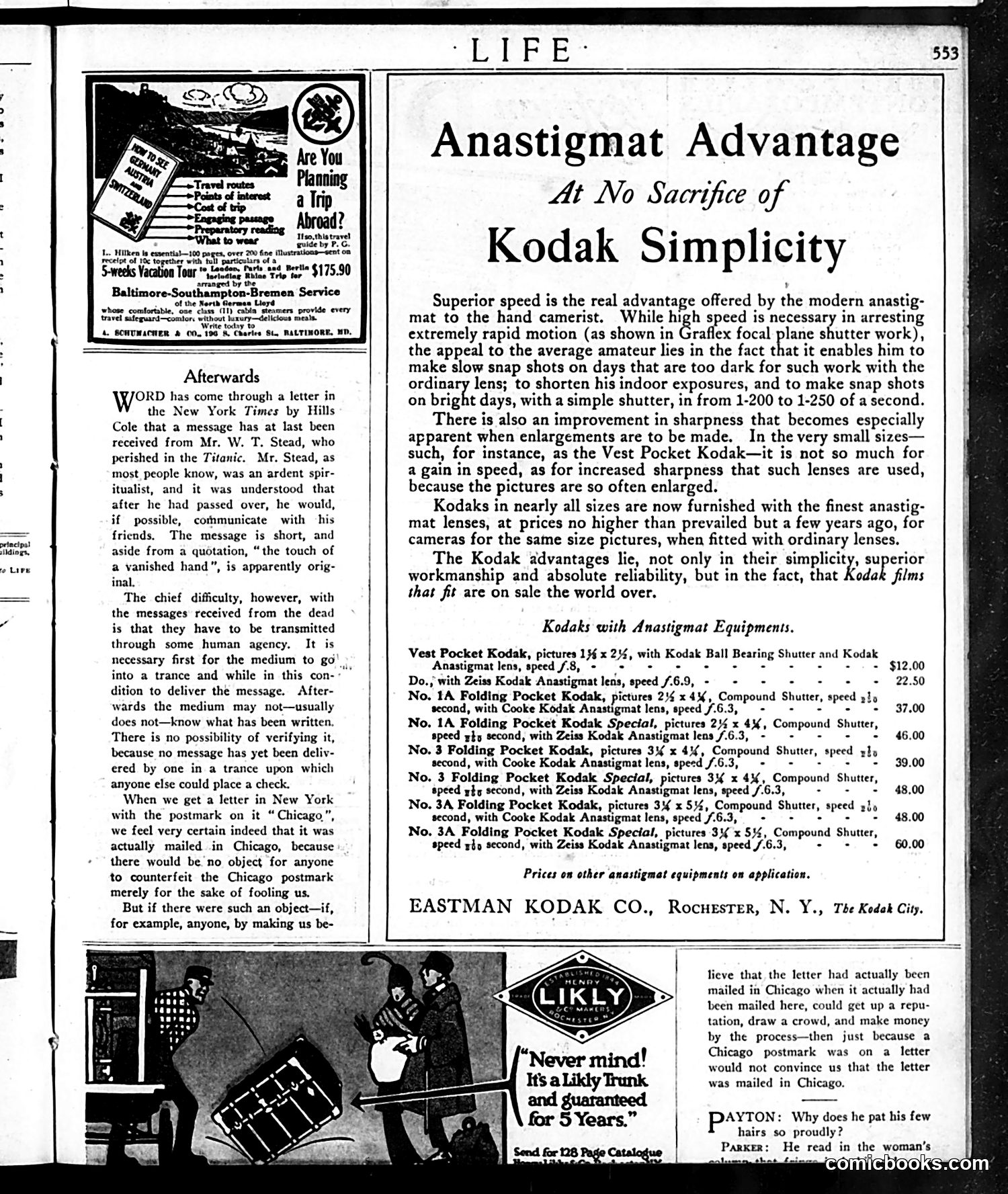
This page contains two distinct elements: **Left side:** A satirical article titled "Afterwards" discussing spiritualism and the Titanic. It references W.T. Stead, a prominent spiritualist who died in the 1912 Titanic sinking. The piece satirizes claims that Stead communicated from beyond death through mediums, arguing that unlike postal postmarks (which can be verified), spiritual messages have no way to be authenticated. The satire mocks both spiritualist believers and the credulous acceptance of unverifiable "messages from the dead." **Right side:** A Kodak camera advertisement promoting anastigmat lenses—superior optical technology that offered faster speeds and sharper images while maintaining the simplicity Kodak cameras were known for. This is straightforward product marketing, not satire. **The cartoon** (bottom left) appears to be a Likily Trunk advertisement, unrelated to the text above it. The page juxtaposes serious satire about spiritualism with commercial advertising, typical of Life's format during this era.
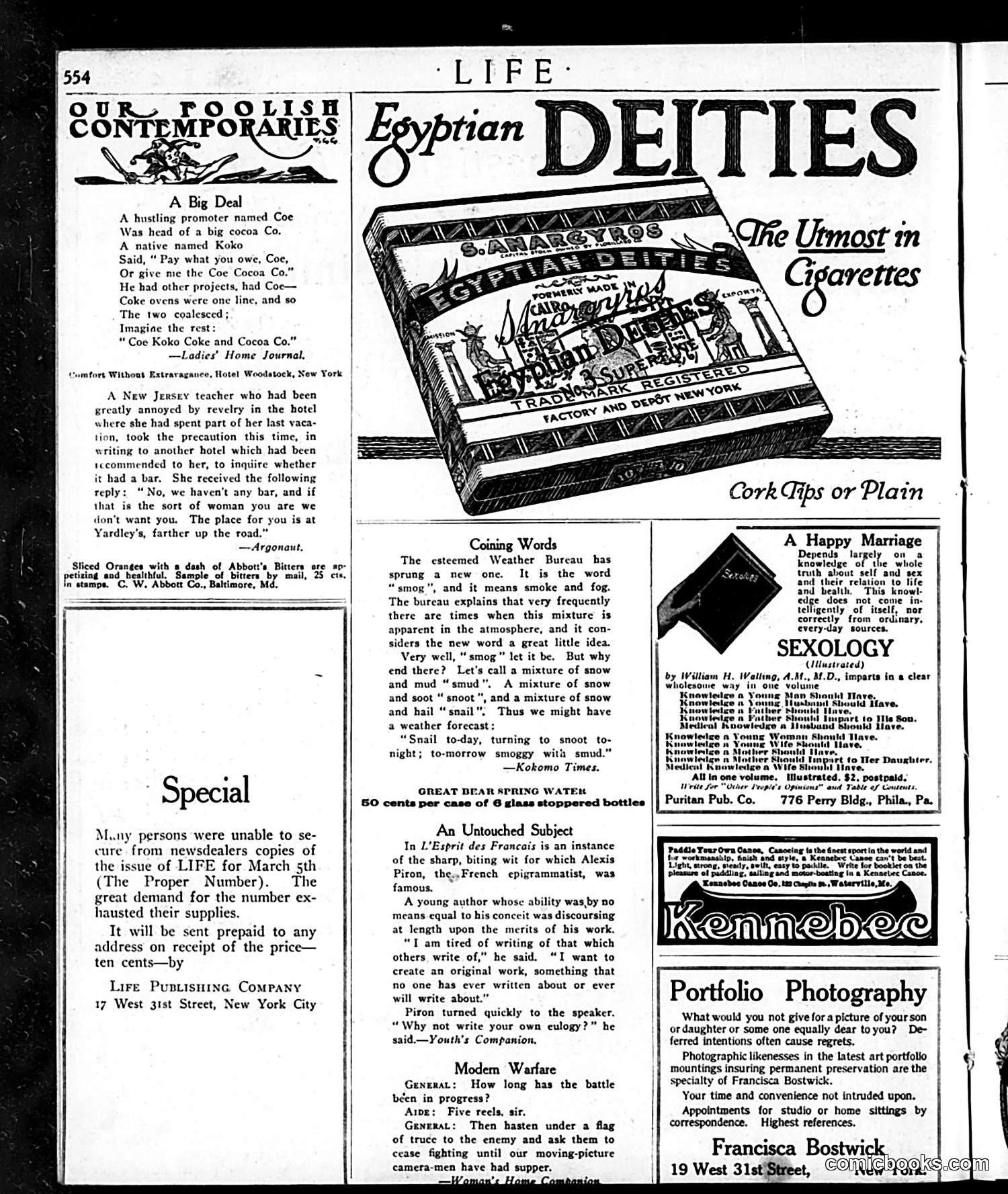
This page contains primarily **humorous anecdotes and advertisements** rather than political cartoons. The main satirical content includes: 1. **"A Big Deal"** — A light verse joke playing on words: a cocoa company owner named "Coe" owes money to a native named "Koko," resulting in the absurd merged company name "Coe Koko Coke and Cocoa Co." The humor relies on phonetic wordplay. 2. **"Coining Words"** — Satire mocking the Weather Bureau's newly coined term "smog" (smoke + fog). The author humorously extends this logic to invent similar portmanteau words like "smud" (snow + mud) and "snail" (snow + hail), exposing the arbitrary nature of neologisms. 3. **"Modern Warfare"** — A joke about film crews: generals pause actual battle to allow movie cameramen to finish dinner, satirizing early cinema's obsession with capturing action footage. The page also includes advertisements for Egyptian Deities cigarettes, photography services, and educational books on marriage and sexuality — typical early 20th-century magazine content.
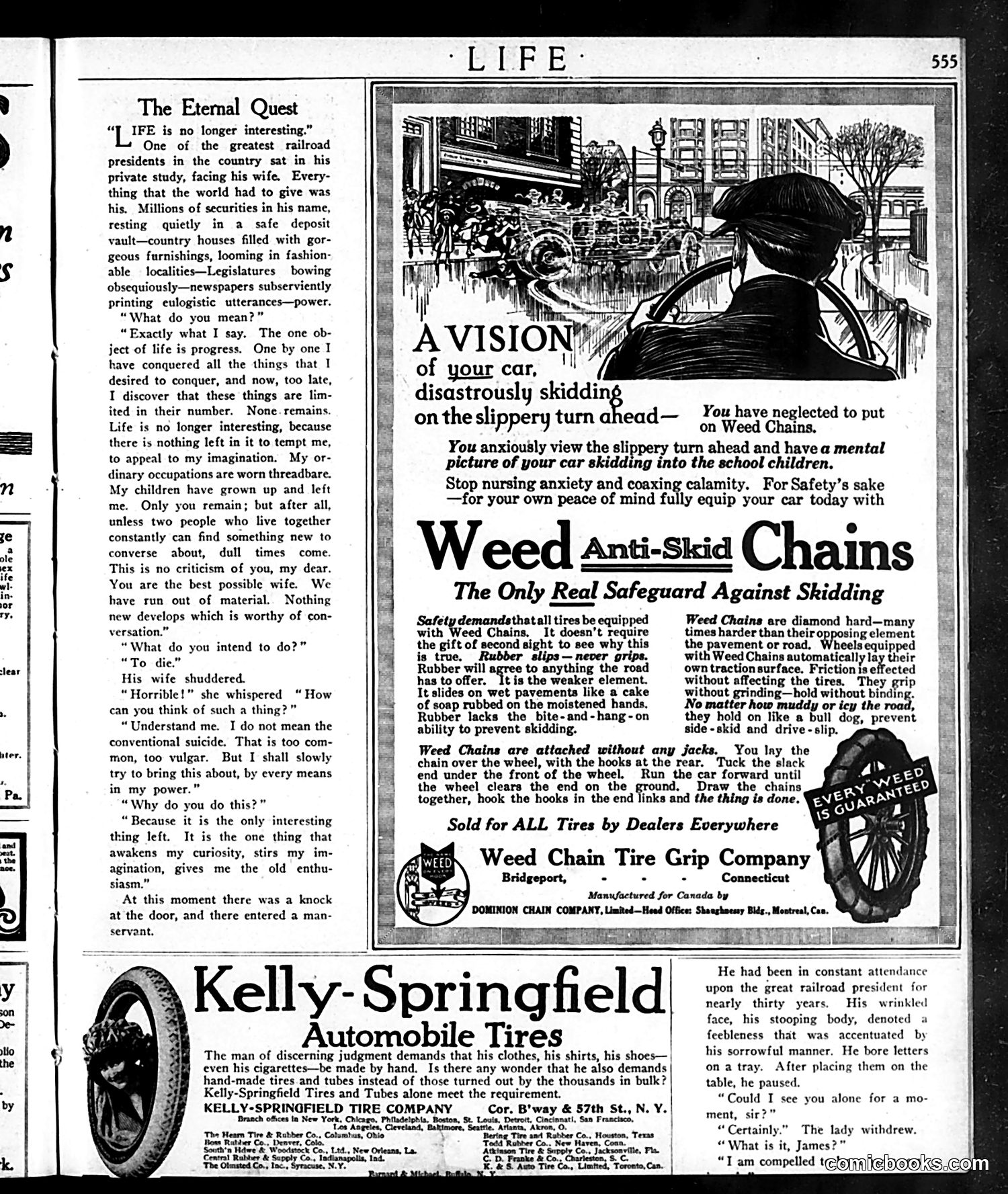
This page contains a short story about a wealthy railroad president experiencing existential ennui. Despite possessing vast fortune, power, and influence, he finds life meaningless because he's "conquered" everything worth pursuing. His only remaining source of interest is contemplating his own death—a dark meditation on the emptiness of material success. The advertisements below—for Weed Anti-Skid Chains and Kelly-Springfield Tires—use fear-based marketing typical of the 1920s-30s era, depicting anxious motorists imagining car accidents. These ads exploit safety concerns to sell products, contrasting sharply with the existential despair of the story above. Together, the page satirizes American consumer culture: the wealthy industrialist seeks meaning in material pursuits (and ultimately nihilism), while ordinary people are manipulated into purchasing safety products through manufactured anxiety. Both reflect the era's anxieties about progress and modern life.
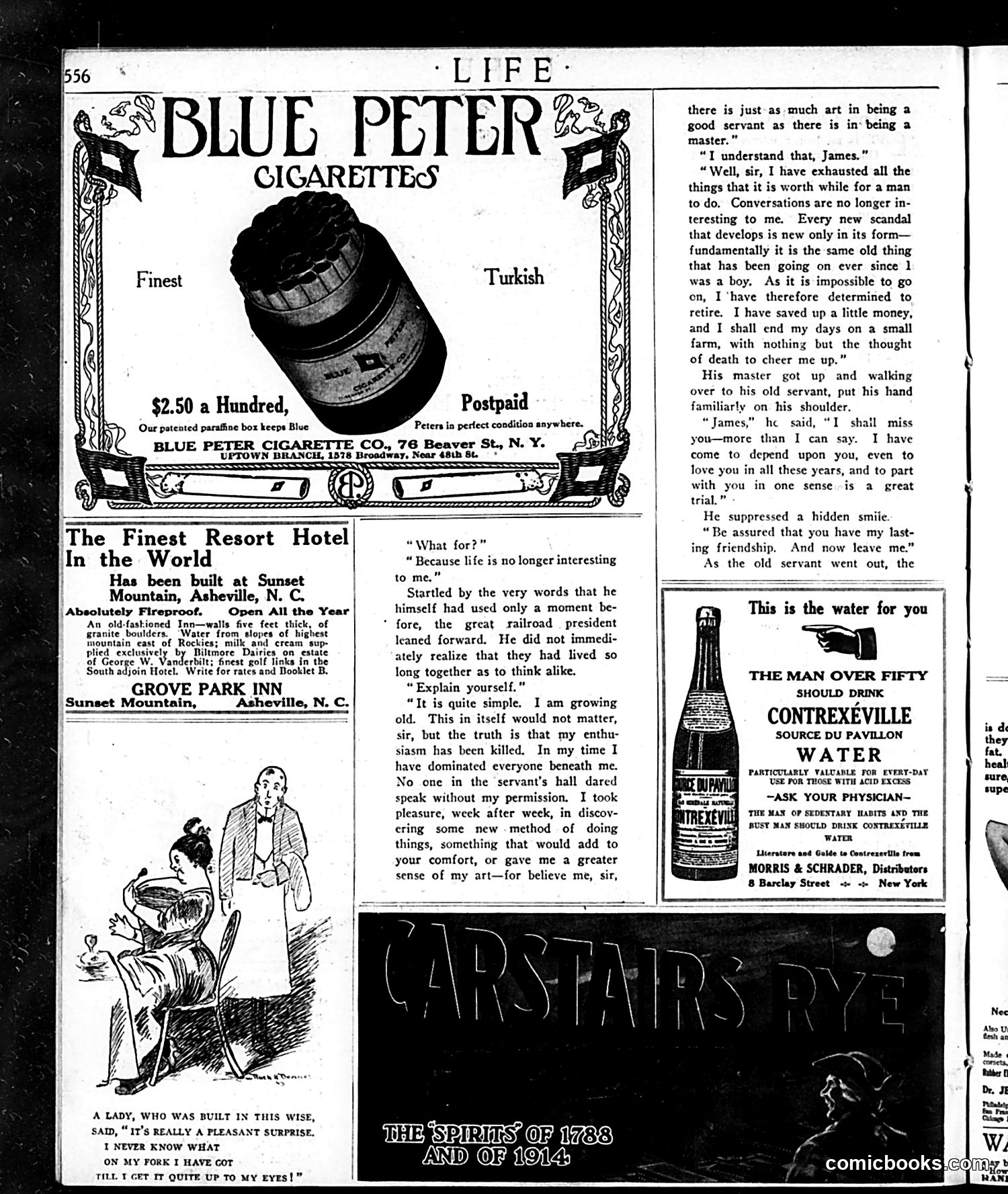
This page is primarily **advertisements and a serialized fiction story**, with minimal political satire. The main narrative depicts a wealthy railroad president and his aging servant "James," who announces his retirement. James claims life has become uninteresting—he's exhausted new experiences, scandals repeat themselves, and dominating subordinates no longer satisfies him. The social commentary here reflects **early 20th-century anxieties about aging and purposelessness** among the elite, though presented sympathetically through the servant's philosophical resignation. The humor in the accompanying illustration shows a woman surprised by what she finds on her fork—a visual pun about uncertainty and class service. The surrounding advertisements (Blue Peter Cigarettes, Grove Park Inn in Asheville, Contrexeville Water) are standard period marketing with no apparent political message. The "Carstairs Rye" whiskey ad references spirits from 1788 and 1914, likely emphasizing brand longevity. This page functions primarily as entertainment and advertising rather than political commentary.
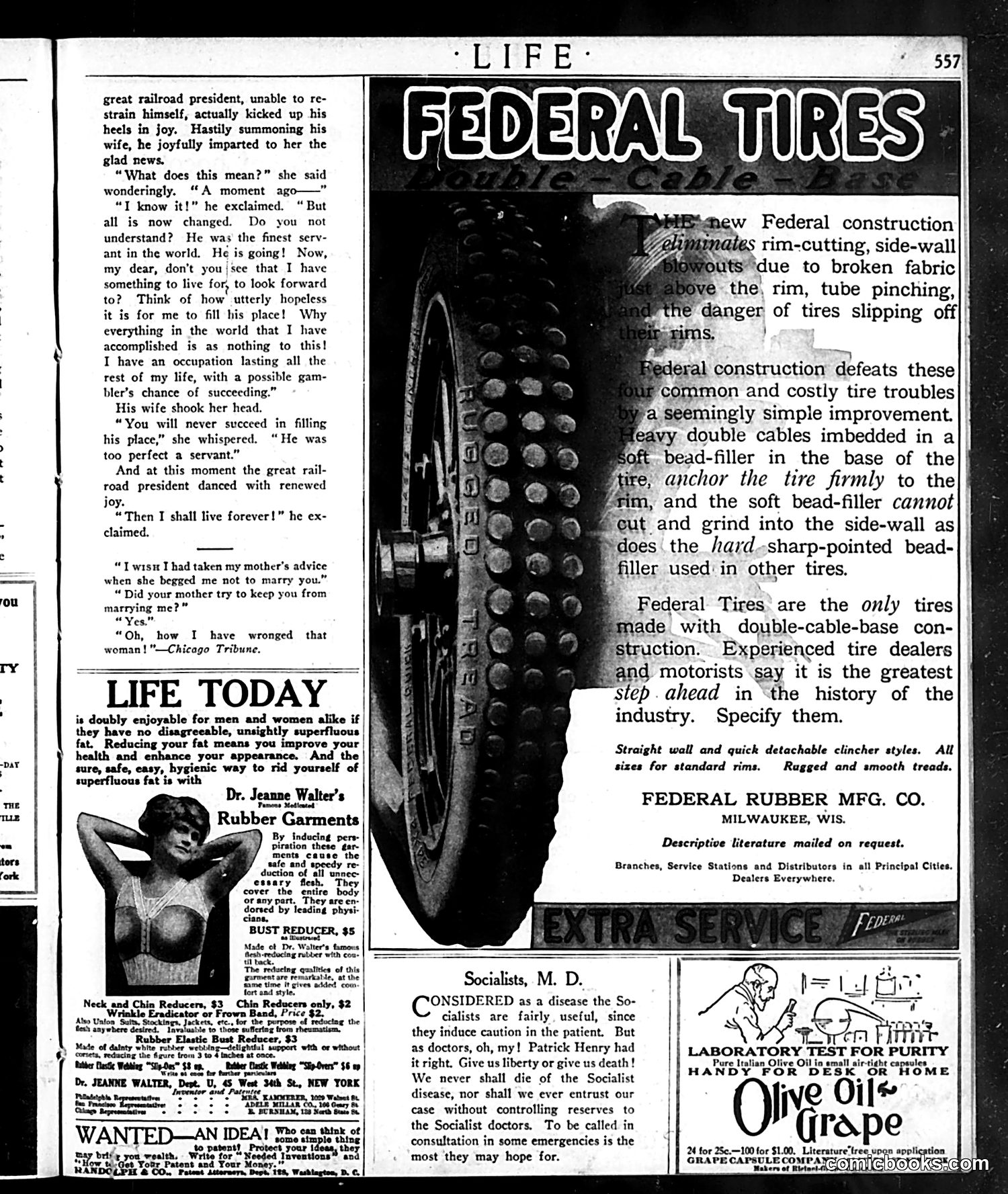
This page contains **primarily advertisements and filler content**, not political cartoons. The main narrative piece (top left) is a humorous anecdote about a railroad president who rejoices upon learning his excellent servant is leaving—finally giving him "something to live for" by having an impossible standard to match. The joke satirizes the president's absurd priorities and vanity. Below that, "**Socialists, M.D.**" is a brief satirical commentary treating socialism as a disease. It argues socialists are useful as a cautionary example to patients but useless as actual doctors/leaders. The reference to Patrick Henry ("Give us liberty or give us death") positions anti-socialist sentiment as patriotic. **The bulk of the page is advertising**: rubber garments for weight reduction, Federal Tires (featuring a close-up tire photograph), and Olive Oil Grape capsules. These ads reflect 1920s consumer culture and health product marketing typical of *Life* magazine's revenue model. No specific historical figures are caricatured or identified beyond generic types (railroad president, socialist doctors).
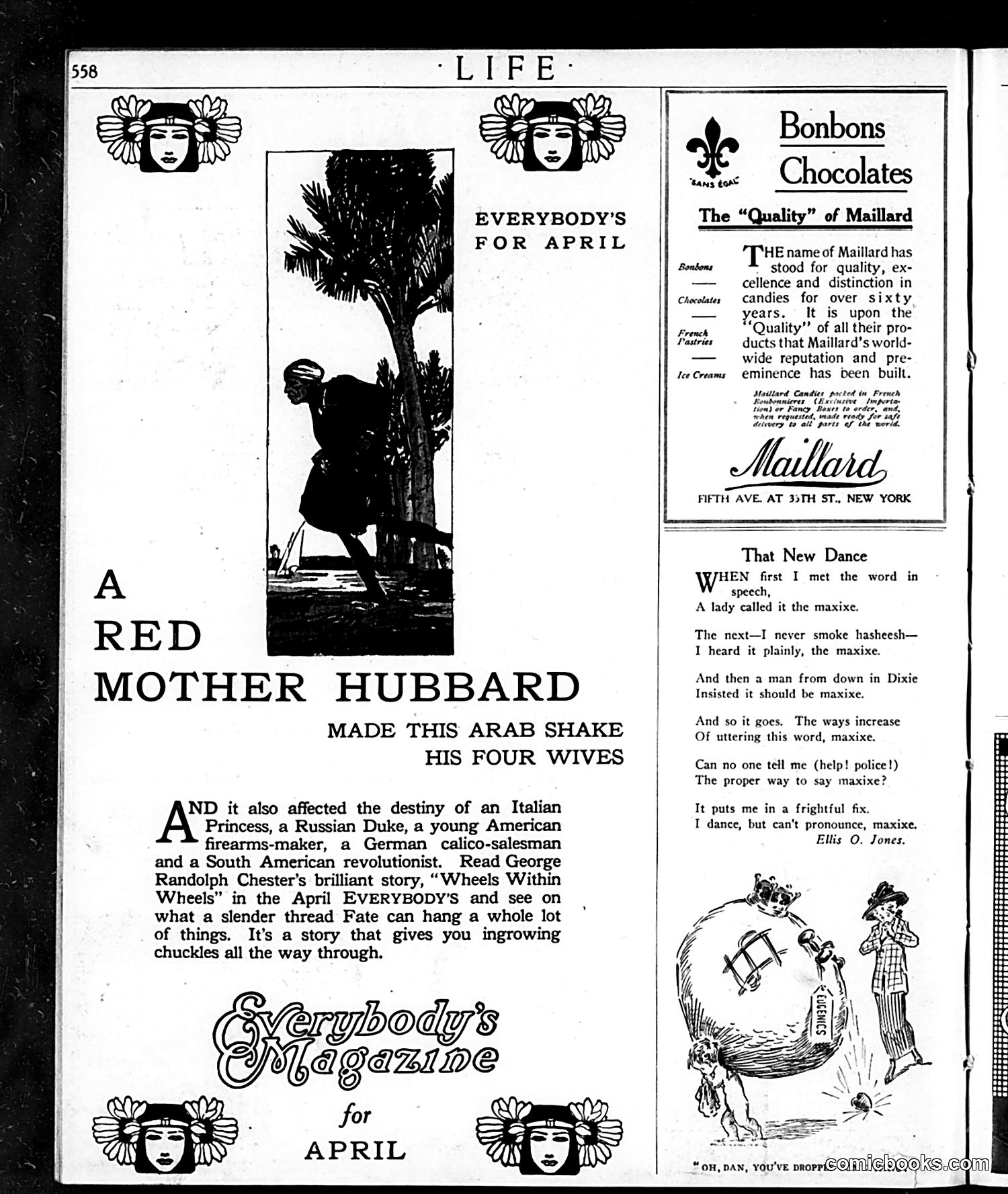
This page mixes advertisements with promotional content for Everybody's Magazine. The main elements are: **Central image**: A silhouette titled "A Red Mother Hubbard Made This Arab Shake His Four Wives"—a humorous headline referencing a story in Everybody's Magazine about how an Italian Princess, Russian Duke, American firearms-maker, German salesman, and South American revolutionist's fates intertwine through a woman wearing a red Mother Hubbard dress (a common loose housedress of the era). **Right side**: A Maillard chocolate advertisement emphasizing quality and worldwide reputation, plus a comic poem about the "maxixe" (a Brazilian dance craze of the 1910s) satirizing Americans' inability to pronounce or properly perform the foreign dance—reflecting early 20th-century anxieties about foreign cultural imports and "proper" pronunciation. The page exemplifies Life's blend of satire, advertising, and popular entertainment for educated American readers circa 1912.
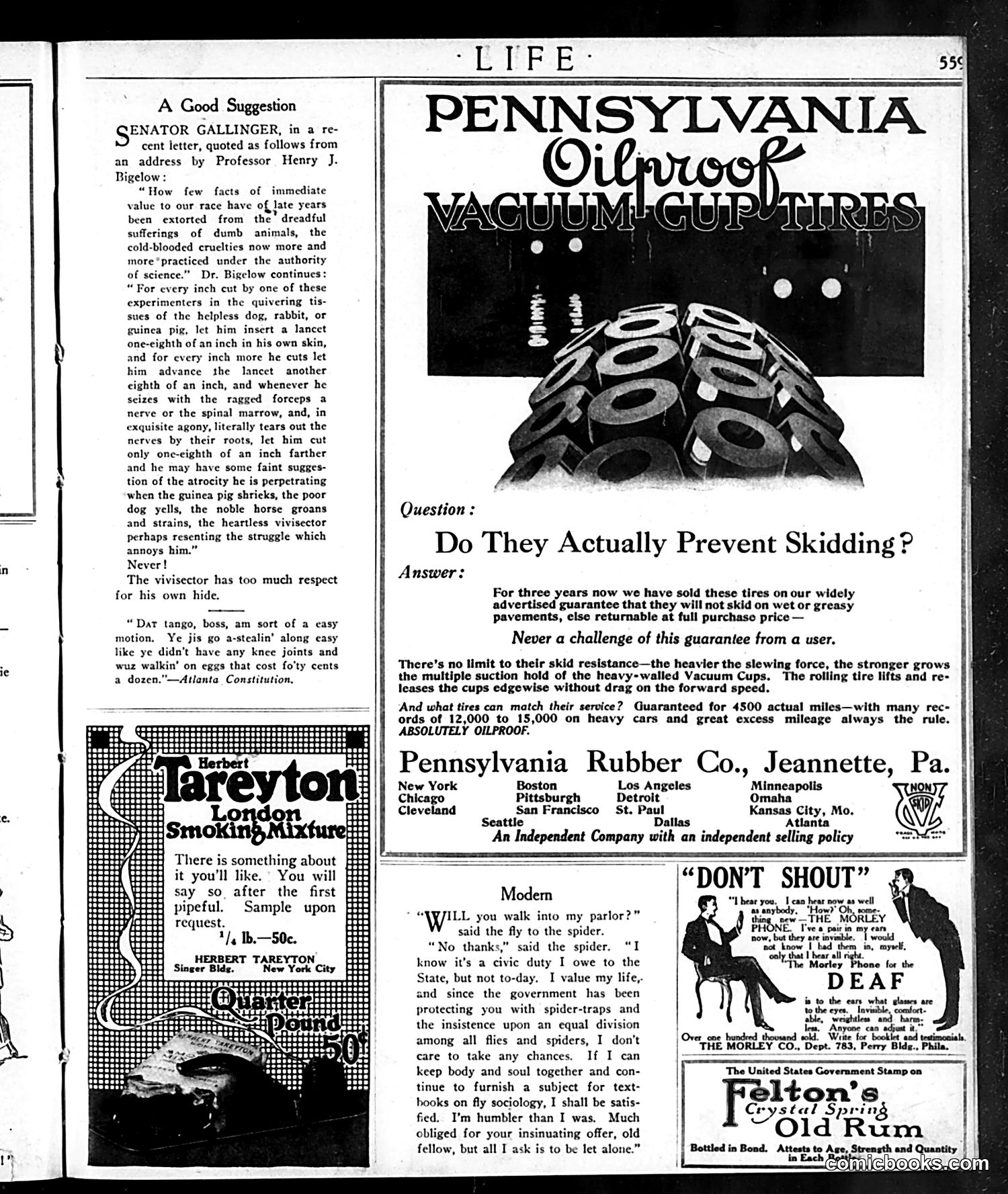
This page contains three distinct pieces: **"A Good Suggestion"** (left): A satirical column quoting Senator Gallinger and Professor Bigelow attacking **vivisection**—animal testing/experimentation. The satire's punch: Bigelow proposes scientists should cut themselves equivalent amounts for every animal they harm. The final joke undermines this: vivisectors won't do it because they value their own bodies too much, exposing the hypocrisy of inflicting pain they wouldn't endure themselves. **Pennsylvania Oilproof Vacuum Cup Tires** (center): A straightforward tire advertisement claiming superior skid-resistance—period marketing with no satirical content. **"Modern"** (bottom right): A brief satirical dialogue where a spider refuses the fly's invitation, claiming government protection of flies has made predation unfair. This appears to mock **progressive government regulation** as making natural hierarchies "equal" and thus unnatural—likely 1910s-era anti-regulation satire. The page is primarily **advertising-driven** with satirical commentary as filler content typical of Life magazine's format.
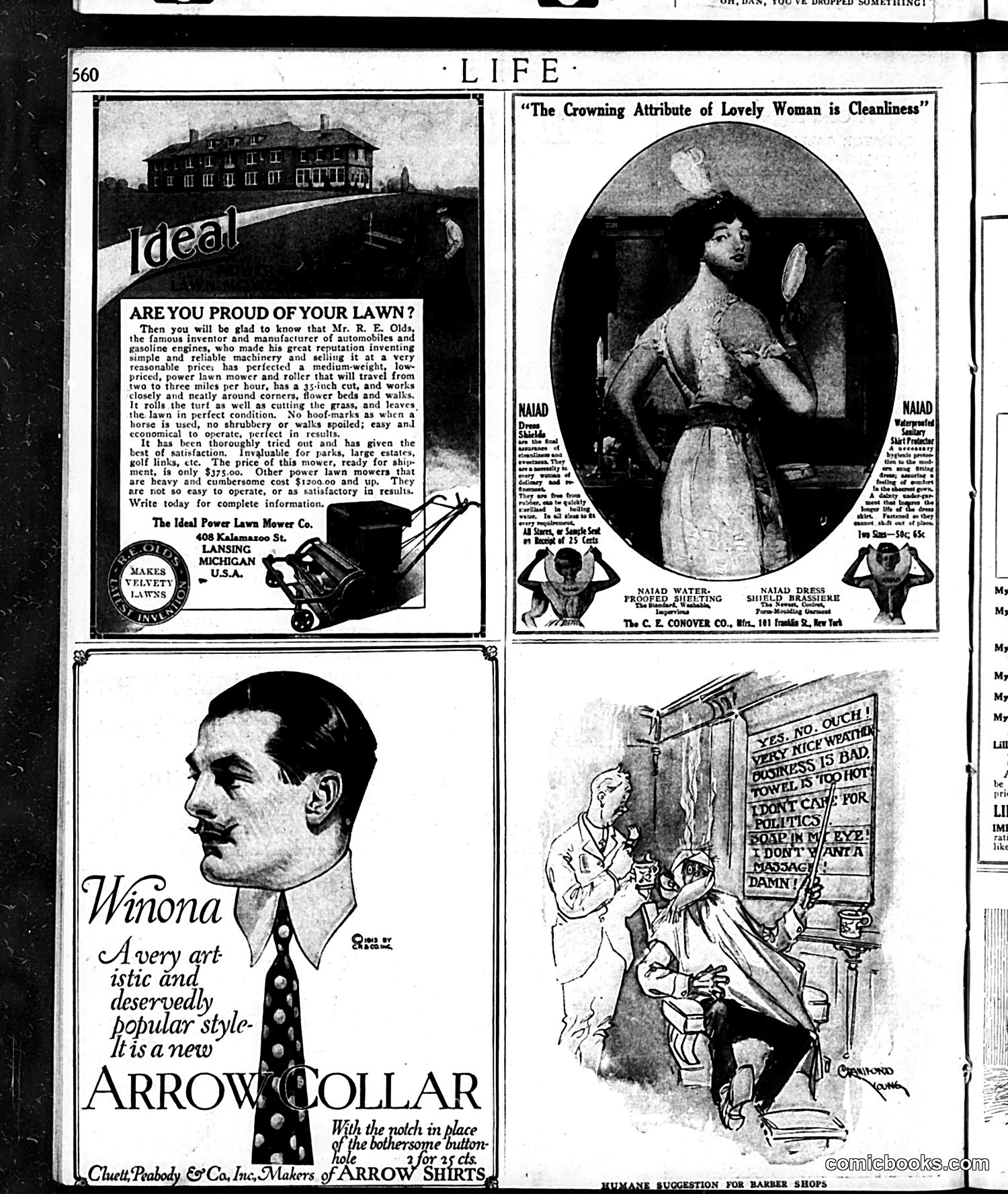
This page combines advertisements with one satirical cartoon. The **main satire** (bottom right) appears in a barber shop scene showing a customer reading notices about avoiding "politics," "soap," and "massage" while the barber works. The humor targets barber shop culture—these establishments were apparently known as spaces where customers complained or discussed contentious topics. The sign humorously warns against such behavior, suggesting barbers wanted quiet, compliant customers. The rest of the page consists of period advertisements: a lawn mower by R.E. Olds (automobile inventor), Arrow Collar shirts featuring the "Winona" style, and Naiad brand women's undergarments claiming cleanliness as "the crowning attribute of lovely woman." These ads reflect early 20th-century consumer culture and gendered marketing—lawn care as masculine pride, fashion as masculine taste, and feminine hygiene as desirable beauty trait.
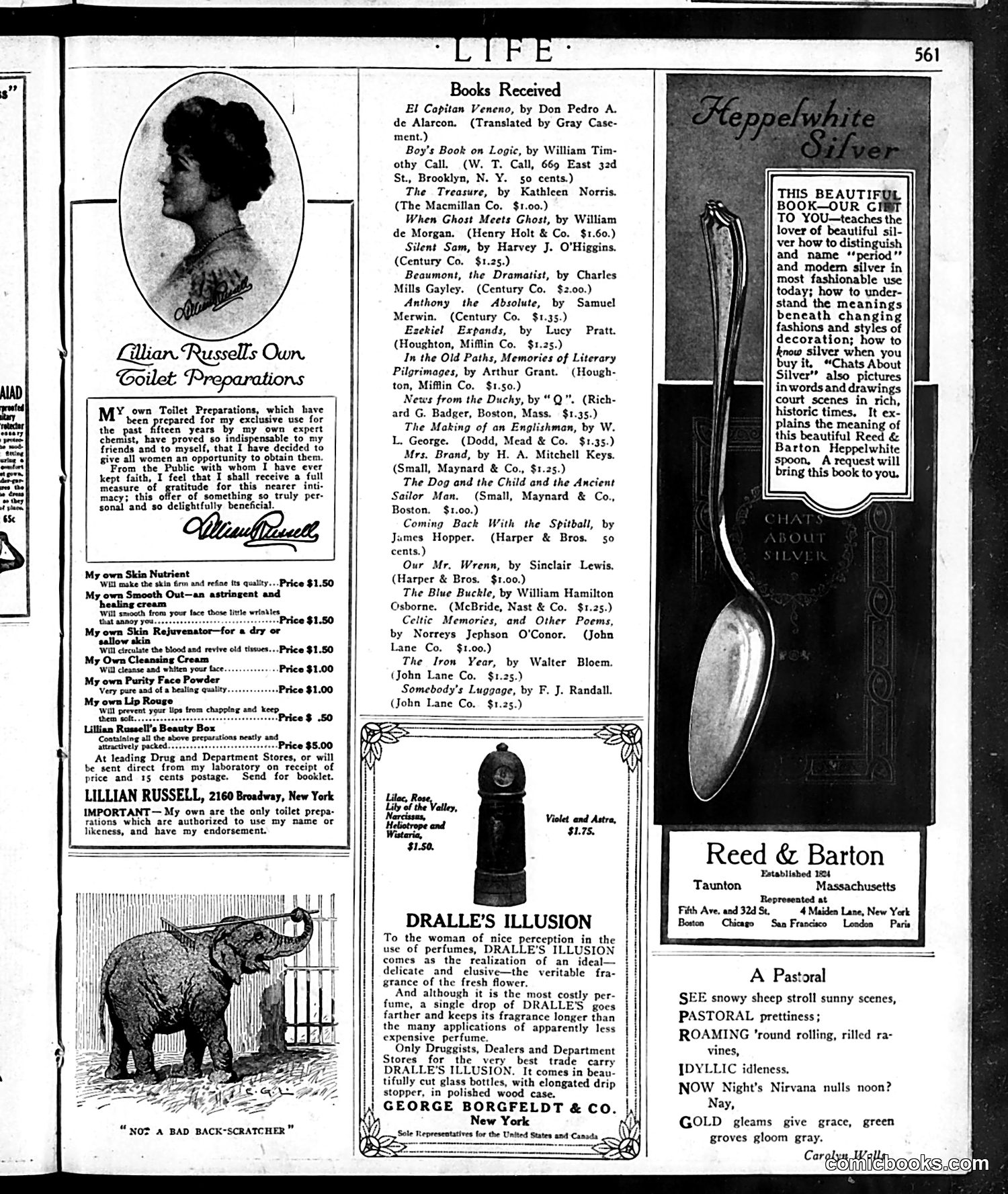
This page is primarily **advertising and book listings**, not political satire. The main content includes: **Left side**: Lillian Russell (a famous stage actress/performer) endorses her own line of beauty products—skin nutrients, face powders, and cleansers. She emphasizes these are her genuine personal preparations, sold at drug stores. **Center**: A list of newly published books from publishers like Macmillan and Century Co. **Bottom left**: A cartoon showing an elephant at a fence with caption "NOT A BAD BACK-SCRATCHER"—likely a visual joke about the elephant's trunk's utility. **Right side**: Advertisements for Heppelwhite Silver (by Reed & Barton, established silversmiths) and Dralle's Illusion perfume, plus a poetic fragment titled "A Pastoral." The page reflects early 1900s consumer culture: celebrity product endorsements, luxury goods advertising, and literature promotion. There is no significant political content or satire visible.
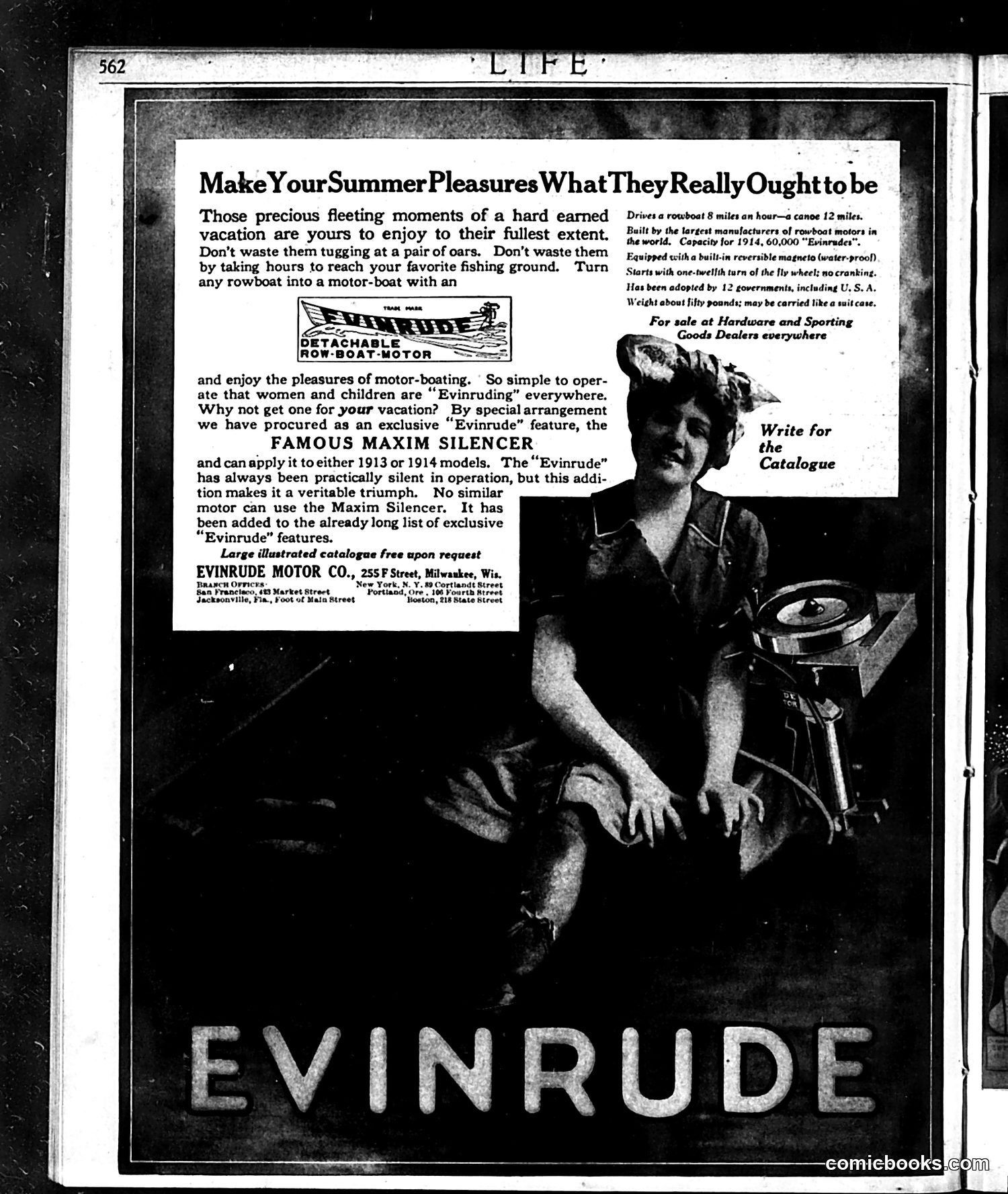
This is **not satire or a political cartoon**—it's a straightforward **product advertisement** for Evinrude outboard motors, placed in Life magazine (circa 1913-1914). The page promotes converting rowboats into motorboats using Evinrude's detachable motor. The marketing pitch emphasizes convenience: vacationers shouldn't waste time rowing or paddling when they could use a motor instead. The advertisement notes the motor is so simple "women and children are 'Evinruding' everywhere"—highlighting the product's ease of use as a selling point. A key feature advertised is the "Maxim Silencer," positioned as an exclusive innovation making the motor exceptionally quiet. The image shows a man operating the motorboat equipment. The ad includes technical specs (8 mph for rowboats, 12 for canoes), pricing information, and lists government adoption, including by the U.S.A. This reflects early-20th-century marketing tactics promoting emerging motorized technology as a leisure upgrade.
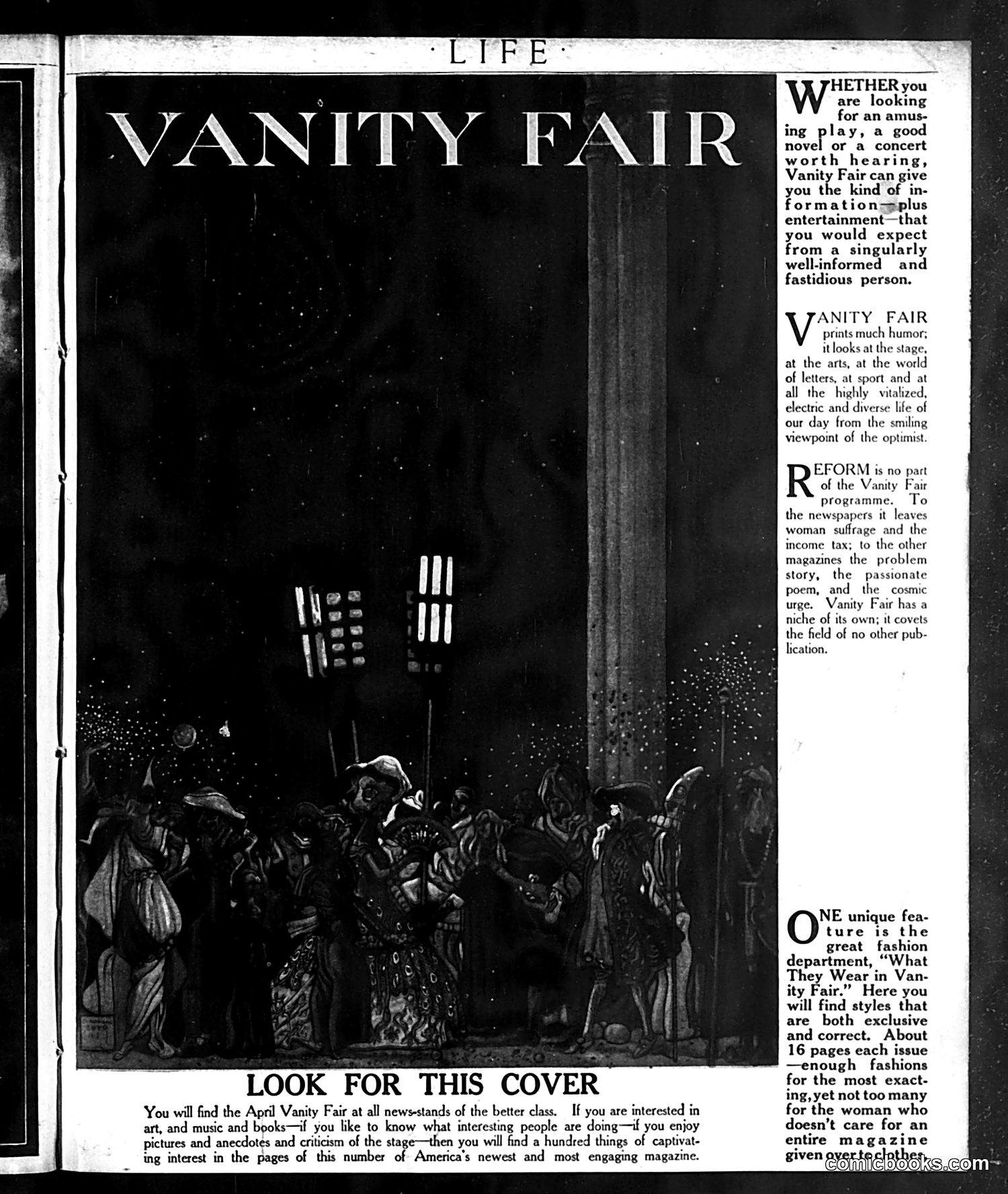
This is primarily a **promotional advertisement** for Vanity Fair magazine's April issue, not a political cartoon. The illustrated cover image depicts what appears to be a **theatrical or cabaret scene** with stylized figures in dramatic poses under stage lighting, suggesting entertainment and sophistication—themes the text emphasizes. The accompanying text positions Vanity Fair as a magazine for the culturally refined: it covers arts, music, theater, and fashion for "well-informed and fastidious" readers. Notably, the text explicitly states that **reform is NOT part of Vanity Fair's program**, and it deliberately avoids coverage of "woman suffrage and the income tax"—major political issues of the early 20th century. This signals the magazine's stance as apolitical entertainment for the leisure class. The emphasis on fashion ("What They Wear in Vanity Fair") and the 16 pages devoted to exclusive styles reinforces its target audience: wealthy, style-conscious readers unconcerned with social reform.
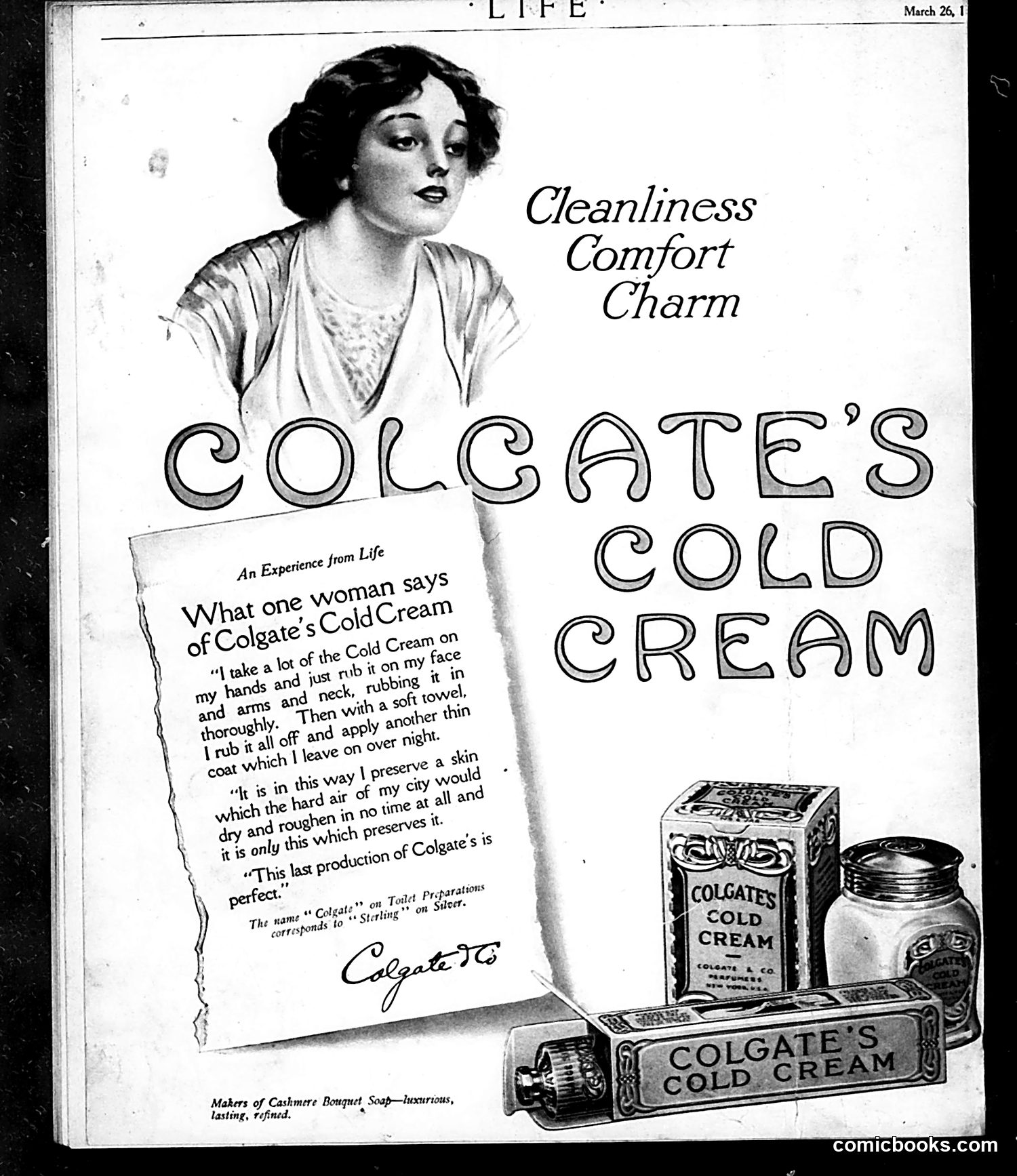
This is a **straightforward advertisement**, not satire or political commentary. It promotes Colgate's Cold Cream as a skincare product emphasizing "Cleanliness, Comfort, Charm." The page features a testimonial from an unnamed woman describing her nighttime skincare routine: applying cold cream to hands, neck, and arms, then rubbing it off with a soft towel before applying a thin coat left overnight. She credits the product with preserving her skin against "the hard air of my city" that would otherwise "dry and roughen" it. The advertisement positions cold cream as essential skincare for urban women dealing with environmental damage. The product packaging is displayed at bottom. There is **no satire here**—this is period advertising typical of early-to-mid 20th century women's magazines, using testimonial format to market cosmetics.
I can see this is a page from Life magazine with a mostly black background and what appears to be a decorative bottle or vessel in the lower left corner. However, the image quality is too dark and degraded for me to reliably make out specific cartoon content, text, or caricatures that would allow me to identify the political or social references with confidence. The date marker "arch 26, 1" (likely March 26) is visible at the top left, but the main content is obscured. Without being able to read the text clearly or discern specific figures, I cannot accurately explain the satire or joke to a modern reader as requested. A clearer image would be needed for proper analysis.