
Life, 1914-03-26 · page 10 of 41
Life — March 26, 1914 — page 10: what you’re looking at
What you’re looking at
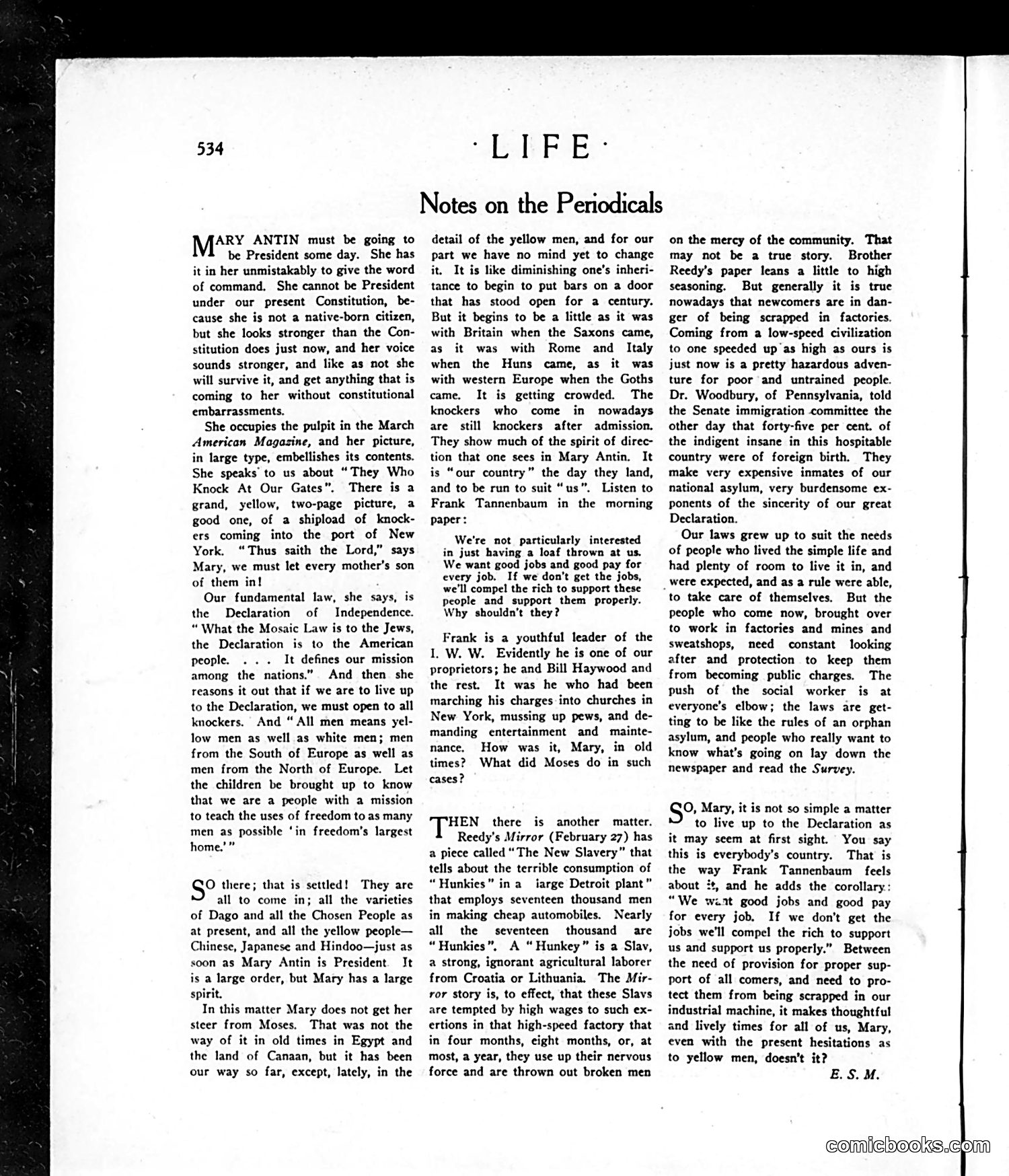
This page contains editorial commentary on contemporary periodicals and social issues, not a political cartoon. The text discusses Mary Antin (a Jewish immigrant author) and her potential as a future political leader, arguing she embodies American democratic ideals better than native-born citizens. The piece critiques the American Magazine for its article on "Hunkeys" (a derogatory term for Eastern European Slavic laborers). It describes their exploitation in Detroit auto factories, where they work grueling shifts before being discarded. The commentary advocates for open immigration, arguing America's founding principles demand it. It defends poor immigrants against nativist rhetoric, suggesting society has a responsibility to protect vulnerable workers from industrial abuse and wage exploitation—a progressive position for the period.
📄 Transcribed text from this page (OCR, searchable)
Machine-transcribed from the original scan — historical spelling and the odd misread are preserved.
ARY ANTIN must be going to be President some day. She has it in her unmistakably to give the word of command, She cannot be President under our present Constitution, be- cause she is not a native-born citizen, but she looks stronger than the Con- stitution does just now, and her voice sounds stronger, and like as not she will survive it, and get anything that is coming to her without constitutional embarrassments. She occupies the pulpit in the March American Magasine, and her picture, in large type, embellishes its contents. She speaks’ to us about “They Who Knock At Our Gates". There is a grand, yellow, two-page picture, a good one, of a shipload of knock- ers coming into the port of New York. “Thus saith the Lord,” says Mary, we must let every mother’s son of them in! Our fundamental law, she says, is the Declaration of Independence. “ What the Mosaic Law is to the Jews, the Declaration is to the American people. It defines our mission among the nations.” And then she reasons it out that if we are to live up to the Declaration, we must open to all knockers. And “All men means yel- low men as well as white men; men from the South of Europe as well as men from the North of Europe. Let the children be brought up to know that we are a people with a mission to teach the uses of freedom to as many men as possible ‘in freedom’s largest home.’ O there; that is settled! They are all to come in; all the varieties of Dago and all the Chosen People as at present, and all the yellow people— Chinese, Japanese and Hindoo—just as soon as Mary Antin is President. It is a large order, but Mary has a large spirit. In this matter Mary does not get her steer from Moses. That was not the way of it in old times in Egypt and the land of Canaan, but it has been our way so far, except, lately, in the “EF E- Notes on the Periodicals detail of the yellow men, and for our part we have no mind yet to change it. It is like diminishing one’s inheri- tance to begin to put bars on a door that has stood open for a century. But it begins to be a little as it was with Britain when the Saxons came, as it was with Rome and Italy when the Huns came, as it was with western Europe when the Goths came. It is getting crowded. The knockers who come in nowadays are still knockers after admission. They show much of the spirit of direc- tion that one sees in Mary Antin. It is “our country” the day they land, and to be run to suit “us”. Listen to Frank Tannenbaum in the morning Paper: We're not particularly interested in just having a loaf thrown at us. We want good jobs and good pay for every job. If we don’t get the jobs, we'll compel the rich to support these people and support them properly. Why shouldn't they? Frank is a youthful leader of the I, W. W. Evidently he is one of our proprietors; he and Bill Haywood and the rest. It was he who had been marching his charges into churches in New York, mussing up pews, and de- manding entertainment and mainte- nance. How was it, Mary, in old times? What did Moses do in such cases? 'HEN there is another matter. Reedy's Mirror (February 27) has a piece called “The New Slavery” that tells about the terrible consumption of “Hunkies” in a iarge Detroit plant” that employs seventeen thousand men in making cheap automobiles. Nearly all the seventeen thousand are “Hunkies”, A “Hunkey” is a Slav, a strong, ignorant agricultural laborer from Croatia or Lithuania. The Mir- ror story is, to effect, that these Slavs are tempted by high wages to such ex- ertions in that high-speed factory that in four months, eight months, or, at most, a year, they use up their nervous force and are thrown out broken men on the mercy of the community. That may not be a true story. Brother Reedy’s paper leans a little to high seasoning. But generally it is true nowadays that newcomers are in dan- ger of being scrapped in factories. Coming from a low-speed civilization to one speeded up as high as ours is just now is a pretty hazardous adven- ture for poor and untrained people. Dr. Woodbury, of Pennsylvania, told the Senate immigration committee the other day that forty-five per cent. of the indigent insane in this hospitable country were of foreign birth. They make very expensive inmates of our national asylum, very burdensome ex- ponents of the sincerity of our great Declaration. Our laws grew up to suit the needs of people who lived the simple life and had plenty of room to live it in, and were expected, and as a rule were able, to take care of themselves. But the people who come now, brought over to work in factories and mines and sweatshops, need constant looking after and protection to keep them from becoming public charges. The push of the social worker is at everyone’s elbow; the laws are get- ting to be like the rules of an orphan asylum, and people who really want to know what’s going on lay down the newspaper and read the Survey. O, Mary, it is not so simple a matter to live up to the Declaration as it may seem at first sight. You say this is everybody’s country. That is the way Frank Tannenbaum feels about t, and he adds the corollary: “We wiat good jobs and good pay for every job. If we don’t get the jobs we'll compel the rich to support us and support us properly.” Between the need of provision for proper sup- port of all comers, and need to pro- tect them from being scrapped in our industrial machine, it makes thoughtful and lively times for all of us, Mary, even with the present hesitations as to yellow men, doesn’t it? E.S.M. comichooks.com