
Life, 1914-03-26 · page 23 of 41
Life — March 26, 1914 — page 23: what you’re looking at
What you’re looking at
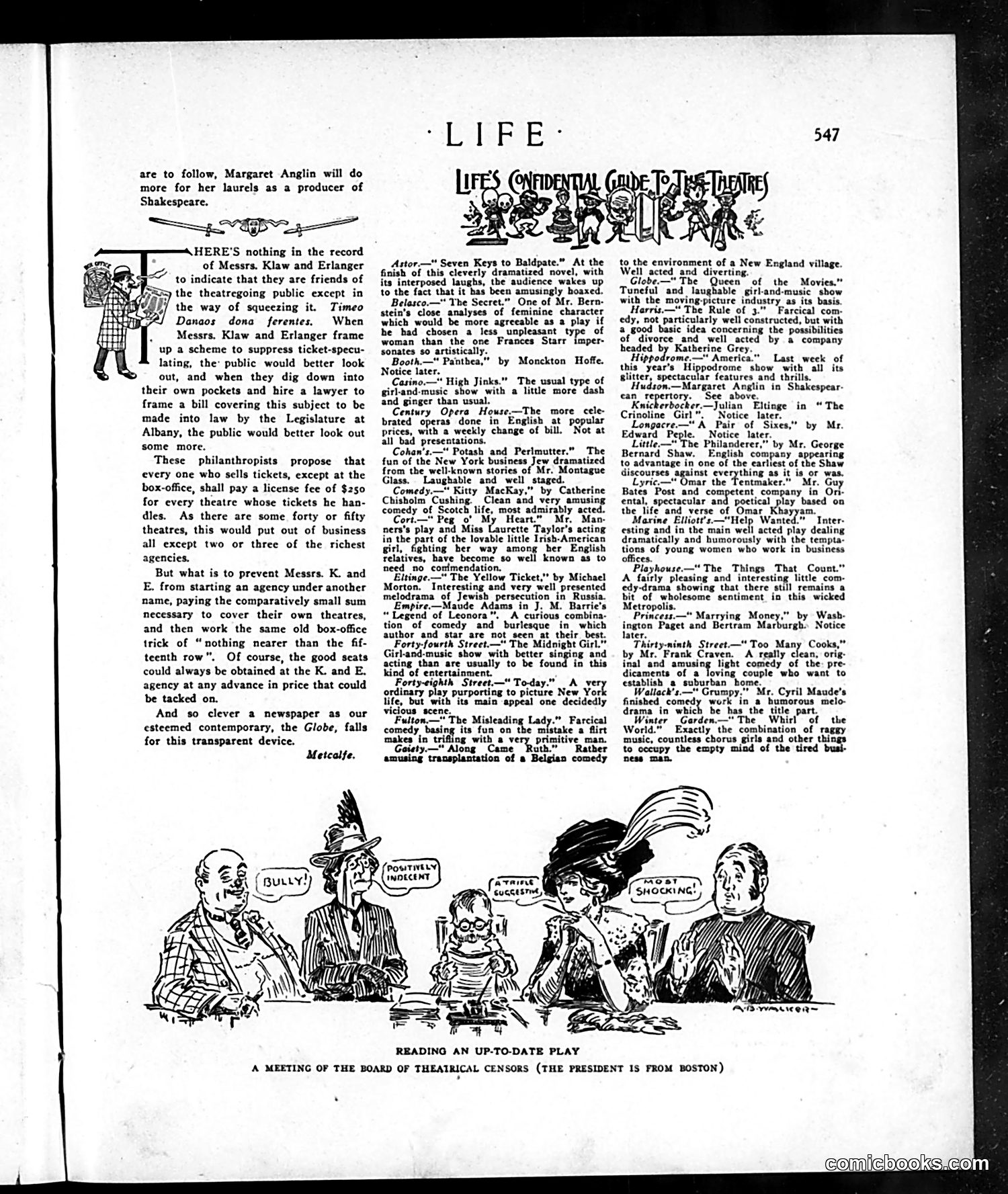
This page from *Life* magazine contains two distinct satirical pieces: **Top Article:** A scathing critique of theatrical producers **Klaw and Erlanger**, prominent Broadway monopolists of the early 1900s. The author accuses them of claiming to combat ticket speculation through a proposed $250 licensing fee for ticket sellers—a scheme that would actually eliminate competition and benefit only their own ticket agency. The satire highlights their hypocrisy: they pose as consumer advocates while actually scheming to consolidate their market power and maintain control over seat allocation (the reference to "nothing nearer than the fifteenth row" means average customers get poor seats while premium seats go to their agency). **Bottom Cartoon:** Depicts a "Board of Theatrical Censors" meeting to review an "up-to-date play." The board members' shocked reactions ("BULLY!", "POSITIVELY INDECENT!", "AWFUL!", "SHOCKING!") satirize theatrical censorship boards of the era, which frequently banned or heavily edited plays deemed morally inappropriate—a common practice in early 20th-century America. Both pieces mock theatrical industry corruption and censorship.
📄 Transcribed text from this page (OCR, searchable)
Machine-transcribed from the original scan — historical spelling and the odd misread are preserved.
are to follow, Margaret Anglin will do more for her laurels as a producer of Shakespeare. HERE'S nothing in the record of Messrs. Klaw and Erlanger to indicate that they are friends of the theatregoing public except in the way of squeezing it. Timeo Danaos dona ferentes, When Messrs. Klaw and Erlanger frame up a scheme to suppress ticket-specu- lating, the: public would better look out, and when they dig down into their own pockets and hire a lawyer to frame a bill covering this subject to be made into law by the Legislature at Albany, the public would better look out some more. These philanthropists propose that every one who sells tickets, except at the box-office, shall pay a license fee of $250 for every theatre whose tickets he han- dles. As there are some forty or fifty theatres, this would put out of business all except two or three of the richest agencies. But what is to prevent Messrs. K. and E. from starting an agency under another name, paying the comparatively small sum necessary to cover their own theatres, and then work the same old box-office trick of “nothing nearer than the fif- teenth row”. Of course, the good seats could always be obtained at the K. and E. agency at any advance in price that could be tacked on. And so clever a newspaper as our esteemed contemporary, the Globe, falls for this transparent device. Metcalfe. Astor_—" Seven Keys to Baldpate.” At the finish of this cleverly dramatized novel, with its interposed laughs, the audience wakes up to the fact that it has been amusingly hoaxed. Belasco.—" The Secret.” One of Mr. Bern- stei close analyses of feminine character which would be more agreeable as a play if he had chosen a less unpleasant type of woman than the one Frances Starr imper- sonates so artistically. Booth.— Painthea,' by Monckton Hoffe. The usual type of a little more dash at ‘Singer than usual. Century Opera House.—The more cele- brated operas done in English at popular prices, with a weekly change of bill, Not at all bad presentations. Cohan’s.—" Potash and Perlmutter.” The fun of the New York business Jew dramatized from the well-known stories of Mr. Montague Gh le and well staged. Comedy.—" Kitty MacKay,” by Catherine Chisholm Cushing Clean and very amusing comedy of Seotch, life, most admirably acted. Peg o' My Heart.” Mr, Man- sers's play and Miss Laurette Taylor’s acting in the part of the lovable little Irish-Ameri girl, fighting her way among her Engli relatives, have become so well known as need no commendation. Eltinge.—" The Yellow Ticket,” by Michael Morton. “Interesting and very well presented mr ma of Jewish persecution in Russia. ‘mp aude Adams in J. M. Barrie's bed tegend of Leonor ‘A curious combina- tion of comedy and’ burlesque in which author and star are not seen at their best. Forty-fourth Street.—* The Mii ht Girl.” fand-music show with better si aging and ting than are usually to be foun kind of entertainment. Forty-eighth Street.—" To-day.” A ve ordinary play purporting to picture New Yor life, but with its main rae ‘one decidedly icious act Fulton.—" The Misleadin, ” Farcical comedy basing its fun on t be Ar makes in trifing with a ae primitive mac. Goiety.—" Along Came amusing transplantation of a Belgian Y (Positive) INDECENT READING AN UP-TO-DATE PLAY to the environment of a New England vill Well acted and diverting. ee Globe—" The “Queen” of the Movies.” Tuneful and laughable girl-and-music show try as its basis Farcical com: not particularly well constructed, but with a good basic idea concerning the possibilities of divorce and well acted by a company headed by ‘ine Grey. ippodrom Spat a Py Year's Hippodrome show with all its glitter, spectacular features and thrills. Hudson.—Margaret Angin. in. Shakespear- can, repertory. ‘See above. Knickerbocker —Jul in Eltinge in Crinoline Gin Lonoeere ai * by Mr. award Peple, Notice later Ree ae ‘he Fallanderes,"s by Mr. eC ernard Shaw. English company appearing to advantage in one of the carilest of the Shaw diasourses aguinat everything av it is or wan yric—" Omar the Tentmaker.” Mr. Guy Bates Post and competent company in Or ental, spectacular and poetical play based on the life and verse of Omar hay Marine Elliott’s.—"Hel Wanted Toners and in the main well acted play dealing tically and humorously with the tempta- tions of young women who work in business offices. a rlaghouse—"The Things That. Count.” ly pleasing and interesting little com- daytdrazea showing that there stil remaine 4 bit of wholesome sentiment in this wicked Metropolis. Princess.—" Marrying Money,” by Wasb- ie Paget and Bertram Marburgh. Notice later. “The irtyeninth Street—" Too Many Cooks, by Mr Freak Craven. A really clean, ori inal and amusing light comedy of the: pre- dicaments of a loving couple who want to establish a suburban bome. Wallack’s.—" Grumpy.” Mr. Cyril Maude’s i iy york in a humerous melo- drama in which be has the title part, Winter Garden.—" The Whirl World.” Exactly the combination of a music, countless chorus girls and other things to occupy the empty mind of the tired busi- man = eee tcl) D | SHOCKING: al | RACERS A MEETING OP THE BOARD OF THEATRICAL CENSORS (THE PRESIDENT 1S FROM BOSTON)