
Life, 1914-03-26 · page 24 of 41
Life — March 26, 1914 — page 24: what you’re looking at
What you’re looking at
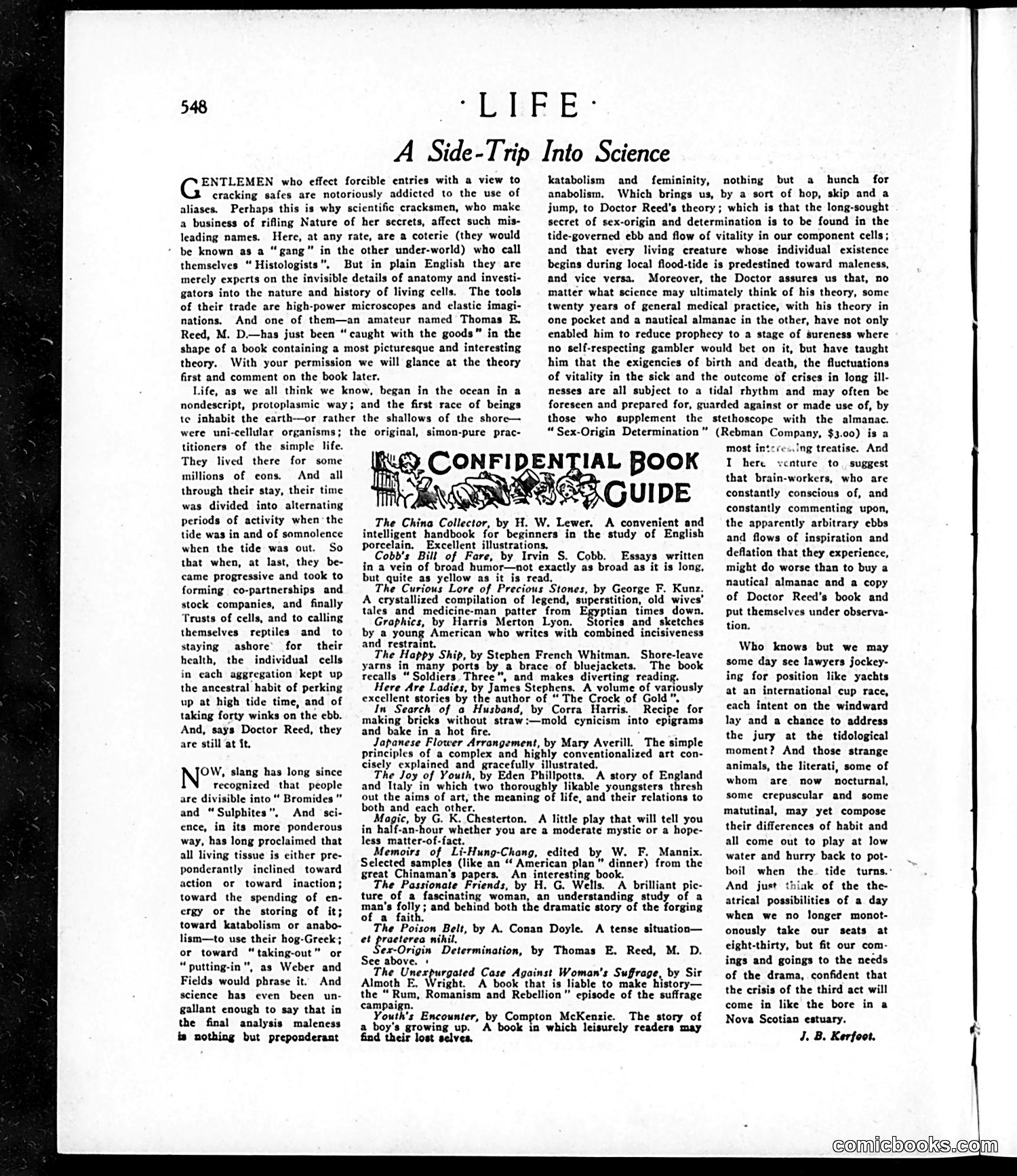
This page satirizes pseudoscientific theories by presenting Dr. Thomas E. Reed's book "Sex-Origin Determination," which claims to predict a baby's sex based on tidal cycles during conception and birth. The satire works through extended metaphor: scientists are compared to safecrackers and criminals ("gang," "caught with the goods"), suggesting they operate outside normal bounds. Reed's theory—that tides govern vitality in our cells, determining maleness or femaleness, and can even predict illness outcomes—is presented as simultaneously ridiculous and oddly compelling to its author after twenty years of practice. The humor lies in mocking the era's obsession with pseudo-scientific "systems" that promise certainty through arbitrary mechanisms. By calling it a "Side-Trip Into Science," Life suggests readers have wandered into speculative territory masquerading as legitimate medical knowledge. The comparison to popular psychology concepts like "Bromides" and "Sulphites" reinforces that this represents fashionable but dubious thinking.
📄 Transcribed text from this page (OCR, searchable)
Machine-transcribed from the original scan — historical spelling and the odd misread are preserved.
“EERIE A Side-Trip Into Science ENTLEMEN who effect forcible entries with a view to cracking safes are notoriously addicted to the use of aliases. Perhaps this is why scientific cracksmen, who make a business of rifling Nature of her secrets, affect such mis- leading names. Here, at any rate, are a coterie (they would * be known a “gang” in the other under-world) who call themselves “ Histologists". But in plain English they are merely experts on the invisible details of anatomy and investi- gators into the nature and history of living cells. The tools of their trade are high-power microscopes and clastic imagi- nations. And one of them—an amateur named Thomas E. Reed, M. D.—has just been “caught with the goods” in the shape of a book containing a most picturesque and interesting theory. With your permission we will glance at the theory first and comment on the book later. Life, as we all think we know, began in the ocean in a nondescript, protoplasmic way; and the first race of beings te inhi the earth—or rather the shallows of the shore— were uni-cellular organisms; the original, simon-pure prac- katabolism and femininity, nothing but a hunch for anabolism, Which brings us, by a sort of hop, skip and a jump, to Doctor Reed’s theory; which is that the long-sought secret of sex-origin and determination is to be found in the tide-governed ebb and flow of vitality in our component cells; and that every living creature whose individual existence begins during local flood-tide is predestined toward malencss, and vice versa. Moreover, the Doctor assures us that, no matter what science may ultimately think of his theory, some twenty years of general medical practice, with his theory in one pocket and a nautical almanac in the other, have not only enabled him to reduce prophecy to a stage of sureness where no self-respecting gambler would bet on it, but have taught him that the exigencies of birth and death, the fluctuations of vitality in the sick and the outcome of crises in long ill- nesses are all subject to a tidal rhythm and may often be foreseen and prepared for, guarded against or made use of, by those who supplement the stethoscope with the almanac. “ Sex-Origin Determination” (Rebman Company, $3.00) is a titioners of the simple life. They lived there for some millions of eons. And all through their stay, their time was divided into alternating periods of activity when the tide was in and of somnolence when the tide was out. So that when, at last, they be- came progressive and took to forming co-partnerships and stock companies, and finally Trusts of cells, and to calling themselves reptiles and to staying ashore’ for their health, the individual cells in each aggregation kept up the ancestral habit of perking up at high tide time, and of taking forty winks on the ebb. And, says Doctor Reed, they are still at it. OW, slang has long since recognized that people are divisible into “ Bromides " and “Sulphites”. And sci- ence, in its more ponderous way, has long proclaimed that all living tissue is either pre- ponderantly inclined toward action or toward inaction; toward the spending of en- ergy or the storing of it; toward katabolism or anabo- lism—to use their hog-Greek; or toward “taking-out” or “ putting-in", as Weber and Fields would phrase it. And science has even been un- gallant enough to say that in the final analysis maleness ts nothing but preponderant Baa SRR GUIDE The China Collector, by H. W. Lewer. A convenient and intelligent handbook for beginners in the study of English porcelain, Excellent illustrations, Cobb's Bill of Fare, by Irvin S. Cobb. Essays written in a vein of broad humor—not exactly as broad as it is long, but_ quite as yellow as it is read. ‘he Curious Lore of Precious Stones, by George F. Kunz. A crystallized compilation of legend, superstition, old wives’ tales and medicine-man patter from ptian times down. Graphics, by Harris Merton Lyon. Stories and sketches by a young American who writes with combined incisiveness and restraint. The Happy Ship, by Stephen French Whitman. Shore-leave yarns in many ports by a brace of bluejackets. The book recalls “ Soldiers Three”, and makes diverting reading. Here Are Ladies, by James Stephens, A_volume of variously excellent stories by the author of “ The Crock of Gold". In Search of a Husband, by Corra Harris. Recipe for making bricks without straw:—mold cynicism into epigrams and bake in a hot fire. : Japanese Flower Arrangement, by Mary Averill. The simple principles of a complex and highly conventionalized art con- cisely explained and gracefully illustrated. The Joy of Youth, by Eden Phillpotts, A story of England and Italy in which two thoroughly) likable youngsters thresh out the aims of art, the meaning of life, and their relations to both and each other. Magic, by G. K. Chesterton. A little play that will tell you in half-an-hour whether you are a moderate mystic or a hope- less matter-of-fact. Memoirs of Li-Hung-Chang, edited by W. F. Mannix. Selected samples (like an “ American plan” dinner) from the great Chinaman’s papers. An interesting book. The Passionate Friends, by H. G. Wells. A brilliant pic- ture of a fascinating woman, an understanding study of a f is and behind both the dramatic story of the forging a faith. The Poison raeterea nihil. ex-Origin Determination, by Thomas E, Reed, M. D. See above. + The Unexpurgated Case Against Woman's Suffrage, by Sir Almoth E, Wright. A book that is liable to make history— the “Rum, Romanism and Rebellion” episode of the suffrage campaign. Youth's Encounter, by Compton McKenzie. The story of a boy's growing up. A book in which leisurely readers may find their lost selves, by A. Conan Doyle. A tense situation— most intcres.ing treatise. And I here venture to. suggest that brain-workers, who are constantly conscious of, and constantly commenting upon, the apparently arbitrary ebbs and flows of inspiration and deflation that they experience, might do worse than to buy a nautical almanac and a copy of Doctor Reed’s book and put themselves under observa- tion, Who knows but we may some day sce lawyers jockey- ing for position like yachts at an international cup race, each intent on the windward lay and a chance to address the jury at the tidological moment? And those strange animals, the literati, some of whom are now nocturnal, some crepuscular and some matutinal, may yet compose their differences of habit and all come out to play at low water and hurry back to pot- boil when the tide turns. And just thiak of the the- atrical possibilities of a day when we no longer monot- onously take our seats at eight-thirty, but fit our com- ings and goings to the necds of the drama, confident that the crisis of the third act will come in like the bore in a Nova Scotian estuary. J, B. Kerfoot. comichooks.