
Life, 1914-03-26 · page 22 of 41
Life — March 26, 1914 — page 22: what you’re looking at
What you’re looking at
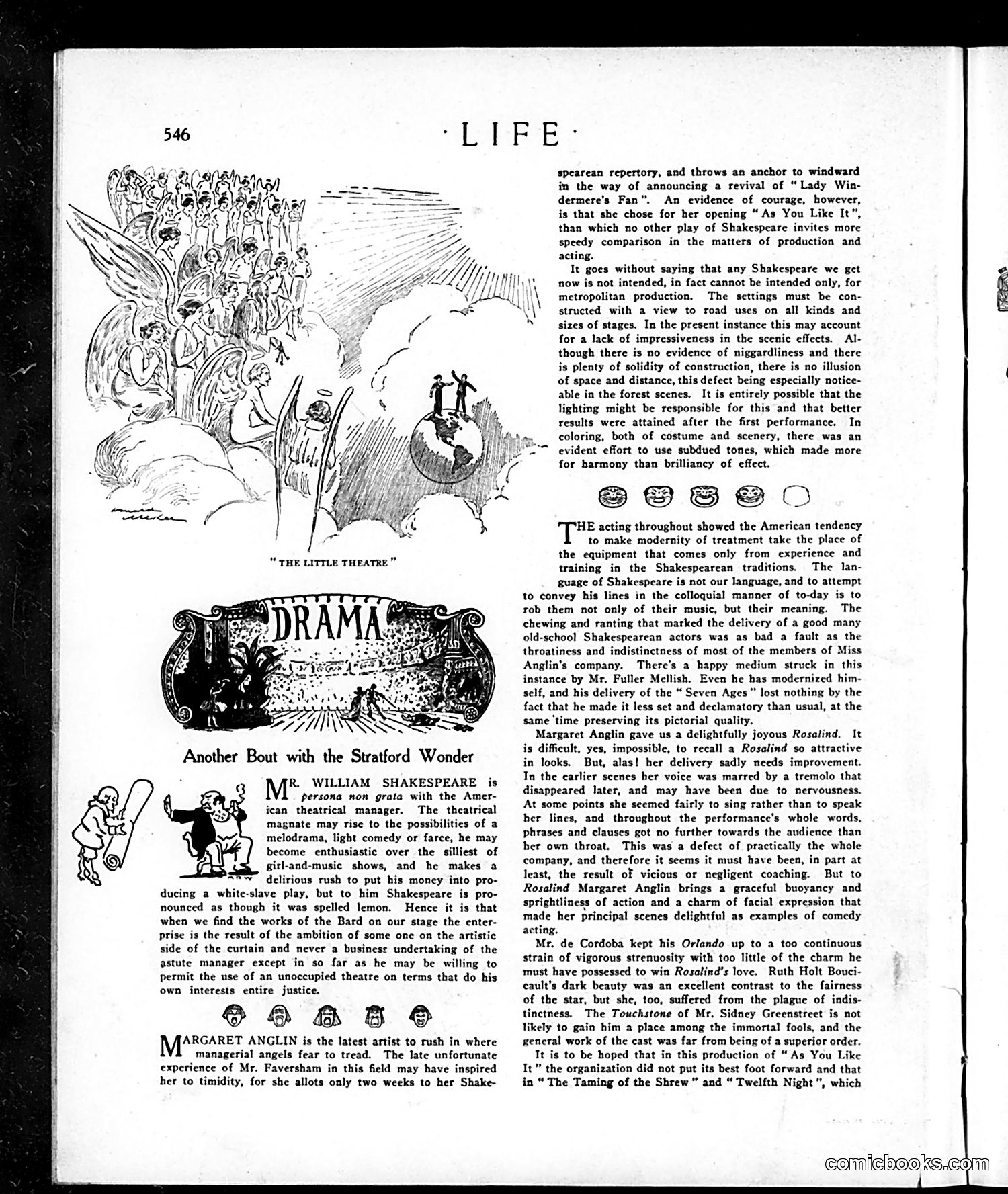
This page reviews actress Margaret Anglin's production of Shakespeare's *As You Like It*. The cartoon at top—"The Little Theatre"—appears to show figures on a tiny stage dwarfed by forest scenery, satirizing the challenge of staging Shakespeare affordably for touring productions. The text's central complaint: American theatrical managers dismiss Shakespeare as commercially unviable ("pronounced as though it was spelled lemon"), forcing Shakespeare productions to rely on artists' ambition rather than business investment. Anglin's gambit—allocating only two weeks to Shakespeare while hedging with a revival of the commercial *Lady Windermere's Fan*—illustrates this reluctance. The review criticizes the cast for "modernizing" Shakespeare's language into colloquial delivery, losing the music of his verse. Margaret Anglin's Rosalind is praised for beauty but faulted for vocal tremolo and unclear diction. The piece laments that American actors lack proper Shakespearean training, offering a technical rather than artistic critique of contemporary theater practice.
📄 Transcribed text from this page (OCR, searchable)
Machine-transcribed from the original scan — historical spelling and the odd misread are preserved.
bis bes dae Another Bout with the Stratford Wonder R. WILLIAM SHAKESPEARE is Persona non grata with the Amer- ican theatrical manager. The theatrical magnate may rise to the possibilities of a melodrama, light comedy or farce, he may become enthusiastic over the silliest of gitl-and-music shows, and he makes a “sv delirious rush to put his money into pro- ducing a white-slave play, but to him Shakespeare is pro- nounced as though it was spelled lemon. Hence it is that when we find the works of the Bard on our stage the enter- prise is the result of the ambition of some one on the artistic side of the curtain and never a business undertaking of the astute manager except in so far as he may be willing to permit the use of an unoccupied theatre on terms that do his own interests entire justice. o) & B % ARGARET ANGLIN is the latest artist to rush in where managerial angels fear to tread. The late unfortunate experience of Mr. Faversham in this field may have inspired her to timidity, for she allots only two weeks to her Shake- spearean repertory, and throws an anchor to windward in the way of announcing a revival of “Lady Win- dermere’s Fan”. An evidence of courage, however, is that she chose for her opening “As You Like It”, than which no other play of Shakespeare invites more speedy comparison in the matters of production and acting. It goes without saying that any Shakespeare we get now is not intended, in fact cannot be intended only, for metropolitan production. The settings must be con- structed with a view to road uses on all kinds and sizes of stages. In the present instance this may account for a lack of impressiveness in the scenic effects. Al- though there is no evidence of niggardliness and there is plenty of solidity of construction, there is no illusion of space and distance, this defect being especially notice- able in the forest scenes. It is entirely possible that the lighting might be responsible for this and that better results were attained after the first performance. In coloring, both of costume and scenery, there was an evident effort to use subdued tones, which made more for harmony than brilliancy of effect. SSSeo HE acting throughout showed the American tendency to make modernity of treatment take the place of the equipment that comes only from experience and training in the Shakespearean traditions. The lan- guage of Shakespeare is not our language, and to attempt to convey his lines in the colloquial manner of to-day is to rob them not only of their music, but their meaning. The chewing and ranting that marked the delivery of a good many old-school Shakespearean actors was as bad a fault as the throatiness and indistinctness of most of the members of Miss Anglin’s company. There's a happy medium struck in this instance by Mr. Fuller Mellish. Even he has modernized him- self, and his delivery of the “ Seven Ages” lost nothing by the fact that he made it less set and declamatory than usual, at the same ‘time preserving its pictorial quality. Margaret Anglin gave us a delightfully joyous Rosalind, It is difficult, yes, impossible, to recall a Rosalind so attractive in looks. But, alas! her delivery sadly needs improvement. In the earlier scenes her voice was marred by a tremolo that disappeared later, and may have been due to nervousness. At some points she seemed fairly to sing rather than to speak her lines, and throughout the performance's whole words, phrases and clauses got no further towards the audience than her own throat. This was a defect of practically the whole company, and therefore it seems it must have been, in part at least, the result of vicious or negligent coaching. But to Rosalind Margaret Anglin brings a graceful buoyancy and sprightliness of action and a charm of facial expression that made her principal scenes delightful as examples of comedy acting. Mr. de Cordoba kept his Orlando up to a too continuous strain of vigorous strenuosity with too little of the charm he must have possessed to win Rosalind’s love. Ruth Holt Bouci- cault's dark beauty was an excellent contrast to the fairness of the star, but she, too, suffered from the plague of indis- tinctness. The Touchstone of Mr. Sidney Greenstreet is not likely to gain him a place among the immortal fools, and the general work of the cast was far from being of a superior order. It is to be hoped that in this production of “As You Like It” the organization did not put its best foot forward and that in “ The Taming of the Shrew” and “ Twelfth Night", which comichooks.com