
Life, 1914-03-26 · page 14 of 41
Life — March 26, 1914 — page 14: what you’re looking at
What you’re looking at
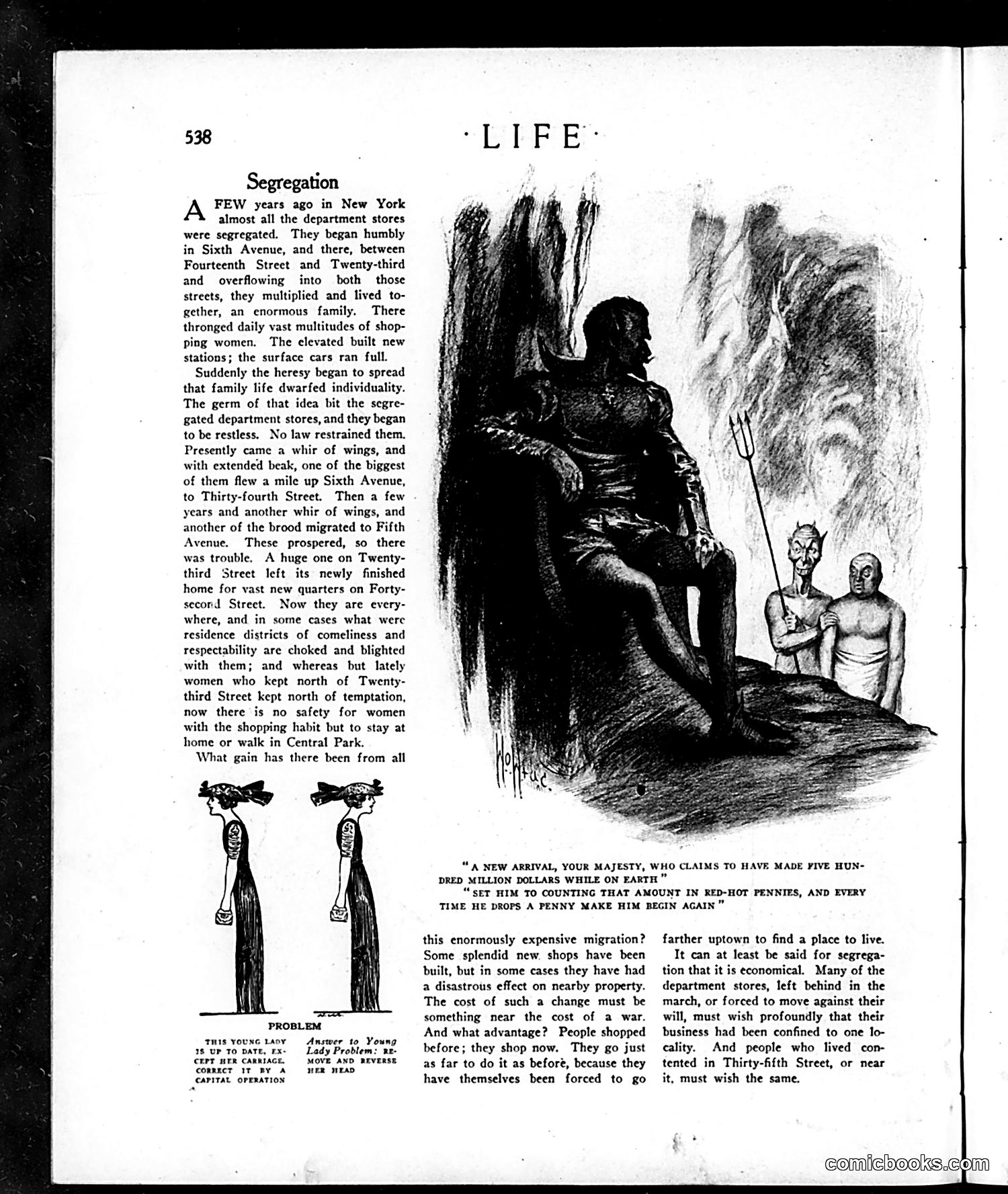
This article critiques the unintended consequences of New York City's residential segregation. The text describes how a wealthy family's arrival in the Sixth Avenue area sparked a migration pattern—other affluent residents followed, forcing working-class residents northward in a domino effect that eventually reaches the Upper West Side and beyond. The accompanying illustration depicts winged figures (appearing to represent wealthy migrants or perhaps symbolic of the idea's spread) displacing poorer residents. The cartoon captioned "A New Arrival" satirizes wealth's corrupting influence through a metaphorical figure literally dropping pennies—suggesting that money (and those who have it) create cycles of displacement and economic inequality that harm entire neighborhoods and force less-affluent residents into increasingly precarious situations.
📄 Transcribed text from this page (OCR, searchable)
Machine-transcribed from the original scan — historical spelling and the odd misread are preserved.
538 Segregation A FEW years ago in New York almost all the department stores were segregated. They began humbly in Sixth Avenue, and there, between Fourteenth Street and Twenty-third and overflowing into both those streets, they multiplied and lived to- gether, an enormous family. There thronged daily vast multitudes of shop- ping women. The elevated built new stations; the surface cars ran full. Suddenly the heresy began to spread that family life dwarfed individuality. The germ of that idea bit the segre- gated department stores, and they began to be restless. No law restrained them. Presently came a whir of wings, and with extended beak, one of the biggest of them flew a mile up Sixth Avenue, to Thirty-fourth Street. Then a few years and another whir of wings, and another of the brood migrated to Fifth Avenue. These prospered, so there was trouble. A huge one on Twenty- third Street left its newly finished home for vast new quarters on Forty- secord Street. Now they are every- where, and in some cases what were residence districts of comeliness and respectability are choked and blighted with them; and whereas but lately women who kept north of Twenty- third Street kept north of temptation, now there is no safety for women with the shopping habit but to stay at home or walk in Central Park. What gain has there been from all PROBLEM. THIS YOUNG LAoY 18 UP TO DATE, EX- CEPT HER CARRIAGE. CORRECT IT BY A CAPITAL OPERATION Answer to Young Lady Problem: nx- MOVE AND REVERSE MER HEAD “ A NEW ARRIVAL, YOUR MAJESTY, WHO CLAIMS TO HAVE MADE FIVE HUN- DRED MILLION DOLLARS WHILE ON EARTH” “SET HIM TO COUNTING THAT AMOUNT IN RED-HOT PENNIES, AND EVERY TIME HE DROPS A PENNY MAKE HIM BEGIN AGAIN” this enormously expensive migration? Some splendid new. shops have been built, but in some cases they have had a disastrous effect on nearby property. The cost of such a change must be something near the cost of a war. And what advantage? People shopped before; they shop now. They go just as far to do it as before, because they have themselves been forced to go farther uptown to find a place to live. It can at least be said for segrega- tion that it is economical. Many of the department stores, left behind in the march, or forced to move against their will, must wish profoundly that their business had been confined to one lo- cality. And people who lived con- tented in Thirty-fifth Street, or near it, must wish the same. comichooks.com