
A complete issue · 40 pages · 1914
Life — January 29, 1914
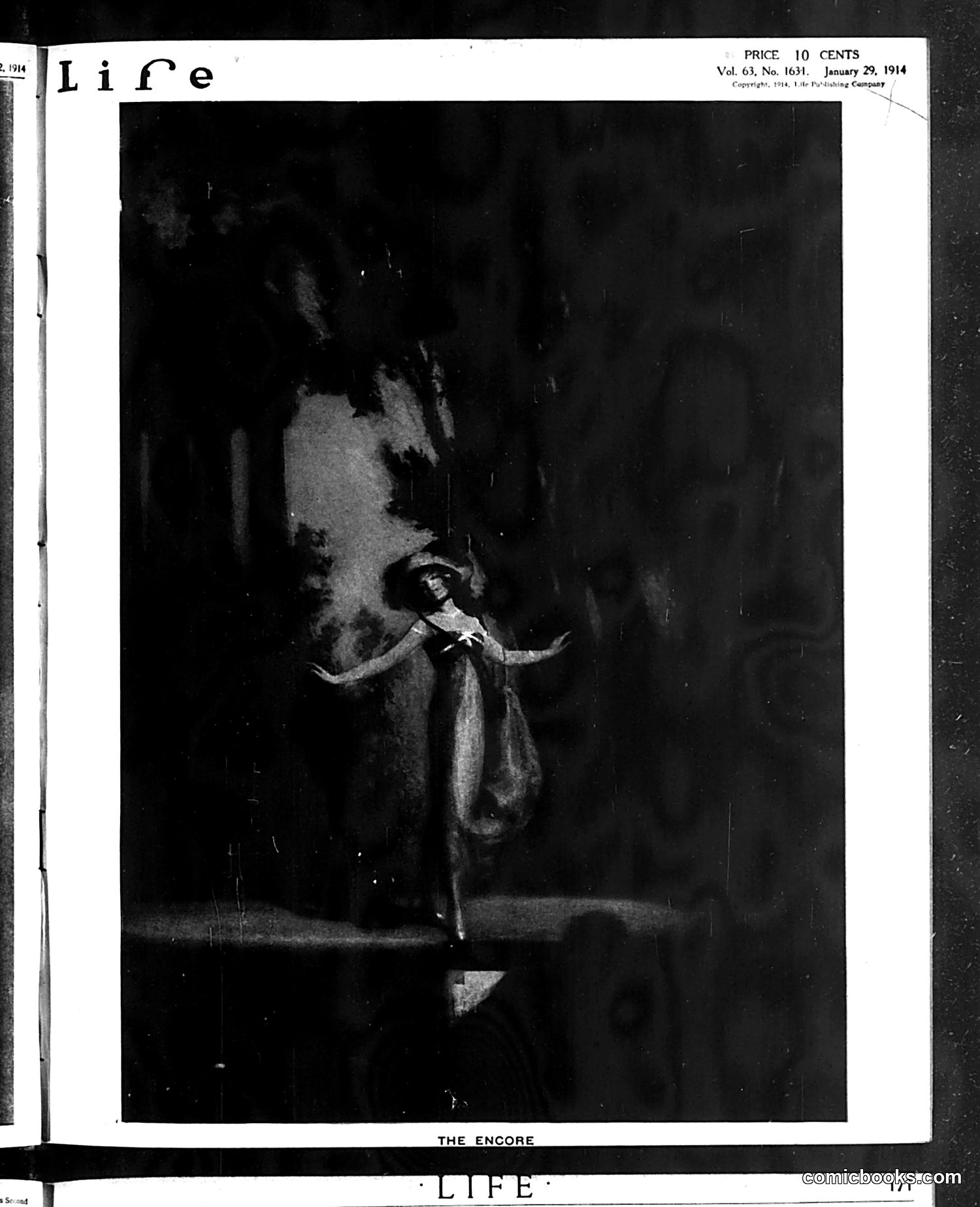
This theatrical image shows a female performer in an elegant gown with arms outstretched on stage, bathed in spotlight against a dark background. The caption "THE ENCORE" suggests a performance context. Without additional text or identifying information visible on this page, I cannot definitively identify which specific performer or theatrical production this depicts. The image appears to be a dramatic photograph or illustration rather than a political cartoon. The theatrical staging and formal presentation suggest this may be commentary on popular entertainment or a notable stage performer of 1914, but the specific satire or social commentary intended remains unclear from the visual alone. Additional context from the magazine's accompanying text would be needed to explain the particular relevance or point of this image.
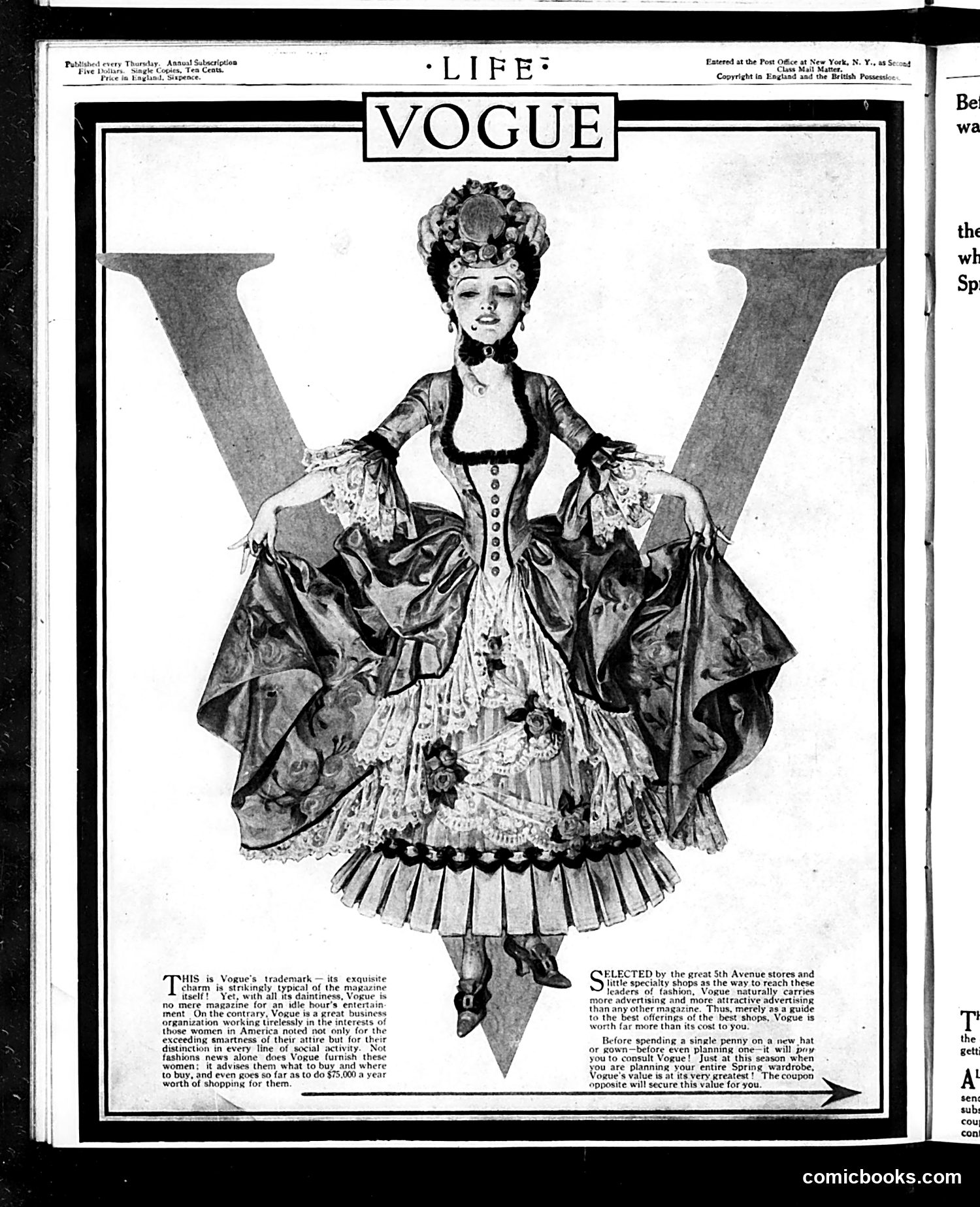
This appears to be primarily a **Vogue fashion advertisement** rather than political satire. The large "V" forms the backdrop for an elegantly dressed woman in elaborate early 20th-century clothing—featuring an ornate hat, fitted bodice, lace details, and a dramatic dark cape or cloak. The accompanying text describes Vogue as a business guide for fashionable women, praising its authority on style and shopping. It mentions that Vogue advises readers on purchasing decisions and recommends particular Fifth Avenue stores and specialty shops. This is **commercial advertising content**, not political commentary. The "satire" in Life magazine appears elsewhere; this page promotes Vogue's fashion authority to potential subscribers, using the striking illustration to showcase aspirational style and elegance for wealthy women readers.
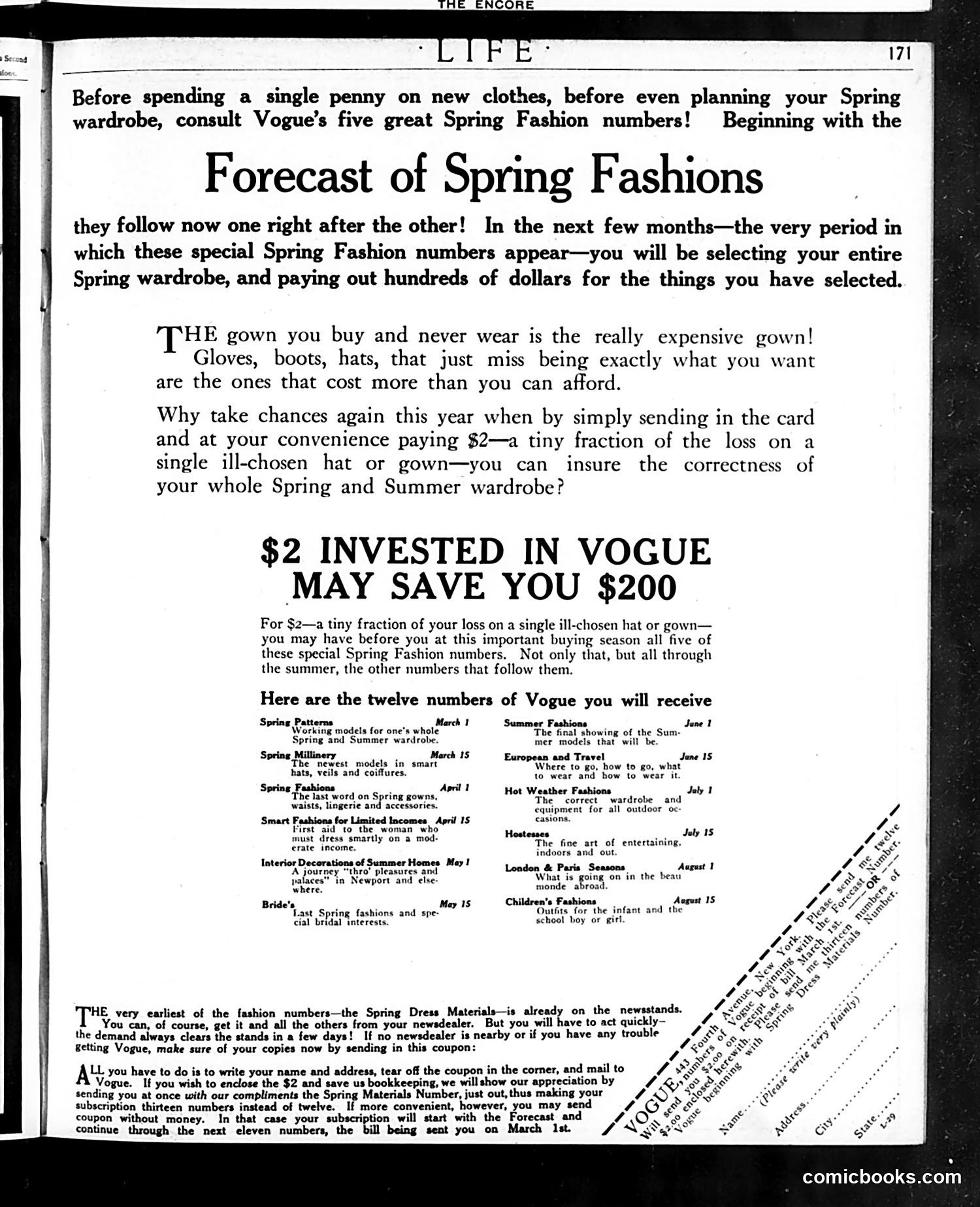
This page is **not a political cartoon**, but rather an **advertisement for Vogue magazine subscriptions**, published in Life magazine (page 171). The ad promotes Vogue's upcoming "Spring Fashion" issues, listing twelve special issues from March through August covering topics like spring dress materials, millinery, bridal fashions, and children's clothing. The sales pitch is straightforward: for a $2 subscription investment, readers can access fashion guidance that will allegedly save them $200 by helping them make informed clothing purchases and avoid costly mistakes. The "coupon" shown in the image's corner was the subscription mechanism—readers would tear it out, include $2, and mail it to Vogue to begin their subscription. This reflects early 20th-century magazine marketing practices, not satire.
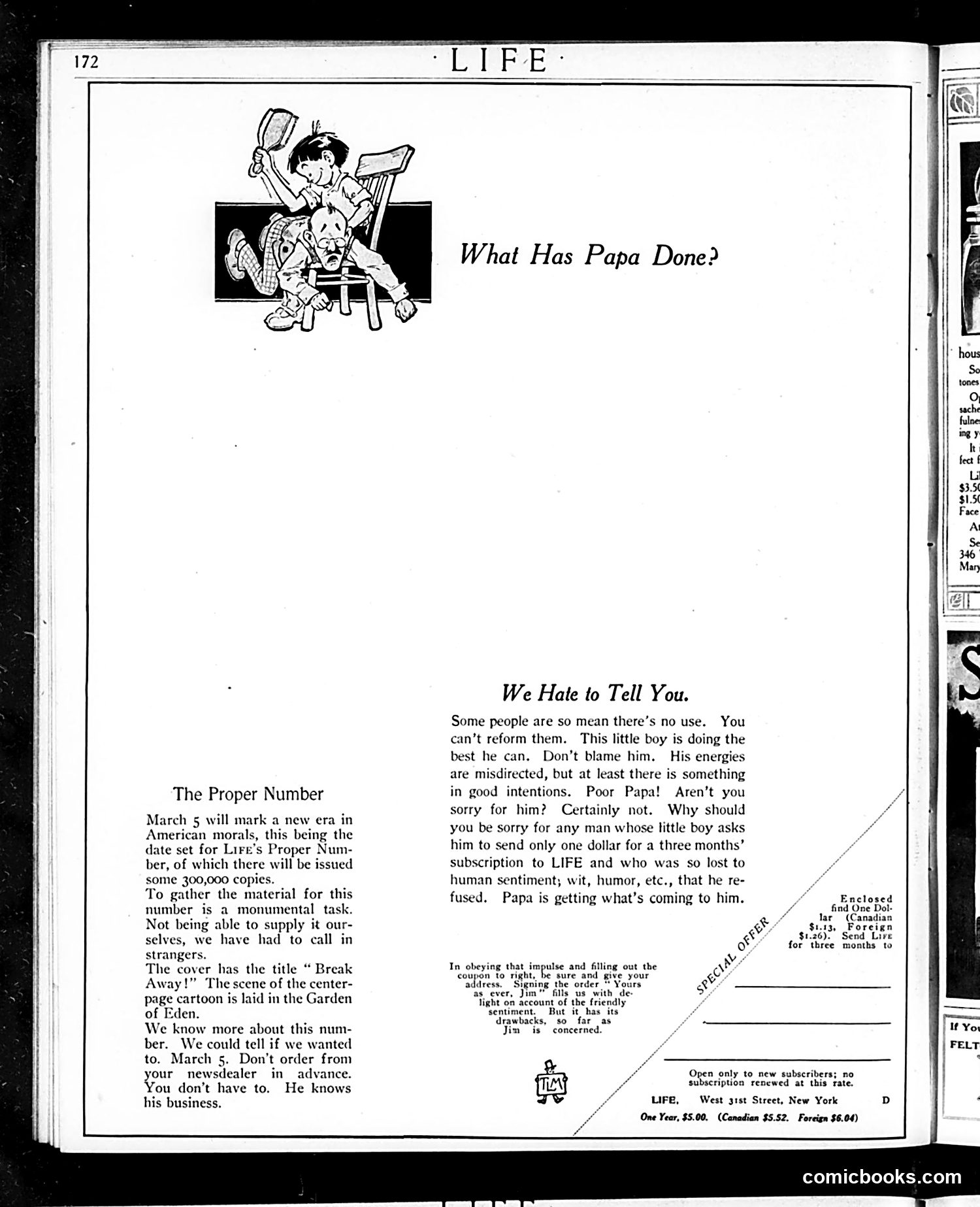
**Main Cartoon:** "What Has Papa Done?" depicts a child spanking an adult man in a chair—a role reversal suggesting the man has misbehaved. The cartoon accompanies text titled "We Hate to Tell You," which defends a misbehaving boy by criticizing his father ("Papa"), suggesting the father bears responsibility for the child's poor behavior. **Context:** This appears to be satirical social commentary on parental responsibility and discipline, popular themes in early 20th-century American humor. The joke inverts expectations: rather than children being punished, the parent is portrayed as deserving punishment. **Additional Content:** The page includes "The Proper Number," announcing Life's Proper Number issue (March 5) with 20,000 copies and subscription information. The satire targets parental accountability rather than specific political figures.
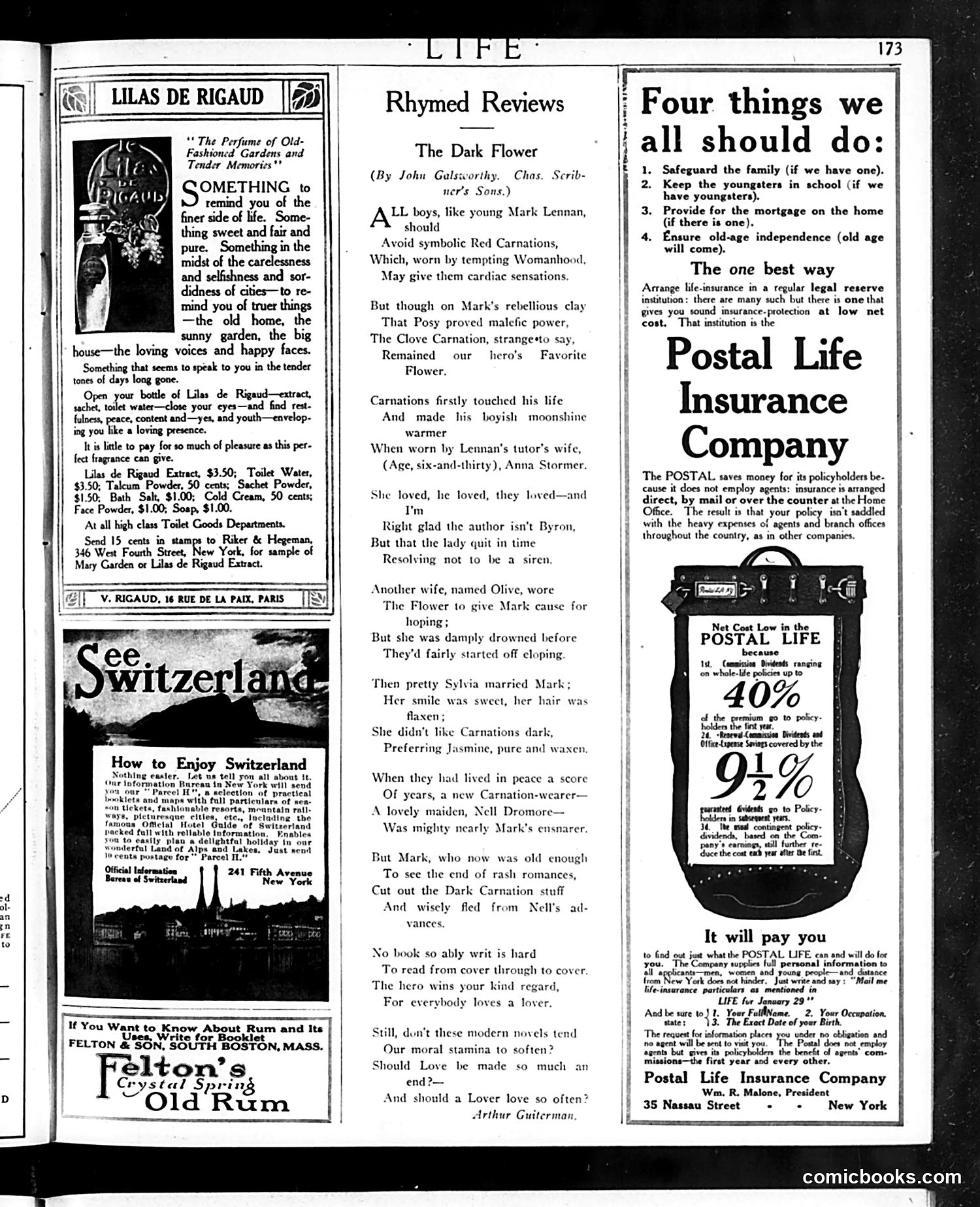
This page contains **no political cartoons**. Instead, it features: 1. **Left column**: Advertisement for Lilas de Rigaud perfume, emphasizing nostalgic scents ("the old house, the sunny garden") 2. **Center**: "The Dark Flower," a poem by John Galsworthy about Mark Lennan and various women who gave him carnations—a romantic narrative about love and relationships 3. **Right column**: Advertisement for Postal Life Insurance Company, emphasizing low cost (40% and 9½% rates mentioned) and broad coverage The page is primarily **commercial/advertising content** with literary material, typical of Life magazine's format mixing editorial content with paid advertisements. There is no satirical commentary or political messaging present.
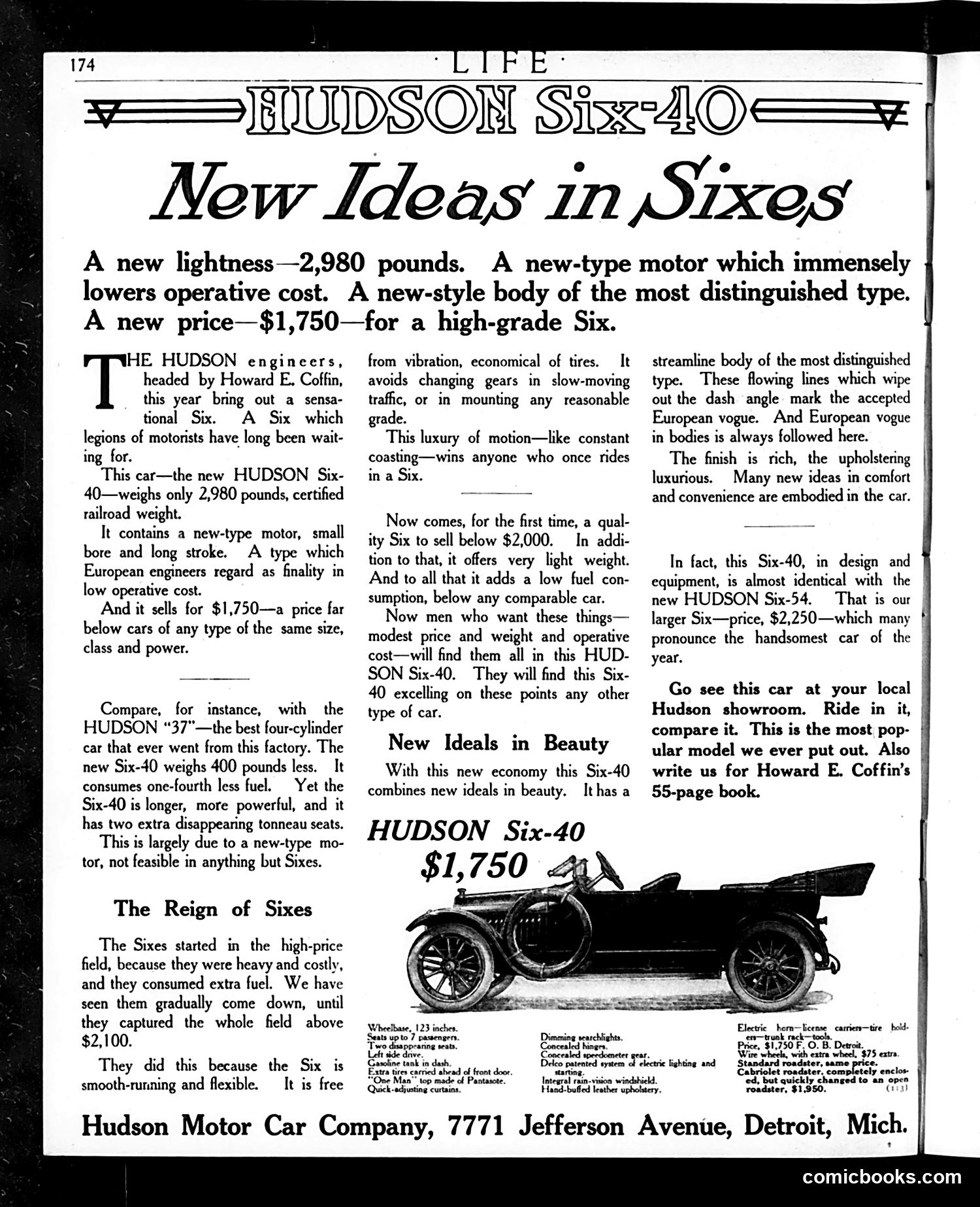
This is not a political cartoon or satire page—it's a **straightforward automobile advertisement** for the Hudson Six-40, published in *Life* magazine (page 174). The content promotes Hudson Motor Car Company's new economy-priced six-cylinder automobile at $1,750. Key selling points include: lightweight construction (2,980 pounds), fuel efficiency, lower operating costs, and distinguished European-influenced styling. The ad compares it favorably to Hudson's larger Six-54 model and their previous "37" model. The only image is a technical illustration of the car itself with specifications listed below. This appears to be a paid advertisement rather than editorial satire or commentary. *Life* magazine frequently featured full-page car ads during the 1920s automotive boom.
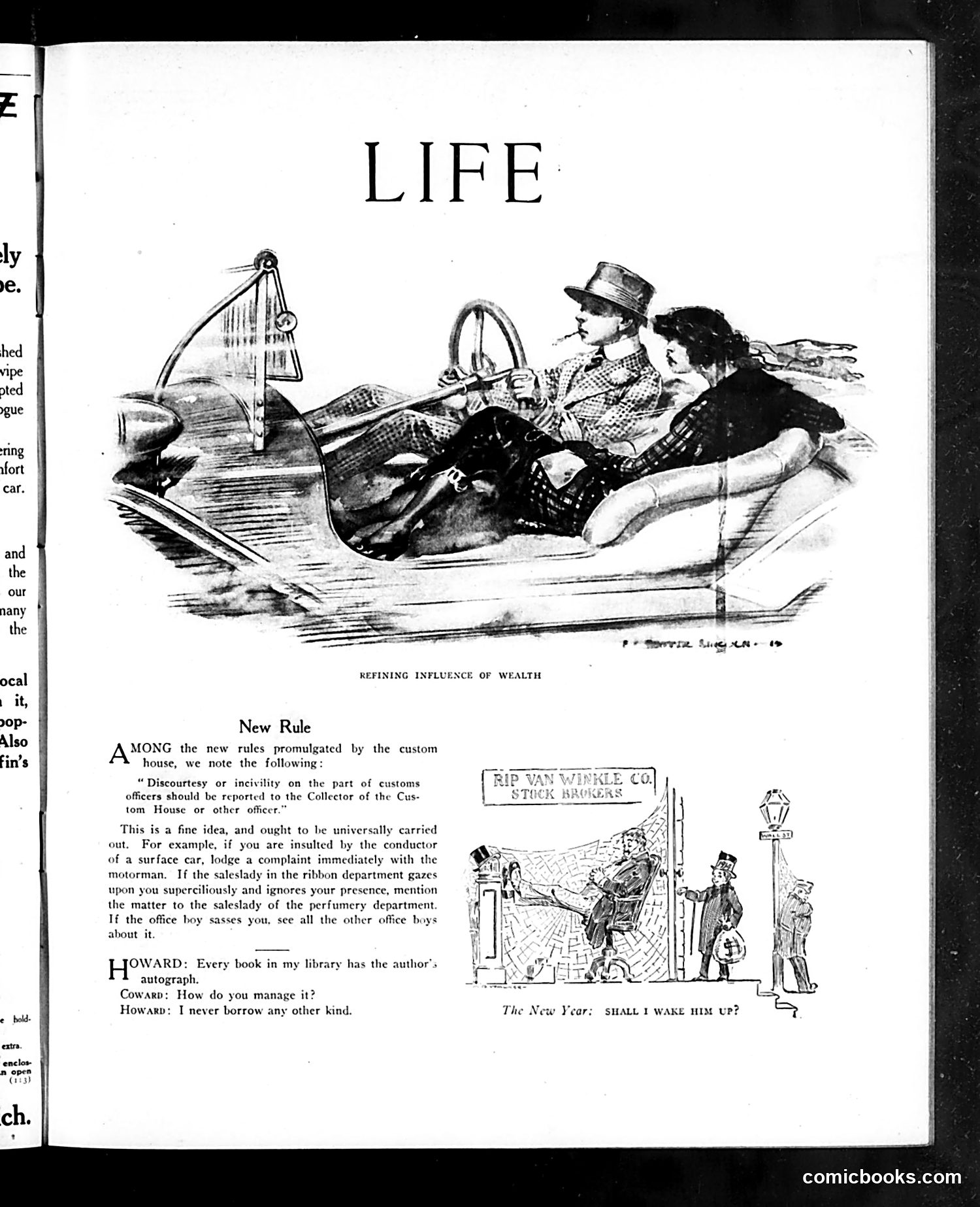
This page from *Life* magazine contains satirical content about wealth and social etiquette. The top illustration, captioned "REFINING INFLUENCE OF WEALTH," shows a couple in a small boat—appearing to depict newly wealthy individuals enjoying leisure activities associated with the upper class. Below is a "New Rule" section mocking customs house regulations and proper behavior among the wealthy. It satirizes petty complaints about rudeness from customs officials. The dialogue between Howard and Coward jokes about library etiquette: Howard boasts that every book in his library bears the author's autograph. When asked how he manages this, he reveals he "never borrow[s] any other kind"—meaning he steals signed copies, turning his pretension into a confession of theft. The rightmost cartoon appears to be a separate seasonal joke about New Year's resolutions, though details are unclear in reproduction.
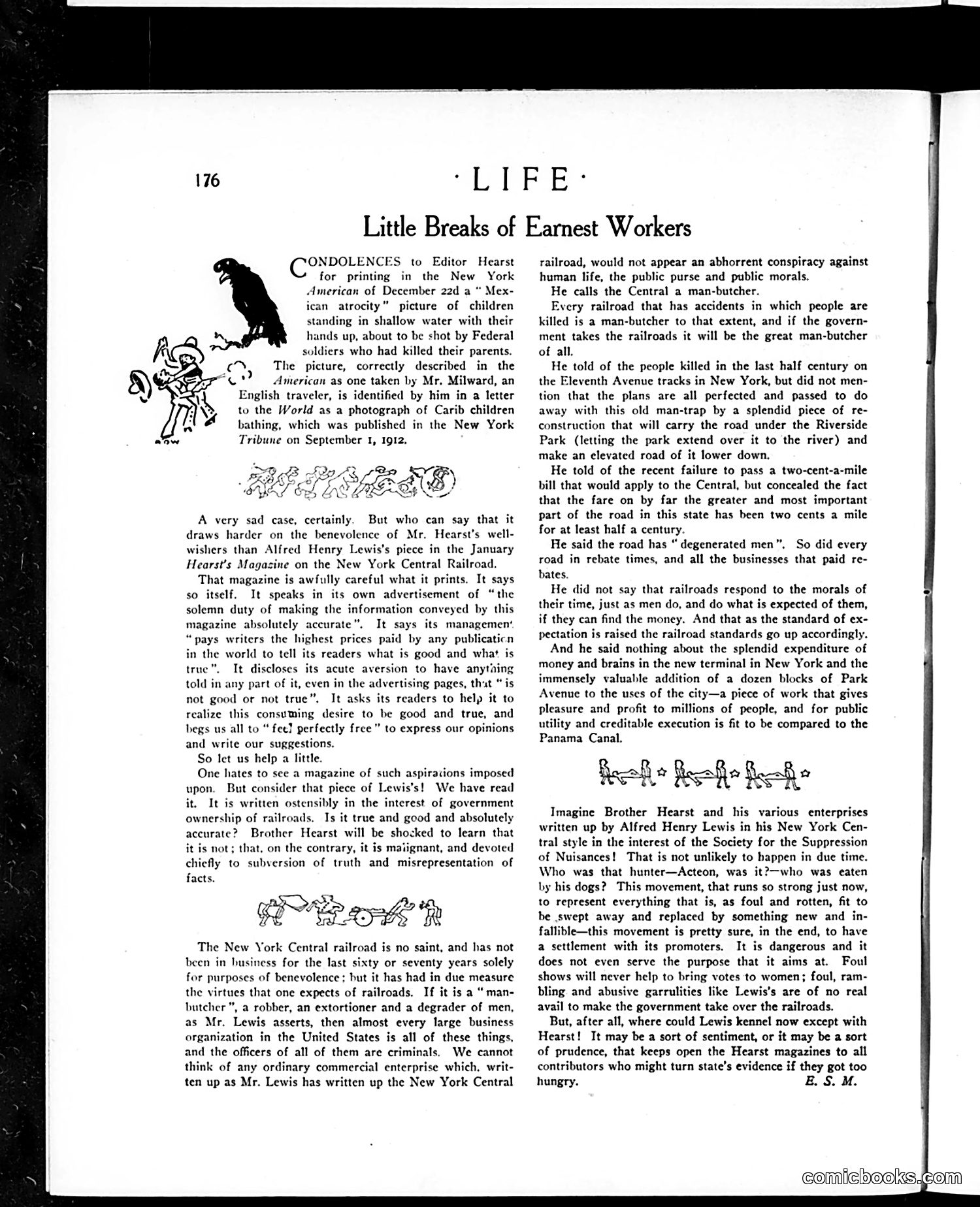
This page contains a letter to the editor criticizing **William Randolph Hearst** and his magazine's coverage of the New York Central Railroad. The cartoons (simple line drawings of figures) illustrate the letter's argument that Hearst's publications misrepresent facts to serve corporate interests—specifically, they're accused of falsely portraying the railroad as a "man-butcher" (responsible for deaths) while concealing its safety improvements. The letter writer argues that Hearst's "accuracy" claims are hypocritical, noting his publications suppress unfavorable railroad facts (like reduced accident rates and low ticket costs) while emphasizing sensational stories. The cartoons satirize how Hearst's journalistic practices manipulate public opinion rather than report truth, presenting a critique of media dishonesty and corporate bias in early 20th-century American journalism.
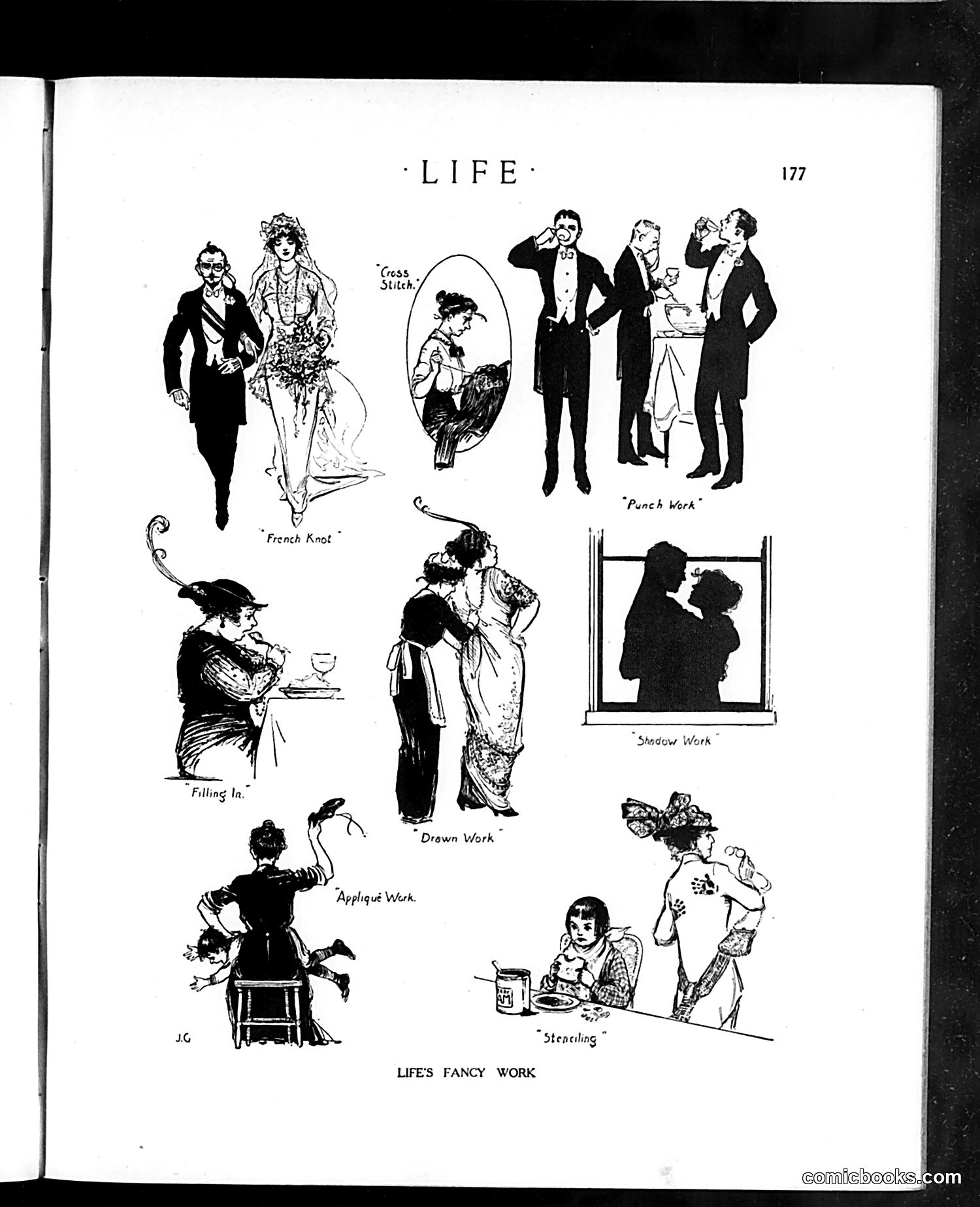
This page from *Life* magazine satirizes needlework and embroidery techniques popular among upper-class women. Each illustration is labeled with a different fancy-work method: "Cross Stitch," "French Knot," "Punch Work," "Shadow Work," "Filling In," "Drawn Work," "Appliqué Work," and "Stenciling." The humor lies in visual puns—each technique's name describes both the needlework *and* what the illustrated figures are actually doing. For example, "Punch Work" shows men literally punching each other; "Shadow Work" depicts a silhouetted couple kissing at a window; "Drawn Work" shows a woman being pulled by a man's grip. The satire gently mocks the genteel world of domestic crafts by suggesting these delicate feminine pursuits have unexpectedly crude or romantic "real-world" equivalents.
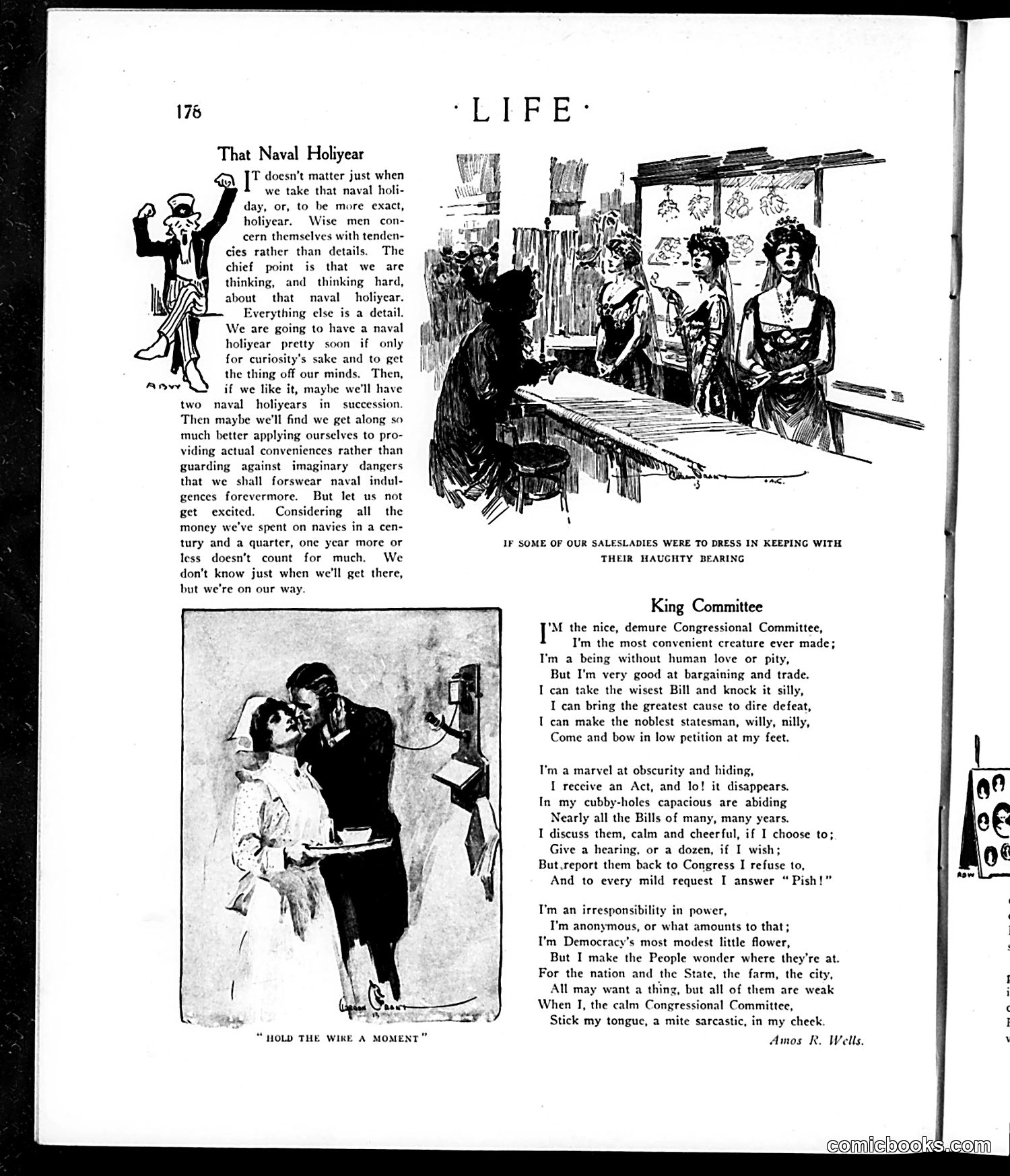
This page contains political satire about naval spending and Congressional committees. The main poem "King Committee" (attributed to Amos K. Wells) mocks a Congressional Committee personified as an arrogant, obstructionist entity. The Committee brags about its power to block bills, hide legislation in "cubby-holes," and frustrate the democratic process through bureaucratic obstruction and sarcasm ("Pah!"). The accompanying article "That Naval Holiyear" discusses prolonged naval appropriations debates, suggesting the Committee's delays waste taxpayer money while preventing practical improvements. The cartoon illustrations show casual domestic scenes, contrasting with the serious political critique—likely emphasizing how Congressional obstruction affects ordinary citizens. The satire targets legislative gridlock and committee power as obstacles to governance.
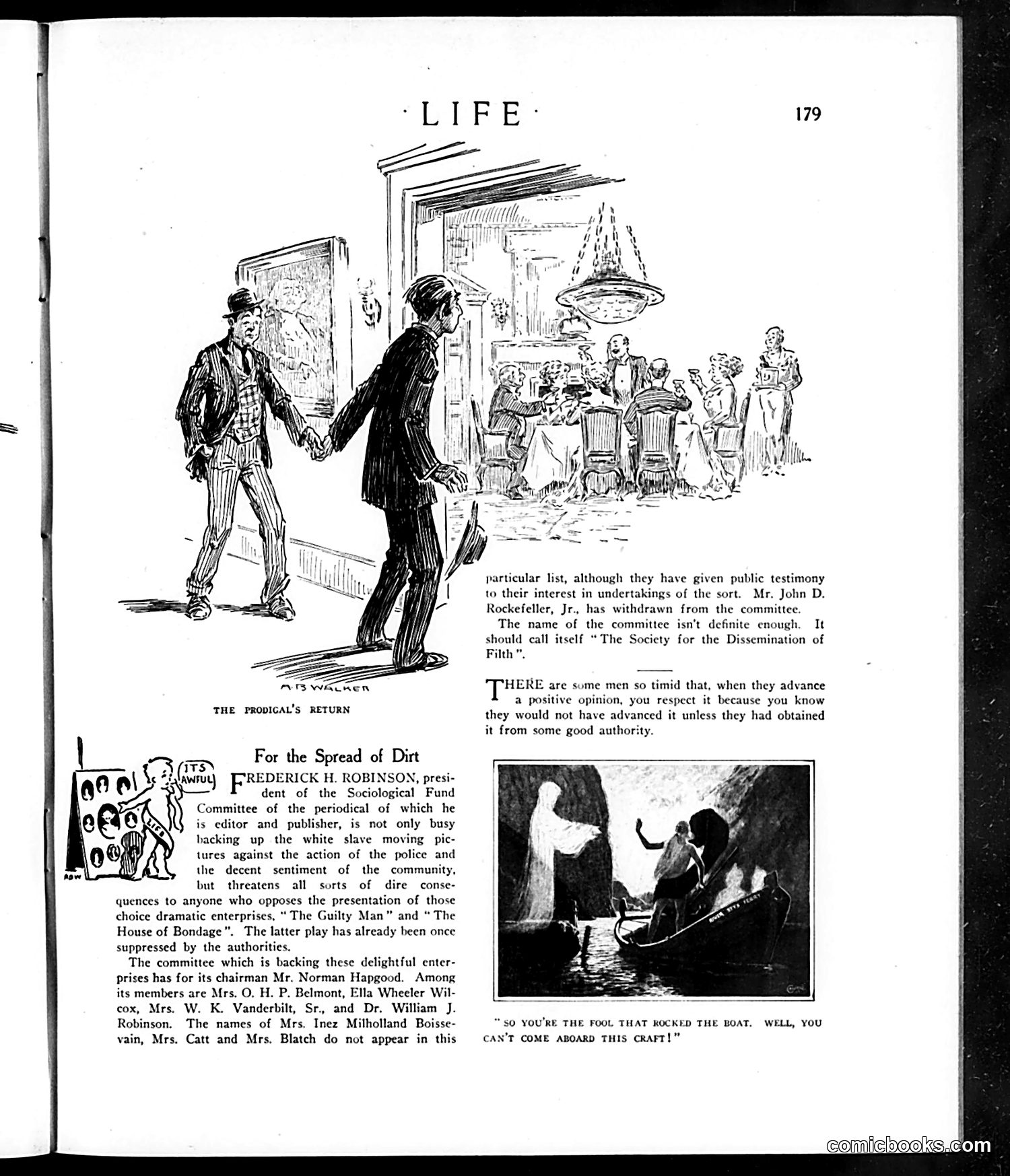
**Main Cartoon ("The Prodigal's Return"):** Shows two men shaking hands at a doorway while a crowd gathers inside. The caption references a "prodigal's return," suggesting someone unwelcome or controversial is being brought back into a group or organization. **"For the Spread of Dirt" Article:** This satirizes Frederick H. Robinson, president of the Sociological Fund, who leads a committee backing theatrical productions like "The Gully Man" and "The House of Bondage"—plays apparently suppressed by authorities. The satire mocks Robinson and his committee members for pushing morally questionable dramatic enterprises under the guise of sociological interest, despite public opposition and police action. The cartoon and article together critique using intellectual pretense to justify spreading salacious content.
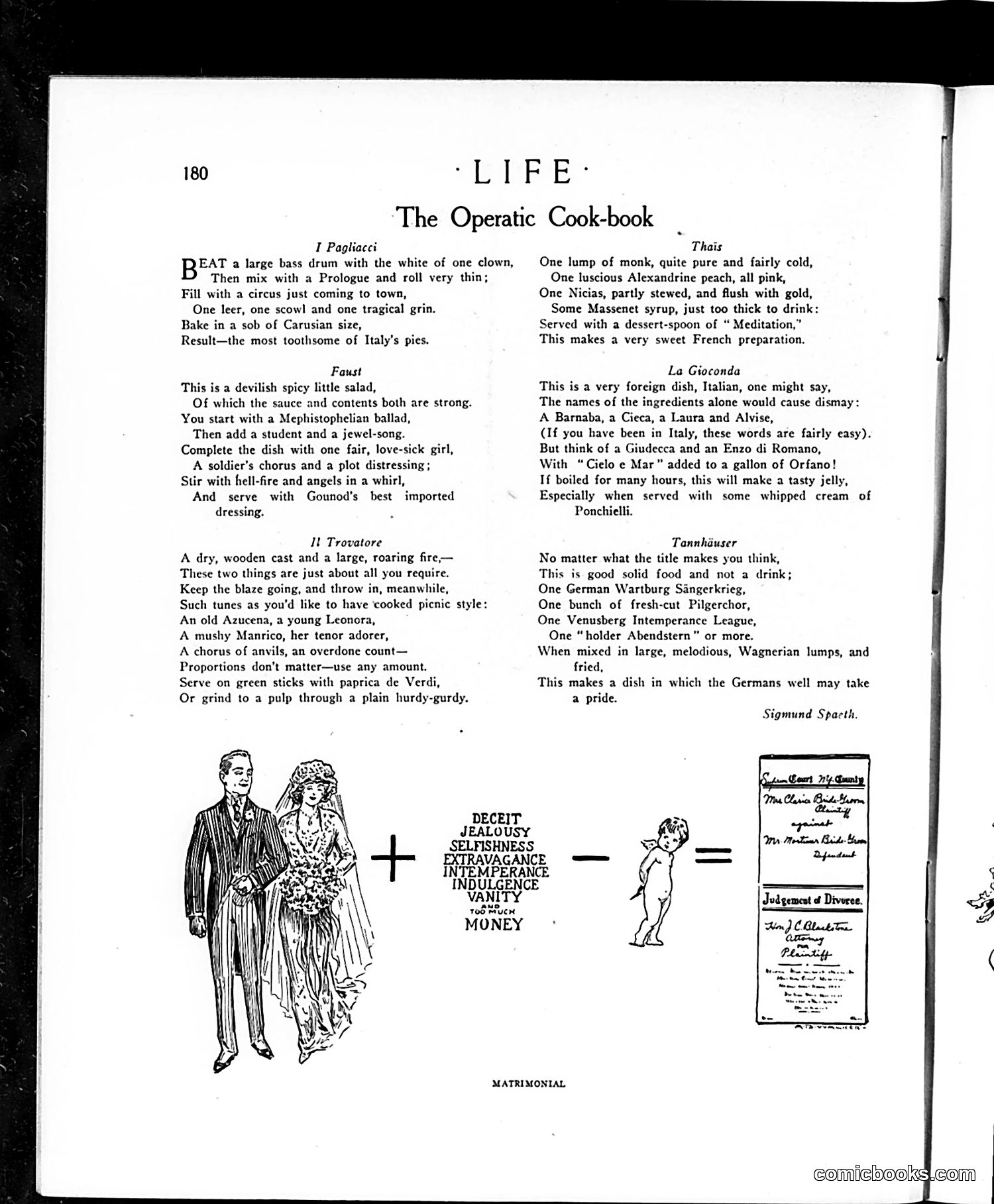
This page satirizes operatic culture by presenting mock recipes named after famous operas (*Pagliacci*, *Faust*, *Il Trovatore*, *Thais*, *La Gioconda*, *Tannhäuser*). Each "recipe" humorously mimics the plot or themes of its opera—for example, *Pagliacci* mentions a "clown," while *Faust* references a "Mephistophelian ballad" and a "love-sick girl." The lower cartoon uses a mathematical equation format to satirize marriage: a well-dressed couple plus vices like "deceit, jealousy, selfishness" minus a cherub (cupid/love) equals a legal document (divorce decree). This critiques matrimony as inevitably ending in dissolution when vice overcomes romance—a commentary on marriage's fragility in early 20th-century society. The satire is genteel but pointed.
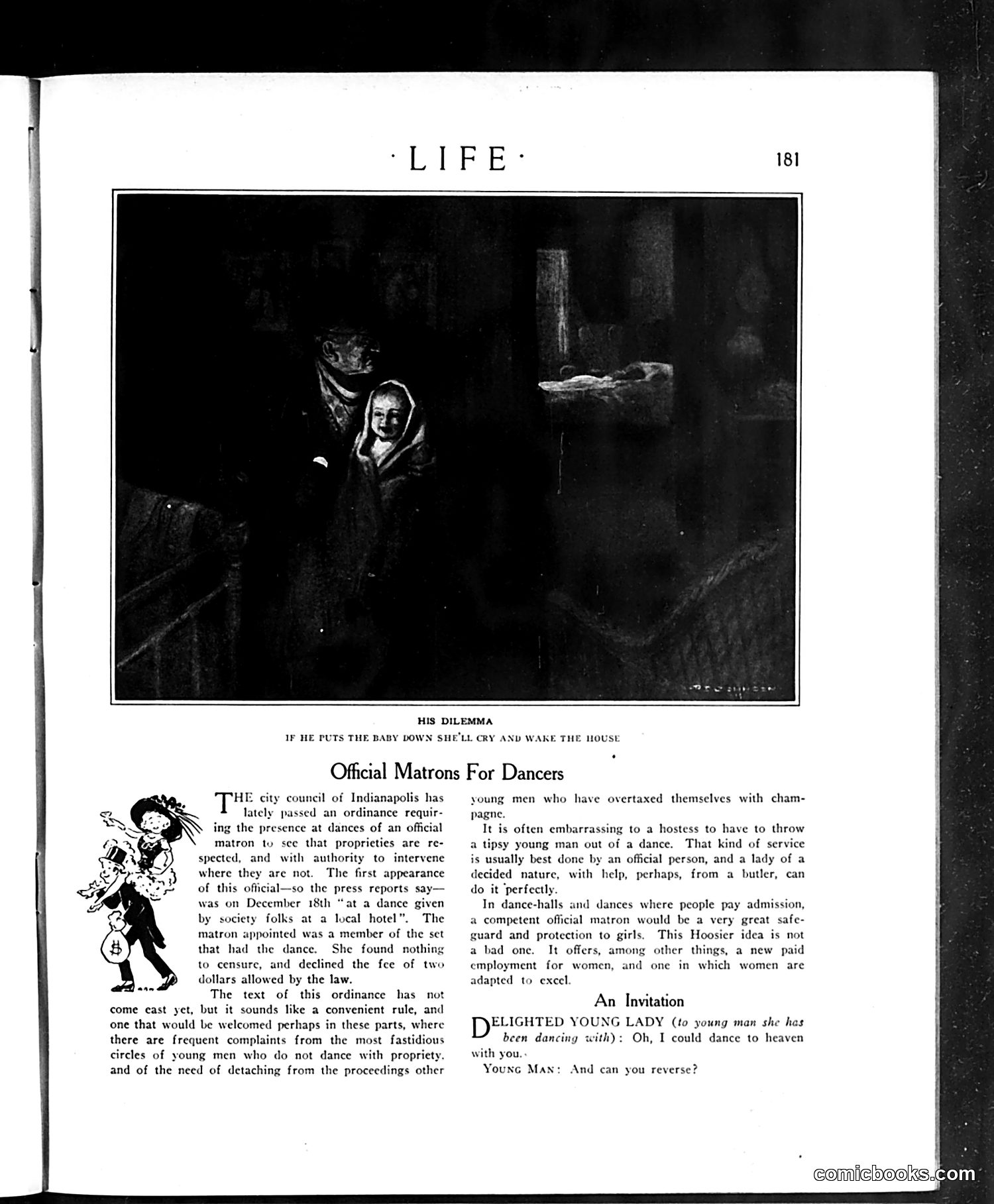
This Life magazine page (181) contains a photograph titled "His Dilemma" showing a man holding a baby in a dark interior, with the caption "If he puts the baby down she'll cry and wake the house." Below is an article titled "Official Matrons For Dancers" discussing Indianapolis's new city ordinance requiring official matrons at dances. The piece explains these matrons—typically older women—would supervise propriety and manage rowdy young men, particularly intoxicated ones who needed removing without causing disturbance. The humor lies in the gap between the serious civic solution and practical reality: just as the man in the photograph faces an impossible situation (the baby will cry either way), the ordinance's underlying problem—unruly young men at dances—may be unsolvable through mere supervision. The satire mocks well-intentioned bureaucratic solutions to social disorder.
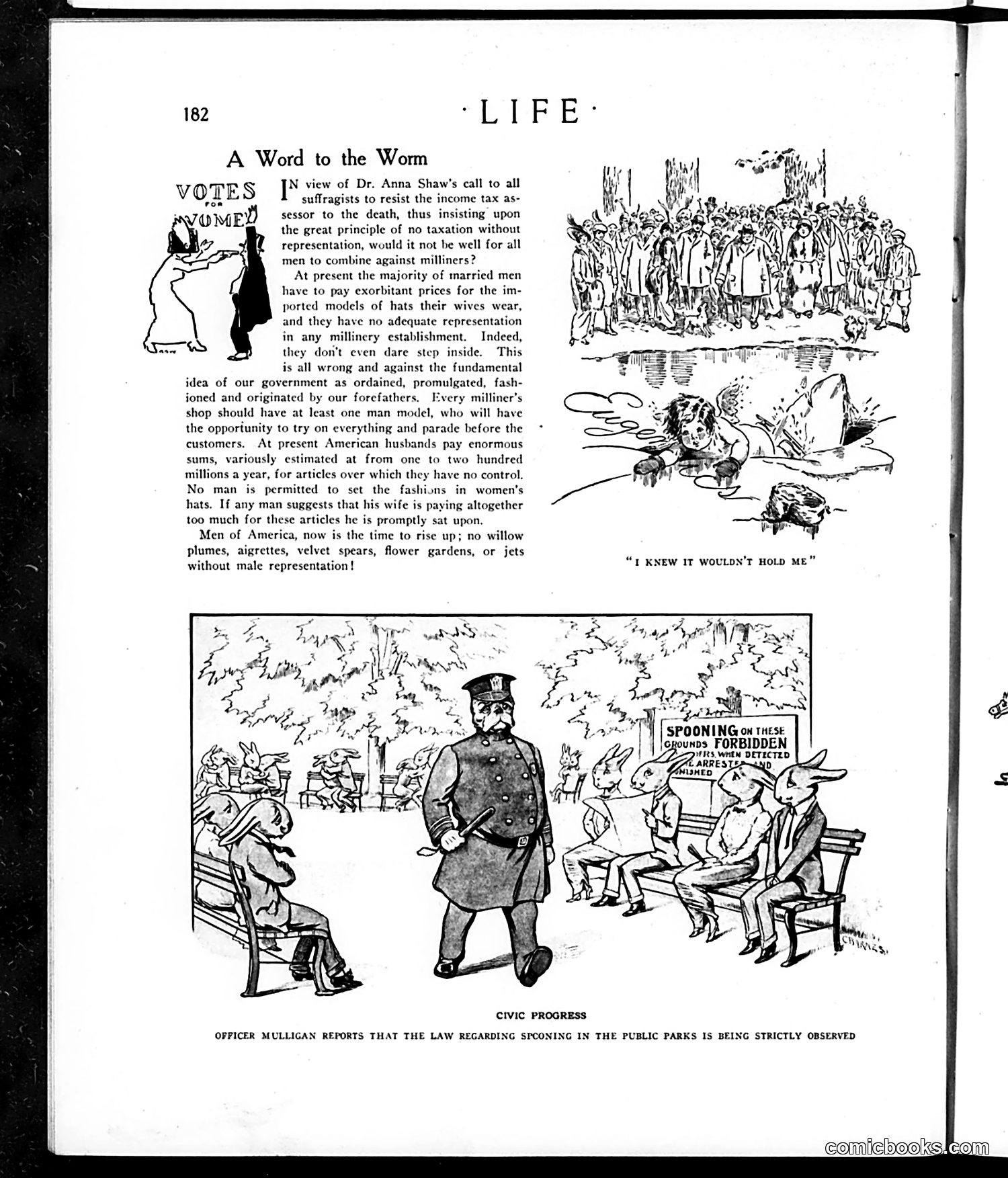
This page from *Life* magazine satirizes two distinct issues: **Top section ("A Word to the Worm"):** Dr. Anna Shaw calls on suffragists to resist an income tax, arguing men should bear costs of their wives' millinery expenses. The satire mocks the argument that women's hat purchases justify denying them taxation representation—applying the "no taxation without representation" principle to challenge this logic. **Bottom cartoon ("Civic Progress"):** Officer Mulligan enforces public park "spooning" laws (laws against public displays of affection). The humor targets over-regulation and enforcement of morality laws, depicting rabbits being arrested for innocent behavior, suggesting such laws are absurdly excessive. Both pieces use satire to critique gender politics and excessive legal restrictions of the early 20th century.
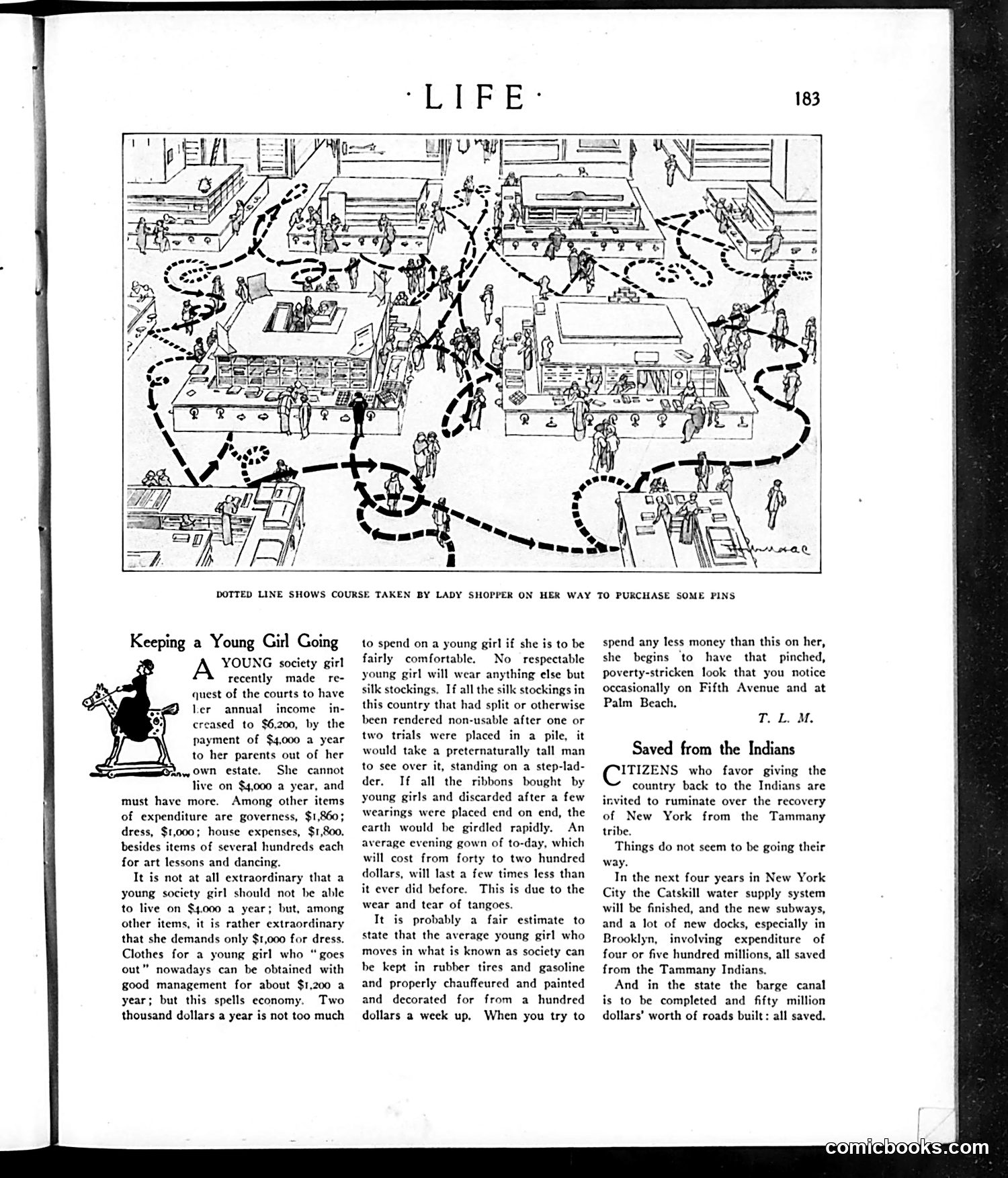
This page contains two satirical pieces from *Life* magazine: **"Keeping a Young Girl Going"** (top): The diagram shows a lady shopper's unnecessarily convoluted route to buy pins—mocking the wasteful, inefficient spending habits of wealthy society women. The accompanying article sarcastically defends why $1,000/year for clothing is insufficient for a debutante, citing expenses like silk stockings that tear easily and evening gowns destroyed by the "tango" dance craze. The satire critiques both wealthy women's frivolous consumption and the absurdity of a society girl petitioning courts for increased allowance. **"Saved from the Indians"** (bottom): This references Tammany Hall, the corrupt Democratic political machine controlling New York City. The metaphor equates Tammany's mismanagement to Native American governance, sarcastically celebrating recent infrastructure improvements (water systems, subways, roads) as money "saved" from Tammany's theft. The piece mocks those advocating returning society to pre-industrial conditions while celebrating modern urban progress ironically wrested from political corruption.
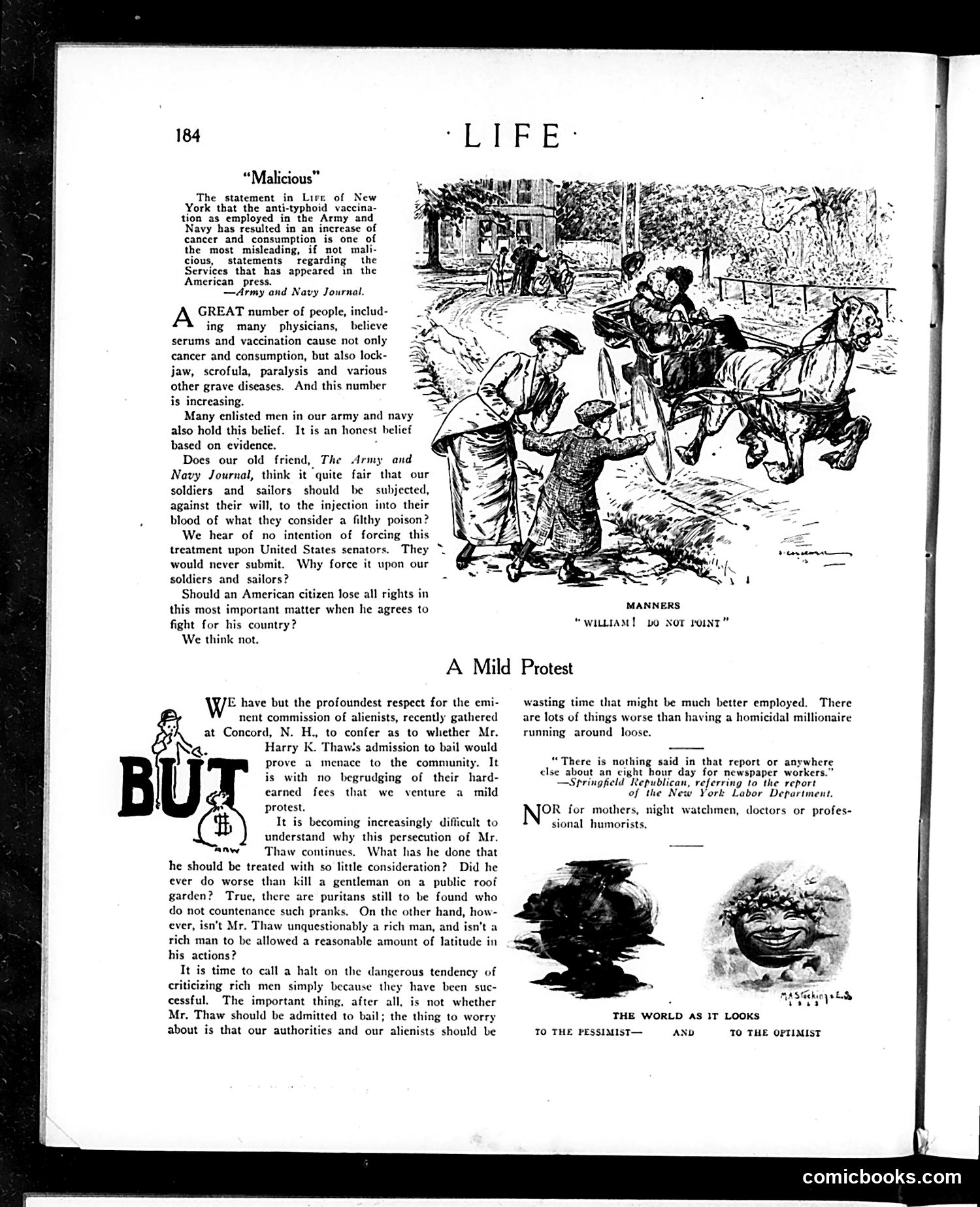
This page satirizes two distinct controversies through opposing viewpoints: **Top Section ("Malicious"):** Critiques anti-vaccination sentiment in the military. Life defends mandatory troop vaccinations against claims they cause cancer and disease, arguing soldiers shouldn't lose constitutional rights merely by enlisting—yet sarcastically notes senators aren't forced to undergo the same treatment, exposing the hypocrisy of imposing medical procedures on enlisted men without consent. **Bottom Section ("A Mild Protest"):** Mocks wealthy industrialist Harry K. Thaw through heavy irony. Thaw had infamously killed architect Stanford White on a rooftop in 1906; Life ridicules the legal system's leniency toward wealthy defendants, suggesting rich men deserve "reasonable latitude" to commit crimes. The sarcasm attacks class privilege: authorities fret over whether a "homicidal millionaire" should be released while ignoring genuine labor concerns (referenced in the New York Labor Department quote about workers' hours). Both sections target hypocrisy: forced medical treatment for the powerless versus freedom for the powerful; and legal indulgence toward the wealthy while dismissing workers' legitimate grievances.
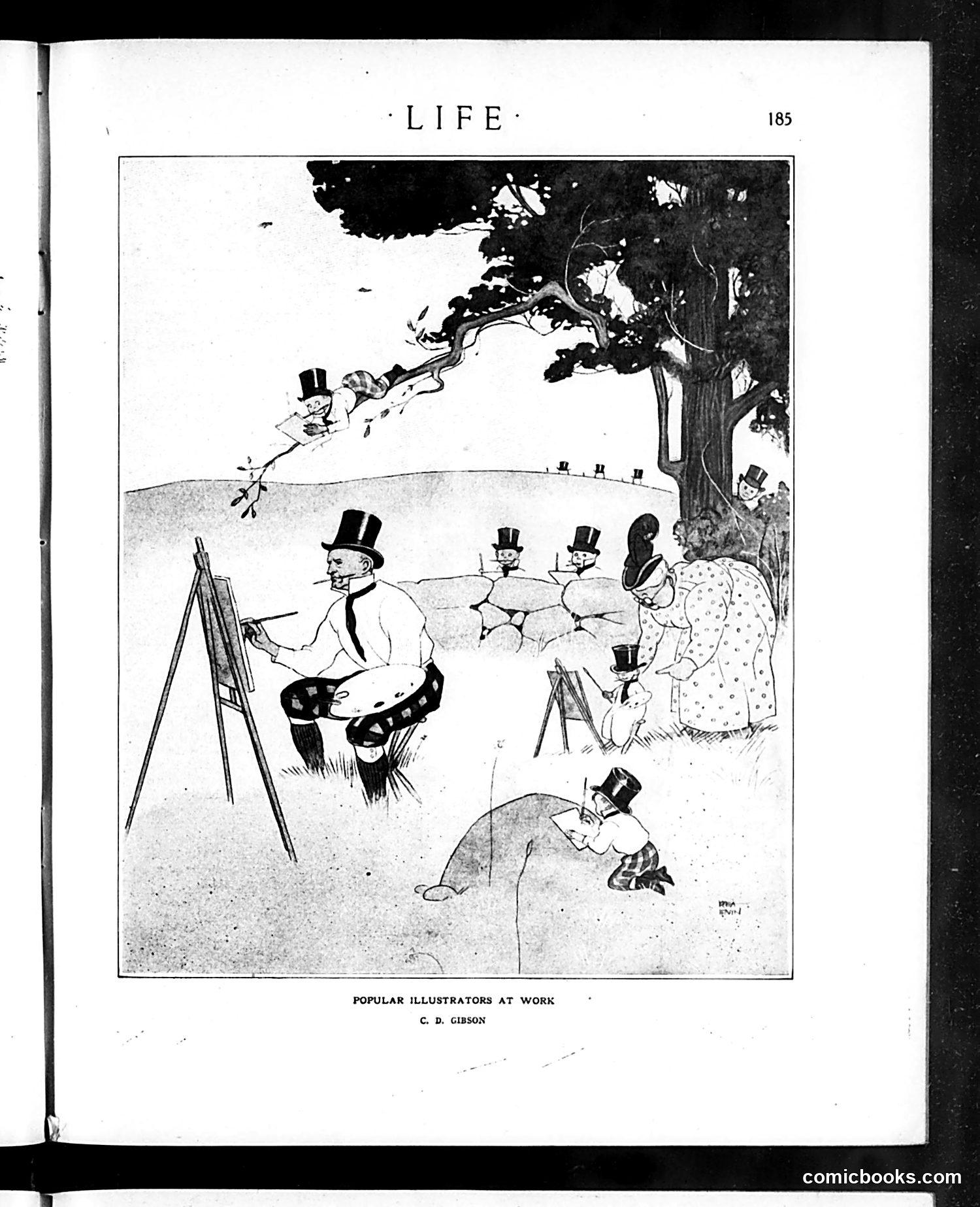
This is an illustration by C.D. Gibson titled "Popular Illustrators at Work." The cartoon depicts several gentlemen in top hats engaged in artistic pursuits outdoors. One sketches at an easel while others observe or work nearby. A woman in a polka-dot dress also participates in the scene. The satire appears to mock the pretensions of Gilded Age illustrators and artists—showing them dressed formally in top hats even while working in a pastoral setting, suggesting the affectation and self-importance of the artistic class. Gibson, himself a celebrated illustrator famous for depicting high society, likely intended this as gentle self-mockery of his profession's pomposity. The juxtaposition of refined formal dress with outdoor creative labor creates the humorous effect.
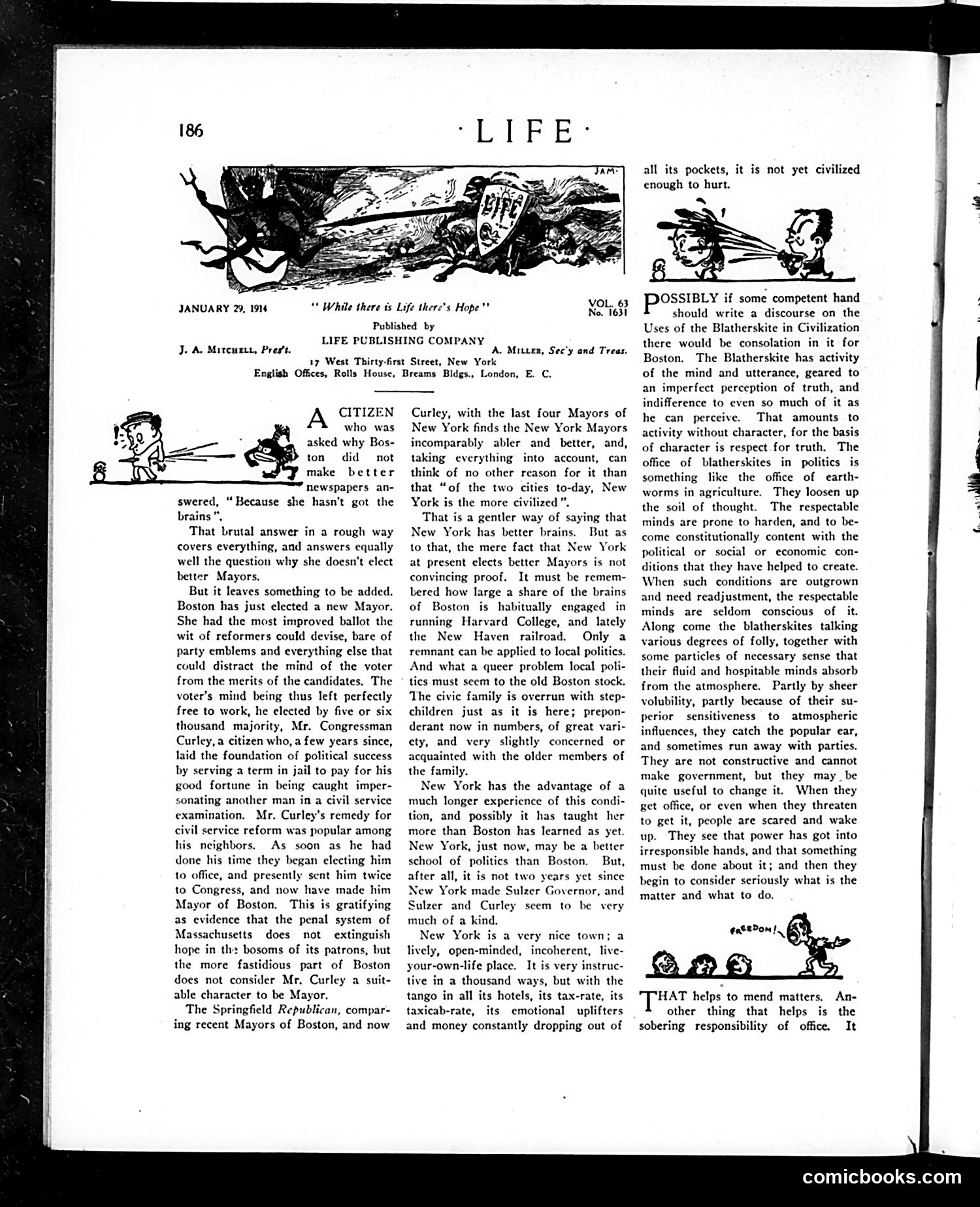
This January 1914 *Life* magazine article satirizes Boston's recent mayoral election of James Michael Curley by comparing it unfavorably to New York's leadership. **The Target:** Curley, a Congressman who had previously served jail time for impersonating someone during a civil service exam—yet was elected mayor anyway by a large majority. **The Joke:** The article argues Boston lacks "brains" because voters elected such an unsuitable candidate despite a reformed ballot designed to let voters judge candidates purely on merit. The satire suggests that removing partisan distractions merely exposed Boston voters' poor judgment. **The Comparison:** *Life* notes that New York's recent mayors were superior, though it snidely adds that New York isn't truly "civilized" either—citing Governor Sulzer (implying similar corruption) and New York's frivolous culture (tango dancing, high taxes, emotional excess). **"Blatherskite" Reference:** The right-column text defines a "blatherskite" as someone with activity and utterance but imperfect truth-perception—clearly describing both Curley and similar politicians. The satire is biting social commentary on American urban politics and voter competence.
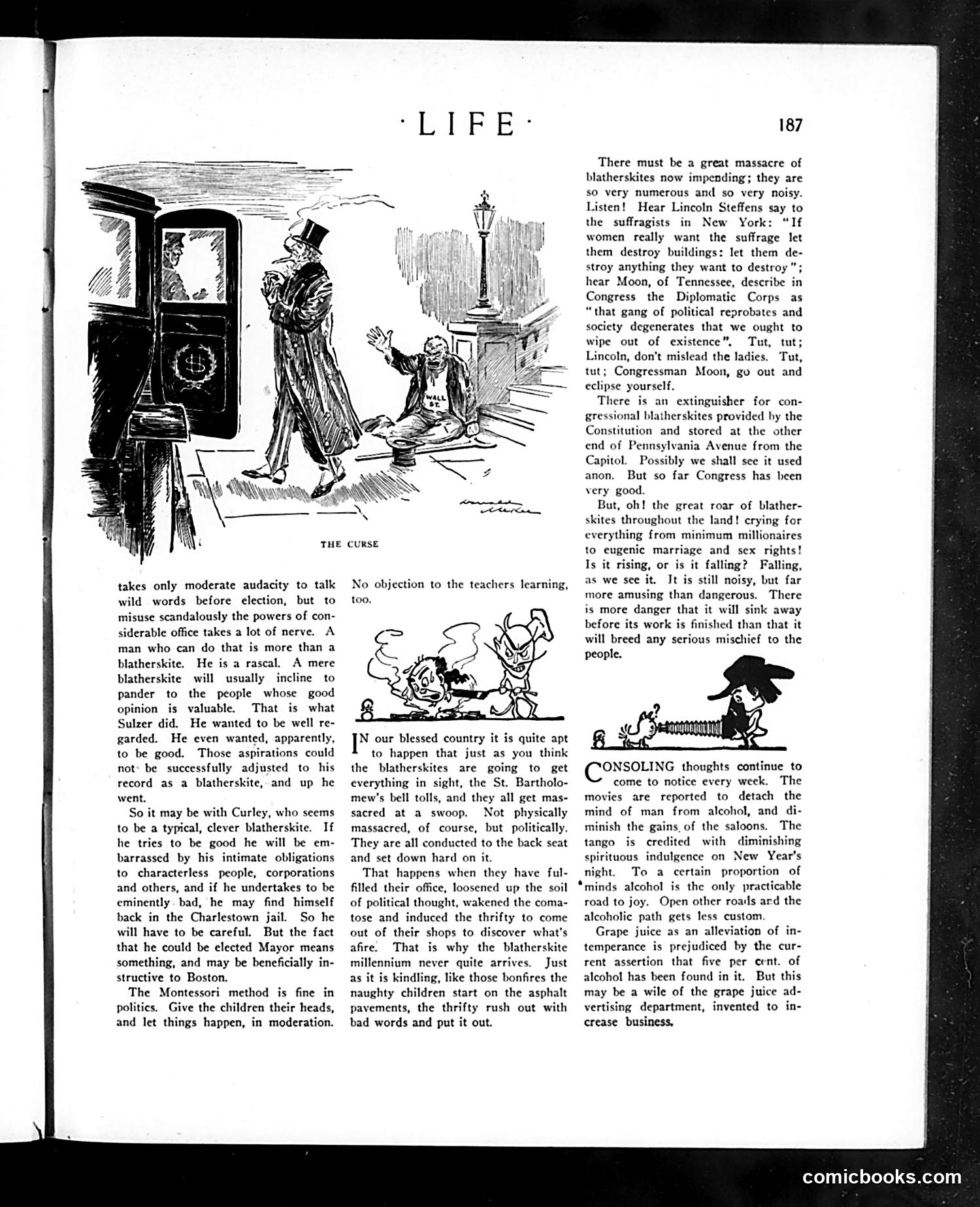
This page satirizes American political rabble-rousers ("blatherskites") of the early 1910s. The cartoon depicts one such figure being confronted, likely illustrating the article's main argument. The text references specific figures: Governor **Sulzer** (impeached for corruption), Boston politician **Curley** (later a notorious mayor), muckraker **Lincoln Steffens** (advocating militant suffragism), and Congressman **Moon of Tennessee** (criticizing diplomats). The satire's core message: these inflammatory speakers temporarily excite public opinion, but ultimately accomplish little before being politically "massacred" and forgotten. The writer suggests this cycle—where demagogues "loosen the soil of political thought" then fade—actually serves democracy by briefly energizing citizens before order reasserts itself. The piece treats radical rhetoric (women destroying property for suffrage, congressional grandstanding) with bemused condescension, viewing such agitation as ultimately toothless noise rather than genuine threat.
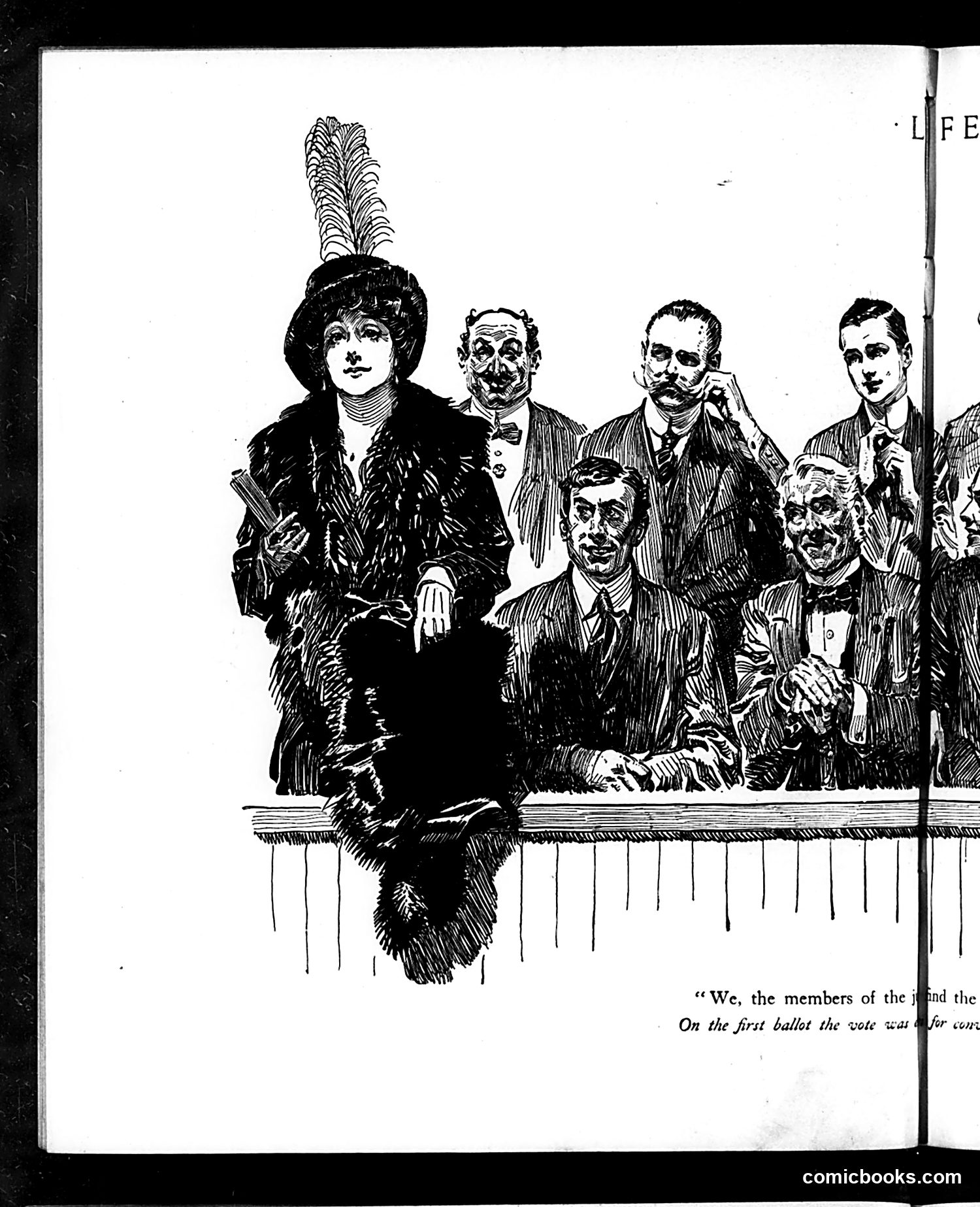
This appears to be a political cartoon from *Life* magazine satirizing a voting or selection process. The image shows a woman in fashionable dress with an elaborate feathered hat sitting prominently, surrounded by several men in formal attire arranged in a gallery or box setting—suggesting they are voting members or judges observing her. The incomplete text references "the first ballot" and a vote count, indicating this satirizes some kind of formal election or selection. The woman's prominent, decorative appearance and the men's formal arrangement suggests this may mock a beauty pageant, political nomination, or similar public selection process where appearance influences voting outcomes. However, without complete text and date information, I cannot identify the specific historical event referenced.
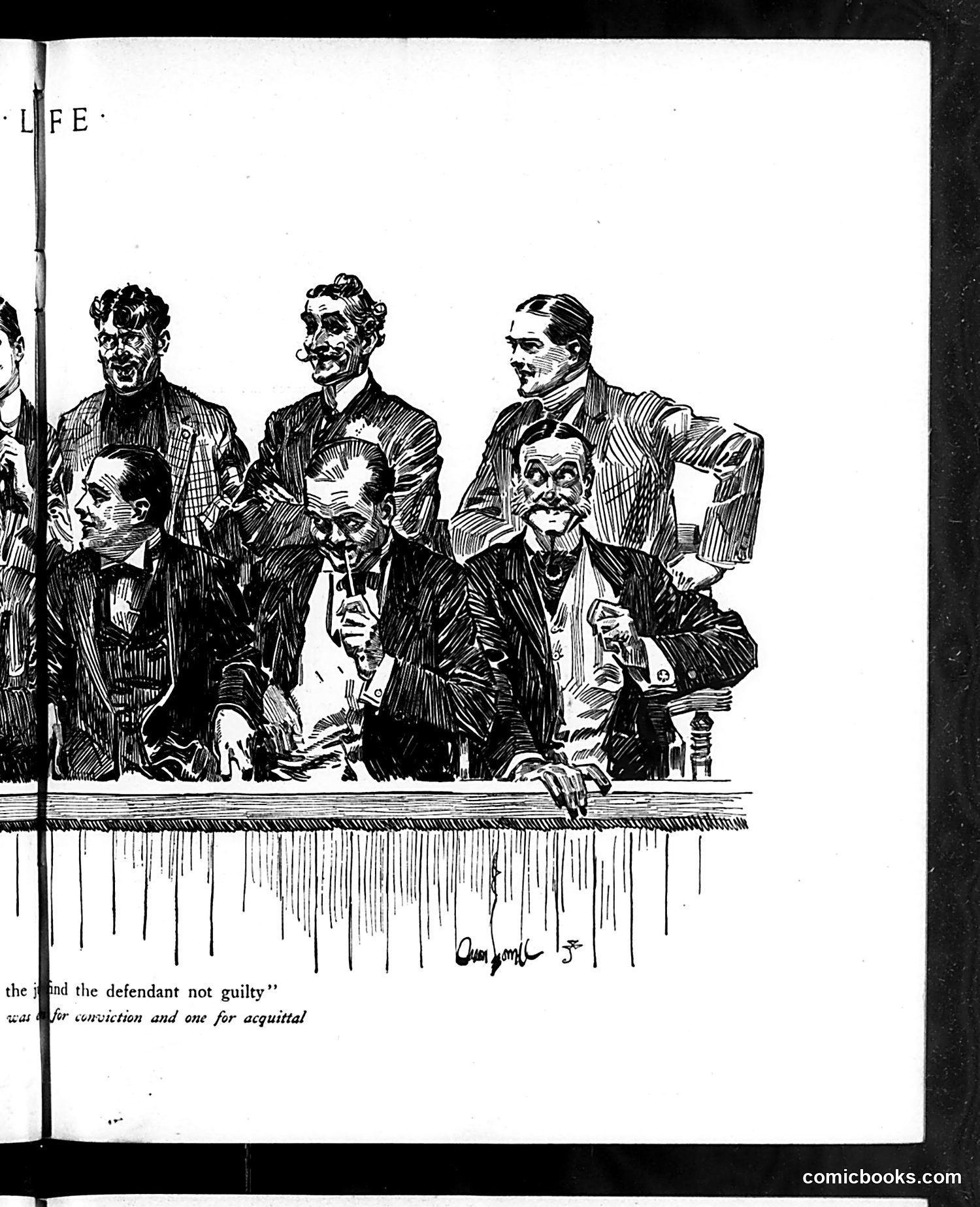
This editorial illustration depicts a jury or panel of judges delivering a split verdict—one person announcing "not guilty" while another simultaneously declares a conviction. The cartoon satirizes judicial inconsistency or contradiction within the legal system. The sketch shows five men in formal attire at what appears to be a bench or formal setting. The exaggerated facial expressions and the contradictory verdicts being announced simultaneously suggest the cartoon critiques conflicting judicial outcomes or the absurdity of receiving opposite rulings at once. Without the full article context or publication date, the specific case referenced remains unclear, but the satire targets the frustrating illogic of simultaneous guilty and not-guilty verdicts—a legal impossibility that highlights systemic judicial problems or specific controversial case outcomes Life's editors wished to mock.
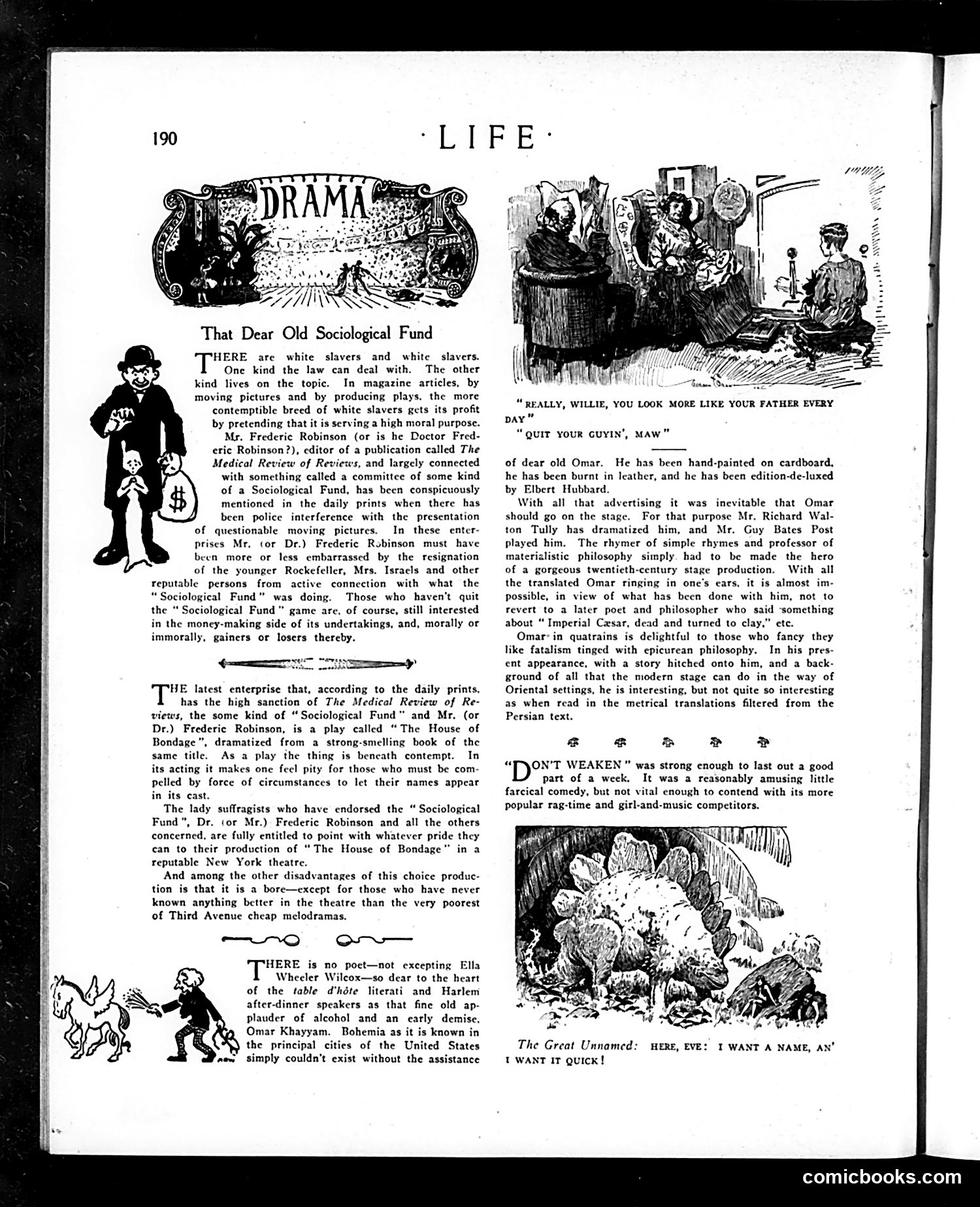
This page satirizes moral hypocrisy in Progressive-era entertainment and reform. **Main target:** Frederic Robinson and the "Sociological Fund"—a supposedly charitable organization that claims to combat vice (particularly white slavery) through plays and films, but actually profits from the salacious content it purports to condemn. The article notes Robinson presents morally questionable entertainment as "serving a high moral purpose." **Key figures:** Young Rockefeller and Mrs. Israels are mentioned as respectable people who *resigned* from the organization, suggesting they recognized the fraud. The article credits lady suffragists with endorsing the group—likely implying they were manipulated by false moral claims. **The plays discussed:** "The House of Bondage" and an Omar Khayyam adaptation are savaged as artistically terrible yet profitable ventures dressed in reformist language. **The satire's point:** Life exposes how reformers and editors exploit public concern about social problems to make money while producing inferior art—they're "white slavers" themselves, enslaving audiences to bad theater under the guise of moral improvement.
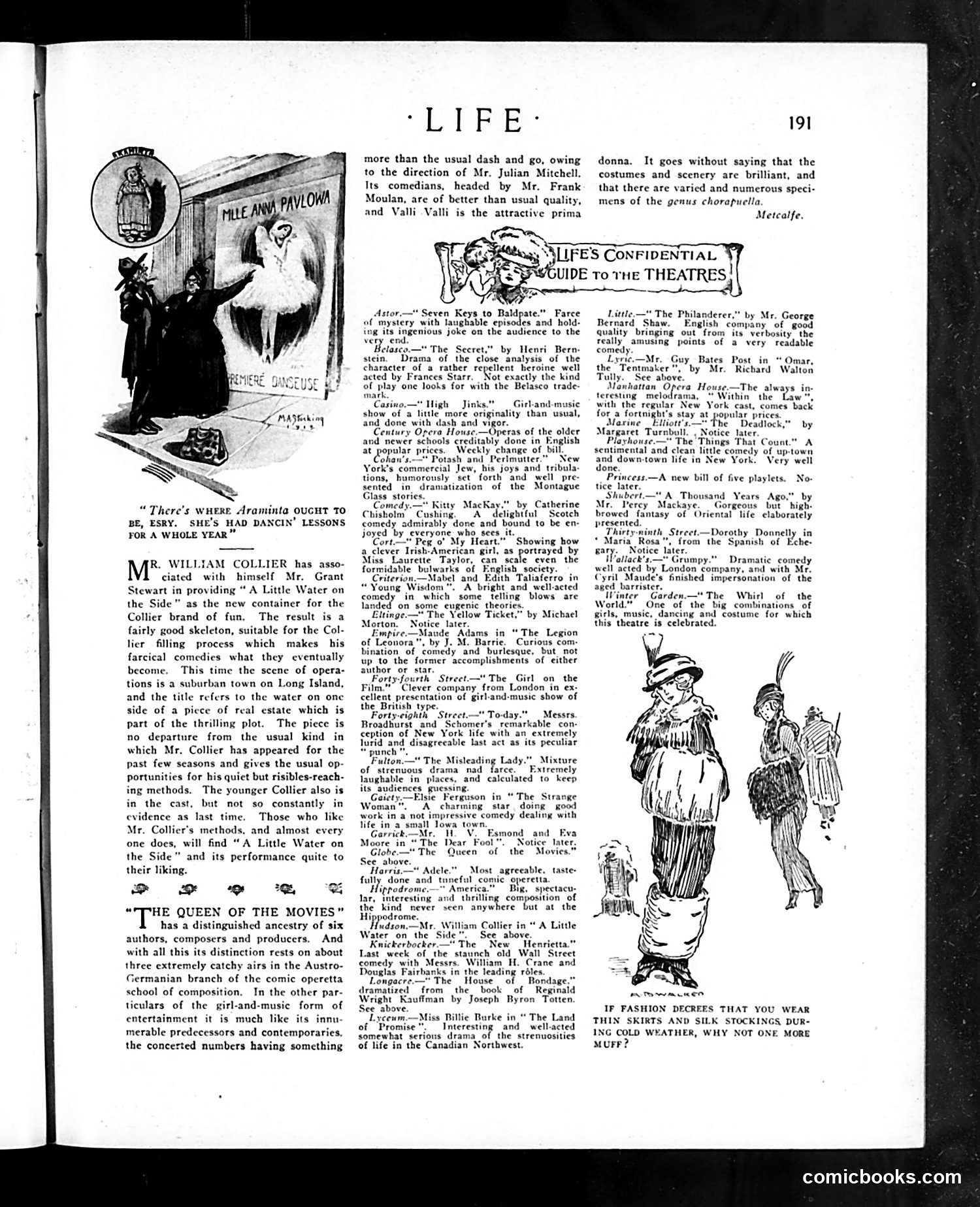
This page from *Life* magazine contains theater reviews and advertisements for Broadway shows circa 1910s. The top-left illustration depicts a scene from "A Little Water on the Side," a farce comedy starring William Collier, showing domestic/slapstick humor typical of the era. The opening anecdote mocks amateur dancers: someone named Araminta has taken dance lessons for a year, yet still performs poorly—the satire targets nouveau-riche aspirations to culture among the suburban middle class. The bulk of the page is *Life's* theater guide, reviewing current Broadway productions with characteristic irreverence. Reviews note which shows feature attractive female performers ("prima donna"), catchy music, and clever comedians. The magazine takes particular interest in musical comedies and operettas—the era's dominant theatrical form. The satirical tone emphasizes that these shows largely follow formula: pretty women, recycled plots, spectacle, and chorus girls ("genus chorapuella"—a playful neologism for chorus performers). *Life* presents this formulaic entertainment as predictable but entertaining for contemporary audiences.
This page contains a satirical fairy tale titled "The Fairy Tale of the Writer-Lady and the Hop-Gobbles," authored by J. B. Kerfoot (byline visible at right). The story mocks **women writers and their creative output**. The "writer-lady" represents female authors who search for creative inspiration ("ideas") in nature. She discovers whimsical creatures called "hop-gobbles"—appearing to represent sentimental or fanciful literary creations. The satire's point: her first creation ("Molly Make-Believe") charms everyone initially, but audiences eventually demand more. She produces a second, inferior creation ("The White Linen Nurse") that disappoints—it's wan, desperate, and joyless. The tale suggests that **women writers, particularly those in sentimental genres, cannot sustain quality work** and resort to increasingly desperate, artificial efforts to maintain reader interest. The reference to Eleanor Hallowell Abbott at the story's end (author of "The White Linen Nurse") indicates this is a direct literary criticism of a contemporary female author's work.
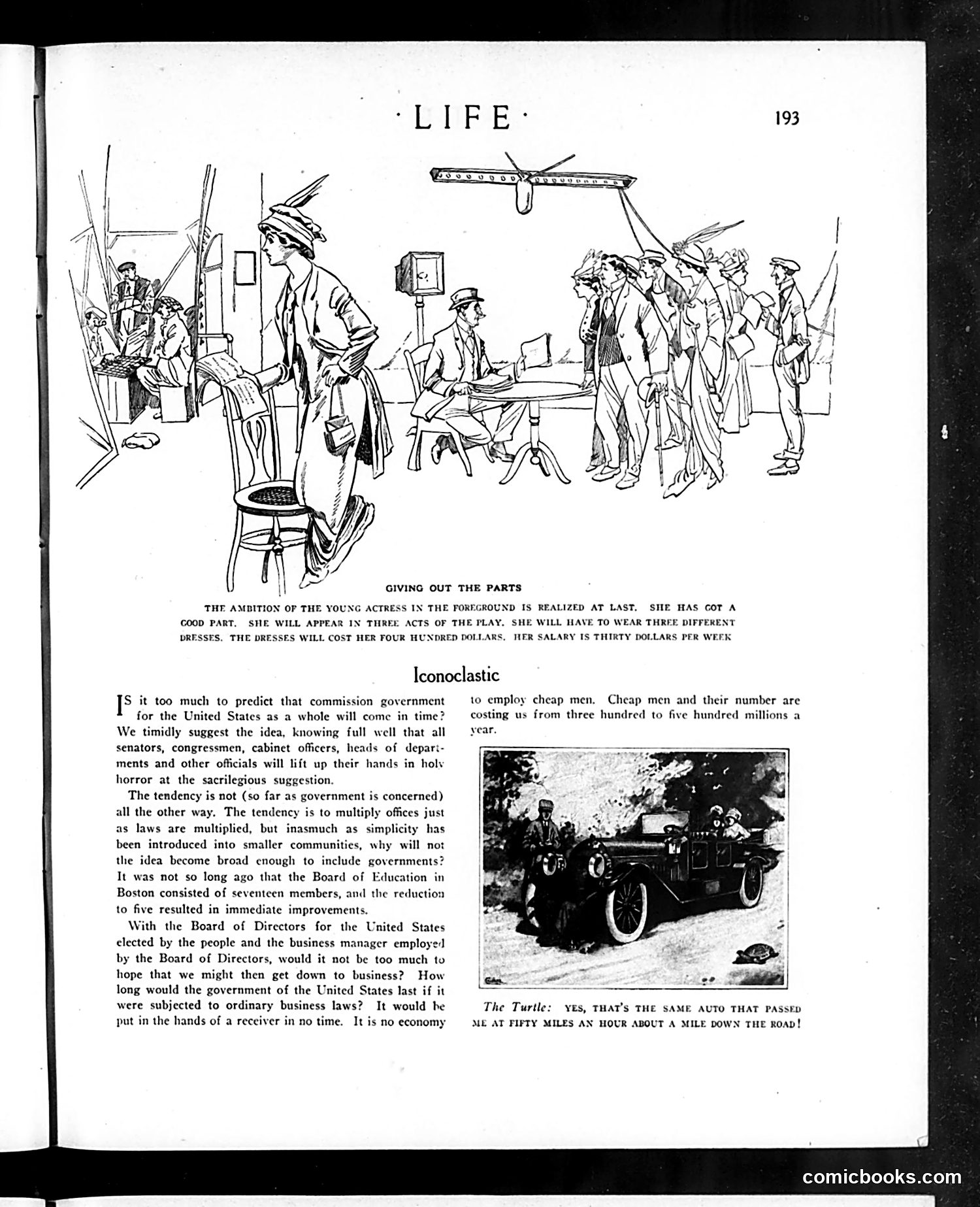
**Top Cartoon ("Giving Out the Parts"):** This satirizes the economic reality of young actresses in theater. Despite landing a coveted acting role, the protagonist earns only $30/week but must purchase three different dresses costing $400 total—over 13 weeks' salary. The joke exposes how theatrical work, seemingly glamorous, actually exploits performers financially. The sketch shows a casting director distributing roles while the hopeful actress realizes her "good part" is economically ruinous. **Bottom Article ("Iconoclastic"):** This editorial argues for applying business efficiency principles to government, advocating a "commission government" model with a professional business manager rather than career politicians. It uses the Boston Board of Education (reduced from 17 to 5 members with improved results) as precedent, suggesting the U.S. government is so wasteful it would face receivership under ordinary business laws. **The Turtle Cartoon:** A motorist's joke about seeing the same slow automobile repeatedly—implying it's so slow it was passed hours earlier yet is somehow still ahead.
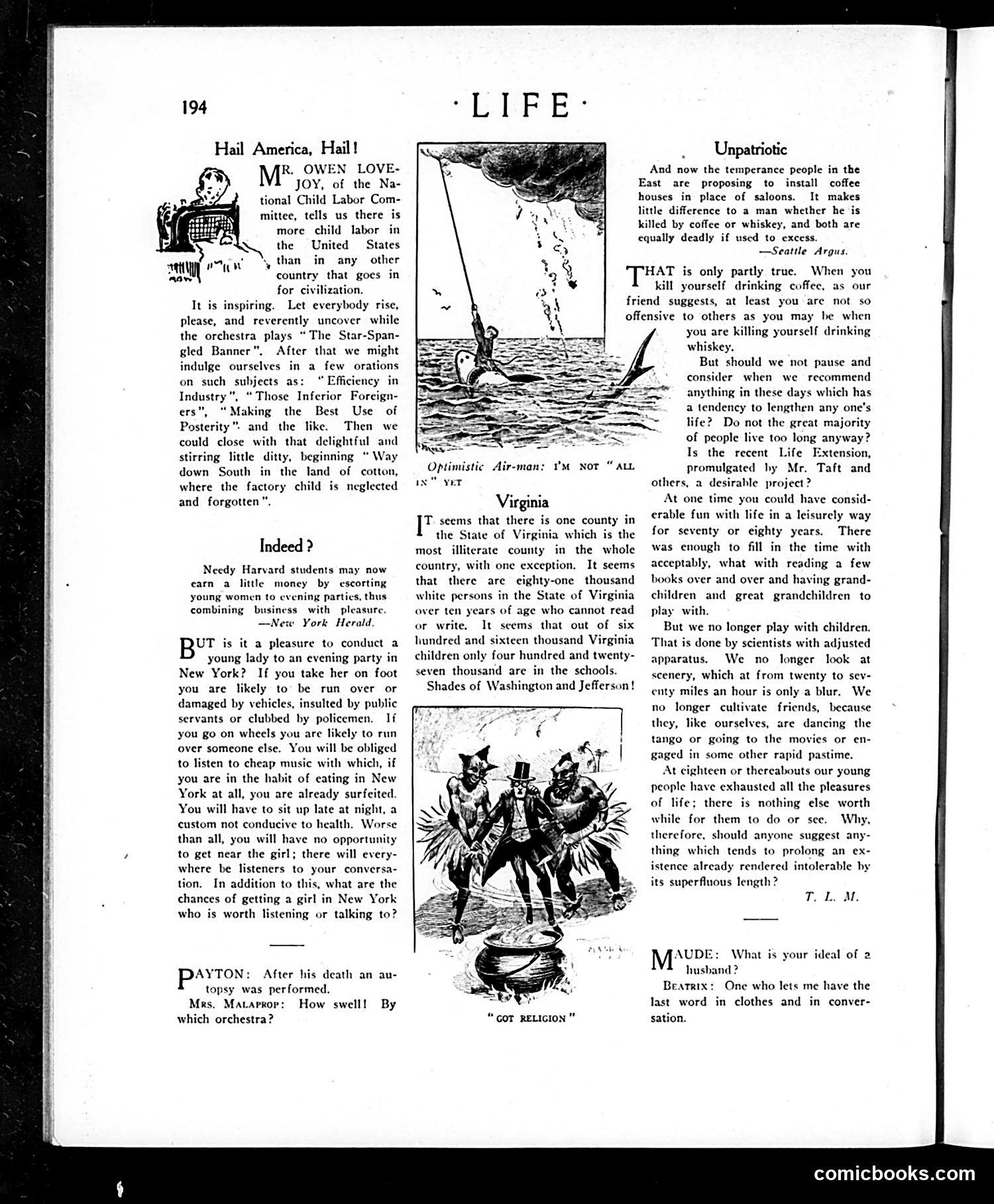
This page contains several interconnected satirical pieces critiquing American society's contradictions: **"Hail America, Hail!"** mocks patriotic rhetoric about American superiority while child labor remains endemic. The piece sarcastically suggests celebrating with national songs while ignoring that the U.S. has MORE child labor than other "civilized" nations—exposing the gap between nationalist pride and actual conditions. **"Optimistic Air-man"** cartoon depicts a figure fishing in dangerous waters, captioned "I'm not 'all in' yet"—likely satirizing naive optimism despite obvious peril. **"Got Religion"** cartoon shows figures dancing around a pot, presumably mocking superficial religious conversion without genuine moral change. **"Virginia"** cites statistics about illiteracy and school attendance in Virginia, invoking the state's founding fathers (Washington, Jefferson) to highlight how far it has fallen. The **coffee/whiskey debate** sardonically questions whether temperance reformers truly improve society if they simply substitute one vice for another. Throughout, *Life* attacks American complacency: celebrating progress while ignoring child labor, promoting life extension while draining life of meaning, and invoking national ideals while tolerating systemic failures.
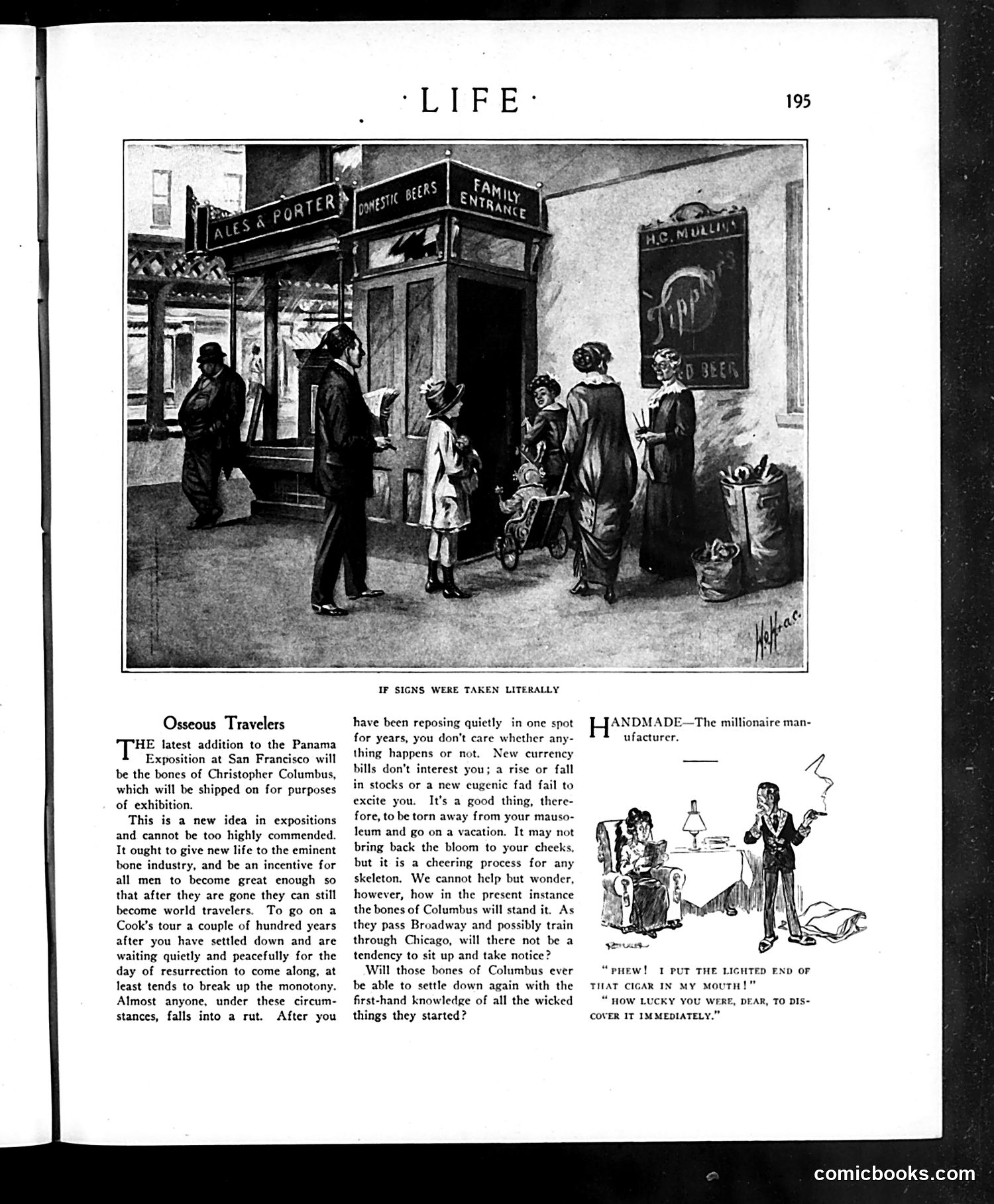
**"Osseous Travelers"** satirizes the Panama-Pacific Exposition's plan to exhibit Christopher Columbus's remains. The author humorously suggests that shipping Columbus's skeleton around America is actually a *benefit* to the dead explorer—a "vacation" breaking the monotony of eternal rest. The joke escalates absurdly: once Columbus's bones experience the excitement of Broadway and Chicago, they'll become too restless to settle peacefully back in their tomb, having "first-hand knowledge of all the wicked things they started" (likely referencing Columbus's colonial legacy). **"If Signs Were Taken Literally"** is a separate cartoon showing a bar entrance with signs for "Ales & Porter," "Domestic Beers," and "Family Entrance." It depicts people literally interpreting the "Family Entrance" sign—treating it as an actual family gathering place rather than just a bar entrance. The accompanying cartoon shows a wealthy man accidentally igniting a cigar backwards, with his companion praising his "luck" in discovering the mishap immediately. Both mock absurd literal interpretations.
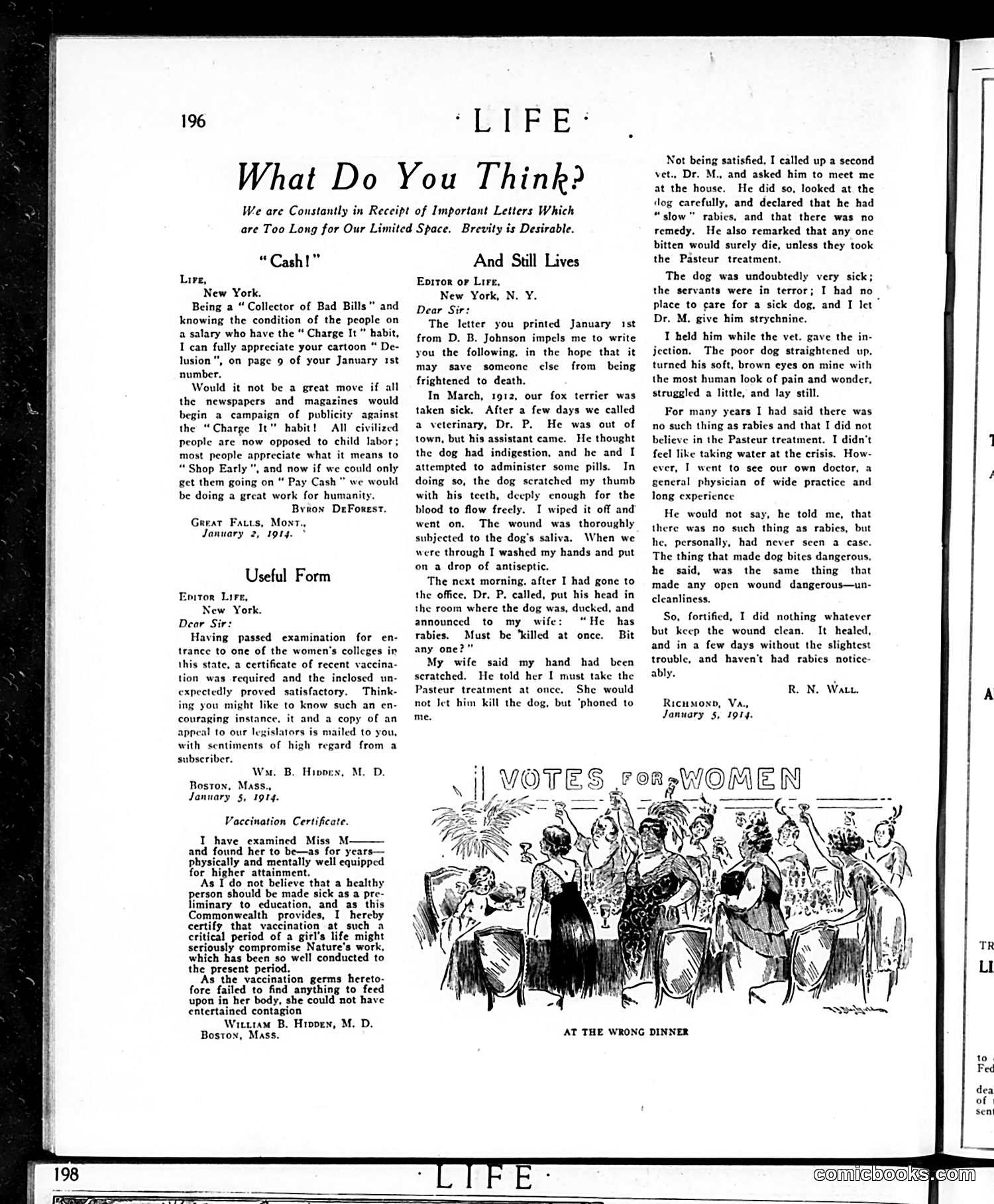
This page features readers' letters to the editor on various topics. The cartoon "At the Wrong Dinner" (bottom) appears to satirize women's suffrage advocacy—showing women at a formal dinner, likely making political arguments for voting rights in an inappropriate social setting. The caption suggests the humor lies in the *timing* or *venue* of such activism. The letters themselves address: (1) consumer debt and the "Charge It" habit, with one reader advocating newspapers promote "Pay Cash" campaigns; (2) vaccination requirements for college entrance, with a doctor providing an alternative "vaccination certificate" claiming healthy people shouldn't be artificially sickened; and (3) a lengthy account of a fox terrier possibly exposed to rabies in 1912, questioning whether the Pasteur treatment was necessary. The page reflects Progressive Era debates about consumer habits, medical mandates, and public health—issues still recognizable today, though the suffrage reference requires historical context.
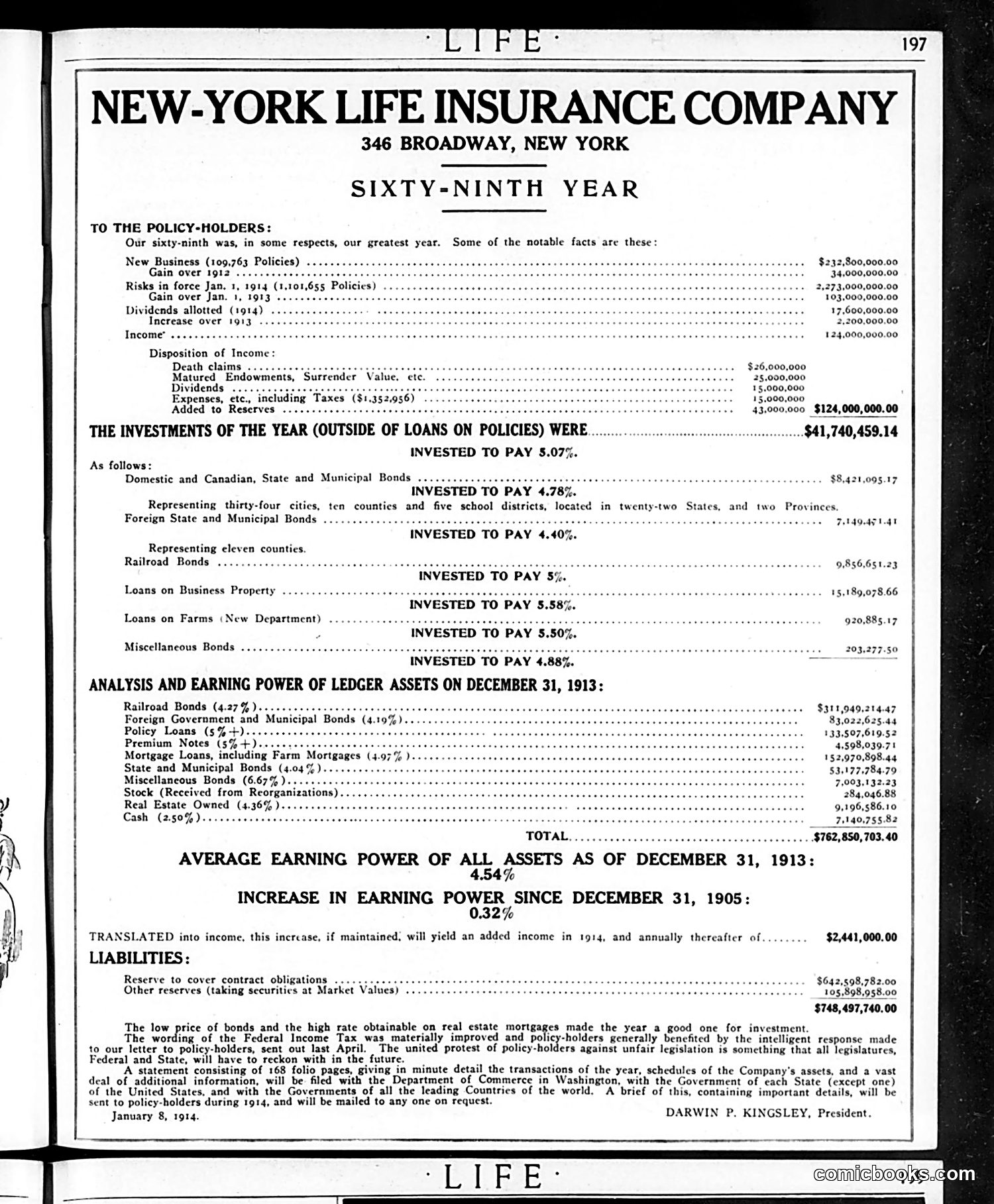
This is **not a cartoon or satire**—it's a corporate financial statement from New York Life Insurance Company's 1913 annual report to policyholders. The page presents the company's financial performance in its 69th year of operation. Key figures include: $212.8 million in new business, $124 million in income, and $41.7 million invested that year. The company emphasizes strong earnings power (4.54% average return on assets) and notes a 0.32% increase in earning power since 1905. The statement highlights investments in bonds (railroad, municipal, foreign), farm loans, and real estate mortgages. A notable mention addresses the Federal Income Tax's impact on policyholders and thanks them for protesting "unfair legislation." This is straightforward corporate communication—no satire intended, though Life magazine's inclusion reflects how financial reports were presented to the public in this era.
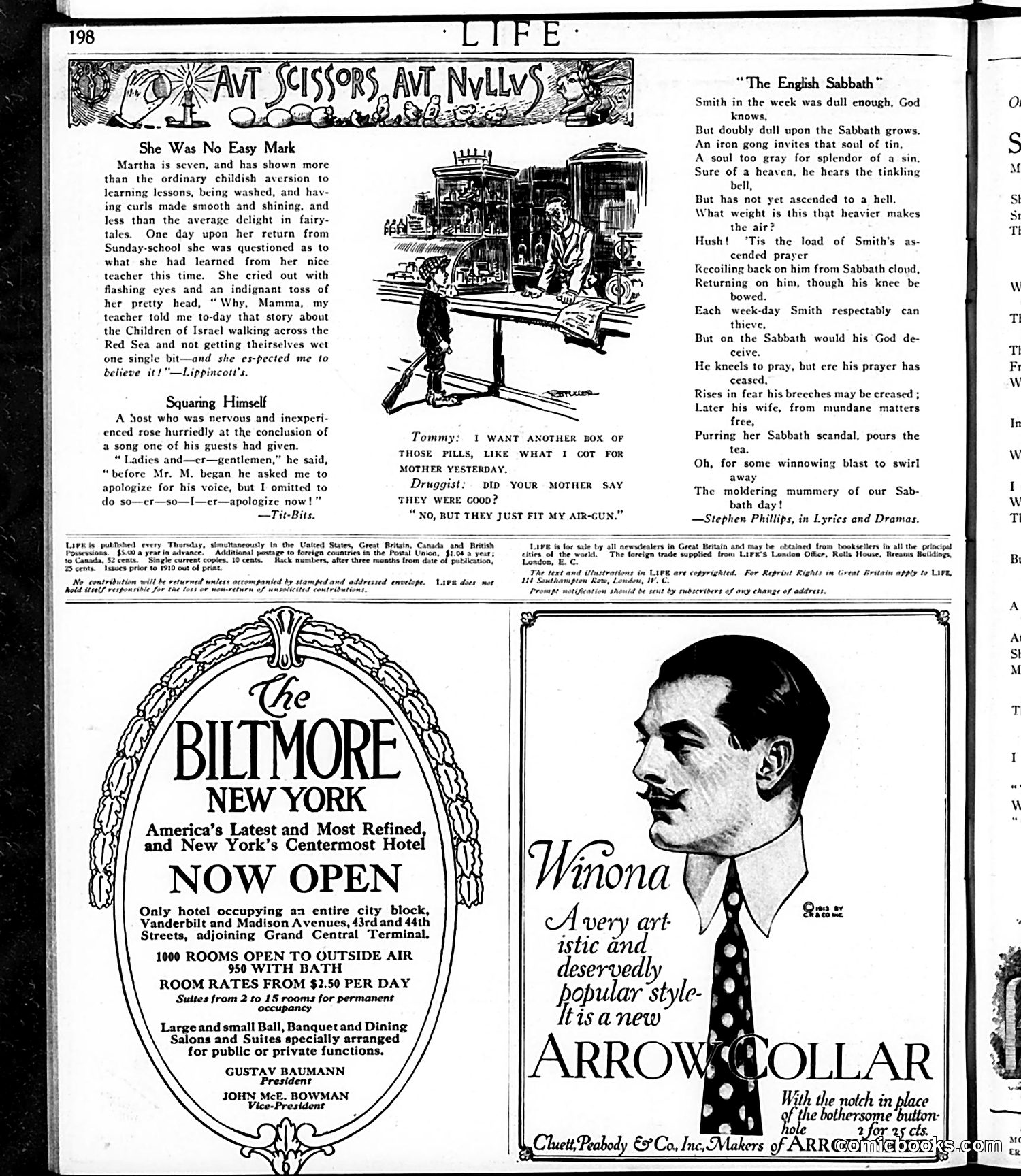
This page from *Life* (a satirical American weekly) presents three humor pieces and period advertisements: **The cartoons/jokes:** 1. "She Was No Easy Mark" mocks religious instruction—a seven-year-old girl rejects her Sunday school teacher's account of the Red Sea crossing as unbelievable, highlighting the tension between children's rational skepticism and expected faith. 2. "Squaring Himself" portrays social awkwardness: a nervous host apologizes for a guest's poor singing voice, then awkwardly apologizes again for forgetting to apologize initially. 3. The Tommy/druggist exchange is a pun-based joke: a boy asks for pills "like mother's," claiming they "fit my air-gun"—implying the pills were actually pellets/ammunition, not medicine. **The Stephen Phillips poem** satirizes hypocritical religious observance: a man ("Smith") who steals during the week but performs Sabbath piety—his prayers recoil on him, and his wife gossips over tea instead of genuine devotion. **The advertisements** promote The Biltmore Hotel (New York) and Arrow Collar shirts—typical luxury goods of the era.
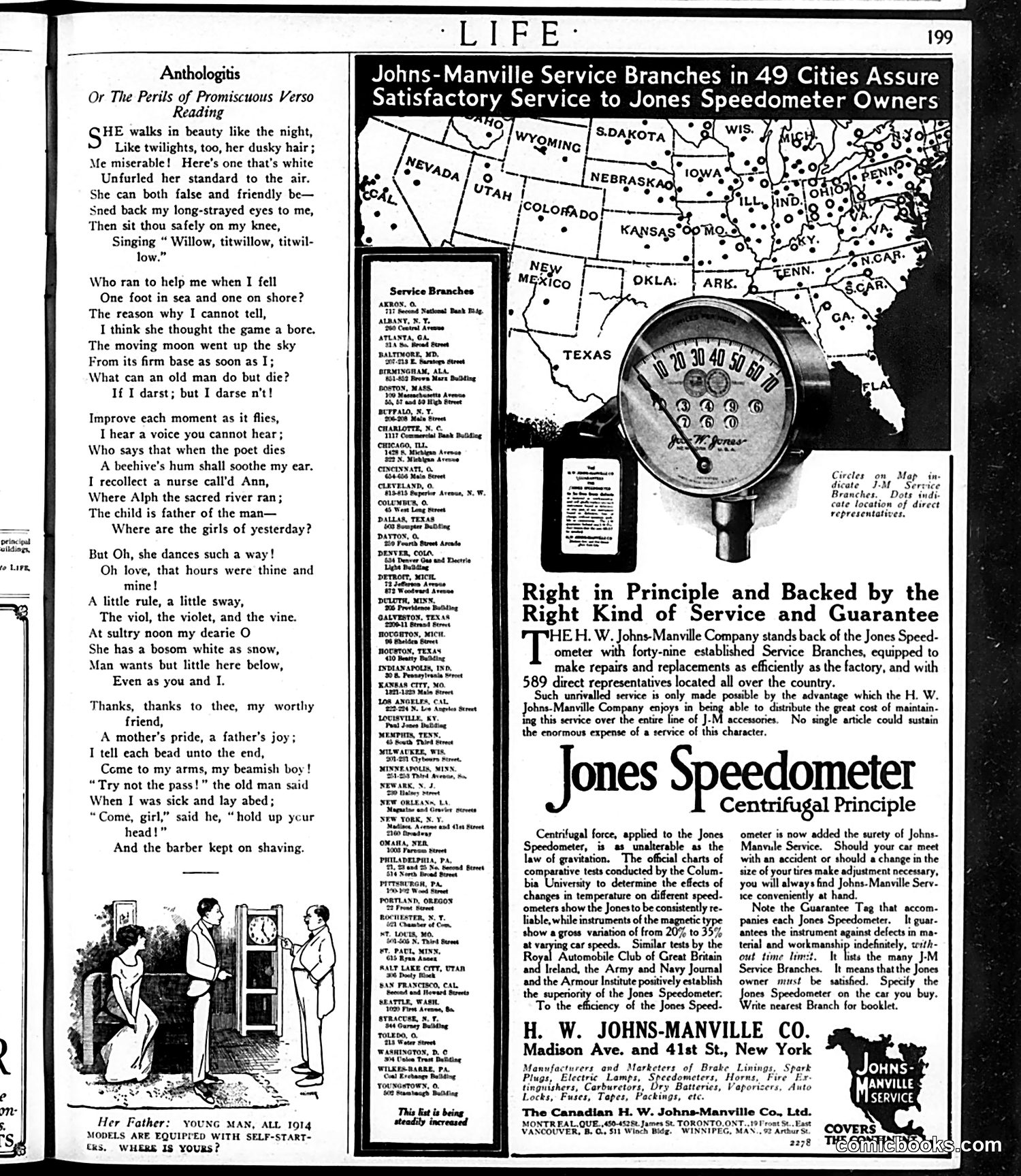
## Left Side: "Anthologitis" Poem This is satirical verse mocking the excessive use of literary quotations. The title suggests an affliction from "promiscuous verse reading." The poem strings together famous lines from canonical poets (Romantic and Victorian era literature) to absurd effect, creating non-sequiturs about a woman. References appear to include Byron ("She walks in beauty"), Gilbert & Sullivan ("Willow, titwillow"), and Coleridge ("Where Alph the sacred river ran"). The humor targets intellectuals who compulsively quote famous poetry, often inappropriately, and the pretentiousness of literary culture circa 1914. ## Right Side: Advertisement Primarily an advertisement for the Jones Speedometer, featuring a map showing Johns-Manville Service Branches in 49 U.S. cities. The ad emphasizes the reliability of the speedometer using "centrifugal principle" and claims endorsement from universities and military organizations. **Bottom illustration**: A barber-shop scene depicting generational tension—a young man without a car contrasts with an older man who owned one ("all 1914 models"), highlighting early automotive adoption divides.
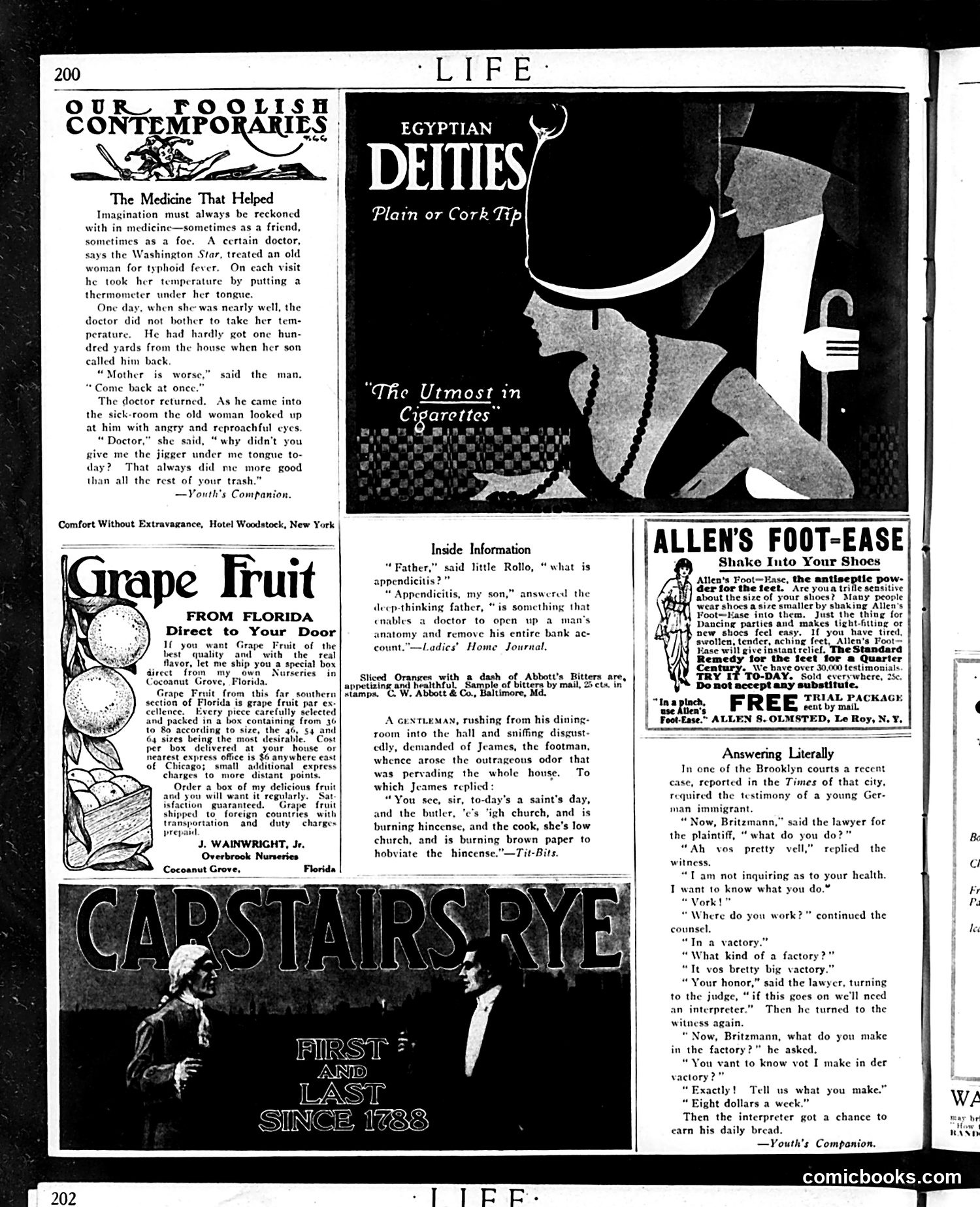
This page contains three humorous anecdotes satirizing common human foibles and professional practices: **"The Medicine That Helped"** mocks the placebo effect and doctor-patient relationships. An elderly woman recovers from typhoid fever, attributing her improvement to the doctor's temperature-taking ritual (the thermometer under her tongue) rather than actual medical treatment. When the doctor skips this step, she demands he return, revealing she credited the *procedure* over the *medicine*—a joke about imagination's power in healing and patients' misplaced faith in doctors' practices. **"Inside Information"** satirizes medical profiteering, depicting appendicitis as a condition doctors invented to justify lucrative surgeries that empty patients' bank accounts. **"Answering Literally"** features a German immigrant witness who comically misinterprets a lawyer's question "what do you do?" as asking about his health rather than his occupation—a gentle satire of language barriers and literal-minded responses. The page is primarily **advertising and humor content**, typical of Life's satirical magazine format.
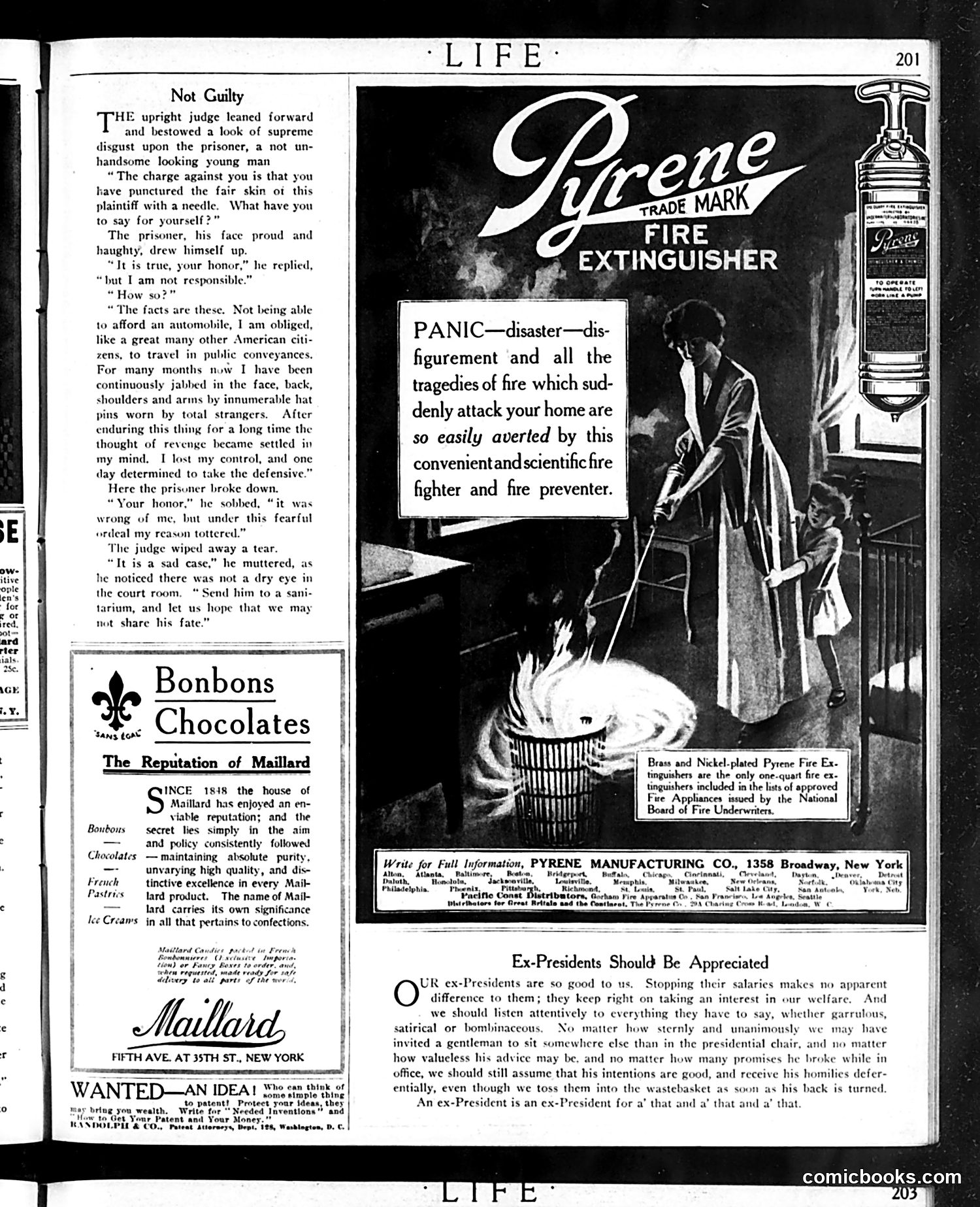
This satirical story-cartoon mocks the epidemic of **hat pins** in early 20th-century public transportation. Women wore large, ornate hats secured with long, sharp pins that frequently stabbed other passengers on crowded streetcars and buses—a genuine social nuisance of the era. The joke: A young man is charged with deliberately stabbing a woman with a needle, but argues he's not responsible because he was merely retaliating against months of being jabbed by strangers' hat pins on public transit. The sympathetic judge weeps and sends him to a sanitarium instead of jail, suggesting the real culprits are the women wearing dangerous fashion accessories. The satire criticizes both the absurdity of women's fashion (enormous hats with protruding pins) and the legal system's inconsistent application of justice—the defendant escapes punishment by revealing a systemic problem nobody addresses. It's commentary on how trivial male inconvenience receives sympathy while women's fashion choices, however hazardous to others, go unchecked.
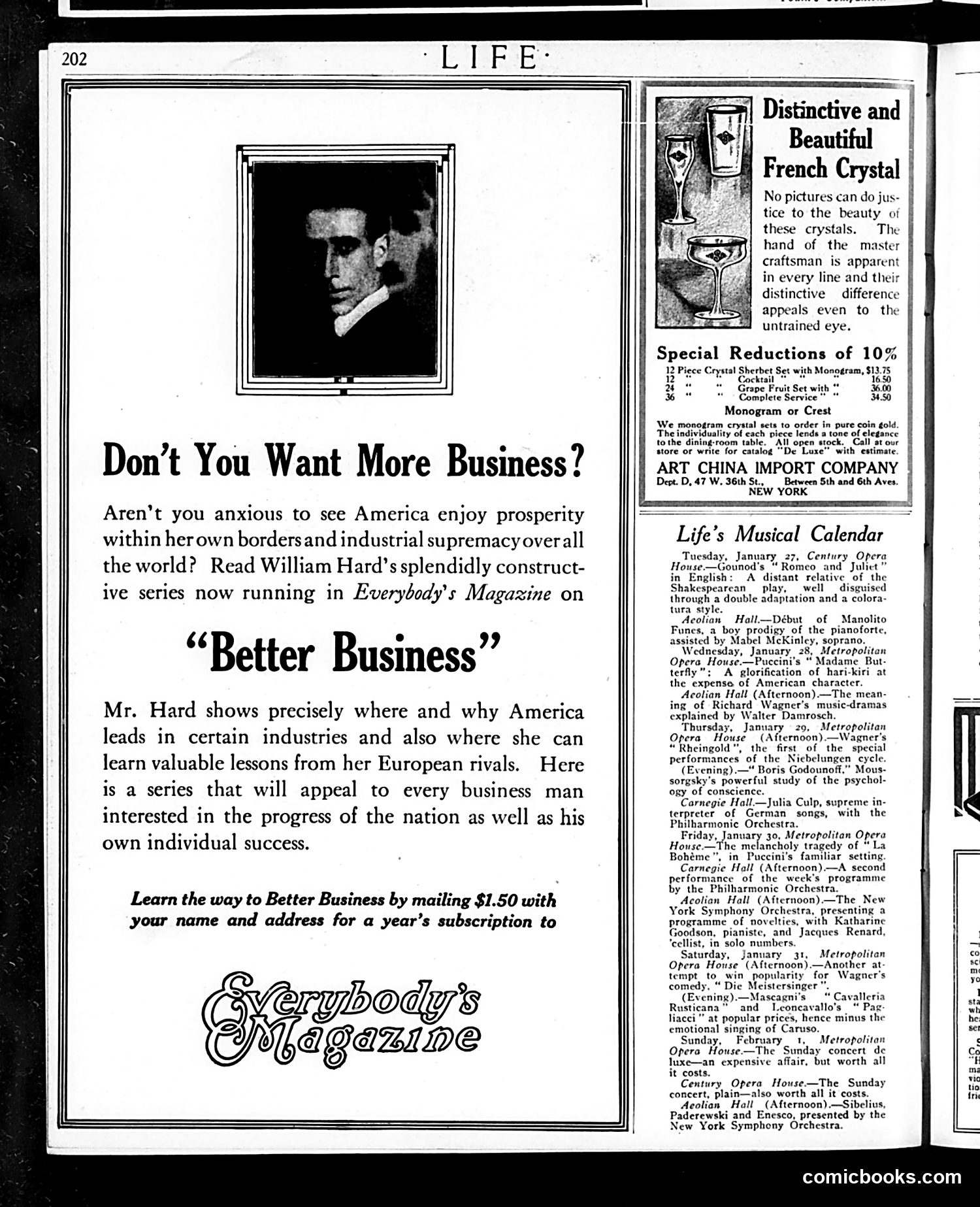
This page contains **advertising and editorial content**, not political satire. The main feature is a **recruitment advertisement** for *Everybody's Magazine*, promoting William Hard's article series titled "Better Business." The copy appeals to businessmen by promising insights into American industrial supremacy and lessons from European competitors—reflecting early 20th-century concerns about maintaining economic dominance. The portrait (identity unclear from the image alone) accompanies the pitch that readers will learn "where and why America leads in certain industries." The right column contains **unrelated content**: a French crystal advertisement and a musical calendar listing New York City opera and concert performances for late January/early February, including works by Wagner, Puccini, and contemporary composers. This is essentially a magazine page mixing paid advertising with listings—typical of the era's publication format.
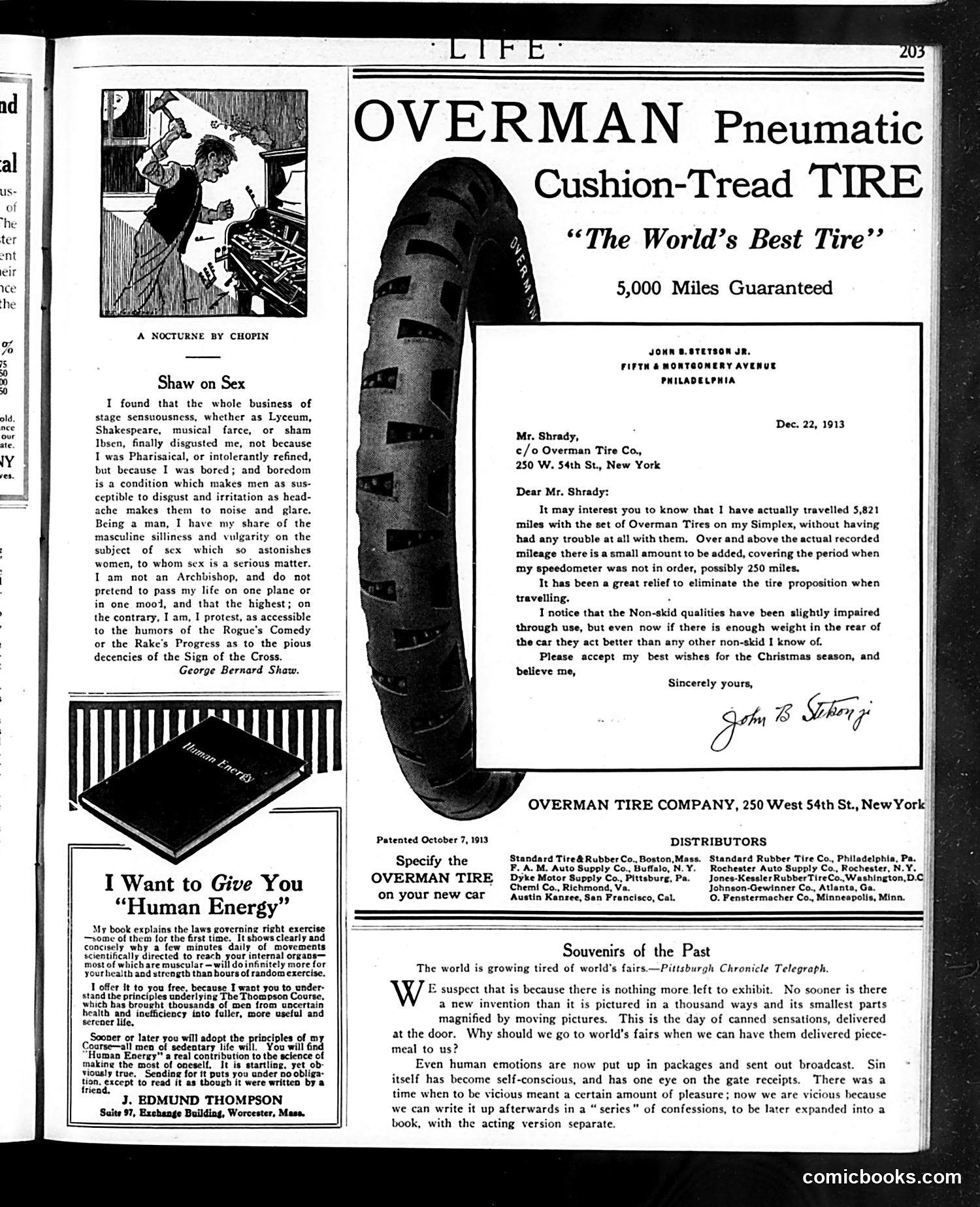
This page mixes editorial content with advertising, typical of Life's satirical format. **"Shaw on Sex"** presents George Bernard Shaw's provocative essay defending his interest in theatrical sensuality. Shaw argues against puritanical attitudes, claiming boredom—not morality—drove his disgust with stage sensuousness. He positions himself as neither prudish Archbishop nor crude, but rather someone who appreciates both "Rogue's Comedy" and religious "decencies." The piece reflects early 20th-century debates about artistic expression and Victorian moral restraint. **"Souvenirs of the Past"** below sardonically comments on modern commercialization of human experience. The column laments that even sin and emotion are now packaged for public consumption and broadcast—anticipating concerns about mass media commodifying authentic feeling. It suggests vice has become self-conscious performance rather than genuine experience. The **Overman Tire advertisement** and **Thompson "Human Energy" book offer** are typical period advertising, unrelated to the editorial content.
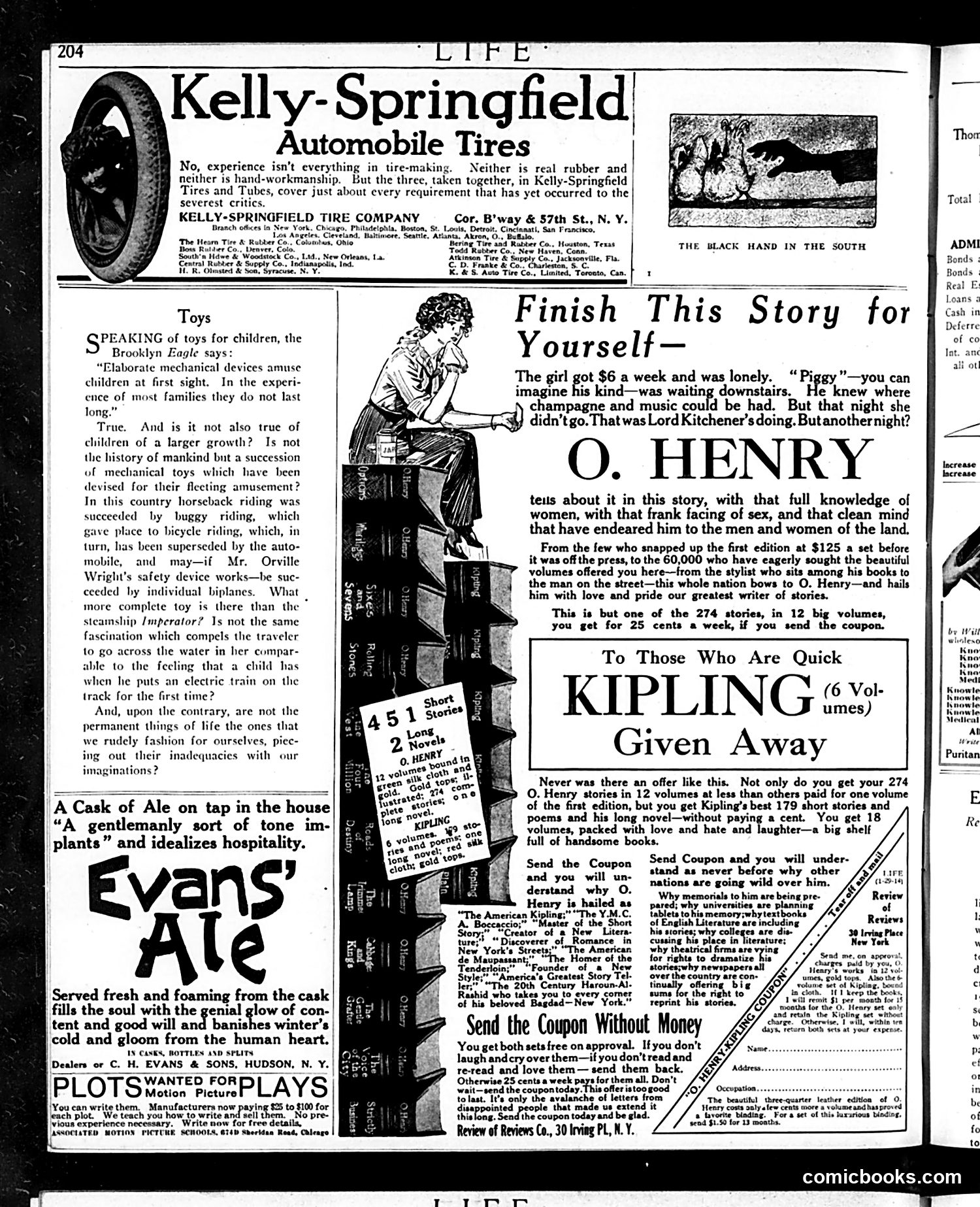
This page consists primarily of **advertisements and promotional content** rather than political satire or editorial cartoons. The main content is a promotional offer for **O. Henry's collected stories** (274 stories in 12 volumes plus Kipling works), marketed as an unprecedented bargain at 25 cents weekly. The accompanying illustration shows a young woman climbing a stack of books—visualizing the substantial "shelf of handsome books" promised to subscribers. The "story to finish yourself" references a Lord Kitchener anecdote (appearing to be WWI-era content, given the reference), but this is simply a narrative hook to promote O. Henry's reputation as a writer who understood human nature and relationships. The page also features advertisements for **Kelly-Springfield automobile tires** and **Evans' Ale**, using period marketing language about quality and reliability. There is **no political cartoon or satirical commentary** visible here—this is a commercial page designed to sell products and subscriptions to Life's readers.
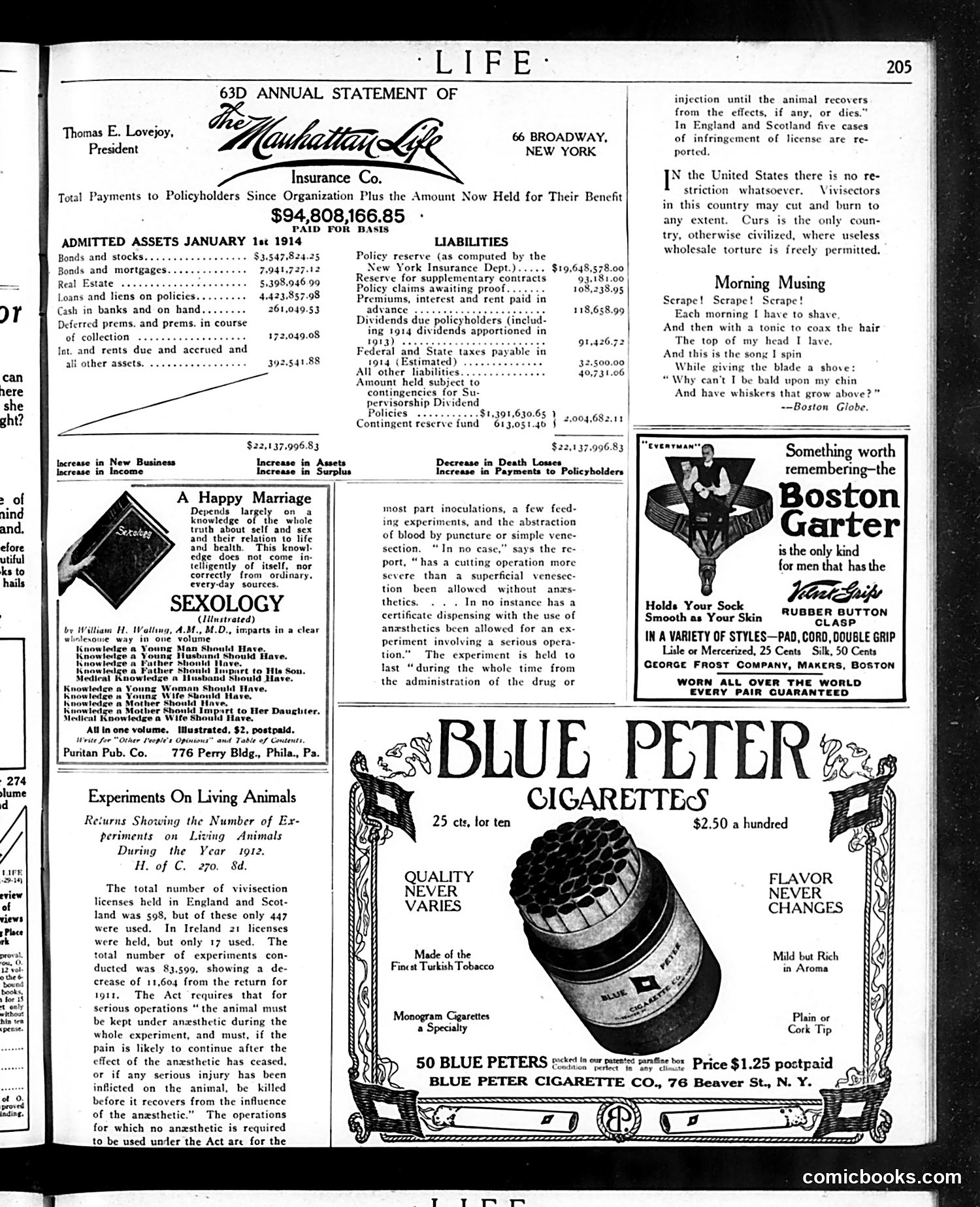
This page is primarily **financial and advertising content** rather than political satire. The top two-thirds consists of the Manhattan Life Insurance Company's 63rd annual statement, listing assets, liabilities, and financial data for 1914—routine corporate disclosure. The advertisements include a **"Sexology" book** (a medical/educational volume), **Boston Garter** socks, and **Blue Peter cigarettes** prominently featured with decorative Art Nouveau borders. The only editorial content is a brief **"Morning Musing"** poem about shaving frustrations (why can't one be bald on the chin but have whiskers above?), and a section on **vivisection experiments** documenting animal testing regulations in England, Scotland, and Ireland—noting the US had no restrictions, unlike "civilized" countries. The page reflects early 20th-century concerns: corporate financial transparency, gentlemen's grooming products, and emerging animal welfare advocacy—not political cartooning.
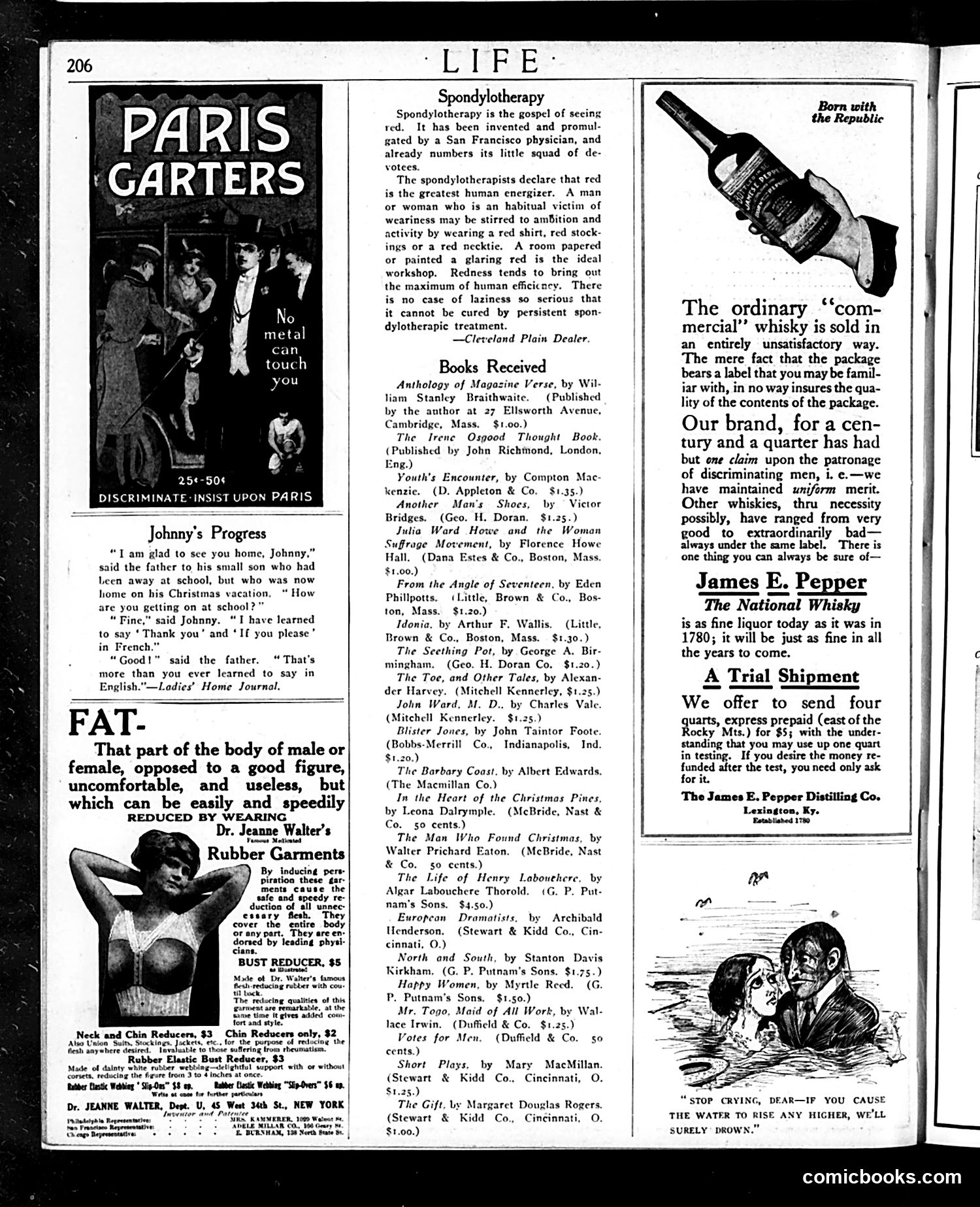
This page is primarily advertising and book reviews, with two satirical commentaries embedded: **"Johnny's Progress"**: A brief joke about a boy returning from boarding school who learned French politeness ("Thank you," "If you please") but never managed to say these things in English. The satire mocks American manners and education. **"Spondylotherapy"**: A pointed satire of pseudoscientific medical fads. Attributed to the *Cleveland Plain Dealer*, it ridicules a supposed "San Francisco physician" whose gospel claims that the color red—worn on clothing or painted on walls—cures laziness and boosts human efficiency. The passage mocks both the inventor and gullible followers of this invention. The surrounding advertisements for reducing garments and Dr. Jeanne Walter's rubber corsets reflect period obsessions with body modification, while the books listed were contemporary publications circa 1910s-1920s.
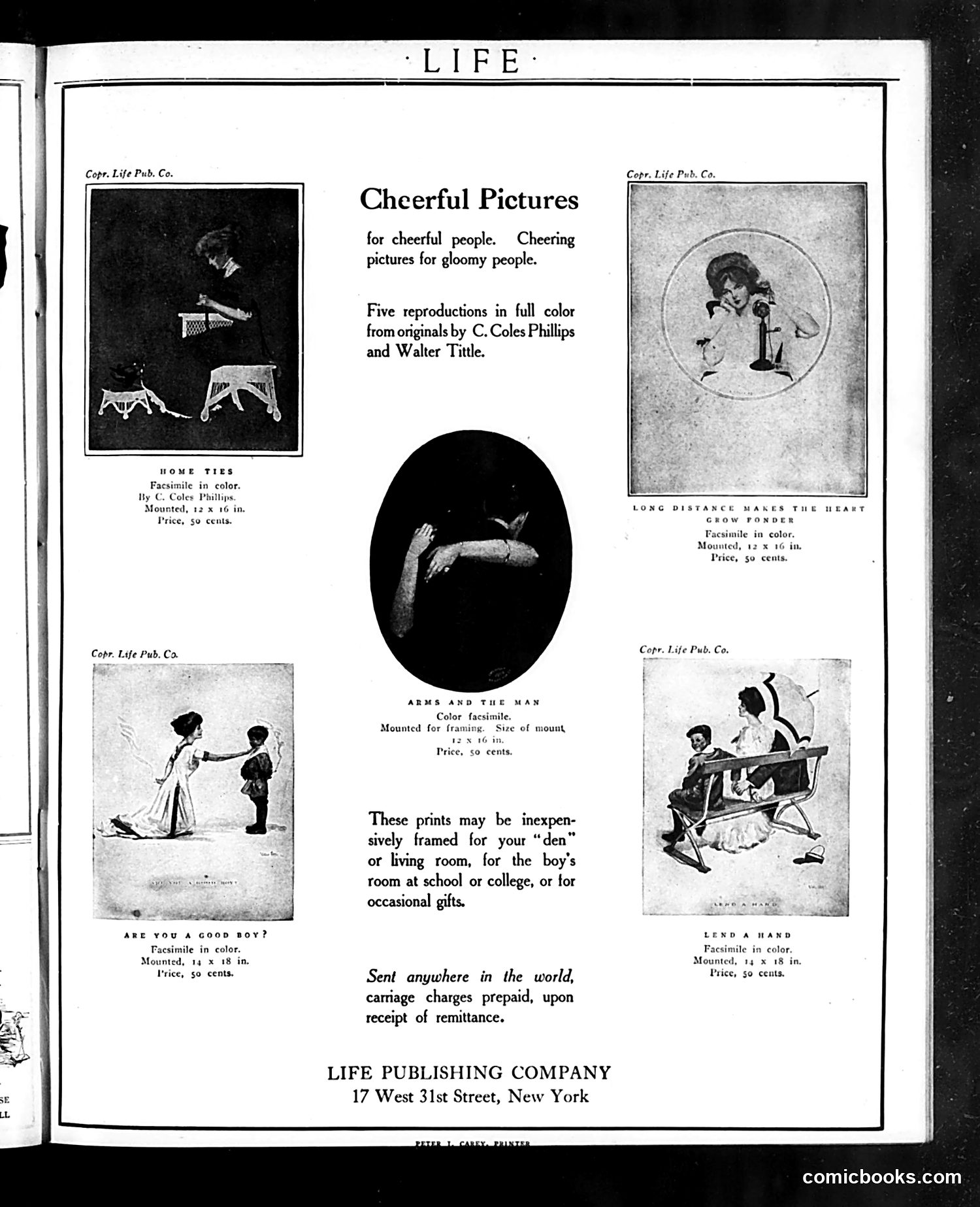
This is an advertisement page, not satire or political commentary. Life Publishing Company promotes five sentimental art prints by illustrators C. Coles Phillips and Walter Tittle, priced at 50 cents each. The images depict domestic sentimentality typical of early-20th-century popular art: a man at home with furniture, a young woman with flowers, a woman comforting a child, embracing figures (titled "Arms and the Man"), and a woman in a rocking chair. The marketing pitch targets gift-givers and home decorators, suggesting these prints suit "dens," living rooms, school dorm rooms, and gift-giving. The headline's ironic promise—"cheerful pictures for gloomy people"—uses light humor to appeal to purchasers seeking uplifting wall décor. This reflects the era's commercialization of domestic imagery and sentimental art for middle-class consumption.
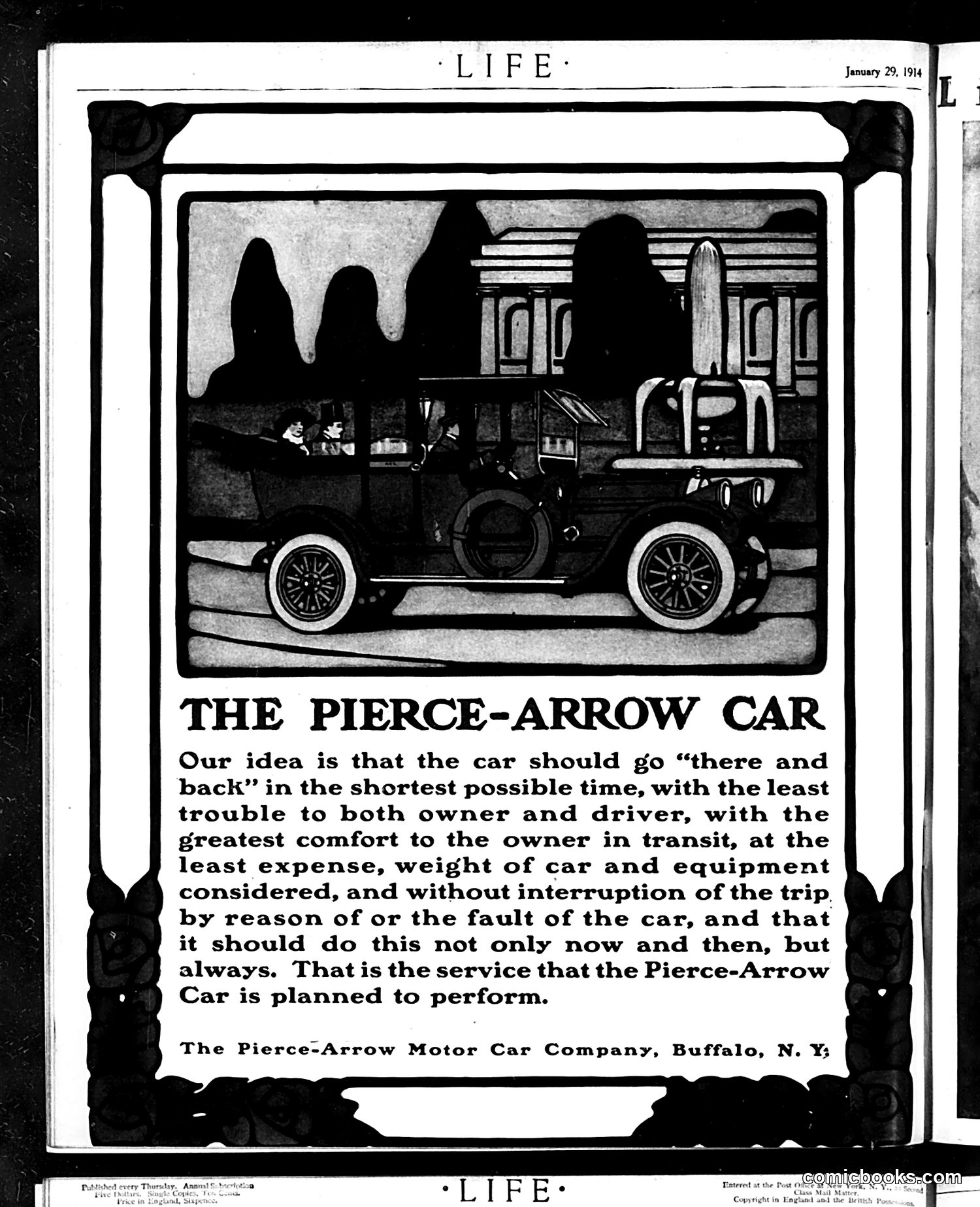
This is a **straightforward automobile advertisement**, not political satire. Published January 29, 1914, it promotes the Pierce-Arrow Motor Car Company of Buffalo, New York. The image shows a sleek early automobile with passengers, positioned outside what appears to be an elegant building or mansion, establishing the car's luxury positioning. The accompanying text articulates the company's philosophy: the Pierce-Arrow should deliver reliable, comfortable, fast transportation without mechanical failures or trip interruptions. The messaging emphasizes dependability, comfort, efficiency, and low maintenance—core selling points for premium automobiles of the era. This represents typical **early automotive advertising**, when car reliability was still a significant consumer concern and luxury manufacturers competed partly on the promise of trouble-free operation. There is no satirical content or political commentary on this page.