
Life, 1914-01-29 · page 15 of 40
Life — January 29, 1914 — page 15: what you’re looking at
What you’re looking at
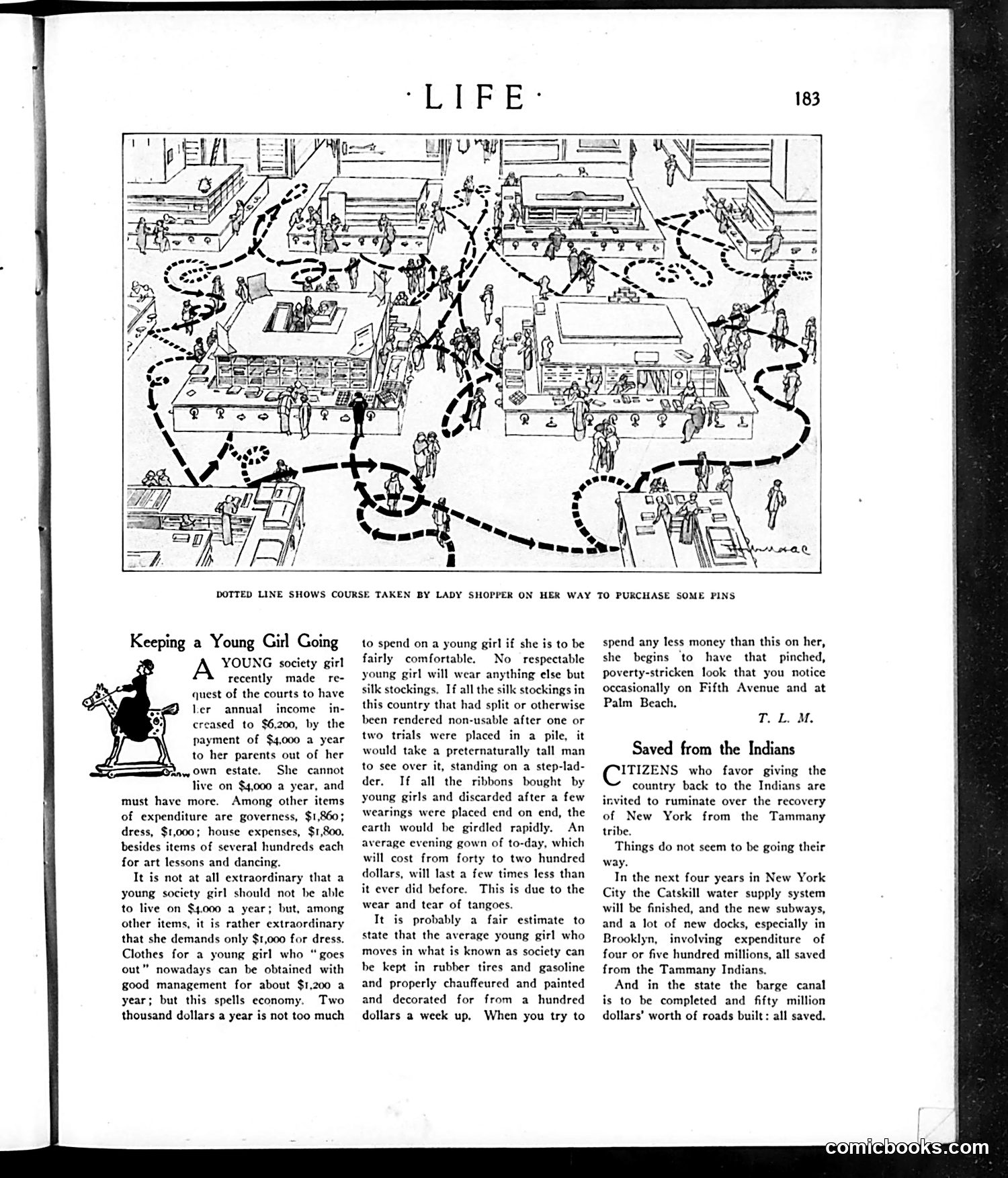
This page contains two satirical pieces from *Life* magazine: **"Keeping a Young Girl Going"** (top): The diagram shows a lady shopper's unnecessarily convoluted route to buy pins—mocking the wasteful, inefficient spending habits of wealthy society women. The accompanying article sarcastically defends why $1,000/year for clothing is insufficient for a debutante, citing expenses like silk stockings that tear easily and evening gowns destroyed by the "tango" dance craze. The satire critiques both wealthy women's frivolous consumption and the absurdity of a society girl petitioning courts for increased allowance. **"Saved from the Indians"** (bottom): This references Tammany Hall, the corrupt Democratic political machine controlling New York City. The metaphor equates Tammany's mismanagement to Native American governance, sarcastically celebrating recent infrastructure improvements (water systems, subways, roads) as money "saved" from Tammany's theft. The piece mocks those advocating returning society to pre-industrial conditions while celebrating modern urban progress ironically wrested from political corruption.
📄 Transcribed text from this page (OCR, searchable)
Machine-transcribed from the original scan — historical spelling and the odd misread are preserved.
DOTTED LINE SHOWS COURSE TAKEN BY LADY SHOPPER ON HER WAY TO PURCHASE SOME PINS Keeping a Young Girl Going YOUNG society girl recently made re- quest of the courts to have Ler annual income in- creased to $6,200, by the payment of $4,000 a year to her parents out of her Mnwown estate. She cannot live on $4,000 a year, and must have more. Among other items of expenditure are governess, $1,860; dress, $1,000; house expenses, $1,800, besides items of several hundreds each for art lessons and dancing. It is not at all extraordinary that a young society girl should not be able to live on $4,000 a year; but, among other items, it is rather extraordinary that she demands only $1,000 for dress. Clothes for a young girl who “goes out” nowadays can be obtained with good management for about $1,200 a year; but this spells economy, Two thousand dollars a year is not too much to spend on a young girl if she is to be fairly comfortable. No respectable young girl will wear anything else but silk stockings, If all the silk stockings in this country that had split or otherwise been rendered non-usable after one or two trials were placed in a pile, it would take a preternaturally tall man to see over it, standing on a step-lad- der. If all the ribbons bought by young girls and discarded after a few wearings were placed end on end, the earth would be girdled rapidly. An average evening gown of to-day, which will cost from forty to two hundred dollars, will last a few times less than it ever did before. This is due to the wear and tear of tangoes. It is probably a fair estimate to state that the average young girl who moves in what is known as society can be kept in rubber tires and gasoline and properly chauffeured and painted and decorated for from a hundred dollars a week up, When you try to spend any less money than this on her, she begins ‘to have that pinched, poverty-stricken look that you notice occasionally on Fifth Avenue and at Palm Beach, T. L. M. Saved from the Indians ITIZENS who favor giving the country back to the Indians are invited to ruminate over the recovery of New York from the Tammany tribe. Things do not seem to be going their way. In the next four years in New York City the Catskill water supply system will be finished, and the new subways, and a lot of new docks, especially in Brooklyn, involving expenditure of four or five hundred millions, all saved from the Tammany Indians. And in the state the barge canal is to be completed and fifty million dollars’ worth of roads built: all saved,