
Life, 1914-01-29 · page 8 of 40
Life — January 29, 1914 — page 8: what you’re looking at
What you’re looking at
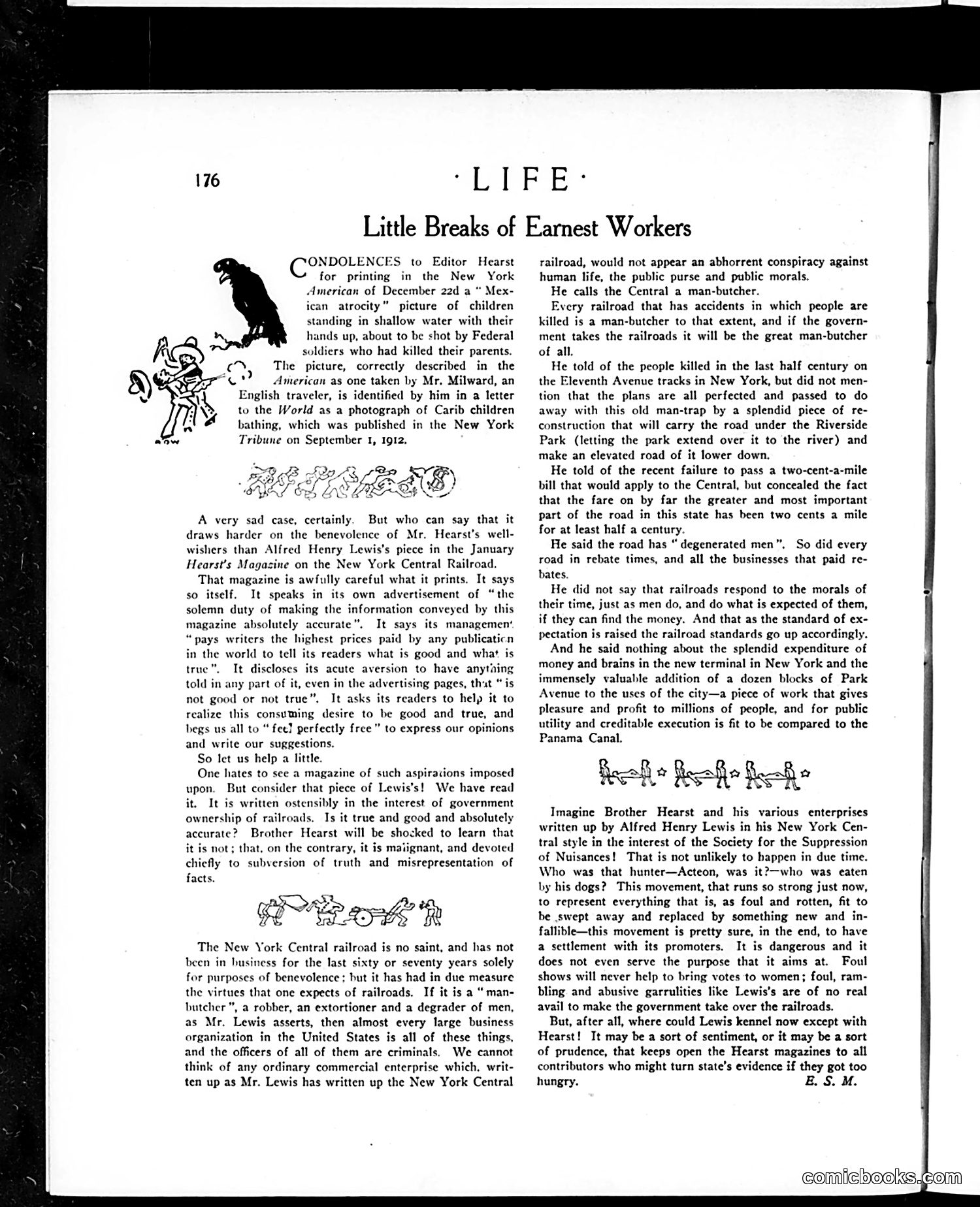
This page contains a letter to the editor criticizing **William Randolph Hearst** and his magazine's coverage of the New York Central Railroad. The cartoons (simple line drawings of figures) illustrate the letter's argument that Hearst's publications misrepresent facts to serve corporate interests—specifically, they're accused of falsely portraying the railroad as a "man-butcher" (responsible for deaths) while concealing its safety improvements. The letter writer argues that Hearst's "accuracy" claims are hypocritical, noting his publications suppress unfavorable railroad facts (like reduced accident rates and low ticket costs) while emphasizing sensational stories. The cartoons satirize how Hearst's journalistic practices manipulate public opinion rather than report truth, presenting a critique of media dishonesty and corporate bias in early 20th-century American journalism.
📄 Transcribed text from this page (OCR, searchable)
Machine-transcribed from the original scan — historical spelling and the odd misread are preserved.
“LIFE: Little Breaks of Earnest Workers ONDOLENC to Editor Hearst for printing in the New York American of December 22d a “ Mex- ican atrocity” picture of children standing in shallow water with their hands up, about to be shot by Federal soldiers who had killed their parents. The picture, correctly described in the American as one taken by Mr. Milward, an English traveler, is identified by him in a letter to the World as a photograph of Carib children bathing, which was published in the New York Tribune on September 1, 1912. A very sad case, certainly. But who can say that it draws harder on the benevolence of Mr. Hearst's well- wishers than Alfred Henry Lewis’s piece in the January Hearst’s Magazine on the New York Central Railroad. That magazine is awfully careful what it prints. It says so itself. It speaks in its own advertisement of “the solemn duty of making the information conveyed by this magazine absolutely accurate”. It says its managemen‘ “pays writers the hest prices paid by any publicaticn in the world to tell its readers what is good and what is true”. It discloses its acute aversion to have anything told in any part of it, even in the advertising pages, that “ is not good or not true”. It asks its readers to help it to realize this consuming desire to be good and true, and begs us all to “ fee} perfectly free” to express our opinions and write our suggestions. So let us help a little. One hates to see a magazine of such aspiracions imposed upon. But consider that piece of Lewis's! We have read it. It is written ostensibly in the interest of government ownership of railroads. Is it true and good and absolutely accurate? Brother Hearst will be shocked to learn that it is not; that, on the contrary, it is maiignant, and devoted chiefly to subversion of truth and misrepresentation of Pele The New York Central railroad is no saint, and has not been in business for the last sixty or seventy years solely for purposes of benevolence; but it has had in due measure the virtues that one expects of railroads. If it is a “ man- butcher”, a robber, an extortioner and a degrader of men, as Mr. Lewis asserts, then almost every large business organization in the United States is all of these things, and the officers of all of them are criminals. We cannot think of any ordinary commercial enterprise which. writ- ten up as Mr. Lewis has written up the New York Central railroad, would not appear an abhorrent conspiracy against human life, the public purse and public morals. He calls the Central a man-butcher. Every railroad that has accidents in which people are killed is a man-butcher to that extent, and if the govern- ment takes the railroads it will be the great man-butcher of all. He told of the people killed in the last half century on the Eleventh Avenue tracks in New York, but did not men- tion that the plans are all perfected and passed to do away with this old man-trap by a splendid piece of re- construction that will carry the road under the Riverside Park (letting the park extend over it to the river) and make an elevated road of it lower down. He told of the recent failure to pass a two-cent-a-mile bill that would apply to the Central, but concealed the fact that the fare on by far the greater and most important part of the road in this state has been two cents a mile for at least half a century. He said the road has “degenerated men”. So did every road in rebate times, and all the businesses that paid re- bates. He did not say that railroads respond to the morals of their time, just as men do, and do what is expected of them, if they can find the money. And that as the standard of ex- pectation is raised the railroad standards go up accordingly. And he said nothing about the splendid expenditure of money and brains in the new terminal in New York and the immensely valuable addition of a dozen blocks of Park Avenue to the uses of the city—a piece of work that gives pleasure and profit to millions of people, and for public utility and creditable execution is fit to be compared to the Panama Canal. Imagine Brother Hearst and his various enterprises written up by Alfred Henry Lewis in his New York Cen- tral style in the interest of the Society for the Suppression of Nuisances! That is not unlikely to happen in due time. Who was that hunter—Acteon, was it?—-who was eaten by his dogs? This movement, that runs so strong just now, to represent everything that is, as foul and rotten, fit to be swept away and replaced by something new and in- fallible—this movement is pretty sure, in the end, to have a settlement with its promoters. It is dangerous and it does not even serve the purpose that it aims at. Foul shows will never help to bring votes to women; foul, ram- bling and abusive garrulities like Lewis’s are of no real avail to make the government take over the railroads. But, after all, where could Lewis kennel now except with Hearst! It may be a sort of sentiment, or it may be a sort of prudence, that keeps open the Hearst magazines to all contributors who might turn state’s evidence if they got too hungry. EB. S. M.