
Life, 1914-01-29 · page 22 of 40
Life — January 29, 1914 — page 22: what you’re looking at
What you’re looking at
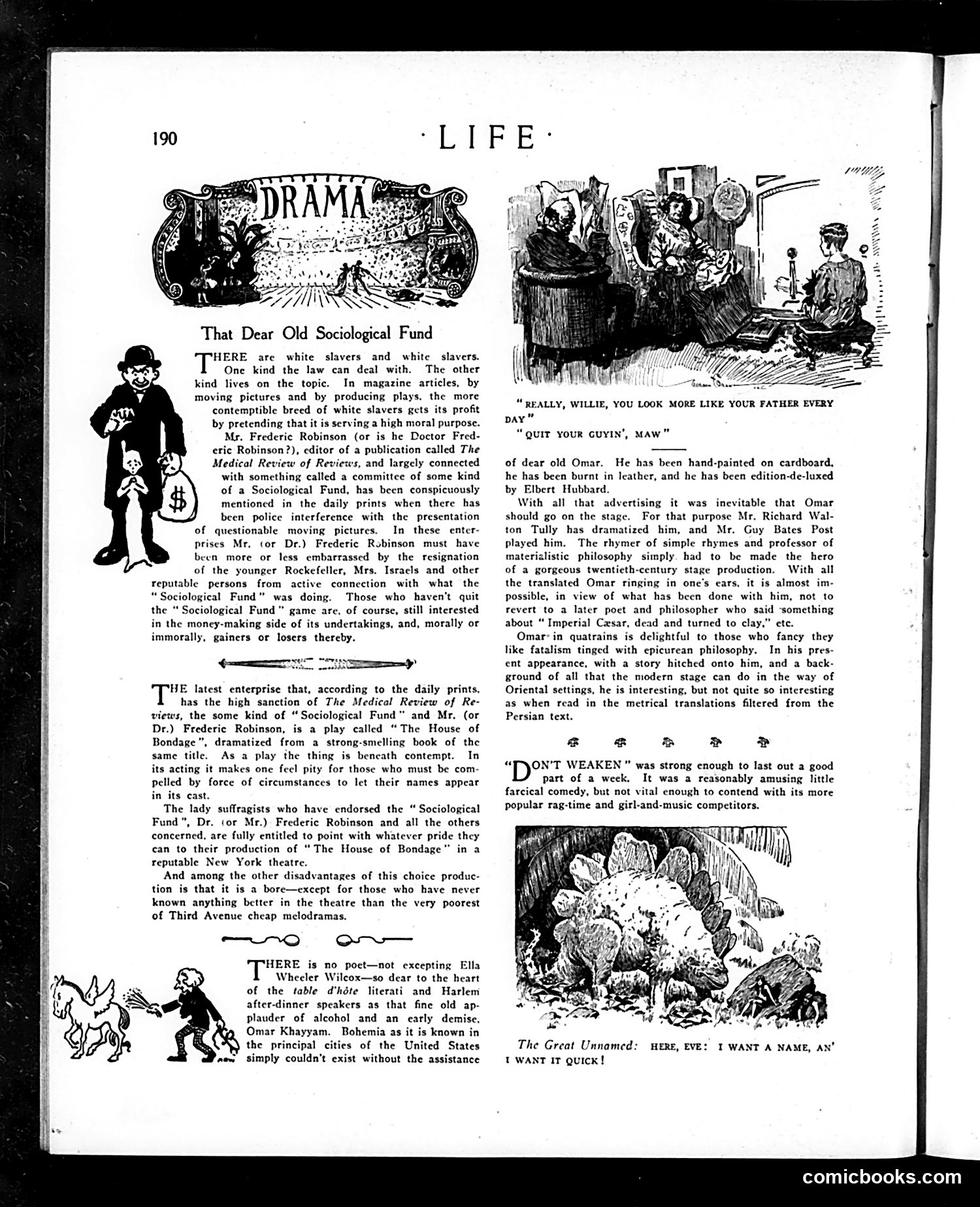
This page satirizes moral hypocrisy in Progressive-era entertainment and reform. **Main target:** Frederic Robinson and the "Sociological Fund"—a supposedly charitable organization that claims to combat vice (particularly white slavery) through plays and films, but actually profits from the salacious content it purports to condemn. The article notes Robinson presents morally questionable entertainment as "serving a high moral purpose." **Key figures:** Young Rockefeller and Mrs. Israels are mentioned as respectable people who *resigned* from the organization, suggesting they recognized the fraud. The article credits lady suffragists with endorsing the group—likely implying they were manipulated by false moral claims. **The plays discussed:** "The House of Bondage" and an Omar Khayyam adaptation are savaged as artistically terrible yet profitable ventures dressed in reformist language. **The satire's point:** Life exposes how reformers and editors exploit public concern about social problems to make money while producing inferior art—they're "white slavers" themselves, enslaving audiences to bad theater under the guise of moral improvement.
📄 Transcribed text from this page (OCR, searchable)
Machine-transcribed from the original scan — historical spelling and the odd misread are preserved.
SSS That Dear Old Sociological Fund HERE are white slavers and white slavers. One kind the law can deal with. The other kind lives on the topic. In magazine articles, by moving pictures and by producing plays, the more contemptible breed of white slavers gets its profit by pretending that it is serving a high moral purpose. Mr. Frederic Robinson (or is he Doctor Fred- eric Robinson ?), editor of a publication called The Medical Review of Reviews, and largely connected with something called a committee of some kind of a Sociological Fund, has been conspicuously mentioned in the daily prints when there has been police interference with the presentation of questionable moving pictures. In these enter- prises Mr. ‘or Dr.) Frederic Robinson must have been more or less embarrassed by the resignation of the younger Rockefeller, Mrs. Israels and other reputable persons from active connection with what the “Sociological Fund" was doing. Those who haven't quit the “ Sociological Fund” game are, of course, still interested in the money-making side of its undertakings, and, morally or immorally, gainers or losers thereby. Ey HE latest enterprise that, according to the daily prints. has the high sanction of The Medical Review of Re- views, the some kind of “ Sociological Fund” and Mr. (or Dr.) Frederic Robinson, is a play called “The House of Bondage”, dramatized from a strong-smelling book of the same title. As a play the thing is beneath contempt. In its acting it makes one feel pity for those who must be com- pelled by force of circumstances to let their names appear in its cast. The lady suffragists who have endorsed the “ Sociological Fund”, Dr. ‘or Mr.) Frederic Robinson and all the others concerned, are fully entitled to point with whatever pride they can to their production of “The House of Bondage" in a reputable New York theatre. And among the other disadvantages of this choice produc- tion is that it is a bore—except for those who have never known anything better in the theatre than the very poorest of Third Avenue cheap melodramas. —O OOF HERE is no poet—not excepting Ella Wheeler Wilcox—so dear to the heart of the table d’héte literati and Harlem after-dinner speakers as that fine old ap- plauder of alcohol and an early demise, Omar Khayyam. Bohemia as it is known in the principal cities of the United States ae simply couldn't exist without the assistance “ REALLY, WILLIE, YOU LOOK MORE LIKE YOUR FATHER EVERY pay” “QuIT your GUYIN’, MAW" of dear old Omar. He has been hand-painted on cardboard, he has been burnt in leather, and he has been edition-de-luxed by Elbert Hubbard. With all that advertising it was inevitable that Omar should go on the stage. For that purpose Mr. Richard Wal- ton Tully has dramatized him, and Mr. Guy Bates Post played him. The rhymer of simple rhymes and professor of materialistic philosophy simply. had to be made the hero of a gorgeous twentieth-century stage production. With all the translated Omar ringing in one’s ears, it is almost im- possible, in view of what has been done with him, not to revert to a later poet and philosopher who said something about “Imperial Casar, dead and turned to clay,” ete. Omar’ in quatrains is delightful to those who fancy they like fatalism tinged with epicurean philosophy. In his pres- ent appearance, with a story hitched onto him, and a back- ground of all that the modern stage can do in the way of Oriental settings, he is interesting, but not quite so interesting as when read in the metrical translations filtered from the Persian text. & & & 2 > “P)ON'T WEAKEN " was strong enough to last out a good part of a week. It was a reasonably amusing little farcical comedy, but not vital enough to contend with its more popular rag-time and girl-and-music competitors. pi Ai The Great Unnamed: T WANT IT guicx! HERE, EVE: I WANT A NAME, AN’ comicbooks.com