
Life, 1914-01-29 · page 24 of 40
Life — January 29, 1914 — page 24: what you’re looking at
What you’re looking at
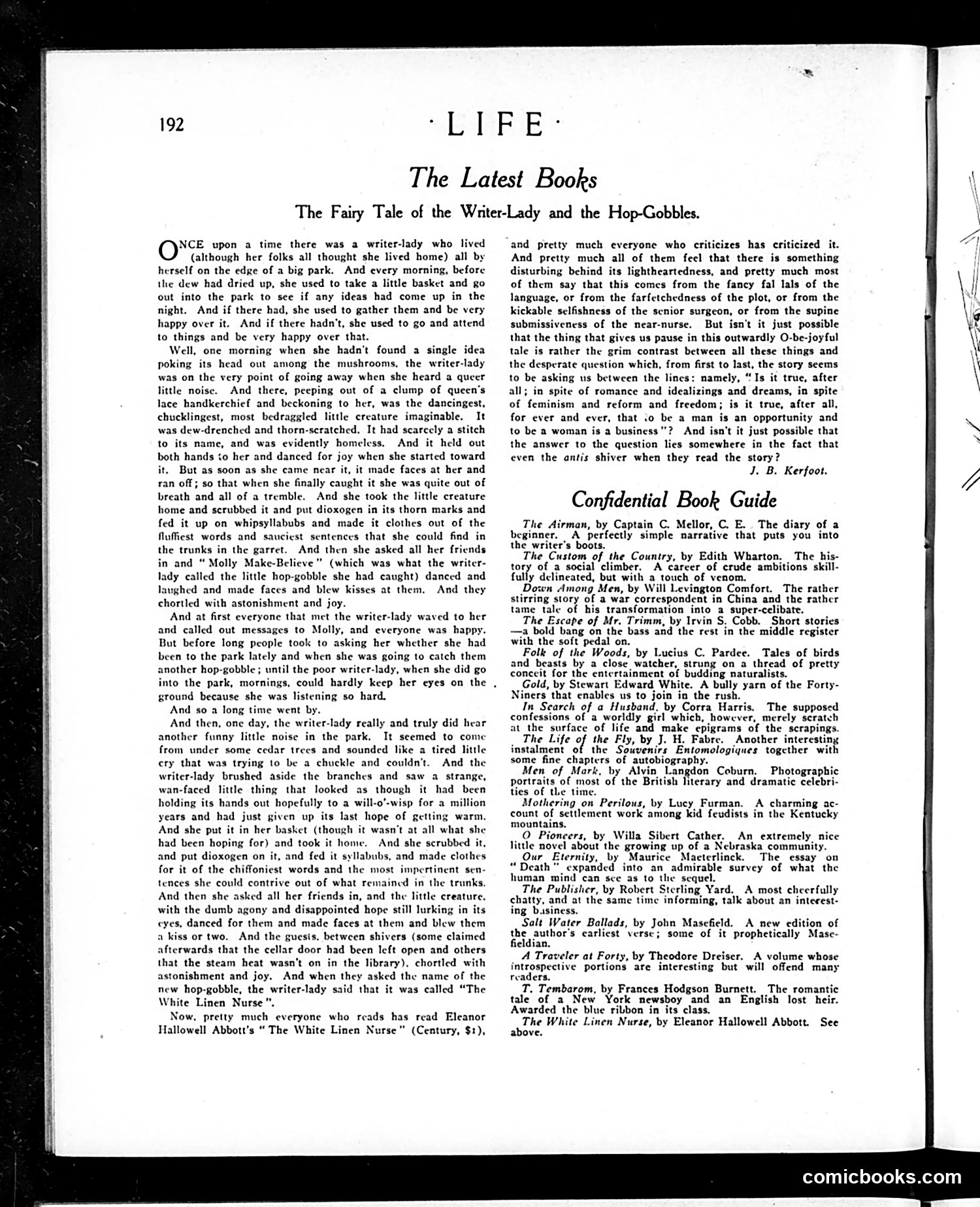
This page contains a satirical fairy tale titled "The Fairy Tale of the Writer-Lady and the Hop-Gobbles," authored by J. B. Kerfoot (byline visible at right). The story mocks **women writers and their creative output**. The "writer-lady" represents female authors who search for creative inspiration ("ideas") in nature. She discovers whimsical creatures called "hop-gobbles"—appearing to represent sentimental or fanciful literary creations. The satire's point: her first creation ("Molly Make-Believe") charms everyone initially, but audiences eventually demand more. She produces a second, inferior creation ("The White Linen Nurse") that disappoints—it's wan, desperate, and joyless. The tale suggests that **women writers, particularly those in sentimental genres, cannot sustain quality work** and resort to increasingly desperate, artificial efforts to maintain reader interest. The reference to Eleanor Hallowell Abbott at the story's end (author of "The White Linen Nurse") indicates this is a direct literary criticism of a contemporary female author's work.
📄 Transcribed text from this page (OCR, searchable)
Machine-transcribed from the original scan — historical spelling and the odd misread are preserved.
“LIFE: The Latest Books The Fairy Tale of the Wniter-Lady and the Hop-Gobbles. NCE upon a time there was a writer-lady who lived (although her folks all thought she lived home) all by herself on the edge of a big park. And every morning, before the dew had dried up, she used to take a little basket and go out into the park to see if any ideas had come up in the night. And if there had, she used to gather them and be very happy over it. And if there hadn't, she used to go and attend to things and be very happy over that. Well, one morning when she hadn't found a single idea poking its head out among the mushrooms, the writer-lady was on the very point of going away when she heard a queer little noise. And there, peeping out of a clump of queen's lace handkerchief and beckoning to her, was the dancingest, chucklingest, most bedraggled little creature imaginable. It was dew-drenched and thorn-scratched. It had scarcely a stitch to its name, and was evidently homeless, And it held out both hands to her and danced for joy when she started toward it. But as soon as she came near it, it made faces at her and ran off; so that when she finally caught it she was quite out of breath and all of a tremble. And she took the little creature home and scrubbed it and put dioxogen in its thorn marks and fed it up on whipsyllabubs and made it clothes out of the fluffiest words and sauciest sentences that she could find in the trunks in the garret. And then she asked all her friends in and “ Molly Make-Believe” (which was what the writer- lady called the little hop-gobble she had caught) danced and laughed and made faces and blew kisses at them. And they chortled with astonishment and joy. And at first everyone that met the writer-lady waved to her and called out messages to Molly, and everyone was happy. But before long people took to asking her whether she had been to the park lately and when she was going to catch them another hop-gobble ; until the poor writer-lady, when she did go into the park, mornings, could hardly keep her eyes on the ground because she was listening so hard, And so a long time went by. And then, one day, the writer-lady really and truly did hear another funny little noise in the park. It seemed to come from under some cedar trees and sounded like a tired little cry that was trying to be a chuckle and couldn't. And the writer-lady brushed aside the branches and saw a strange, wan-faced little thing that looked as though it had been holding its hands out hopefully to a will-o’-wisp for a million years and had just given up its last hope of getting warm. And she put it in her basket (though it wasn’t at all what she had been hoping for) and took it home. And she scrubbed it, and put dioxogen on it, and fed it syllabubs, and made clothes for it of the chiffoniest words and the most impertinent sen- tences she could contrive out of what remained in the trunks. And then she asked all her friends in, and the little creature, with the dumb agony and disappointed hope still lurking in its cyes, danced for them and made faces at them and blew them a kiss or two. And the guests. between shivers (some claimed afterwards that the cellar door had been left open and others that the steam heat wasn’t on in the library), chortled with astonishment and joy. And when they asked the name of the new hop-gobble, the writer-lady said that it was called “The White Linen Nurse”. Now, pretty much everyone who reads has read Eleanor Hallowell Abbott’s “ The White Linen Nurse” (Century, $1), and pretty much everyone who criticizes has criticized it. And pretty much all of them feel that there is something disturbing behind its lightheartedness, and pretty much most of them say that this comes from the fancy fal lals of the language, or from the farfetchedness of the plot, or from the kickable selfishness of the senior surgeon, or from the supine submissiveness of the near-nurse. But isn't it just possible that the thing that gives us pause in this outwardly O-be-joyful tale is rather the grim contrast between all these things and the desperate question which, from first to last, the story seems to be asking us between the lincs: namely, “Is it true, after all; in spite of romance and idealizings and dreams, in spite of feminism and reform and freedom; is it true, after all, for ever and ever, that .o be a man is an opportunity and to be a woman is a business"? And isn't it just possible that the answer to the question lies somewhere in the fact that even the antis shiver when they read the story? J. B. Kerfoot. Confidential Book Guide The Airman, by Captain C. Mellor, C. E. The diary of a beginner. A perfectly simple narrative that puts you into the writer's boots. The Custom of the Country, by Edith Wharton, The his- tory of a social climber. A career of crude ambitions skill- fully delineated, but with a touch of venom. Down Among Men, by Will Levington Comfort. The rather stirring story of a war correspondent in China and the rather tame tale of his transformation into a super-celibate. The Escape of Mr. Trimm, by Irvin S, Cobb. Short stories —a bold bang on the bass and the rest in the middle register with the soft pedal on. Folk of the Woods, by Lucius C. Pardee. Tales of birds and beasts by a close watcher, strung on a thread of pretty conccit for the entertainment of budding naturalists. Gold, by Stewart Edward White. A bully yarn of the Forty- Niners that enables us to join in the rush. In Search of a Husband, by Corra Harris. The supposed confessions of a worldly girl which, however, merely scratch at the surface of life and make epigrams of the scrapings. The Life of the Fly, by J. H. Fabre. Another interestin; instalment of the Souvenirs Entomologiques together wit! some fine chapters of autobiography. Men of Mark, by Alvin Langdon Coburn. Photographic portraits of most of the British literary and dramatic celebri- ties of the time. Mothering on Perilous, by Lucy Furman. A charming ac- count of settlement work among kid feudists in the Kentucky mountains. ..O Pioneers, by Willa Sibert Cather. An extremely nice little novel about the growing up of a Nebraska community. Our Eternity, by Maurice Maeterlinck. The essay on “Death” expanded into an admirable survey of what the human mind can sce as to the sequel. The Publisher, by Robert Sterling Yard. A most cheerfully chatty, and at the same time informing, talk about an intecest- ing business. Salt Water Ballads, by John Masefield. A new edition of the author's carliest verse; some of it prophetically Mase- fieldian. A Traveler at Forty, by Theodore Dreiser. A volume whose introspective portions are interesting but will offend many readers. T. Tembarom, by Frances Hodgson Burnett. The romantic tale of a New York newsboy and an English lost heir. Awarded the blue ribbon in its class. poled White Linen Nurse, by Eleanor Hallowell Abbott. See above. comicbooks.com