
Life, 1914-01-29 · page 28 of 40
Life — January 29, 1914 — page 28: what you’re looking at
What you’re looking at
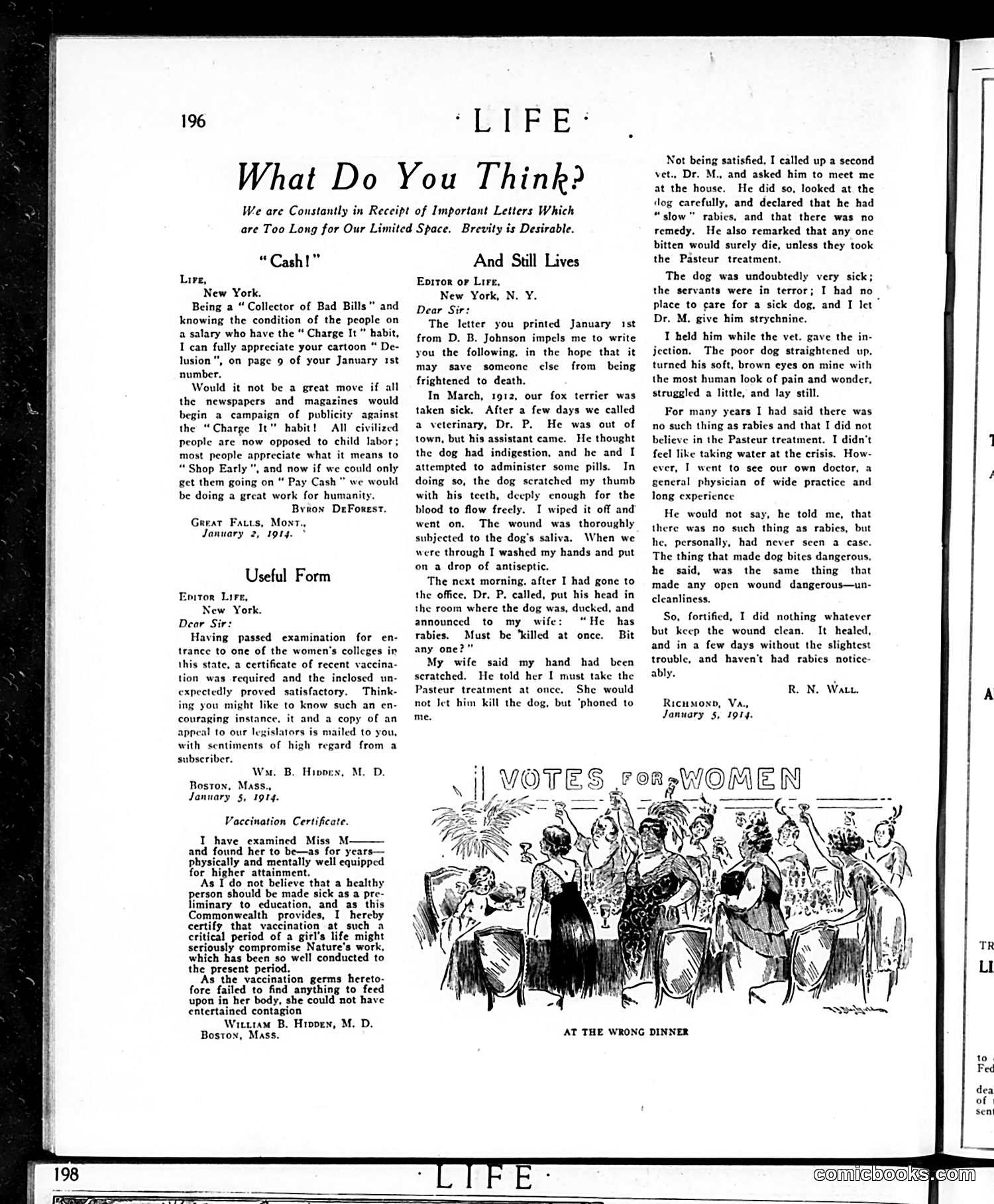
This page features readers' letters to the editor on various topics. The cartoon "At the Wrong Dinner" (bottom) appears to satirize women's suffrage advocacy—showing women at a formal dinner, likely making political arguments for voting rights in an inappropriate social setting. The caption suggests the humor lies in the *timing* or *venue* of such activism. The letters themselves address: (1) consumer debt and the "Charge It" habit, with one reader advocating newspapers promote "Pay Cash" campaigns; (2) vaccination requirements for college entrance, with a doctor providing an alternative "vaccination certificate" claiming healthy people shouldn't be artificially sickened; and (3) a lengthy account of a fox terrier possibly exposed to rabies in 1912, questioning whether the Pasteur treatment was necessary. The page reflects Progressive Era debates about consumer habits, medical mandates, and public health—issues still recognizable today, though the suffrage reference requires historical context.
📄 Transcribed text from this page (OCR, searchable)
Machine-transcribed from the original scan — historical spelling and the odd misread are preserved.
“Cash!” Lie, New York. Being a “Collector of Bad Bills” and knowing the condition of the people on a salary who have the “ Charge It” habit, I can fully appreciate your cartoon “ De- lusion”, on page 9 of your January 1st number, Would it not be a great move if all the newspapers and magazines would begin a campaign of publicity against the “Charge It" habit! All civilized people are now opposed to child labor; most people appreciate what it means to “ Shop Early”, and now if we could only get them going on “ Pay Cash " we would be doing a great work for humanity. Byron DeForest. Great Fatts, Moxr., January 2, 1914. ° Useful Form Enitor Lire, New York. Dear Sir: Having passed examination for en- trance to one of the women's colleges in this state, a certificate of recent vaccina- tion was required and the inclosed un- expectedly proved satisfactory. Think- ing you might like to know such an en- couraging instance, it and a copy of an appeal to our legislators is mailed to you, with sentiments of high regard from a subscriber. Wa. B Boston, Mass., January §, 1914. Hipvex, M. D. Vaccination Certificate. I have examined Miss M- and found her to be—as for years— physically and mentally well equipped for higher attainment. As I do not believe that a healthy rson should be made sick as a pre- iminary to education, and as this Commonwealth provides, I hereby certify that vaccination such a critical period of a girl's life might seriously compromise Nature's work, which has been so well conducted to the present period, As the vaccination germs hereto- fore failed to find anything to feed upon in her body, she could not have entertained contagion Witutaw B. Hrovey, M. D. Bostox, Mass. ULAIRETE = What Do You Think? We are Constantly in Receipt of Important Letters Which are Too Long for Our Limited Space. Brevity is Desirable. And Still Lives Enrror or Lire, New York, N. Y. Dear Sir: The letter you printed January 1st from D, B. Johnson impels me to write you the following, in the hope that it may save someone from being frightened to death. In March, 1912, our fox terrier was taken sick. After a few days we called a veterinary, Dr. P. He was out of town, but his assistant came. He thought the dog had indigestion, and he and I attempted to administer some pills. In doing so, the dog scratched my thumb with his teeth, deeply enough for the blood to flow freely. I wiped it off and went on, The wound was thoroughly subjected to the dog's saliva. When we were through I washed my hands and put on a drop of antiseptic. The next morning, after I had gone to the office. Dr. P. called, put his head in the room where the dog was, ducked, and announced to my fe: “He has rabies. Must be ‘killed at once. Bit any one?” My wife else said my hand had been scratched. He told her I must take the Pasteur treatment at once, She would not Iet him kill the dog, but ‘phoned to me. Not being satisfied, I called up a second vet., Dr. M., and asked him to meet me at the house. He did so, looked at the dog carefully, and declared that he had “slow” rabies, and that there was no remedy. He also remarked that any one bitten would surely die, unless they took the Pasteur treatment. The dog was undoubtedly very sick; the servants were in terror; I had no place to care for a sick dog, and TI let” Dr. M. give him strychnine. T held him while the vet. gave the in- jection, The poor dog straightened up, turned his soft, brown eyes on mine with the most human look of pain and wonder, struggled a little, and lay still. For many years I had said there was no such thing as rabies and that I did not believe in the Pasteur treatment. I didn’t feel like taking water at the crisis. How- ever, I went to see our own doctor, a general physician of wide practice and long experience He would not say, he told me, that there was no such thing as rabies, but he, personally, had never scen a case. The thing that made dog bites dangerous, he said, was the same thing that made any open wound dangerous—un- cleanliness. So, fortified, I did nothing whatever but keep the wound clean. It healed, and in a few days without the slightest trouble, and haven't had rabies notice- ably. R.N. Watt. Ricumonxp, Va, January $, 1914. AT THE WRONG DINNER