
A complete issue · 40 pages · 1913
Life — December 11, 1913
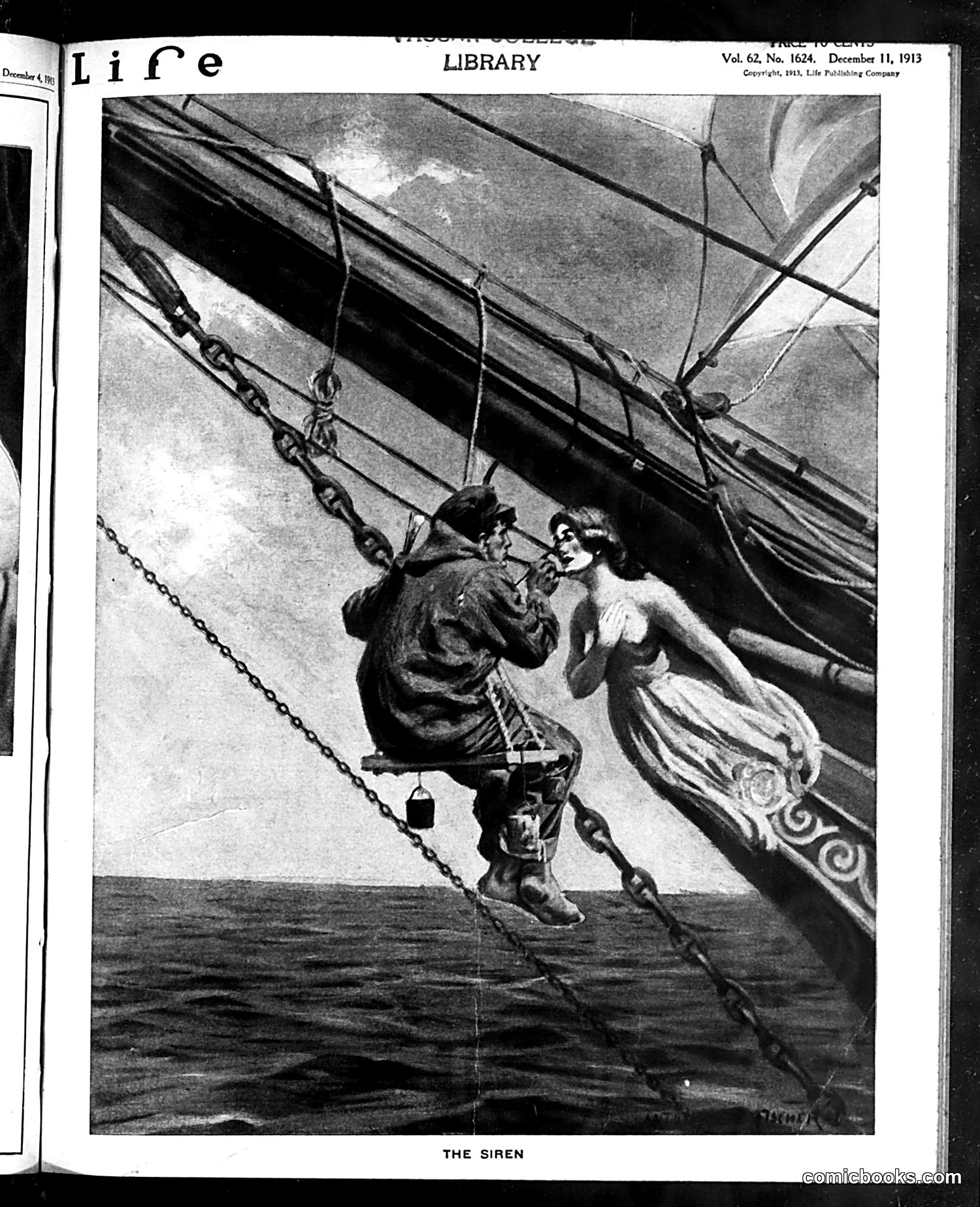
This illustration depicts a classical mythological scene: a sailor being lured by a siren—a legendary sea creature whose enchanting song supposedly drew sailors to their doom. The image shows a uniformed sailor climbing a rope toward a ship while a bare-breasted female figure (the siren) beckons from above, representing dangerous feminine allure. The cartoon likely functions as social commentary on temptation and male vulnerability, using the timeless myth as metaphor. The siren's seductive power over the sailor suggests themes about moral weakness or the dangers of distraction—whether literal naval hazards or broader social critiques about desire and judgment. The classical subject matter was common in early 20th-century satirical illustration.
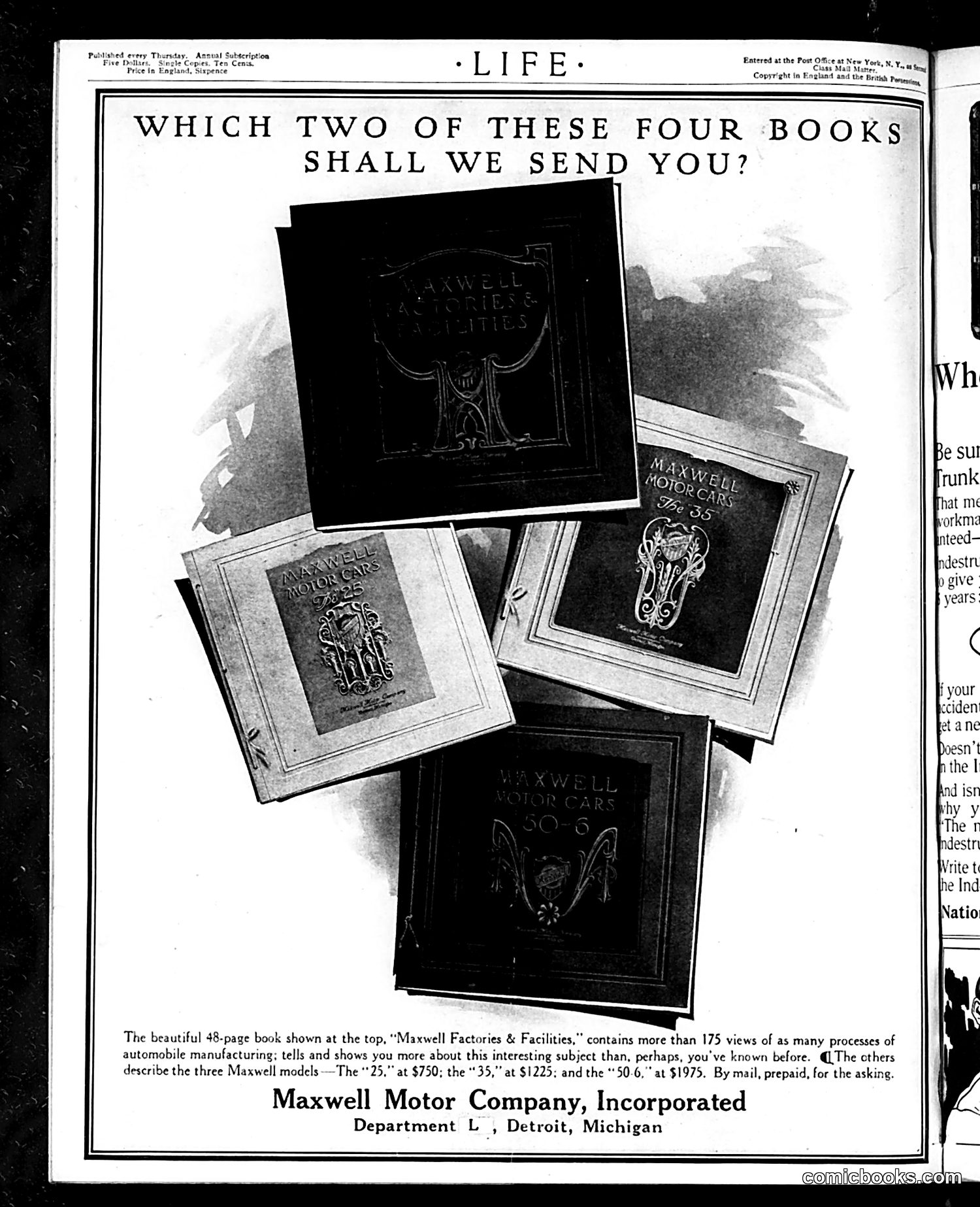
This page is primarily a **Maxwell Motor Company advertisement**, not satirical content. It promotes four books about Maxwell automobiles and their manufacturing processes, asking readers to choose which two they'd like to receive. The advertisement showcases book covers featuring Maxwell motor car models: the "25," "35," and "50.6," with prices listed ($750, $1225, and $1975 respectively). The central book, "Maxwell Factories & Facilities," contains 48 pages with over 175 views of manufacturing processes and automobile production. This represents early 20th-century industrial-era advertising strategy—using educational materials about manufacturing to build consumer interest and trust in the product. There is no political satire or caricature present; it's straightforward commercial promotion.
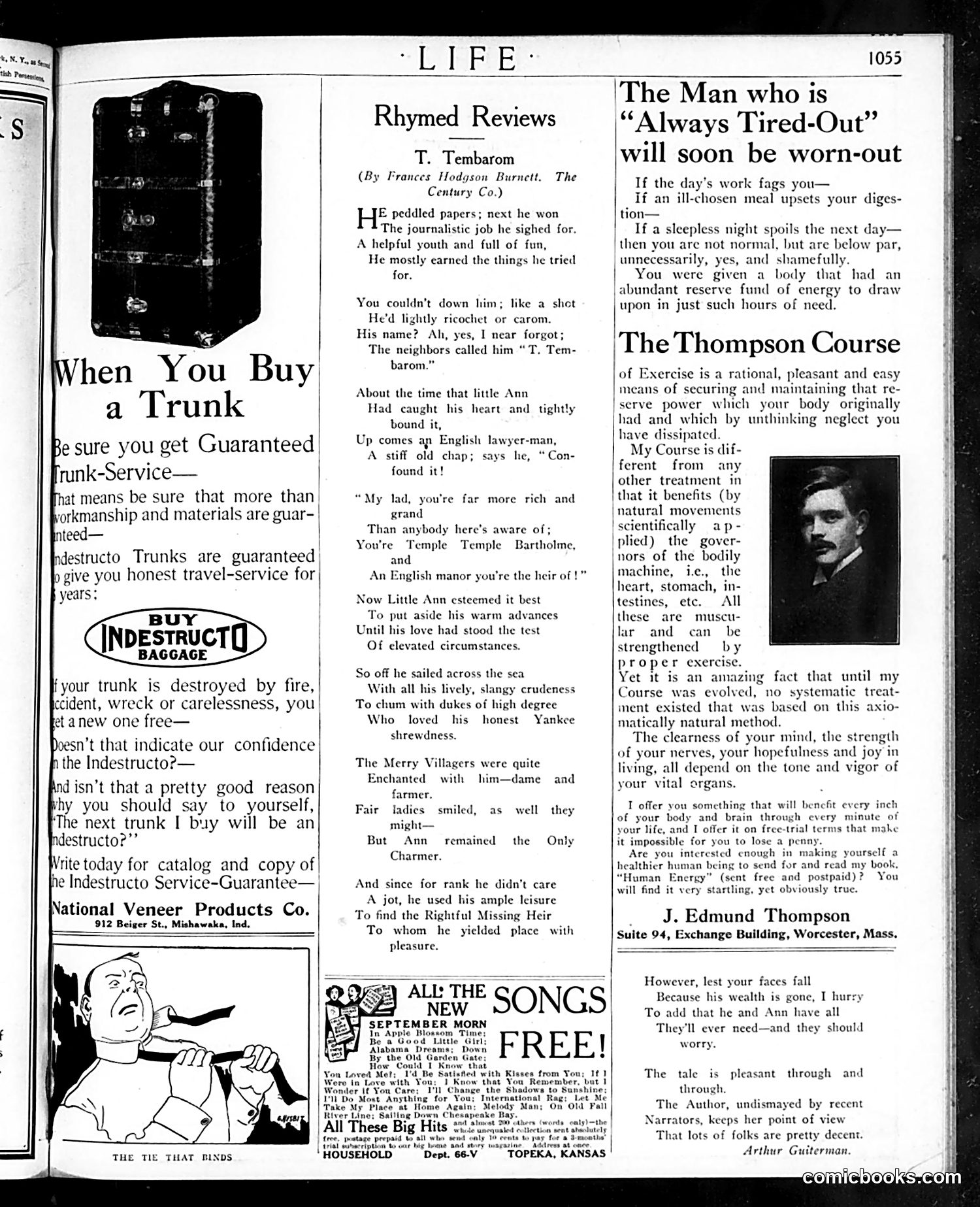
This page is **primarily advertising and editorial content** rather than political satire. The main elements are: **"When You Buy a Trunk"** — An Indestructo Baggage advertisement emphasizing guaranteed durability and service. **"Rhymed Reviews: T. Tembarom"** — A book review in verse form about Frances Hodgson Burnett's novel, following a wealthy English heir and an American girl's romantic storyline. The satirical tone gently mocks upper-class pretension and romantic conventions of the era. **"The Thompson Course of Exercise"** — A health/fitness advertisement featuring J. Edmund Thompson promoting natural exercise methods. **"All the New Songs"** — Sheet music advertising. The page reflects early 20th-century consumer culture, with mixed editorial and commercial content typical of Life magazine's format during this period.
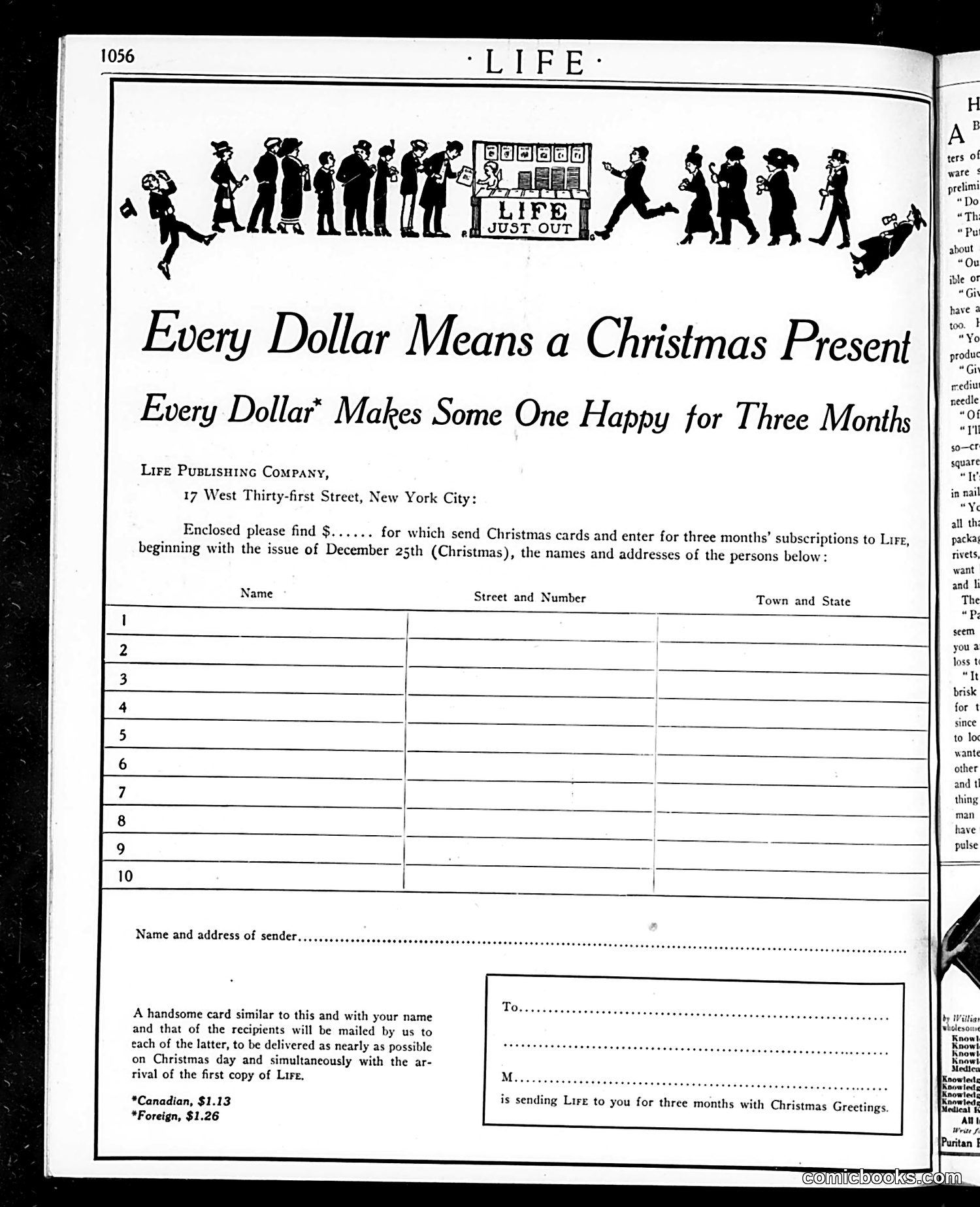
This page is primarily **advertising content**, not satire or political commentary. It's a subscription promotion for *Life* magazine presented as a Christmas gift offer. The illustration at top shows a stylized queue of figures (appearing to represent diverse recipients) at a "Life Just Out" newsstand kiosk, with figures departing in various directions. This visualizes the magazine's broad readership and circulation. The core pitch: sending dollar donations purchases three-month *Life* subscriptions as Christmas presents for recipients' names listed below. The message—"Every Dollar Makes Some One Happy for Three Months"—frames magazine subscriptions as charitable gifts. Pricing notes Canadian ($1.13) and Foreign ($1.26) rates, suggesting this targets American donors sending gifts internationally during wartime (likely WWI or WWII era).
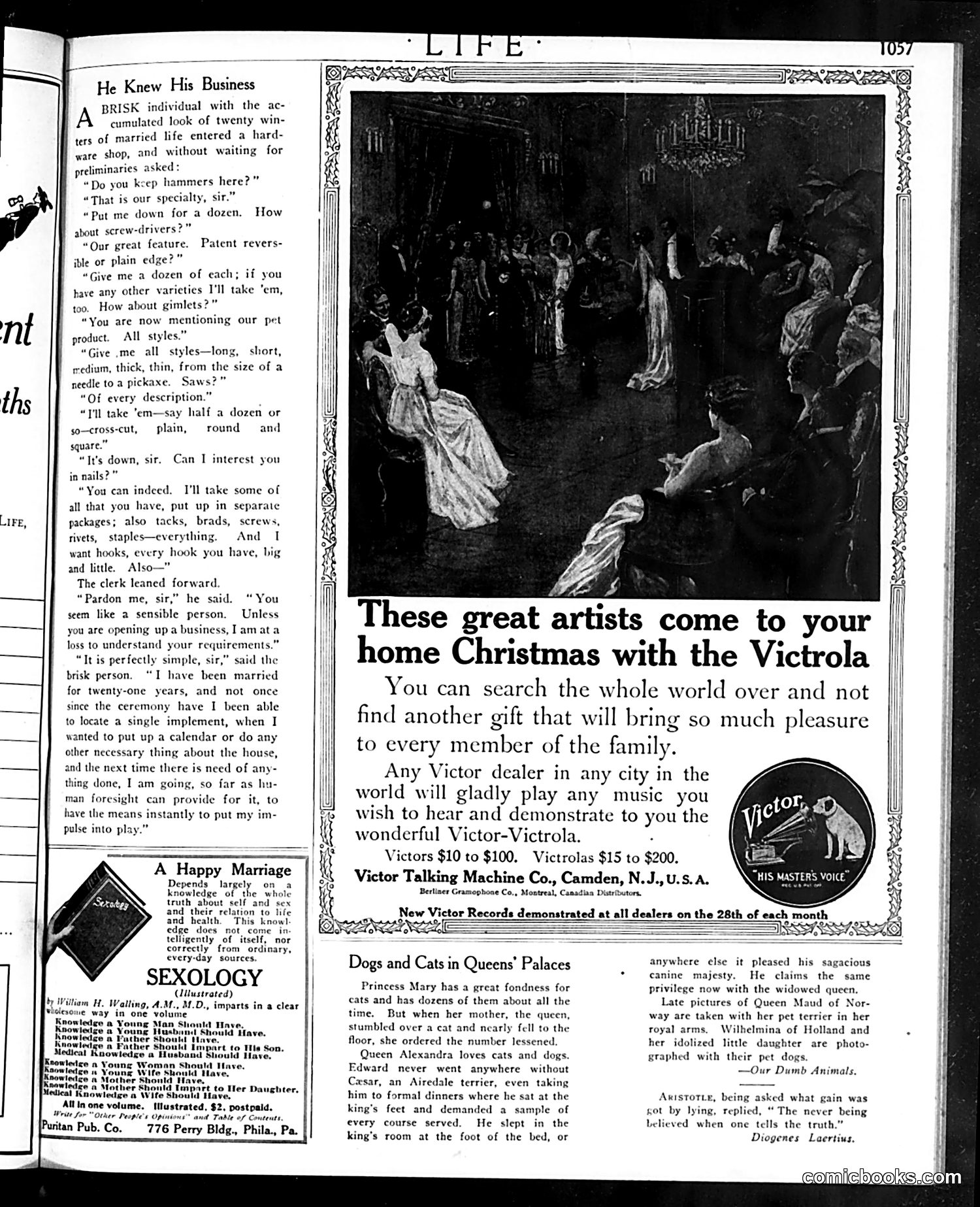
This page contains **primarily advertising and light content rather than political satire**. The main image advertises the **Victrola phonograph**, showing well-dressed people at what appears to be a formal gathering or concert. The ad emphasizes the Victrola as an ideal Christmas gift, claiming it brings "great artists" into the home. Below this is a brief humorous anecdote titled "He Knew His Business," depicting a hardware store clerk confidently upselling a customer on various products—a gentle satire on salesmanship and commercial efficiency rather than politics. The remaining content includes a book advertisement for "Sexology" and a brief piece on "Dogs and Cats in Queens' Palaces" about royal pets. The page reflects early 20th-century consumer culture and advertising aesthetics.
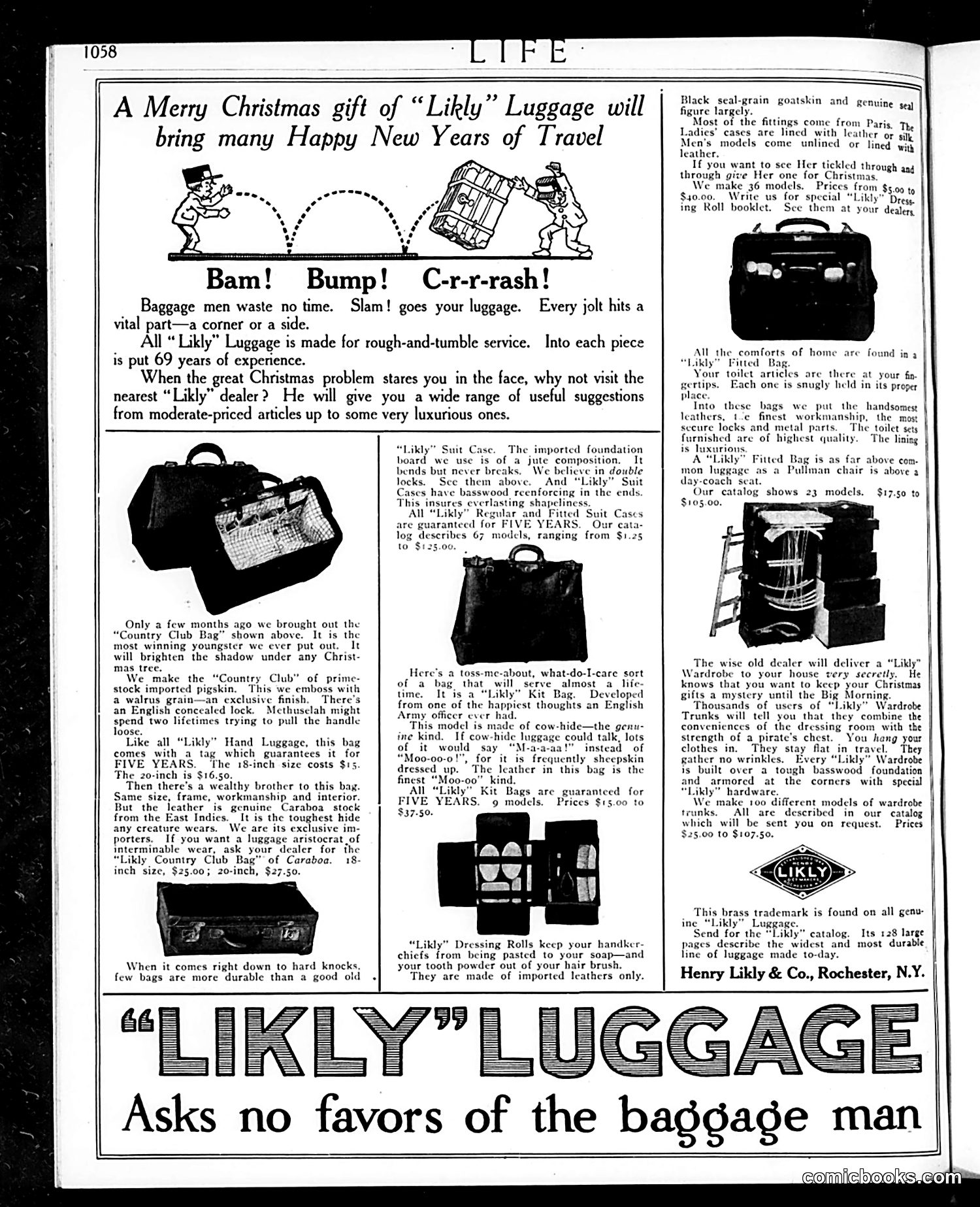
This page is primarily an advertisement for "Likly" brand luggage, not a political cartoon. The ad uses humorous illustrations and copywriting to market various travel bags and accessories as durable Christmas gifts. The satire is gentle and commercial: it mocks baggage handlers through exaggerated sound effects ("Bam! Bump! C-r-r-ash!") and claims that Likly luggage, having "60 years of experience," can withstand rough treatment. The cartoons show luggage being roughly tossed by porters—a relatable complaint for travelers of that era. The ad emphasizes durability and value across multiple product lines (suit cases, wardrobe trunks, dressing rolls, kit bags), positioning Likly as the solution to travel frustrations. There is no political content; it's purely commercial messaging targeting prosperous travelers.
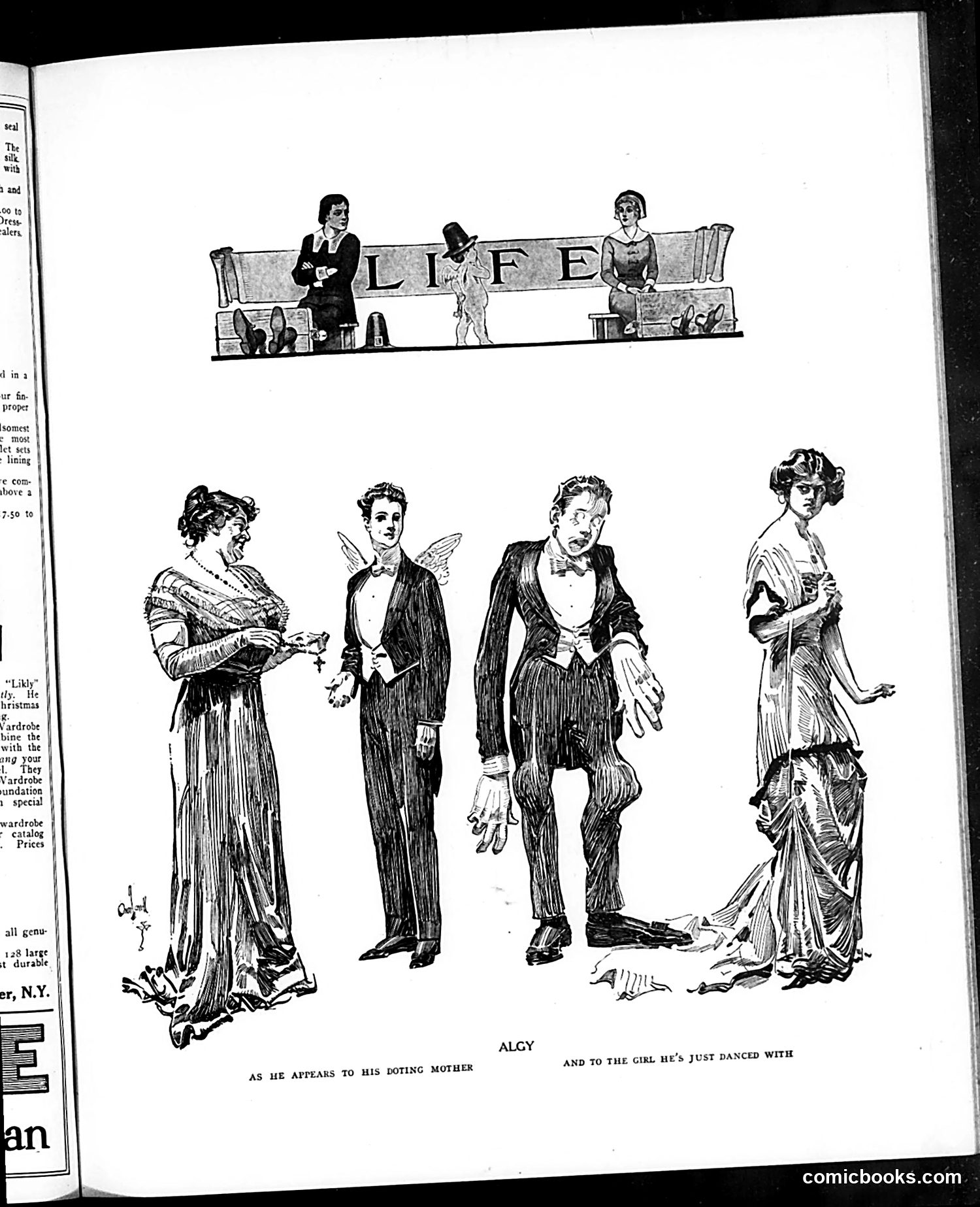
This page depicts "Algy," a character appearing to his doting mother (left) and to a girl he's just danced with (right). The illustration satirizes a particular type of young man—likely a wealthy, effeminate dandy or society figure of the early 20th century. The top panel shows what appears to be a social scene at an elegant venue (possibly a theater or club, given "LFFE" visible on the backdrop). The bottom illustrations contrast Algy's behavior: appearing refined and proper before his mother, while revealing himself as awkward or ridiculous to the young woman he's courted. The satire mocks a specific social archetype—the mama's boy or foppish gentleman who cannot maintain consistent dignity in different social contexts. This reflects period anxieties about masculinity and social pretense.
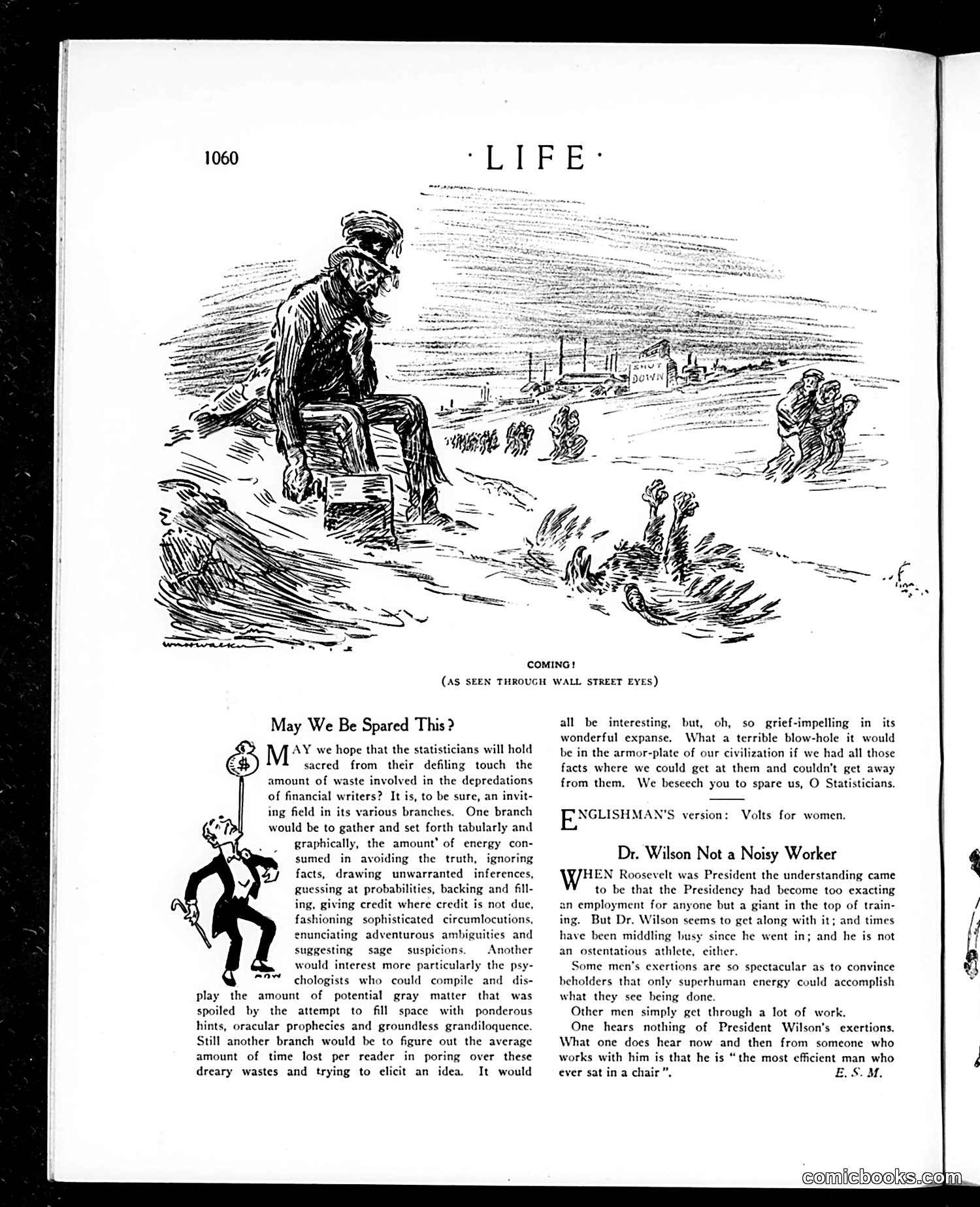
The main illustration depicts a skeletal soldier sitting on a grave, overlooking an industrial landscape with factories and troops—a WWI commentary on mechanized warfare's human cost, captioned "Coming! (As Seen Through Wall Street Eyes)." The article "May We Be Spared This?" criticizes financial writers for speculative, sensationalist reporting about wartime waste and inefficiency. It accuses them of drawing unwarranted conclusions and fashioning "sophisticated circumlocutions" to fill space with grandiloquent language—essentially mocking financial journalism's tendency toward verbose, unjustified doom-saying. A secondary piece humorously notes President Roosevelt's aide Dr. Wilson doesn't draw attention despite working hard, contrasting him with more ostentatious colleagues.
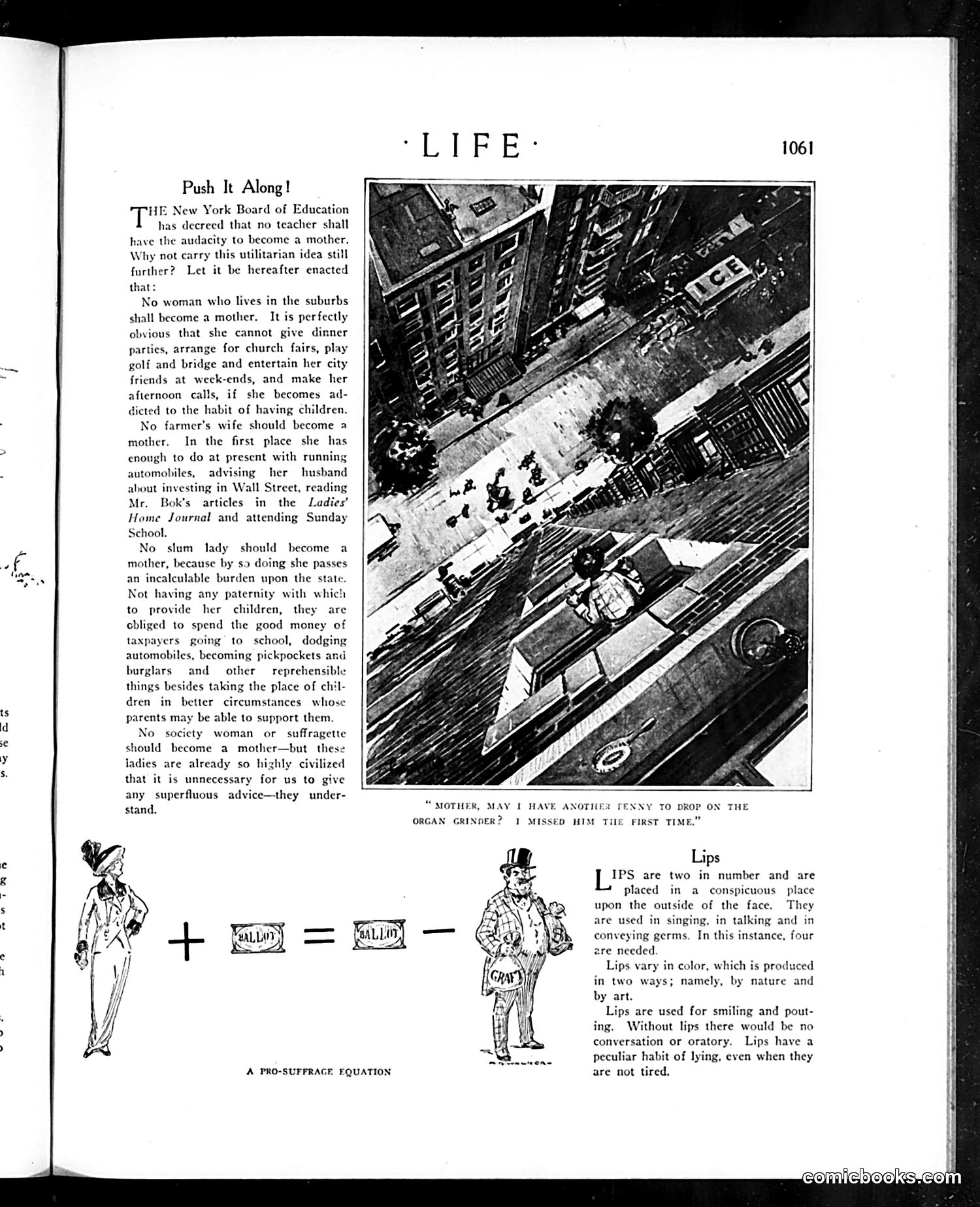
This page satirizes the New York Board of Education's decision prohibiting teachers from becoming mothers. The "Push It Along!" editorial argues this rule is absurdly expansive—if we deny motherhood to teachers, why not extend the prohibition to suburban women, farmers' wives, slum women, and society women? The accompanying aerial photograph shows a crowded urban street, with the caption joking about a woman missing her chance to "drop" a baby on an organ grinder—dark humor mocking the absurdity of the proposed restrictions. Below, "A Pro-Suffrage Equation" uses a visual math joke: a man plus a ballot equals a man minus a woman—satirizing how women's suffrage advocates worry that voting rights would somehow diminish women's traditional roles, particularly motherhood.
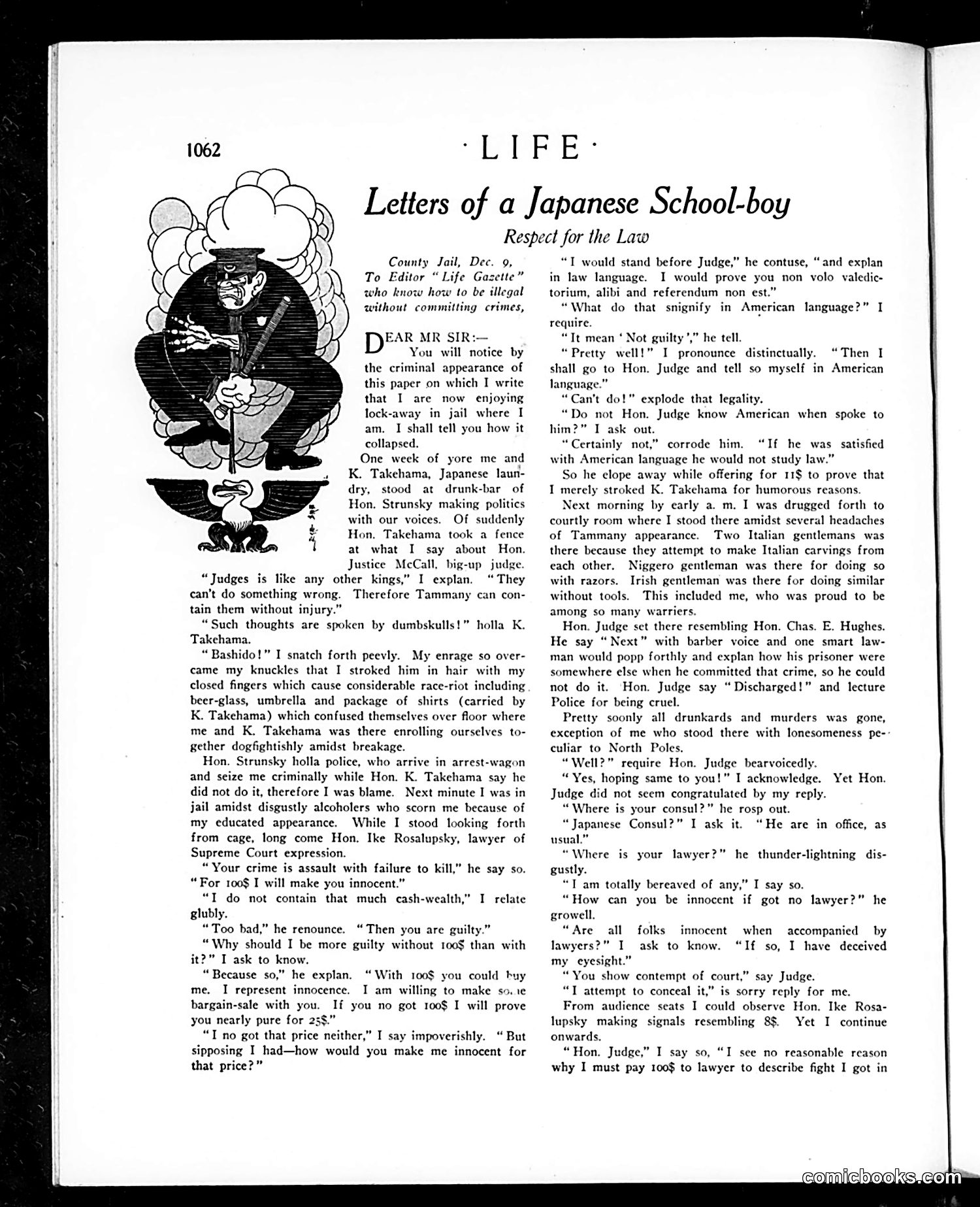
This satirical piece mocks a Japanese visitor's bewilderment with American legal procedures and social customs. The caricatured figure (with exaggerated facial features typical of early-20th-century racist imagery) is confused by the American judicial system—particularly concepts like "not guilty" pleas, the role of lawyers, and bail. The humor derives from cultural clash: the Japanese observer finds it absurd that defendants need lawyers, that innocence requires legal representation, and that justice isn't straightforward. The satire cuts two ways—mocking both Japanese rigidity and American legal complexity. The illustration shows a stereotypical "Oriental" figure in traditional dress, reflecting the period's casual racism. The piece appears designed to amuse American readers by portraying foreign incomprehension of their own institutions.
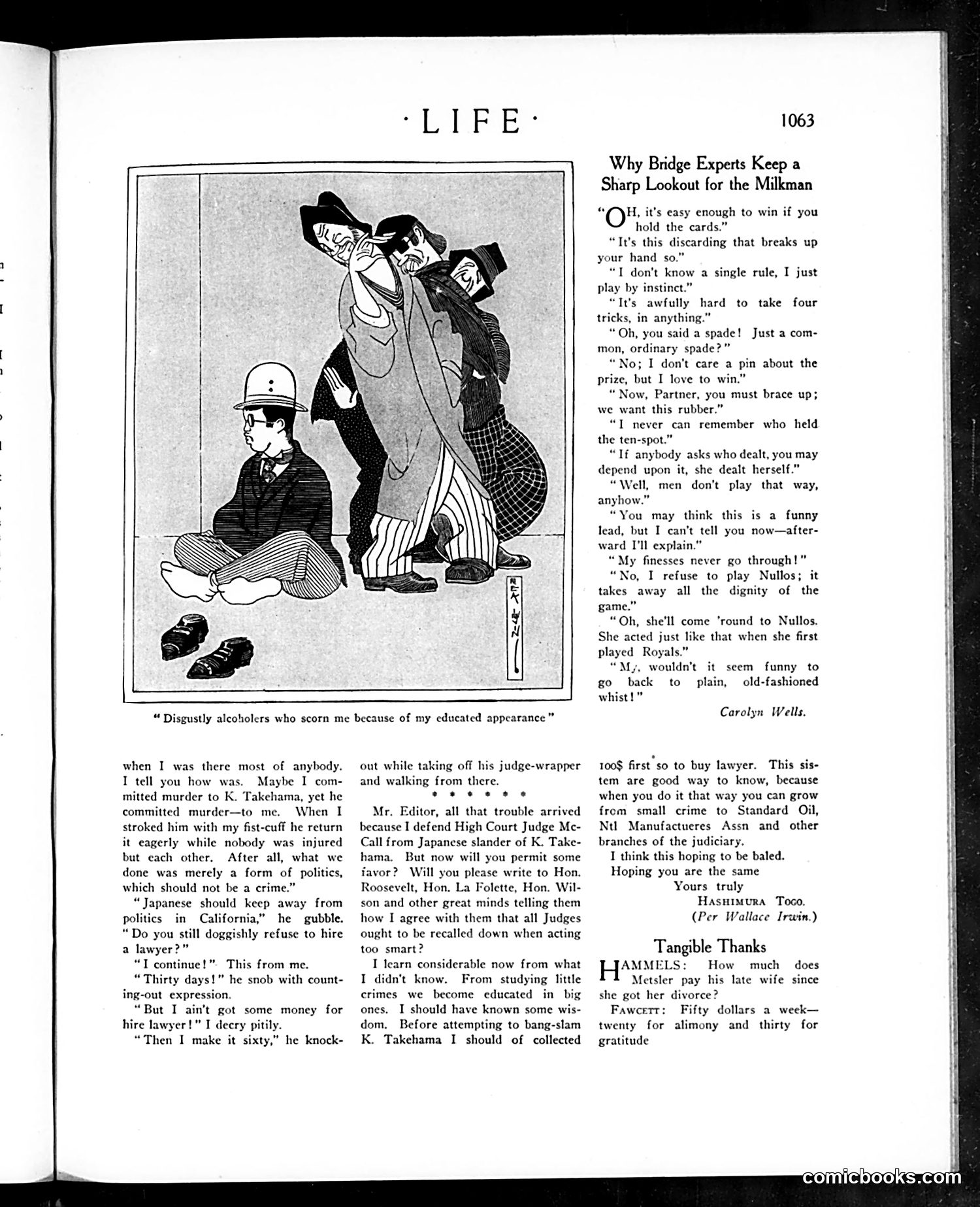
This page contains a satirical cartoon and accompanying text about bridge (the card game). The cartoon depicts a man in a suit gesticulating dramatically while playing cards with a woman, illustrating the article's theme: "Why Bridge Experts Keep a Sharp Lookout for the Milkman." The humor involves a man caught cheating at bridge—apparently signaling to a partner (likely his wife) about his hand. The reference to "the milkman" suggests infidelity, implying that while husbands worry about the mailman/delivery person visiting their wives, the real scandal is the husband's cheating at cards. The accompanying text presents dialogue between bridge players debating rules and competitive honor. This satirizes both bridge culture's complexity and contemporary anxieties about marital fidelity and gentlemen's conduct during the interwar period.
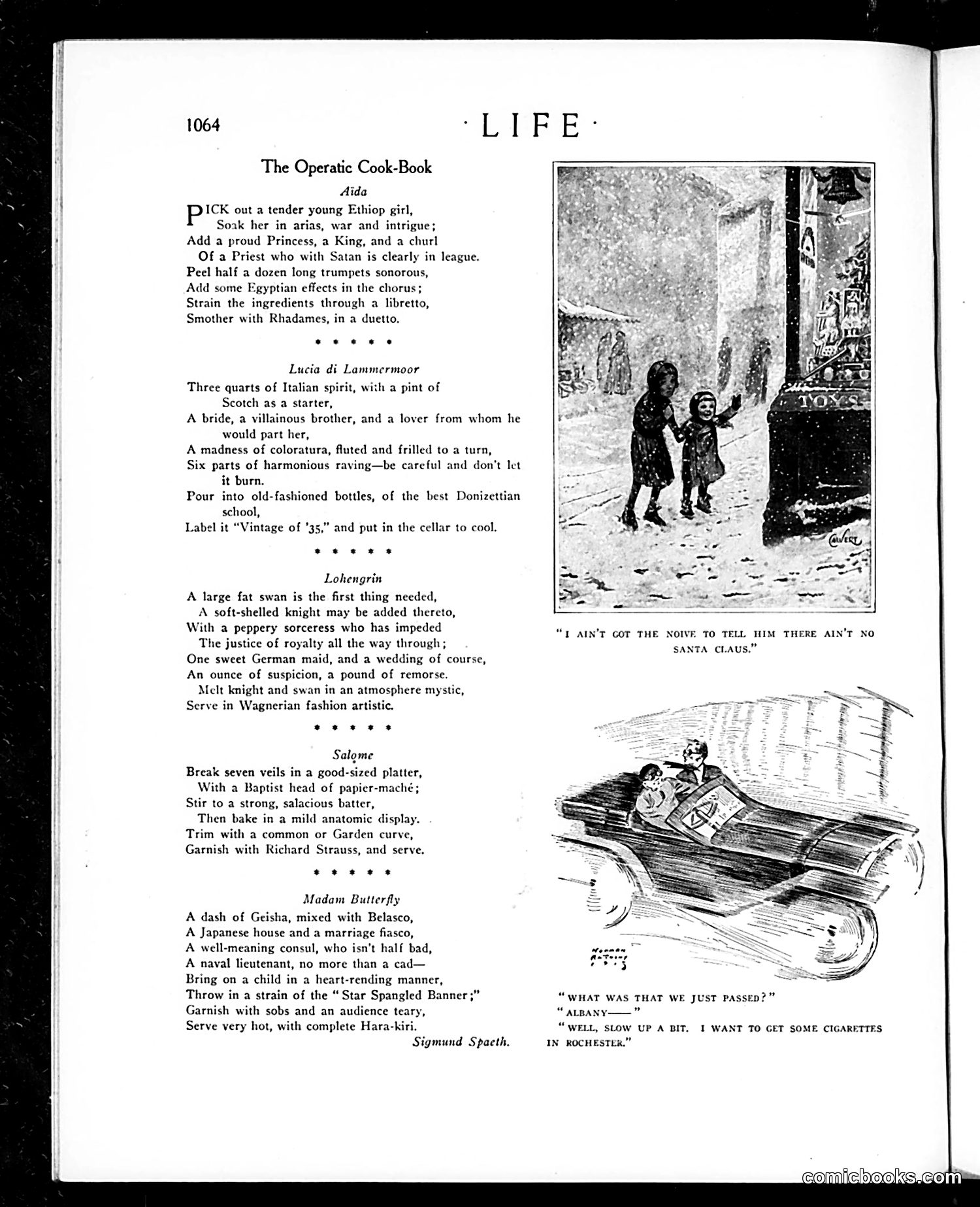
This page presents "The Operatic Cook-Book," a humorous section pairing absurdist recipes with operatic titles (*Lucia di Lammermoor, Lohengrin, Salome, Madam Butterfly, Sigmund Spaeth*). The two cartoons illustrate winter holiday scenes. The top image shows children encountering Santa Claus with the caption "I AIN'T GOT THE NOIVE TO TELL HIM THERE AIN'T NO SANTA CLAUS"—using working-class dialect for comedic effect. The bottom cartoon depicts children in a sleigh with dialogue about stopping for cigarettes in Rochester, suggesting humorous obliviousness to what appears to be a dangerous or inappropriate situation. Both comics employ period-typical humor about childhood innocence and class-marked speech patterns typical of early 20th-century American satire.
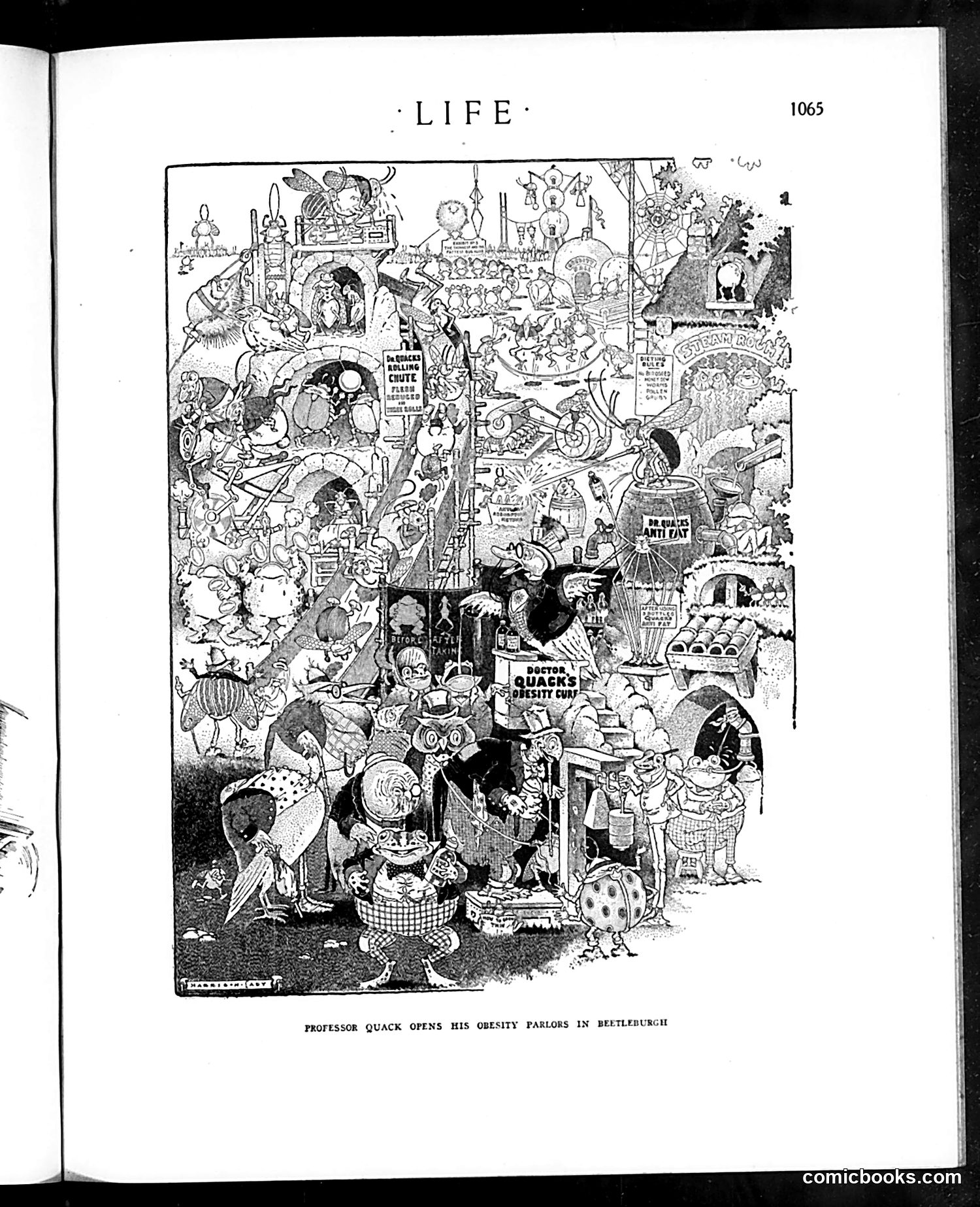
This is a satirical cartoon mocking fraudulent weight-loss schemes. The caption references "Professor Quack," a stock character representing quack doctors and charlatans. The densely-packed illustration depicts an absurd, fantastical establishment filled with contradictory treatments and dubious contraptions—presumably all promising obesity cures. The satire targets several elements: fake medical authority ("Professor"), the proliferation of sham weight-loss businesses in early 20th-century America, and the gullibility of customers seeking quick fixes. The chaotic, cluttered design emphasizes the absurdity and chaos of such operations. "Beetleburgh" appears to be a fictional town name, possibly chosen for comedic effect. The cartoon likely commented on the prevalence of mail-order remedies and medical frauds that were common during this era.
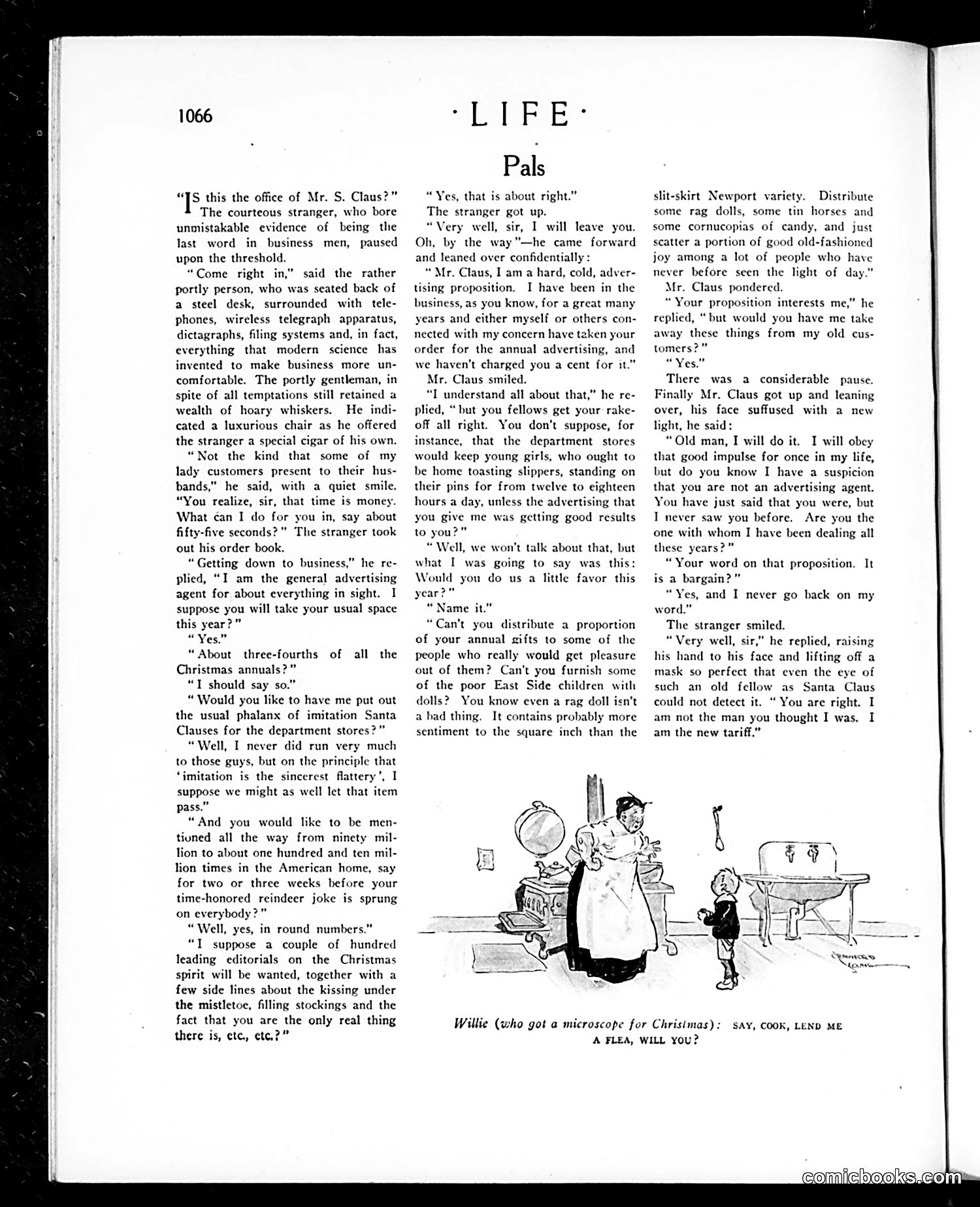
This page contains a satirical dialogue titled "Pals" between Mr. S. Claus (Santa Claus) and a business stranger. The conversation mocks commercialization of Christmas advertising. A wealthy businessman proposes using Santa Claus imitation figures for department store advertising during the Christmas season, arguing it would be flattery rather than theft of the holiday tradition. The accompanying cartoon illustrates the concept: a fat Santa figure stands amid children and toys in a store setting. The caption reads: "Willie (who got a microscope for Christmas): SAY, COOK, LEND ME A FLEA, WILL YOU?"—a joke about a child treating his Christmas gift casually, perhaps satirizing consumer excess. The piece critiques both commercialization of Santa and American consumer culture's impact on children.
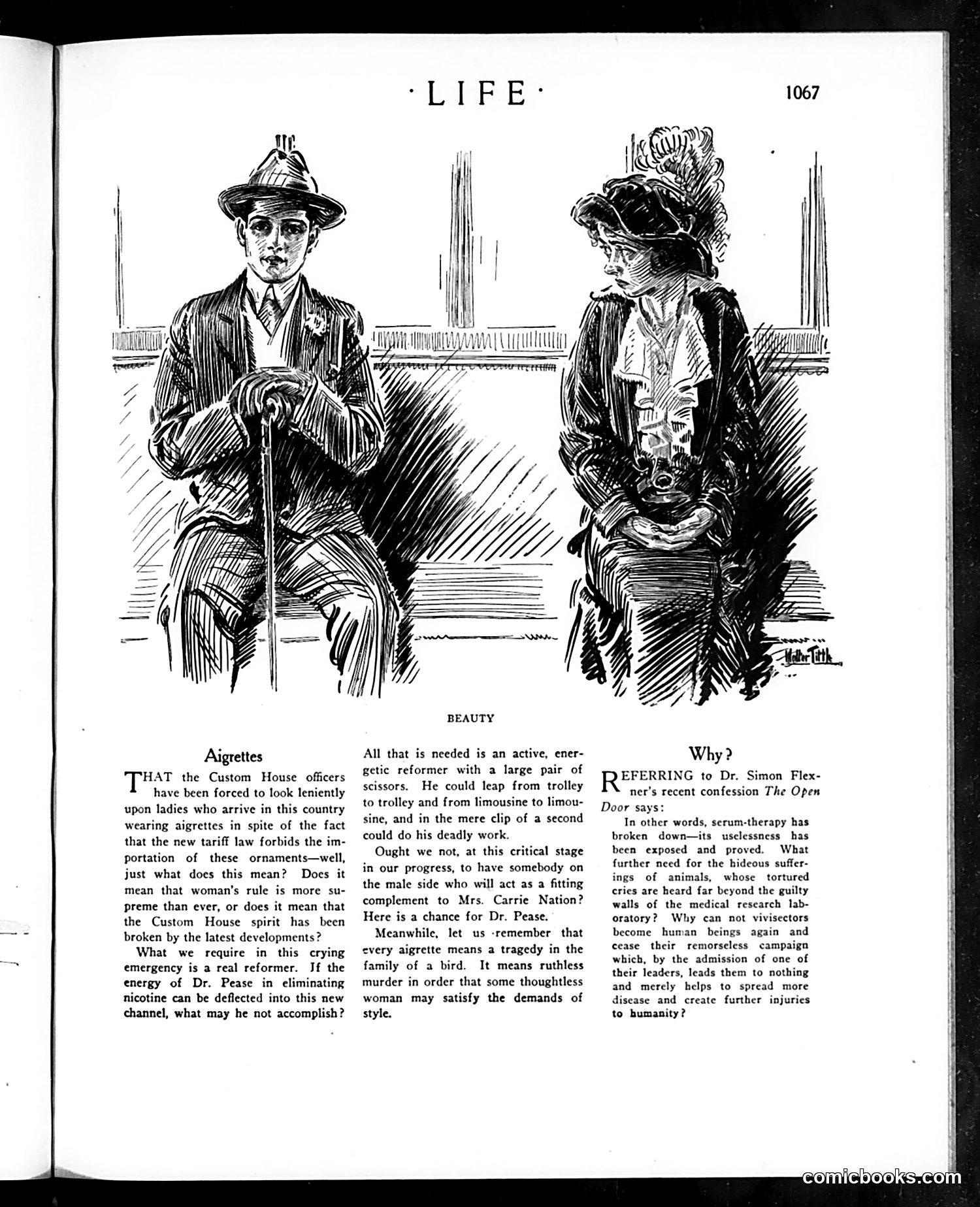
This page satirizes early 20th-century fashion and reform movements. The cartoon depicts a couple seated together, illustrating a social critique about **aigrettes**—feathered plumes worn as women's hat ornaments that were technically banned by new tariff laws, yet Custom House officers allowed their import anyway. The article mock-seriously proposes a male reformer (like the anti-smoking "Dr. Pease") armed with scissors to cut aigrettes from women's hats in public, comparing this to **Carrie Nation's** temperance activism. The satire's real target: the hypocrisy that women's fashion demands override law enforcement. The second article criticizes animal testing ("vivisection") in medical research, citing Dr. Simon Flexner's admission that serum-therapy has failed—arguing that animal suffering has been pointless. Both pieces use exaggerated proposal and moral outrage as satirical devices to expose inconsistency in contemporary law, commerce, and ethics.
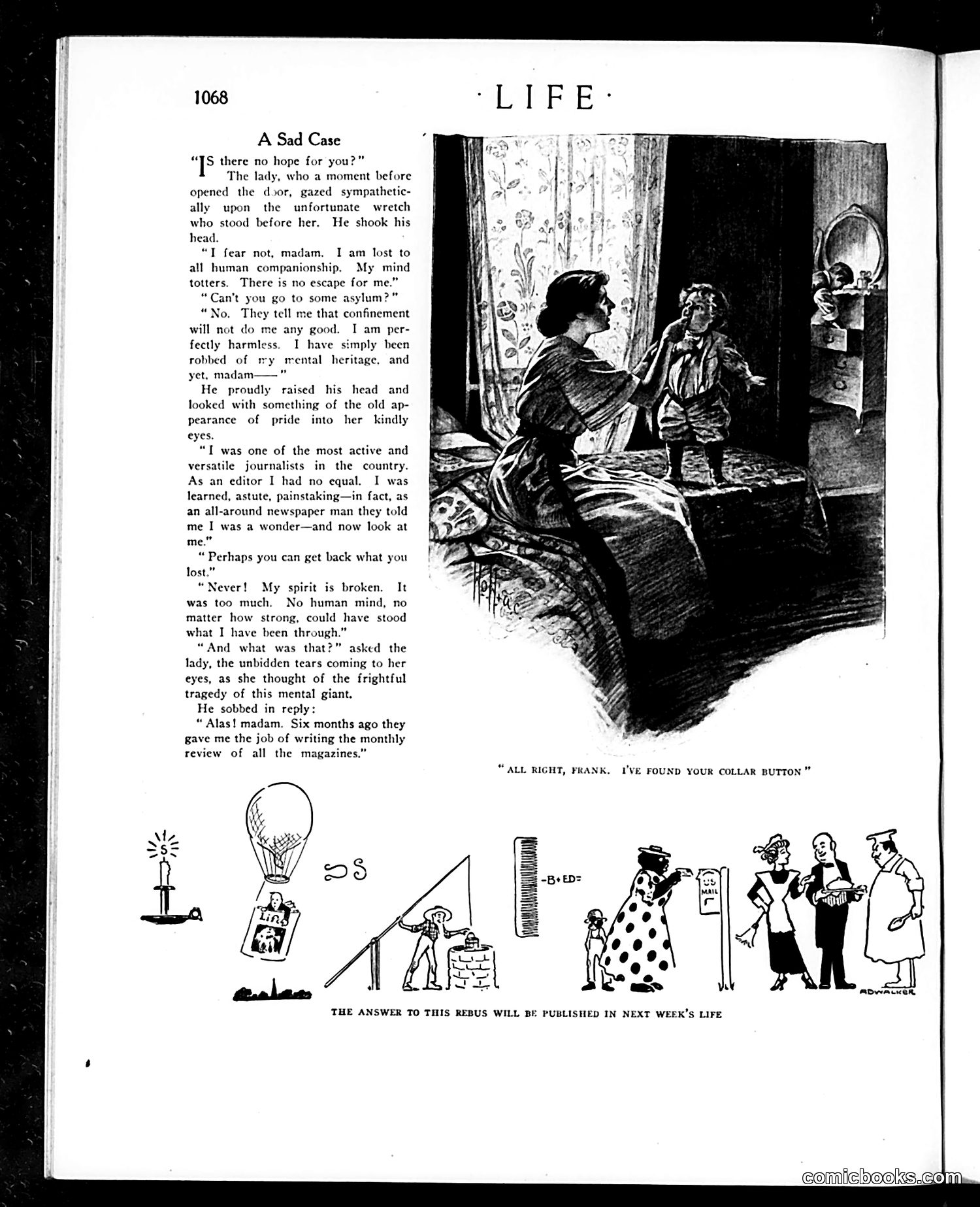
This piece satirizes the professional decline of a once-prominent newspaper editor reduced to mental breakdown by a humiliating assignment: writing monthly magazine reviews. The joke targets the editorial hierarchy of the era, where talented journalists could be demoted to tedious, derivative work as punishment or cost-cutting. The man's collapse—from "active and versatile" editor to broken shell—over this mundane task exaggerates how devastating such demotion would feel to ambitious newsmen. The satire mocks both the casualness with which publications discarded talented staff into dead-end roles, and the fragile ego of journalists who measured their worth by editorial status. The accompanying illustration shows a woman discovering a lost collar button, likely part of a visual puzzle. The rebus at page bottom was apparently a regular feature promising answers in the next week's issue.
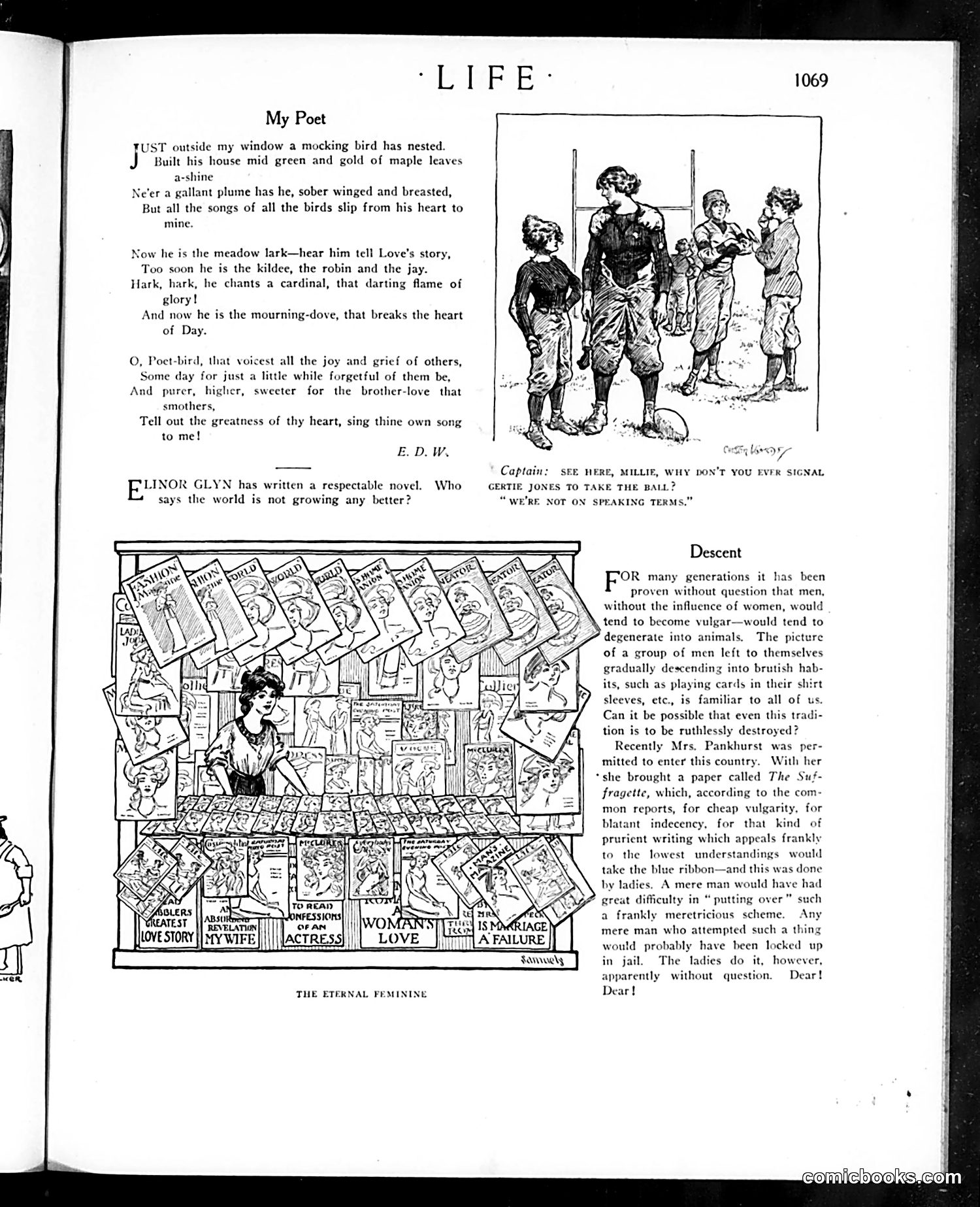
This page contains three satirical pieces reflecting early 20th-century attitudes: **"My Poet"** (top left): A sentimental poem by E.D.W. praising a mockingbird's ability to mimic all birds' songs while calling on it to "sing thine own song." The irony appears to celebrate imitation as virtue—typical of the era's sentimentality. **Baseball cartoon** (top right): Shows children discussing why "Millie" won't signal "Gertie Jones to take the ball"—they're "not on speaking terms." This satirizes petty female quarrels. **"The Eternal Feminine"** (bottom): A large cartoon and accompanying text mocking women's suffrage. It references **Emmeline Pankhurst's** recent entry to America and her publication *The Suffragette*, condemning it as vulgar and indecent. The piece argues that without women's "civilizing influence," men degenerate—yet claims suffragettes themselves demonstrate vulgarity, suggesting women shouldn't have power. This represents anti-suffrage propaganda common before women's voting rights were secured (1920).
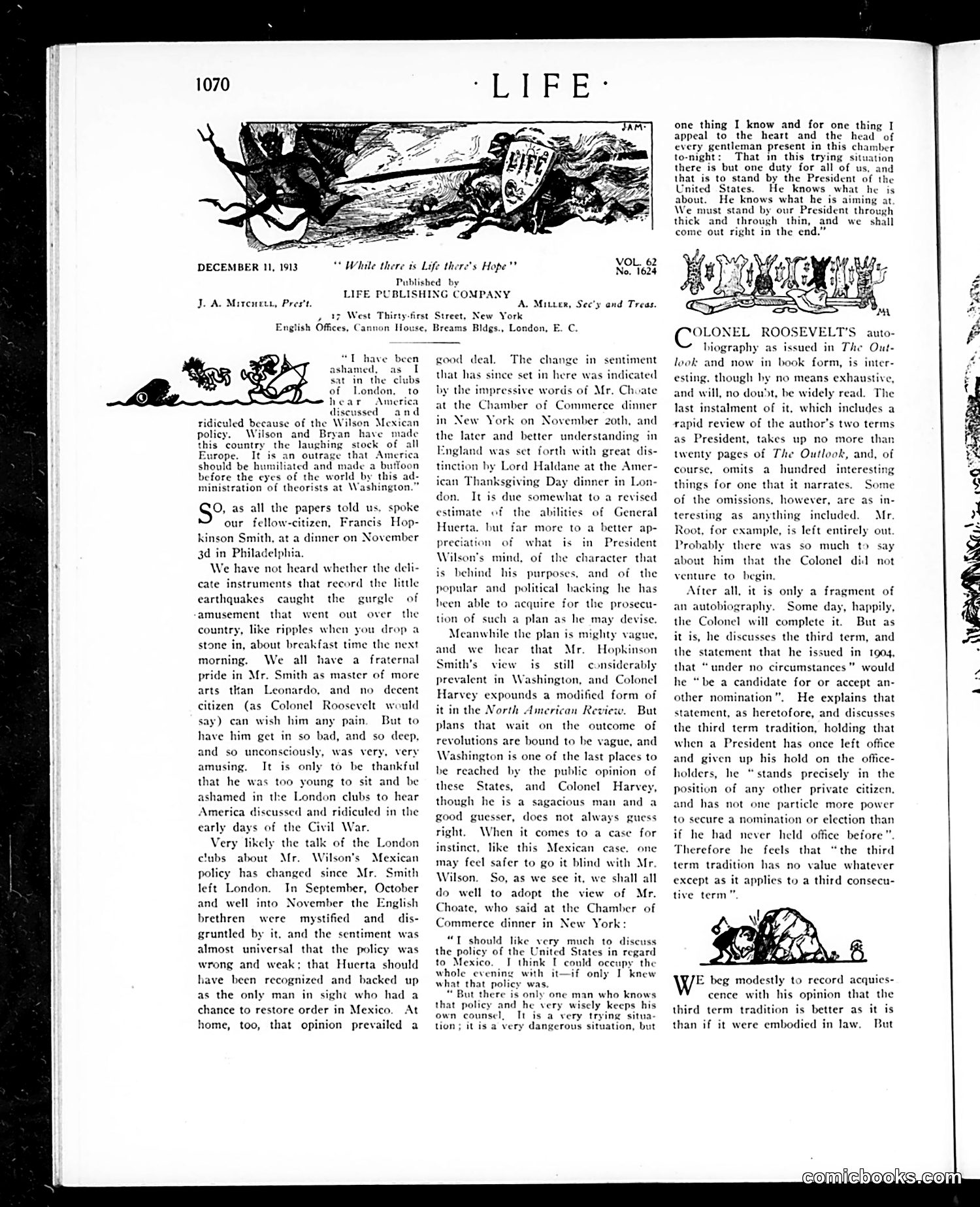
This page discusses President Wilson's Mexican policy, which had drawn criticism from prominent Americans like Francis Hopkinson Smith, who complained in London that Wilson and Secretary of State Bryan had made America "the laughing stock of all Europe." The article notes the irony: Smith criticized the policy abroad while many at home and in Britain initially agreed, wanting the U.S. to recognize and support General Huerta's Mexican government. However, sentiment has shifted—British leaders like Lord Haldane now better understand Wilson's actual aims and political backing for his approach. The piece concludes by quoting diplomat Joseph Choate's witty admission at a Chamber of Commerce dinner: only Wilson truly knows what his Mexican policy is, and "he very wisely keeps his own counsel." The satire targets both the vagueness of Wilson's foreign policy and the irony that critics abroad don't yet grasp what America is actually trying to accomplish in Mexico.
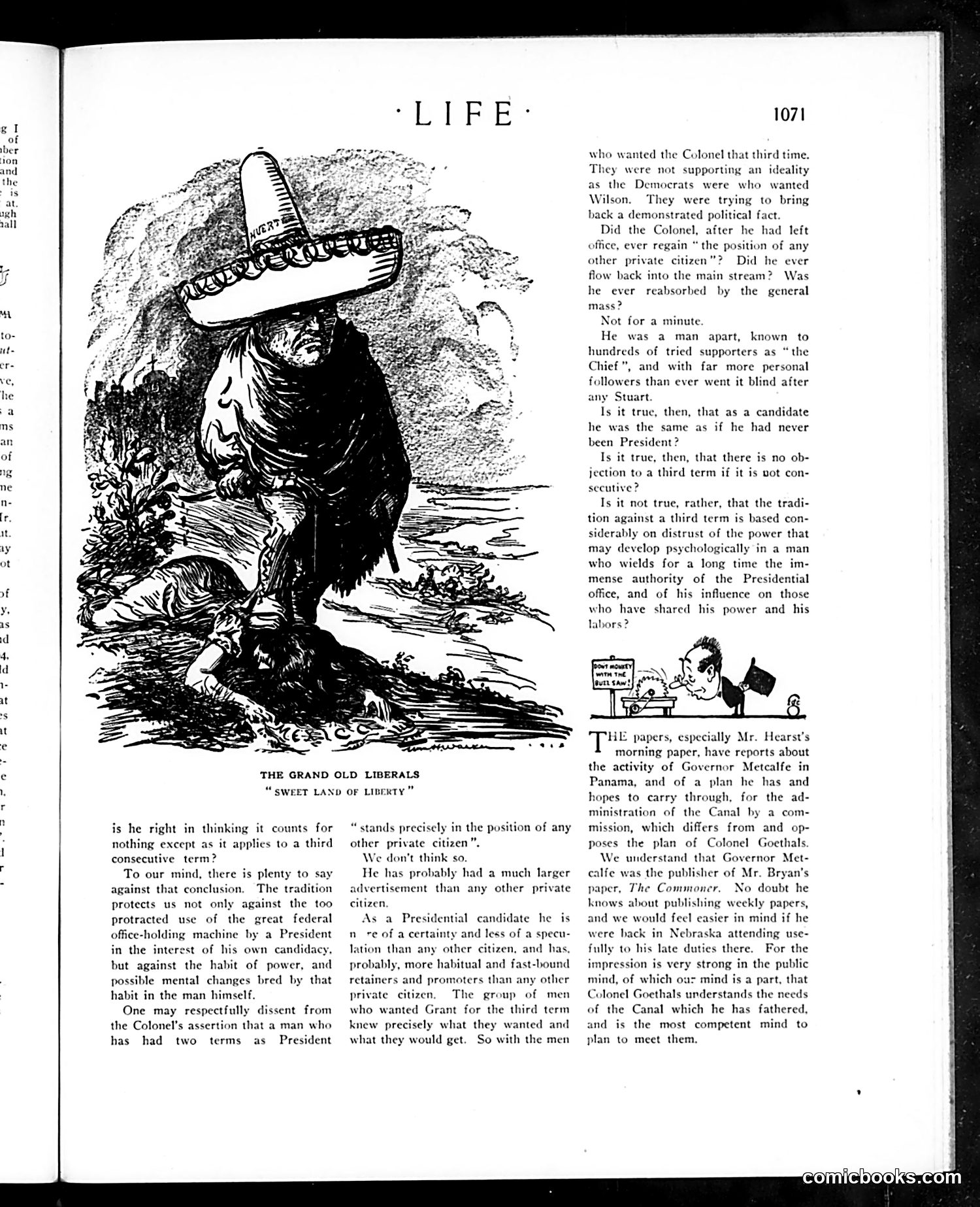
This 1912 *Life* magazine page critiques former President Theodore Roosevelt's potential third-term candidacy. The cartoon depicts "The Grand Old Liberals" as a caricatured Mexican figure (invoking Roosevelt's imperialist interventions), sarcastically titled "Sweet Land of Liberty." The article argues against Roosevelt's claim that a former two-term president stands as "any other private citizen." The satire emphasizes that Roosevelt retained unique power, devoted followers (called "the Chief"), and political machinery unavailable to ordinary citizens—undermining his candidacy's legitimacy. The second section attacks Governor Metcalfe's challenge to Colonel Goethals's Panama Canal administration, noting Metcalfe's ties to William Jennings Bryan's *The Commoner* newspaper. The implication: Metcalfe should stick to publishing rather than interfering with Goethals's canal expertise. The satire defends institutional tradition (third-term prohibition) and expert competence against political opportunism.
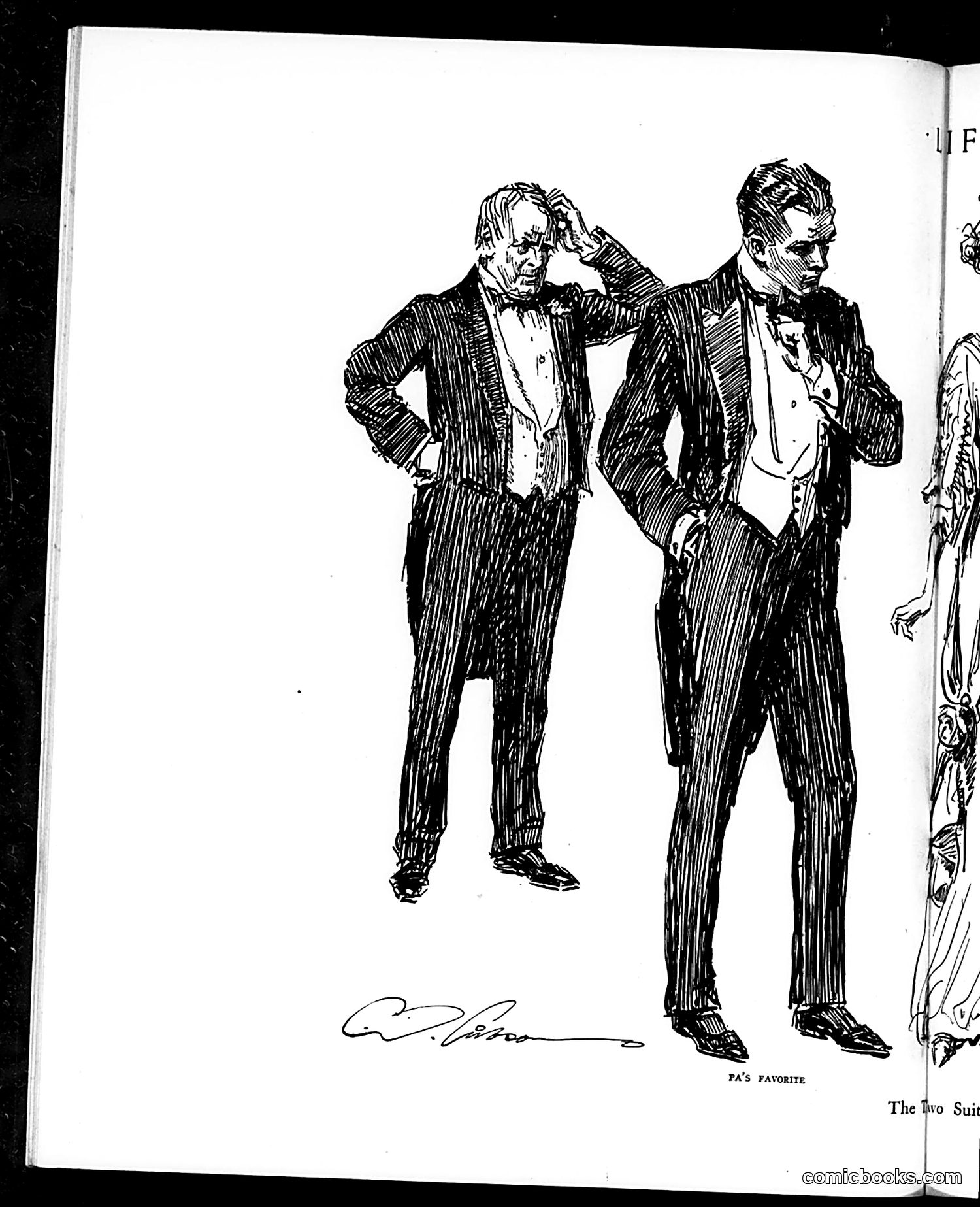
This page shows two men in formal evening wear (tuxedos with tails). The caption reads "PA'S FAVORITE" and the partial text at bottom indicates "The Two Suit[s]" - suggesting this is a satirical commentary on formal attire or fashion choices. The sketch appears to be from Life magazine's humor section, likely mocking either: - The pretentiousness of formal evening wear conventions - Two different styles or fits of formal suits - Possibly two public figures known for their fashion choices However, without the full page context, article text, or clearer identification of whether these represent specific individuals or are generic social commentary, I cannot definitively explain the satirical point or identify who "Pa" refers to. The artistic signature is present but not clearly legible.
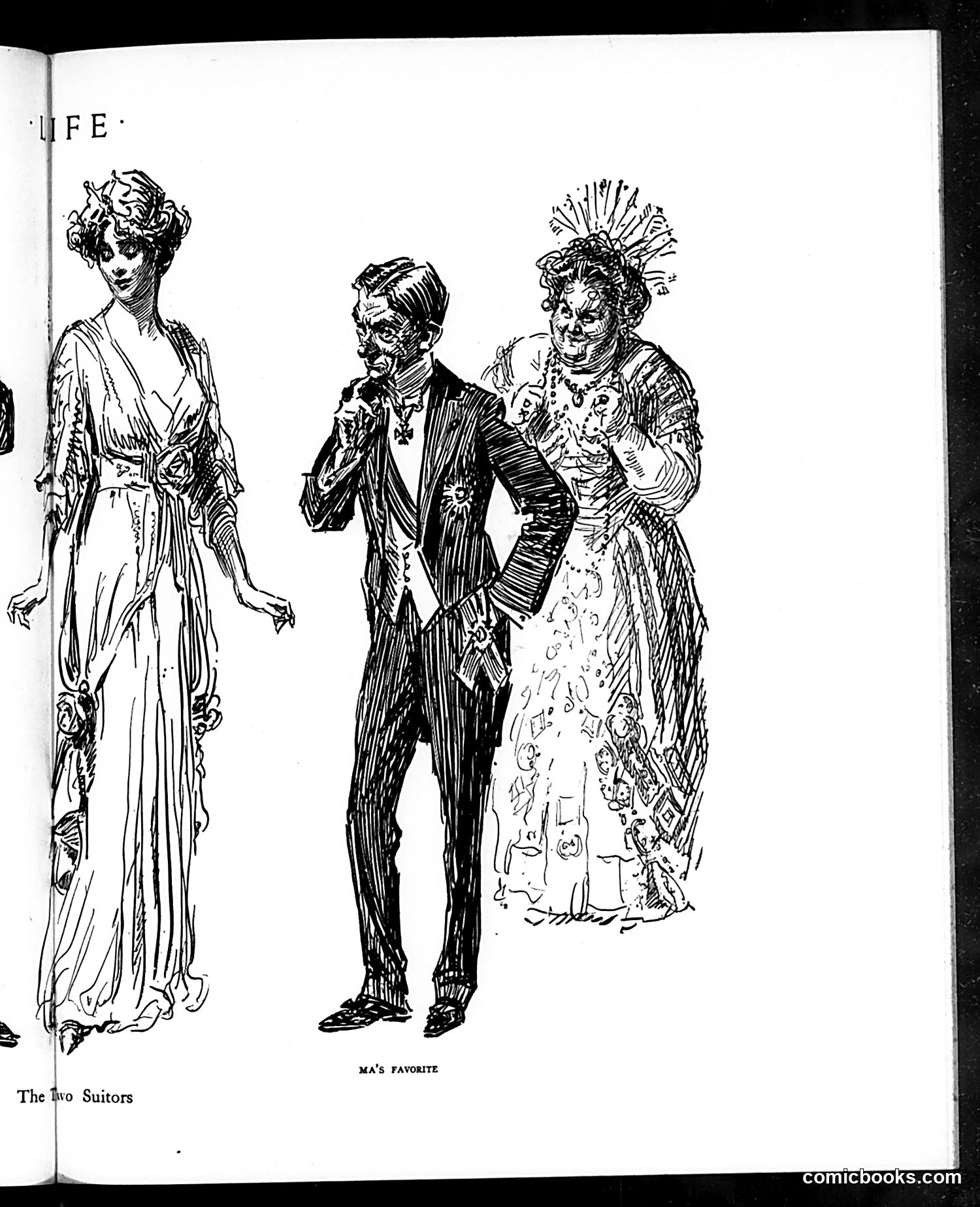
This page from *Life* magazine presents two satirical sketches of early 20th-century courtship and romance. "The Two Suitors" (left) shows a woman being courted by two men in formal dress. The caption "Ma's Favorite" (center) depicts a man in a pinstriped suit flanked by two women—one elegant on the left, one more ornately dressed on the right—suggesting romantic rivalry or the man's divided attention. The satire appears to mock Victorian-era courtship conventions and gender dynamics, likely poking fun at romantic entanglements and the social pretensions surrounding marriage prospects. The exaggerated facial expressions and formal attire emphasize the artificiality of such social rituals, typical of *Life's* humorous commentary on contemporary manners and morals.
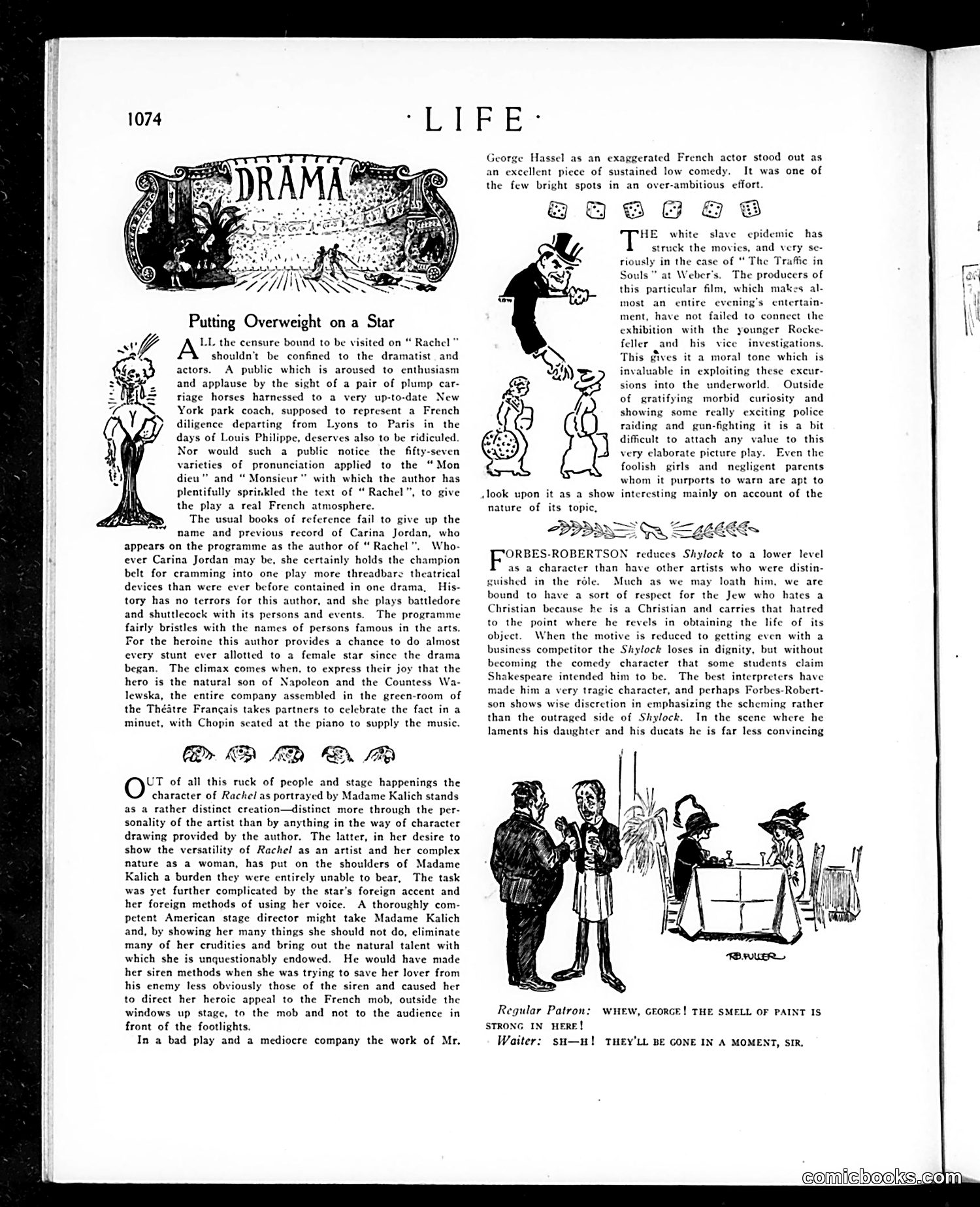
This page reviews theatrical productions, primarily critiquing a play called "Rachel" adapted by Carina Jordan. The satire focuses on **theatrical excess and lazy playwriting**. The main targets are: 1. **"Rachel" production**: The author mocks the play's overwrought ambition—cramming historical references, famous names, and every possible dramatic device into one script. The absurd climax (a minuet celebrating that the hero is Napoleon's illegitimate son) exemplifies this ridiculousness. 2. **The audience**: Life sarcastically blames theatergoers who applaud merely because expensive props (fancy carriage horses) are onstage, missing the terrible French accents and sloppy writing. 3. **Madame Kalich** (the lead actress): While praised for personality, she's burdened by bad material and needs directorial coaching to overcome her foreign accent and theatrical mannerisms. 4. **George Hassel**: Noted as the one bright spot—genuine low comedy amidst mediocrity. The page also briefly mentions "Traffic in Souls," a film exploiting the "white slave epidemic" controversy, using moral outrage as marketing rather than substantive content.
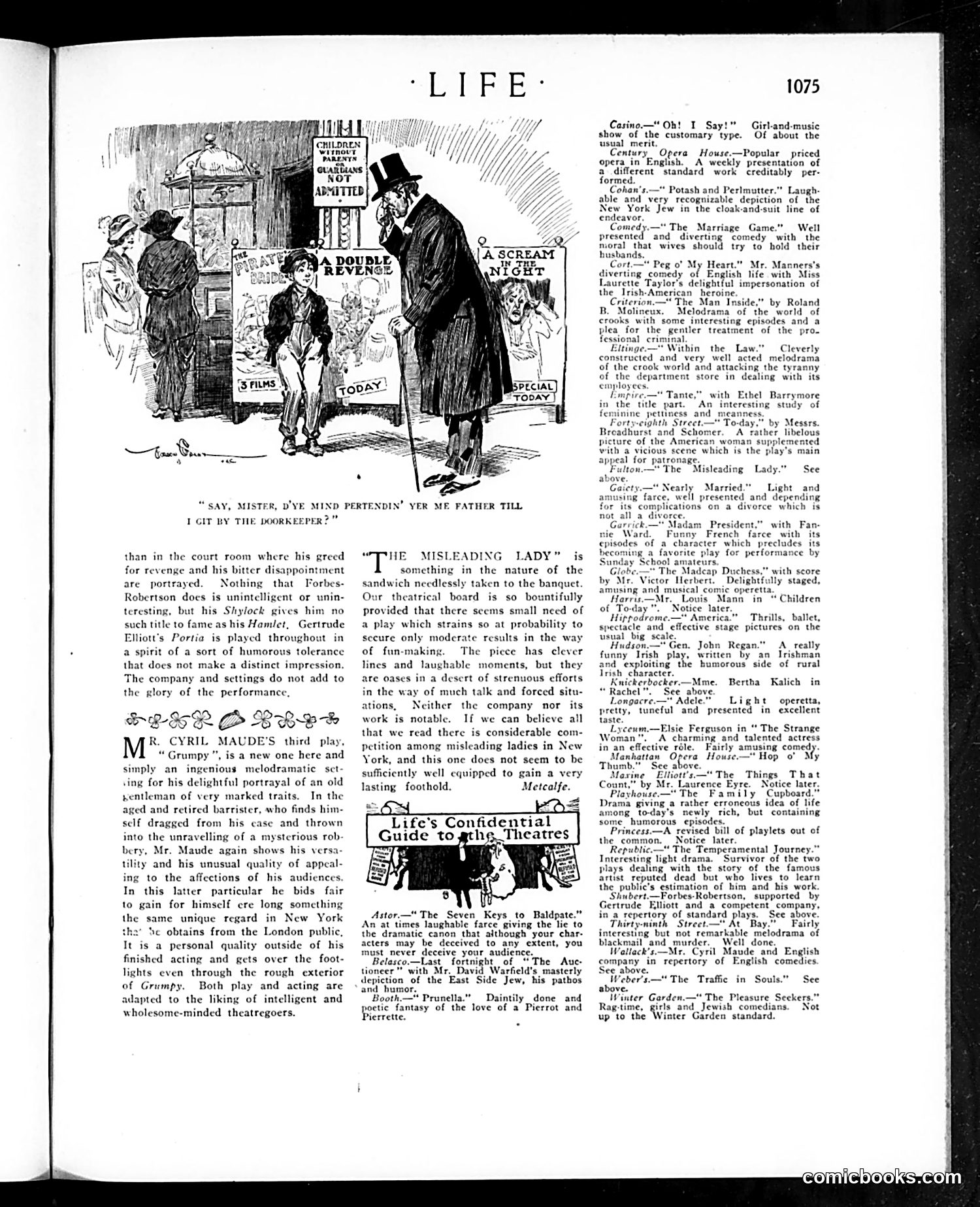
The main cartoon shows a well-dressed man in a top hat speaking to a boy at what appears to be a theater entrance, with various theater marquees visible in the background. The caption reads: "Say, mister, d'ye mind pertendin' yer me father till I git by the doorkeeper?" The joke satirizes **child labor laws and theater admission policies** of the era. The boy is asking the gentleman to pose as his father to bypass the doorkeeper—likely to avoid either an age restriction or a children's admission fee. The cartoon's humor lies in the brazenness of the request and the implicit commentary that such deceptions were commonplace enough that a child would casually ask a stranger to participate. It reflects early 20th-century concerns about theater attendance regulations and enforcement, while poking fun at both the ease of circumventing rules and children's resourcefulness in doing so. The detailed theater advertisements on the surrounding page reinforce that this was a vibrant period for live theater in New York.
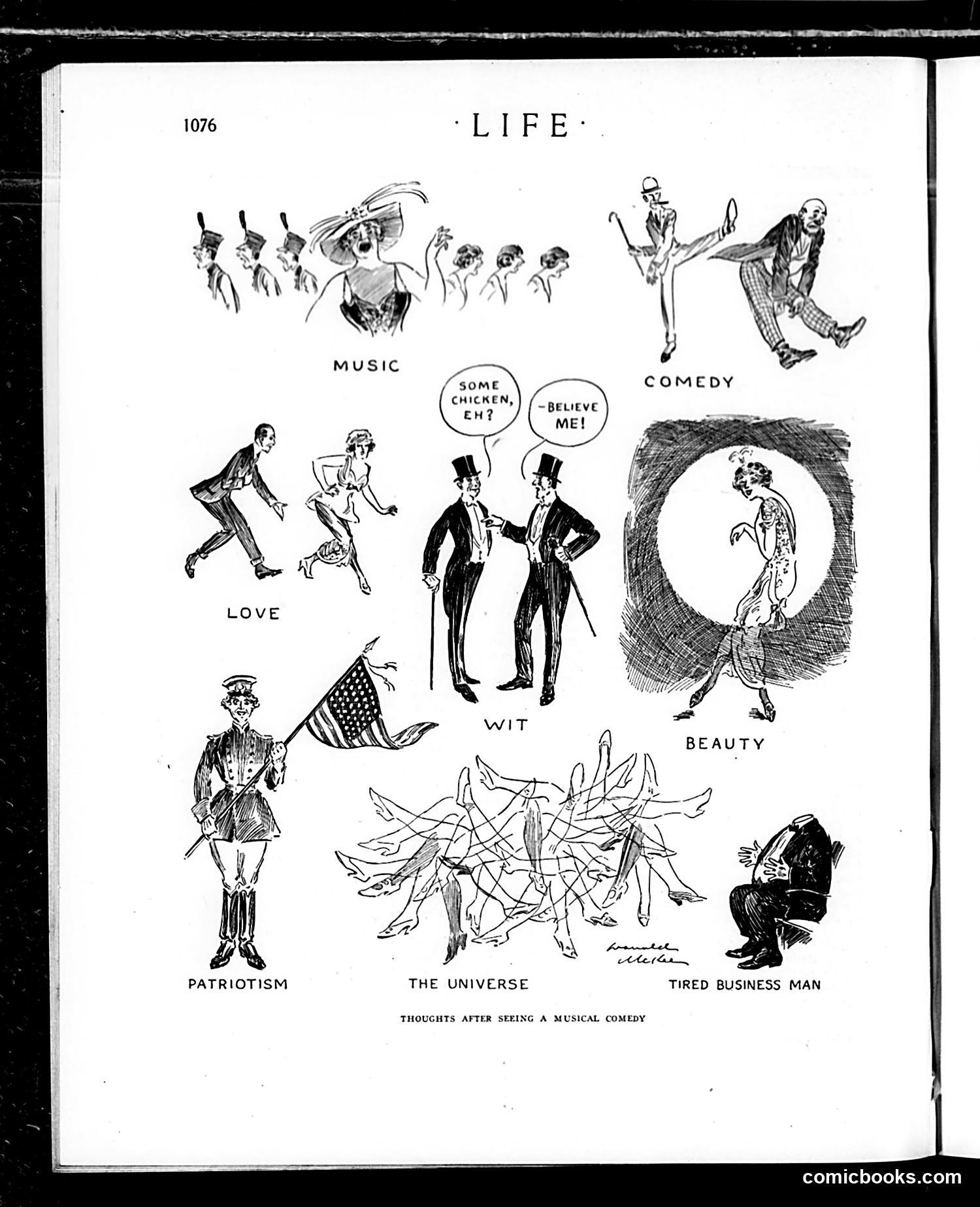
This is a satirical cartoon showing what various audience members think about after watching a musical comedy. The page depicts different mental states labeled as various aspects of "Life": Music, Comedy, Love, Wit, Beauty, Patriotism, The Universe, and a Tired Business Man. The central joke is that a simple musical comedy entertainment produces wildly disproportionate reactions—from profound philosophical contemplation (The Universe depicted as tangled chaos) to patriotic fervor (a figure with American flag) to romantic daydreaming. The "Tired Business Man" at bottom appears exhausted rather than entertained, suggesting the satire critiques both the frivolous nature of musical comedies and audiences' tendency to read deep meaning into light entertainment, or alternatively, their exhaustion from such spectacles.
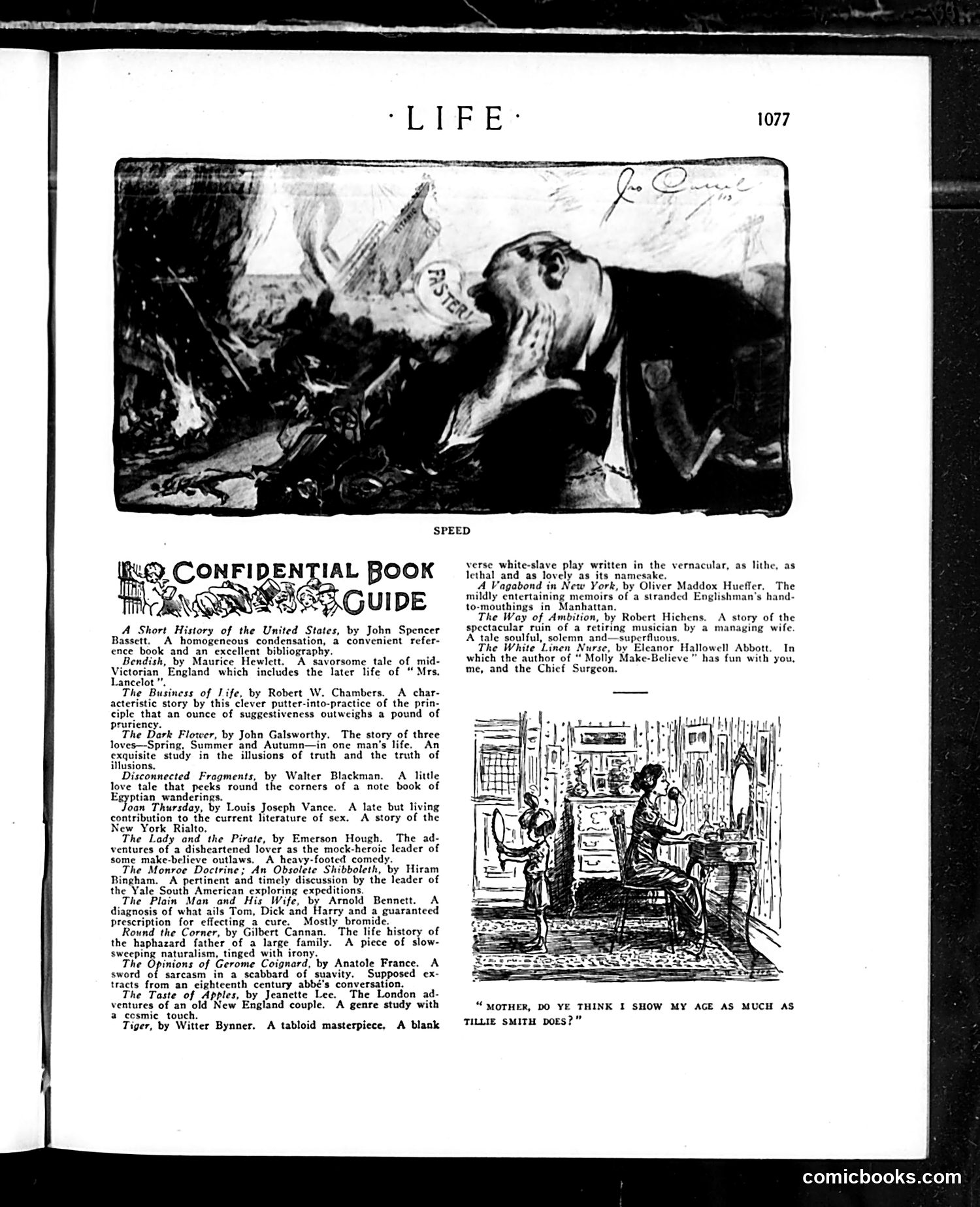
This page features a "Confidential Book Guide"—a satirical book review section common to Life magazine's humor. The top cartoon labeled "SPEED" shows a man in period dress apparently racing or moving frantically, likely mocking contemporary literature's obsession with fast-paced narratives or modern life's frenetic pace. Below, the guide reviews contemporary novels (circa 1910s) with witty, cutting commentary. Life's critics mock pretentious literature: praising Galsworthy's *The Dark Flower* as studying "illusions of truth," dismissing Bennett's *The Plain Man and His Wife* as "mostly bromide" (cliché), and calling Hichens's *The Way of Ambition* "superfluous." The bottom cartoon shows a woman asking her mother whether she looks as aged as "Tillie Smith"—a joke about vanity and women's anxiety over aging appearance, common satire fodder for the era. The overall tone mocks both pretentious literature and contemporary social concerns.
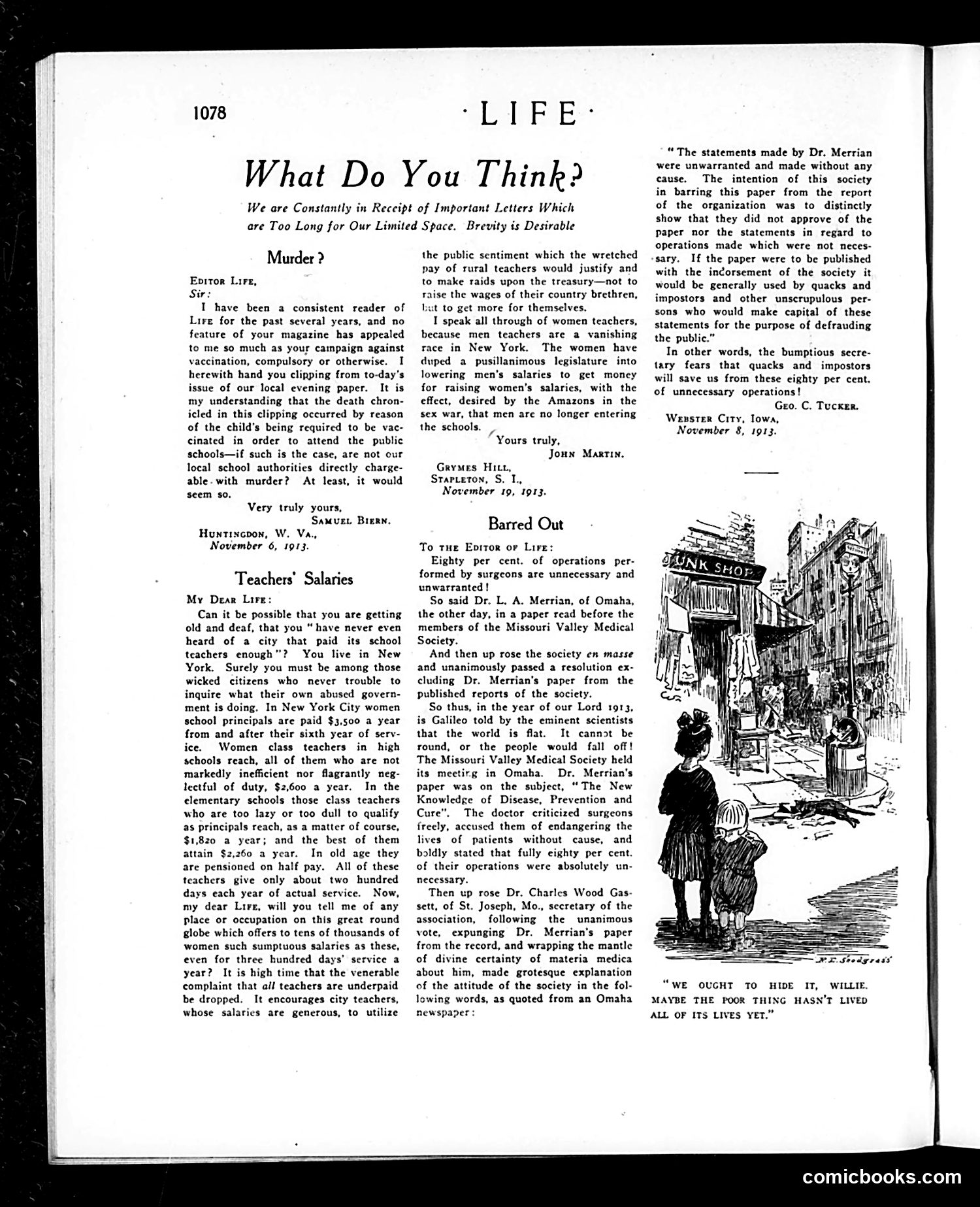
This page features readers' letters on three topics: **"Murder?"** - A reader objects to vaccination requirements for school attendance, calling mandatory vaccination "murder" after a child's death. **"Teachers' Salaries"** - A correspondent argues NYC teachers are actually well-paid (listing salaries of $1,820-$3,500 annually), contrary to Life's criticism. He claims women teachers manipulated legislature to raise their own pay while lowering men's salaries, driving men from the profession—he derisively calls these women "Amazons in the sex war." **"Barred Out"** - The accompanying cartoon satirizes medical censorship: Dr. Merrian presented research claiming 80% of surgeries are unnecessary at a Missouri Valley Medical Society meeting. The society unanimously excluded his paper from official records. Life compares this to silencing Galileo—the medical establishment suppressing inconvenient truth, much as authorities once claimed the world was flat. The cartoon depicts a woman outside a junk shop labeled "JUNK SHOP," with the caption: "We ought to hide it, Willie—maybe the poor thing hasn't lived all of its lives yet," referencing suppressed knowledge.
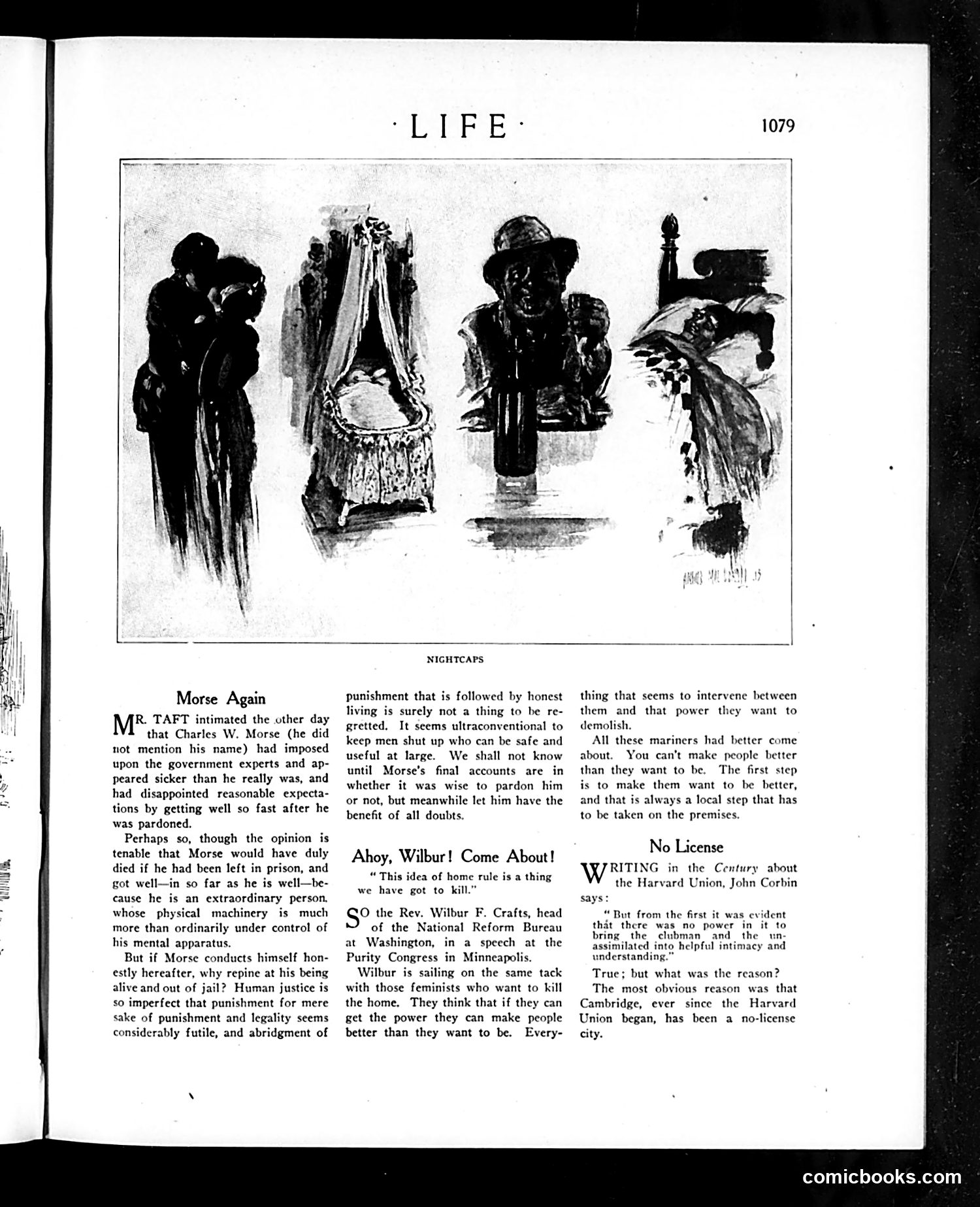
This page contains three separate editorial pieces satirizing American social reformers and their overreach: **"Morse Again"** defends Charles W. Morse, a financier recently pardoned from prison, against President Taft's suggestion he faked illness to gain release. Life argues that if Morse lives honestly afterward, continued punishment serves no purpose—rehabilitation matters more than vengeance. **"Ahoy, Wilbur! Come About!"** mocks Rev. Wilbur F. Crafts of the National Reform Bureau and feminists for attempting to eliminate "home rule" through government power. Life's satire: reformers cannot force moral improvement on unwilling people; change must come from individual desire, not external coercion. **"No License"** criticizes Harvard's no-license (alcohol prohibition) policy, suggesting it prevented the Harvard Union from bringing together different social classes—the restrictive rule undermined its integrative purpose. The uniting theme: skepticism toward paternalistic reformers who believe laws and punishment can engineer better behavior without addressing root causes or individual agency.
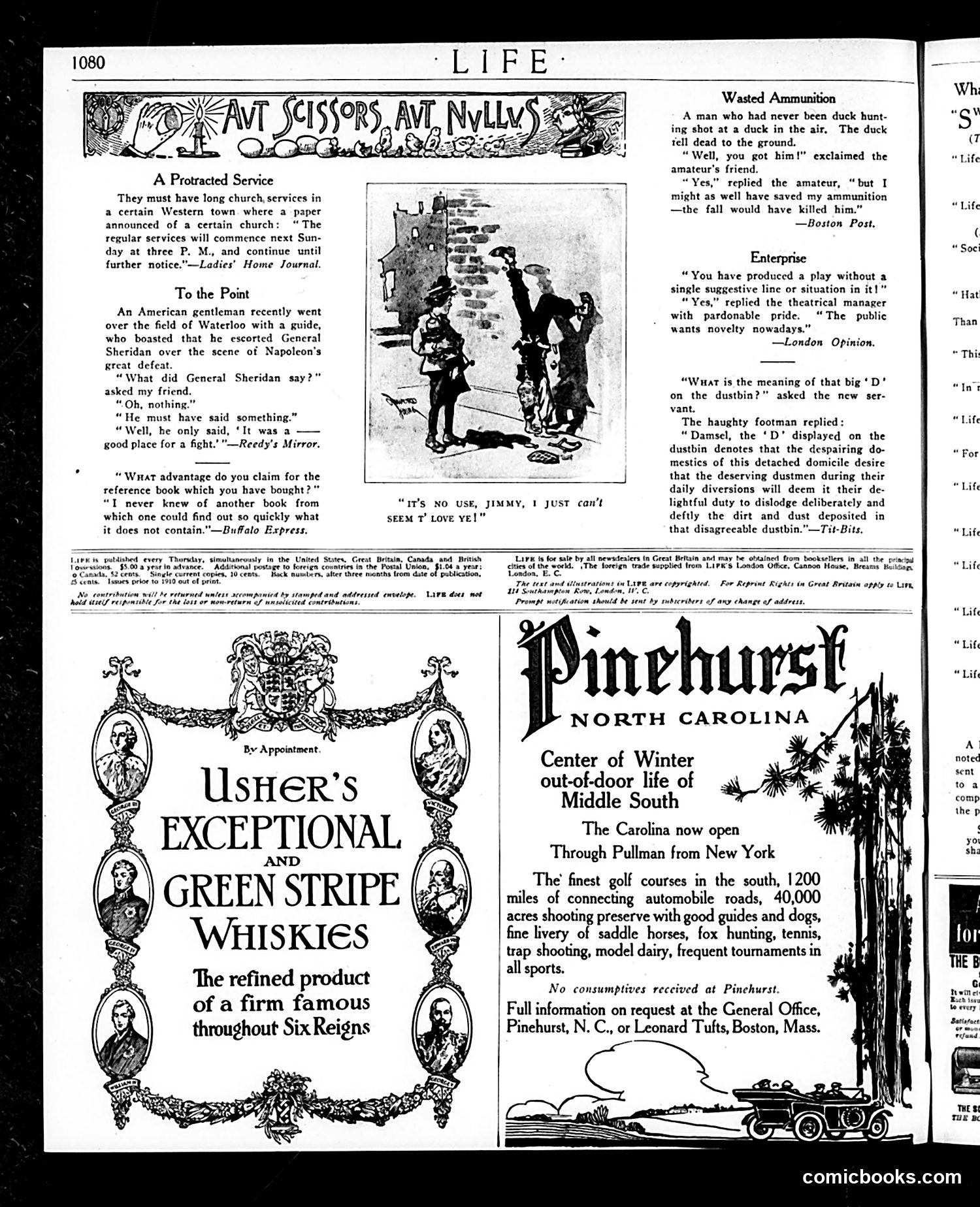
This page contains **five brief humor pieces** plus advertisements, typical of Life's satirical format: 1. **"Wasted Ammunition"**: A novice duck hunter kills a duck through its fall rather than his shot—he wasted bullets. 2. **"A Protracted Service"**: Church announcement says services continue "until further notice," implying they never end—satire on tediously long services. 3. **"To the Point"**: General Sheridan, touring Waterloo battlefield, reportedly says only "It was a good place for a fight"—mocking military brevity/anti-intellectualism. 4. **"Enterprise"**: A theatrical manager boasts his play has no suggestive content, calling this "novelty"—satirizing prudish audiences demanding clean entertainment. 5. **"Dustbin 'D'"**: A pretentious footman uses verbose language to explain a dustbin's marking, mocking artificial class-based speech patterns. The page's humor relies on understated irony and wordplay typical of early 20th-century American magazines. Advertisements for whiskey and Pinehurst resort occupy the lower portion.
This cartoon satirizes the notoriously slow telephone service of the era. The joke depicts insects with such short lifespans that a caller's grandfather has died waiting for a telephone connection to go through. The humor relies on the contrast between the brevity of an insect's life and the glacial pace of early telephone operators connecting calls. A mayfly (or similar short-lived insect) requesting a number dies before the operator completes the connection; generations later, his descendant answers on his behalf. This reflects genuine contemporary frustration with telephone infrastructure—operators manually connected each call, creating bottlenecks and delays that were frequent enough to become a cultural complaint. The exaggeration to absurdist lengths (multiple generations of insects) amplifies the social criticism of an inadequate communication system.
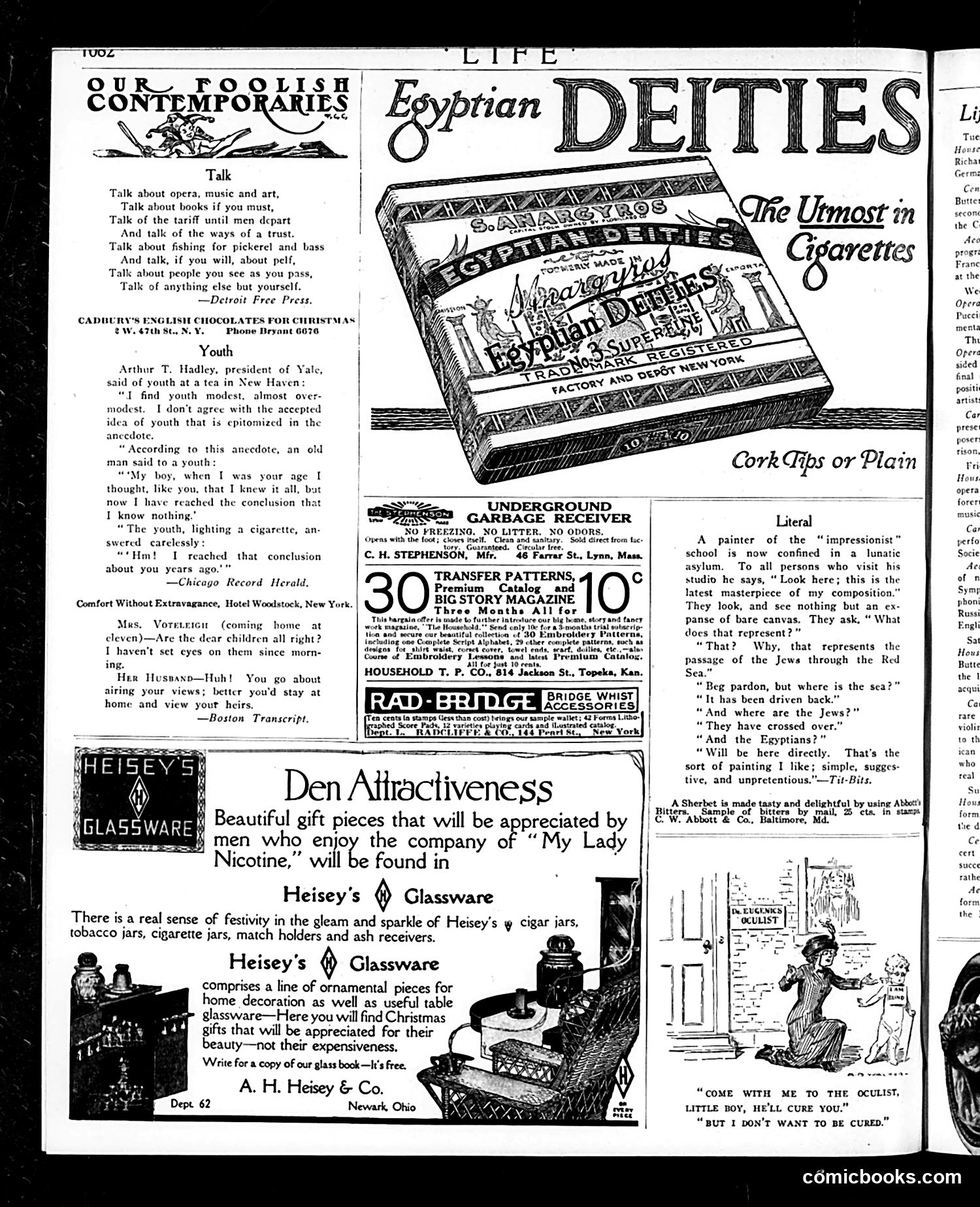
This page mixes satirical content with period advertising (circa 1906). The main humor pieces are: **"Talk"** (poem): Satirizes self-centered conversation—the irony being that while the poem warns against talking about yourself, it's framed as advice *about* oneself. **"Youth"** anecdote: A Yale president quotes an old man saying "I know nothing" at your age, only to realize he knows nothing now. A youth counters that he reached that conclusion "about you a year ago"—mocking the pretense that age brings wisdom. **"Den Attractiveness"** (Heisey glassware ad): Frames decorative glassware for tobacco/cigars as gifts for men who enjoy "My Lady Nicotine" (personification of smoking). **The cartoons**: A brief domestic joke about a husband criticizing his wife's social views while she suggests he focus on his children instead; and a lunatic-asylum painter's abstract canvas representing the Red Sea crossing—poking fun at incomprehensible modern art. The page reflects early-1900s American attitudes toward youth, pretension, gender roles, and artistic modernism.
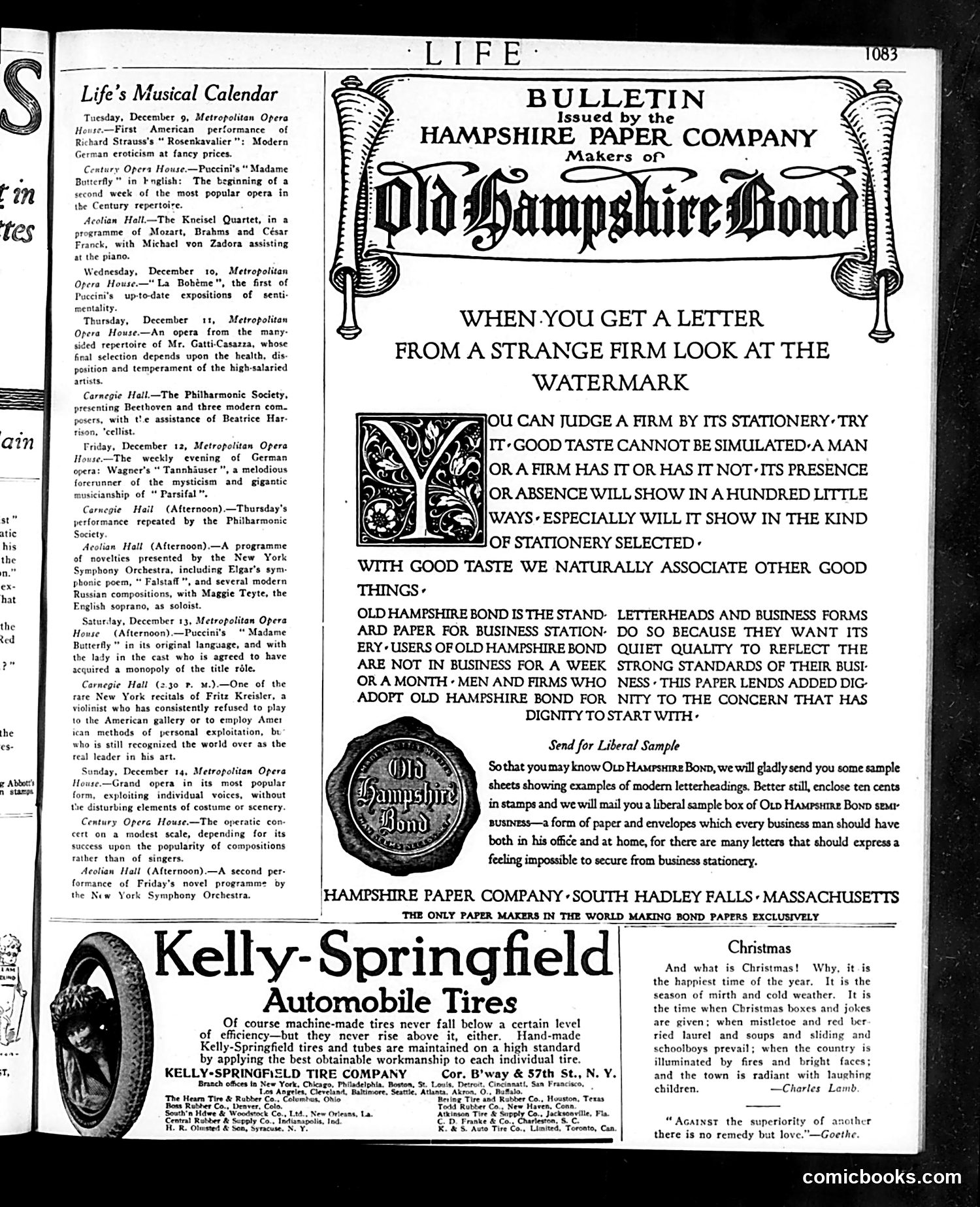
This page is primarily **advertising and entertainment listings**, not political satire. **Content:** - **Left side**: "Life's Musical Calendar" lists Metropolitan Opera, Carnegie Hall, and other NYC classical music performances (Wagner, Puccini, Beethoven). The tone is mildly mocking—describing opera as "fancy prices" and noting that performances depend on singers' "health, disposition and temperament." - **Main feature**: A **Hampshire Paper Company advertisement** disguised as editorial content. It argues that quality stationery reflects a firm's character and trustworthiness. The implicit message: you can judge a business by its letterhead's watermark and paper quality. - **Bottom**: Advertisement for **Kelly-Springfield Automobile Tires**. **The satire (mild)**: The musical calendar gently mocks opera's pretension and high costs. The paper advertisement humorously equates business credibility with stationery choice—a tongue-in-cheek commentary on American materialism and status-consciousness. This is essentially a **sponsored content page** blending ads with light cultural commentary typical of Life's format.
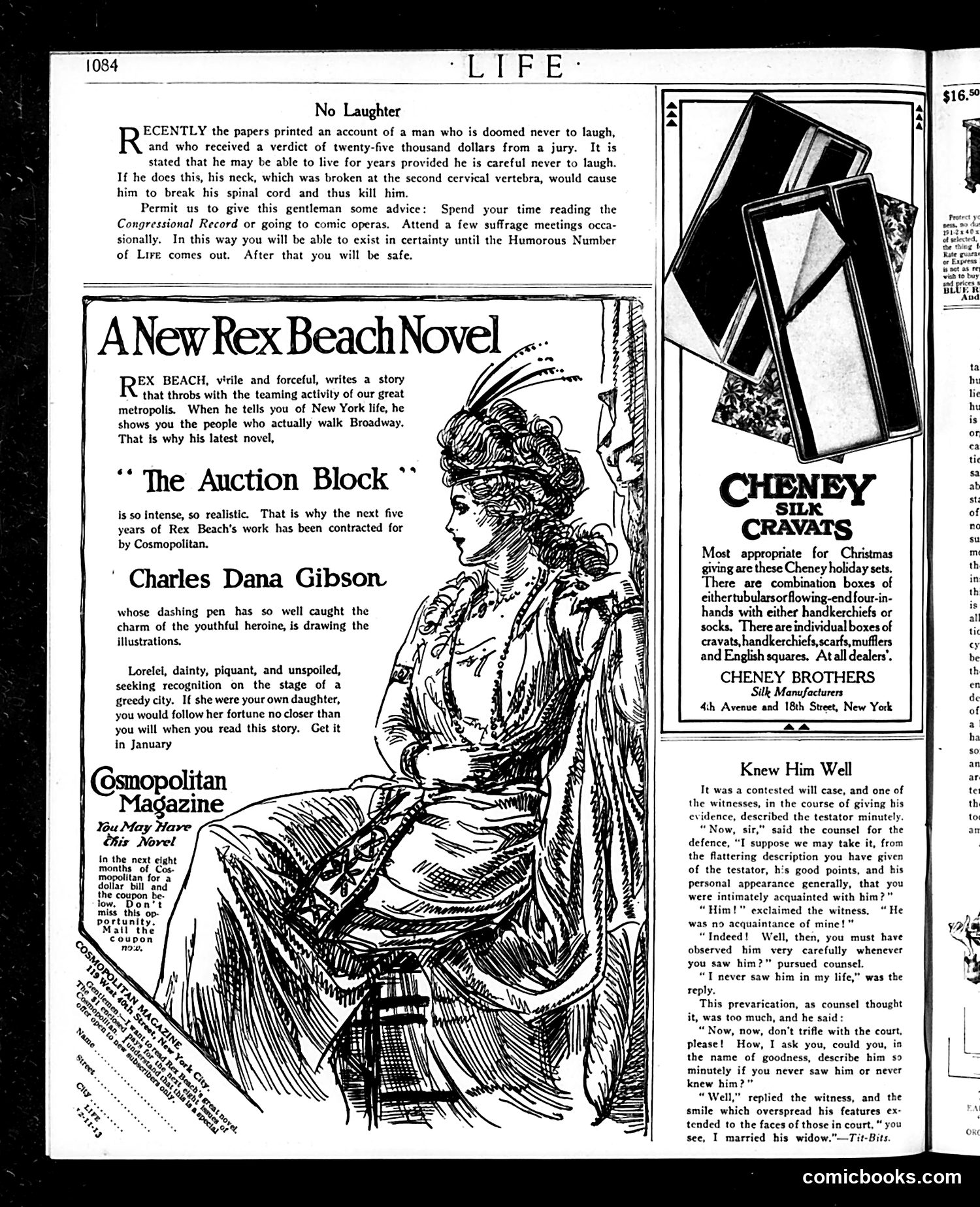
This page combines editorial satire with advertisements and literary promotion, circa early 1900s. **"No Laughter" Section:** Life satirizes a legal case about a man who cannot laugh due to a broken neck (a real verdict of $25,000). The joke advises him to read the Congressional Record, attend comic operas, or suffrage meetings—implying these are so tedious or absurd they won't make him laugh. The reference to "suffrage meetings" reflects anti-women's-suffrage sentiment common in Life at this era. **Main Content:** Advertisements for Rex Beach's novel "The Auction Block" (illustrated by Charles Dana Gibson, famous for "Gibson Girl" drawings) and Cheney silk cravats. **"Knew Him Well" Story:** A courtroom joke where a witness describes a dead man in flattering detail. When pressed, he admits he never met the man—he only knows him through having "married his widow." The humor relies on the absurdity of detailed knowledge through marriage alone.
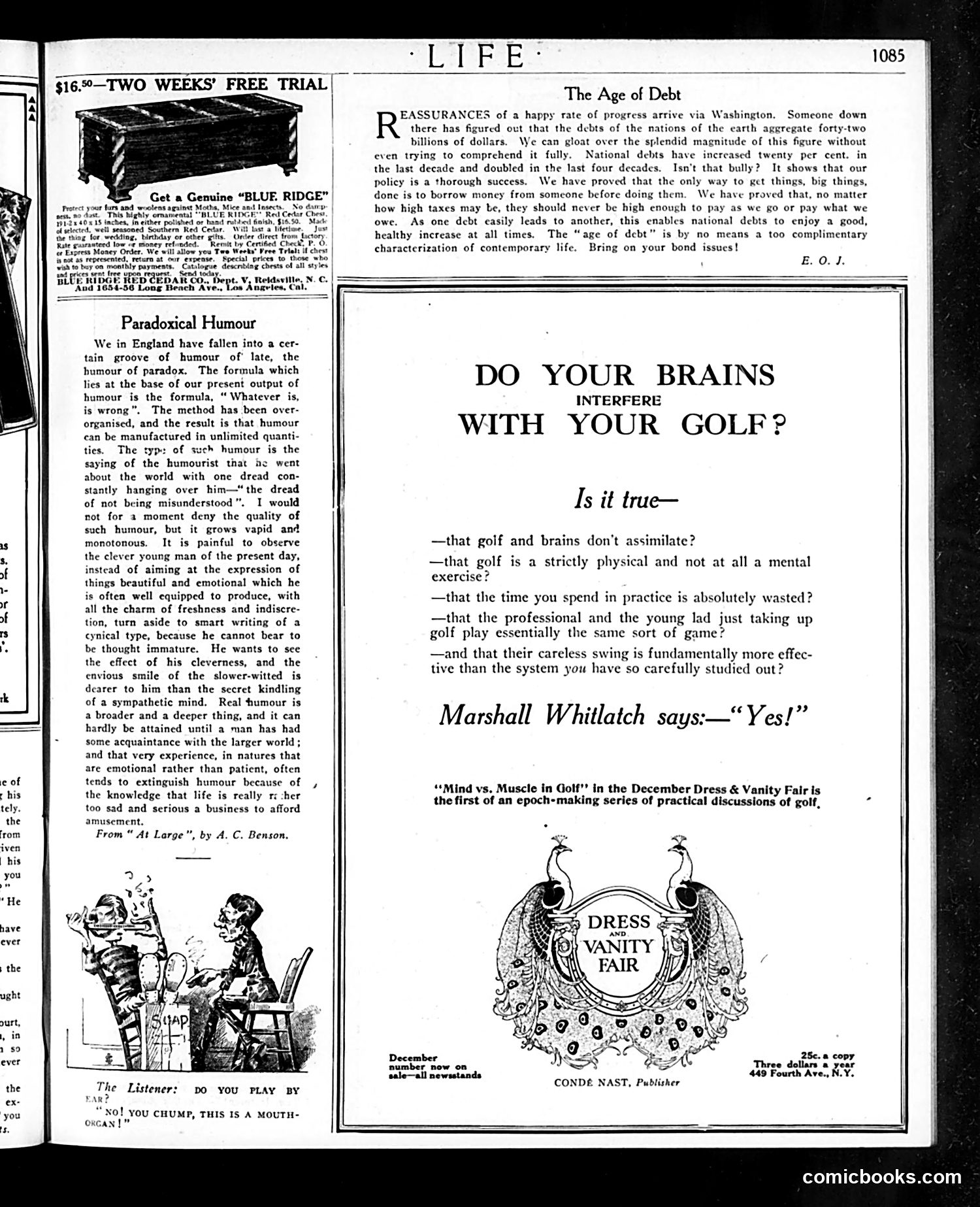
This page contains three distinct pieces: **"The Age of Debt"** (editorial): Satirizes government spending practices post-WWI. It mocks the logic that nations routinely borrow money to fund major projects rather than pay-as-you-go, noting national debts have doubled in four decades. The satire is sarcastic—praising this "bully" system while actually criticizing it as fiscally irresponsible. **"Paradoxical Humour"** (essay): A British commentary on contemporary comedy trends, lamenting that English humorists have become cynically obsessed with paradox and witty contradiction rather than genuine emotional expression. The author criticizes smart writing that chases "the envious smile of the slower-witted" over authentic humor. **Golf Advertisement**: Promotes a Dress & Vanity Fair article featuring Marshall Whitlatch debunking golf myths—specifically that golf is purely physical, that practice time is wasted, and that careless swings outperform studied technique. It's positioning mental analysis as essential to golf. The page is primarily editorial/advertising content rather than traditional political cartooning.
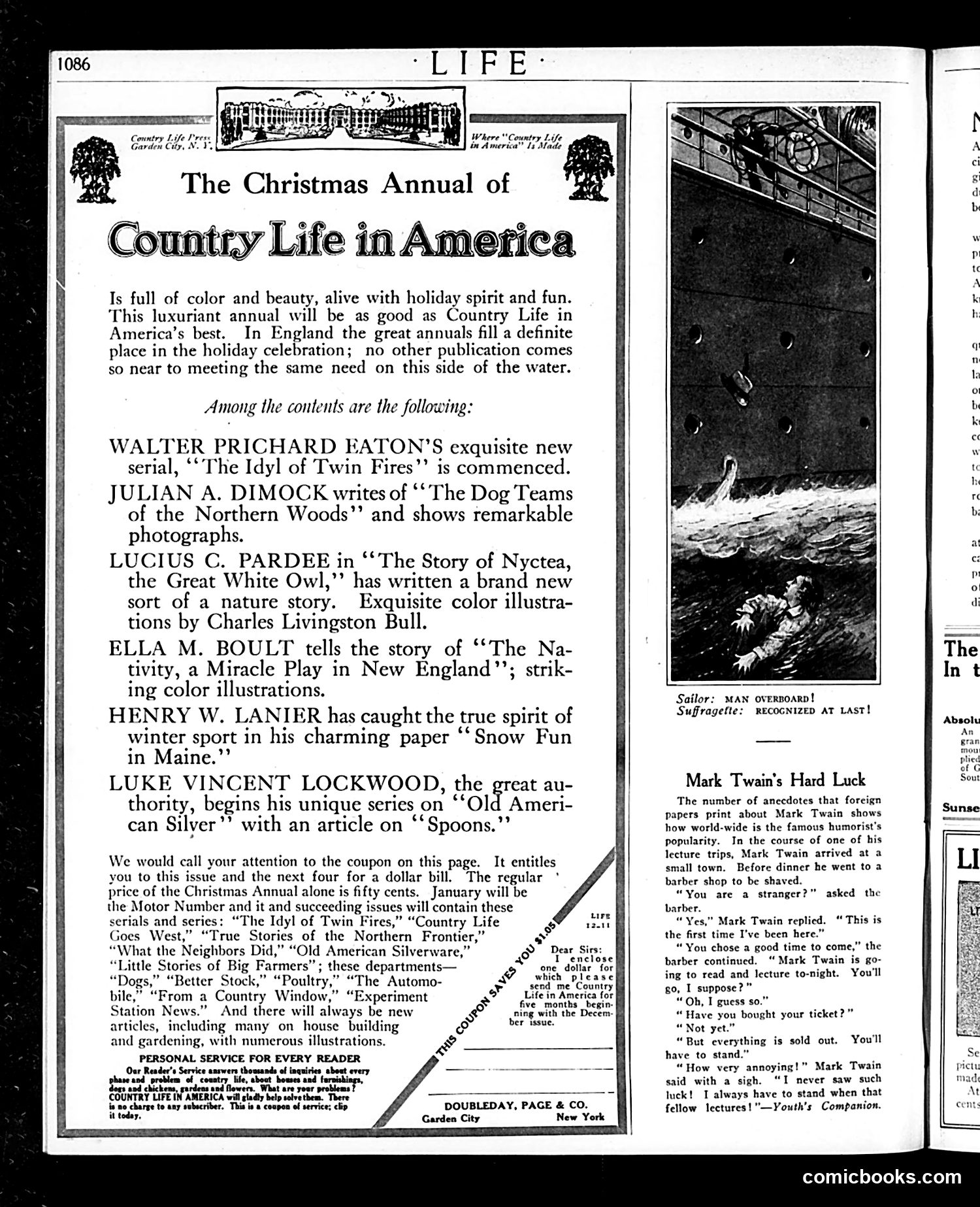
This page is primarily **advertising and promotional content** rather than political satire. It announces the Christmas Annual of *Country Life in America* magazine, listing literary contributions by established authors like Walter Prichard Eaton and Luke Vincent Lockwood. The only cartoon element is the small illustration captioned "Sailor: MAN OVERBOARD! / Suffragette: RECOGNIZED AT LAST!" This appears to be **early suffrage-era satire**—the joke plays on a woman's rights activist (suffragette) being so focused on her cause that even a drowning man means nothing to her except as proof her movement is finally getting noticed. It's mocking suffragettes as single-mindedly obsessed. Below is an anecdote about Mark Twain arriving in a town where he's scheduled to lecture, only to discover all tickets are sold out—ironic given his fame. The page emphasizes *Country Life*'s subscription offer: five issues for one dollar.
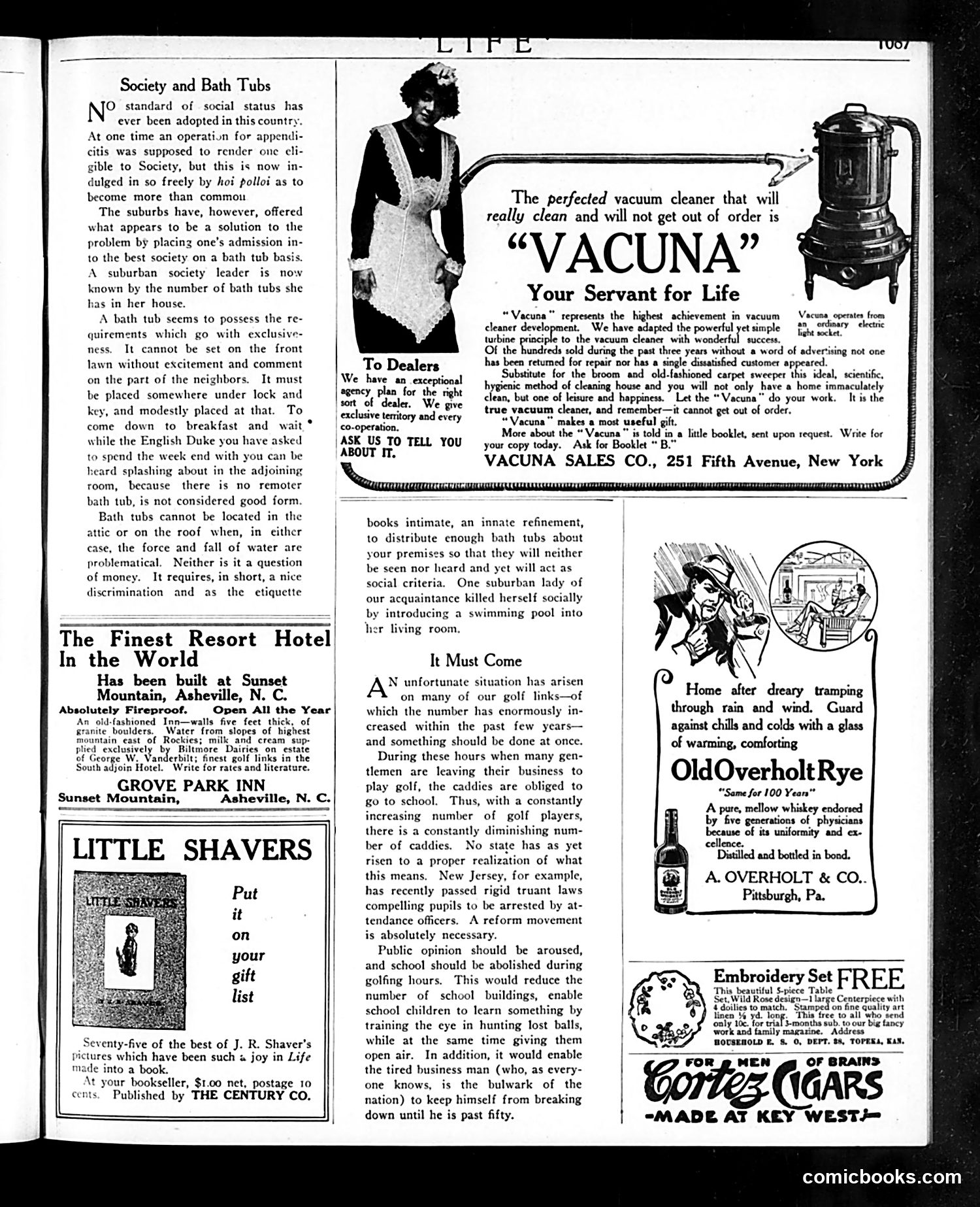
This page is primarily **advertising and social commentary** rather than political cartoons. The main article satirizes American suburban society's obsession with **bath tubs as status symbols**. The humor lies in the absurd notion that possessing multiple bathrooms—hidden discreetly from view—has become the new marker of social respectability, replacing earlier status indicators like appendicitis operations. The piece mocks suburban pretension by highlighting the elaborate etiquette required: bathtubs must be invisible yet prove one's worth, cannot be located inconveniently (attics, roofs), and their proper placement requires "nice discrimination." The page contains several period advertisements: the **Vacuna vacuum cleaner** (promised as trouble-free), **Grove Park Inn** resort hotel in Asheville, **Little Shavers** (a book of humorous illustrations), **Old Overholt Rye whiskey**, and **Gortez Cigars**. The satire targets middle-class anxiety about social positioning and the arbitrary nature of status symbols in early 20th-century America.
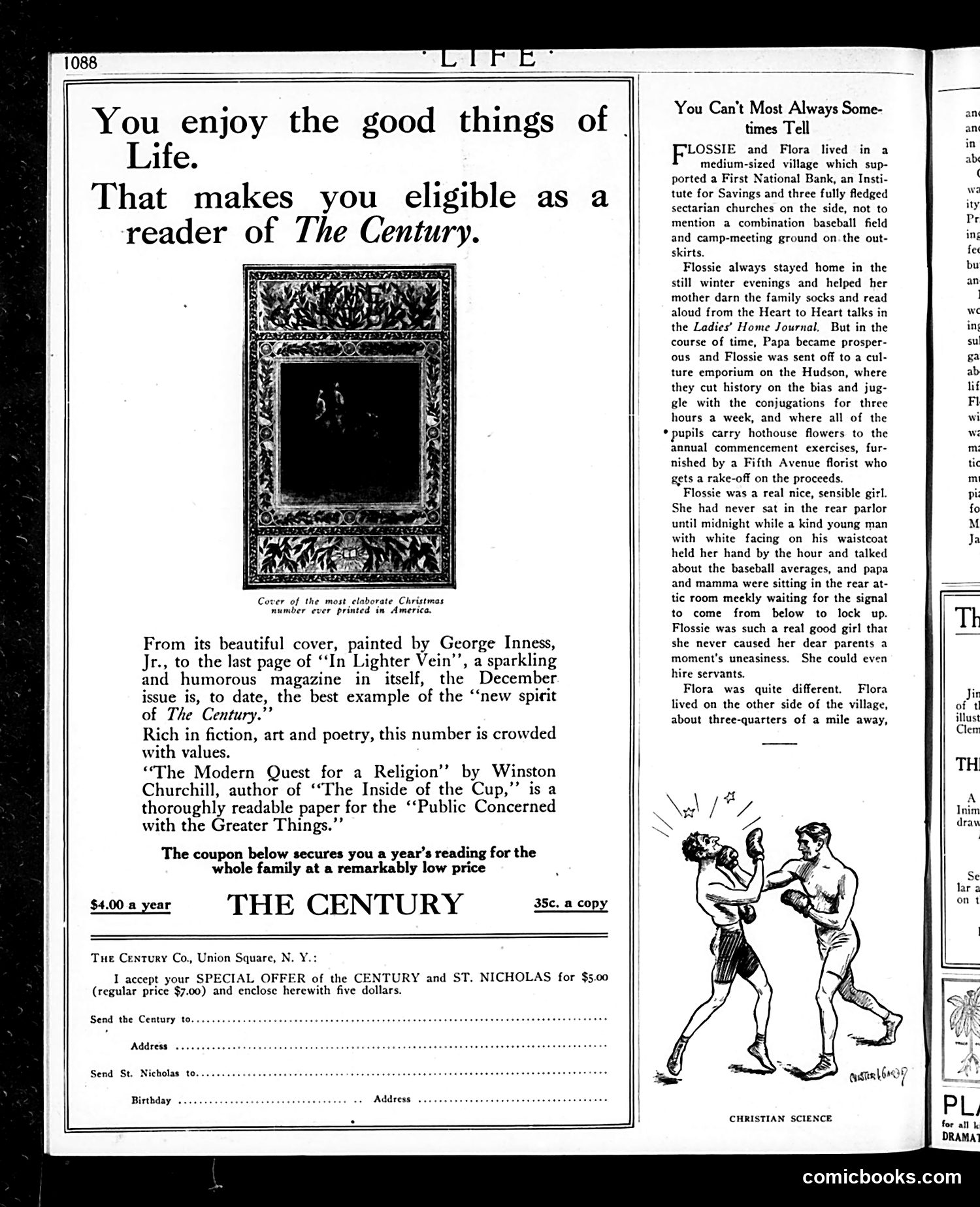
This page is primarily **advertising** for *The Century* magazine and *St. Nicholas* (a children's magazine), not political satire. The main content is a subscription promotion highlighting the December issue's quality. The only narrative content is a short story titled "You Can't Most Always Sometimes Tell," which appears to be a morality tale contrasting two girls: **Flossie**, a "sensible girl" from a prosperous family who attends finishing school and behaves impeccably (never sitting alone with young men), versus **Flora**, from the "other side of the village," whose character implications remain unclear on this page. The story's implicit social commentary likely concerns **class differences and propriety** in small-town America—distinguishing the "cultured" wealthy girl from the working-class girl—though the full narrative point requires seeing the story's conclusion. The illustration (marked "Christian Science") shows two women playing sports or exercising, likely related to the story content.
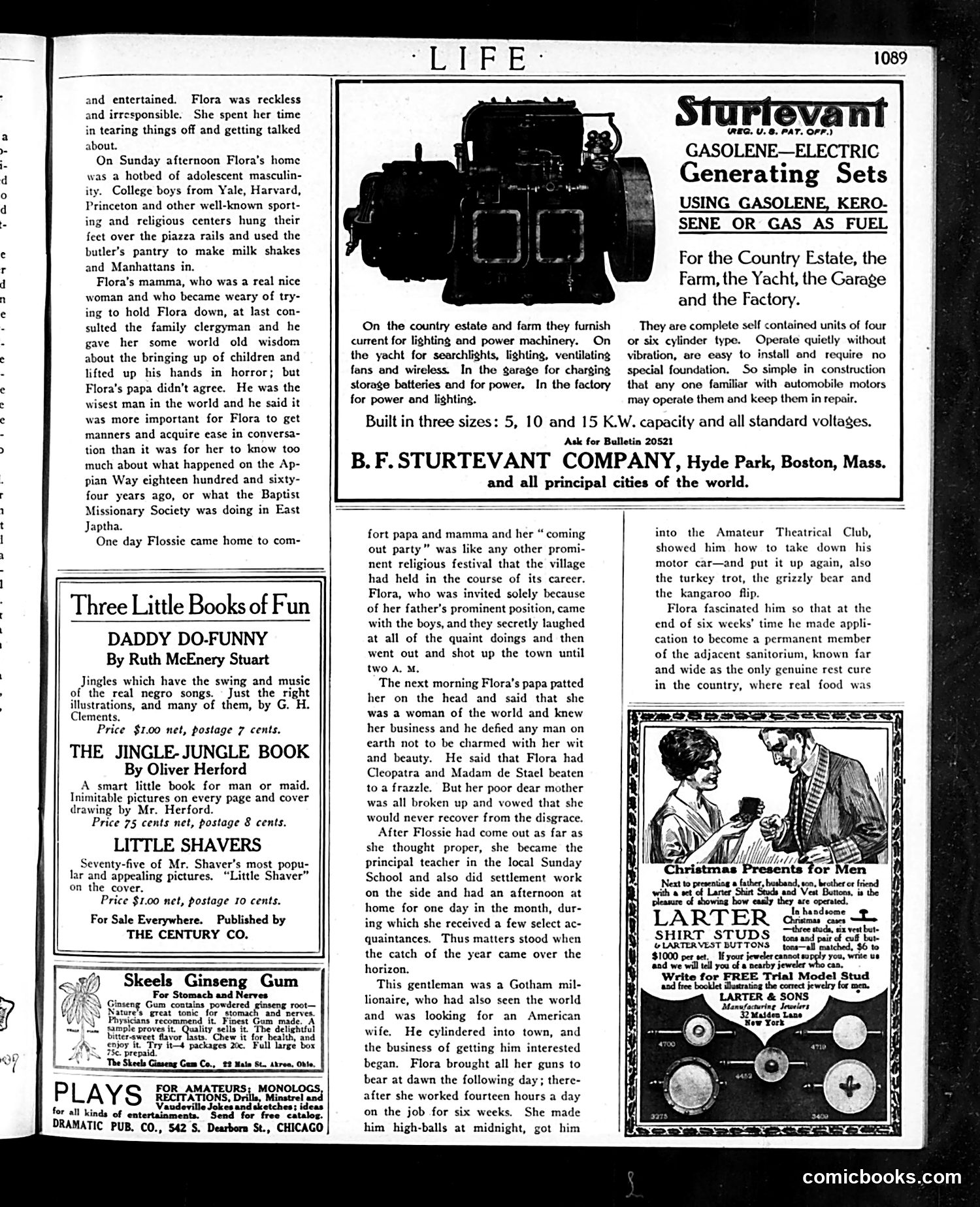
This page is primarily **advertising**, not satire or political commentary. The dominant content is a full-page ad for B.F. Sturtevant Company's gasoline-electric generating sets—early 20th-century power equipment for estates, farms, yachts, and factories. The text column contains a serialized story about "Flora," a reckless young woman from a wealthy family whose father values social polish over education or morality. The narrative critiques parental indulgence: Flora's mother consults the family clergyman for help, while her father dismisses concerns about her behavior, claiming "manners and ease in conversation" matter more than knowing history or theology. Flora attends a "coming out party" (debutante ball), then shoots up the town at 2 A.M., yet her father rewards her—suggesting satirical commentary on upper-class hypocrisy and failed parental guidance. The smaller advertisements promote books and patent medicines typical of the era.
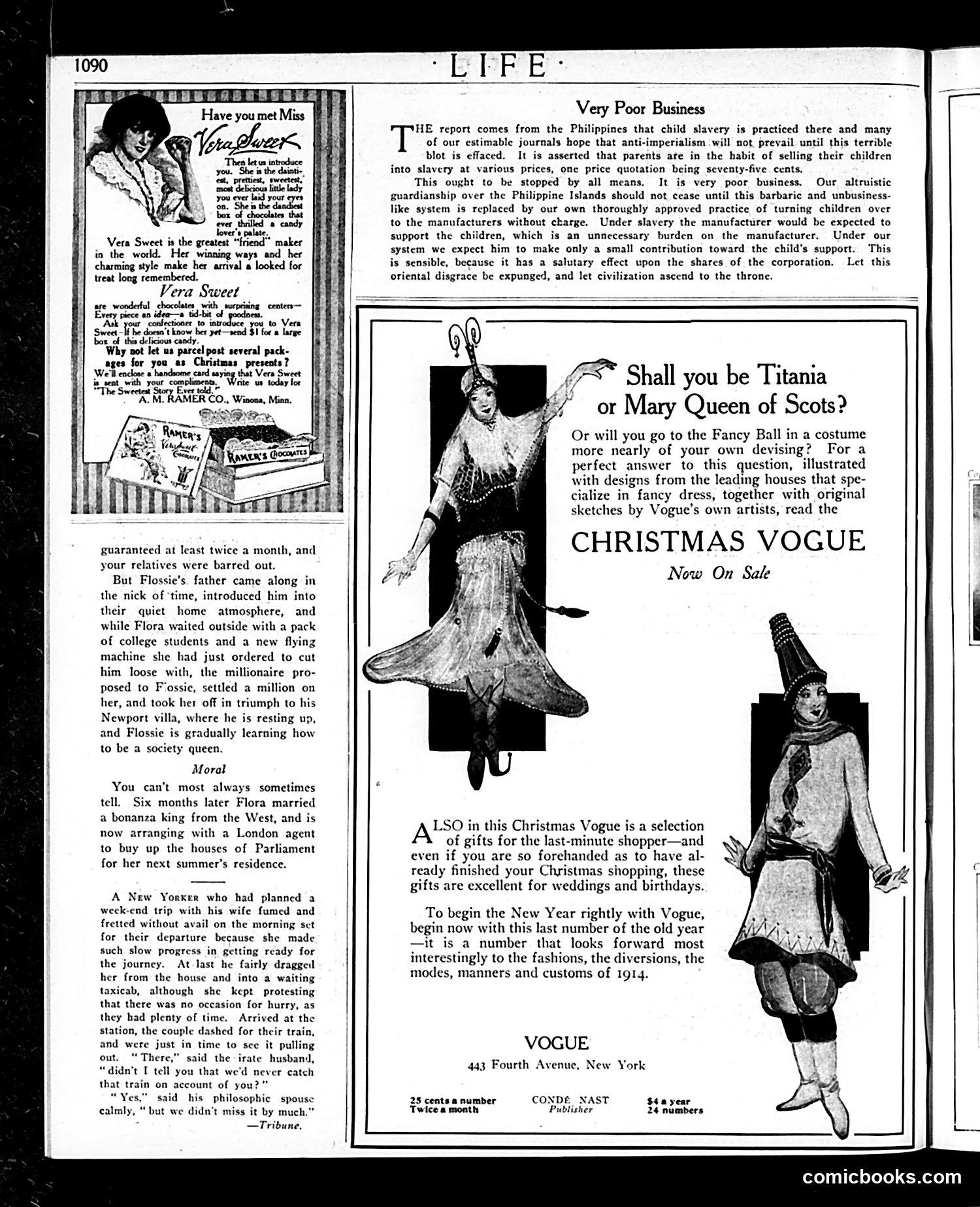
This page mixes advertising with satirical social commentary typical of early 20th-century *Life* magazine. **Left side:** Vera Sweet candy advertisements and two brief humorous anecdotes mocking American social pretension. One describes a woman who marries a millionaire, then her sister marries a "bonanza king from the West" and plans to buy Parliament buildings—satire on nouveau riche excess and American social climbing. The second mocks a husband's complaint about missing a train, with his wife's philosophical response that they "didn't miss it by much." **Right side:** The main satirical piece, "Very Poor Business," attacks American colonial practice in the Philippines. It uses biting irony to compare child labor there (selling children into slavery for 75 cents) unfavorably with American industrial practice—where manufacturers receive free child labor with minimal support obligations. The satire exposes American hypocrisy: condemning foreign "barbarism" while defending exploitative domestic child labor practices as economically sensible. **Also featured:** A *Vogue* magazine advertisement.
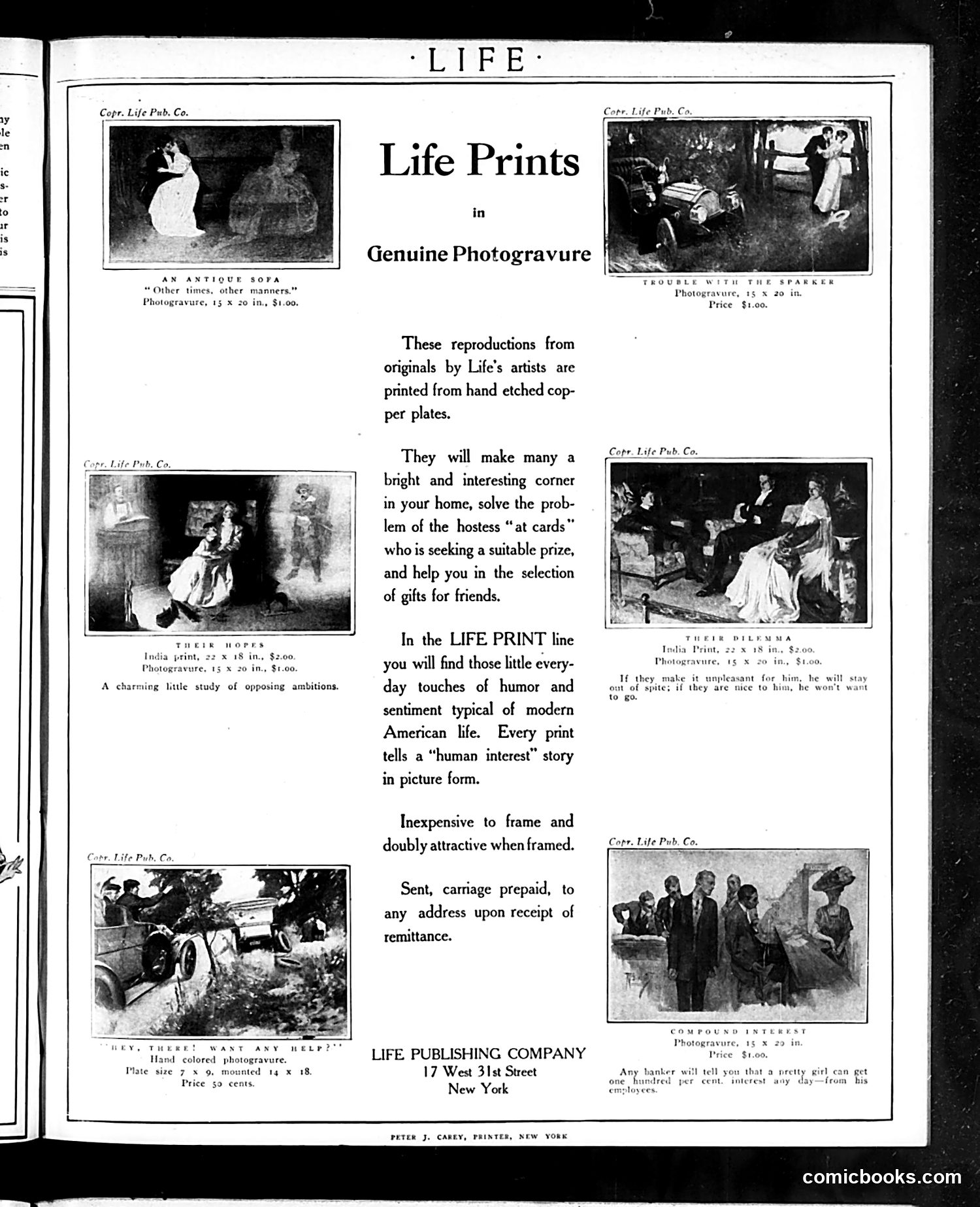
This is primarily an **advertisement**, not political satire. Life Publishing Company is promoting its "Life Prints"—reproductions of illustrations by Life magazine's artists, sold as affordable home décor and gifts. The page displays six sample prints, each depicting everyday American domestic or social scenes rendered as humorous "human interest" stories. Titles include "An Antique Sofa," "Trouble with the Sparker," and "Their Dilemma"—scenes capturing moments of mild comedy or pathos from ordinary life. The marketing emphasizes these prints' appeal: inexpensive framing options, suitable as hostess gifts, and reflective of "modern American life" with touches of humor and sentiment. Prices range from 50 cents to $2.00, with carriage prepaid delivery available. This represents Life magazine's commercial expansion beyond editorial content into the decorative arts market of the early 20th century.
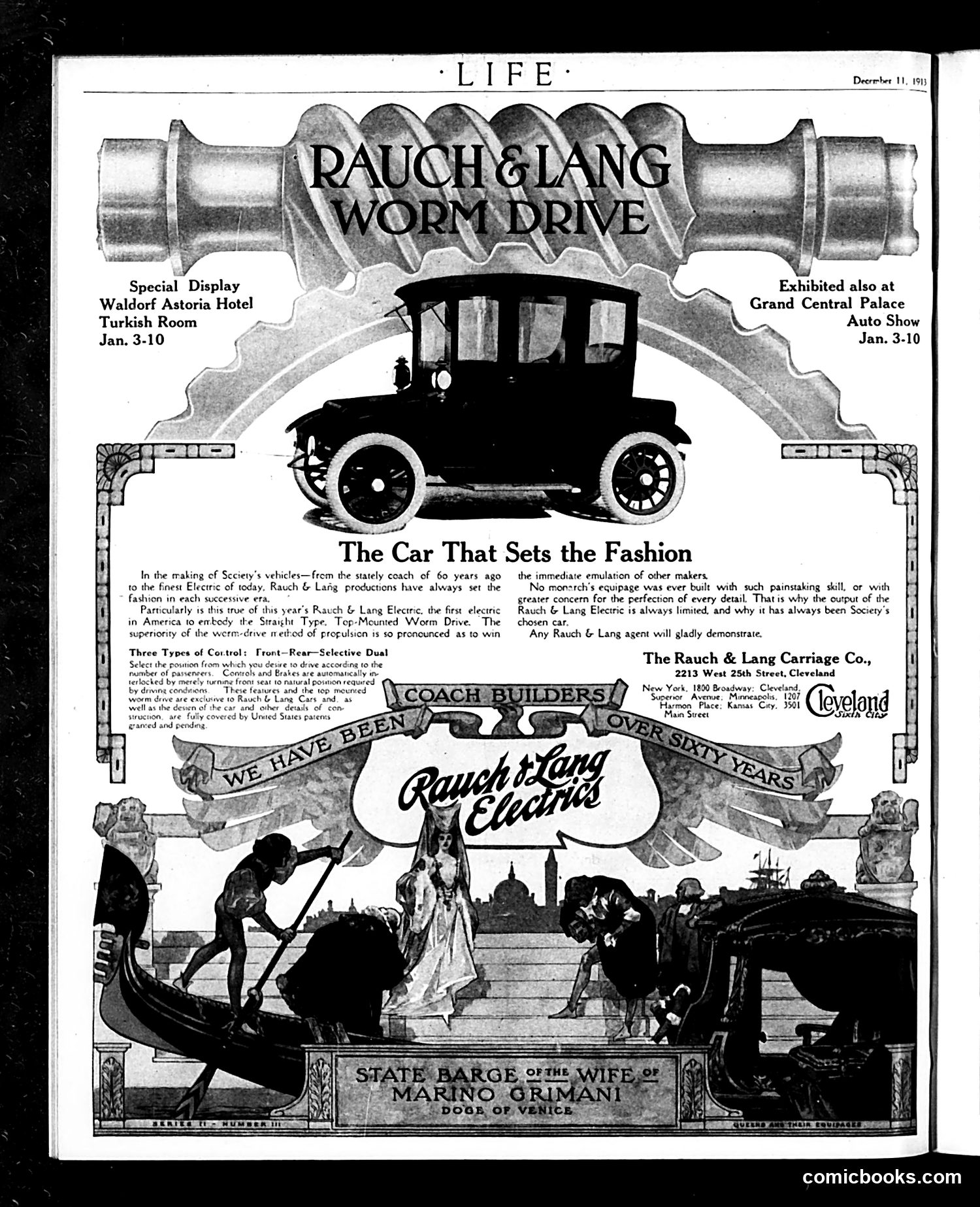
This is primarily a **luxury automobile advertisement** rather than political satire. The Rauch & Lang company is advertising their new electric car model, emphasizing its status as a fashionable choice for wealthy society. The bottom illustration depicts a Venetian state barge, referencing historical luxury and prestige—a metaphor suggesting the car is as finely crafted and exclusive as Renaissance royal vessels. The text claims Rauch & Lang has "set the fashion" for 60 years in high-society vehicles. The ad's central claim is that this electric automobile represents cutting-edge engineering (featuring a "Straight Type. Top-Mounted Worm Drive") while maintaining exclusivity through limited production. The phrase "Society's chosen car" targets wealthy buyers. This reflects early-1900s attitudes where automobiles were luxury goods for the elite, not mass transportation. The comparison to royal barges and emphasis on handcrafted perfection reflects pre-industrial notions of prestige still applied to early automobiles.