
Life, 1913-12-11 · page 23 of 40
Life — December 11, 1913 — page 23: what you’re looking at
What you’re looking at
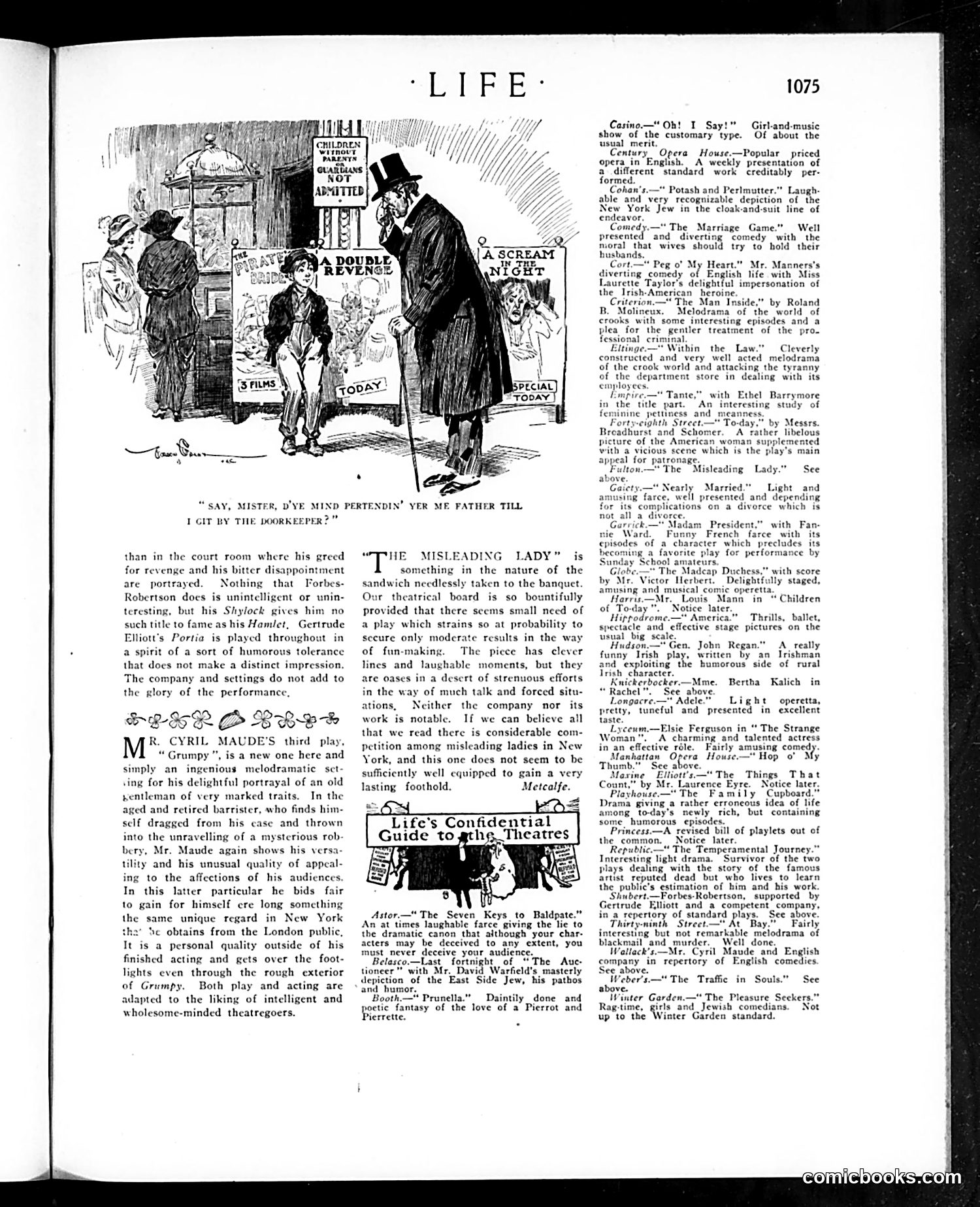
The main cartoon shows a well-dressed man in a top hat speaking to a boy at what appears to be a theater entrance, with various theater marquees visible in the background. The caption reads: "Say, mister, d'ye mind pertendin' yer me father till I git by the doorkeeper?" The joke satirizes **child labor laws and theater admission policies** of the era. The boy is asking the gentleman to pose as his father to bypass the doorkeeper—likely to avoid either an age restriction or a children's admission fee. The cartoon's humor lies in the brazenness of the request and the implicit commentary that such deceptions were commonplace enough that a child would casually ask a stranger to participate. It reflects early 20th-century concerns about theater attendance regulations and enforcement, while poking fun at both the ease of circumventing rules and children's resourcefulness in doing so. The detailed theater advertisements on the surrounding page reinforce that this was a vibrant period for live theater in New York.
📄 Transcribed text from this page (OCR, searchable)
Machine-transcribed from the original scan — historical spelling and the odd misread are preserved.
CHILDREN wrrnow PARENTS Y, MISTER, D’ I GIT BY THE DOORKEEPER? than in the court room where his greed for revenge and his bitter disappointment are portrayed. Nothing that Forbes- Robertson docs is unintelligent or unin- teresting, but his Shylock gives him no such title to fame as his Hamlet, Gertrude Elliott’s Portia is played throughout in a spirit of a sort of humorous tolerance that does not make a distinct impression, The company and settings do not add to the glory of the performance, FESR OLROH R. CYRIL MAUDE'S third play, “ Grumpy", is a new one here and simply an ingenious melodramatic sct- sing for his delightful portrayal of an old hentleman of very marked traits. In the aged and retired barrister, who finds him- self dragged from his case and thrown into the unravelling of a mysterious rob- bery, Mr. Maude again shows his versa- tility and his unusual quality of appecal- ing to the affections of his audience In this latter particular he bids fj to gain for himsclf cre long something the same unique regard in New York ‘ye obtains from the London public, It is a personal quality outside of his finished acting and gets over the foot- lights even through the rough exterior of Grumpy. Both play and acting are adapted to the liking of intelligent and wholesome-minded theatregoers. iy (| D PERTENDIN’ YER ME FATHER TILL “THE MISL LADY” is something in the nature of the sandwich needlessly taken to the banquet. Our theatrical board is so bountifully provided that there scems small need of a play which strains so at probability to secure only moderate results in the way of fun-making. The picce has clever lines and laughable moments, but they a desert of strenuous efforts in the way of much talk and forced situ- ations, Neither the company nor its work is notable. If we can believe all that we read there is considerable com- petition among misleading ladies in New York, and this one does not scem to be sufficiently well equipped to gain a very lasting foothold. Metcalfe. are oases Life’s Confidential hg_Theatres Astor—"The Seven Keys to Baldpate.” An at times laughable farce giving the lie to the dramatic canon that although your char- acters may be deceived to any extent, you must never deceive your audience. Belasco.—Last_ fortnight, of “The Auc- tioneer” with Mr, David Warfield's masterly depiction of the East Side Jew, his patbos and Booth Daintily_ done and poetic fantasy of the love of a Pierrot and Pierrette. 1075 Casino.—" Oh! IT Say!” show of the customary type. usual merit. Century Opera opera in’ English. a different formed. Cohan's.—" Potash and Perlmutter.” Laugh- able and very recognizable depiction of the New York Jew in the cloak-and-suit line of endeavor. Comedy.—" The Marriage Game.” Well presented and diverting comedy with the moral that wives should try to hold their husbands. ort." Deg o! My Heart.” Mr. Manners's diverting comedy of English life with Miss Laurette Taylor's delightful impersonation of the Irish-American heroine. Criterio The Man Inside,” by Roland B. Moli Melodrama of the world of crooks with some interesting episodes and a plea for the gentler treatment of the pro- fessional crimi ithin the Law.” Cleverly constructed and very well acted melodrama of the crook world and attacking the tyranny the department store in dealing with its ployees. Empire.—" Tante,” with Ethel in the title part. “An interesting feminine pettiness and meanness. ighth Strect.—" To-day,” by Messrs. Breadhurst and Schomer. A rather libelous picture of the American woman supplemented with a vicious scene which is the play's main appeal for patronage. The Misleading Girl-and-music Of about the House.—Popular priced A weekly presentation of standard work creditably per- Ba Lad: —"Nearly Married." Light and farce, well presented and depending s complications on a divorce which is not_all a divorce. Garrick.—" Madam President,” with Fan- nie Ward. Funny French farce with its episodes of a character which precludes its ing a favorite play for performance by * The Madcap Duchess.” with score by Mr. Victor Herbert. Delightfully staged, amusing and musical comic operetta Harris.—Mr. Louis. Mann in“ Children of To-day". Notice later. Hiprodrome.—" America.” Thrills, ballet, spectacle and effective stage pictures on the usual big scale. Hi —"Gen. John Regan." A_ really funny Irish play, written by an Tri and exploiting the humorous side of rural Irish character. . Knickerbocker.—Mme. Bertha Kalich in “ Rachel" See above. Longacre.—" Adele.” Light operetta, pretty, tuneful and presented in excellent taste. Lyceum.—Elsie Ferguson in The Strange Woman”. A charming and talented actress in an effective role. Fairly amusing comed; Manhattan Opera House—" Hop o° My Thumb.” See above. . Marine Eltiott’s—" The Things That Count,” by Mr. Laurence Eyre. Notice later, Plaxyhouse.—" The Family Cupboard Drama giving a rather erroneous idea of life among, today’s newly rich, but containing some humorous episodes. Princess.—A revised bill of playlets out of the, common. Notice later. Republic.—" The Temperamental Journey.” Interesting light drama. Survivor of the two plays dealing with the story of the famous artist reputed dead but who lives to learn the public’s estimation of him and his work. Shnbert.—Forbes-Robertson, supported by Gertrude Elliott and a competent company, in a repertory of standard plays. See above. Thirty-ninth Street—" At Bay.” — Fairly interesting but not remarkable melodrama of blackmail and murder. Well done. Wellack’s.—Mr. Cyril Maude and English company in repertory of English comedies. See abo c The Traffic in Souls.” See The Pleasure Seeker Not ter Garden. — Rag-time, girls and Jewish comedians up to the Winter Garden standard.