
Life, 1913-12-11 · page 22 of 40
Life — December 11, 1913 — page 22: what you’re looking at
What you’re looking at
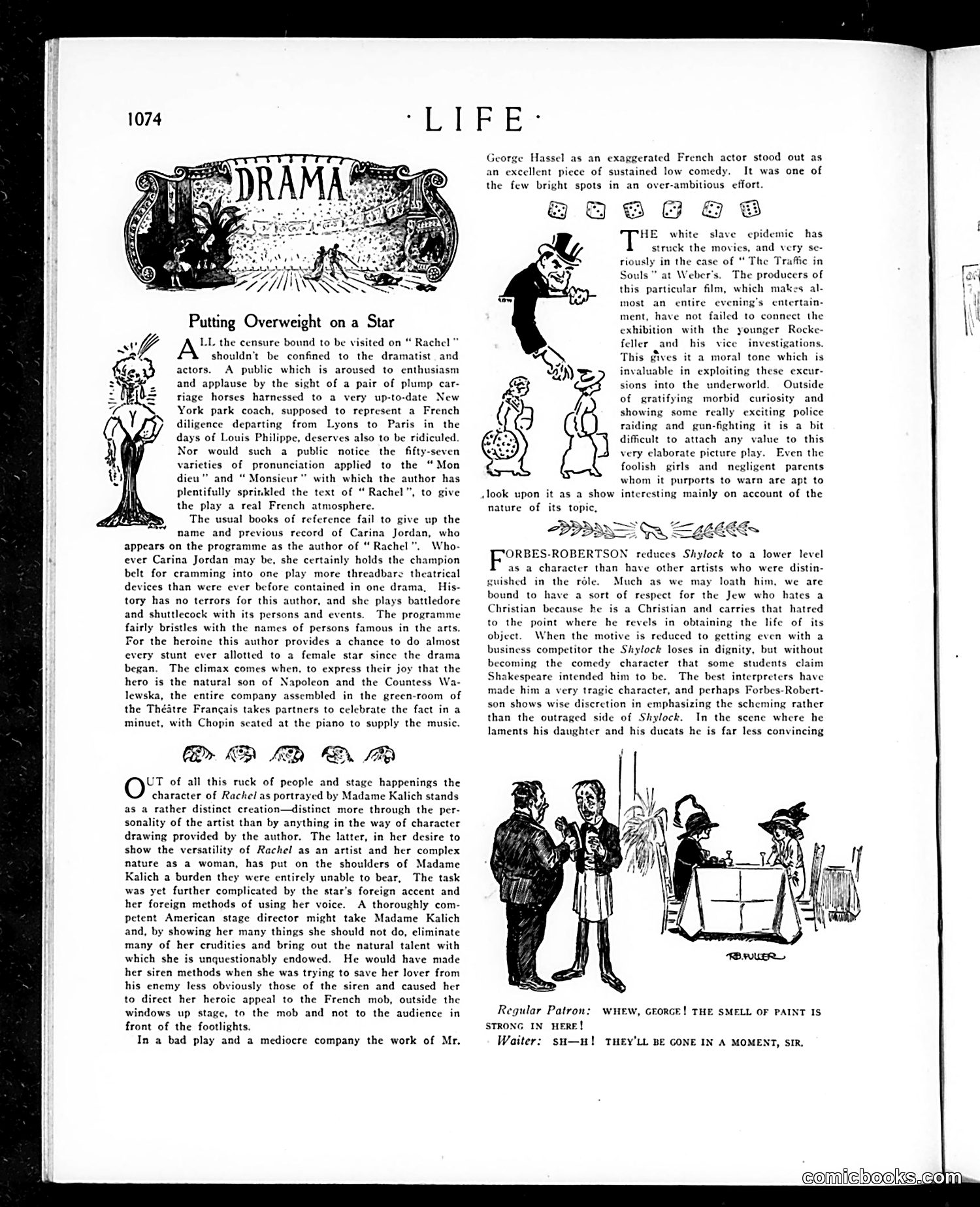
This page reviews theatrical productions, primarily critiquing a play called "Rachel" adapted by Carina Jordan. The satire focuses on **theatrical excess and lazy playwriting**. The main targets are: 1. **"Rachel" production**: The author mocks the play's overwrought ambition—cramming historical references, famous names, and every possible dramatic device into one script. The absurd climax (a minuet celebrating that the hero is Napoleon's illegitimate son) exemplifies this ridiculousness. 2. **The audience**: Life sarcastically blames theatergoers who applaud merely because expensive props (fancy carriage horses) are onstage, missing the terrible French accents and sloppy writing. 3. **Madame Kalich** (the lead actress): While praised for personality, she's burdened by bad material and needs directorial coaching to overcome her foreign accent and theatrical mannerisms. 4. **George Hassel**: Noted as the one bright spot—genuine low comedy amidst mediocrity. The page also briefly mentions "Traffic in Souls," a film exploiting the "white slave epidemic" controversy, using moral outrage as marketing rather than substantive content.
📄 Transcribed text from this page (OCR, searchable)
Machine-transcribed from the original scan — historical spelling and the odd misread are preserved.
RE ALL Ltt ZZ Putting Overweight on a Star LL the censure bound to be visited on “ Rachel ” shouldn't be confined to the dramatist and actors. A public which is aroused to enthusiasm and applause by the sight of a pair of plump car- riage horses harnessed to a very up-to-date New York park coach, supposed to represent a French diligence departing from Lyons to Paris in the days of Louis Philippe, deserves also to be ridiculed Nor would such a public notice the fifty-seven varieties of pronunciation applied to the “Mon dieu” and “ Monsicur” with which the author has plentifully sprinkled the text of “ Rachel”, to give the play a real French atmosphere. The usual books of reference fail to give up the name and previous record of Carina Jordan, who appears on the programme as the author of “ Rachel". Who- ever Carina Jordan may be, she certainly holds the champion belt for cramming into one play more threadbare theatrical devices than were ever before contained in one drama, His- tory has no terrors for this author, and she plays battledore and shuttlecock with its persons and events. The programme fairly bristles with the names of persons famous in the arts. For the heroine this author provides a chance to do almost every stunt ever allotted to a female star since the drama began. The climax comes when, to express their joy that the hero is the natural son of Napoleon and the Countess Wa- lewska, the entire company assembled in the green-room of the Théatre Francais takes partners to celebrate the fact in a minuet, with Chopin seated at the piano to supply the music. UT of all this ruck of people and stage happenings the character of Rachel as portrayed by Madame Kalich stands as a rather distinct creation—distinct more through the per- sonality of the artist than by anything in the way of character drawing provided by the author. The latter, in her desire to show the versatility of Rachel as an artist and her complex nature as a woman, has put on the shoulders of Madame Kalich a burden they were entirely unable to bear, The task was yet further complicated by the star’s foreign accent and her foreign methods of using her voice. A thoroughly com- petent American stage director might take Madame Kalich and, by showing her many things she should not do, eliminate many of her crudities and bring out the natural talent with which she is unquestionably endowed. He would have made her siren methods when she was trying to save her lover from his enemy less obviously those of the siren and caused her to direct her heroic appeal to the French mob, outside the windows up stage, to the mob and not to the audience in front of the footlights. In a bad play and a mediocre company the work of Mr. Jeorge Hassel as an exaggerated French actor stood out as an excellent piece of sustained low comedy. It was one of the few bright spots in an over-ambitious effort TT white slave epidemic has uck the movies, and very se- riously in the case of “ The Traffic in Souls” at Weber's, The producers of this particular film, which makes al- most an entire evening's entertain- ment, have not failed to connect the exhibition with the younger Roc feller and his vice investigation’ This gives it a moral tone which is invaluable in exploiting these excur- sions into the underworld. Outside of gratifying morbid curiosity and showing some really exciting police raiding and gun-fighting it is a bit difficult to attach any value to this very elaborate picture play. Even the foolish girls and negligent parents whom it purports to warn are apt to «look upon it as a show interesting mainly on account of the nature of its topic, ORBES-ROBERTSON reduces Shylock to a lower level as a character than have other artists who were distin- guished in the réle. Much as we may loath him, we are bound to have a sort of respect for the Jew who hates a Christian because he is a Christian and carries that hatred to the point where he revels in obtaining the life of its object. When the motive is reduced to getting even with a business competitor the Shylock loses in dignity, but without becoming the comedy character that some students claim Shakespeare intended him to be. The best interpreters have made him a very tragic character, and perhaps Forbes-Rober son shows wise discretion in emphasizing the scheming rather than the outraged side of Shylock. In the scene where he laments his daughter and his ducats he is far less convincing Regular Patron: wew, Grorce! THE SMELL OF PAINT IS STRONG IN HERE! Waiter: su—u! THEY'LL BE GONE IN A MOMENT, SIR. comichooks, com=