
Life, 1913-12-11 · page 27 of 40
Life — December 11, 1913 — page 27: what you’re looking at
What you’re looking at
This page contains three separate editorial pieces satirizing American social reformers and their overreach: **"Morse Again"** defends Charles W. Morse, a financier recently pardoned from prison, against President Taft's suggestion he faked illness to gain release. Life argues that if Morse lives honestly afterward, continued punishment serves no purpose—rehabilitation matters more than vengeance. **"Ahoy, Wilbur! Come About!"** mocks Rev. Wilbur F. Crafts of the National Reform Bureau and feminists for attempting to eliminate "home rule" through government power. Life's satire: reformers cannot force moral improvement on unwilling people; change must come from individual desire, not external coercion. **"No License"** criticizes Harvard's no-license (alcohol prohibition) policy, suggesting it prevented the Harvard Union from bringing together different social classes—the restrictive rule undermined its integrative purpose. The uniting theme: skepticism toward paternalistic reformers who believe laws and punishment can engineer better behavior without addressing root causes or individual agency.
📄 Transcribed text from this page (OCR, searchable)
Machine-transcribed from the original scan — historical spelling and the odd misread are preserved.
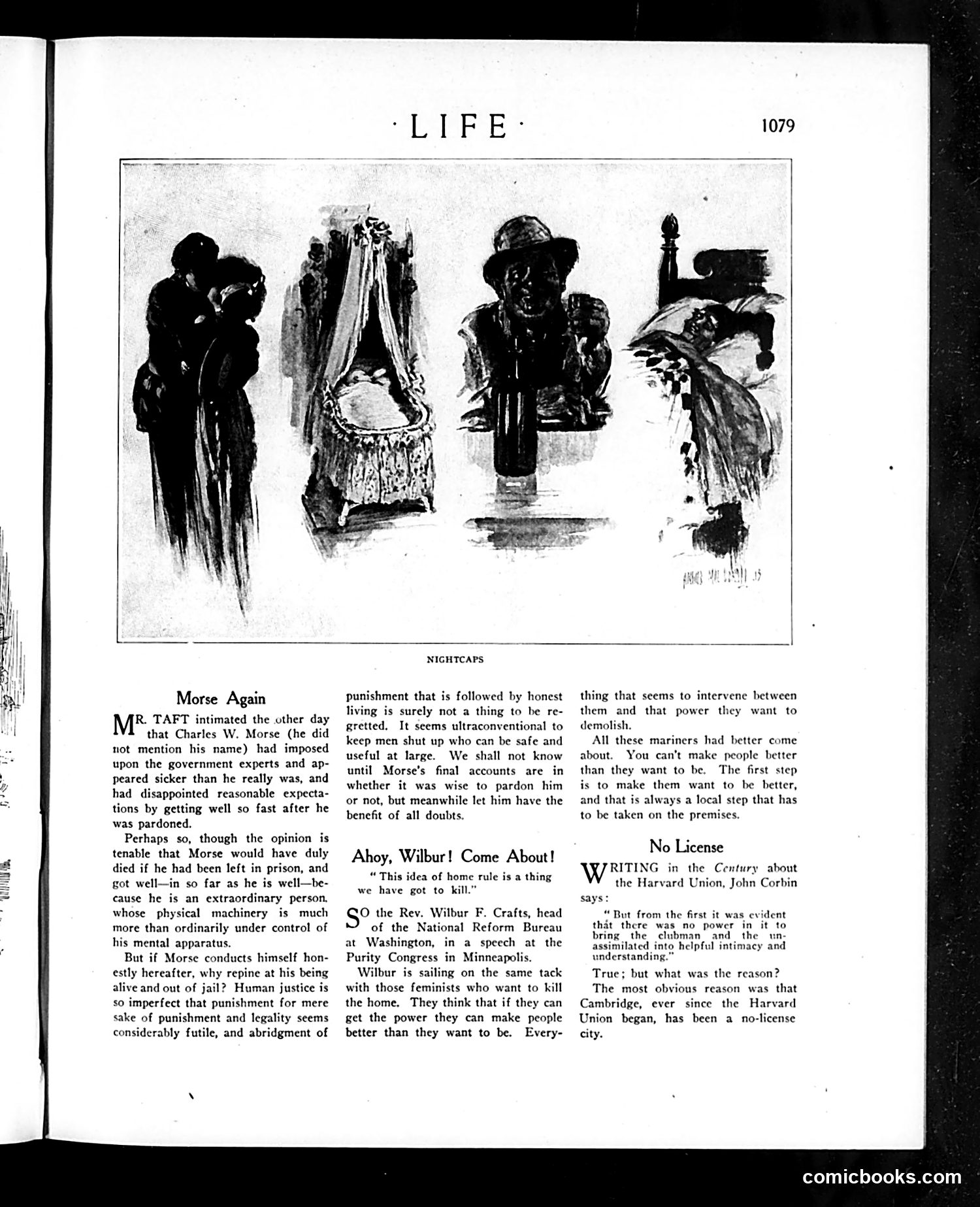
Morse Again R. TAFT intimated the other day that Charles W. Morse (he did not mention his name) had imposed upon the government experts and ap- peared sicker than he really was, and had disappointed reasonable expecta- tions by getting well so fast after he was pardoned. Perhaps so, though the opinion is tenable that Morse would have duly died if he had been left in prison, and got well—in so far as he is well—be- cause he is an extraordinary person, whose physical machinery is much more than ordinarily under control of his mental apparatus. But if Morse conducts himself hon- estly hereafter, why repine at his being alive and out of jail? Human justice is so imperfect that punishment for mere sake of punishment and legality seems considerably futile, and abridgment of NIGHTCAPS punishment that is followed by honest living is surely not a thing to be re- gretted. It seems ultraconventional to keep men shut up who can be safe and useful at large. We shall not know until Morse’s final accounts are in whether it was wise to pardon him or not, but meanwhile let him have the benefit of all doubts. Ahoy, Wilbur! Come About! “ This idea of home rule is a thing we have got to kill.” O the Rev. Wilbur F. Crafts, head of the National Reform Bureau at Washington, in a speech at the Purity Congress in Minneapolis. Wilbur is sailing on the same tack with those feminists who want to kill the home, They think that if they can get the power they can make people better than they want to be. Every- thing that seems to intervene between them and that power they want to demolish, All these mariners had better come about. You can’t make people better than they want to be, The first step is to make them want to be better, and that is always a local step that has to be taken on the premises. No License RITING in the Century about the Harvard Union, John Corbin says: “But from the first it was nt that there was no power in it to bring the clubman and the un- assimilated into helpful intimacy and understanding.” True; but what was the reason? The most obvious reason was that Cambridge, ever since the Harvard Union began, has been a no-license city. comicbooks.com