
Life, 1913-12-11 · page 18 of 40
Life — December 11, 1913 — page 18: what you’re looking at
What you’re looking at
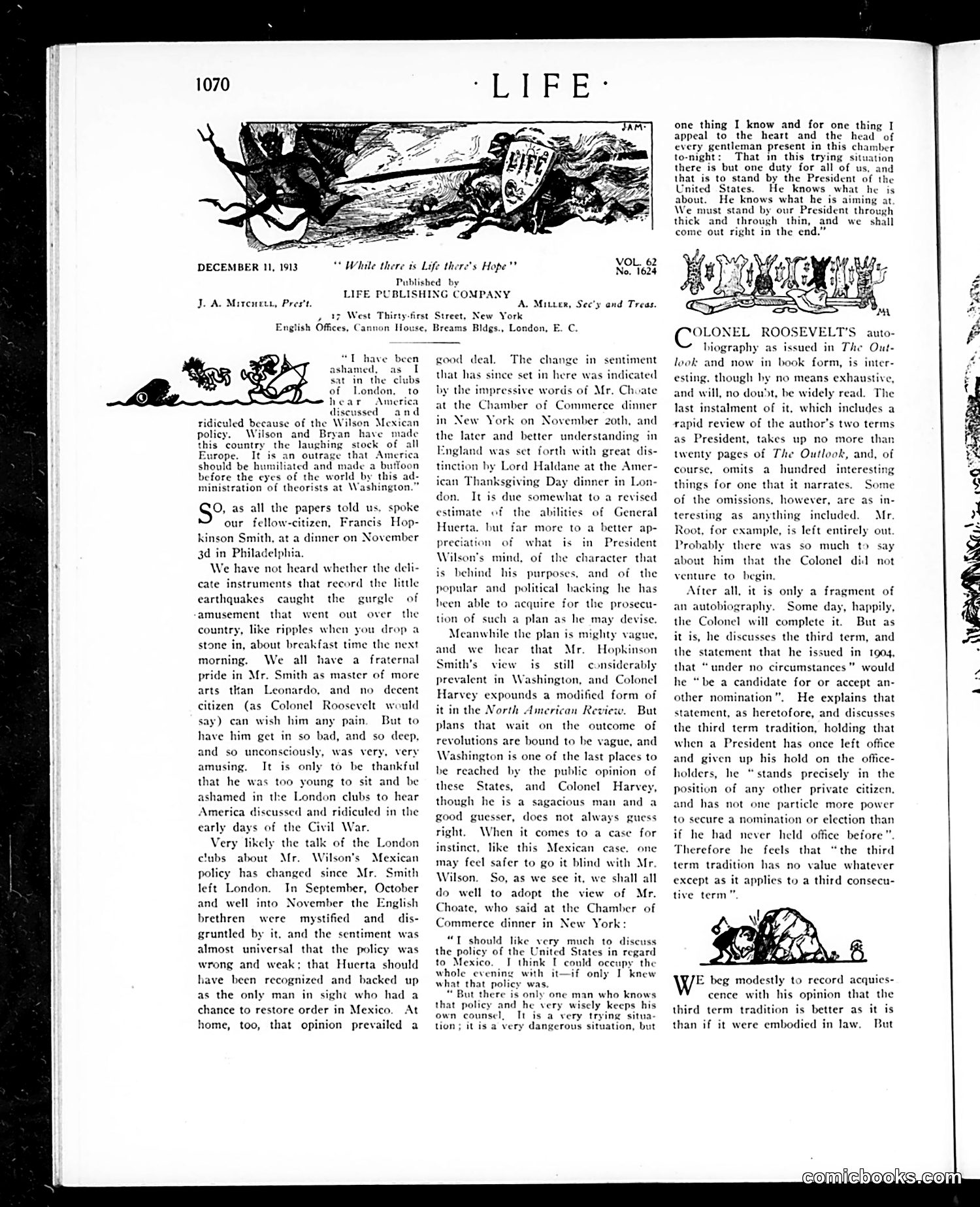
This page discusses President Wilson's Mexican policy, which had drawn criticism from prominent Americans like Francis Hopkinson Smith, who complained in London that Wilson and Secretary of State Bryan had made America "the laughing stock of all Europe." The article notes the irony: Smith criticized the policy abroad while many at home and in Britain initially agreed, wanting the U.S. to recognize and support General Huerta's Mexican government. However, sentiment has shifted—British leaders like Lord Haldane now better understand Wilson's actual aims and political backing for his approach. The piece concludes by quoting diplomat Joseph Choate's witty admission at a Chamber of Commerce dinner: only Wilson truly knows what his Mexican policy is, and "he very wisely keeps his own counsel." The satire targets both the vagueness of Wilson's foreign policy and the irony that critics abroad don't yet grasp what America is actually trying to accomplish in Mexico.
📄 Transcribed text from this page (OCR, searchable)
Machine-transcribed from the original scan — historical spelling and the odd misread are preserved.
DECEMBER 11, 1913 ‘* While there is Life there's Hope" VOL. 62 No. 1624 Published by LIFE PUBLISHING COMPANY JA. Mirent by Pres’t. A. Mitter, Sec’y and Treas. , 17 West Thirty-first Street, New York English Offices, Cannon House, Breams Bldgs., London, E. C. “T have been ashamed, as 1 sat in the ¢! of london, to hear America iscussed and ridiculed because of the Wilson Mexican policy. Wilson and Bryan have de this country the laughing stock of all Europe. It is an outrage that America should be humiliated and made a butfoon before the cyes of the world by this ad- ministration of theorists at Washington.” O, as all the papers told us, spoke our fellow-citizen, Francis Hop- kinson Smith. a dinner on November 3d in Philadelphia. We have not heard whether the deli- cate instruments that record the litle earthquakes caught the gurgle of amusement that went out over the country, like ripples when you drop a stone in, about breakfast time the next morning. We all have a fraternal pride in Mr. Smith as master of more arts than Leonardo, and no decent citizen (as Colonel Roosevelt: would say) can wish him any pain. But to have him get in so bad, and so deep, and so unconsciously, was very, very amusing. It is only to be thankful that he was too young to sit and be ashamed in the London clubs to hear America discussed and ridiculed in the early days of the Civil War. Very likely the talk of the London clubs about Mr. Wilson’s Mexican policy has changed since Mr. Smith left London. In September, October and well into November the English brethren were mystified and dis- gruntled by it, and the sentiment was almost universal that the policy was wrong and weak; that Huerta should have been recognized and backed up as the only man in sight who had a chance to restore order in Mexico. At home, too, that opinion prevailed a good deal. The change in sentiment that has since set in here was indicated the impressive words of Mr. Choate at the Chamber of Commerce dinner in New York on November 20th, and the later and better understanding in England was set forth with great dis- tinction by Lord Haldane at the Amer- ican Thanksgiving Day dinner in Lon- don. It is due somewhat to a revised estimate of the abilities of General Huerta. but far more to a better ap- preciation of wh: Wilson's mind, of at is in President re character that is behind his purposes, and of the popular and political backing he h heen able to acquire for the prosecu- tion of such a plan as he may devise. Meanwhile the plan is mighty vague, and we hear that Mr. Hopkinson Smith's view is still considerably prevalent in Washington, and Colonel Harvey expounds a modified form of it in the North American Review. But plans that wait on the outcome of revolutions are bound to be vague, and Washington is one of the last places to be reached by the public opinion of these States, and Colonel Harvey, though he is a si cious man and a good guesser, does not always guess right. When it comes to a case for instinct, like this Mexican case. one may feel safer to go it blind with Mr. Wilson. So, as we see it, we shall all do well to adopt the view of Mr. Choate, who said at the Chamber of Commerce dinner in New York: “T should like very much to discuss the policy of the United States in regard to Mexico. I think I conld occupy the whole evening with it—if only I knew what that policy was. “ But there is only one man who knows that policy and he very wisely keeps his own counsel, It is a very trying situa- tion; it is a very dangerous situation, but one thing I know and for one thing I appeal to the heart and the head of every gentleman present in this chamber to-night: That in this trying situation there is but one duty for all of us, and that is to stand by the President of the United States. He knows what he is about. He knows what he is aiming at We must stand by our President through thick and through thin, and we shall come out right in the end.” COLONEL ROOSEVELT’S auto- biography as issued in The Out- look and now in book form, is inter- esting, though hy no means exhaustive, and will, no dou t, be widely read. The last instalment of it, which includes a rapid review of the author's two terms s President, takes up no more than twenty pages of The Outlook, and, of course, omits a hundred interesting things for one that it narrates. Some of the omissions, however, are as in- teresting as anything included. Mr Root, for example, is left entirely out. Probably there was so much to say about him that the Colonel did not venture to begin. After all, it is only a fragment of an autobiography. Some day, happily, the Colonel will complete it. But as. it is, he discusses the third term, and the statement t! he issued in 1904, that “under no circumstances" would he “be a candidate for or accept an- other nomination”, He explains that statement, as heretofore, and discusses the third term tradition, holding that when a President has once left office and given up his hold on the office- holders, he “stands precisely in the position of any other private citizen, and has not one particle more power to secure a nomination or election than if he had never held office before”. Therefore he feels that “the third term tradition has no value whatever except as it applies to a third consecu- tive term”, E. beg modestly to record acquic cence with his opinion that the third term tradition is better as it is than if it were embodied in law. But