
Life, 1913-12-11 · page 25 of 40
Life — December 11, 1913 — page 25: what you’re looking at
What you’re looking at
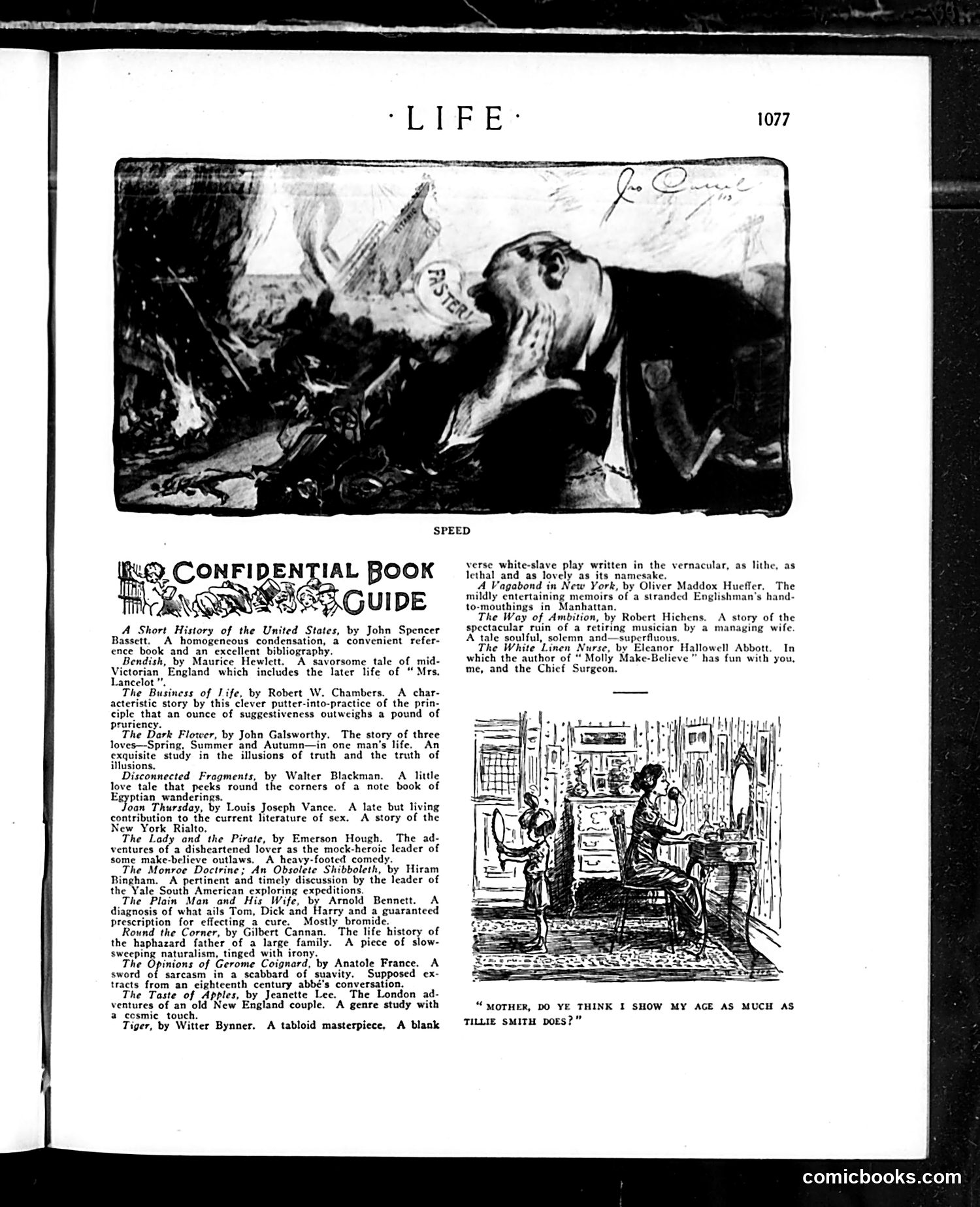
This page features a "Confidential Book Guide"—a satirical book review section common to Life magazine's humor. The top cartoon labeled "SPEED" shows a man in period dress apparently racing or moving frantically, likely mocking contemporary literature's obsession with fast-paced narratives or modern life's frenetic pace. Below, the guide reviews contemporary novels (circa 1910s) with witty, cutting commentary. Life's critics mock pretentious literature: praising Galsworthy's *The Dark Flower* as studying "illusions of truth," dismissing Bennett's *The Plain Man and His Wife* as "mostly bromide" (cliché), and calling Hichens's *The Way of Ambition* "superfluous." The bottom cartoon shows a woman asking her mother whether she looks as aged as "Tillie Smith"—a joke about vanity and women's anxiety over aging appearance, common satire fodder for the era. The overall tone mocks both pretentious literature and contemporary social concerns.
📄 Transcribed text from this page (OCR, searchable)
Machine-transcribed from the original scan — historical spelling and the odd misread are preserved.
SPEED CONFIDENTIAL BOOK GUIDE A Short History of the United States, by John Spencer Bassett. A homogencous condensation, a convenient refer- ence book and an excellent bibliography. Bendish, by Maurice Hewlett. savorsome tale of mid- Victorian England which includes the later life of “ Mrs. Lancelot”. The Business of Life, by Robert W. Chambers. A char- acteristic story by this clever putter-into-practice of the prin- ciple that an ounce of suggestiveness outweighs a pound of pruriency. The Dark Flower, by John Galsworthy. The story of three loves—Spring, Summer and Autumn—in one man's life. An exquisite study in the illusions of truth and the truth of illusions. Disconnected Fragments, by Walter Blackman. A little love tale that peeks round the corners of a note book of Egyptian wanderings. ‘oan Thursday, by Louis Joseph Vance. contribution to the current literature of sex. New York Rialto. The Lady and the Pirate, by Emerson Hough. The ad- ventures of a disheartened lover as the mock-heroic leader of some make-believe outlaws. A heavy-footed comedy. The Monroe Doctrine; An Obsolete Shibboleth, by Hiram Bingham. A pertinent and timely discussion by the leader of the Yale South American exploring expeditions. The Plain Man and His Wife, by Arnold Bennett. A diagnosis of what ails Tom, Dick and Harry and a guaranteed prescription for effecting a cure. Mostly bromide, Round the Corner, by Gilbert Cannan. The life history of the haphazard father of a large family. A piece of slow- sweeping naturalism, tinged with irony. The Opinions of Gerome Coignard, by Anatole France. A sword of sarcasm in a scabbard of suavity. Supposed ex- tracts from an eighteenth century abbé's conversation. The Taste of Apples, by Jeanette Lee. The London ad- ventures of an old New England couple. A genre study with a cesmic touch. Tiger, by Witter Bynner. A blank A late but living A story of the A tabloid masterpiece, verse white-slave play written in the vernacular, as lithe, as lethal and as lovely as its namesake. Vagabond in New York, by Oliver Maddox Hueffer. The mildly entertaining memoirs of a stranded Englishman's hand- to-mouthings in Manhattan. The Way of Ambition, by Robert Hichens. A story of the spectacular ruin of a retiring musician by a managing wife A tale soulful, solemn and—superfluous. The White ‘Linen Nurse, by Eleanor Hallowell Abbott. In which the author of “Molly Make-Believe ” has fun with you, me, and the Chief Surgeon. “MOTHER, DO YE THINK I SHOW MY AGE AS MUCH AS TILLIE SMITH DOES?” comicbooks.com