
A complete issue · 44 pages · 1913
Life — October 9, 1913
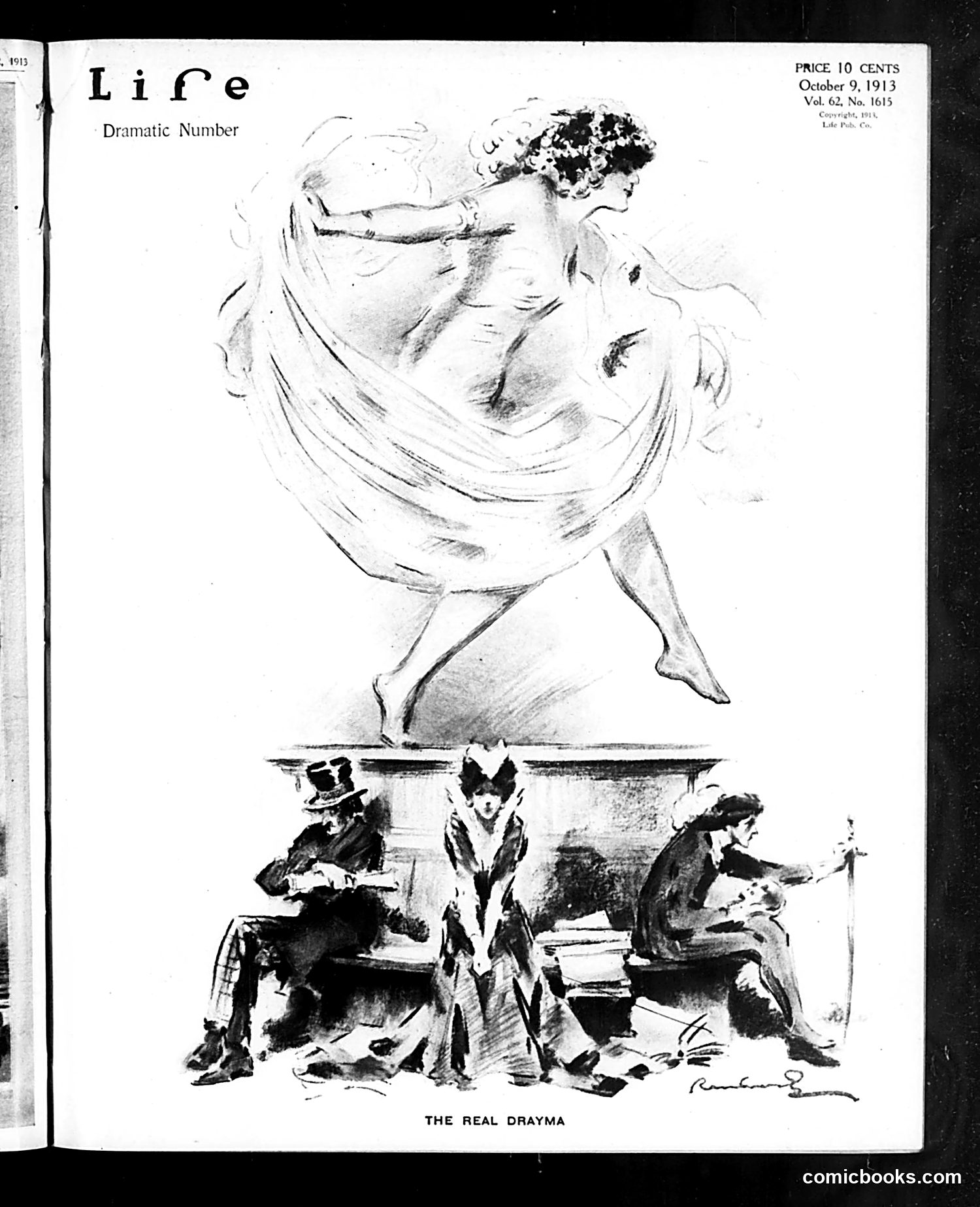
This satirical cartoon contrasts theatrical artifice with reality. The upper image shows an idealized, romanticized female figure—the sort of dramatic heroine audiences expect on stage. Below, titled "The Real Drama," the scene shifts to everyday life: working-class figures hunched over tasks, a man in a top hat (likely a wealthy businessman or politician), and ordinary people dealing with practical concerns. The satire criticizes how theater presents escapist fantasy while ignoring genuine human struggle. The contrast suggests that true drama exists not in contrived stage performances but in the authentic struggles of ordinary people managing work, poverty, and survival. This reflects Progressive Era skepticism toward both theatrical pretense and wealth inequality.
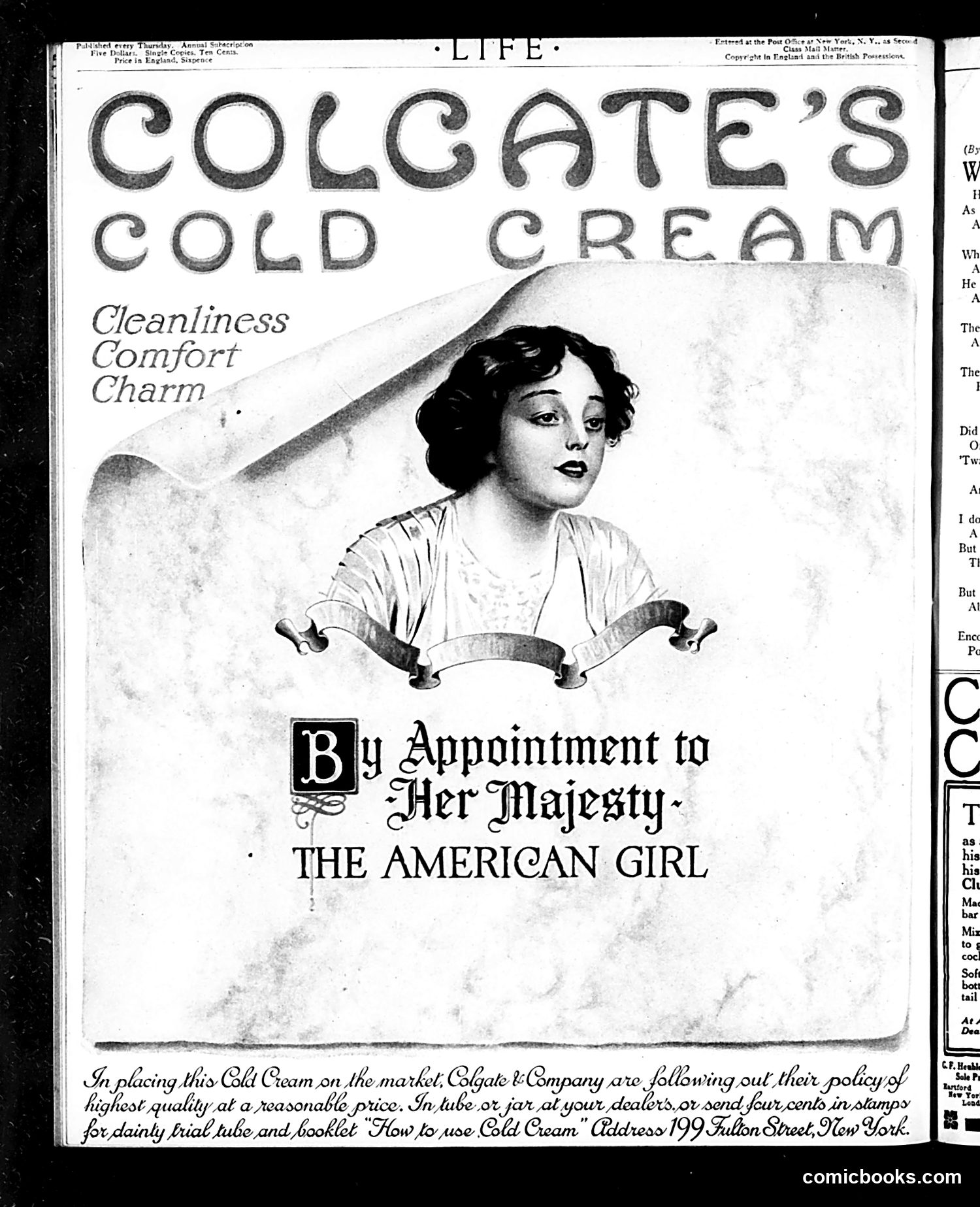
This page is primarily a **commercial advertisement**, not political satire. It promotes Colgate's Cold Cream with the tagline "Cleanliness Comfort Charm." The ad features a stylized portrait of a woman and claims the product holds "By Appointment to Her Majesty"—a marketing strategy invoking royal endorsement to suggest quality and prestige. The phrase "The American Girl" suggests the ad targets American women consumers. The copy emphasizes the product's quality at reasonable price, available in tubes or jars at dealers, or by mail order from the company's New York address (199 Fulton Street). This represents early 20th-century cosmetics marketing that leveraged both royal imagery and nationalist appeals to sell beauty products to American women.
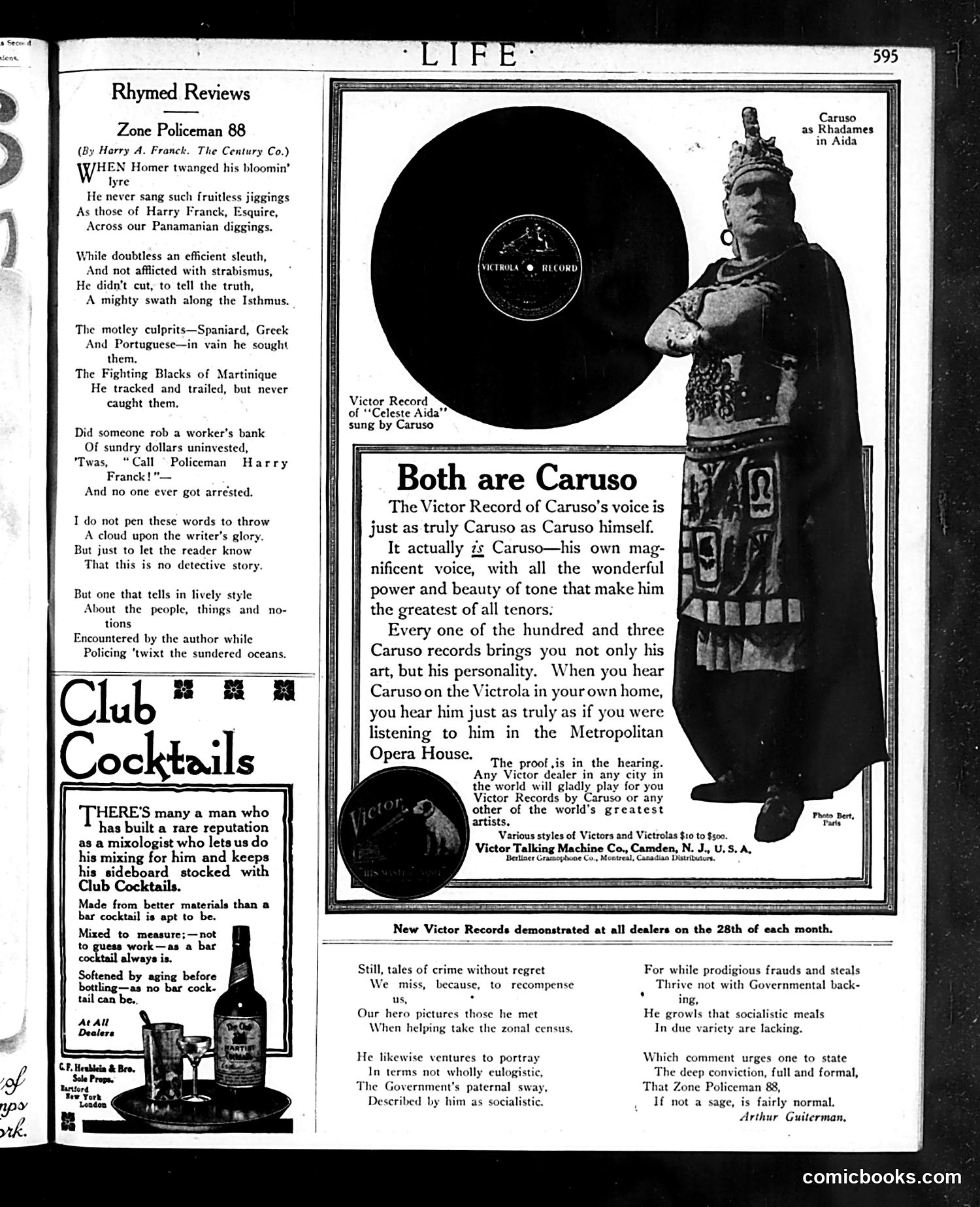
This page combines literary and commercial content from *Life* magazine. The left side features "Zone Policeman 88," a rhymed review by Harry A. Franck mocking an incompetent detective who fails to solve crimes—likely satirizing ineffectual law enforcement of the era. The dominant right side advertises Victor Records' Caruso recordings, featuring tenor Enrico Caruso in operatic costume. The ad claims the recordings authentically capture Caruso's voice and personality, asserting that listening at home equals hearing him perform at the Metropolitan Opera House. The bottom includes poetry by Arthur Guiterman continuing the detective satire theme, criticizing government inefficiency and "socialistic" approaches. The page juxtaposes satirical critique of institutional failure with commercialism—selling cultural prestige through recorded sound technology.
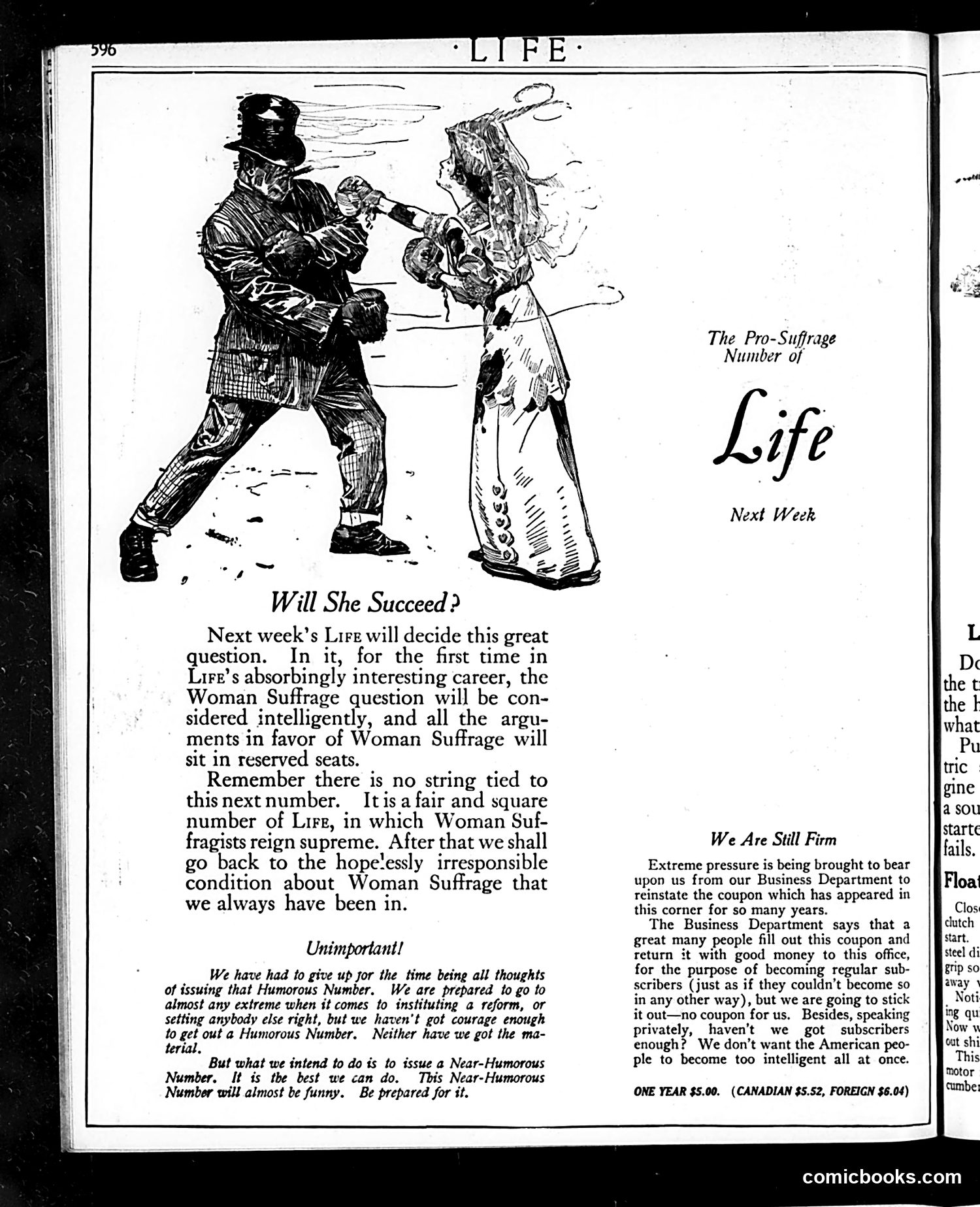
This is a pro-suffrage advertisement from Life magazine announcing next week's issue will seriously address women's voting rights—a first for the publication's "absorbingly interesting career." **The cartoon** depicts a boxer in fighting stance confronting a woman in a dress, titled "Will She Succeed?" The image satirizes opposition to women's suffrage by portraying it as a violent conflict, with the woman as an underdog fighter. **The satire's point**: Life claims to finally give the suffrage question "intelligent" consideration with reserved seating for pro-suffrage arguments. The boxer metaphor suggests suffragists face brutal resistance, yet the woman stands ready to fight. **Context**: This appears to be from the 1910s suffrage movement era, when Life positioned itself as editorially neutral while actually supporting women's voting rights through strategic publication choices.
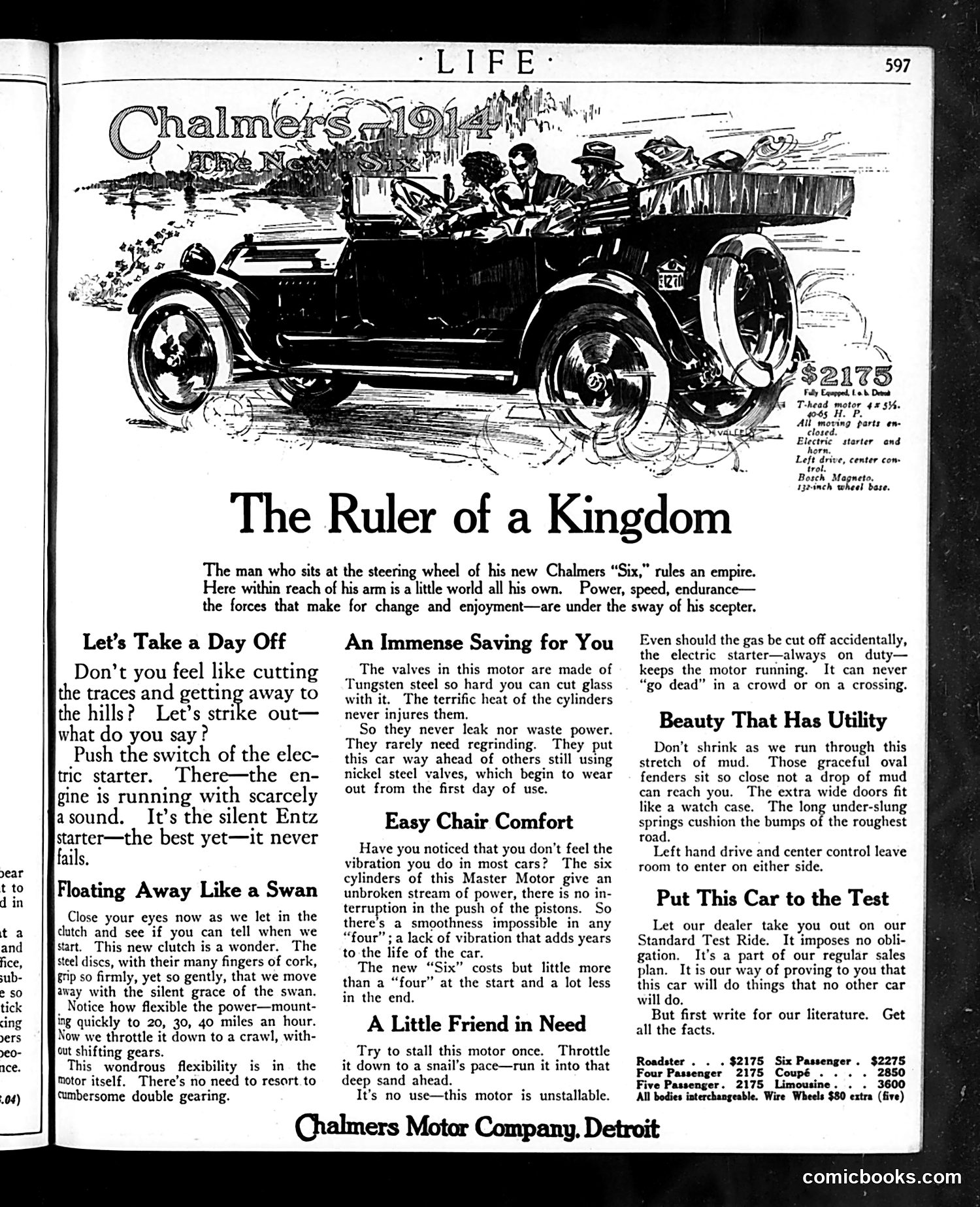
This page is primarily a **Chalmers automobile advertisement**, not political satire. The illustration shows a 1914 Chalmers "Six" luxury car with well-dressed passengers. The headline "The Ruler of a Kingdom" is advertising copy comparing car ownership to imperial power—the driver "rules an empire" through vehicle control. The subheadings ("Let's Take a Day Off," "Floating Away Like a Swan," "Easy Chair Comfort") use poetic language to market features like the electric starter, smooth power delivery, and comfortable suspension. The modest illustration at page margins appears to be a decorative vignette, not political commentary. This is essentially pure commercial promotion dressed in aspirational language about leisure, technology, and status—typical of early 20th-century luxury car advertising in *Life* magazine.
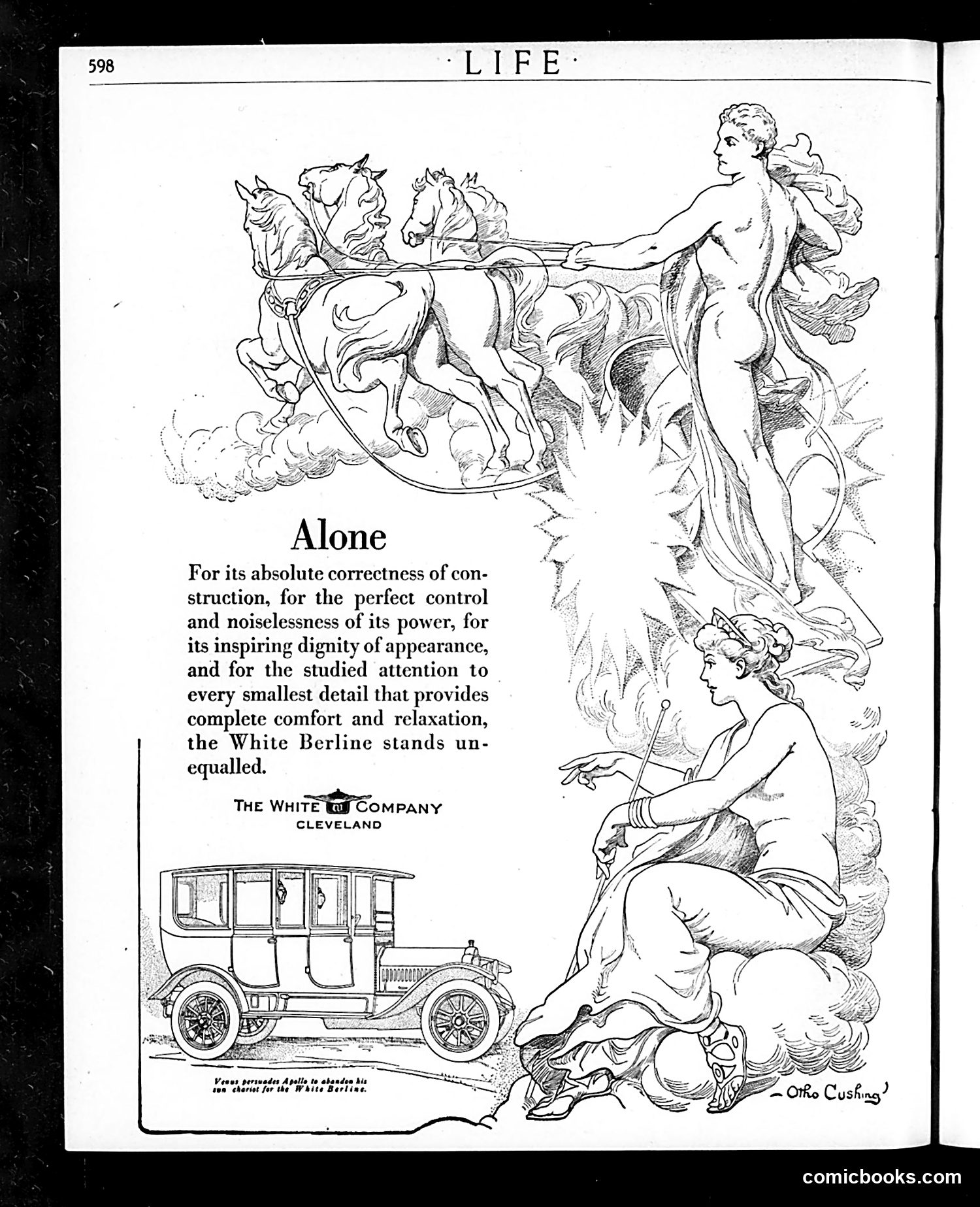
This page is primarily a **White Company automobile advertisement** from Cleveland, not political satire. The classical allegorical imagery—a charioteer controlling winged horses—represents the White Berline motorcar as a vehicle of supreme control and elegance. The advertisement emphasizes the car's "absolute correctness of construction," "perfect control," and "inspiring dignity of appearance." The classical styling (Apollo-like figure, mythological horses, clouds) positions the automobile as a modern achievement worthy of ancient grandeur. The actual automobile shown is modest by comparison, suggesting the ad uses mythological exaggeration to market the vehicle's quality and prestige to early 20th-century consumers. This reflects common advertising practice of the era—elevating commercial products through high art references.
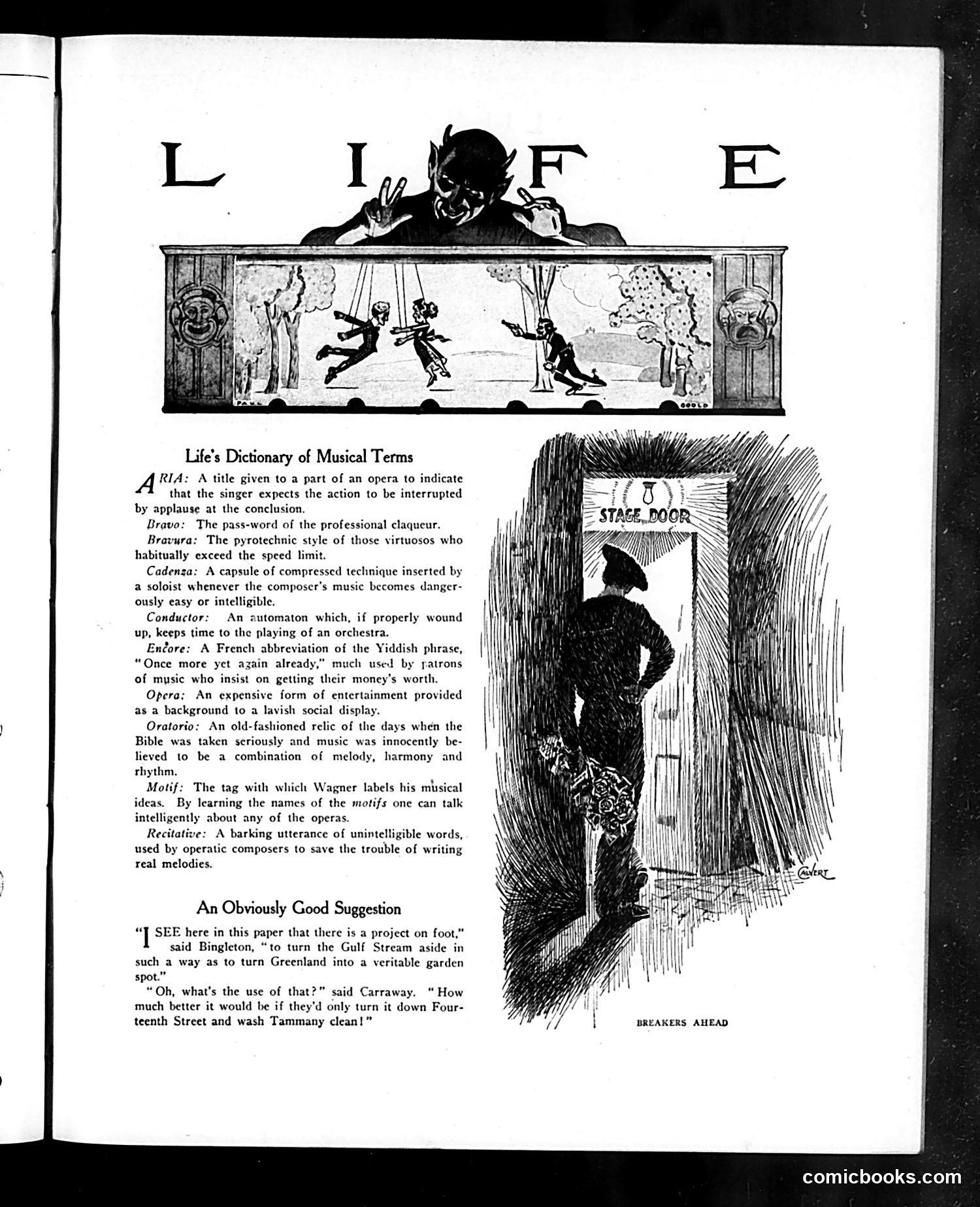
This page combines two distinct items: **Top section ("Life's Dictionary of Musical Terms"):** A humorous guide defining operatic and musical terminology. The cartoon above shows a devilish figure conducting marionettes performing various operatic actions, illustrating the sometimes ridiculous nature of opera performances. **Bottom section ("An Obviously Good Suggestion"):** A brief satirical dialogue between characters named Bingeleow and Carraway discussing a project to turn Greenland into a garden. Carraway jokes it would be better to clean up Fourteenth Street in Manhattan instead—a sardonic comment on urban neglect and misplaced priorities. The accompanying illustration shows a dirty street scene labeled "BREAKERS AHEAD." The overall message mocks both artistic pretension and urban planning failures.
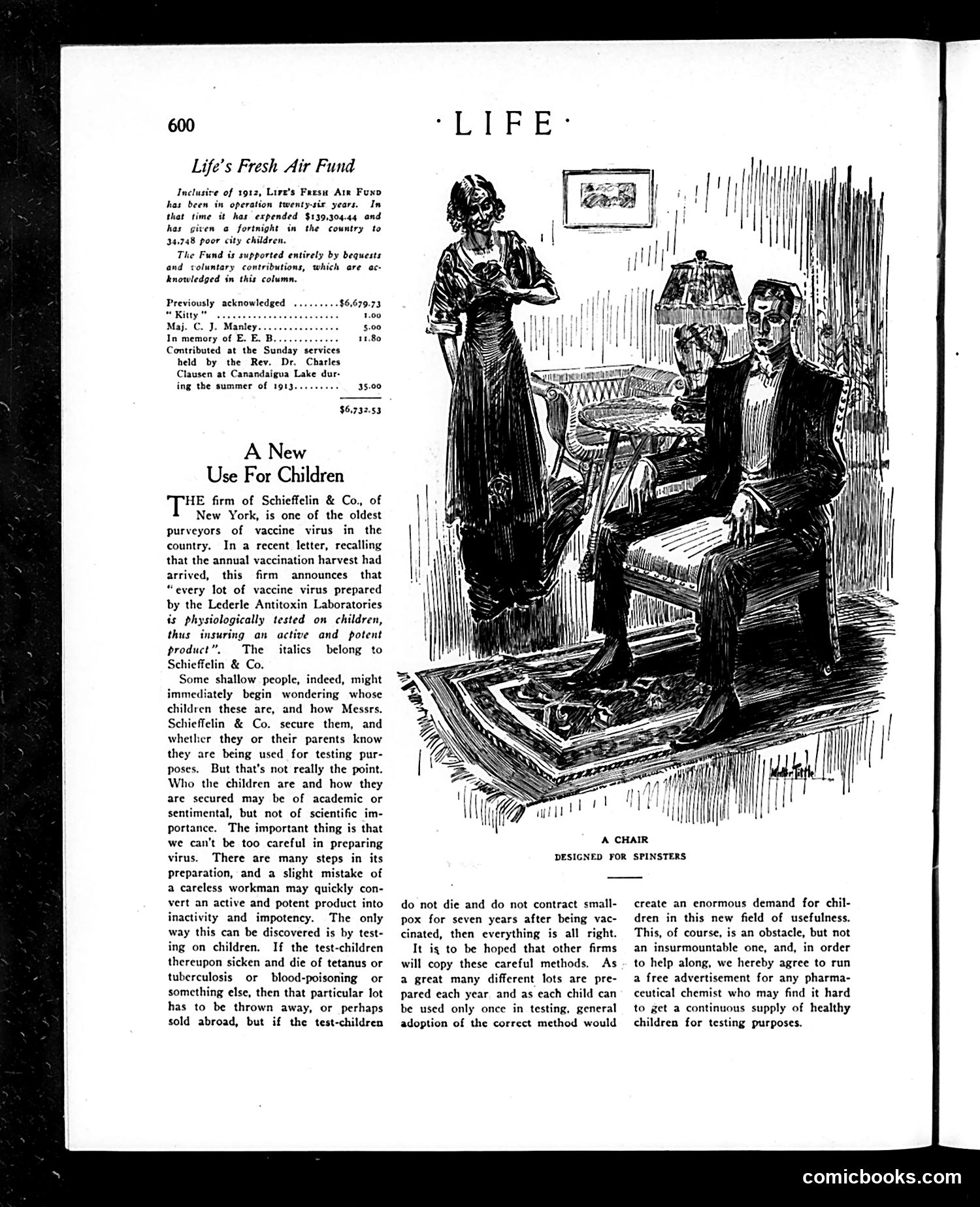
This satirical article critiques unethical medical testing practices. The text describes how the Lederie Antitoxin Laboratories announces that vaccine virus prepared by them has been "physiologically tested on children" — presented as a matter-of-fact business development. The accompanying illustration shows two women and a child in a domestic setting, captioned "A Chair Designed for Spinsters." The satire appears to conflate this casual announcement about child test subjects with the broader treatment of children as disposable experimental material. The article's tone is deliberately understated, making the horror of using children as unwitting test subjects the implicit joke. The text warns that such "careless" practices could turn "active and potent" products into inactive ones, framing the danger to children in terms of pharmaceutical efficacy rather than ethics.
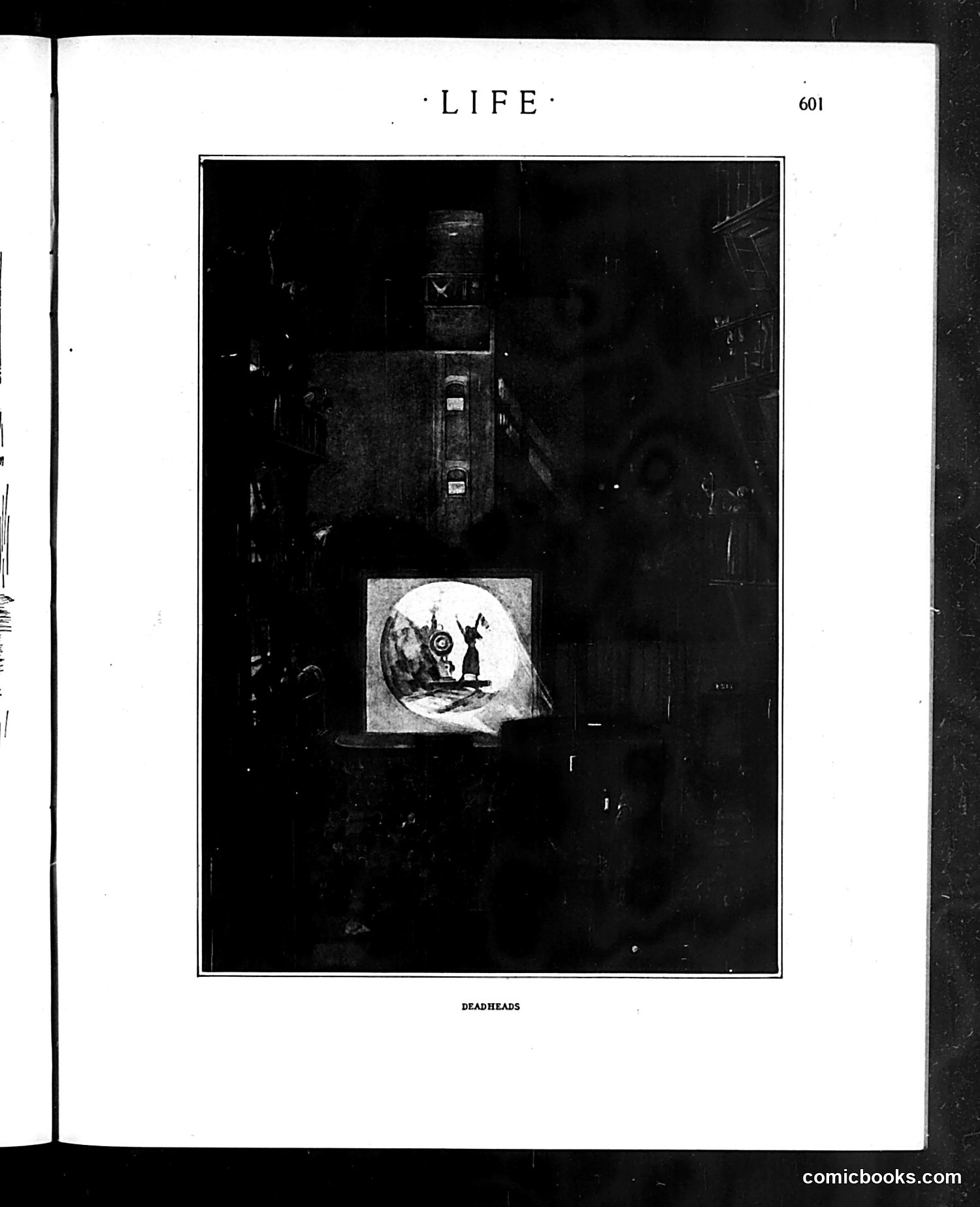
This appears to be a satirical illustration depicting a movie theater or entertainment venue at night. The central image shows a bright screen or display featuring silhouetted figures, contrasting sharply against the dark surrounding architecture and interior space. The caption "DEADHEADS" refers to people who attend entertainment venues without paying—a common target of satirical commentary. The stark, noir-like composition emphasizes the contrast between the glowing spectacle of entertainment and the shadowy, perhaps morally questionable nature of gaining free admission. The architectural details visible in the dark background suggest an urban setting, possibly critiquing both the entertainment industry and those who exploit it for free access. The satirical point likely concerns theater-goers attempting to watch performances without legitimate payment.
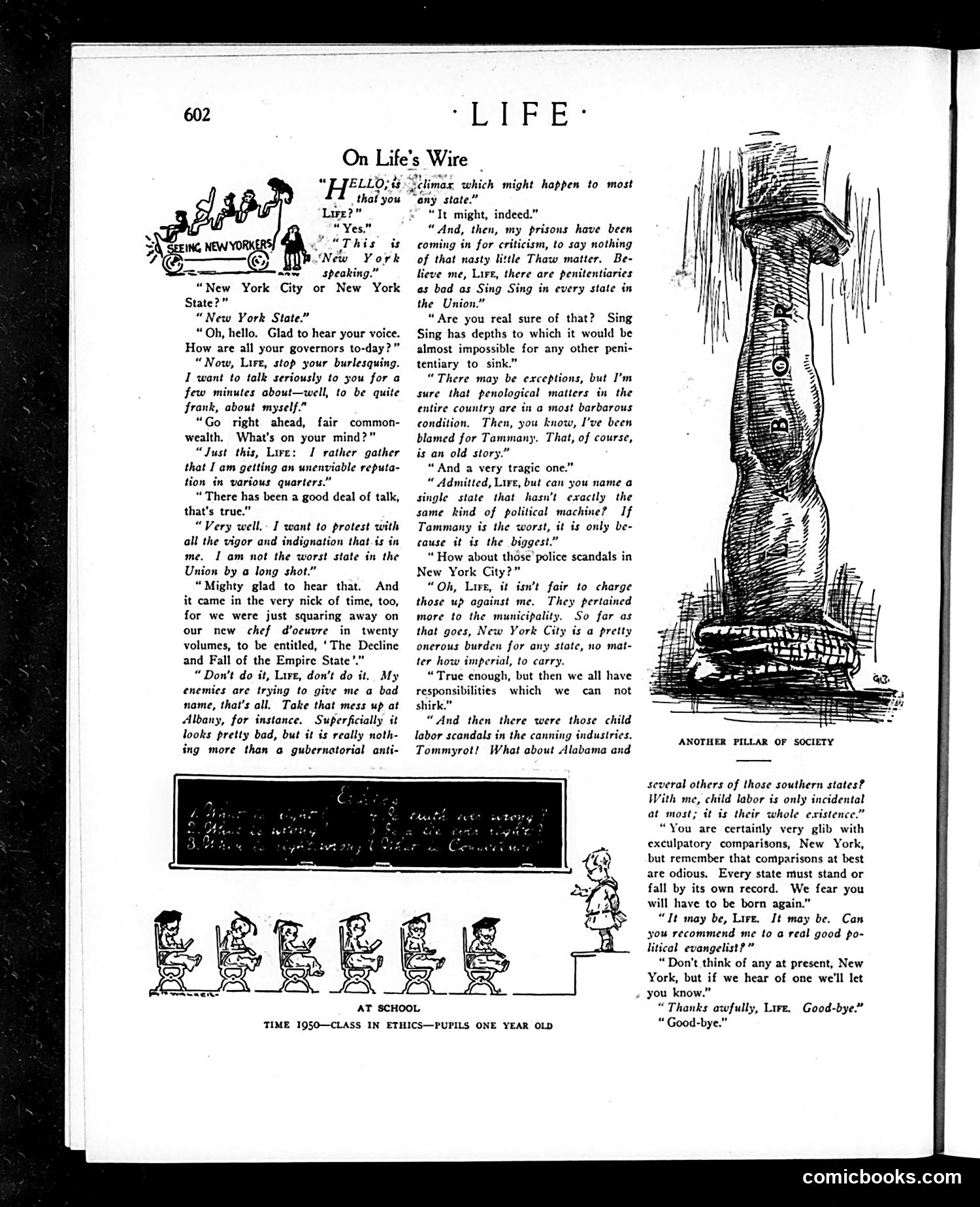
This dialogue between "Life" (the magazine's personified voice) and a character named "Lire" satirizes American federalism and state governance circa 1950. The conversation critiques how individual states operate as semi-autonomous political machines with varying standards of conduct—comparing corruption and mismanagement across New York, New York State, and other regions. The satire targets gubernatorial corruption, police scandals, child labor violations, and systemic inefficiency. "Life" argues each state must be judged by its own record rather than making comparative excuses. The illustration "Another Pillar of Society" (right) depicts a tall, unstable structure—symbolizing how weak individual state governance undermines the nation's foundation. The lower cartoon shows children seated in rows, labeled "Time 1950—Class in Ethics—Pupils One Year Old," sardonically suggesting moral education begins impossibly early given widespread corruption.
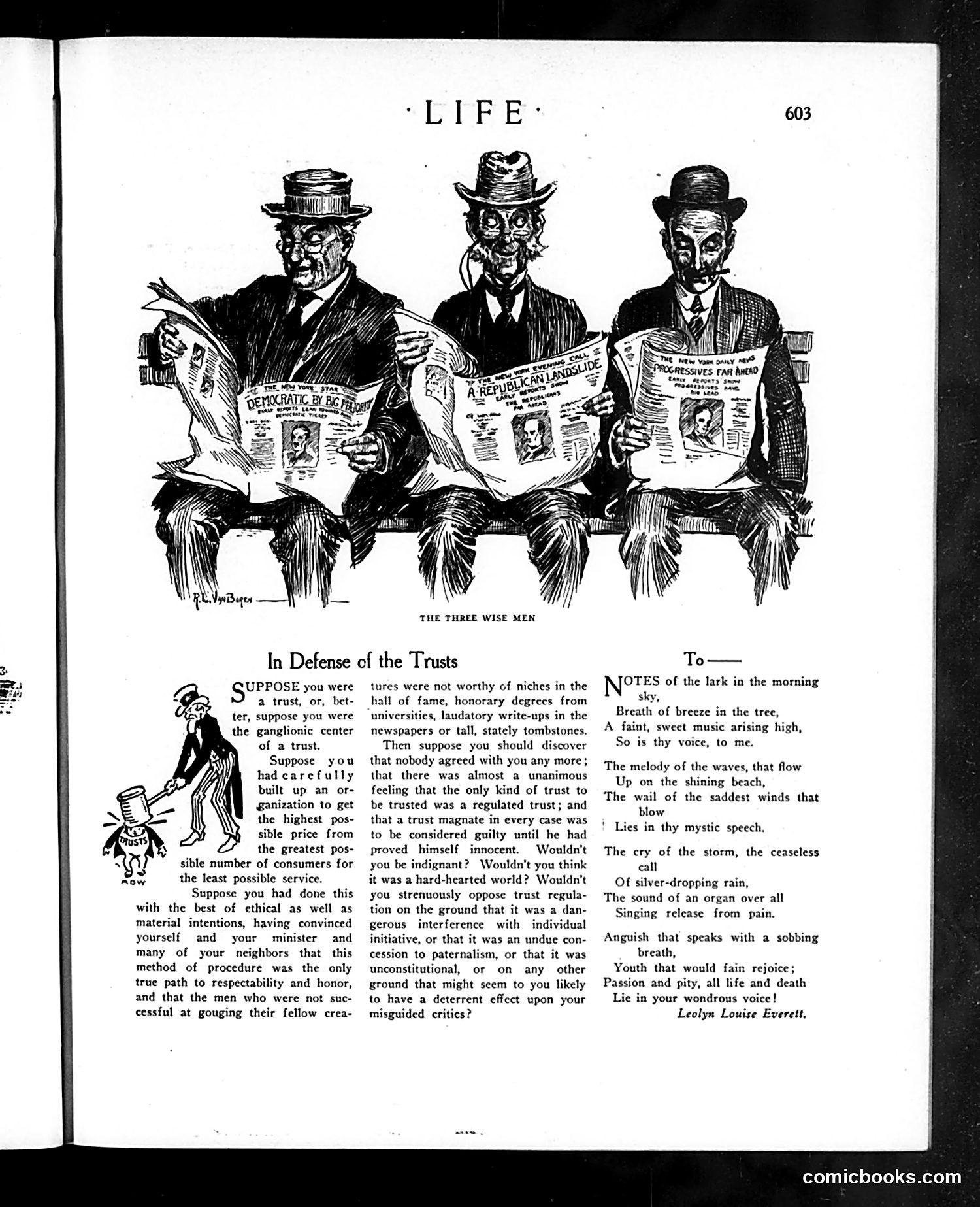
This editorial cartoon depicts three demonic-faced figures in suits reading newspapers with headlines about "Democratic," "Republican," and "Progressive" platforms. The grotesque caricatures suggest these political factions are corrupt or dishonest. The accompanying article, "In Defense of the Trusts," argues that trusts (large corporate monopolies) deserve regulatory oversight rather than blind opposition. The author contends that assuming all trusts are inherently guilty is unfair, and that regulation—not hysteria—should guide policy. The cartoon likely mocks politicians across party lines for exploiting anti-trust sentiment for political gain rather than pursuing genuine reform. The "three wise men" reference is ironic: these figures represent political hypocrisy rather than wisdom, reading their preferred narratives while advancing narrow partisan interests over genuine public welfare.
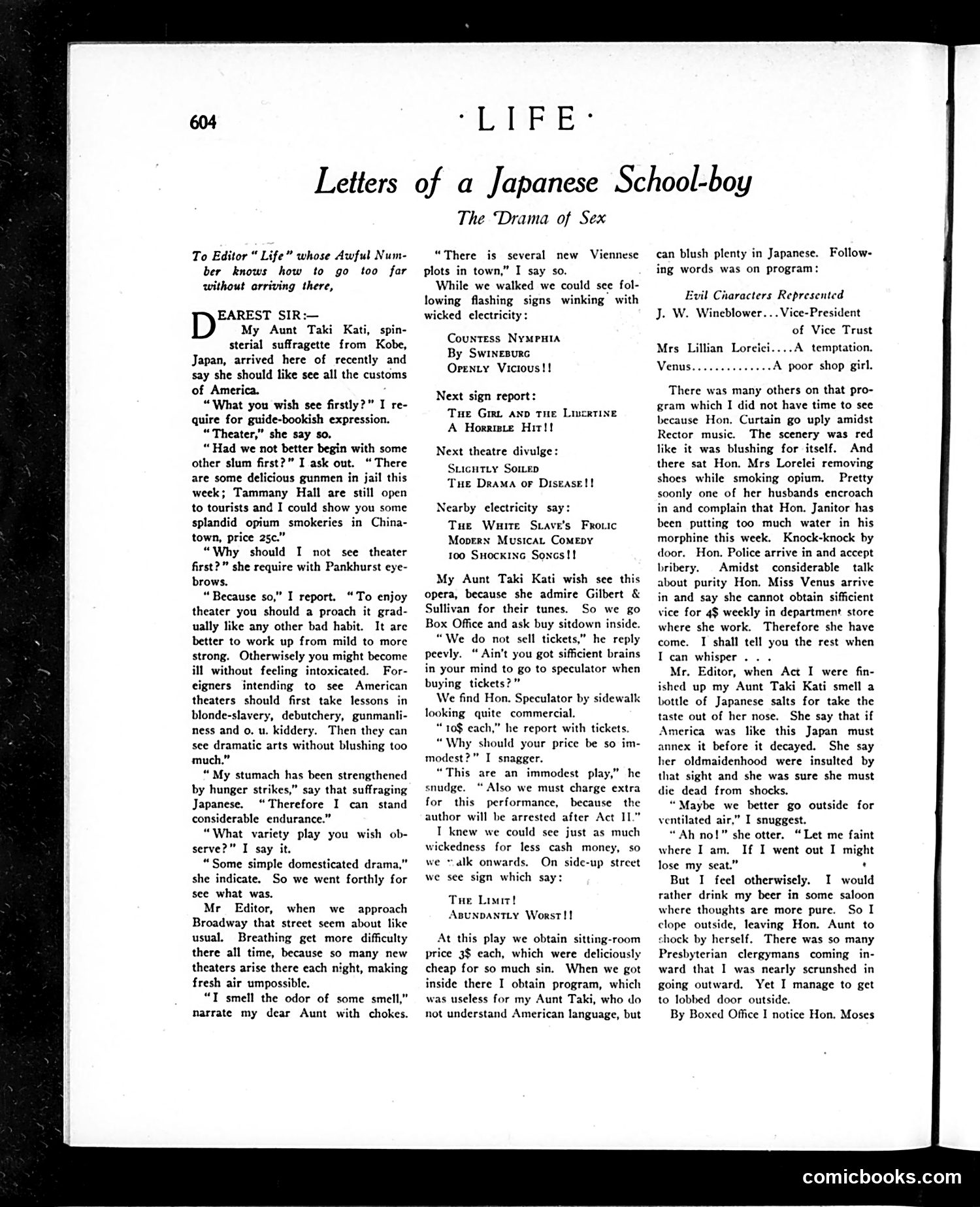
This page from *Life* magazine presents "Letters of a Japanese School-boy: The Drama of Sex"—a satirical letter ostensibly from a Japanese visitor describing his theater-going experiences in America. The humor relies on **cultural clash and innocent misinterpretation**. The correspondent describes Broadway theaters with bemused observations about their proliferation, cost, and content. He mentions attending plays with suggestive titles ("Countess Nymphia," "The Girl and the Libertine," "The Drama of Disease") while maintaining a naive, earnest tone. The satire targets both **American theater's commercialism and moralistic hypocrisy**—the abundance of sexually suggestive entertainment on Broadway is presented through outsider eyes that highlight its excess. The column also gently mocks the Japanese visitor's formal perspective and his aunt's prudish reactions, making the satire bidirectional: critiquing American entertainment while also poking fun at Japanese conservatism.
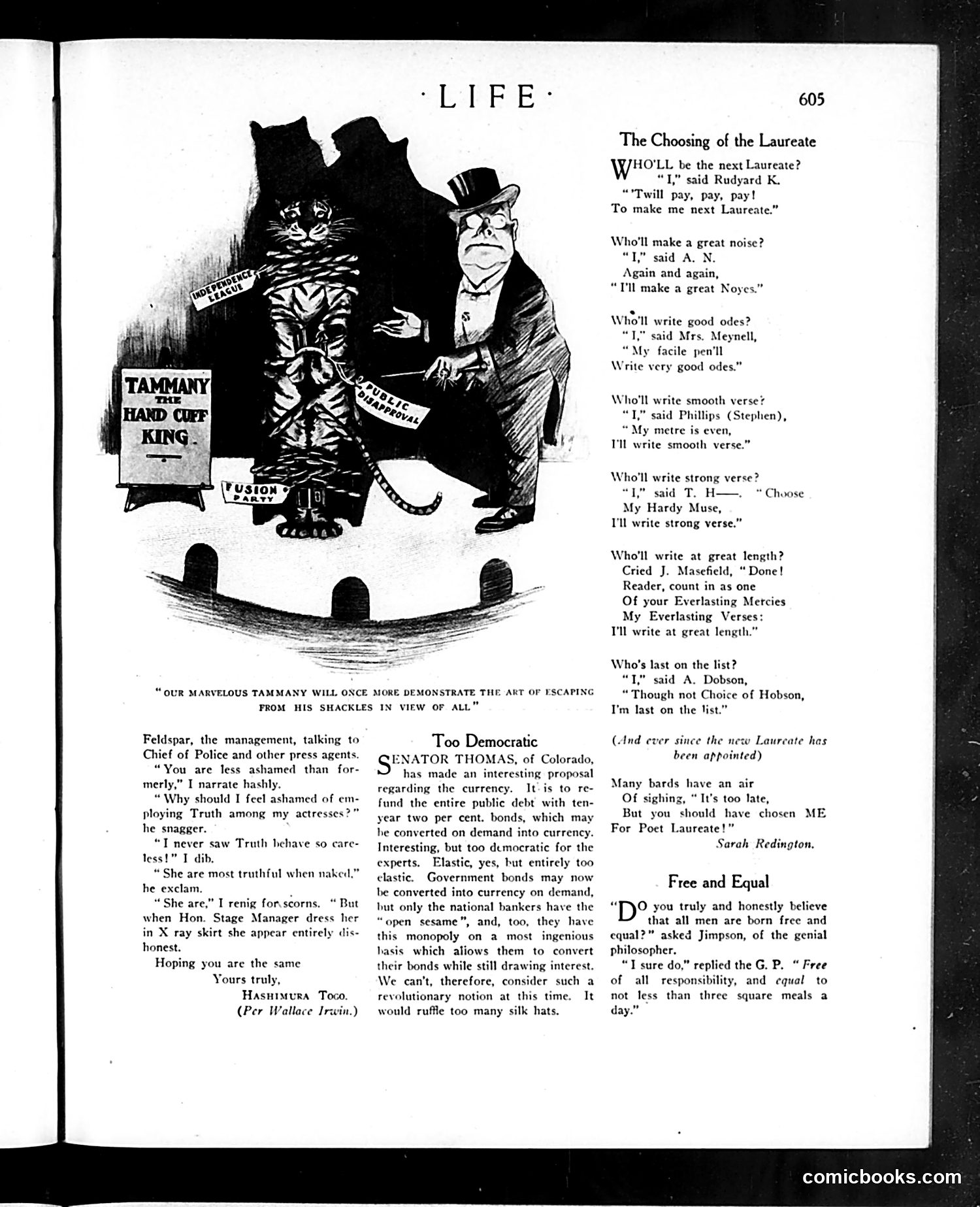
The top cartoon satirizes the selection of a new Poet Laureate. A well-dressed man in a top hat stands beside "Tammany the Bandit King" (a tiger wearing a sash), suggesting Tammany Hall's political influence over literary appointments. The accompanying poem mockingly lists various literary figures claiming "I" should be chosen, each boasting different qualifications—smooth verse, strong verse, great length—culminating absurdly with A. Dobson claiming last place. The satire targets both the vanity of competing poets and the implication that Tammany Hall's machine politics, rather than literary merit, determines such prestigious honors. The cartoon criticizes the corrupting influence of political machines on cultural institutions in the Gilded Age.
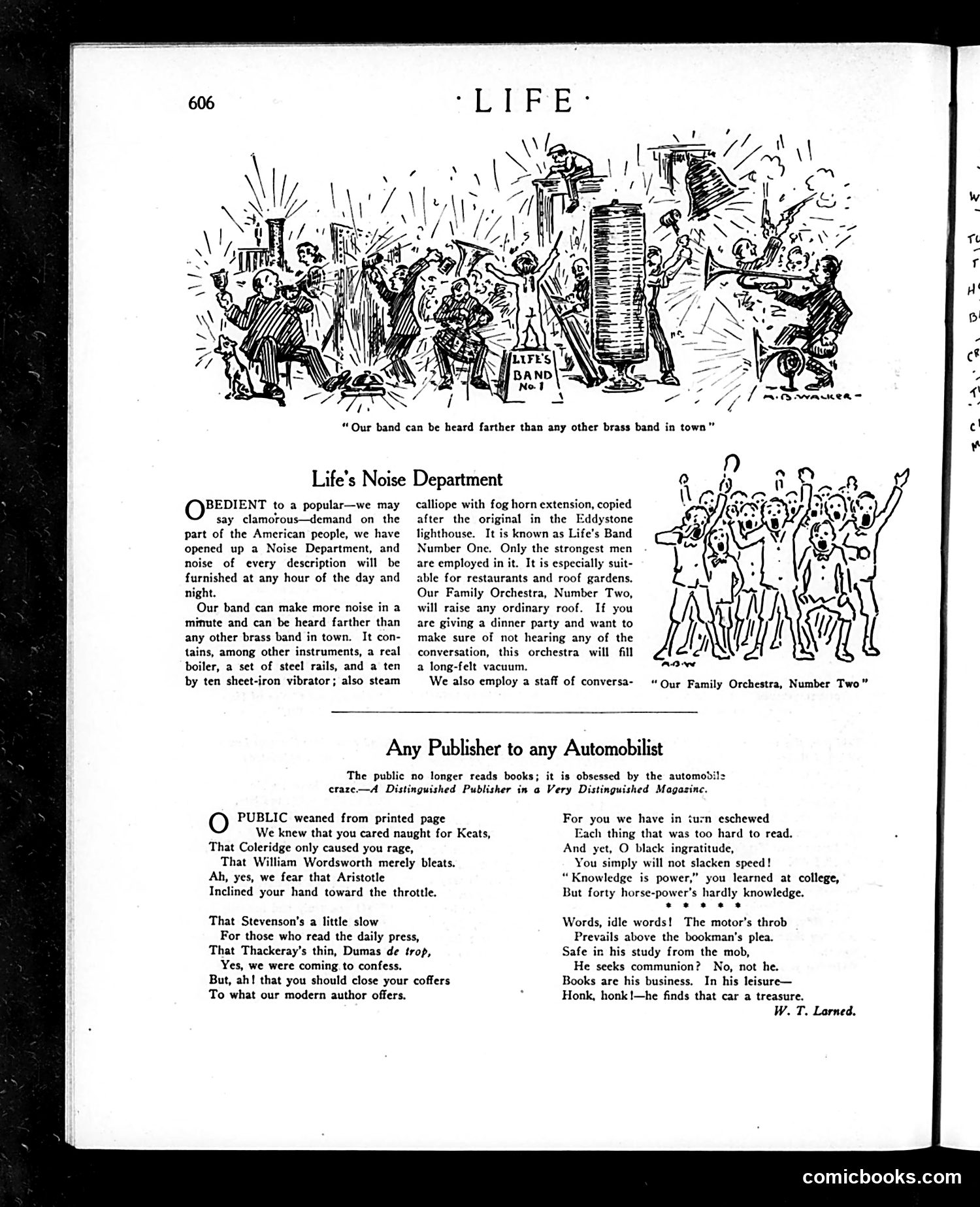
**Top Cartoon ("Life's Noise Department"):** A satirical piece mocking excessively loud bands. The cartoon shows a chaotic brass band with the caption "Our band can be heard farther than any other brass band in town." The accompanying article humorously describes "Life's Band Number One" and other orchestras that specialize in producing maximum noise—featuring boilers, steel rails, and steam whistles alongside instruments. This mocks both the competitive boasting of amateur bands and the era's fascination with volume and novelty. **Bottom Poem ("Any Publisher to any Automoblist"):** A satirical verse lamenting that automobiles have replaced book-reading. The poet laments that the public now obsesses over cars rather than literature, comparing this negatively to earlier intellectual pursuits. The author (W. T. Larned) suggests automobiles represent a loss of cultural refinement.
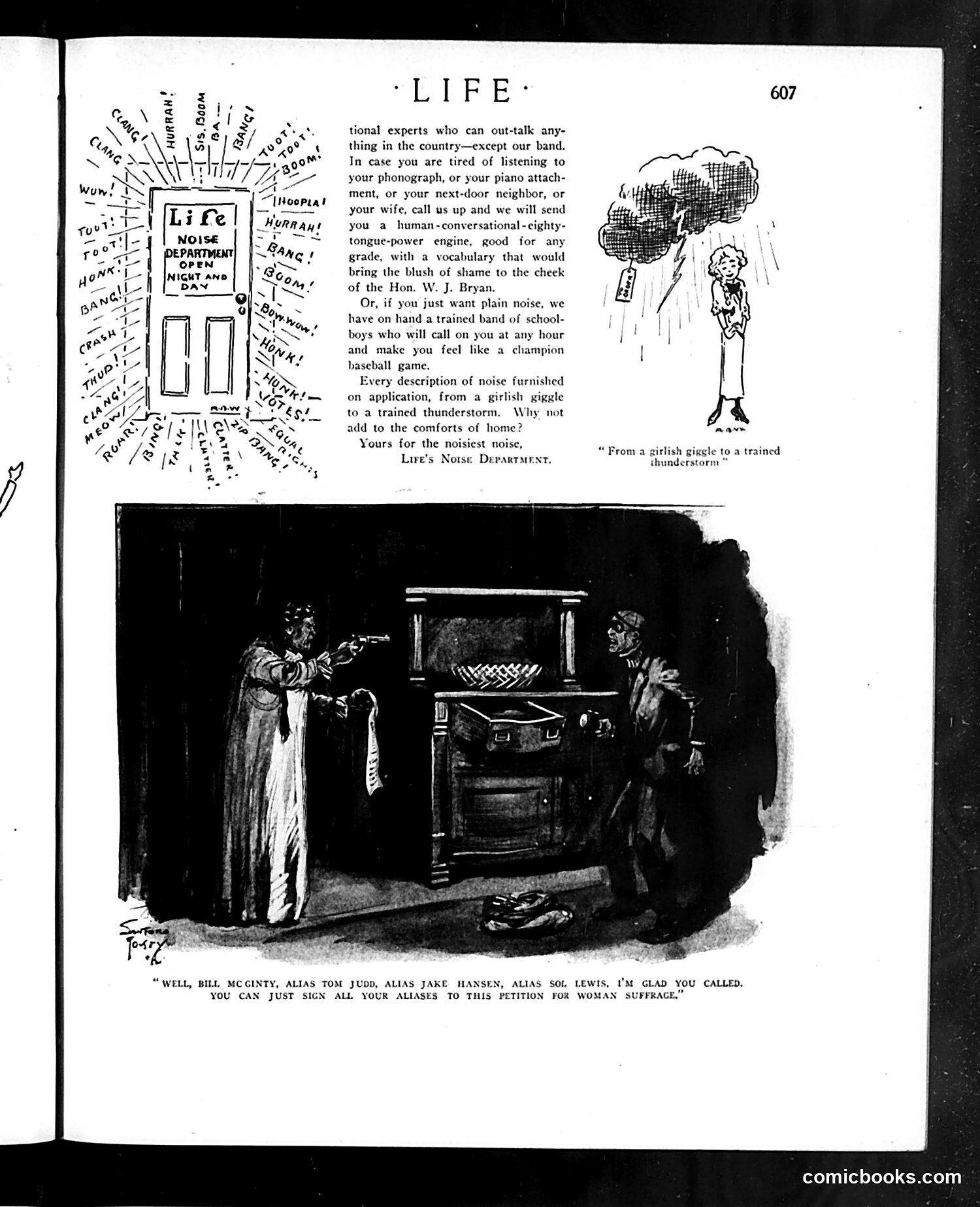
This page from *Life* magazine satirizes two things: **Top section:** A mock "Noise Department" advertisement parodies modern commercial services and urban noise pollution. It humorously offers to rent out various sources of noise—from chatty conversationalists to schoolboys to thunderstorms—for those tired of their own household noises (phonographs, pianos, neighbors). The joke mocks both consumerism and the absurdity of 1910s city life's constant cacophony. **Bottom cartoon:** Shows a criminal with multiple aliases being asked to sign a women's suffrage petition. The satire suggests that opponents of women's voting rights were so eager to block suffrage that they'd accept signatures from anyone—even criminals using fake names. This mocks anti-suffrage resistance as desperate and unprincipled, implying their position was indefensible. Both pieces reflect early 20th-century American debates over women's rights and urbanization.
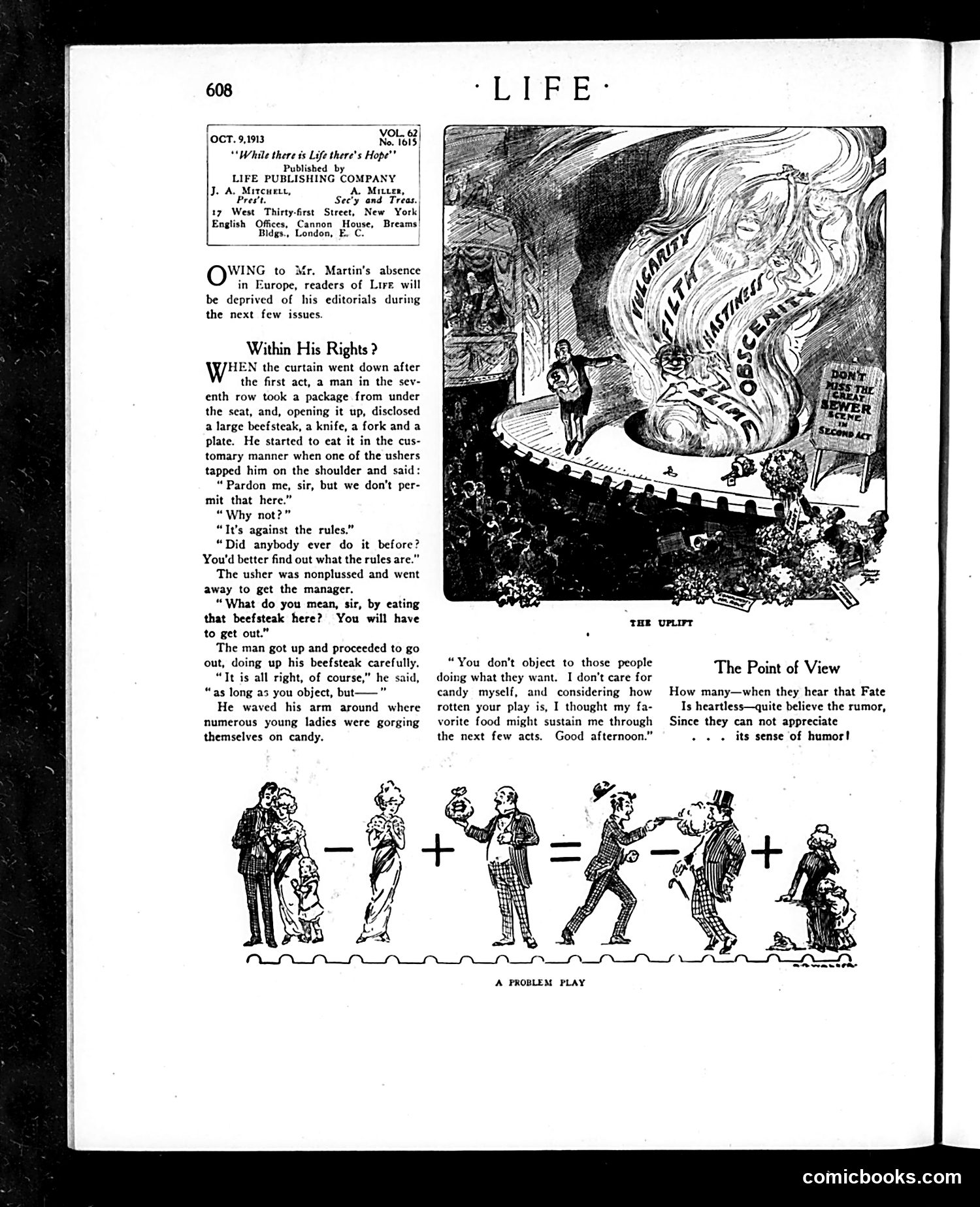
This satirical story critiques arbitrary rules and social hypocrisy. A theater patron brings a beefsteak dinner to eat during a play, violating house policy. When an usher objects, the man points out the obvious double standard: young women openly eating candy throughout the theater face no restriction, yet his meal is forbidden. The joke exposes how rules are selectively enforced based on social acceptability rather than principle. Eating candy is deemed "ladylike" and permitted; eating substantial food is deemed improper and banned—despite both being eating. The man's reasonable question ("Did anybody ever do it before?") highlights that rules often exist simply because they exist, not from logical necessity. The accompanying "Problem Play" cartoon uses mathematical imagery to satirize how life's equation of cause-and-effect rarely works as expected—a commentary on life's inherent unfairness and absurdity.
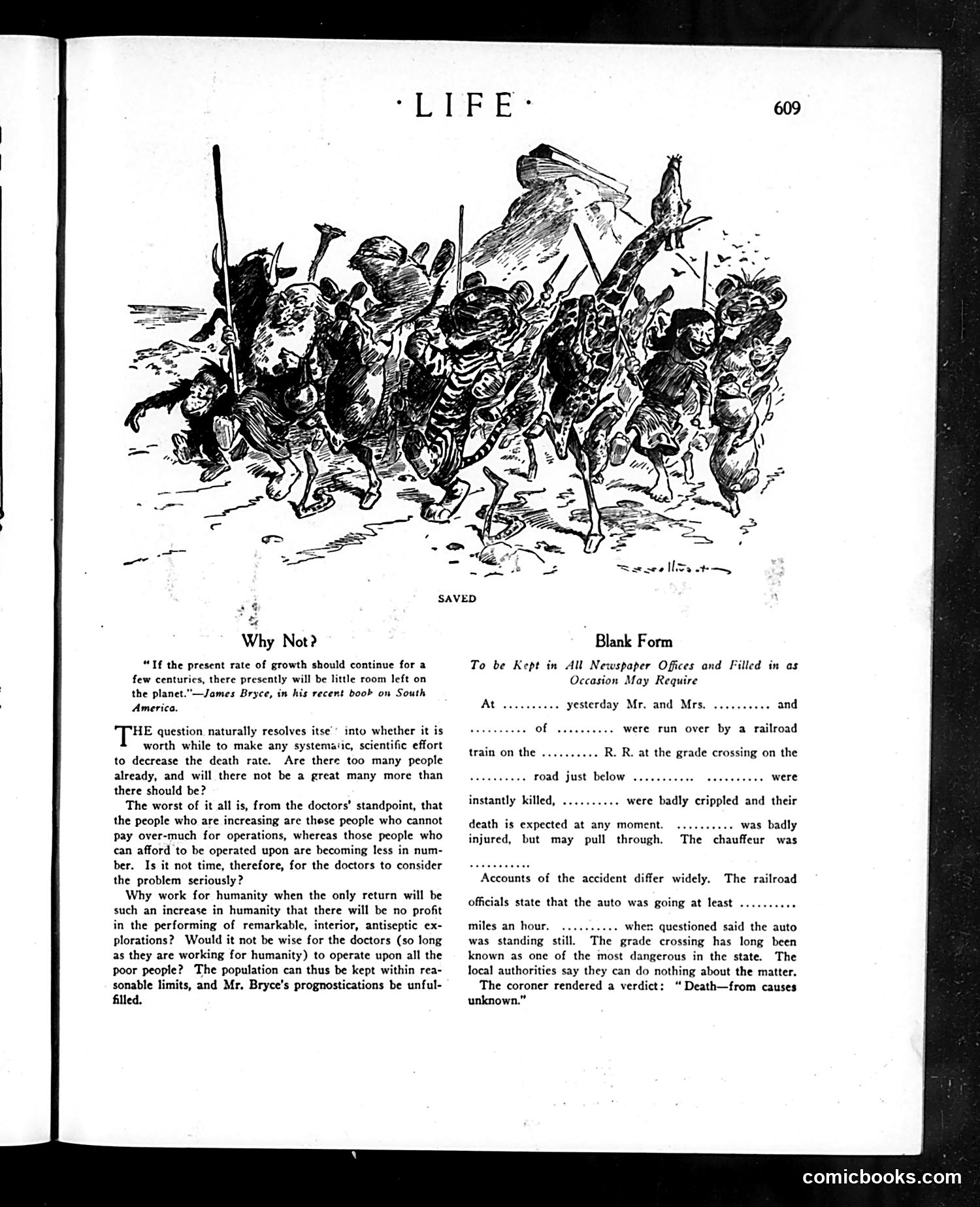
This page contains two distinct satirical pieces from an early 20th-century American magazine: **"Why Not?"** mocks the eugenics debate of the era. It references James Bryce's concerns about overpopulation in South America, then sarcastically argues that doctors shouldn't work to reduce death rates among poor people—since saving poor lives increases the population burden, while wealthy patients (who can "afford to be operated upon") are already declining in number. The satire exposes the cruel logic underlying contemporary class-based attitudes toward medicine and population control. **"Blank Form"** is a template for railroad accident reports, satirizing how such accidents were standardized and routinely reported. It mocks the predictable narrative: conflicting accounts of speed, the crossing's notorious danger, official powerlessness, and the inevitable coroner's verdict of "Death—from causes unknown." This ridicules both corporate negligence and institutional indifference to preventable deaths. Together, these pieces critique social Darwinism, class inequality in healthcare, and corporate accountability.
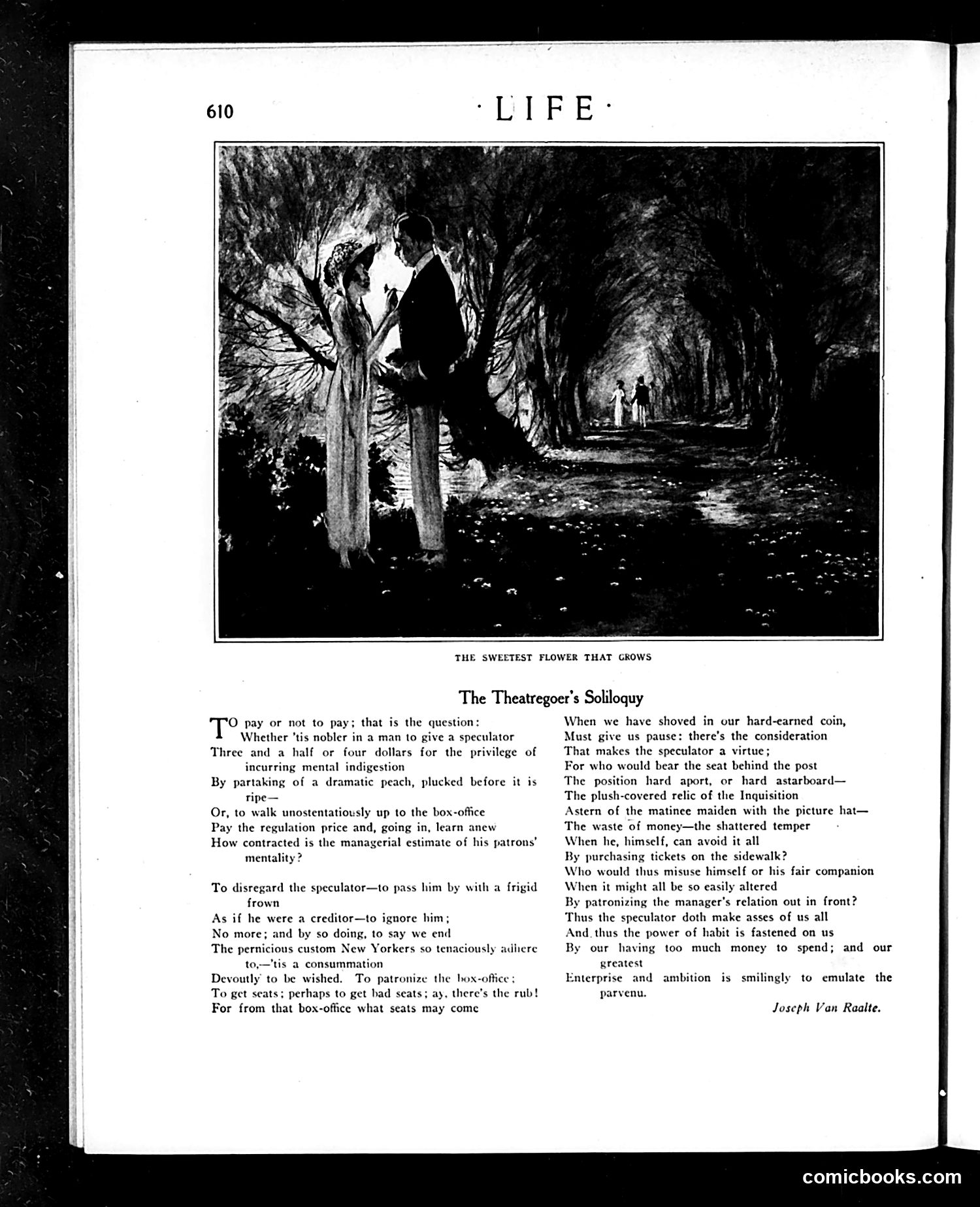
This piece satirizes **ticket scalping in early 20th-century New York theater**, structured as a parody of Hamlet's "To be or not to be" soliloquy. The author (Joseph Van Raalte) mocks theatergoers' willingness to overpay **speculators** (scalpers) operating outside box offices rather than buying directly. The satire identifies the absurd logic: patrons pay inflated prices to avoid poor seats from the official box office, yet they could simply buy at the window and accept whatever seating results. The dark illustration shows a couple meeting with a speculator in a tree-lined passage—depicting the covert, almost illicit nature of scalping transactions. Van Raalte's critique isn't primarily against scalpers, but against the **theater management** (whose "contracted" estimates of patron intelligence and poor seat allocation enable the problem) and against wealthy New Yorkers' habit-driven complicity—they have "too much money to spend" and slavishly imitate the wealthy's behavior, becoming asses in the process.
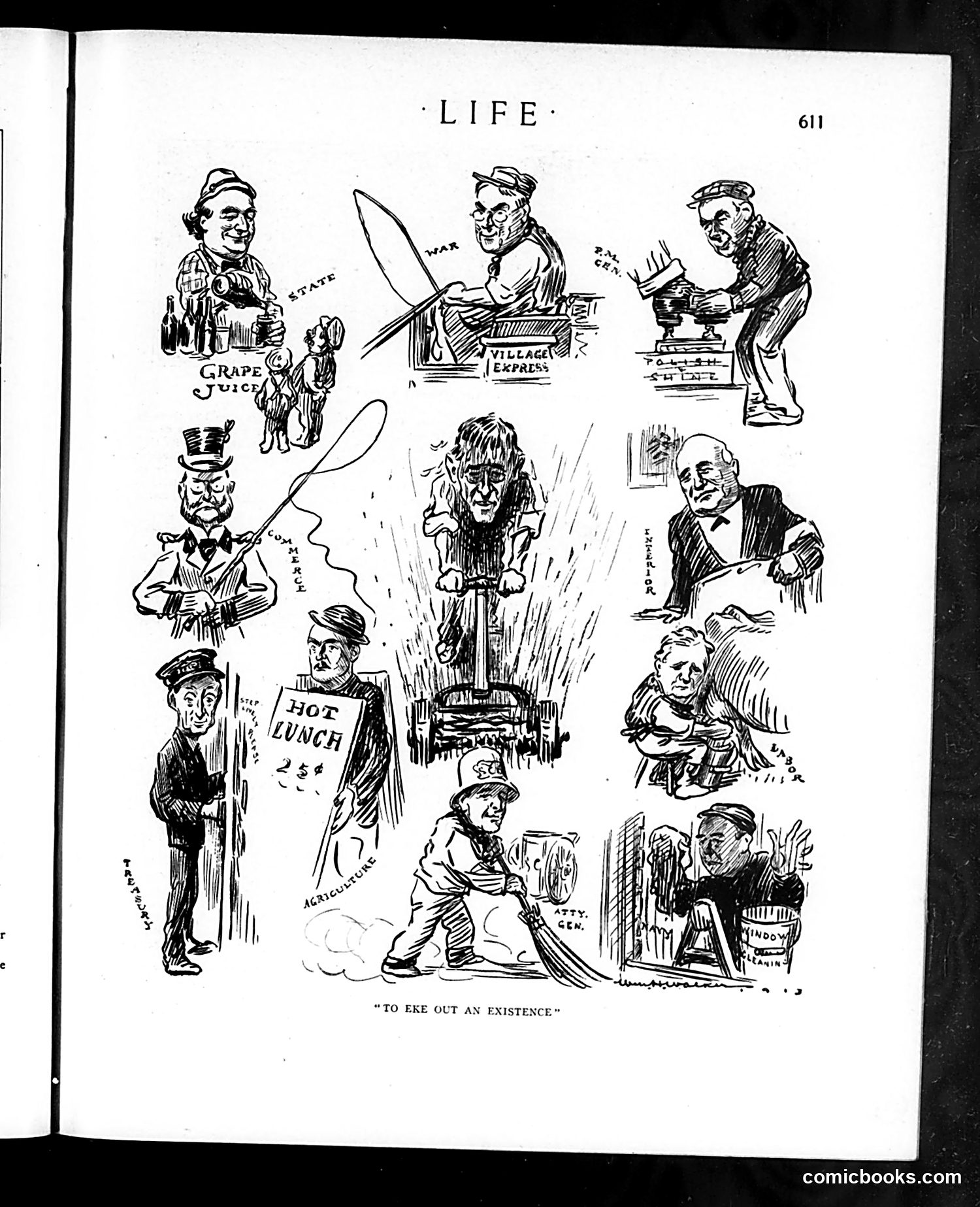
This satirical cartoon depicts various occupations and economic struggles during what appears to be an economic hardship period (likely early 20th century based on style). The central figure shows someone literally "eking out" an existence by scraping/sweeping. The surrounding vignettes illustrate different professions struggling financially: a grape juice vendor, someone operating a "Village Express," agricultural workers, a hot lunch vendor, and various other laborers and tradespeople. Each figure appears gaunt or strained, suggesting economic desperation. The title's phrase "eke out an existence"—meaning to barely survive financially—frames these occupations as precarious livelihoods. The cartoon satirizes economic inequality and the difficulty of making a living through various legitimate trades and labor during this period.
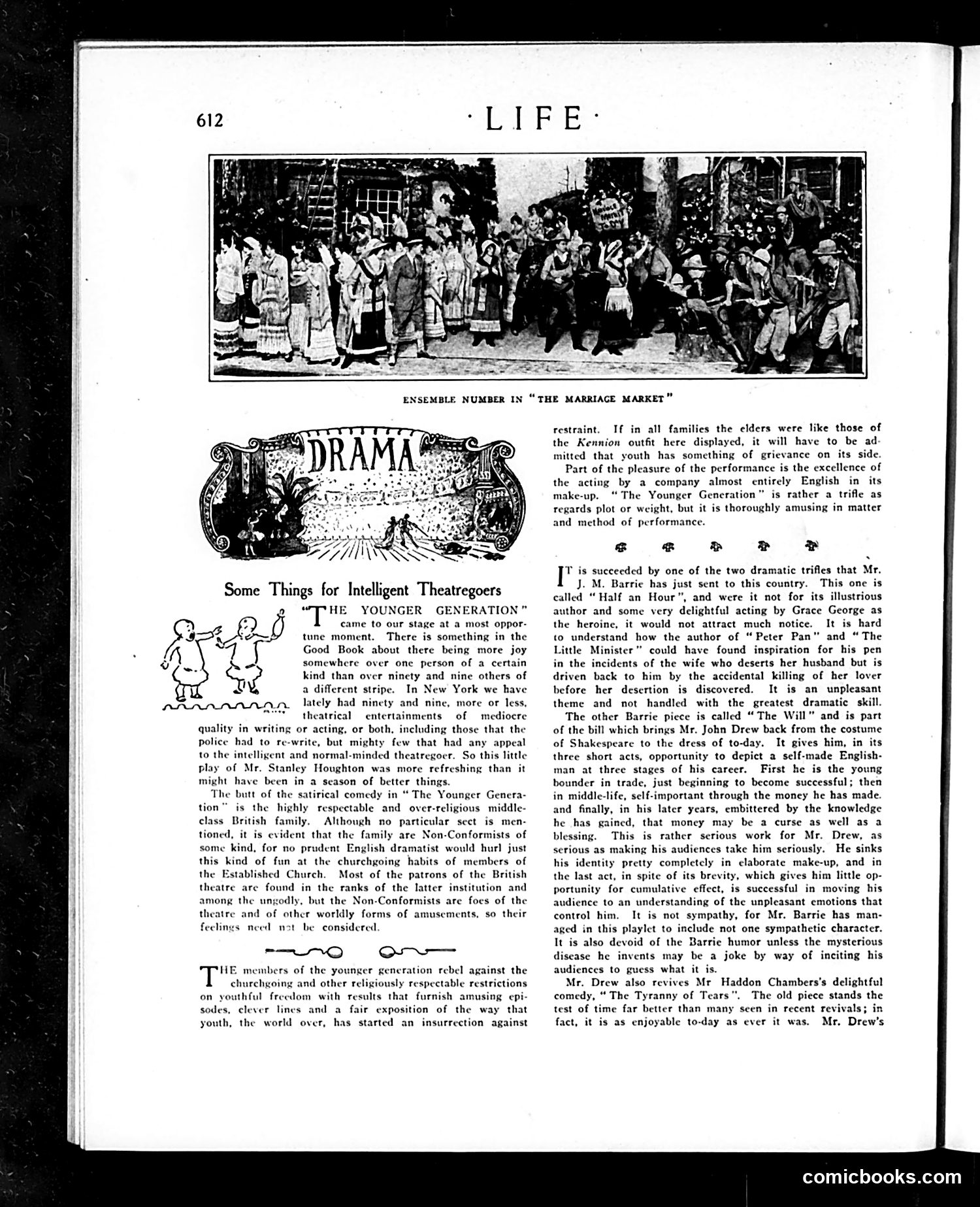
This page reviews three theatrical productions for sophisticated theatergoers. The top image shows an ensemble cast from "The Marriage Market." The main article praises Stanley Houghton's "The Younger Generation," a satirical comedy targeting respectable middle-class British Non-Conformist families (Protestant denominations outside the Church of England). The reviewer notes the satire is deliberately aimed at Non-Conformists rather than the Established Church, since theatre patrons were typically from the latter group. The play depicts youth rebelling against strict religious restrictions imposed by their elders—a timely theme given the cultural generational tensions of the era. The review also discusses J.M. Barrie's "Half an Hour" and "The Will," noting the latter showcases actor John Drew depicting a self-made Englishman across three life stages. While praising the acting quality, the reviewer finds Barrie's dramatic material less substantial than his more famous works like *Peter Pan*.
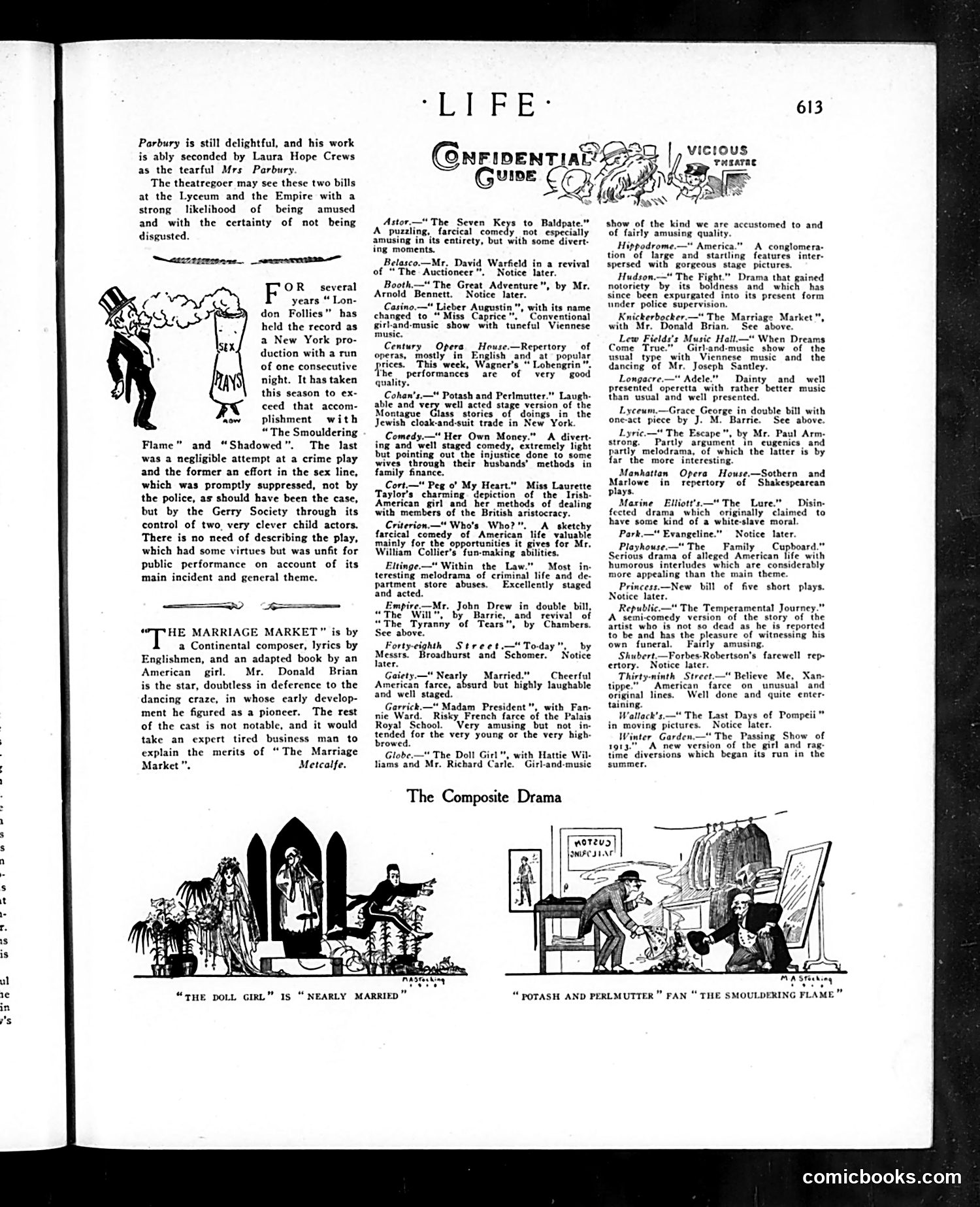
This page from **Life magazine** (a satirical publication, not the photo magazine) reviews theatrical productions on Broadway, circa early 1900s. The text criticizes various shows with dry wit typical of the era's theater criticism. The key satirical point appears in the opening paragraph about "London Follies" and "The Smouldering Flame"—plays so poorly received they lasted only one night. The reviewer notes that "The Smouldering Flame" was suppressed not by police (who should have acted) but by the **Gerry Society**, a child welfare organization, because it was a risqué "sex line" drama featuring child actors. This is satire: the reviewer is mocking both the play's indecency and society's selective censorship. The two cartoon illustrations at bottom appear to reference theatrical productions mentioned—"Nearly Married" and "Potash and Perlmutter"—depicting domestic and comic scenarios typical of period comedies. Overall, this is entertainment criticism employing irony to skewer theatrical mediocrity and moral hypocrisy.
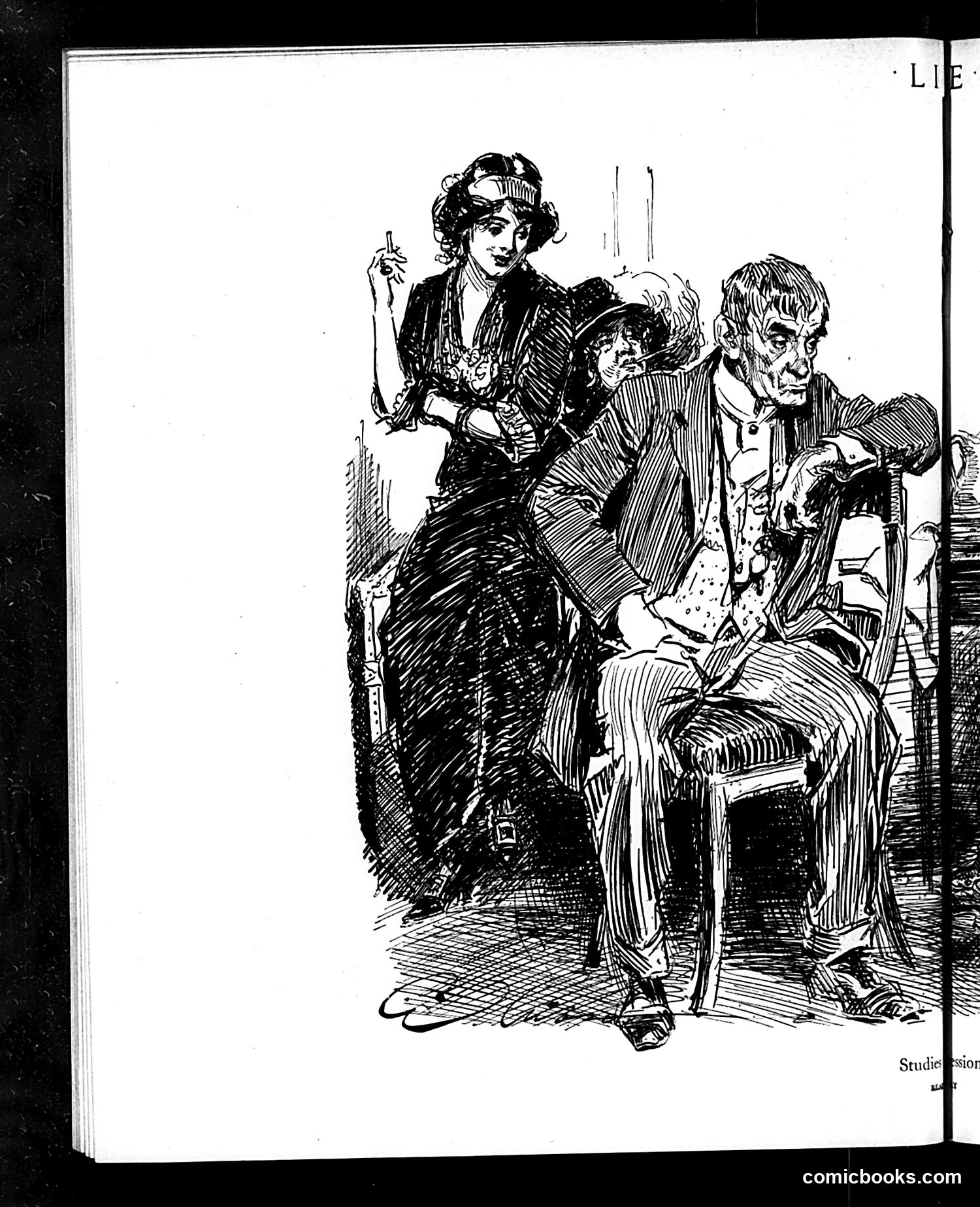
This is a black and white sketch depicting what appears to be a social or domestic scene. A well-dressed woman stands prominently on the left, gesturing expressively with a cigarette holder. To the right sits an older man in formal attire, with a younger woman and child nearby. The style and clothing suggest early-to-mid 20th century. However, the OCR text is too corrupted to determine the specific caption or satirical point. Without legible text identifying the figures or explaining the joke, I cannot reliably identify who these people represent or what social/political commentary the cartoon makes. The composition suggests domestic tension or social criticism, but the precise meaning—whether mocking a particular social type, political figure, or contemporary issue—remains unclear from the image alone.
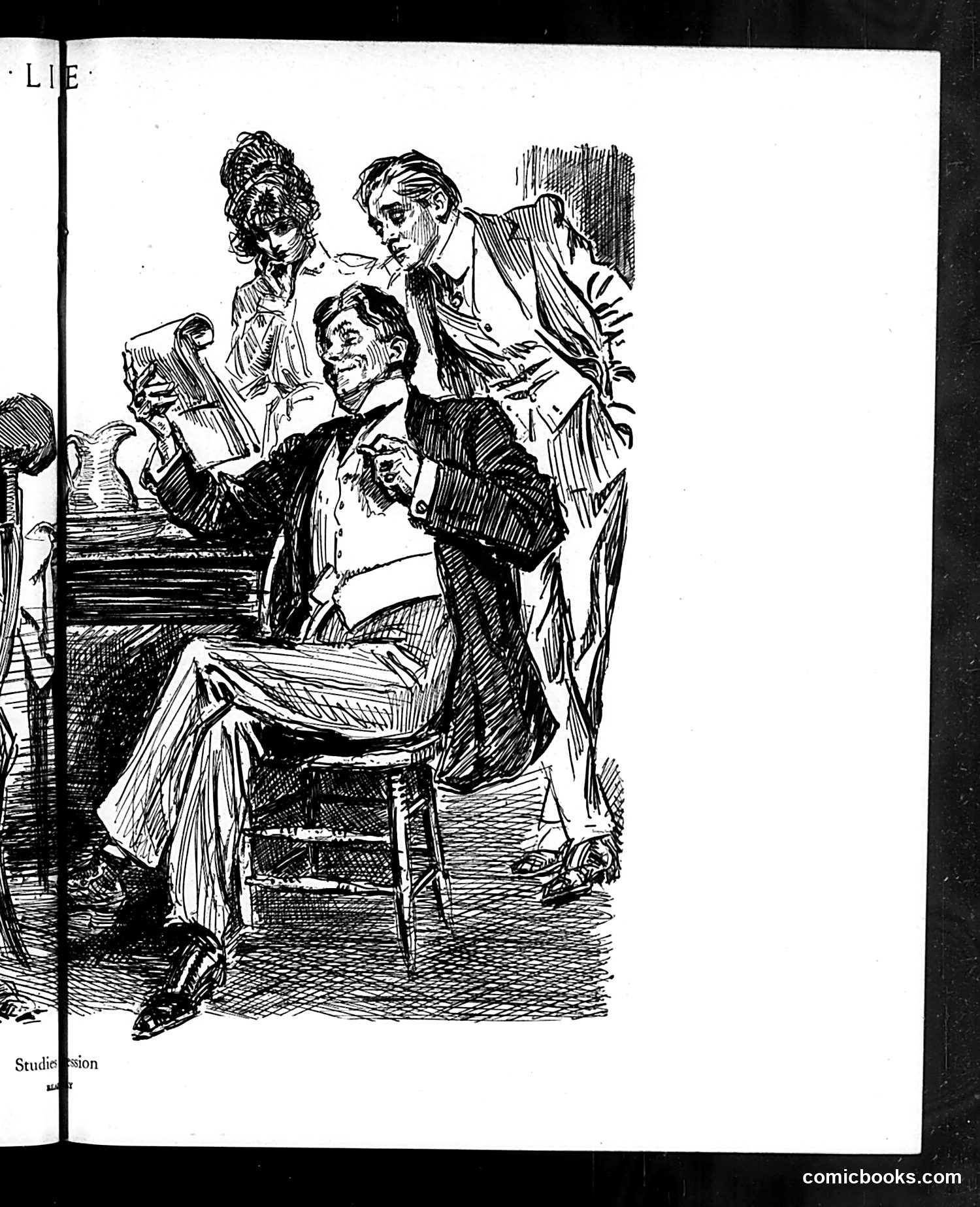
This is a sketch from *Life* magazine showing what appears to be a studio or office scene with four figures. A seated man in formal attire is the focal point, while three others—including a woman with elaborate hair—stand around him in animated poses suggesting conversation or confrontation. The OCR text "Studies fRsi" is too fragmentary to provide clear context. Without legible text identifying the subjects or explaining the satirical premise, I cannot reliably determine who these figures represent or what social/political commentary is intended. The style suggests early-to-mid 20th century satirical illustration, but the specific subject remains unclear from the image alone.
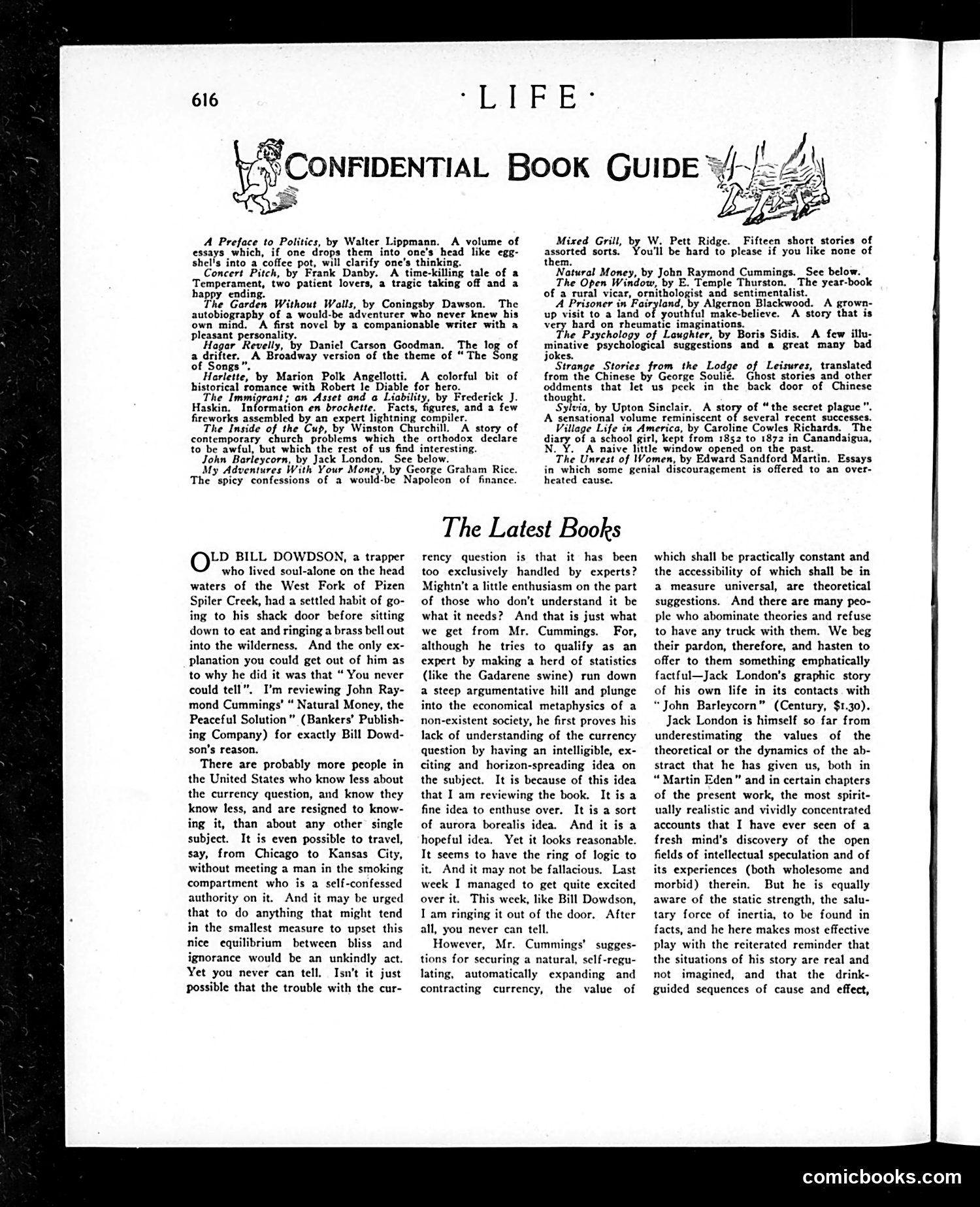
This is a **book review column**, not a cartoon page. It's a "Confidential Book Guide" listing new publications with brief critical commentary. The main review discusses **John Raymond Cummings' "Natural Money"** through a framing device: Old Bill Dowdson, a solitary trapper who rings a brass bell before eating without explaining why—a metaphor for the reviewer's own bewilderment about writing on currency economics. The satire is gentle: the reviewer admits most Americans (himself included) don't understand monetary policy and are comfortable with that ignorance. He suggests Cummings' book might illuminate the subject, but expresses skepticism—echoing Bill's "You never can tell" philosophy. Other listed books include works by **Jack London** (*John Barleycorn*, about alcohol) and **Upton Sinclair** (*Sylvia*, addressing venereal disease)—contemporaneous social-issue literature typical of Progressive Era publishing. The page reflects early-20th-century Life magazine's role as a forum for intellectual and political discourse, not primarily humor.
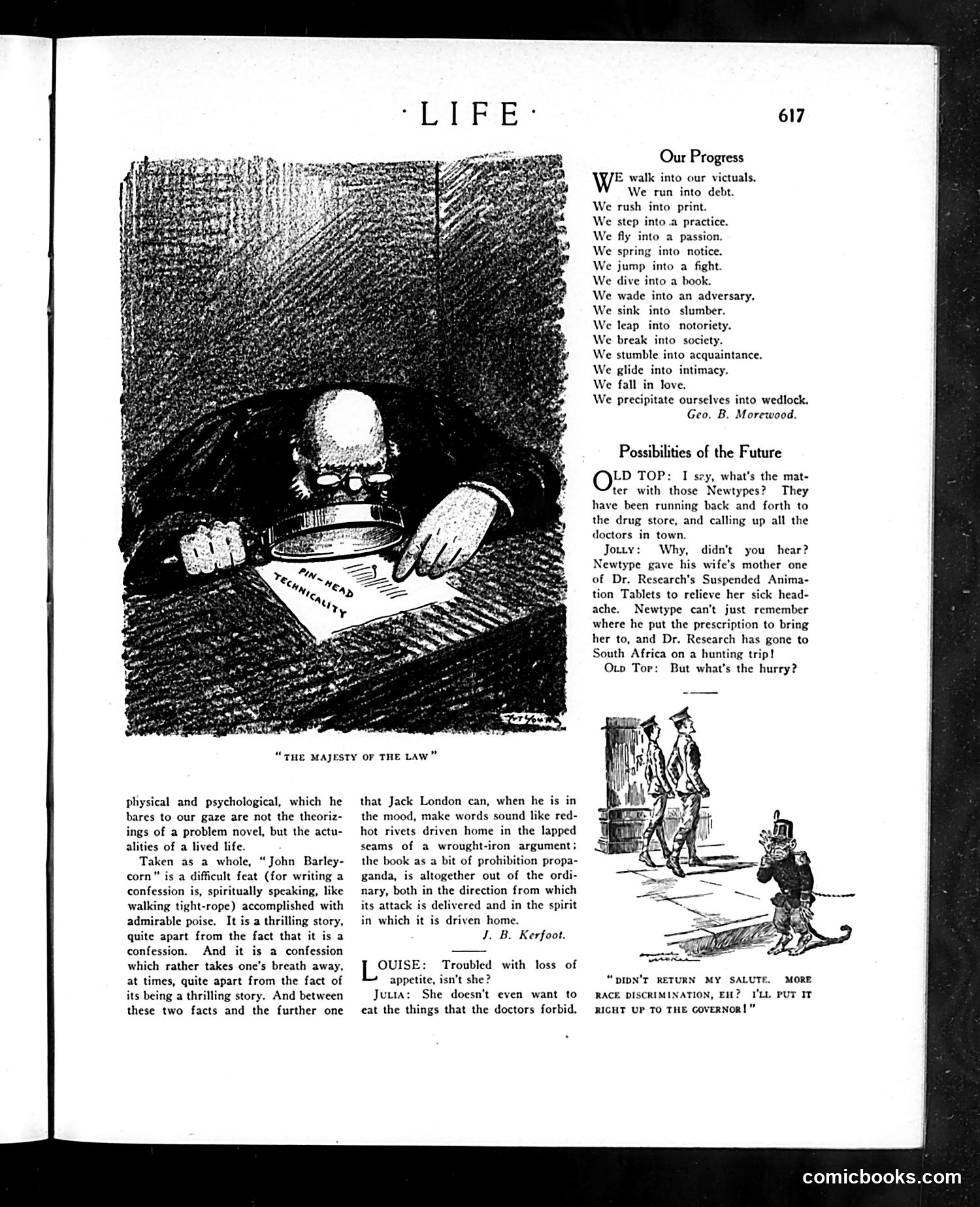
The main cartoon "The Majesty of the Law" depicts a figure in darkness examining legal documents by lamplight, satirizing the opacity and difficulty of navigating the legal system—the "majesty" being ironic commentary on how impenetrable law appears to ordinary citizens. The page includes a poem "Our Progress" by Geo. B. Morewood that satirizes human behavior through a series of metaphors about rushing thoughtlessly into life's situations (debt, passion, love, marriage), suggesting people act impulsively without deliberation. A lower cartoon humorously depicts a scenario where someone administered a fictional "Suspended Animation Tablet" to a relative for a headache, then lost the prescription to revive them—dark comedy about the dangers of experimental medicine and absent-minded behavior. The dialogue snippets mock social pretension and bureaucratic red tape, with one figure threatening to escalate a complaint "to the Governor" over perceived discrimination. Overall, the page satirizes legal systems, human folly, medical quackery, and bureaucratic absurdity typical of Life's social commentary.
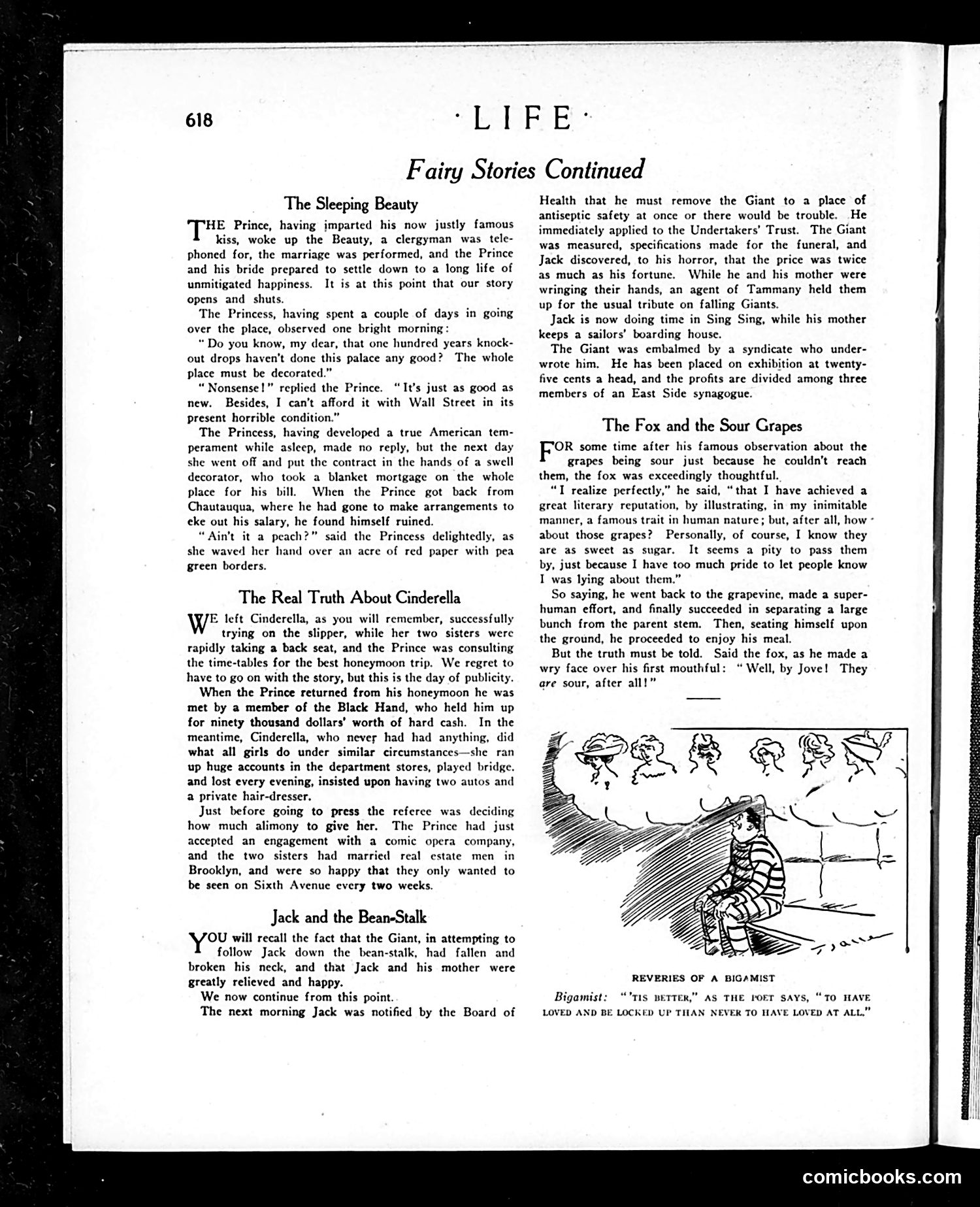
This page presents modern, cynical retellings of classic fairy tales to mock contemporary American society (early 20th century). **The Sleeping Beauty** satirizes marital conflict and financial anxiety: the Princess wants renovations, but the Prince claims poverty due to "Wall Street in its present horrible condition"—likely referencing economic instability of the era. **Cinderella** mocks materialism and divorce: the formerly poor girl immediately becomes a spendthrift, accumulates debt, gambles, demands luxuries, and ultimately seeks alimony—portraying women's newfound independence as morally corrosive. **Jack and the Bean-Stalk** targets urban corruption: Jack faces exploitation by an "Undertakers' Trust" (monopoly), extortion by "Tammany" (New York's notorious political machine), and ends imprisoned. The Giant's corpse becomes a commercial spectacle—all parties profit except Jack. These stories illustrate Life's satirical mission: deflating romantic myths while exposing American greed, monopolism, political corruption, and social climbing beneath the surface of modern life.
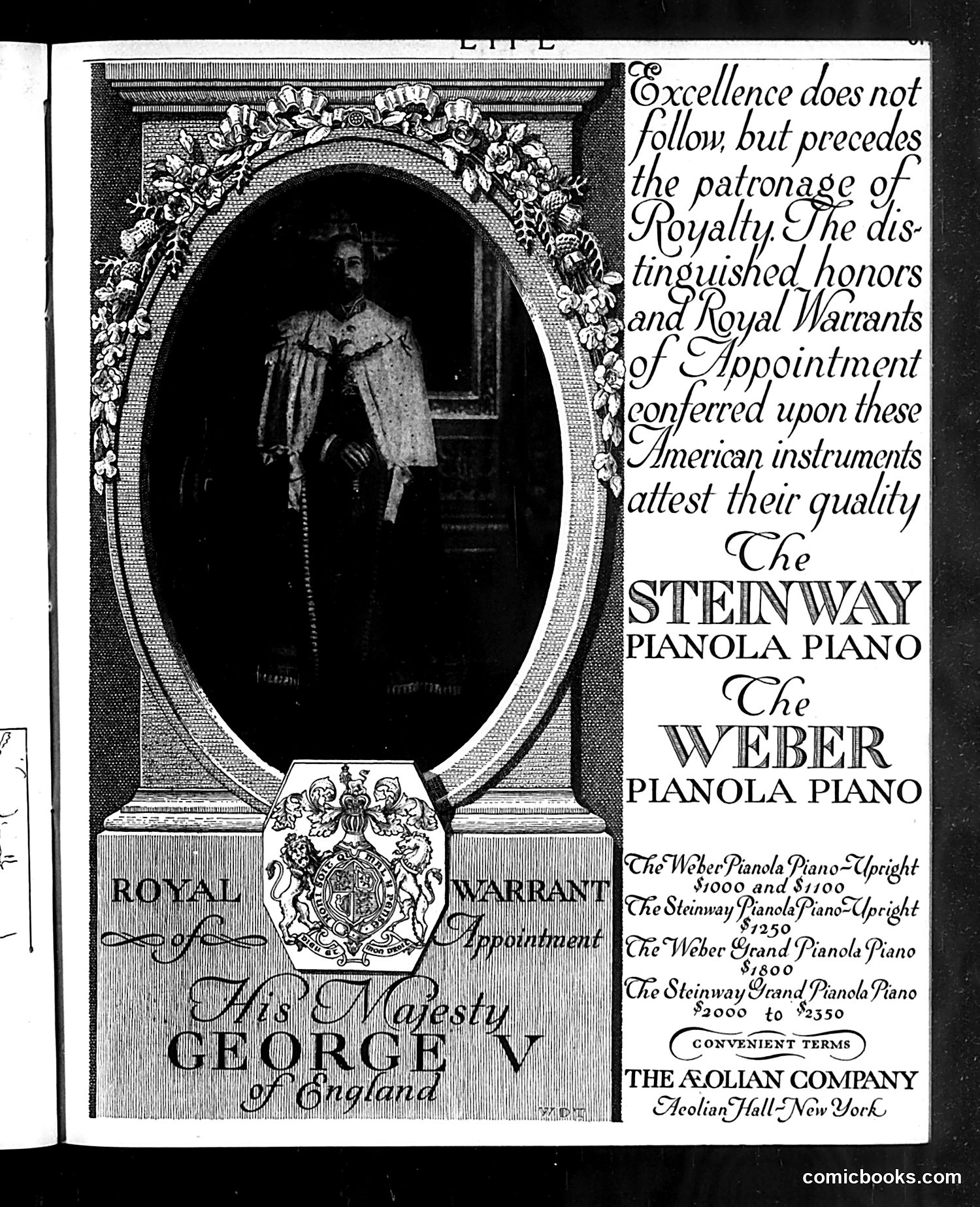
This is primarily a **piano advertisement**, not a political cartoon. The page features a formal portrait of King George V of England in royal regalia within an ornate oval frame, beneath which appears a "Royal Warrant of Appointment." The advertisement leverages royal endorsement as a marketing strategy, claiming that Steinway and Weber pianos have received distinguished honors and royal warrants that "attest their quality." The text states "Excellence does not follow, but precedes the patronage of Royalty." This reflects early 20th-century advertising conventions that used royal approval to establish prestige and quality for American-made luxury goods. By associating pianos with the British monarch's patronage, the Aeolian Company (the seller) positioned their instruments as worthy of elite, international standards—a common sales tactic for expensive consumer products of that era.
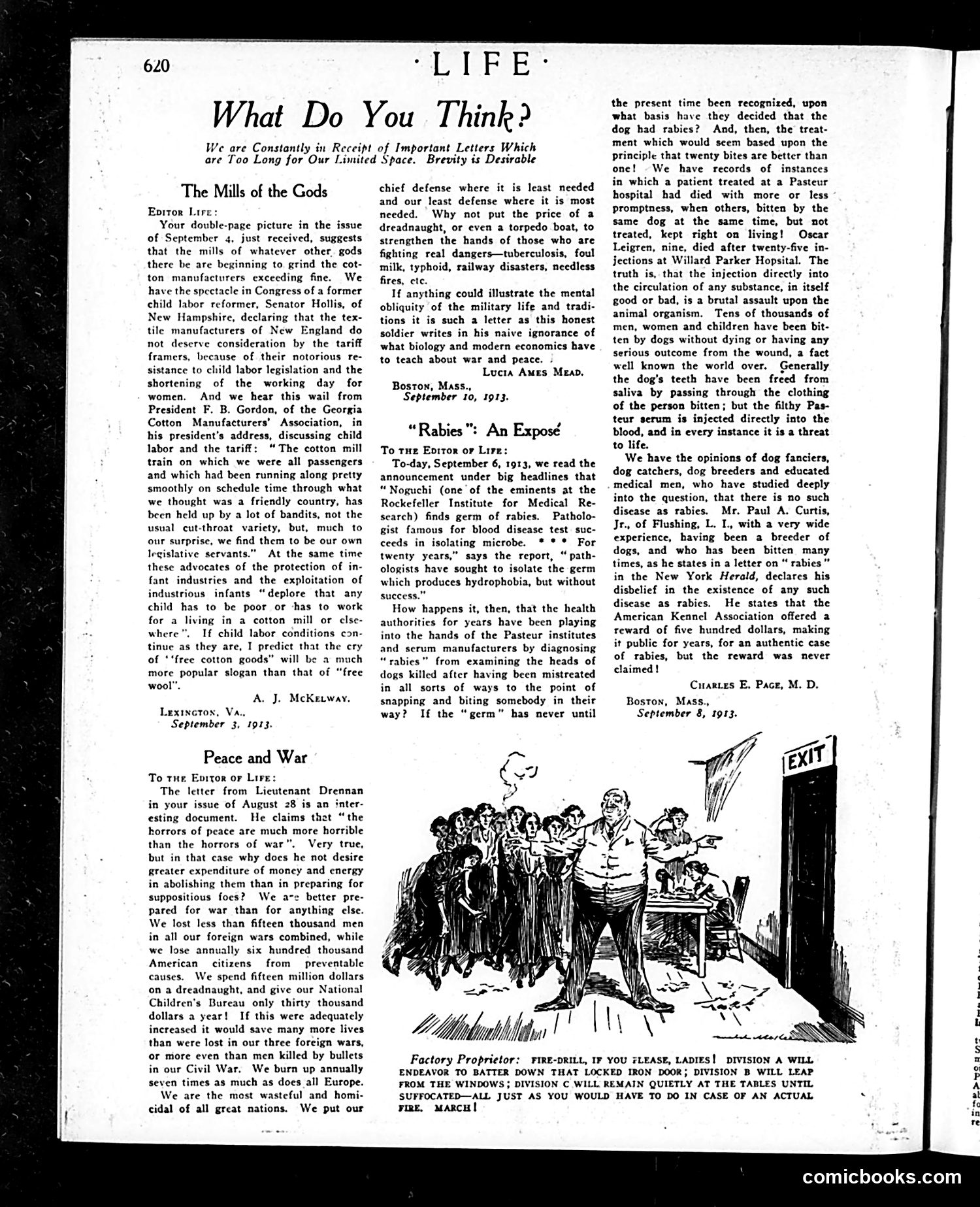
This page contains a readers' letters section ("What Do You Think?") with three letters addressing contemporary social and political issues. **"The Mills of the Gods"** criticizes cotton manufacturers' hypocrisy: they lobby against tariff protections while simultaneously exploiting child labor in their mills. The writer notes that Senator Hollis and Georgia Cotton Manufacturers' Association president F.B. Gordon both deplore child poverty—yet their industry depends on it. The letter sarcastically references their "friendly country" being "held up by bandits" (lawmakers), attacking their self-serving contradictions. **"Peace and War"** argues for redirecting military spending toward public health. The writer disputes Lieutenant Drennan's claim that "horrors of peace" exceed wartime horrors, pointing out America spends $15 million on a dreadnaught while allocating only $30,000 annually to the Children's Bureau—despite 600,000 annual preventable deaths versus minimal foreign war casualties. **"Rabies": An Exposé** appears to begin discussing Rockefeller Institute researcher Noguchi's rabies discovery but is cut off mid-paragraph. The cartoon (bottom) depicts factory safety, though details are unclear without full context.
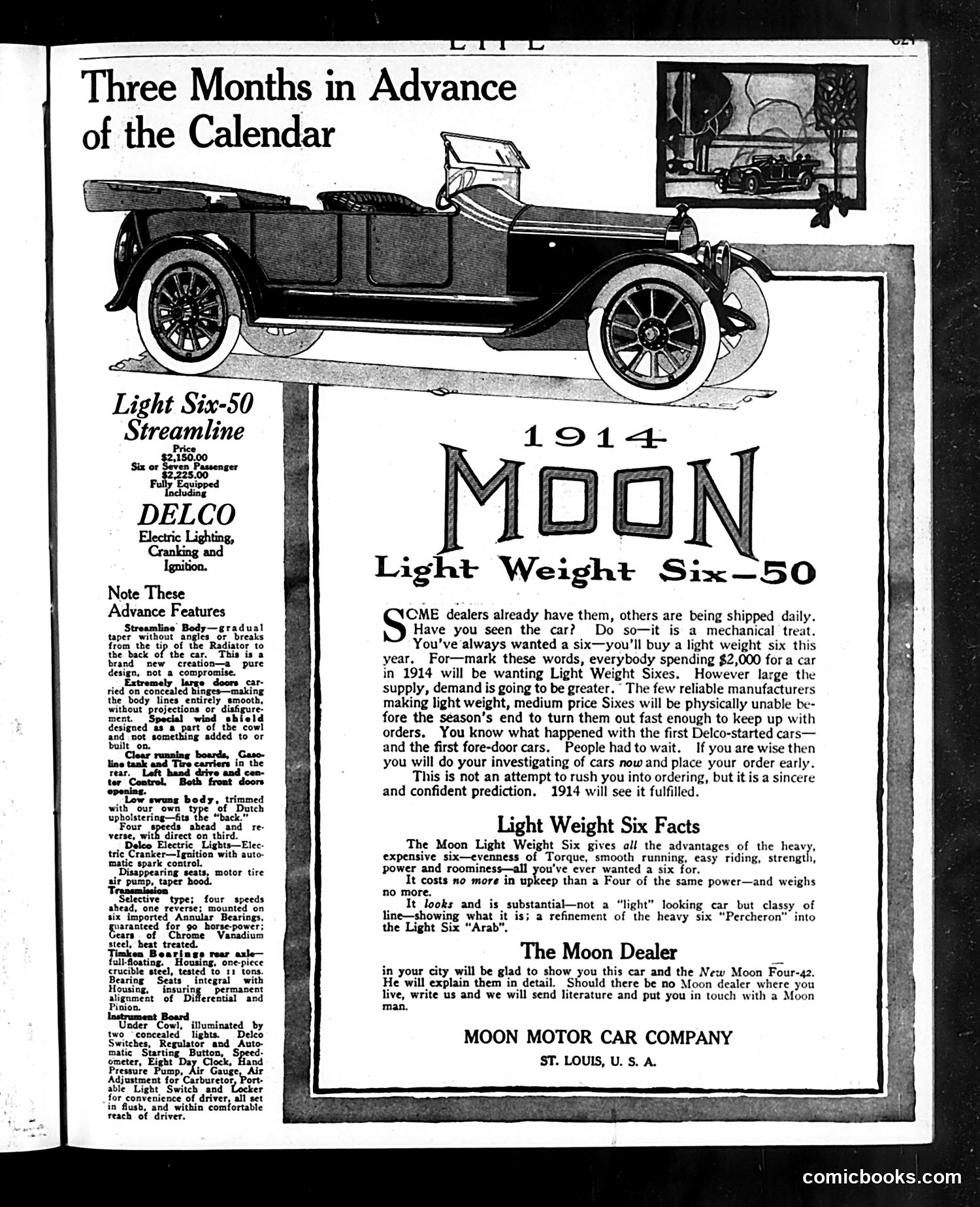
This page is **not a cartoon or satire**—it's a straightforward automobile advertisement from Life magazine, likely early 1914. The heading "Three Months in Advance of the Calendar" refers to Moon Motor Car Company's marketing strategy of promoting 1914 models before the year begins. The ad promotes the Moon "Light Weight Six-50," a moderately-priced automobile positioned as an affordable alternative to expensive heavy six-cylinder cars. Key selling points include streamlined design, electric starting (Delco system), and modern features like disappearing seats and enclosed doors. The text uses contemporary automotive language to emphasize engineering innovations while predicting strong demand ("everybody spending $2,000 for a car in 1914 will be wanting Light Weight Sixes"). The comparison of the car to a refined "Arab" horse versus the heavier "Percheron" illustrates the lightweight positioning. This reflects the early auto industry's rapid development and competitive marketing during the pre-World War I period.
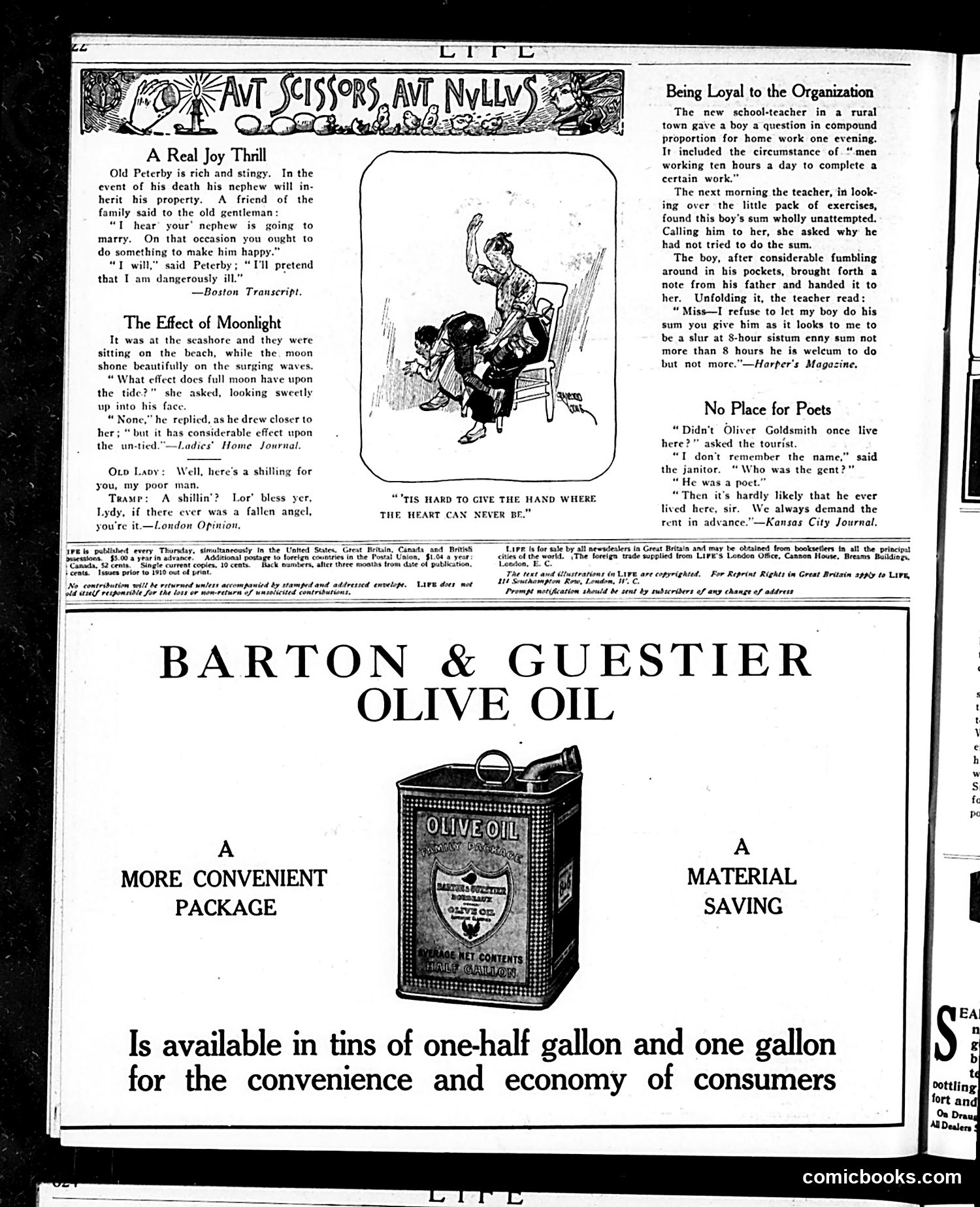
This page contains four brief humorous anecdotes typical of early-20th-century American satirical humor, plus an advertisement. **"A Real Joy Thrill"**: An elderly miser promises to make his nephew happy by pretending to be dangerously ill—the joke being that faking terminal illness is his idea of generosity. **"The Effect of Moonlight"**: A seaside romance joke playing on "tide" versus "untied"—suggesting the moonlight's real effect is loosening the woman's moral restraint. **"Being Loyal to the Organization"**: A father refuses to let his son solve a math problem because it describes an 8-hour workday, arguing the sum should only involve 8-hour shifts. This satirizes rigid labor union ideology prioritizing doctrine over education. **"No Place for Poets"**: A janitor dismisses Oliver Goldsmith as irrelevant because the lodging demands advance rent—satirizing practical, commercial society's indifference to artistic merit. The advertisements promote Barton & Guestier olive oil's convenient packaging.
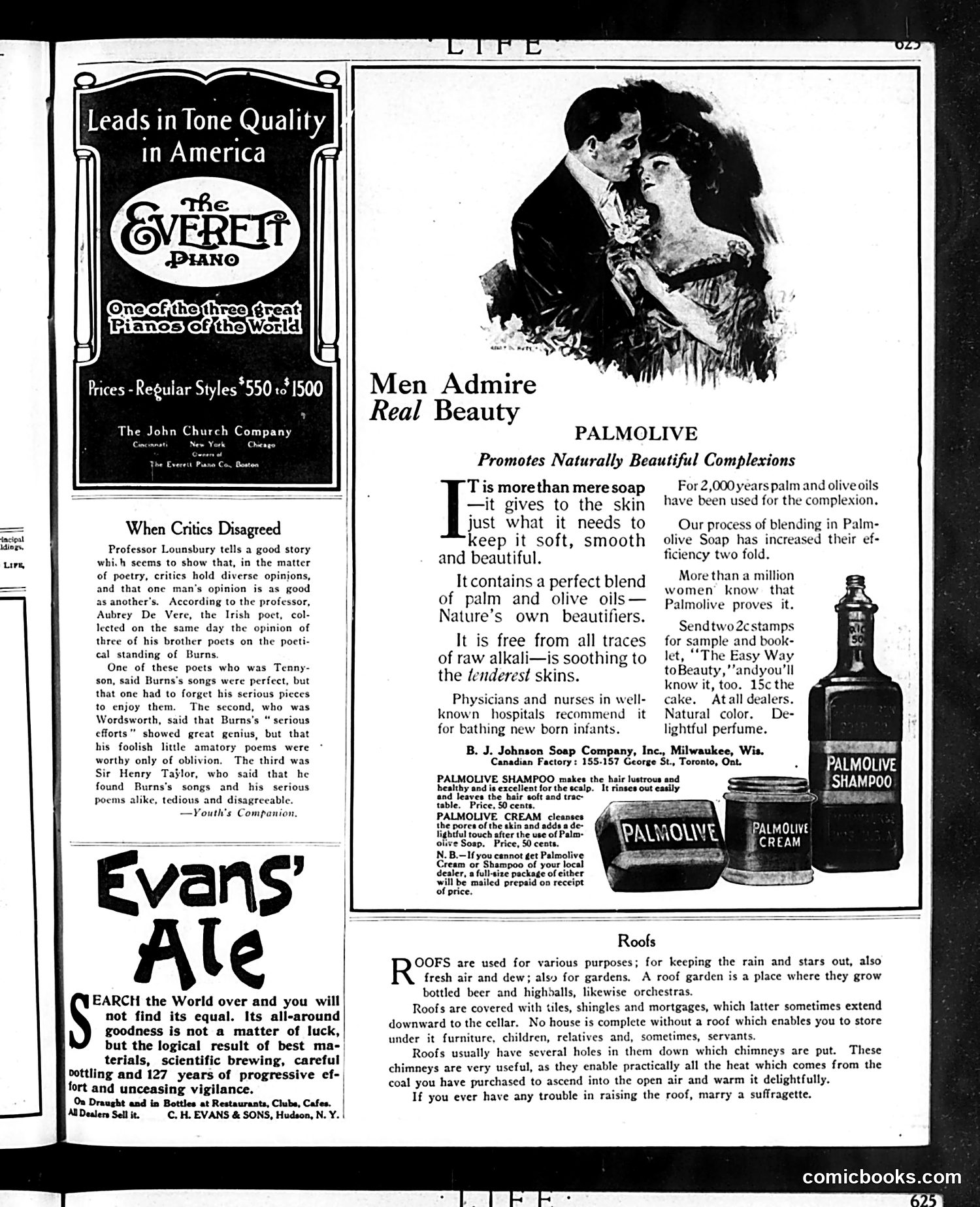
This page is primarily **advertisements** interspersed with light editorial content, typical of early 20th-century Life magazine. The main editorial piece, "When Critics Disagreed," is a brief anecdote about literary criticism. Professor Lounsbury recounts how three famous poets—Tennyson, Wordsworth, and Sir Henry Taylor—gave completely contradictory assessments of Robert Burns's work on the same day. Tennyson praised his songs but dismissed his serious work; Wordsworth reversed this judgment; Taylor found both tedious. The joke satirizes **critical subjectivity in poetry**—the notion that expert opinion is merely personal preference dressed up as authority. The remaining content consists of product advertisements: Everett Piano, Palmolive soap and beauty products, and Evans' Ale. The Palmolive ad emphasizes "natural beauty" and historical use of palm/olive oils. There's a humorous definition of "Roofs" (likely filler humor), ending with a topical joke about suffragettes "raising the roof"—a contemporary reference to women's rights activism of the era.
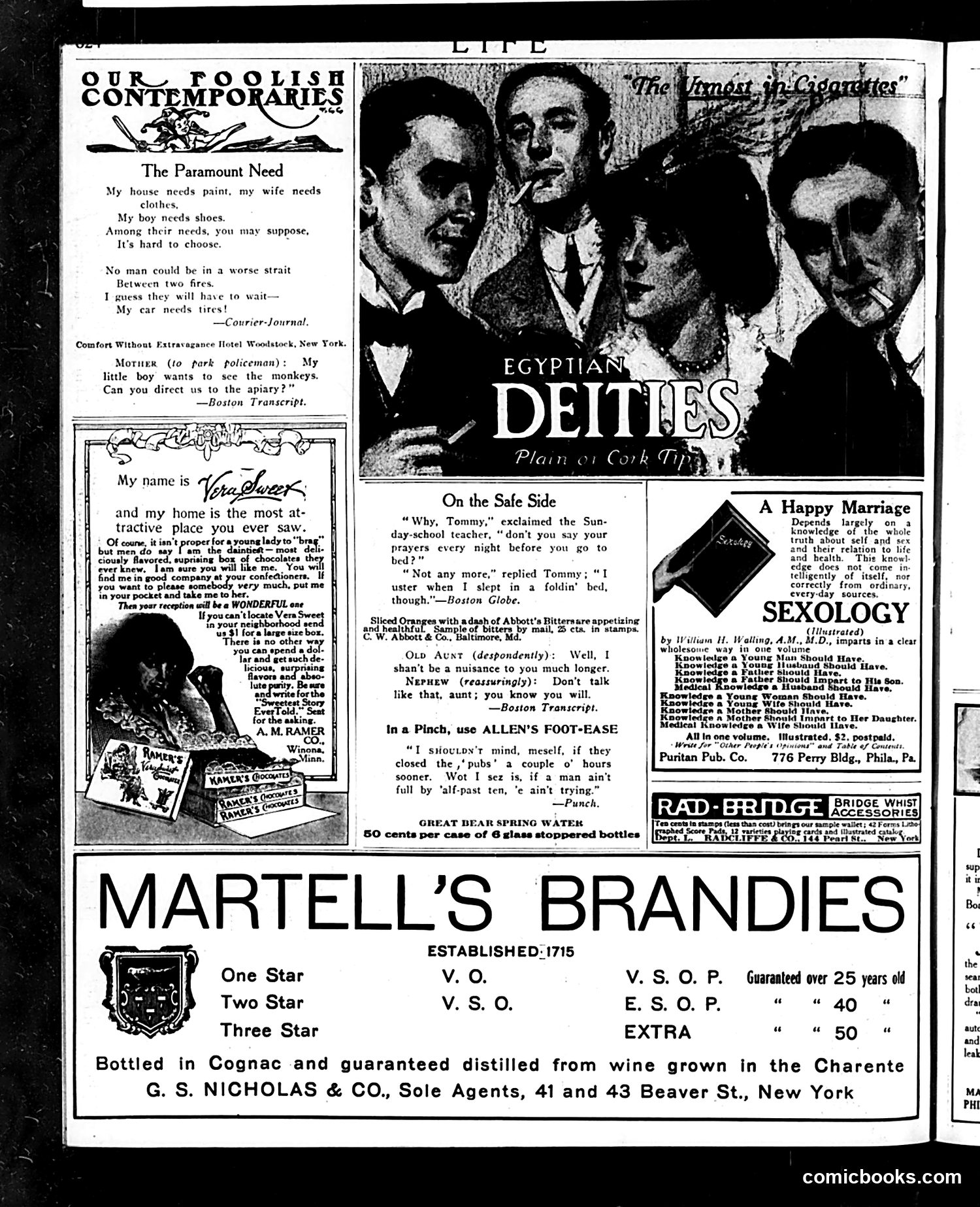
This page from *Life* magazine combines satirical humor with period advertising. The upper section features "Our Foolish Contemporaries"—a recurring column presenting humorous submitted anecdotes about everyday absurdities. The jokes target middle-class anxieties of the era: a homeowner torn between competing financial needs (house paint, children's clothes, car tires), a parent confusing "apiary" (bee farm) with "monkeys," and a child who stopped praying because he slept in a folding bed (implying prayer only worked in a proper bed—absurd logic). The advertisements reflect early 20th-century consumer goods and social concerns: foot powder, brandy, a sex education book marketed as necessary for "happy marriage," and spring water. The satirical tone critiques both the submitted humor (poking fun at ordinary people's silly logic) and period consumer culture itself. The "Vera Sweet" chocolates advertisement uses flirtation to sell products—common for the era but reflecting attitudes toward women modern readers would find dated. The page is primarily advertisement-driven, with humor serving commercial purposes.
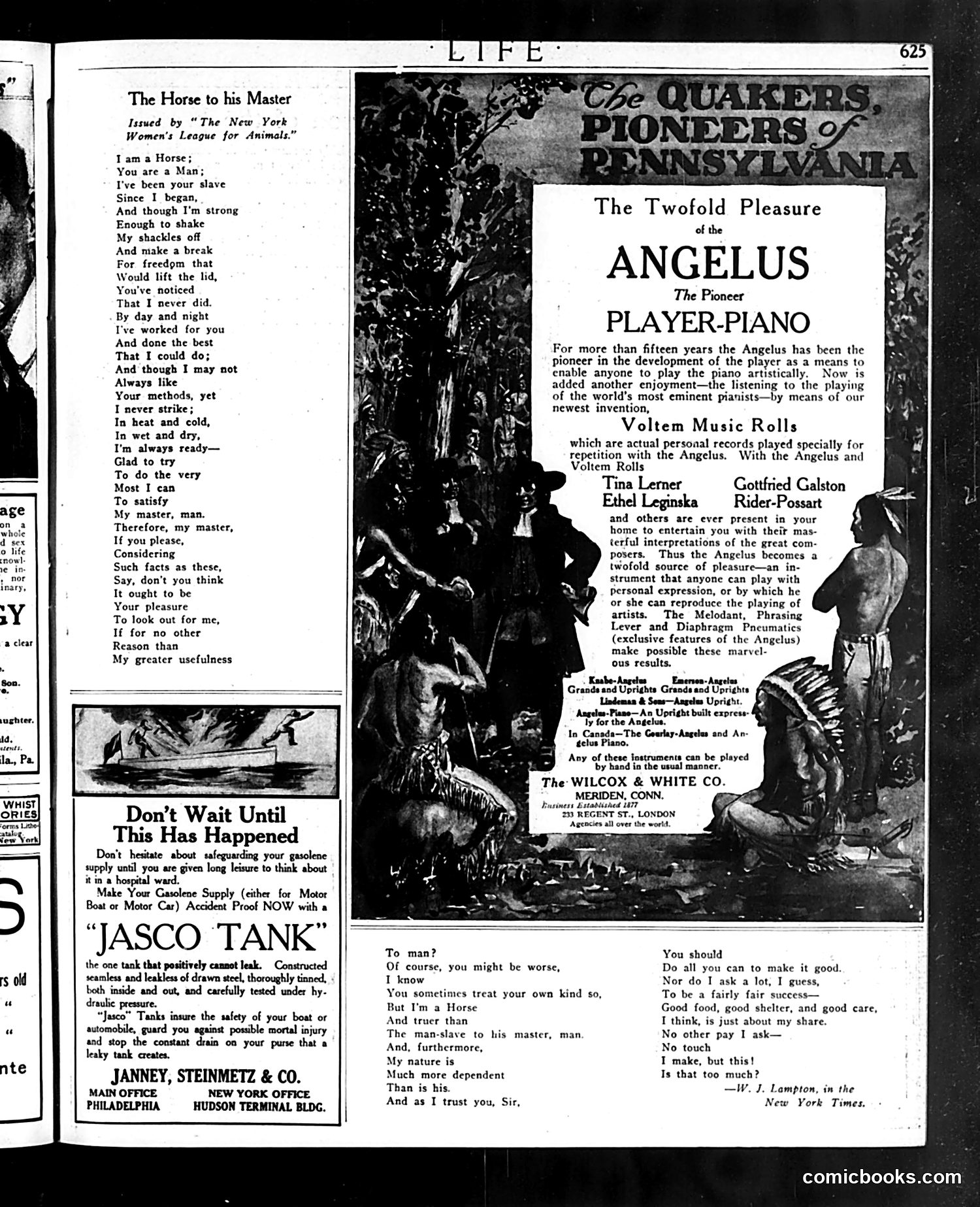
This page features a poem issued by the **New York Women's League for Animals**, presenting a horse's plea for humane treatment. The poem is a sentimental appeal framed as direct address: the horse catalogs its loyalty and labor ("I've worked for you...done the best"), then argues this faithfulness obligates its master to provide basic care—food, shelter, and protection from neglect. The satire works through role-reversal and implied criticism of human masters who exploit animals despite their dependence. The horse's reasonable requests (decent conditions, not cruelty) are presented as modest and earned through service, making any refusal seem callous. This reflects early 20th-century animal welfare activism, when such organizations lobbied for protections against abuse and neglect. The poem's emotional tone—humble yet reproachful—was typical advocacy rhetoric of the era, appealing to owners' sense of obligation toward creatures they controlled.
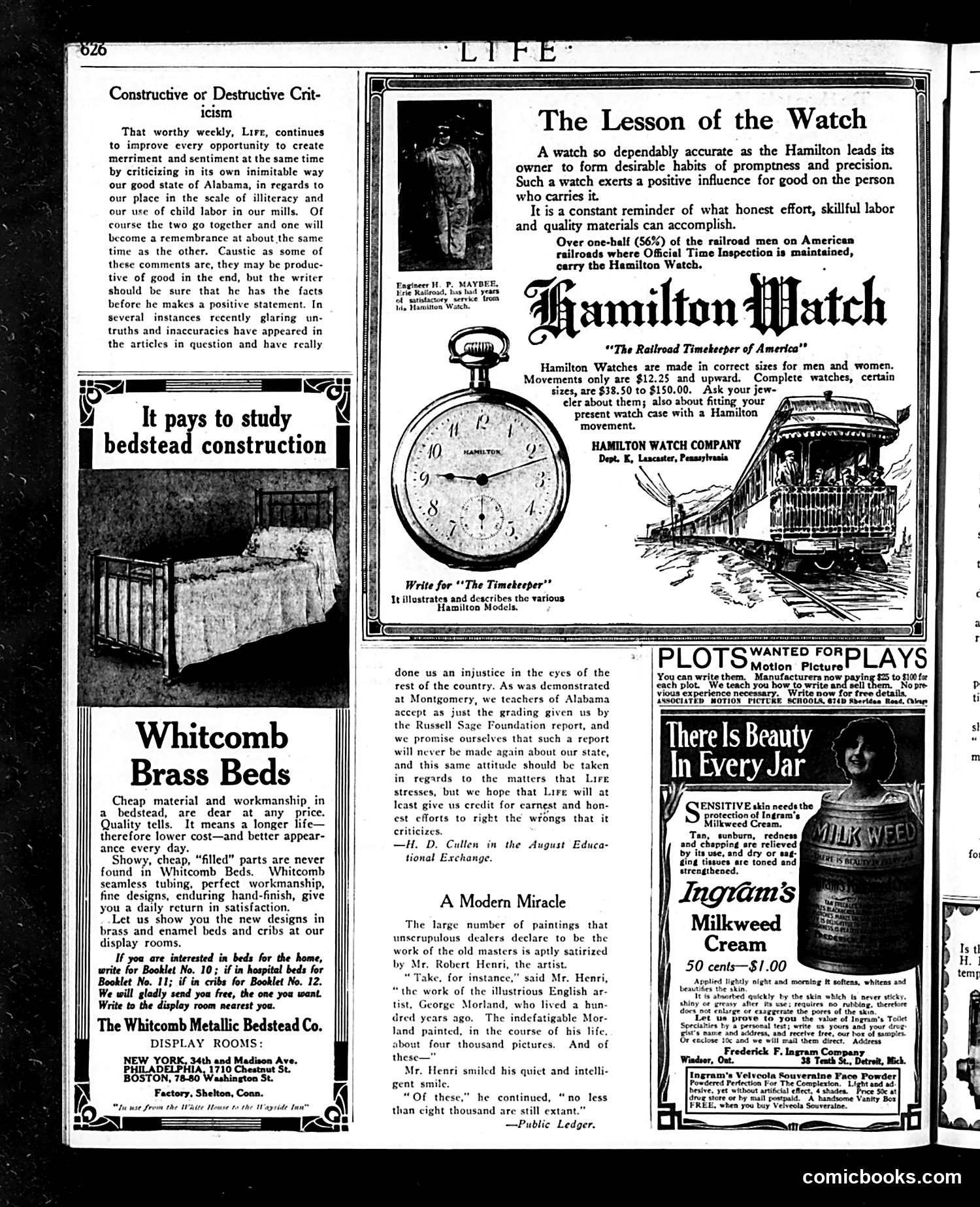
This page comprises mostly **period advertisements and opinion pieces**, not political cartoons. The substantive content includes: **"Constructive or Destructive Criticism"** — An Alabama educator (H. D. Cullen) responds defensively to *Life* magazine's recent satirical critiques of Alabama's child labor practices and illiteracy rates. Cullen acknowledges the issues but complains that *Life* occasionally reported inaccuracies, asking for credit for reform efforts despite valid criticism. **The advertisements** showcase early-20th-century products: brass beds, Hamilton watches (marketed as precision tools for railroads), Ingram's Milkweed Cream (a moisturizer), and calls for screenplay writers. **"A Modern Miracle"** mentions art-world fraud regarding fake Old Master paintings, attributing the satire to artist Robert Henri. The page reflects Progressive Era debates about social reform journalism and corporate accountability.
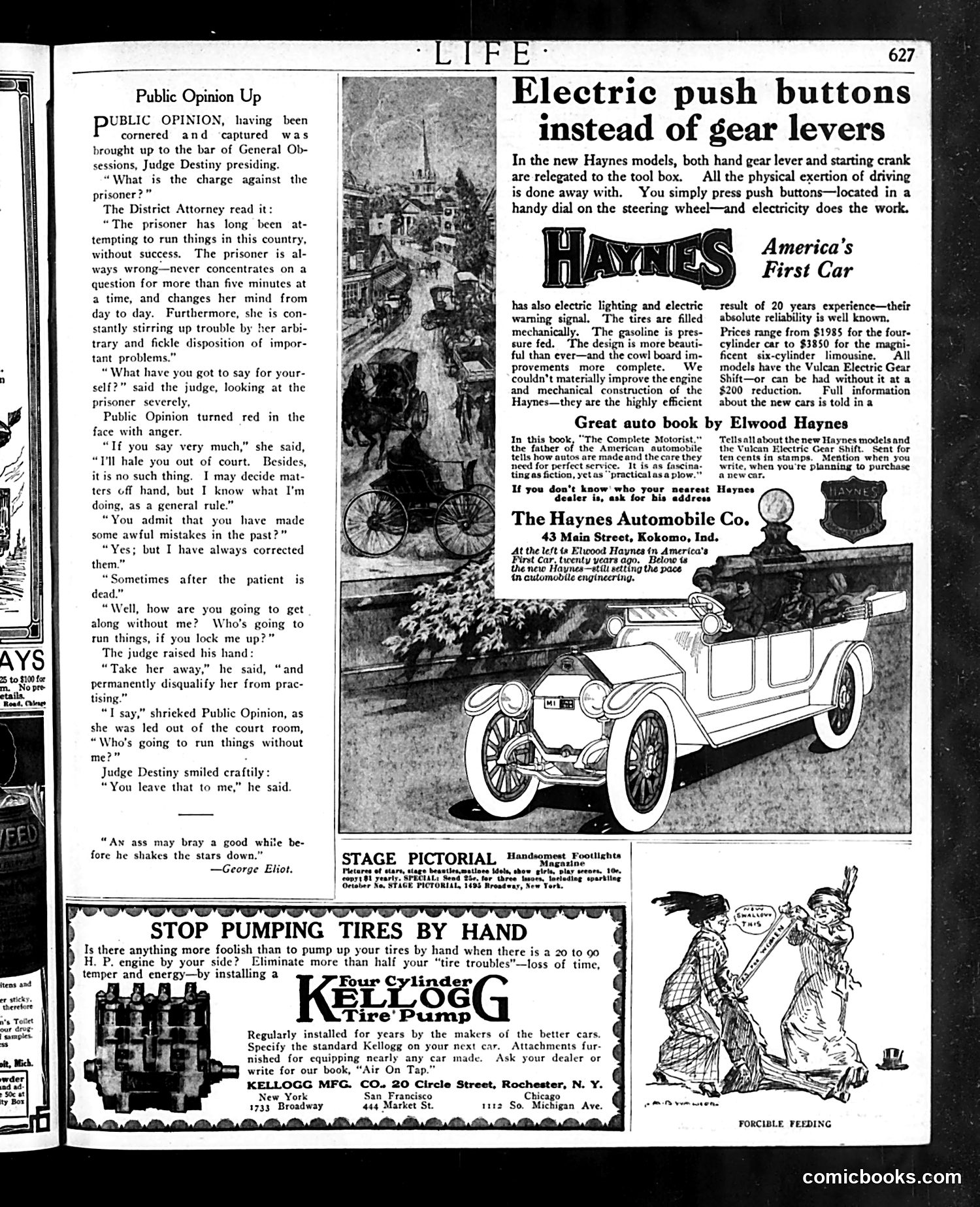
This is a satirical courtroom drama where **Public Opinion** (personified as a woman) is prosecuted by the District Attorney before "Judge Destiny." She's charged with being fickle, indecisive, and unable to "run things" in the country—changing her mind constantly and concentrating on issues for mere minutes. Public Opinion defensively argues she always corrects her mistakes, though the judge notes this sometimes happens "after the patient is dead" (implying delayed corrections cause harm). When she protests that without her input "who's going to run things," Judge Destiny dismisses her, saying he'll handle it himself. **The satire targets the fickle nature of public opinion in democratic governance**—how it shifts unpredictably, fails to focus on issues seriously, and often "corrects" only after damage is done. The joke suggests that maybe allowing the impersonal force of "Destiny" to govern might actually be preferable to depending on the volatile whims of the voting public. The page also contains automobile advertisements unrelated to the cartoon's message.
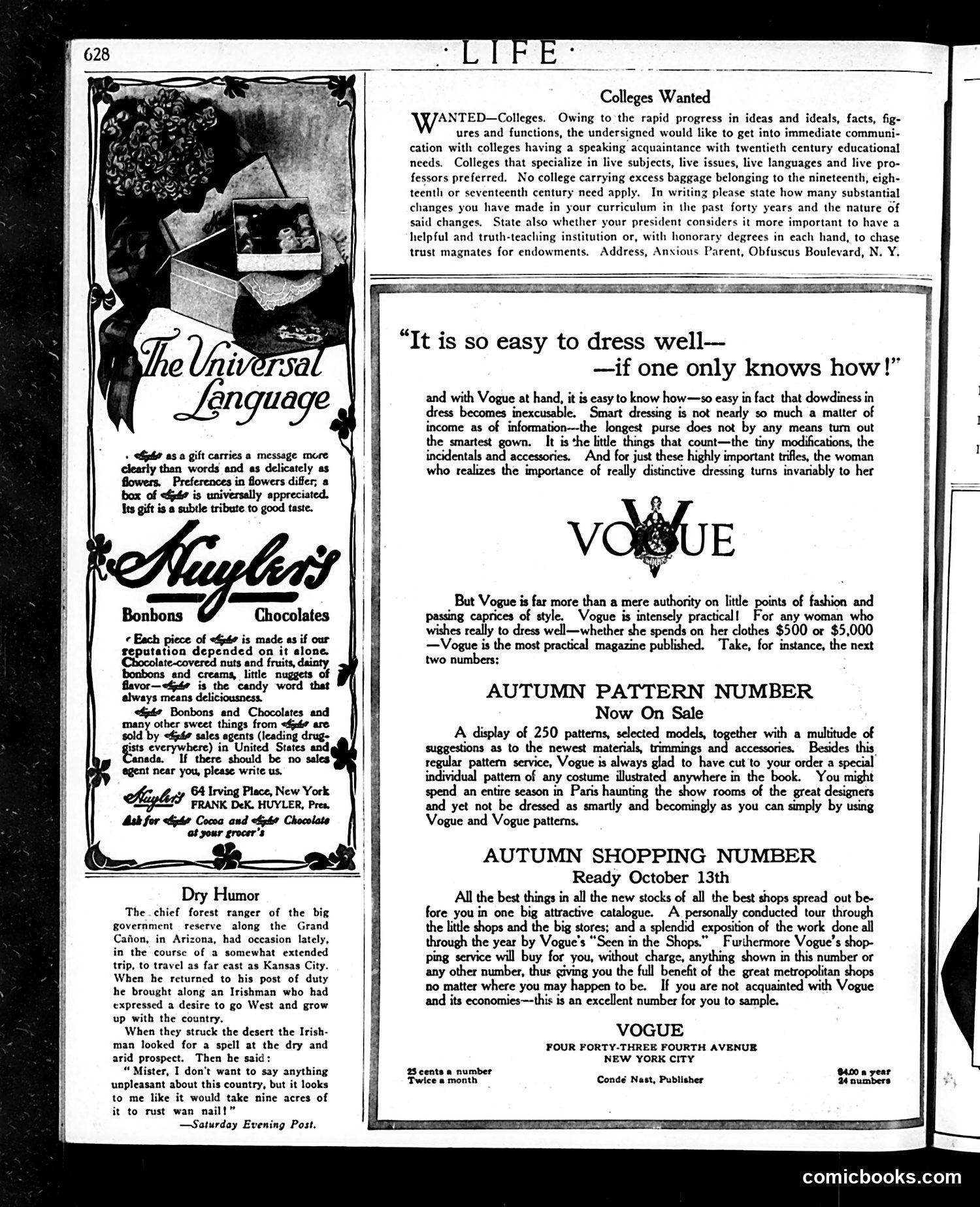
This page contains **satirical advertisements and content typical of early 20th-century Life magazine**. ## "Colleges Wanted" (Right Column) A **mock want-ad** from "Anxious Parent" seeking colleges that embrace modern education. The satire criticizes institutions still clinging to outdated curricula (19th-17th century baggage) and presidents more interested in soliciting donations from wealthy industrialists ("trust magnates") than in genuine education. This reflects Progressive Era concerns about academic stagnation and the corrupting influence of wealthy donors on educational independence. ## "Dry Humor" (Bottom Left) An **Irish immigrant joke** playing on ethnic stereotypes common to the era. An Irishman views Arizona's desert as so barren that "nine acres of it" couldn't rust a single nail—exaggerating the wasteland to absurd effect. Typical period humor targeting Irish workers. ## Left Side Advertisements for **Naylor's Bonbons/Chocolates** and other period products—standard commercial content typical of Life's revenue model. The page is primarily **advertising-driven** rather than satirical commentary.
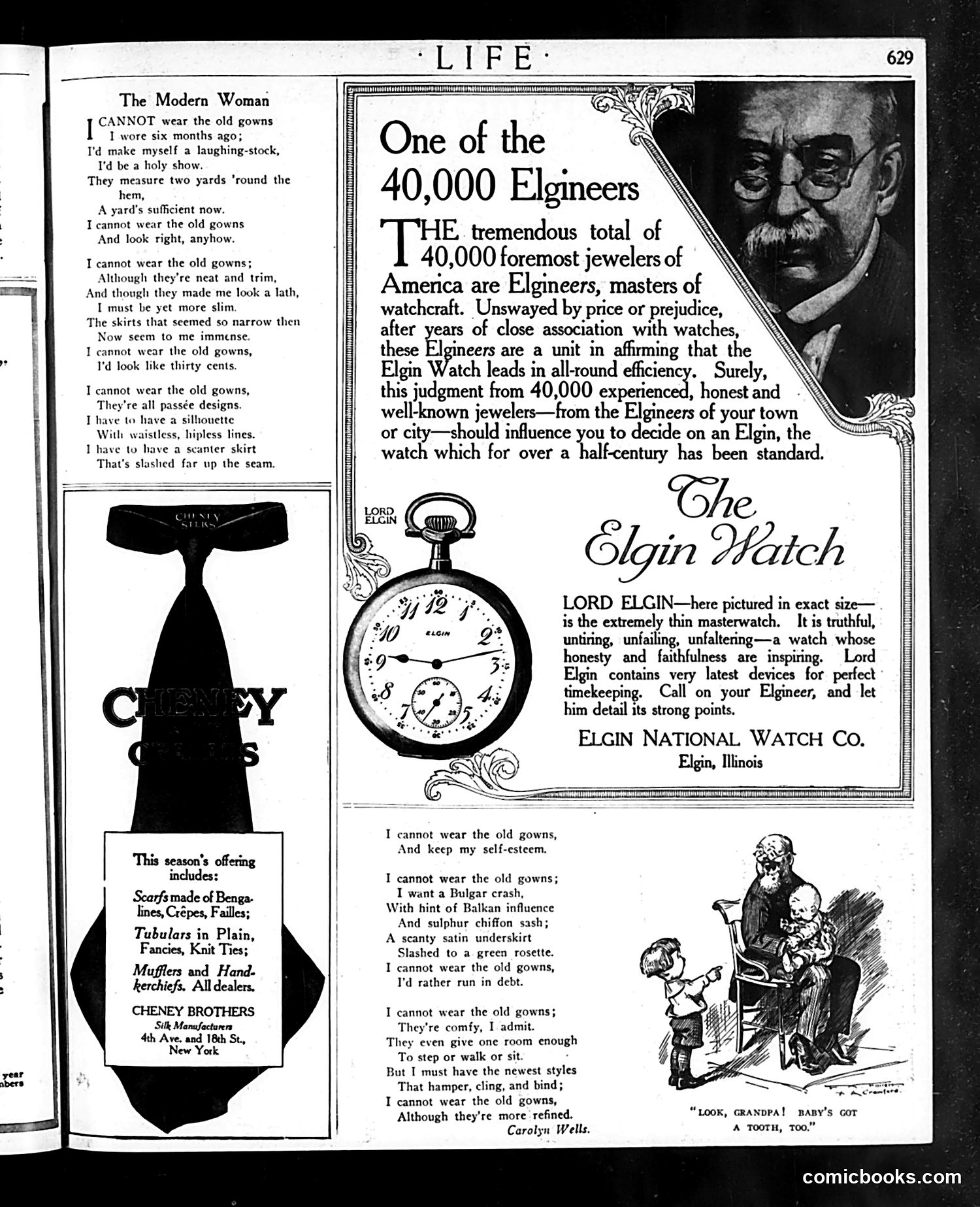
This page satirizes women's fashion obsession in the 1920s. The poem by Carolyn Wells mockingly documents a woman's compulsive need to constantly update her wardrobe, despite the expense and impracticality. She cannot wear gowns from even six months prior—they're now "immense" compared to fashionable silhouettes. The satire intensifies as she admits the new styles are actually uncomfortable ("hamper, cling, and bind") yet she'd "rather run in debt" than wear last season's clothing. The poem targets the perceived vanity and illogical consumer behavior of modern women, suggesting fashion anxiety overrides financial prudence and comfort. The accompanying Cheney Brothers advertisement and Elgin Watch ad are standard commercial content typical of Life magazine's business model. The cartoon appears to be lifestyle commentary on post-WWI women's changing roles and the commercialization of female identity through fashion.
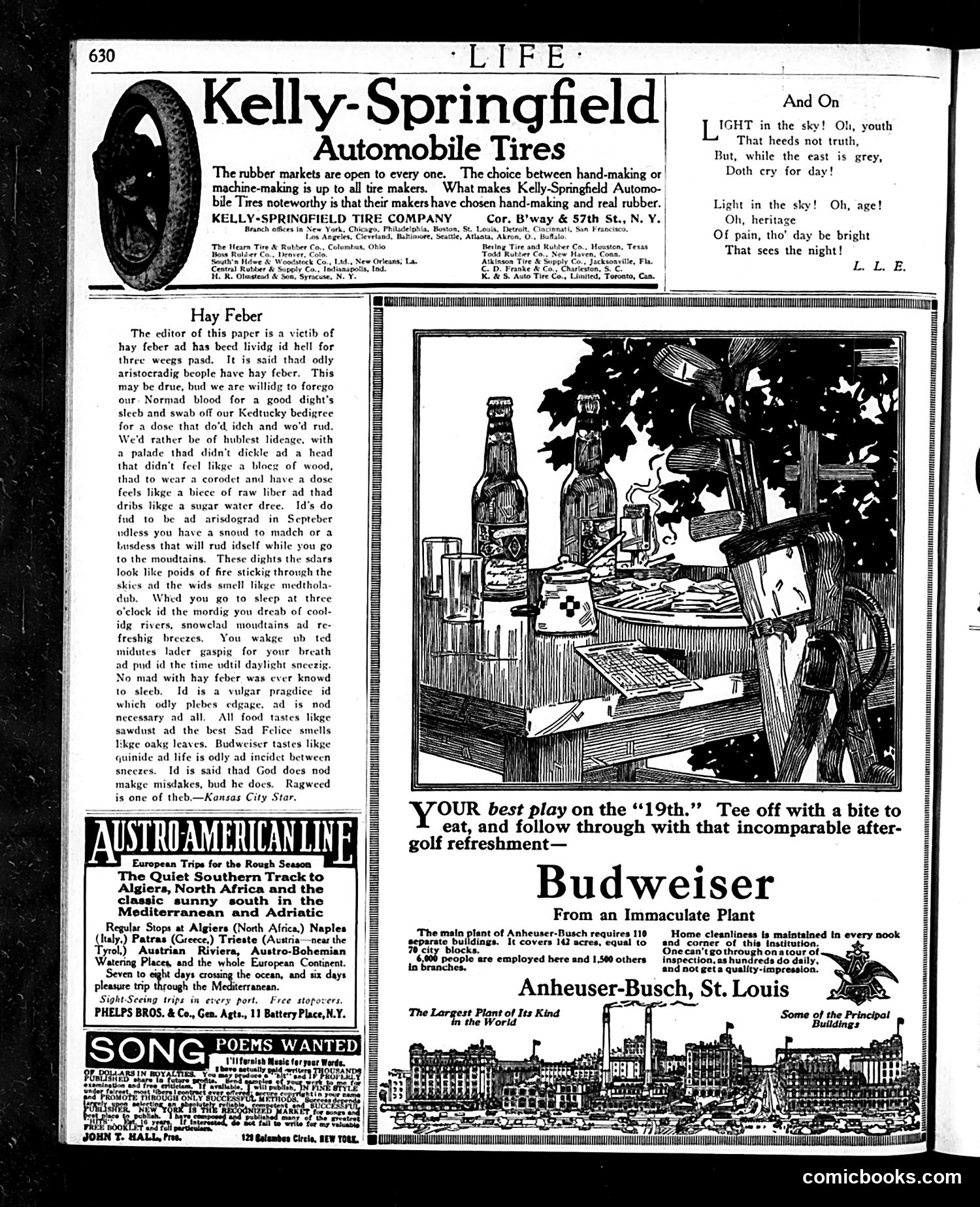
This page is primarily **advertising** with one notable editorial piece. The main content is a humorous essay titled "Hay Fever" by the magazine's editor, complaining about seasonal allergies. The piece sardonically argues that hay fever, though popularly associated with aristocracy, is unbearable—ruining sleep, making food taste like sawdust, and turning even fine beer (Budweiser) bitter. The complaint is tongue-in-cheek social commentary: the editor would gladly trade aristocratic status for relief from the affliction. The writing style contains intentional misspellings (likely typographical errors or stylistic choices of the era). The page features advertisements for: - **Kelly-Springfield Automobile Tires** (emphasizing hand-made quality) - **Austro-American Line** (Mediterranean cruises) - **Budweiser** (with a golf-themed illustration) - **Anheuser-Busch** brewery A poem titled "And On" appears at top right (author L.L.E.), offering romantic verses about light and pain. The content reflects 1920s consumer culture and leisurely travel aspirations.
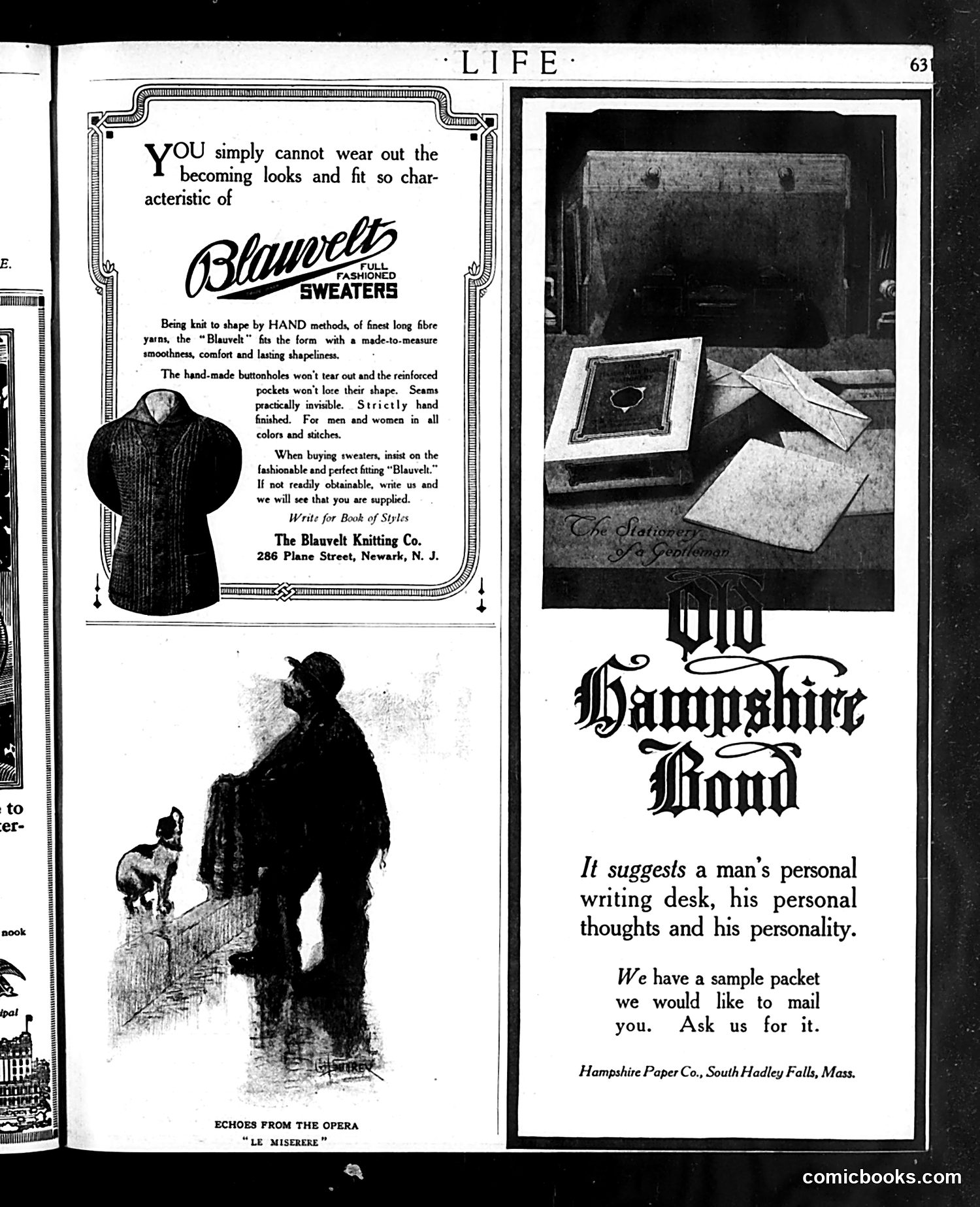
This page contains **two advertisements with no political satire or editorial cartoons**. **Left side:** A Blauvelt sweater ad featuring a knitted garment illustration and an engraving titled "Echoes from the Opera: Le Misérère"—a reference to Verdi's famous opera *Les Misérables*. The opera image (man with child) serves as decorative content, not satire. The ad emphasizes hand-knit durability and quality construction. **Right side:** A Hampshire Bond writing paper advertisement showing stationery and a desk blotter. It appeals to masculine identity by suggesting the product reflects "a man's personal writing desk, his personal thoughts and his personality." Both are straightforward period advertising from an era when *Life* magazine (founded 1883) mixed editorial content with advertisements. The opera reference adds cultural prestige to the sweater brand. There is **no cartoon, caricature, or political commentary** on this page.
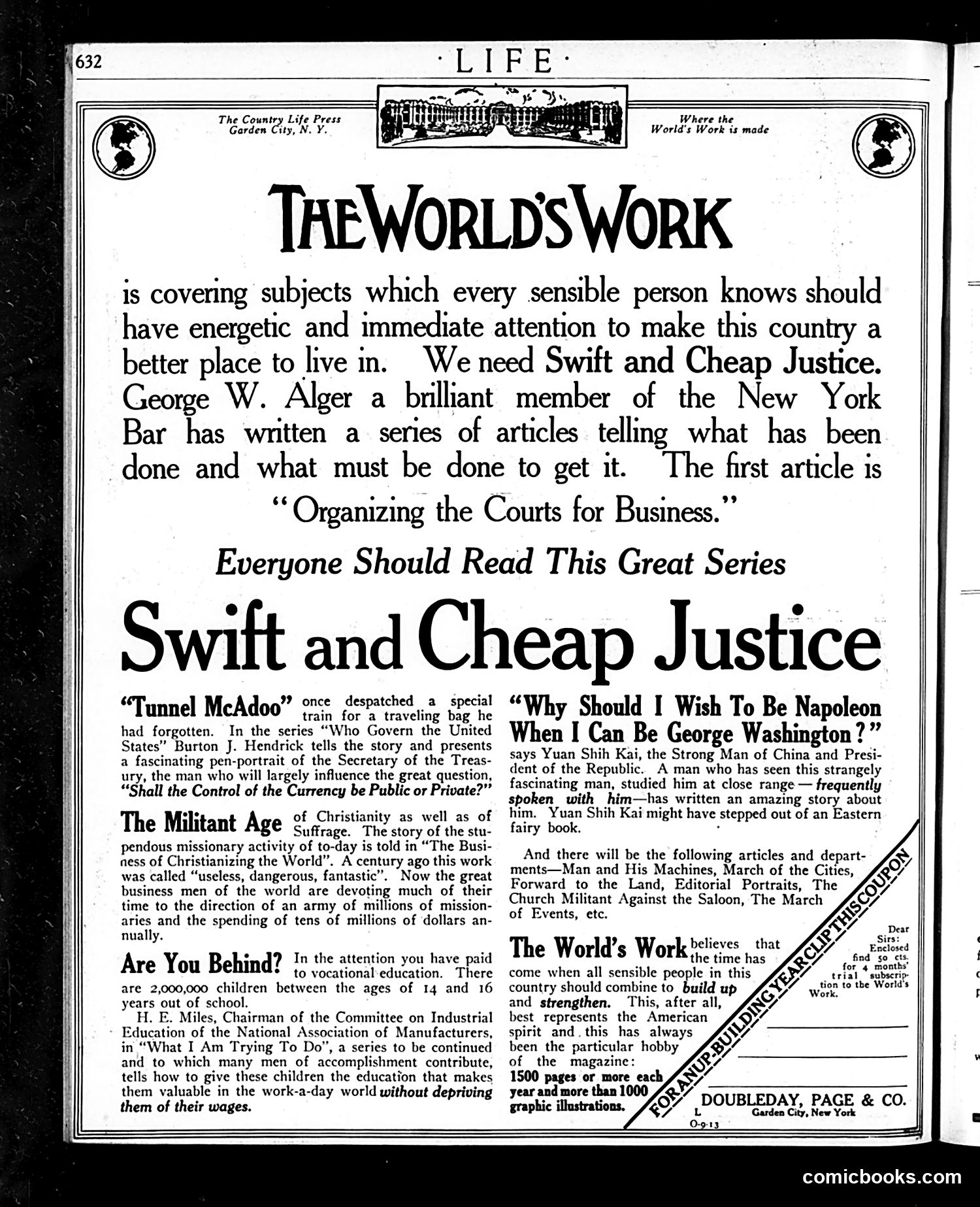
This page is primarily an **advertisement for "The World's Work" magazine**, not a political cartoon. It promotes upcoming articles on progressive-era reform topics. The key figures referenced are: - **George W. Alger**: A New York lawyer writing on judicial reform ("Swift and Cheap Justice") - **William McAdoo**: Treasury Secretary (humorously referenced in an anecdote about a forgotten train) - **Yuan Shih Kai**: China's president, described as "Strong Man of China," presented as an exotic figure for American readers - **H.E. Miles**: Industrial education advocate The **social context** reflects early 1900s Progressive reform concerns: court efficiency, vocational education for 2 million out-of-school children, currency control debates, and missionary/Christian business activities. The satire is gentle—mocking McAdoo's absent-mindedness and presenting Yuan Shih Kai as a romantic Eastern figure. The overall message urges American readers to engage with serious national problems through informed journalism.
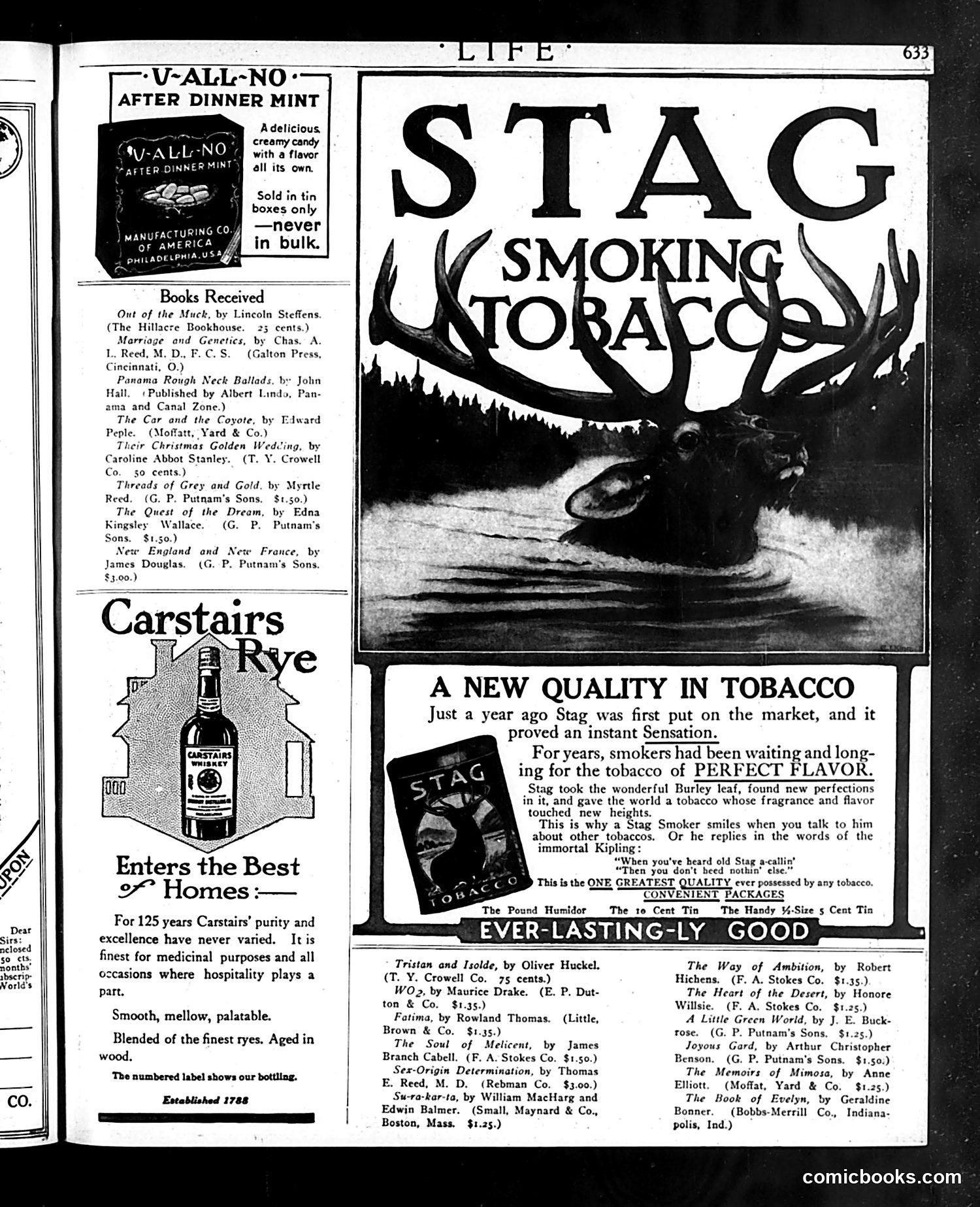
This page is primarily **advertising and book reviews**, not political satire. The main content features: **Stag Smoking Tobacco Advertisement**: A large commercial promoting "Stag" brand tobacco, featuring a stag (male deer) with prominent antlers. The ad claims the product offers "perfect flavor" and quotes Rudyard Kipling to suggest smoking Stag is irresistible. This represents early 20th-century consumer marketing—no satire is apparent. **Supporting Ads**: V-ALL-NO after-dinner mints and Carstairs' Rye whiskey also appear, typical period product advertisements emphasizing quality and tradition. **Books Received**: A standard literary review section listing recently published titles. The page contains **no political cartoons or satirical commentary**. It reflects Life magazine's mixed format of light advertising and cultural content typical of this era, when magazines subsidized editorial content through extensive paid advertising.
This page is **entirely an advertisement** for a new magazine called "Dress & Vanity Fair," published by Condé Nast (publisher of *Vogue*). There are no cartoons or satirical illustrations to analyze. The ad positions the magazine as an American equivalent to English society publications like *Sketch* and *Tatler*—publications that blend fashion, society news, arts coverage, and sports reporting in a sophisticated, illustrated format. The publisher explicitly targets an **elite, refined audience**, not the mass market, emphasizing "fastidiousness and luxuriousness." The appeal reflects early 20th-century attitudes toward aspirational lifestyle journalism: the magazine promises to cover high society, the stage, notable people, fine arts, and leisure activities—content designed to interest wealthy or culturally ambitious readers. The price (25 cents per issue, $3 yearly) was relatively expensive for the era, reinforcing its upscale positioning. This is a historical artifact showing how luxury magazines marketed themselves through appeals to exclusivity and taste.
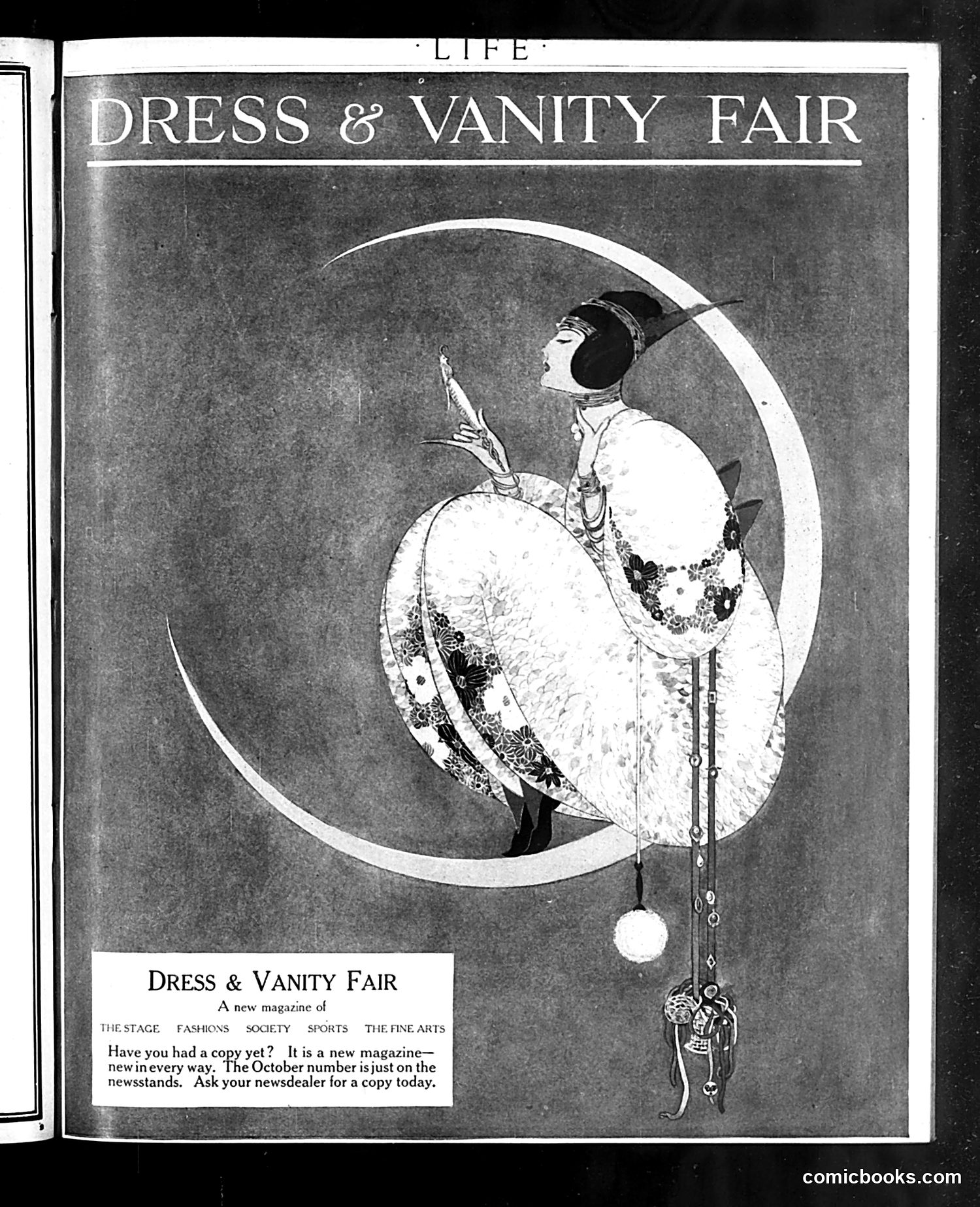
This is primarily an advertisement for a new magazine called "Dress & Vanity Fair," promoting its October issue. The elegant Art Deco illustration depicts a fashionable woman in 1920s style—wearing a white beaded dress, dark headband, and long pearl necklace—gazing at herself in a crescent moon mirror. She holds a compact or hand mirror, emphasizing vanity and self-regard. The image embodies the magazine's focus areas: fashion, society, and the arts. The stylized, sophisticated aesthetic appeals to upscale readers interested in contemporary style and culture. Rather than political satire, this functions as lifestyle advertising targeting women concerned with fashion and social standing during the Jazz Age era.
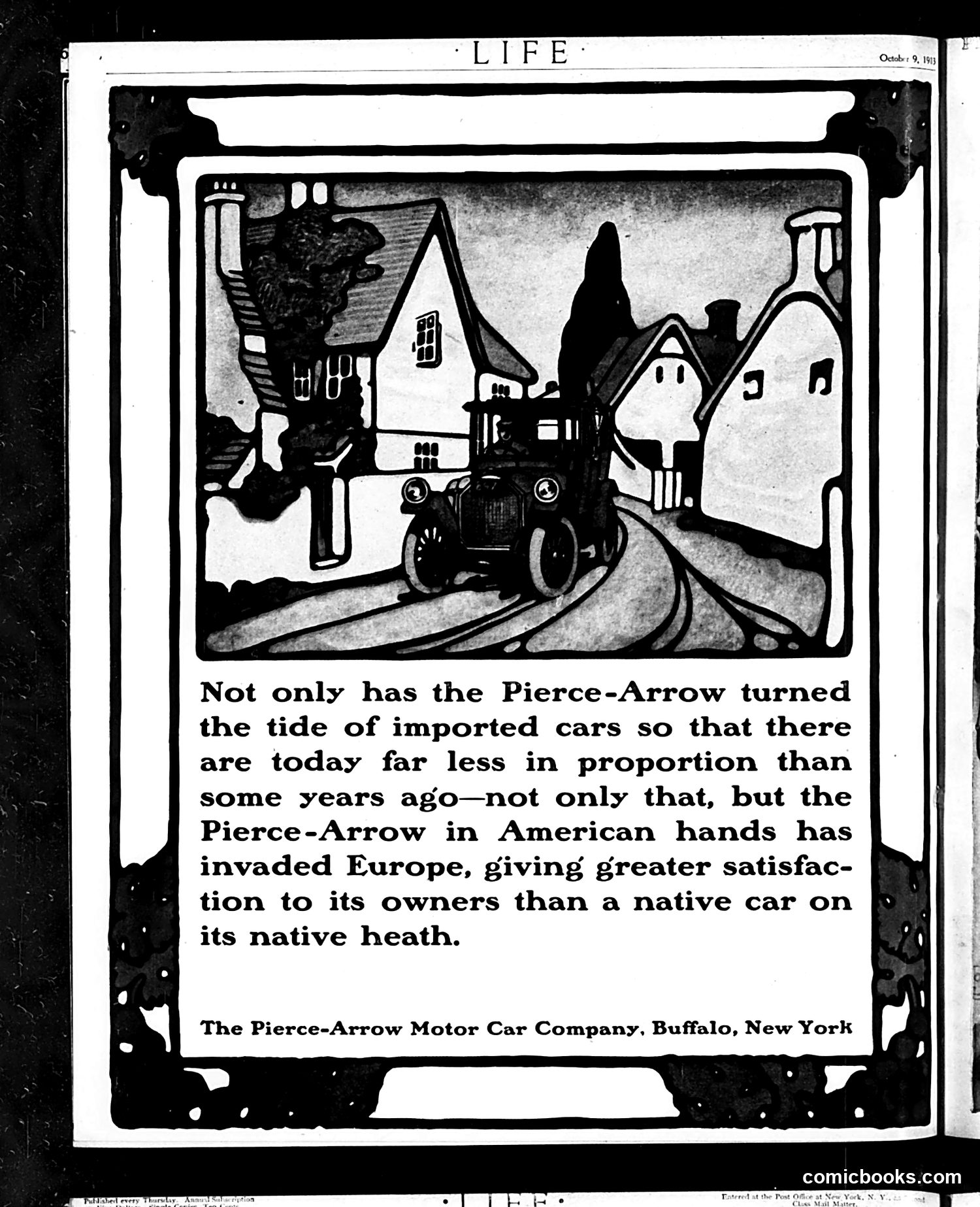
This is an advertisement for Pierce-Arrow Motor Cars, based in Buffalo, New York. The illustration shows an early automobile driving through a charming European village, establishing an aspirational image of the car's quality and sophistication. The ad's message claims that Pierce-Arrow vehicles have successfully competed against imported European cars in America, and moreover, have gained popularity among European owners themselves—suggesting American manufacturing superiority. This reflects early 20th-century American industrial pride and the emerging competitive advantage of American automobile manufacturers over established European brands. The satirical angle, typical of Life magazine's approach, likely mocks such grandiose claims about American products "invading" Europe and outperforming native vehicles on their home territory—a boastful assertion that would have resonated with the magazine's audience.