
Life, 1913-10-09 · page 20 of 44
Life — October 9, 1913 — page 20: what you’re looking at
What you’re looking at
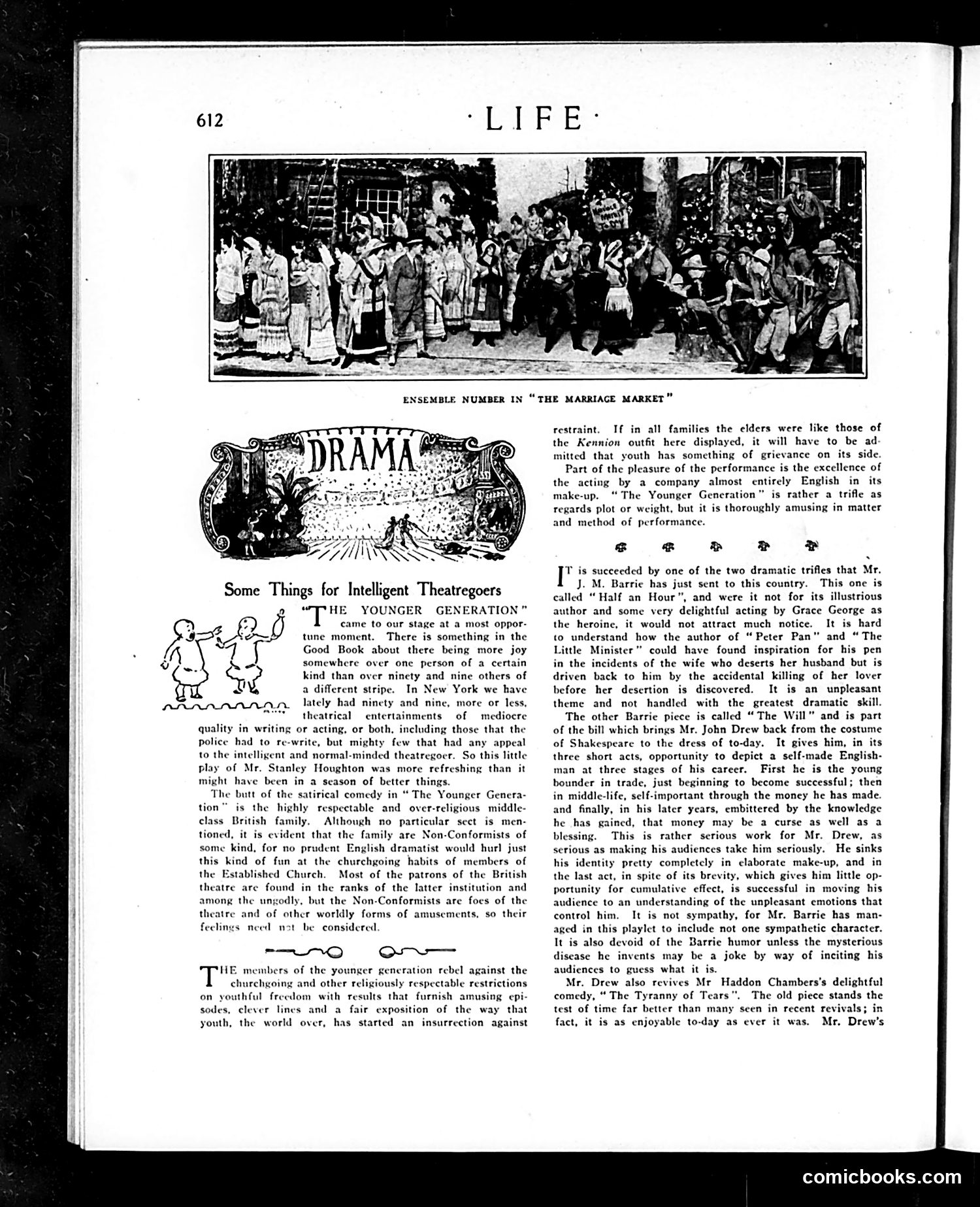
This page reviews three theatrical productions for sophisticated theatergoers. The top image shows an ensemble cast from "The Marriage Market." The main article praises Stanley Houghton's "The Younger Generation," a satirical comedy targeting respectable middle-class British Non-Conformist families (Protestant denominations outside the Church of England). The reviewer notes the satire is deliberately aimed at Non-Conformists rather than the Established Church, since theatre patrons were typically from the latter group. The play depicts youth rebelling against strict religious restrictions imposed by their elders—a timely theme given the cultural generational tensions of the era. The review also discusses J.M. Barrie's "Half an Hour" and "The Will," noting the latter showcases actor John Drew depicting a self-made Englishman across three life stages. While praising the acting quality, the reviewer finds Barrie's dramatic material less substantial than his more famous works like *Peter Pan*.
📄 Transcribed text from this page (OCR, searchable)
Machine-transcribed from the original scan — historical spelling and the odd misread are preserved.
ENSEMBLE NUMBER IN “THE MARRIAGE MARKET” ““THE YOUNGER GENERATION” came to our stage at a most oppor- tune moment. There is something in the Good Book about there being more joy somewhere over one person of a certain kind than over ninety and nine others of a different stripe. In New York we have lately had ninety and nine, more or less, theatrical entertainments of mediocre ing or acting, or both, including those that the police had to re-write, but mighty few that had any appeal to the intelligent and normal-minded theatregoer. So this little play of Mr. Stanley Houghton was more refreshing than it might have been in a scason of better things. The butt of the satirical comedy in “ The Younger Genera- tion” is the highly respectable and over-religious middle- class British family, Although no particular sect is_men- tioned, it is evident that the family are Non-Conformists of some kind, for no prudent English dramatist would hurl just this kind of fun at the churchgoing habits of members of the Established Church. Most of the patrons of the British theatre are found in the ranks of the latter institution and among the ungodly, but the Non-Conformists are foes of the theatre and of other worldly forms of amuscments, so their feelings need not be considered “TO on HE members of the younger generation rebel against the churchgoing and other religiously respectable restrictions on youthful frecdom with results that furnish amusing epi- sodes, clever lines and a fair exposition of the way that youth, the world over, has started an insurrection against restraint. If in all families the elders were like those of the Kennion outfit here displayed, it will have to be ad mitted that youth has something of grievance on its side. Part of the pleasure of the performance is the excellence of the acting by a company almost entirely English in its The Younger Generation” is rather a trifle as zards plot or weight, but it is thoroughly amusing in matter and method of performance. Ss & ® = RP ‘T is succeeded by one of the two dramatic trifles that Mr. J. M. Barrie has just sent to this country. This one is called “Half an Hour", and were it not for its illustrious author and some very delightful acting by Grace George as the heroine, it would not attract much notice. It is hard to understand how the author of “Peter Pan" and “ The Little Minister" could have found inspiration for his pen in the incidents of the wife who deserts her husband but is driven back to him by the accidental killing of her lover before her desertion is discovered. It is an unpleasant theme and not handled with the greatest dramatic skill. The other Barrie piece is called “The Will” and is part of the bill which brings Mr. John Drew back from the costume of Shakespeare to the dress of to-day. It gives him, in its three short acts, opportunity to depict a self-made English- man at three stages of his career. First he is the young bounder in trade, just beginning to become successful; then in middle-life, self-important through the money he has made. and finally, in his later years, embittered by the knowledge he has gained, that money may be a curse as well as a blessing. This is rather serious work for Mr. Drew, as serious as making his audiences take him seriously. He sinks his identity pretty completely in elaborate make-up, and in the last act, in spite of its brevity, which gives him little op- portunity for cumulative effect, is successful in moving his audience to an understanding of the unpleasant emotions that control him. It is not sympathy, for Mr. Barrie has man- aged in this playlet to include not one sympathetic character. It is also devoid of the Barrie humor unless the mysterious disease he invents may be a joke by way of inciting his audiences to guess what it Mr. Drew also revives Mr Haddon Chambers’s delightful comed: The Tyranny of Tears". The old piece stands the test of time far better than many seen in recent revivals; in fact, it is as enjoyable to-day as ever it was. Mr, Drew's comicbooks.com