
Life, 1913-10-09 · page 26 of 44
Life — October 9, 1913 — page 26: what you’re looking at
What you’re looking at
This page presents modern, cynical retellings of classic fairy tales to mock contemporary American society (early 20th century). **The Sleeping Beauty** satirizes marital conflict and financial anxiety: the Princess wants renovations, but the Prince claims poverty due to "Wall Street in its present horrible condition"—likely referencing economic instability of the era. **Cinderella** mocks materialism and divorce: the formerly poor girl immediately becomes a spendthrift, accumulates debt, gambles, demands luxuries, and ultimately seeks alimony—portraying women's newfound independence as morally corrosive. **Jack and the Bean-Stalk** targets urban corruption: Jack faces exploitation by an "Undertakers' Trust" (monopoly), extortion by "Tammany" (New York's notorious political machine), and ends imprisoned. The Giant's corpse becomes a commercial spectacle—all parties profit except Jack. These stories illustrate Life's satirical mission: deflating romantic myths while exposing American greed, monopolism, political corruption, and social climbing beneath the surface of modern life.
📄 Transcribed text from this page (OCR, searchable)
Machine-transcribed from the original scan — historical spelling and the odd misread are preserved.
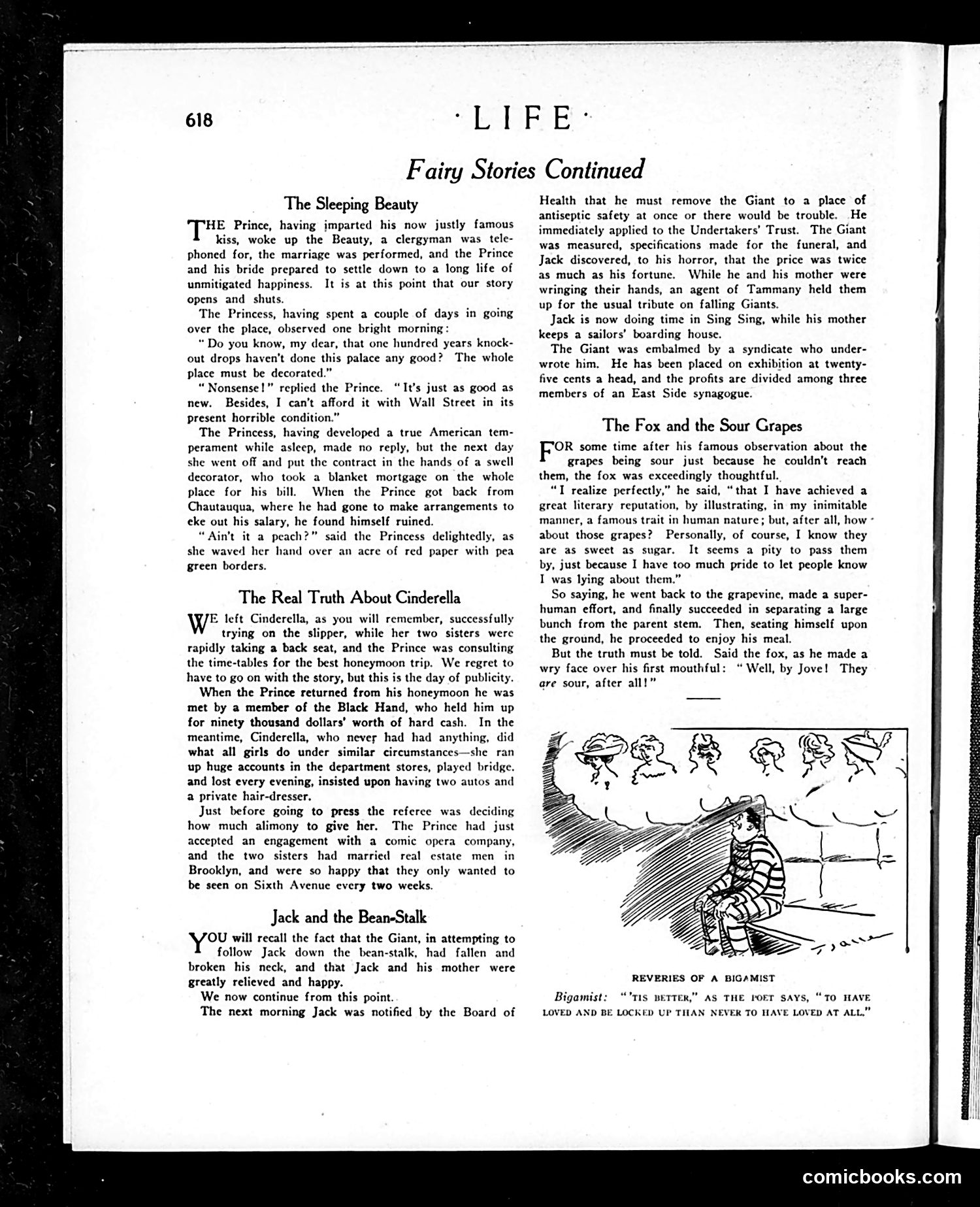
“ARE Fairy Stories Continued The Sleeping Beauty HE Prince, having imparted his now justly famous kiss, woke up the Beauty, a clergyman was tele- phoned for, the marriage was performed, and the Prince and his bride prepared to settle down to a long life of unmitigated happiness. It is at this point that our story opens and shuts. The Princess, having spent a couple of days in going over the place, observed one bright morning: “Do you know, my dear, that one hundred years knock- out drops haven't done this palace any good? The whole place must be decorated.” “Nonsense!” replied the Prince. “It’s just as good as new. Besides, I can’t afford it with Wall Street in its present horrible condition.” The Princess, having developed a true American tem- perament while asleep, made no reply, but the next day she went off and put the contract in the hands of a swell decorator, who took a blanket mortgage on the whole place for his bill, When the Prince got back from Chautauqua, where he had gone to make arrangements to eke out his salary, he found himself ruined. “Ain't it a peach?” said the Princess delightedly, as she waved her hand over an acre of red paper with pea green borders. The Real Truth About Cinderella E left Cinderella, as you will remember, successfully trying on the slipper, while her two sisters were rapidly taking a back seat, and the Prince was consulting the time-tables for the best honeymoon trip. We regret to have to go on with the story, but this is the day of publicity. When the Prince returned from his honeymoon he was met by a member of the Black Hand, who held him up for ninety thousand dollars’ worth of hard cash. In the meantime, Cinderella, who never had had anything, did what all girls do under similar circumstances—she ran up huge accounts in the department stores, played bridge. and lost every evening, insisted upon having two autos and a private hair-dresser. Just before going to press the referee was deciding how much alimony to give her. The Prince had just accepted an engagement with a comic opera company, and the two sisters had married real estate men in Brooklyn, and were so happy that they only wanted to be seen on Sixth Avenue every two weeks. Jack and the Bean-Stalk ‘OU will recall the fact that the Giant, in attempting to follow Jack down the bean-stalk, had fallen and broken his neck, and that Jack and his mother were greatly relieved and happy. We now continue from this point. The next morning Jack was notified by the Board of Health that he must remove the Giant to a place of antiseptic safety at once or there would be trouble. He immediately applied to the Undertakers’ Trust. The Giant was measured, specifications made for the funeral, and Jack discovered, to his horror, that the price was twice as much as his fortune. While he and his mother were wringing their hands, an agent of Tammany held them up for the usual tribute on falling Giants. Jack is now doing time in Sing Sing, while his mother keeps a sailors’ boarding house. The Giant was embalmed by a syndicate who under- wrote him. He has been placed on exhibition at twenty- five cents a head, and the profits are divided among three members of an East Side synagogue. The Fox and the Sour Grapes 'OR some time after his famous observation about the grapes being sour just because he couldn't reach them, the fox was exceedingly thoughtful. “TI realize perfectly,” he said, “that I have achieved a great literary reputation, by illustrating, in my inimitable manner, a famous trait in human nature; but, after all, how ~ about those grapes? Personally, of course, I know they are as sweet as sugar. It seems a pity to pass them by, just because I have too much pride to let people know I was lying about them.” So saying, he went back to the grapevine, made a super- human effort, and finally succeeded in separating a large bunch from the parent stem. Then, seating himself upon the ground, he proceeded to enjoy his meal. But the truth must be told. Said the fox, as he made a wry face over his first mouthful: “ Well, by Jove! They are sour, after all!” REVERIES OF A BIGAMIST Bigamist: “tis weTTER,” AS THE POET SAYS, “TO HAVE LOVED AND BE LOCKED UP THAN NEVER TO HAVE LOVED AT ALL.” comicbooks.com