
Life, 1913-10-09 · page 11 of 44
Life — October 9, 1913 — page 11: what you’re looking at
What you’re looking at
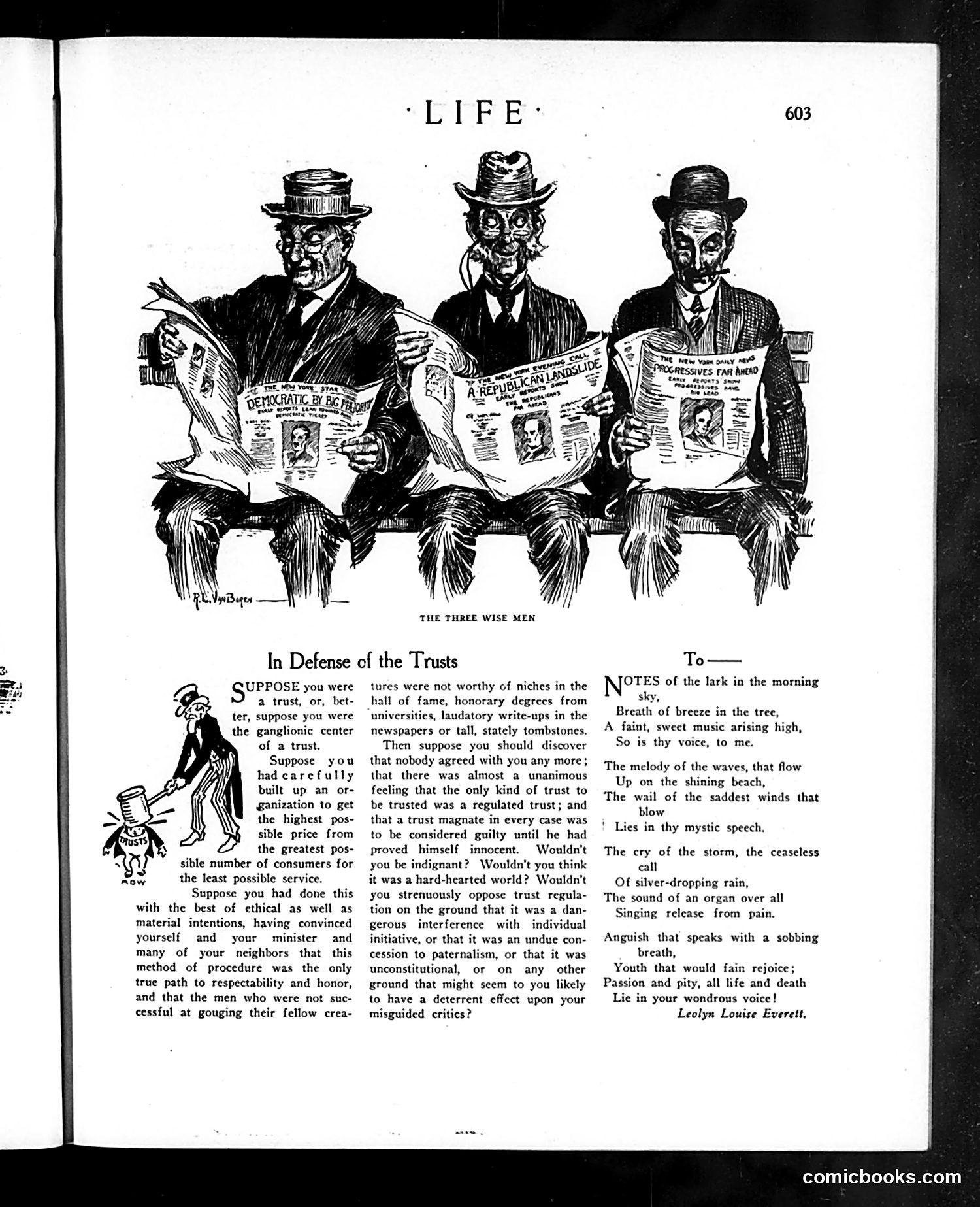
This editorial cartoon depicts three demonic-faced figures in suits reading newspapers with headlines about "Democratic," "Republican," and "Progressive" platforms. The grotesque caricatures suggest these political factions are corrupt or dishonest. The accompanying article, "In Defense of the Trusts," argues that trusts (large corporate monopolies) deserve regulatory oversight rather than blind opposition. The author contends that assuming all trusts are inherently guilty is unfair, and that regulation—not hysteria—should guide policy. The cartoon likely mocks politicians across party lines for exploiting anti-trust sentiment for political gain rather than pursuing genuine reform. The "three wise men" reference is ironic: these figures represent political hypocrisy rather than wisdom, reading their preferred narratives while advancing narrow partisan interests over genuine public welfare.
📄 Transcribed text from this page (OCR, searchable)
Machine-transcribed from the original scan — historical spelling and the odd misread are preserved.
THE THREE WISE MEN In Defense of the Trusts SUEFOSE you were a trust, or, bet- ter, suppose you were the ganglionic center of a trust. Suppose you had carefully built up an or- ganization to get the highest pos- sible price from the greatest pos- sible number of consumers for the least possible service. Suppose you had done this with the best of ethical as well as material intentions, having convinced yourself and your minister and many of your neighbors that this method of procedure was the only true path to respectability and honor, and that the men who were not suc- cessful at gouging their fellow crea- tures were not worthy of niches in the hall of fame, honorary degrees from “universities, laudatory write-ups in the newspapers or tall, stately tombstones. Then suppose you should discover that nobody agreed with you any more; that there was almost a unanimous feeling that the only kind of trust to be trusted was a regulated trust; and that a trust magnate in every case was to be considered guilty until he had proved himself innocent. Wouldn't you be indignant? Wouldn't you think it was a hard-hearted world? Wouldn't you strenuously oppose trust regula- tion on the ground that it was a dan- gerous interference with individual initiative, or that it was an undue con- cession to paternalism, or that it was unconstitutional, or on any other ground that might seem to you likely to have a deterrent effect upon your misguided critics? To NOTES of the lark in the morning Breath of breeze in the tree, A faint, sweet music arising high, So is thy voice, to me. The melody of the waves, that flow Up on the shining beach, The wail of the saddest winds that blow ' Lies in thy mystic speech, The cry of the storm, the ceaseless call Of silver-dropping rain, The sound of an organ over all Singing release from pain. Anguish that speaks with a sobbing breath, Youth that would fain rejoice; Passion and pity, all life and death Lie in your wondrous voice! Leolyn Louise Everett, comicbooks.com