
Life, 1913-10-09 · page 28 of 44
Life — October 9, 1913 — page 28: what you’re looking at
What you’re looking at
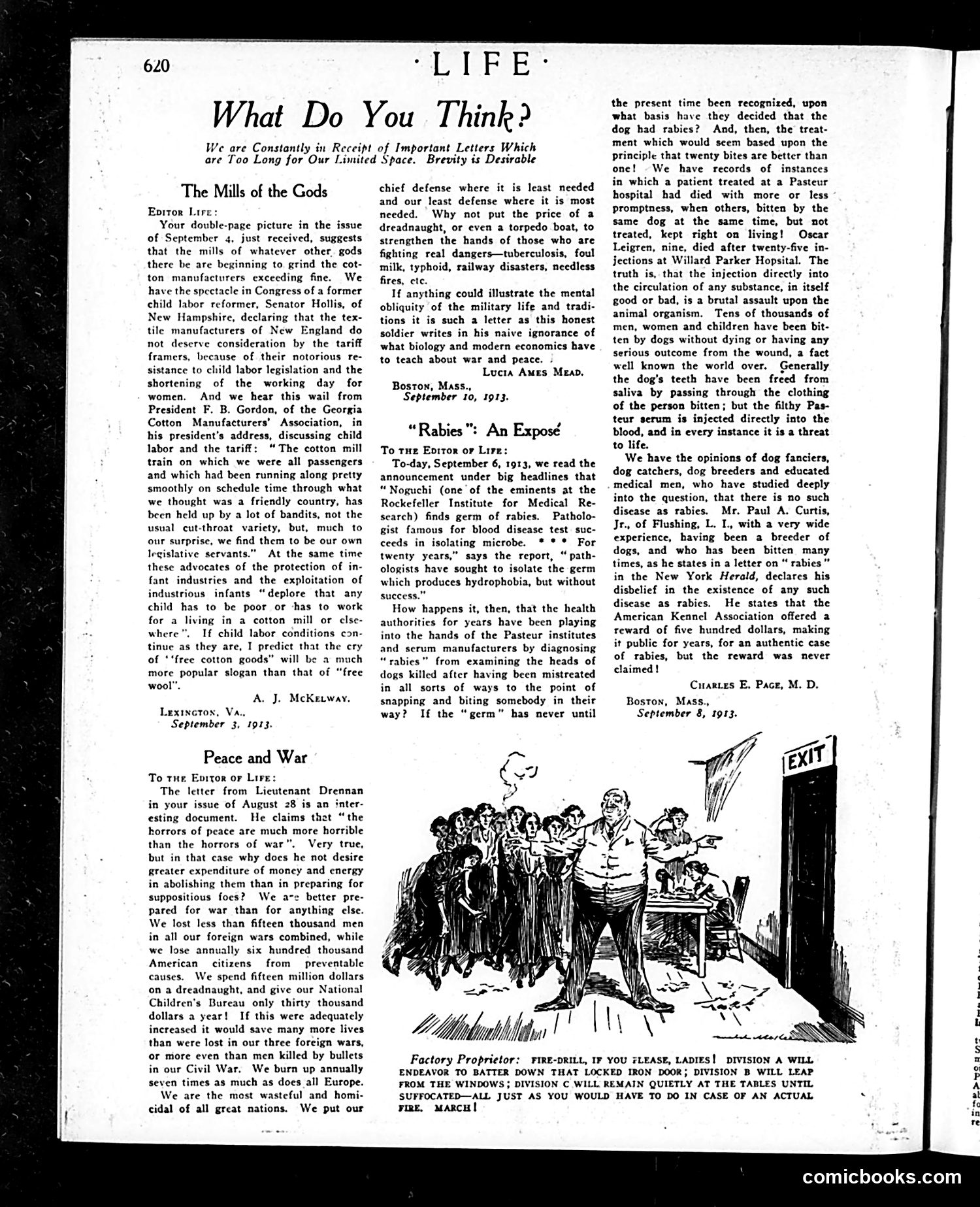
This page contains a readers' letters section ("What Do You Think?") with three letters addressing contemporary social and political issues. **"The Mills of the Gods"** criticizes cotton manufacturers' hypocrisy: they lobby against tariff protections while simultaneously exploiting child labor in their mills. The writer notes that Senator Hollis and Georgia Cotton Manufacturers' Association president F.B. Gordon both deplore child poverty—yet their industry depends on it. The letter sarcastically references their "friendly country" being "held up by bandits" (lawmakers), attacking their self-serving contradictions. **"Peace and War"** argues for redirecting military spending toward public health. The writer disputes Lieutenant Drennan's claim that "horrors of peace" exceed wartime horrors, pointing out America spends $15 million on a dreadnaught while allocating only $30,000 annually to the Children's Bureau—despite 600,000 annual preventable deaths versus minimal foreign war casualties. **"Rabies": An Exposé** appears to begin discussing Rockefeller Institute researcher Noguchi's rabies discovery but is cut off mid-paragraph. The cartoon (bottom) depicts factory safety, though details are unclear without full context.
📄 Transcribed text from this page (OCR, searchable)
Machine-transcribed from the original scan — historical spelling and the odd misread are preserved.
ge) bl ba) id at What Do You Think? We are Constantly in Receipt of Important Letters Which are Too Long for Our Limited Space. Brevity is Desirable The Mills of the Gods Epitor Lire: Your double-page picture in the issue of September 4, just received, suggests that the mills of whatever other gods there be are beginning to grind the cot- ton manufacturers exceeding fine. We have the spectacle in Congress of a former child labor reformer, Senator Hollis, of New Hampshire, declaring that the tex- tile manufacturers of New England do not deserve consideration by the tariff framers, because of their notorious re- sistance to child labor legislation and the shortening of the working day for women. And we hear this wail from President F. B. Gordon, of the Georgia Cotton Manufacturers’ Association, in his president's address, discussing child labor and the tariff: “ The cotton mill train on which we were all passengers and which had been running along pretty smoothly on schedule time through what we thought was a friendly country, has been held up by a lot of bandits, not the usual cut-throat variety, but, much to our surprise, we find them to be our own legislative servants.” At the same time these advocates of the protection of in- fant industries and the exploitation of industrious infants “deplore that any child has to be poor or ‘has to work for a living in a cotton mill or clse- where". If child labor conditions con- tinue as they are, I predict that the cry of ‘‘free cotton goods” will be a much more popular slogan than that of “free wool”. A. J. McKeuway. Lexixctox, Va.. September 3, 1913. Peace and War To tHe Evitor or Liv: The letter from Lieutenant Drennan in your issue of August 28 is an inter- esting document. He claims thet “the horrors of peace are much more horrible than the horrors of war". Very true, but in that case why does he not desire greater expenditure of money and energy in abolishing them than in preparing for suppositious foes? We are better pre- pared for war than for anything else. We lost less than fifteen thousand men in all our foreign wars combined, while we lose annually six hundred thousand American citizens from preventable causes. We spend fifteen million dollars on a dreadnaught, and give our National Children’s Bureau only thirty thousand dollars a year! If this were adequately increased it would save many more lives than were lost in our three foreign wars, or more even than men killed by bullets in our Civil War. We burn up annually seven times as much as does all Europe. We are the most wasteful and homi- cidal of all great nations. We put our chief defense where it is least needed and our least defense where it is most needed. Why not put the price of a dreadnaught, or even a torpedo boat, to strengthen the hands of those who are fighting real dangers—tuberculosis, foul milk, typhoid, railway disasters, needless fires, etc. If anything could illustrate the mental obliquity of the military life and tradi- tions it is such a letter as this honest soldier writes in his naive ignorance of what biology and modern economics have to teach about war and peace. - Lucta Ames Mean. Boston, Mass., September 10, 1913. “Rabies”: An Exposé To tHe Eortor or Lire: To-day, September 6, 1913, we read the announcement under big headlines that “Noguchi (one of the eminents at the Rockefeller Institute for Medical Re- search) finds germ of rabies. Patholo- gist famous for blood disease test suc- ceeds in isolating microbe. * ° * For twenty years,” says the report, “ path- ologists have sought to isolate the germ which produces hydrophobia, but without success.” How happens it, then, that the health authorities for years have been playing into the hands of the Pasteur institutes and serum manufacturers by diagnosing “rabies from examining the heads of dogs killed after having been mistreated in all sorts of ways to the point of snapping and biting somebody in their way? If the “germ” has never until Lddddbeabllbas!' the present time been recognized, upon what basis have they decided that the dog had rabies? And, then, the treat- ment which would seem based upon the principle that twenty bites are better than one! We have records of instances in which a patient treated at a Pasteur hospital had died with more or less Promptness, when others, bitten by the same dog at the same time, but not treated, kept right on living! Oscar Leigren, nine, died after twenty-five in- jections at Willard Parker Hopsital. The truth is, that the injection directly into the circulation of any substance, in itself good or bad, is a brutal assault upon the animal organism. Tens of thousands of men, women and children have been bit- ten by dogs without dying or having any serious outcome from the wound, a fact well known the world over. Generally the dog’s teeth have been freed from saliva by passing through the clothing of the person bitten; but the filthy Pas- teur serum is injected directly into the blood, and in every instance it is a threat to life. We have the opinions of dog fanciers, dog catchers, dog breeders and educated medical men, who have studied deeply into the question, that there is no such disease as rabies. Mr. Paul A. Curtis, Jr., of Flushing, L. 1, with a very wide experience, having been a breeder of dogs, and who has been bitten many times, as he states in a letter on “ rabies” in the New York Herald, declares his disbelief in the existence of any such disease as rabies. He states that the American Kennel Association offered a reward of five hundred dollars, making it public for years, for an authentic case of rabies, but the reward was never claimed! Cuartes E, Pace, M. D. Boston, Mass., September 8, 1913. Factory Proprietor: FIRE-DRILL, IF YOU 7LEASE, LADIES! DIVISION A WILL ENDEAVOR TO BATTER DOWN THAT LOCKED IRON DOOR; DIVISION B WILL LEAP FROM THE WINDOWS ; DIVISION C WILL REMAIN QUIETLY AT THE TABLES UNTIL SUFFOCATED—ALL JUST AS YOU WOULD HAVE TO DO IN CASE OF AN ACTUAL FIRE, MARCH! comicbooks.com