
Life, 1913-10-09 · page 21 of 44
Life — October 9, 1913 — page 21: what you’re looking at
What you’re looking at
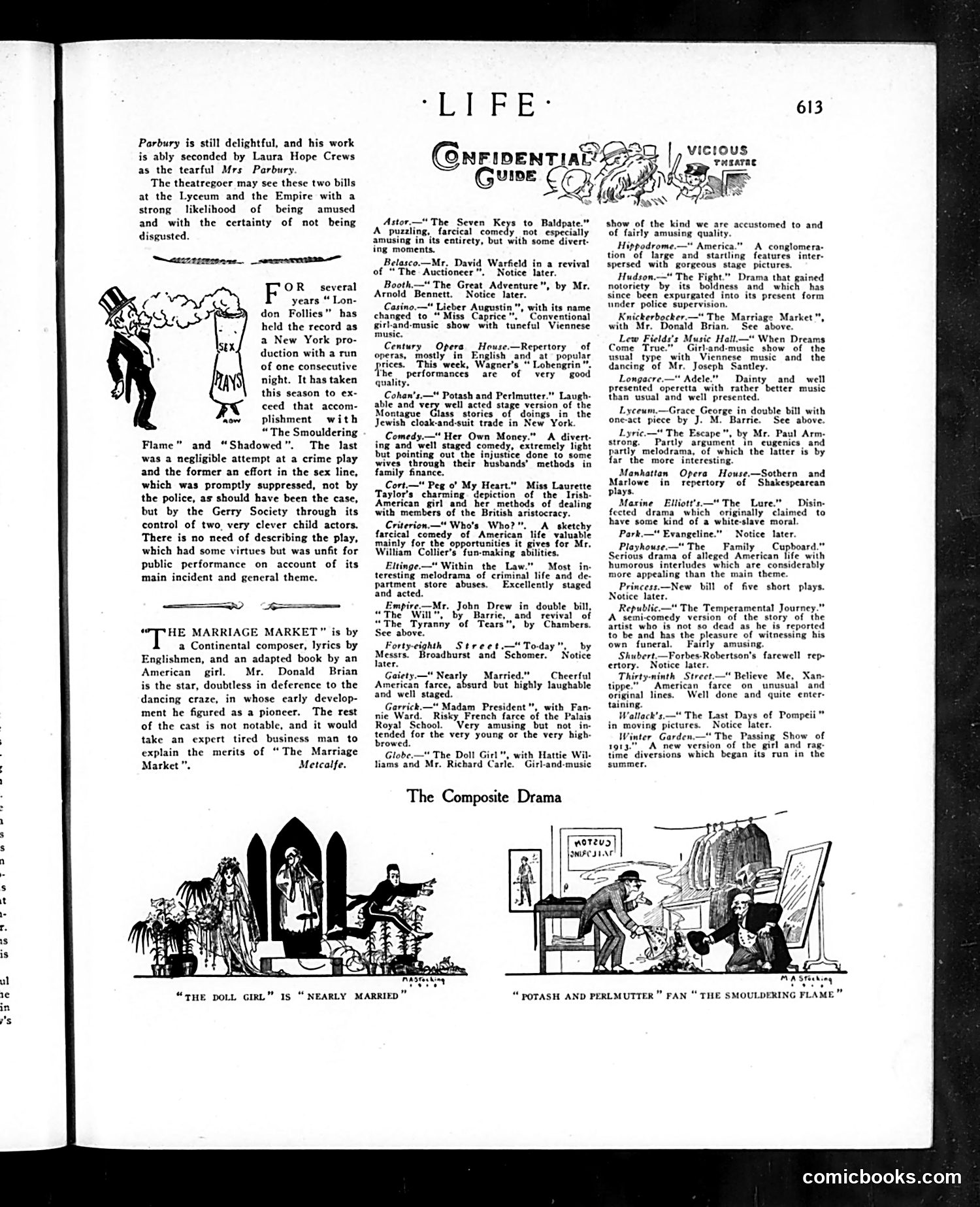
This page from **Life magazine** (a satirical publication, not the photo magazine) reviews theatrical productions on Broadway, circa early 1900s. The text criticizes various shows with dry wit typical of the era's theater criticism. The key satirical point appears in the opening paragraph about "London Follies" and "The Smouldering Flame"—plays so poorly received they lasted only one night. The reviewer notes that "The Smouldering Flame" was suppressed not by police (who should have acted) but by the **Gerry Society**, a child welfare organization, because it was a risqué "sex line" drama featuring child actors. This is satire: the reviewer is mocking both the play's indecency and society's selective censorship. The two cartoon illustrations at bottom appear to reference theatrical productions mentioned—"Nearly Married" and "Potash and Perlmutter"—depicting domestic and comic scenarios typical of period comedies. Overall, this is entertainment criticism employing irony to skewer theatrical mediocrity and moral hypocrisy.
📄 Transcribed text from this page (OCR, searchable)
Machine-transcribed from the original scan — historical spelling and the odd misread are preserved.
Parbury is still delightful, and his work is ably seconded by Laura Hope Crews as the tearful Mrs Parbury. The theatregoer may see these two bills at the Lyceum and the Empire with a strong likelihood of being amused and with the certainty of not being disgusted. erties reer OR | several years “ Lon- don Follies” has held the record as a New York pro- duction with a run of one consecutive night. It has taken this season to ex- ceed that accom- plishment with “The Smouldering Flame” and “Shadowed”. The last was a negligible attempt at a crime play and the former an effort in the sex line, which was promptly suppressed, not by the police, as should have been the case, but by the Gerry Society through its control of two, very clever child actors. There is no need of describing the play, which had some virtues but was unfit for public performance on account of its main incident and general theme. ‘now Ne HE MARRIAGE MARKET” is by a Continental composer, lyrics by Englishmen, and an adapted book by an American girl. Mr. Donald Brian is the star, doubtless in deference to the dancing craze, in whose early develop- ment he figured as a pioncer. The rest of the cast is not notable, and it would take an expert tired business man to explain the merits of “The Marriage Market”. Metcalfe. pa Fo le) og Cnrinentiat Gviee Astor.—" The Seven Keys to Baldpate.” A“ puzzling, farcical comedy not especially amusing in its entirety, but with some divert- ing moments. Belasco.—Mr. David Warfield in a revival of “The Auctioneer”. Notice later. Booth.—“ The Great Adventure”, by Mr. Arnold Bennett. Notice late ih Casino.—" Lieber Augustin”, with its name changed to “Miss Caprice ".’ Conventional girland-music show with tuneful Viennese music. Century Opera House.—Repertory of operas, mostly in English and at popular rices. This week, Wagner's “ Lohengrin”. he performances are of very good quality. Cohan’s.—" Potash and Perlmutter.” Laugh- able and very well acted stage version of the Montague Glass stories of doings in the Jewish cloak-and-suit trade in New York. Comedy.—" Her Own Money.” A divert: ing and well staged comedy, extremely Ii but pointing out the injustice done to some wives through their husbands’ methods in family finance. * Peg o' My Heart.” Miss Laurette charming depiction of the Irish- American girl and her methods of dealing with members of the British aristocracy. Criterion.—" Who's Who?". A sketchy farcical comedy of American life valuable mainly for the opportunities it gives for Mr. William Collier's fun-making abilities. Eltinge.—" Within the Law.” Most in- teresting melodrama of criminal life and de- partment store abuses. Excellently staged and acted. Empire. John Drew in double bill, The Will”, by Barrie, and revival of “The Tyranny of Tears", by Chambers. See above. Forty-eighth Messrs. later. Gaiety.—" Nearl Married.” Cheerful American farce, ‘absurd but highly laughable and well staged. _Garrick—" Madam President", with Fan nie Ward. Risky French farce of the Pal Royal School. Very amusing but not in- tended for the very young or the very high browed. Globe.—" The Doll Girl", with Hattie Wil- liams and Mr. Richard Carle. Girl-and-music Street.—"Today”, by Broadburst and Schomer. Notice The Composite Drama vicious rotgarae show of the kind we are accustomed to and of fairly amusing quality. Hippodrome.— America.” A conglomera- tion of large and startling features inter- spersed with gorgeous stage pictures. Hudson.—" The Fight.” Drama that gained notoriety by its boldness and which has since been expurgated into its present form under police supervision. Knickerbocker —“ The Marriage Market, with Mr. Donald Brian. See above. Lew Fields's Music Hall—" When Dreams ¢ "" Girland-music show of the usual type with Viennese music and the dancing of Mr. Joseph Santley. Longacre.—" Adele." Dainty and well presented operetta with rather better music than usual and well presented. Lyceum.—Grace George in double bill with one-act piece by J. M. Barrie. See above. Lyric. The Escape”, by Mr. Paul Arm. strong. Partly argument in eugenics and partly melodrama, of which the latter is by far the more interesting. Manhattan Opera House.—Sothern and Marlowe in repertory of Shakespearean plays. Maxine Eliiott's—" The Lure.” Disin- fected drama which originally claimed to have some kind of a white-slave moral. Park. Notice later. Playhouse —" The Family Cupboard." Serious drama of alleged American life with humorous interludes which are considerably more appealing than the main theme. Princess.—New bill of five short plays. Notice later. Republic.—" The Temperamental Journey.” A. semi-comedy version of the story of the artist who is not so dead as he is reported to be and has the pleasure of witnessing his own funeral, Fairly amusing. Shubert—Forbes-Robertson's farewell rep- ertory. Notice later. Thirty-ninth Strect—" Believe Me, Xan- tippe.” American farce on unusual and original lines. Well done and quite enter- taining. Wellack’s.—Y The Last. Days of Pompe in moving pictures. Notice later. Winter Garden.—" The Passing Show of 1913." A new version of the girl and rag- time diversions which began its run in the summer, “THE DOLL GIRL” IS “ NEARLY MARRIED” “ POTASH AND PERLMUTTER” FAN “ THE SMOULDERING FLAME comicbooks.com