
Life, 1913-10-09 · page 24 of 44
Life — October 9, 1913 — page 24: what you’re looking at
What you’re looking at
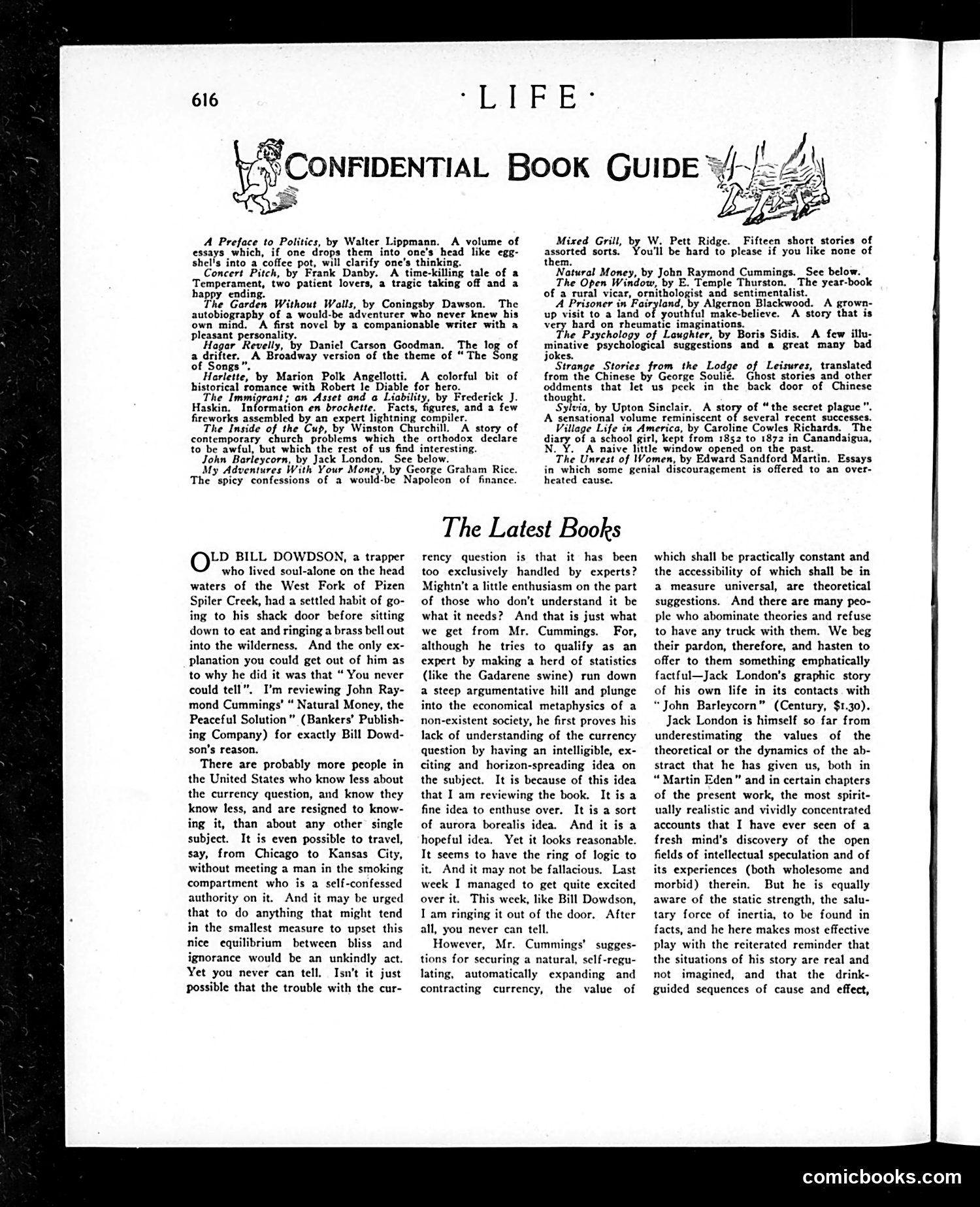
This is a **book review column**, not a cartoon page. It's a "Confidential Book Guide" listing new publications with brief critical commentary. The main review discusses **John Raymond Cummings' "Natural Money"** through a framing device: Old Bill Dowdson, a solitary trapper who rings a brass bell before eating without explaining why—a metaphor for the reviewer's own bewilderment about writing on currency economics. The satire is gentle: the reviewer admits most Americans (himself included) don't understand monetary policy and are comfortable with that ignorance. He suggests Cummings' book might illuminate the subject, but expresses skepticism—echoing Bill's "You never can tell" philosophy. Other listed books include works by **Jack London** (*John Barleycorn*, about alcohol) and **Upton Sinclair** (*Sylvia*, addressing venereal disease)—contemporaneous social-issue literature typical of Progressive Era publishing. The page reflects early-20th-century Life magazine's role as a forum for intellectual and political discourse, not primarily humor.
📄 Transcribed text from this page (OCR, searchable)
Machine-transcribed from the original scan — historical spelling and the odd misread are preserved.
A Preface to Politics, by Walter Lippmann. A volume of essays which, if one drops them into one’s head like egg- shel's into a coffee pot, will clarify one’s thinking. Concert Pitch, by Frank Danby. A time-killing tale of a Temperament, two patient lovers, a tragic taking off and a happy ending. The Garden Without Walls, by Coningsby Dawson. The autobiography of a would-be adventurer who never knew his own mind. <A first novel by a companionable writer with a pleasant personality. Hager Revelly, by Daniel Carson Goodman. A Broadway version of the theme of “ The of Songs”. Harlette, by Marion Polk Angelotti. A colorful bit of historical romance with Robert le Diable for hero. The Immigrant; an Asset and a Liability, by Frederick J. Haskin, Information en brochette, Facts, figures, and a few fireworks assembled by an expert lightning compiler. The Inside of the Cup, by Winston Churchill. A story of contemporary church problems which the orthodox declare to be awful, but which the rest of us find interesting. John Barleycorn, by Jack London. See below. The log of a drifter. ong: My Adventures With Your Money, by George Graham Rice. The spicy confessions of a would-be Napoleon of finance. Mixed Grill, by assorted sorts. them. Natural Money, by John Raymond Cummings. See below. The Open Window, by E. Temple Thurston. The year-book of a rural vicar, ornithologist and sentimentalist. A Prisoner in Fairyland, by Algernon Blackwood. A grown- up visit to a land of youthful make-believe. A story that is very hard on rheumatic imaginations. The Psychology of Laughter, by Boris Sidis. A few illu- minative ‘psychological suggestions and a great many bad jokes. i serange \Storiés: fede “vke Lodga of Lelawres.. translated from the Chinese by George Soulié. Ghost stories and other oddments that let us peck in the back door of Chinese Sa Sylvia, by Upton Sinclair. A story of “the secret plague”. A sensational volume reminiscent of several recent successes. Village Life in America, by Caroline Cowles Richards. The diary of a school girl, kept from 1852 to 1872 in Canandaigua, N. XY. A naive little window opened on the past. The Unrest of Women, by Edward Sandford Martin. Essays in which some genial discouragement is offered to an over- heated cause. W. Pett Ridge. Fifteen short stories of ‘ou'll be hard to please if you like none of LD BILL DOWDSON, a trapper who lived soul-alone on the head waters of the West Fork of Pizen Spiler Creek, had a settled habit of go- ing to his shack door before sitting down to eat and ringing a brass bell out into the wilderness. And the only ex- planation you could get out of him as to why he did it was that “ You never could tell”. I’m reviewing John Ray- mond Cummings’ “ Natural Money, the Peaceful Solution” (Bankers’ Publish- ing Company) for exactly Bill Dowd- son’s reason. There are probably more people in the United States who know less about the currency question, and know they know less, and are resigned to know- ing it, than about any other single subject. It is even possible to travel, say, from Chicago to Kansas City, without meeting a man in the smoking compartment who is a self-confessed authority on it. And it may be urged that to do anything that might tend in the smallest measure to upset this nice equilibrium between bliss and ignorance would be an unkindly act. Yet you never can tell, Isn't it just possible that the trouble with the cur- The Latest Books rency question is that it has been too exclusively handled by experts? Mightn’t a little enthusiasm on the part of those who don’t understand it be what it needs? And that is just what we get from Mr. Cummings. For, although he tries to qualify as an expert by making a herd of statistics (like the Gadarene swine) run down a steep argumentative hill and plunge into the economical metaphysics of a non-existent society, he first proves his lack of understanding of the currency question by having an intelligible, ex- citing and horizon-spreading idea on the subject. It is because of this idea that I am reviewing the book. It is a fine idea to enthuse over. It is a sort of aurora borealis idea. And it is a hopeful idea. Yet it looks reasonable. It seems to have the ring of logic to it. And it may not be fallacious. Last week I managed to get quite excited over it. This week, like Bill Dowdson, Tam ringing it out of the door. After all, you never can tell. However, Mr. Cummings’ sugges- tions for securing a natural, self-regu- lating, automatically expanding and contracting currency, the value of which shall be practically constant and the accessibility of which shall be in a measure universal, are theoretical suggestions. And there are many peo- ple who abominate theories and refuse to have any truck with them. We beg their pardon, therefore, and hasten to offer to them something emphatically factful—Jack London's graphic story of his own life in its contacts with “John Barleycorn” (Century, $1.30). Jack London is himself so far from underestimating the values of the theoretical or the dynamics of the ab- stract that he has given us, both in “ Martin Eden” and in certain chapters of the present work, the most spirit- ually realistic and vividly concentrated accounts that I have ever seen of a fresh mind’s discovery of the open fields of intellectual speculation and of its experiences (both wholesome and morbid) therein. But he is equally aware of the static strength, the salu- tary force of inertia, to be found in facts, and he here makes most effective play with the reiterated reminder that the situations of his story are real and not imagined, and that the drink- guided sequences of cause and effect, comicbooks.com