
A complete issue · 43 pages · 1913
Life — September 25, 1913
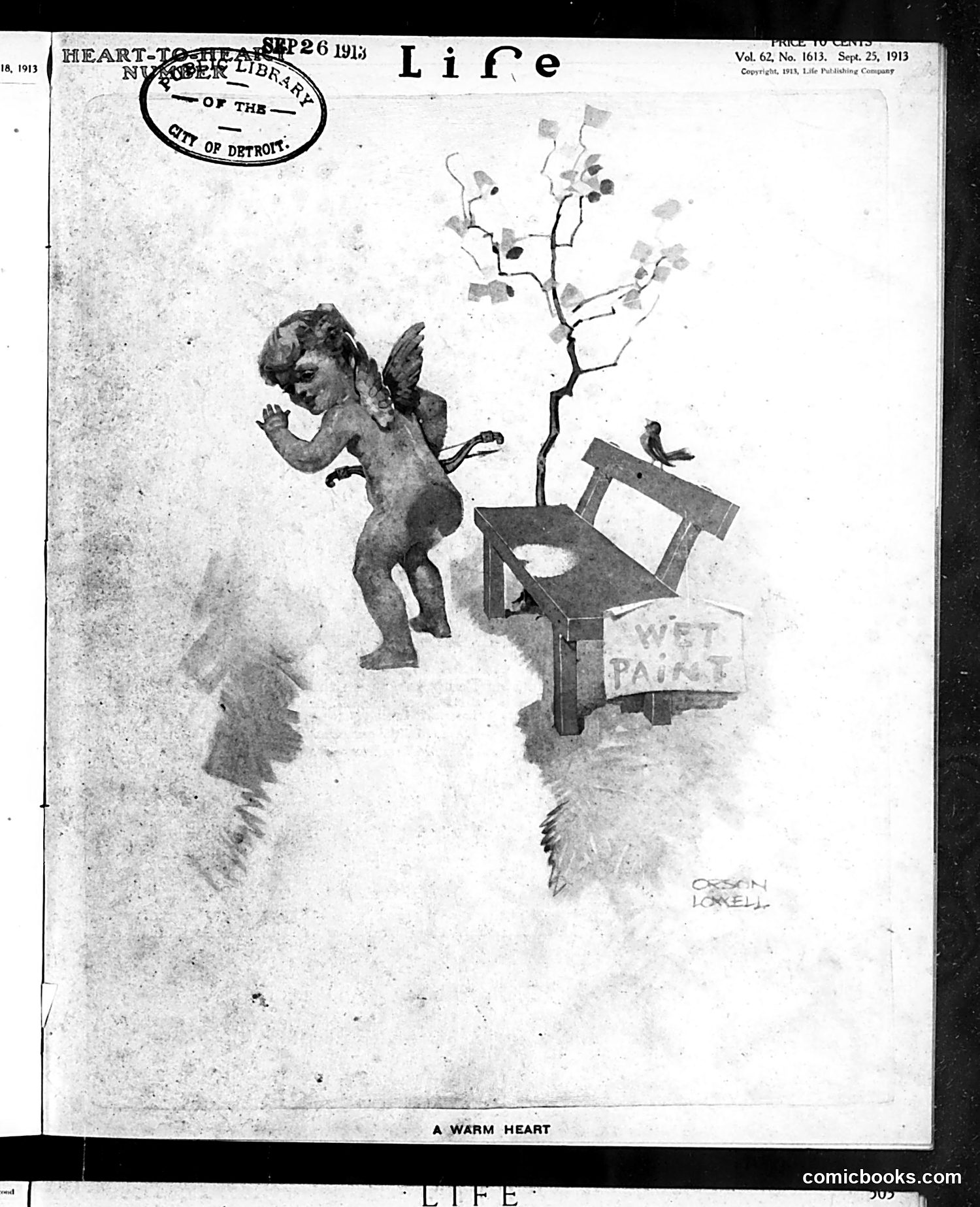
This illustration by Orson Lowell depicts Cupid (the winged cherub) tending a "Wet Paint" sign attached to a wooden structure or sign. The title "A Warm Heart" suggests ironic commentary on romantic sentiment or affection. The image likely satirizes sentimentality or love in early 20th-century culture. The "wet paint" warning could represent caution about romantic gestures—suggesting that expressions of love or affection require careful handling, or that romantic warmth can be messy or problematic. The cherub's attentiveness to the mundane warning sign undermines traditional romantic imagery, humorously contrasting the ideal of love with practical reality. The specific contemporary reference remains unclear without additional context.
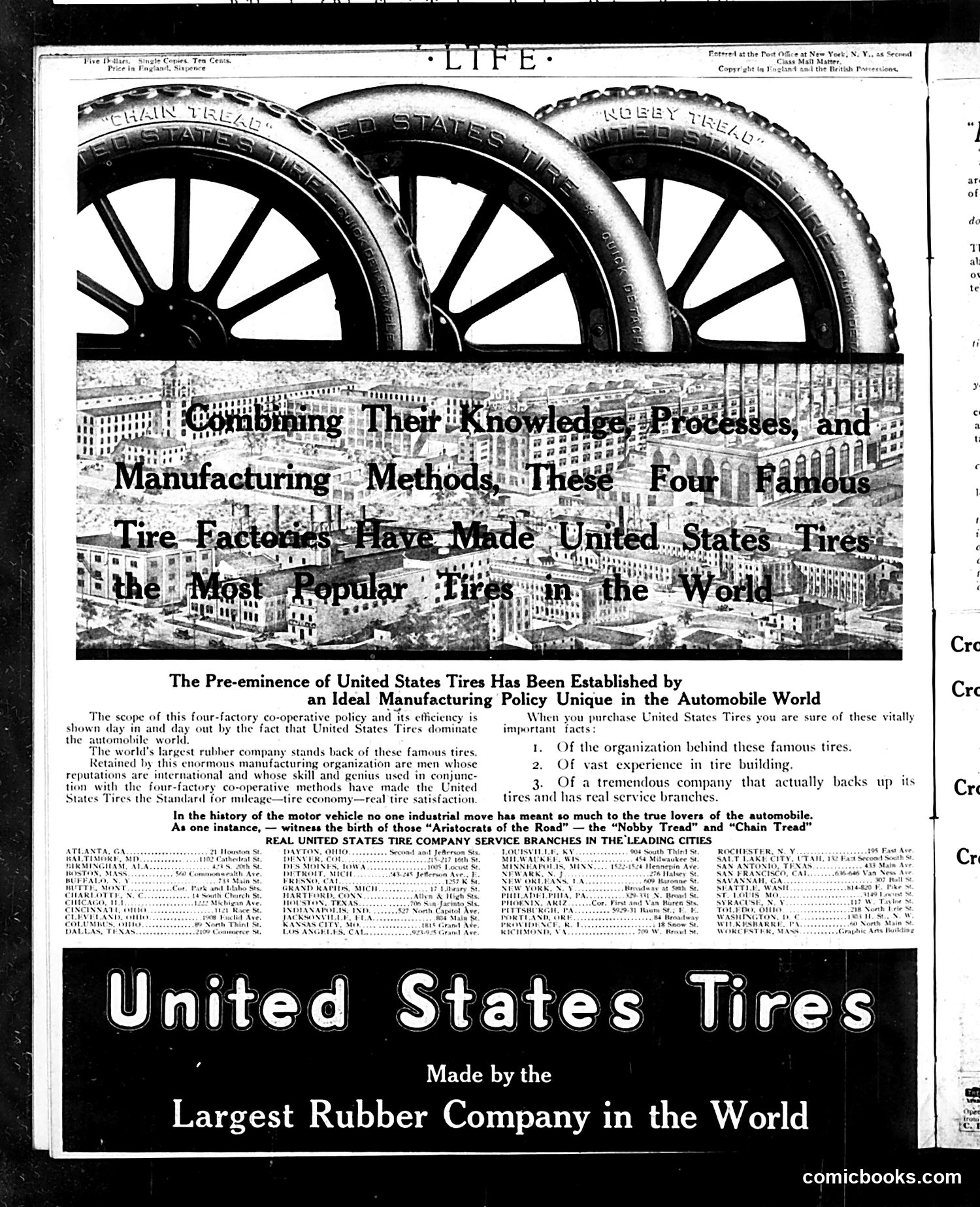
This page is **primarily advertising**, not satire or political commentary. It's a United States Tires company advertisement from *Life* magazine promoting their tire manufacturing dominance. The top image shows three large tires labeled "Chain Tread," "Smooth Tread," and "Nobby Tread"—different tire designs—displayed above an urban cityscape. The text claims United States Tires' four factories use superior "knowledge, processes, and manufacturing methods" making them "the most popular tires in the world." Below is a list of US company service branches in major cities, followed by the tagline: "United States Tires, Made by the Largest Rubber Company in the World." This is straightforward product promotion with no satirical content—typical early automotive-era advertising emphasizing American industrial superiority and manufacturing prowess.
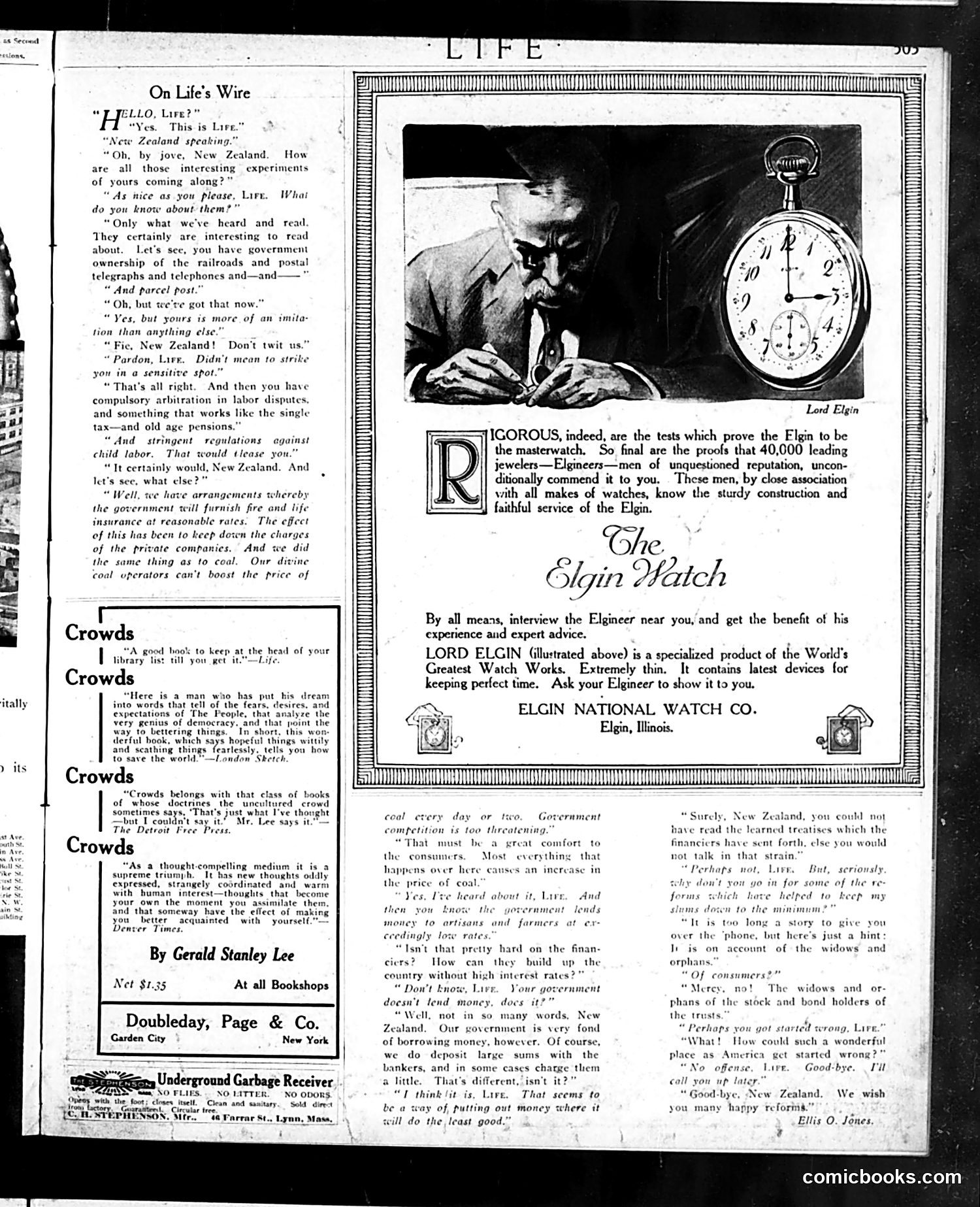
This page consists primarily of **advertising and editorial content rather than political satire**. The main feature is a dialogue called "On Life's Wire" between two speakers discussing New Zealand's government experiments with railways, postal services, and labor arbitration. One speaker (appearing to be from New Zealand) defends their nation's interventionist approach against the other's skepticism. Below this is a book advertisement for *Crowds* by Gerald Stanley Lee, and a large **Elgin Watch advertisement** featuring an illustration of a pocket watch and a man examining it. The "Life's Wire" dialogue reflects early 20th-century debates about government ownership versus private enterprise — a genuine policy discussion rather than satirical commentary. The page illustrates Life magazine's mix of editorial commentary and commercial advertising typical of the era.
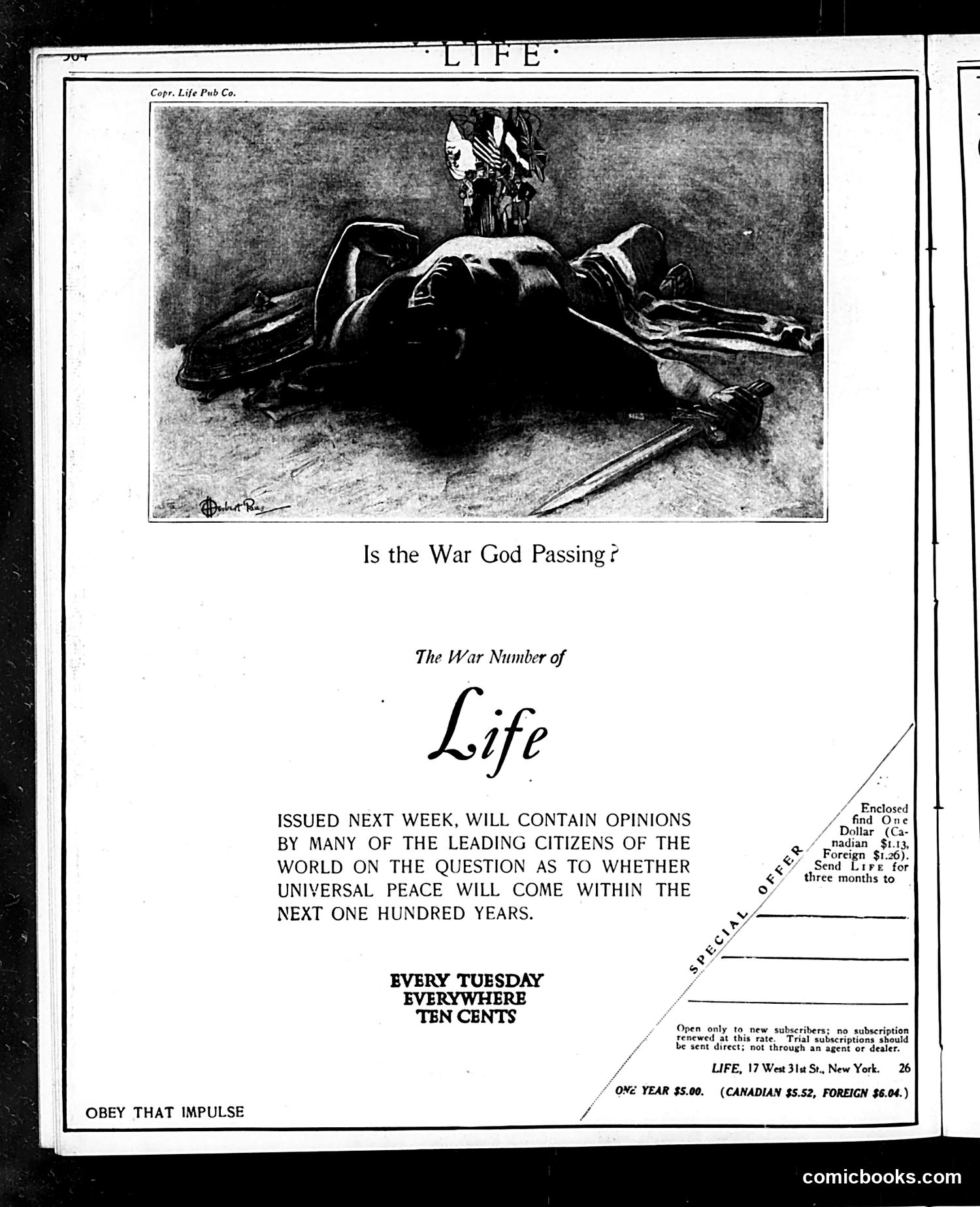
This is a Life magazine advertisement promoting their "War Number," likely from World War I era (given the historical style and reference to "universal peace"). The stark illustration shows a fallen soldier lying dead with a sword beside him and what appears to be a divine or angelic figure above—visualizing the question "Is the War God Passing?" The image sardonically contrasts the carnage of warfare with hopes for peace. The accompanying text announces that the next issue will feature opinions from "leading citizens of the world" on whether universal peace might arrive within the next hundred years—a pointed commentary on wartime optimism and the distance between battlefield reality and political idealism. The advertisement uses the horror of war imagery to sell the magazine to readers concerned with these urgent questions.
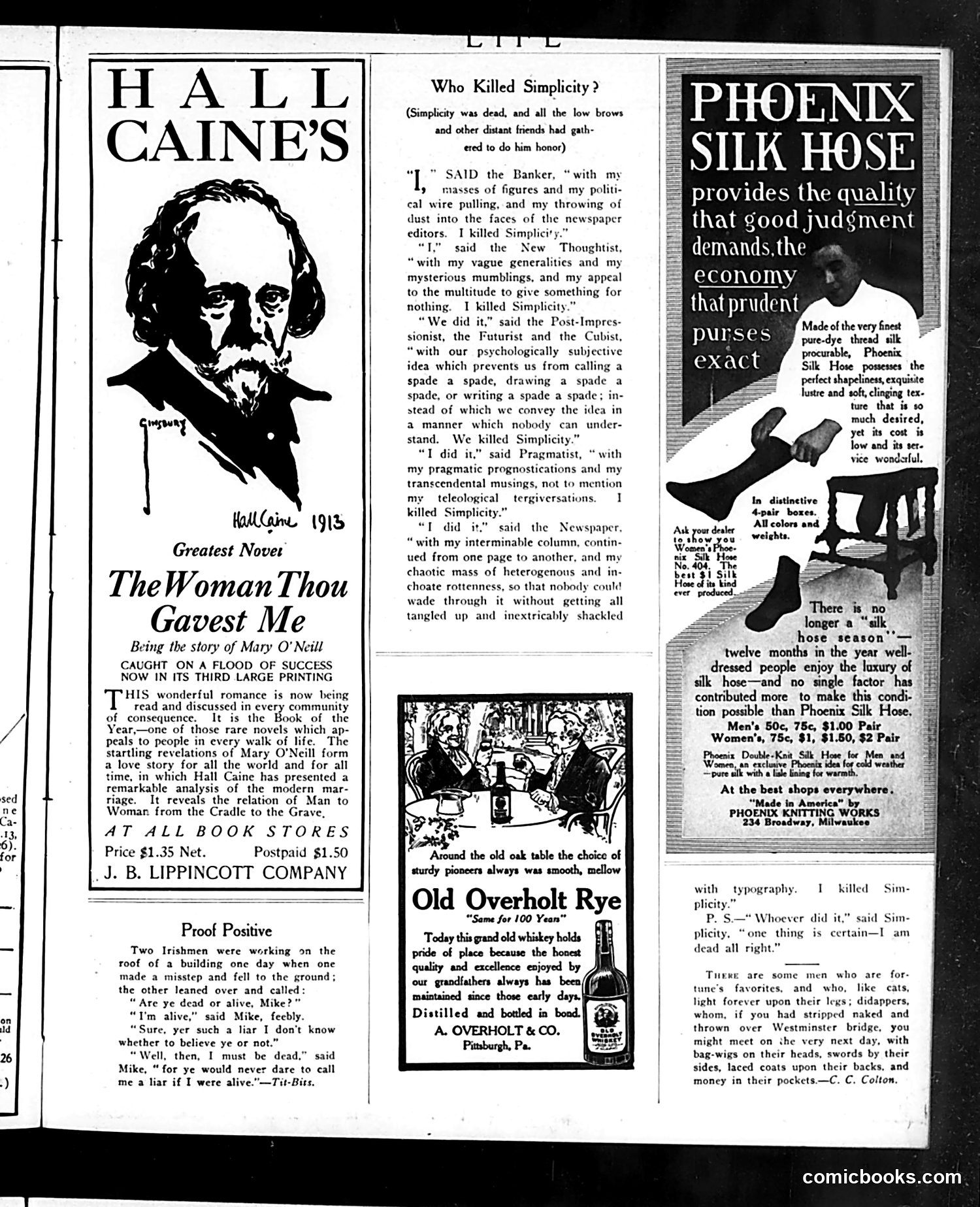
This page is **primarily advertising** (Phoenix Silk Hose, Old Overholt Rye) with limited editorial content. The main satirical piece is "Who Killed Simplicity?" featuring a portrait of **Hall Caine** (prominent 1915 novelist). Various figures—a Banker, Poet, Post-Impressionist, Pragmatist, and Newspaper Editor—each humorously claim responsibility for killing "Simplicity" through their respective professions' excesses: financial manipulation, vague generalities, artistic obscurity, and journalistic chaos. The satire mocks **early 20th-century intellectual and cultural trends** that the magazine viewed as overwrought and pretentious. The joke suggests that modern society (banking, art, philosophy, journalism) had abandoned straightforward simplicity for needless complexity. The "Proof Positive" story about workers on a building is a brief humorous anecdote about mistaking a corpse for a living coworker.
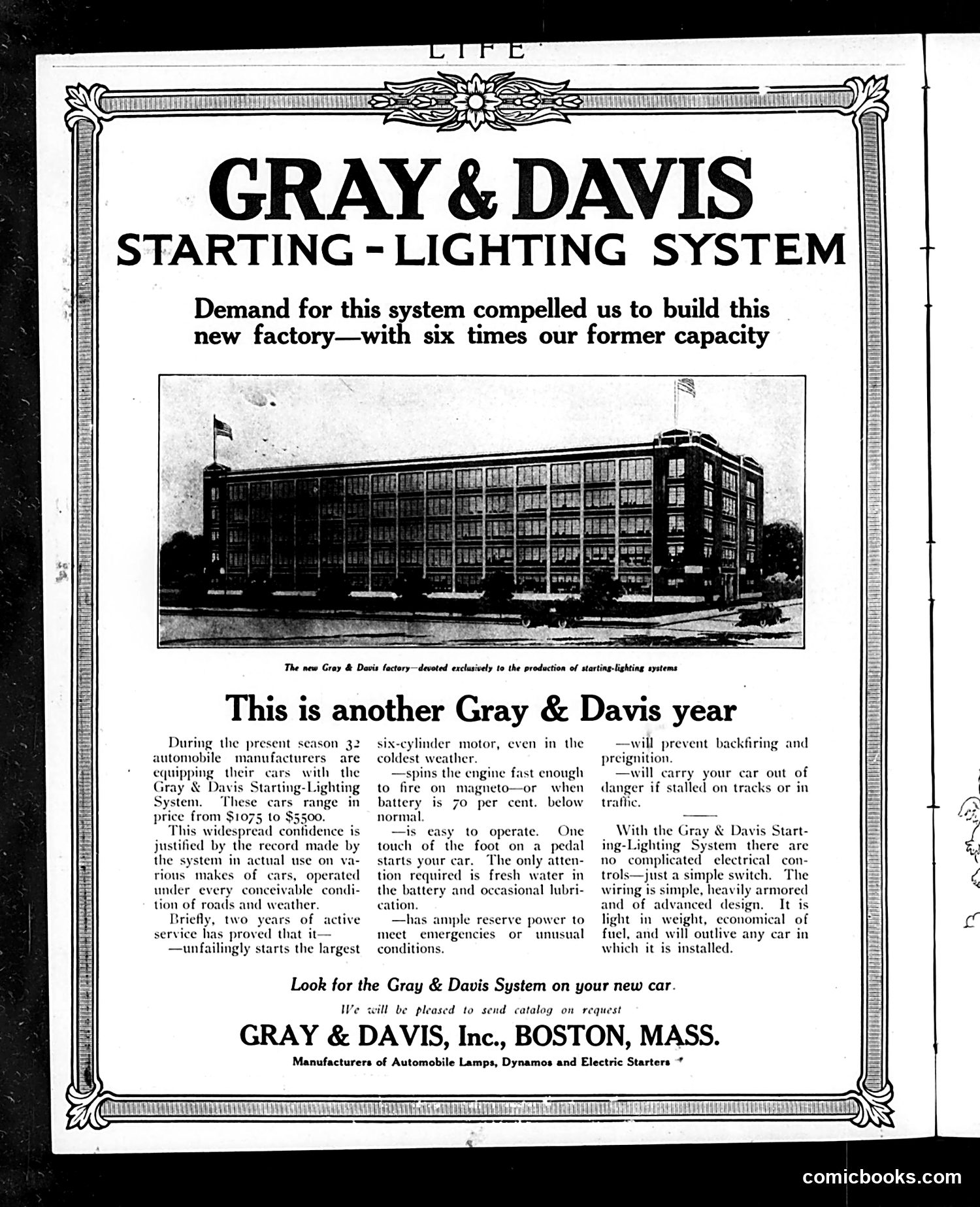
This is **not a cartoon or satire page**—it's a straightforward **automobile advertisement** for the Gray & Davis Starting-Lighting System, a manufacturer of car electrical components based in Boston, Massachusetts. The page features a photograph of the company's new factory building and describes their starter-lighting system's reliability in cars. It emphasizes practical benefits: easy cold-weather starting, simple operation via a foot pedal, and uncomplicated wiring. The phrase "This is another Gray & Davis year" suggests the company is claiming market success and widespread adoption among automobile manufacturers during the era shown (likely 1910s-1920s, based on the typeface and design style). There is no political or social satire present—this is period advertising.
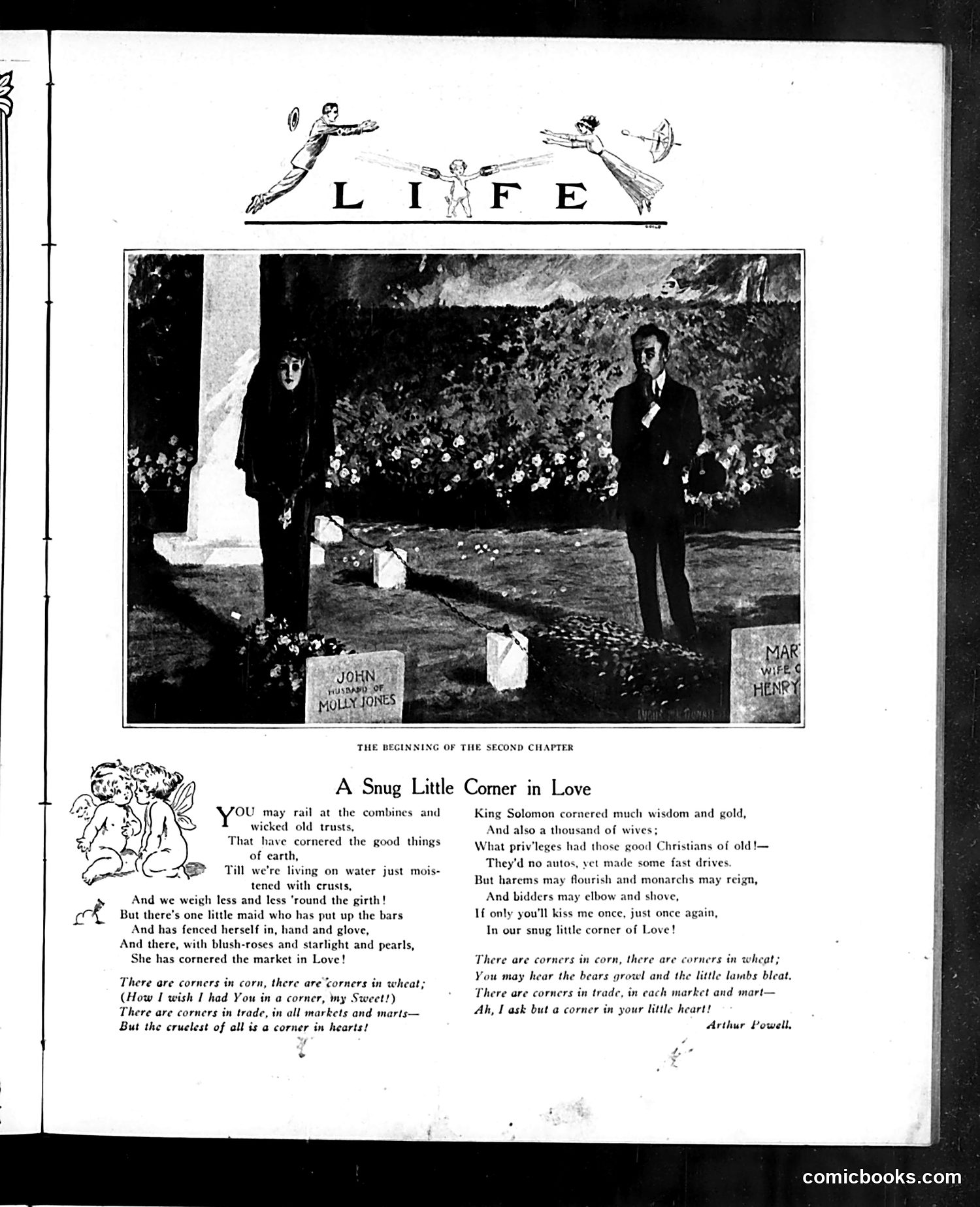
This page from *Life* magazine illustrates "The Beginning of the Second Chapter" of what appears to be a serialized story or comic narrative. The black-and-white photograph shows two men in dark suits standing in a cemetery beside gravestones marked "John" and "Mary Wife of Henry," with a large crowd visible in the background. The accompanying poem by Arthur Powell celebrates having "cornered the market in Love"—securing a romantic partner despite life's difficulties. The satire appears to mock romantic sentiment and the idea of romantic exclusivity, using the cemetery setting ironically to juxtapose death with love's supposed triumph. The text contrasts worldly "corners" (in commerce, agriculture, trade) with an emotional "corner in your little heart."
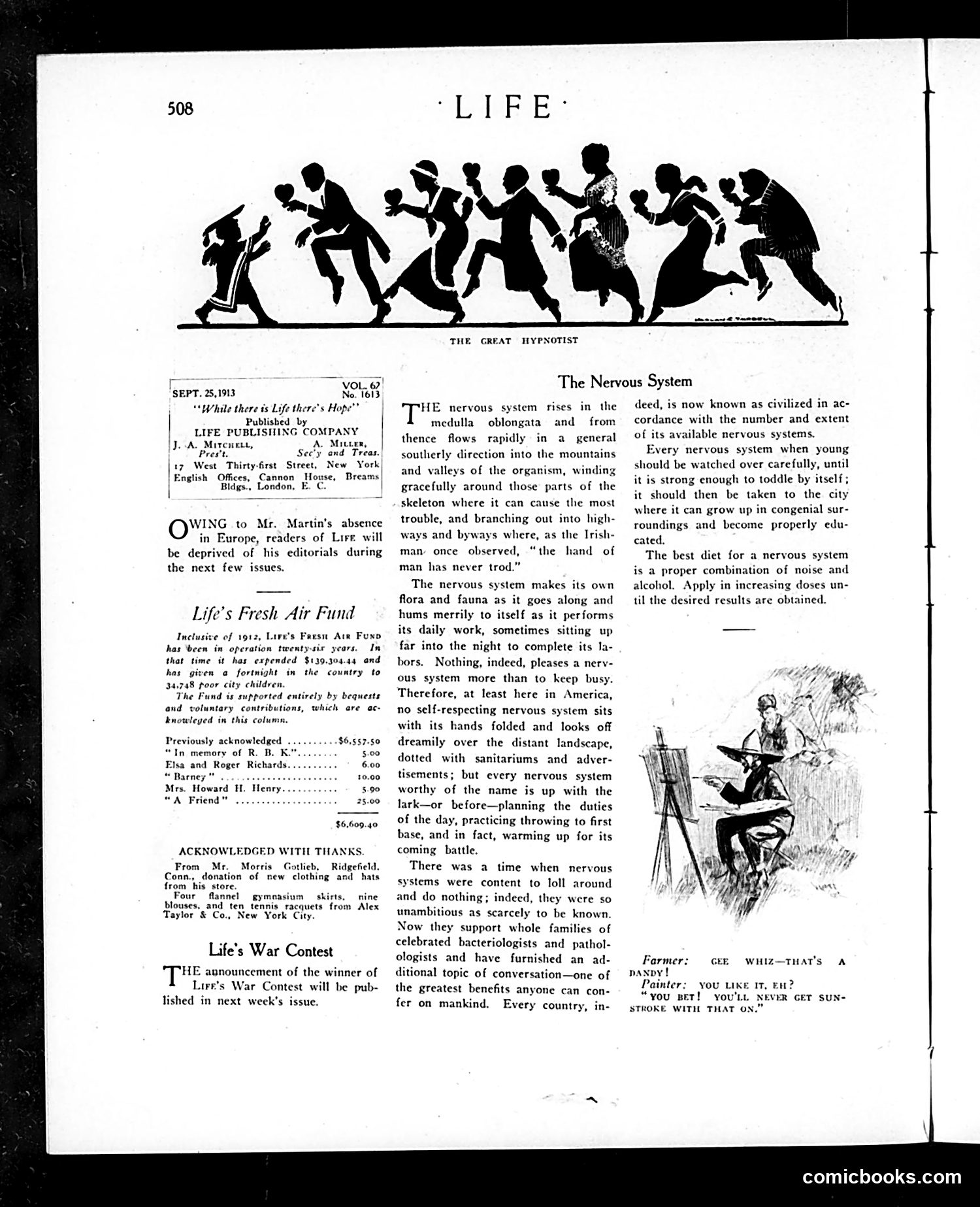
The silhouette cartoon at the page top depicts a hypnotist manipulating a line of people who follow obediently behind. The title "THE GREAT HYPNOTIST" suggests satire about mass manipulation or social control—likely referencing concerns about propaganda, charismatic leaders, or media influence during the World War I era (the magazine is dated September 23, 1913). The accompanying article "The Nervous System" humorously discusses keeping nervous systems active through "noise and alcohol," contrasting this with the cartoon's theme of passive, controlled populations. The juxtaposition implies satire about how people surrender their will to authority figures or trends rather than maintaining independent, active minds. The bottom illustration shows a painter and farmer in conversation, unrelated to the hypnotist theme.
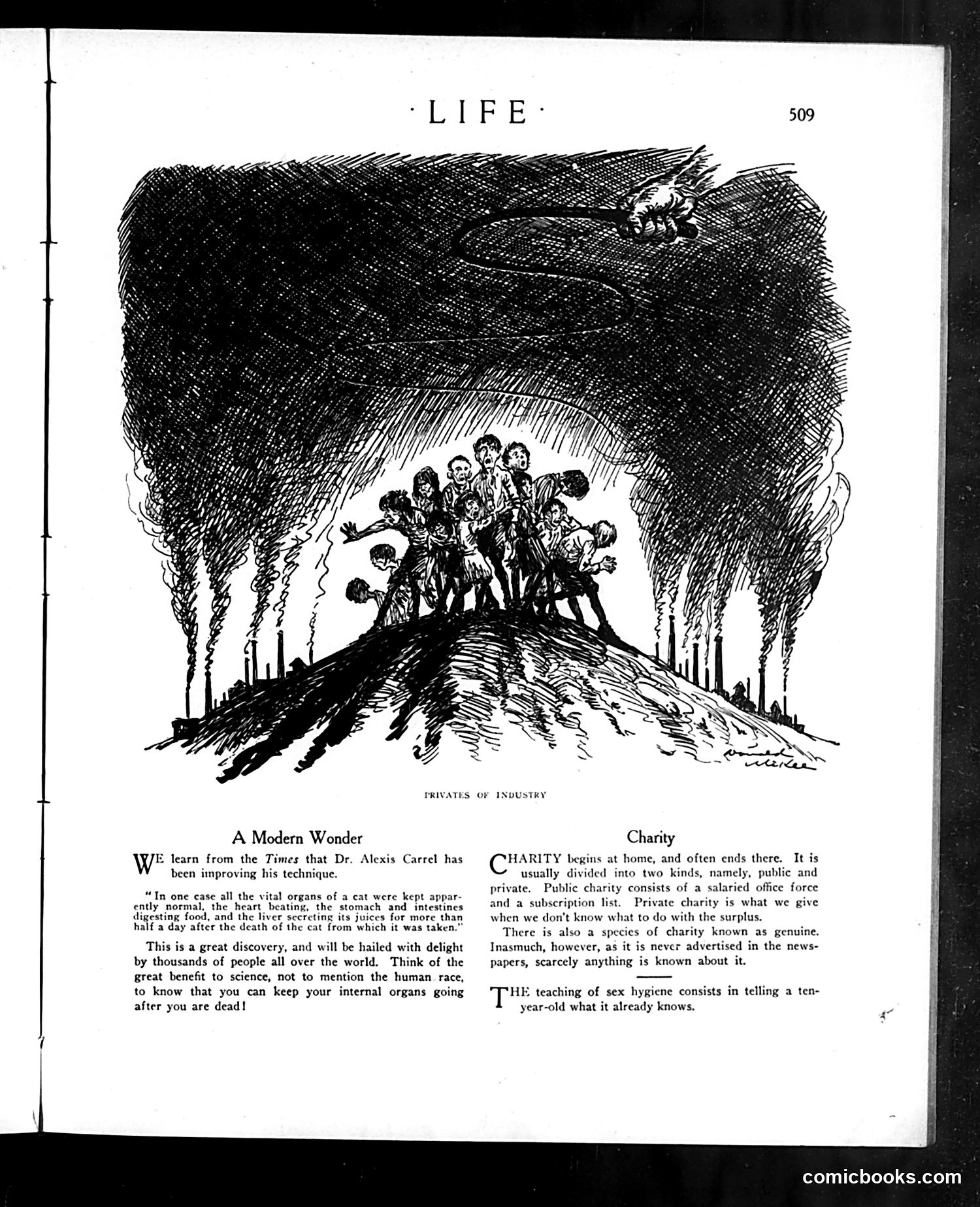
**The Cartoon:** Titled "Privates of Industry," this illustration depicts a group of industrial workers standing on a mound beneath an ominous cavern. The dark, threatening overhead structure suggests they labor in dangerous, oppressive conditions. A small figure (possibly a supervisor or industrialist) appears at the top. **The Satire:** The cartoon critiques exploitative labor practices in early 20th-century American industry. "Privates" puns on military rank, comparing factory workers to soldiers—suggesting they're expendable foot soldiers serving industrial powers. The cavernous, hellish setting emphasizes the grim, dehumanizing nature of industrial work. **The Articles:** The accompanying text discusses a medical technique for preserving organs post-mortem and addresses "charity" and sex education—diverse social commentary typical of Life's satirical approach to contemporary issues.
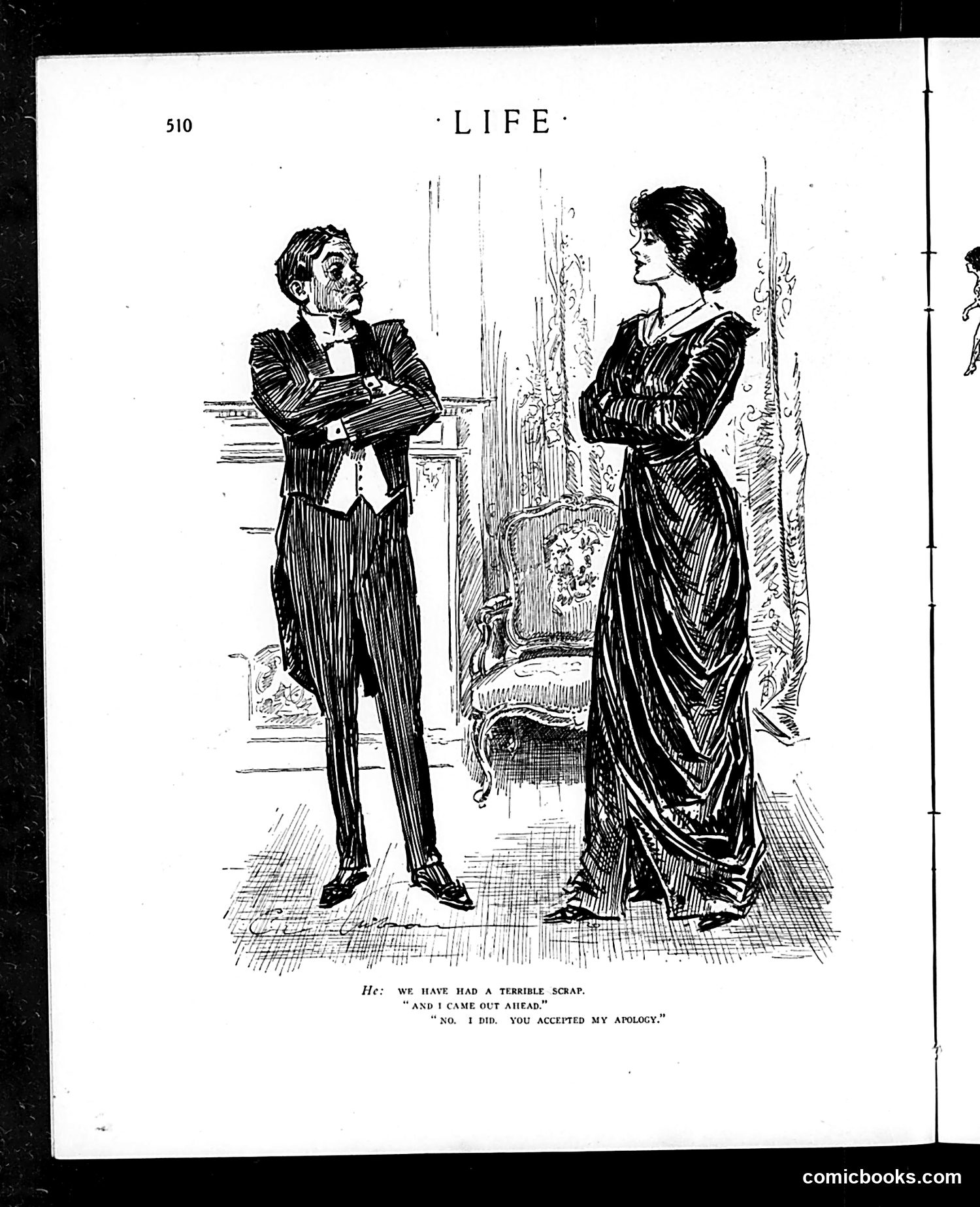
This satirical cartoon depicts a domestic argument between a well-dressed man and woman in an elegant interior. The man claims "we have had a terrible scrap" and states "and I came out ahead," while the woman responds "No. I did. You accepted my apology." The humor lies in the ironic reversal of who "won" the argument. The man believes his victory was decisive, but the woman's interpretation suggests that his accepting *her* apology actually constituted *his* defeat—a clever rhetorical trap. The cartoon satirizes the dynamics of marital disputes and the often-unclear resolution of arguments between spouses, where declaring victory proves more complicated than it appears. The woman's logic turns the man's claim of success against him.
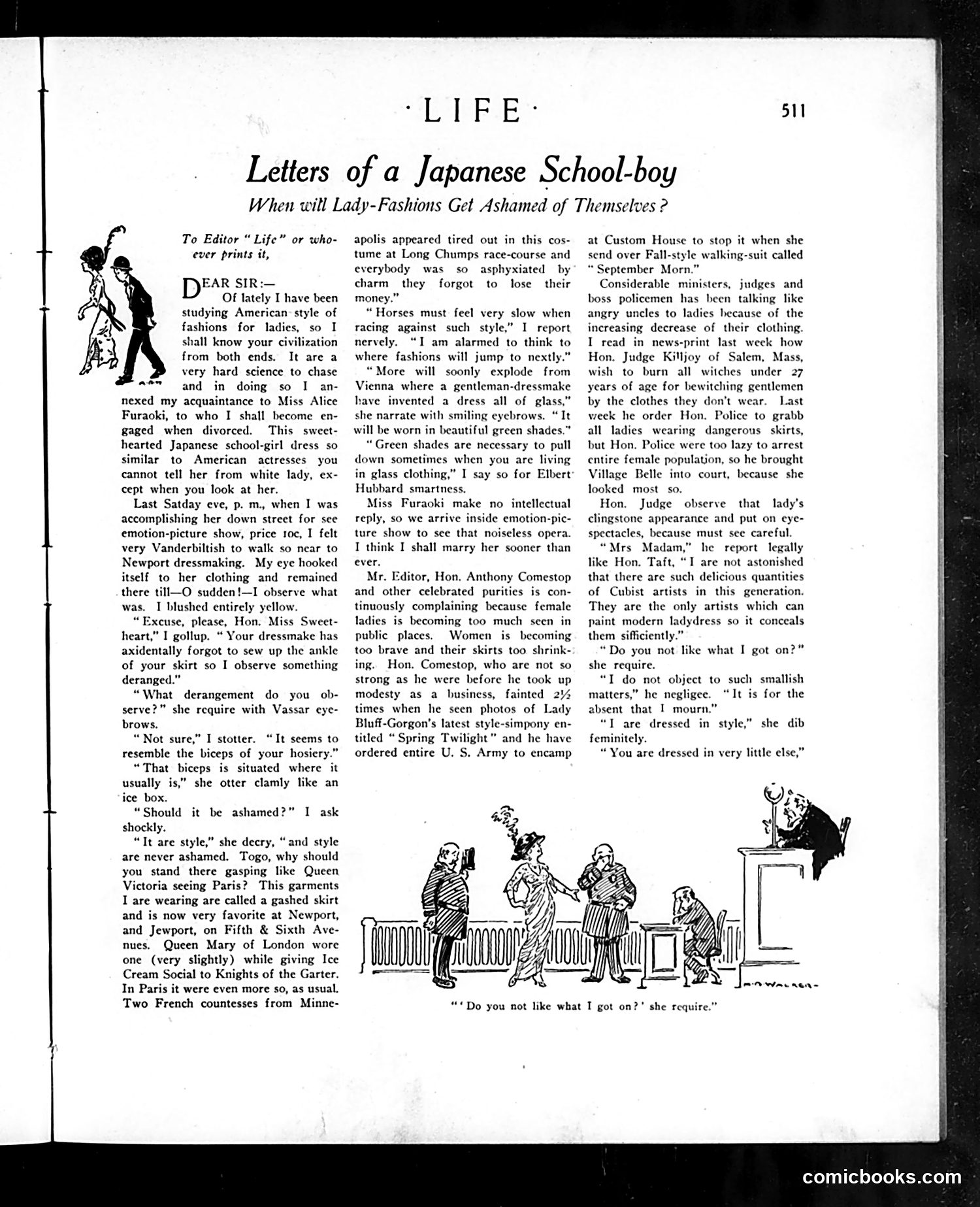
This is a satirical letter purporting to be from a Japanese schoolboy criticizing American women's fashion trends. The writer complains that ladies' clothing has become increasingly revealing and scandalous—mentioning short skirts, glass dresses, and immodest exposure. The satire works on multiple levels: it uses a foreign perspective to mock American fashion excess, while simultaneously mocking Japanese attitudes toward Western culture. The accompanying cartoon shows women in various scanty outfits being critiqued by what appears to be a stern authority figure. The piece satirizes both the rapid adoption of daring fashions in 1920s America and the conservative moral panic these changes provoked. By presenting criticism through a "shocked foreigner" lens, Life magazine both ridicules excessive prudishness and pokes fun at how American fashion was perceived internationally.
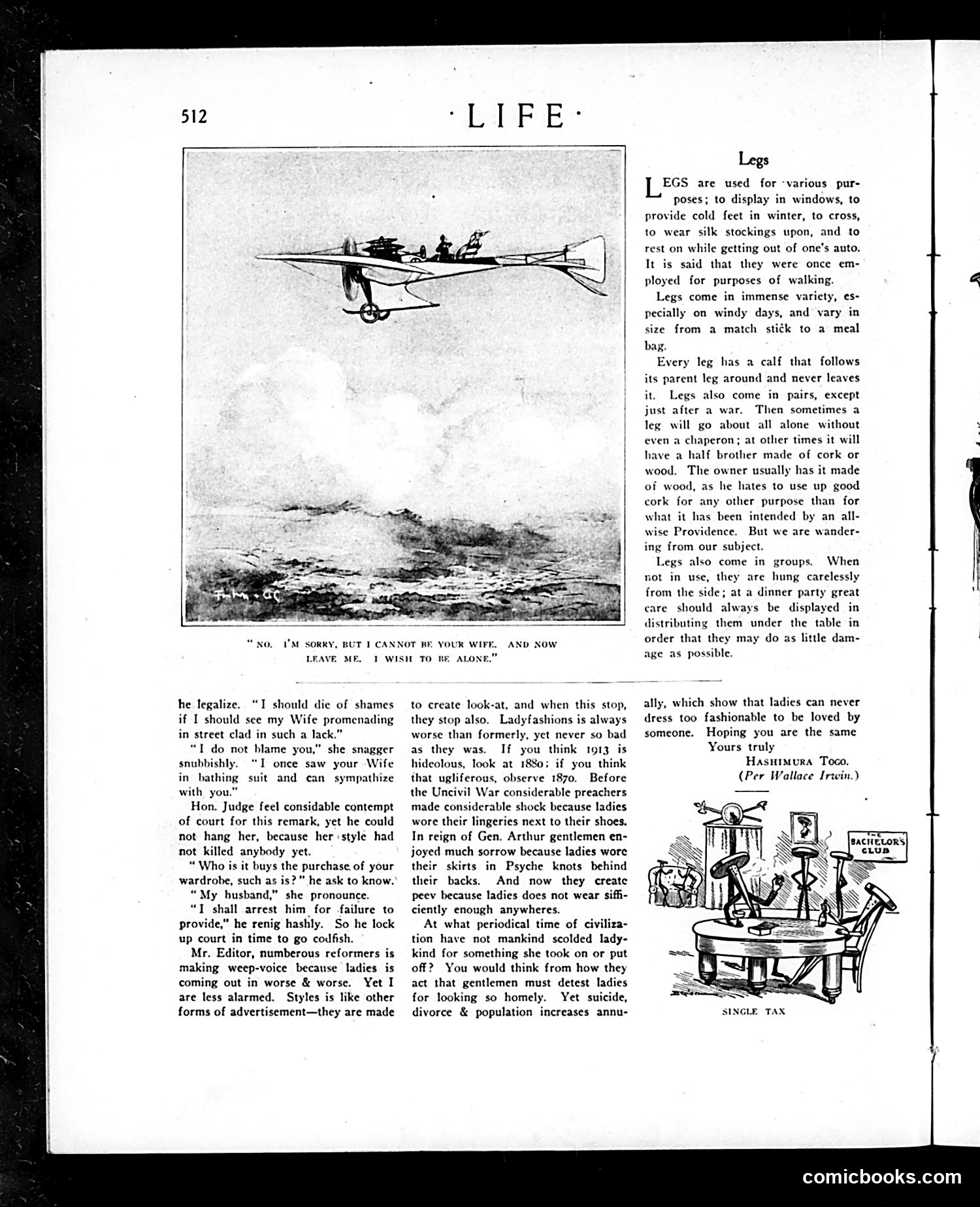
**Top Image**: An early airplane photograph, likely from the early 1900s, showing a primitive aircraft in flight over terrain. **Main Article**: A letter to the editor criticizing women's fashion changes. The writer complains that ladies' clothing has become increasingly scandalous—skirts shorter, lingerie visible. He argues this represents moral decline and blames such fashion changes for social problems like divorce and population decline. **Social Context**: This reflects early 20th-century anxieties about women's liberation. As women gained more freedom and independence, conservative observers saw shorter hemlines and more practical clothing as threats to traditional morality and family stability. **Right Cartoon**: "Single Tax"—depicts a bachelor at his desk, likely satirizing tax policy debates of the era. The page captures period concerns about modernization and changing gender roles.
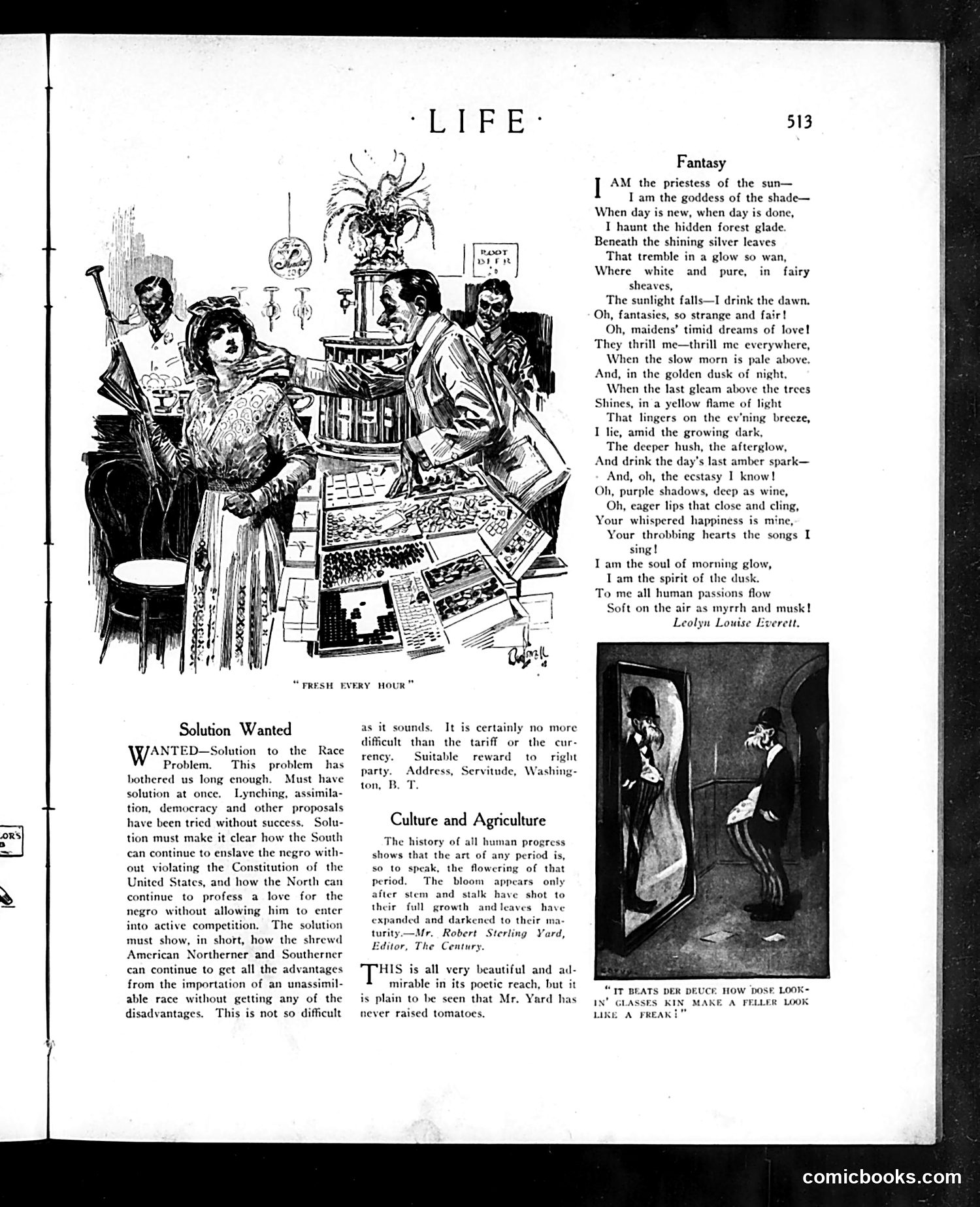
This cartoon satirizes **consumer culture and commercial manipulation**. The illustration shows elegantly dressed figures examining or arranging various commercial products and advertisements spread before them—newspapers, prints, and packaged goods dominate the composition. The title "Fresh Every Hour" appears to mock how modern marketing constantly repackages and recycles the same products or ideas, presenting them as perpetually "new." The figures seem almost hypnotized or obsessively engaged with consumption, suggesting satire about how advertising creates artificial desire. This reflects early 20th-century *Life* magazine's recurring critique: the relentless nature of American commercial culture and advertising's power to manipulate consumer behavior by presenting manufactured novelty as genuine freshness.
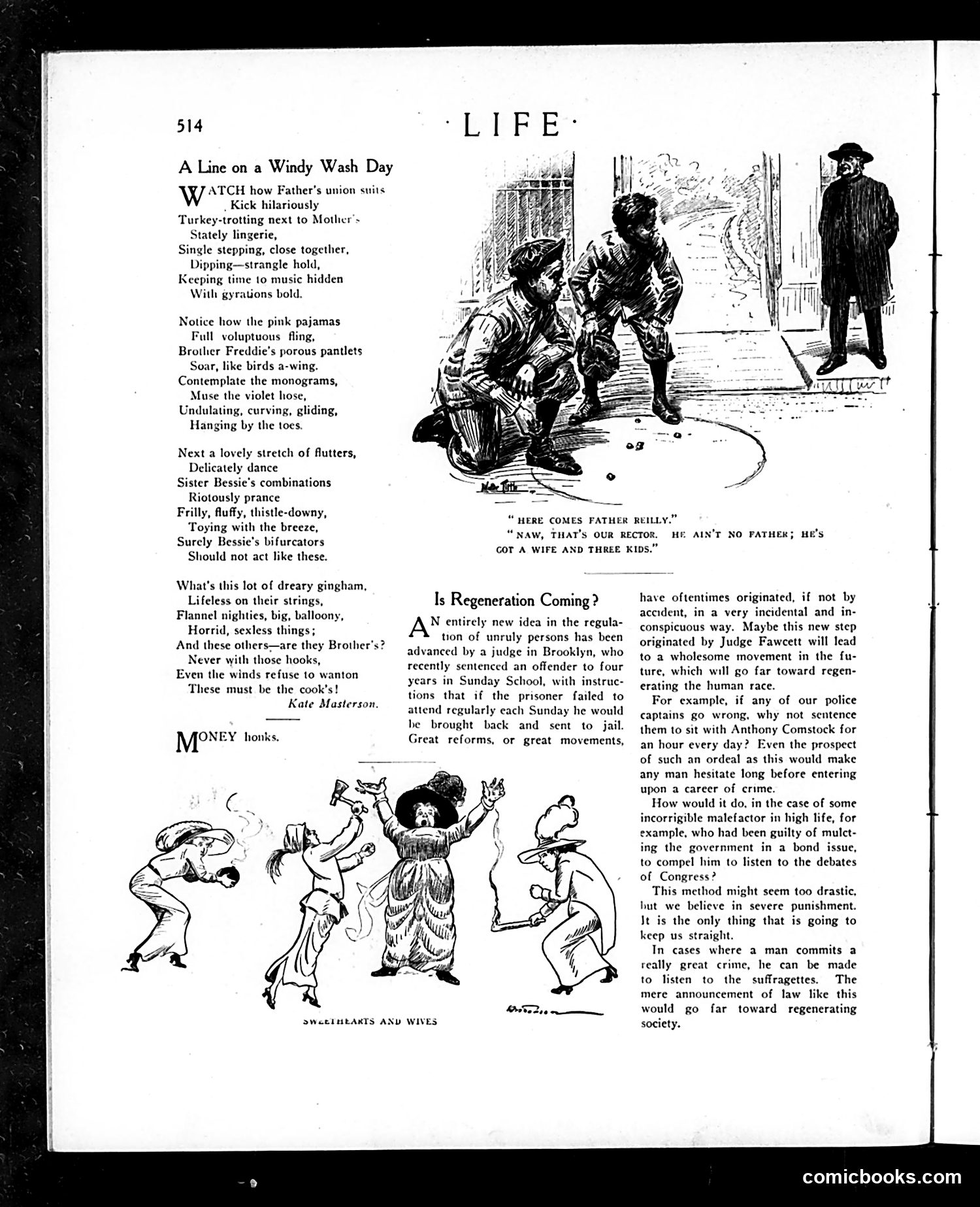
**"A Line on a Windy Wash Day"** (top left) is a humorous poem by Kate Masterson depicting laundry day mishaps—clothes flapping chaotically on a clothesline, with vivid descriptions of garments flying about ("pink pajamas," "violet hose," "thistle-down"). **The central cartoon** shows children playing in the street while an adult (labeled "Father Beilly") observes. The caption jokes that he's not their father—he's their rector with a wife and three children of his own, suggesting confusion about paternity or domestic arrangements. **"Sweethearts and Wives"** (bottom) features dancing couples in an energetic, carefree style, likely satirizing romantic entanglements or marital dynamics. **"Is Regeneration Coming?"** (right) is a serious editorial piece discussing criminal justice reform, proposing that convicted offenders receive education and rehabilitation rather than purely punitive sentences.
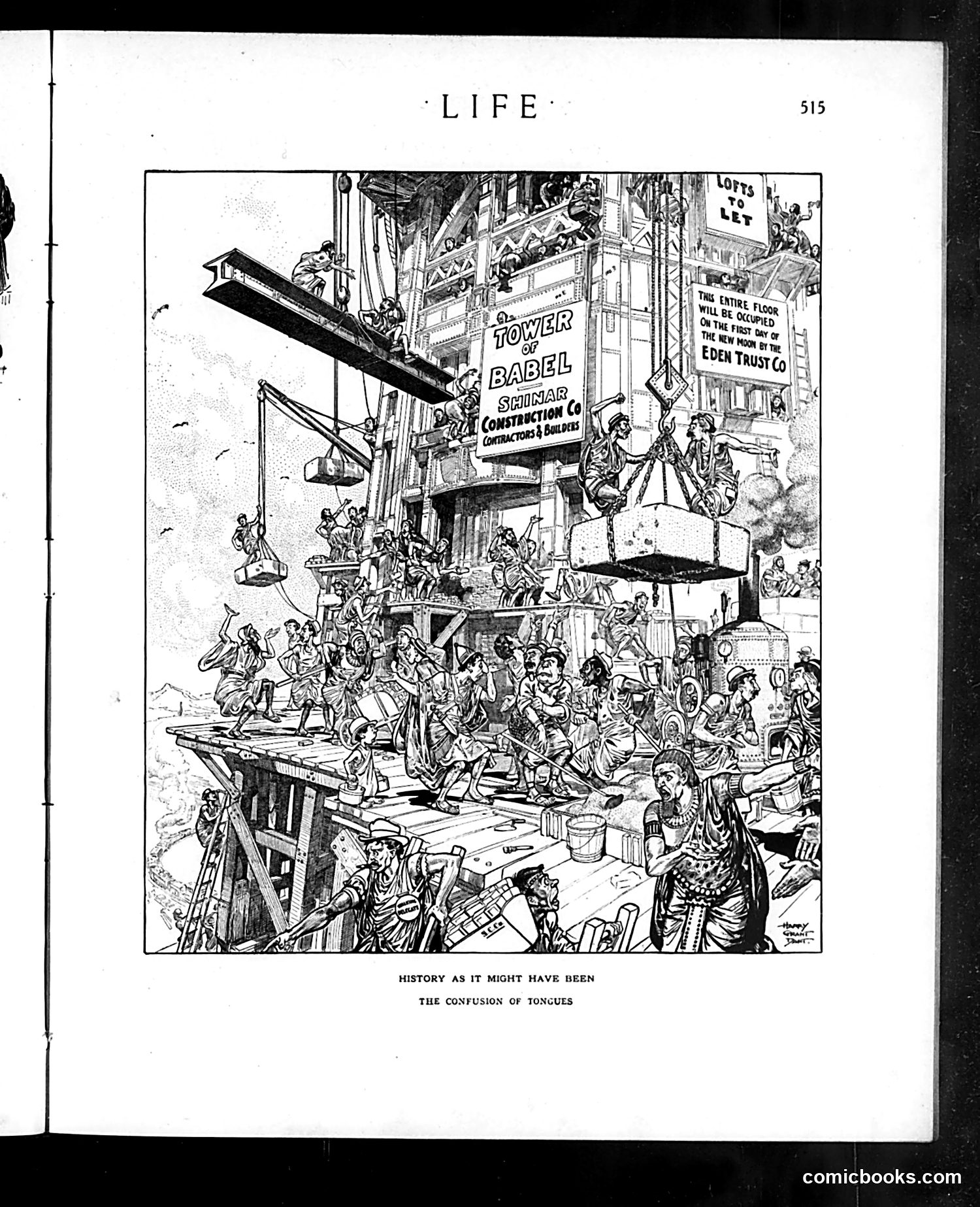
This cartoon satirizes the Tower of Babel story from the Bible, reimagined as a modern construction site. The "Tower of Babel" sign advertises "Schimag Construction Co., Contractors & Builders," while visible signs reference the "Eden Trust Co." and property available to let. The satire mocks contemporary construction chaos and commercial development, suggesting modern builders create the same confusion and disorder as the biblical tower. Multiple workers in various poses—some suspended, some scattered—illustrate pandemonium on the job site. The title "History as It Might Have Been" indicates this is an imaginative take on how ancient confusion might parallel modern construction mishaps. The cartoon likely critiques either urban development, labor conditions, or commercial greed through religious allegory, presenting chaotic building projects as modern equivalents to humanity's biblical hubris.
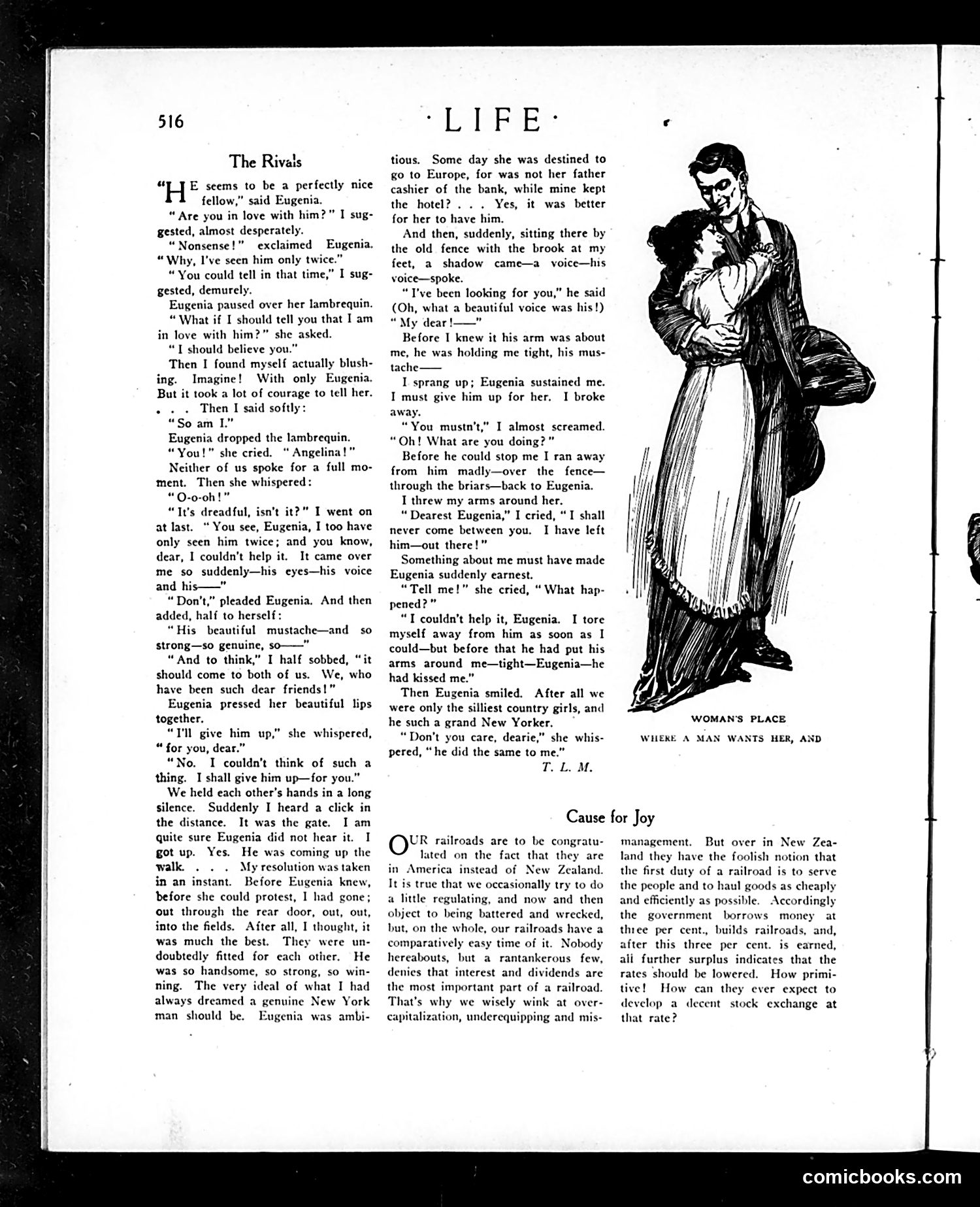
This page contains two separate pieces from *Life* magazine: **"The Rivals"** (left): A romantic comedy story about two female friends, Angelina and Eugenia, who discover they're both attracted to the same man—a charming New Yorker. After an emotional confrontation where each claims to sacrifice him for the other's sake, Angelina flees when he arrives. She later learns from Eugenia that he kissed them both. The story satirizes melodramatic sentiment and female rivalry, ending with the caption "Woman's Place: Where a Man Wants Her"—mocking how women were portrayed as competing for male attention. **"Cause for Joy"** (right): An editorial praising American railroads for being less regulated than New Zealand's, emphasizing that shareholder dividends matter more than safety. The piece sarcastically celebrates corporate interests over public welfare—typical *Life* satire of Gilded Age capitalism and corporate excess. Both pieces exemplify the magazine's social commentary on gender relations and business ethics.
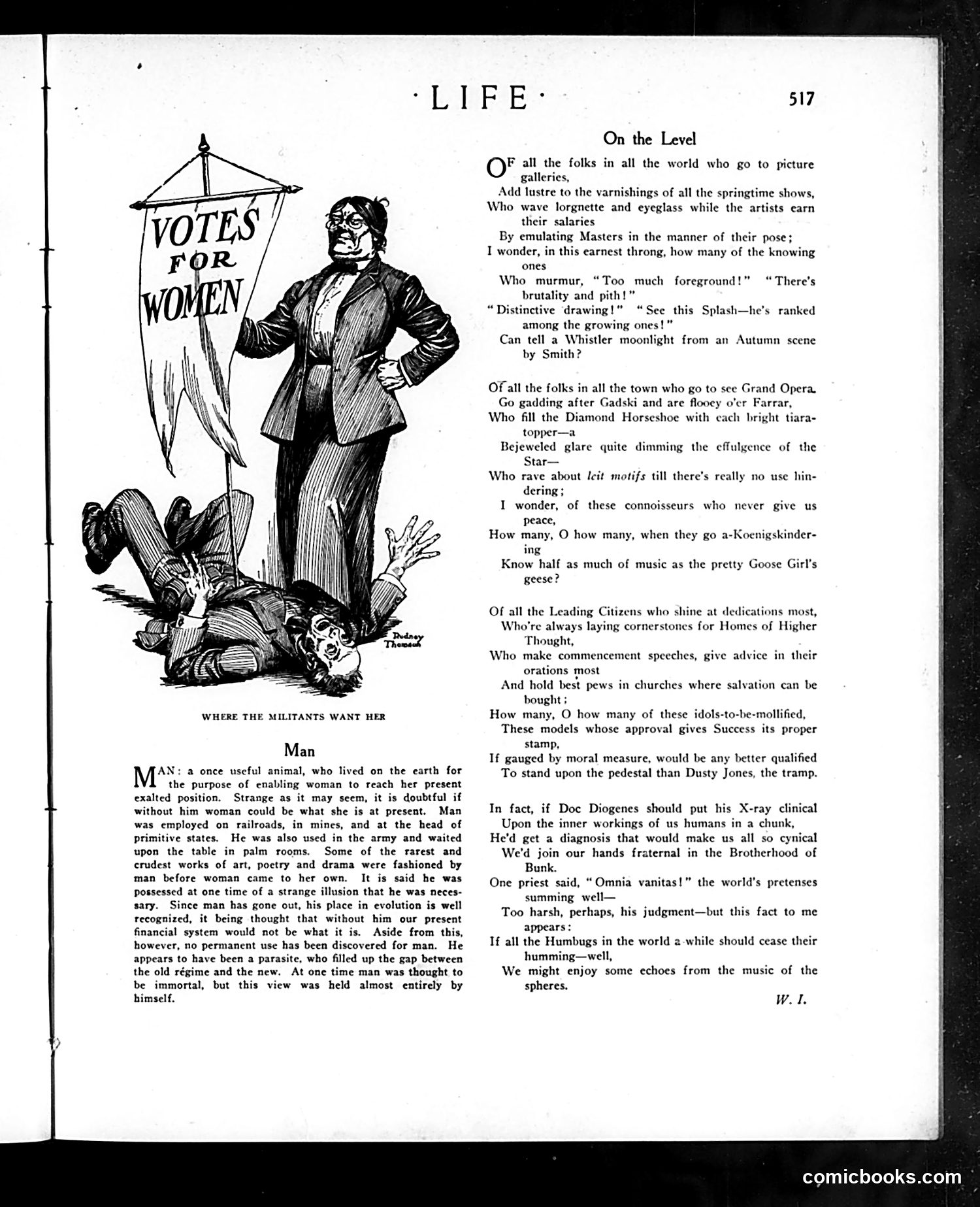
## The Cartoon The left illustration shows a woman in a jacket holding a "VOTES FOR WOMEN" banner, standing triumphantly over a prone man labeled "WHERE THE MILITANTS WANT HER." This is satire opposing women's suffrage—the cartoonist mockingly depicts the suffragist movement's goals as desiring to literally crush or dominate men. ## The Text The accompanying essay "Man" sarcastically redefines men as obsolete "parasites" who existed only to enable women's advancement. It claims men have no permanent use now that women have "come to her own"—heavily ironic, since women lacked voting rights at this publication's time. ## Historical Context This page satirizes the women's suffrage movement (pre-1920 in America). "Militants" refers to aggressive suffragists, particularly British activists. The satire operates through reversal: by exaggerating suffragists' supposed goals as male subjugation, the cartoonist mocks the movement itself. The right column's poem "On the Level" shifts targets, mocking cultural pretension among the wealthy and powerful—different subject matter entirely.
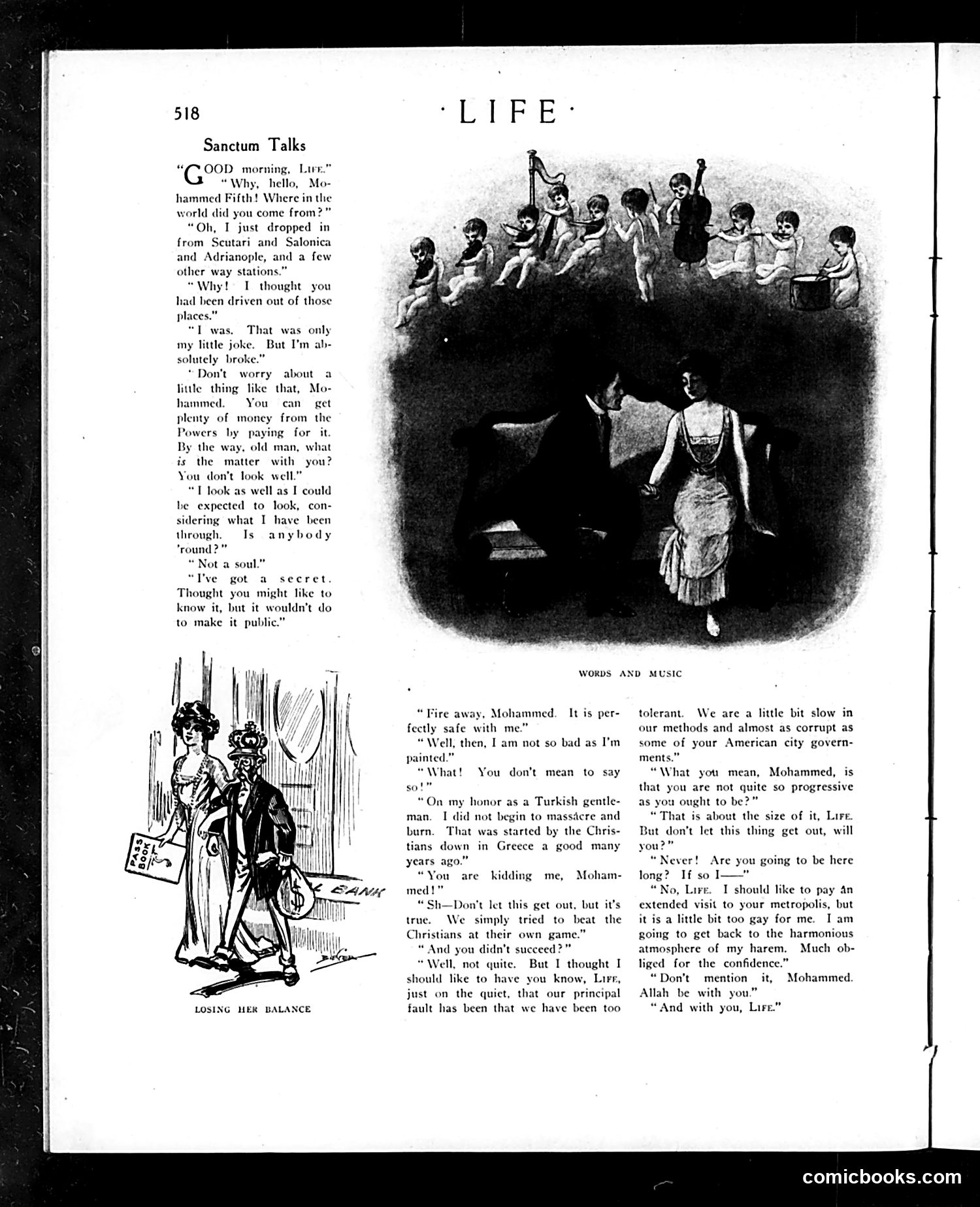
This satirical dialogue features **Mohammed V**, the Ottoman Sultan, visiting Life magazine's editor ("Lire"). The cartoon references the **Balkan Wars and Ottoman decline** in the early 1910s, when Ottoman territories in southeastern Europe (Seutari, Salonica, Adrianople) were lost to Christian nations. The satire works through **ironic reversal**: Mohammed claims the Ottomans aren't as brutal as portrayed and that *Christians* started the violence. He admits their main failing is being "too tolerant"—absurdly blaming their losses on excessive restraint rather than actual military weakness and administrative corruption. The accompanying cartoon "Losing Her Balance" (lower left) reinforces this: a woman losing equilibrium represents the Ottoman Empire's collapsing stability. The joke targets both Ottoman excuses for imperial failure and contemporary Western attitudes toward Ottoman brutality—suggesting the Ottomans cynically blame victims while Life's editor naively accepts these claims. It's satirical commentary on geopolitical hypocrisy and Ottoman decline.
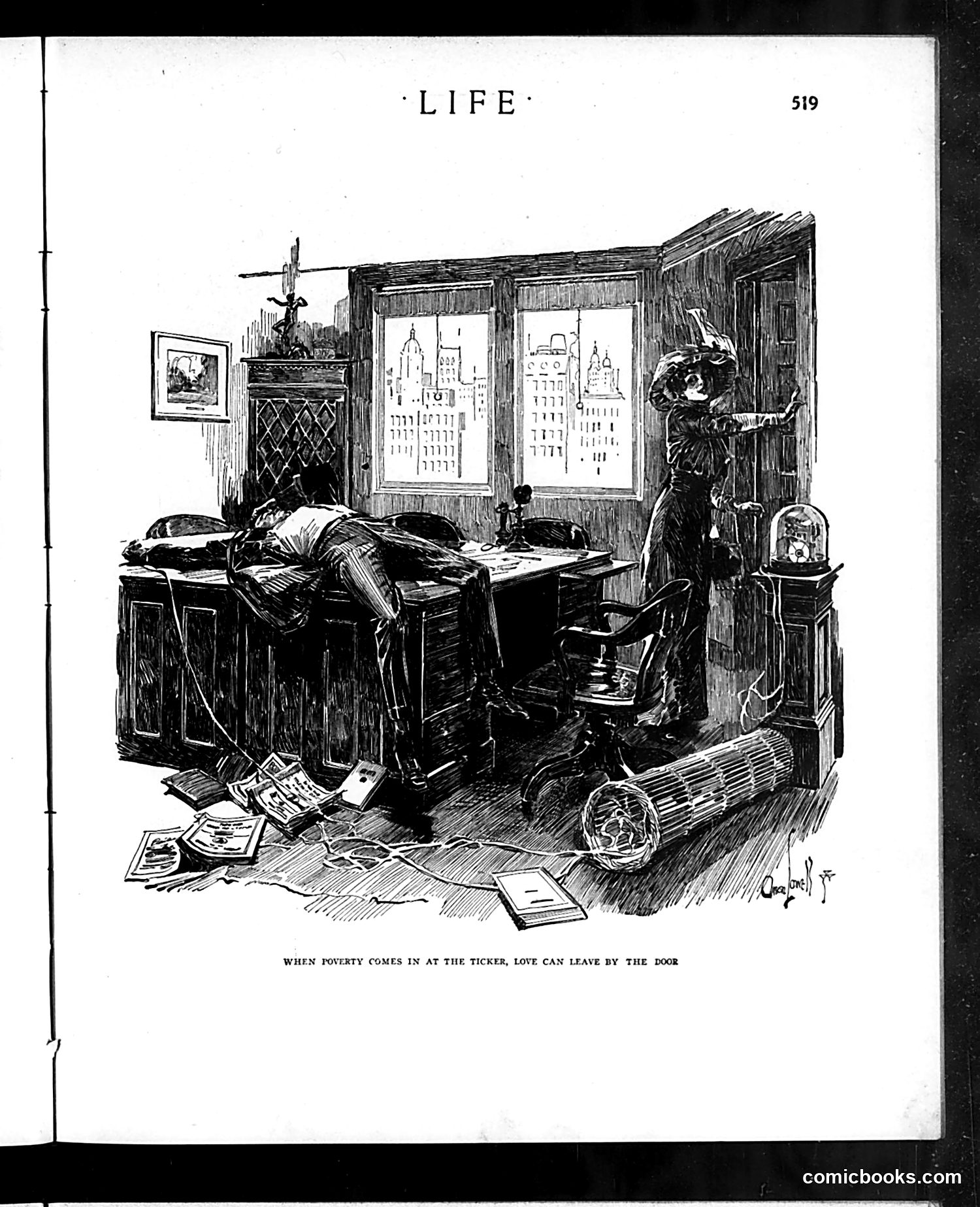
This is a single cartoon satirizing the relationship between financial hardship and romantic commitment. The scene depicts a man slumped dejectedly at his desk in a high-rise office (visible through windows showing city skyline), surrounded by scattered financial documents and papers on the floor. A woman stands at the door, apparently departing—the caption suggests she's abandoning him now that his financial circumstances have declined. The "ticker" references the stock ticker tape machine, symbolizing Wall Street and financial markets. The satire comments on the superficiality of relationships based on wealth: romantic love proves conditional when money disappears. The cartoon likely reflects economic anxiety from the early 20th century, when market fluctuations directly impacted personal fortunes and social standing.
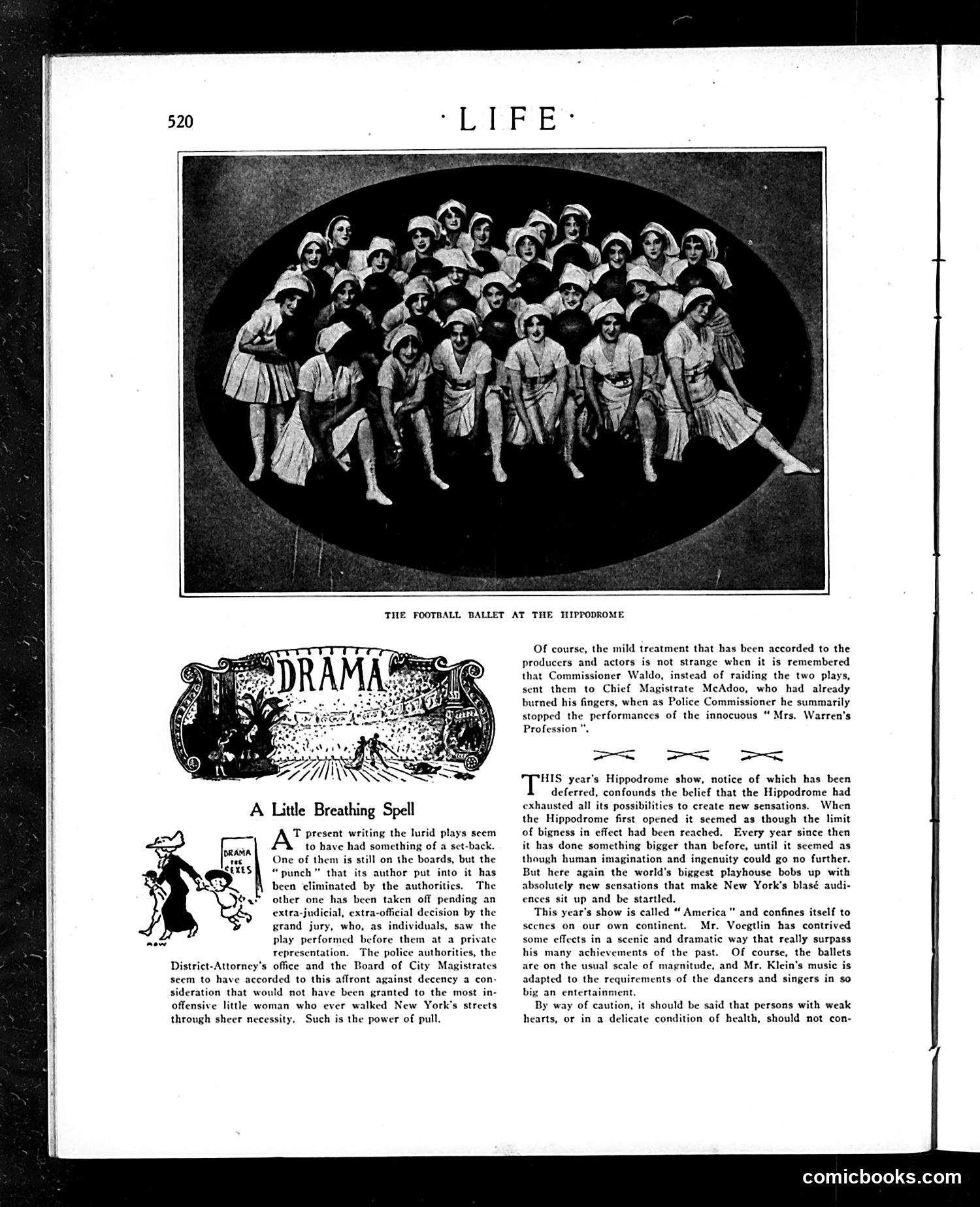
This page satirizes censorship of theater in early 20th-century New York. The main text criticizes how authorities (Commissioner Waldo, Chief Magistrate McAdoo, police) treated "lurid plays" with leniency—removing offensive content rather than banning them entirely—while claiming to protect public decency. The satire's point: these same officials had previously shut down "Mrs. Warren's Profession" (a Shaw play about prostitution), yet now show restraint toward other controversial productions. Life mocks this inconsistency as reflecting "the power of pull" (political favoritism). The photograph shows the Hippodrome's football ballet—a large chorus line in athletic costume—illustrating the magazine's simultaneous coverage of entertainment. The juxtaposition suggests Life's interest in both theatrical controversy and spectacle. The article's closing cautions people with weak hearts against attending the Hippodrome's new "America" show, likely a gentle joke about its overwhelming scale and sensations.
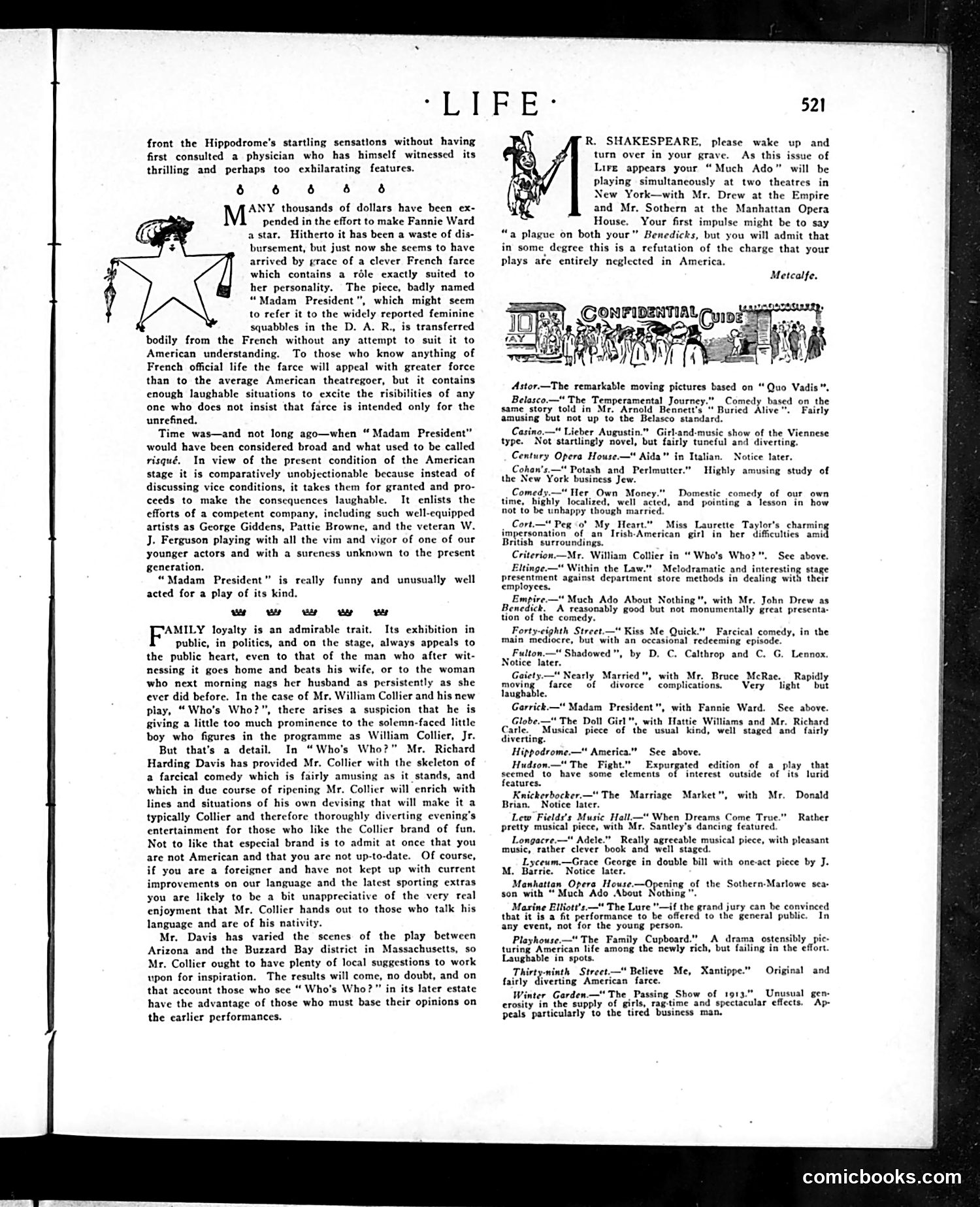
This page contains theatrical reviews rather than political cartoons. The small illustration shows a figure dangling from a star—likely satirizing the effort to make actress Fannie Ward a star through the French farce "Madam President." The reviews critique contemporary Broadway productions. The "Madam President" section notes the play is "badly named" and unsuitable for American audiences, originally referencing French governmental scandals. The reviewer suggests modern American theater has become so permissive that once-risqué farce now seems tame—a commentary on changing theatrical standards. The second review discusses William Collier's "Who's Who?", based on a Richard Harding Davis sketch, praising Collier's comic timing while gently mocking his prominence of his young son in the cast. The Shakespeare reference at page's end humorously notes his "Much Ado About Nothing" is playing simultaneously at two New York theaters—suggesting his work remains perpetually relevant to current entertainment.

This page appears to be mostly blank or contains an image that is too dark to read clearly. The visible text includes "The SasMoon" at the bottom right and a watermark "comicbooks.com," suggesting this is a digitized archive page. The large black rectangular area in the center may be a photograph, illustration, or heavily darkened image that has not reproduced well in this scan. Without legible content or clear imagery, I cannot identify specific figures, political references, or satirical intent. To provide meaningful analysis of the cartoon or satire, a clearer scan or additional context about the publication date and issue would be necessary.
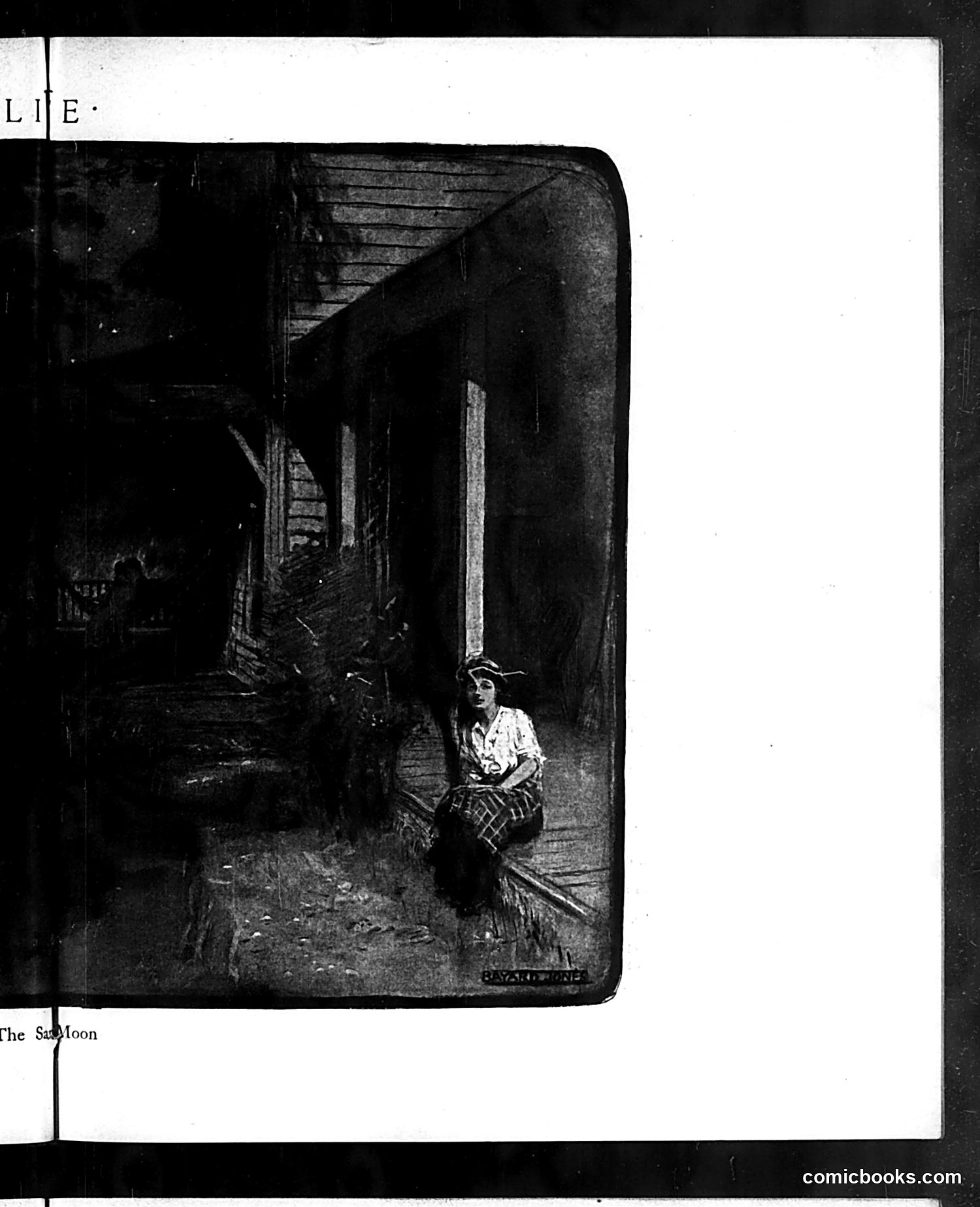
This page from *Life* magazine shows "The Saloon" — a dark, shadowy illustration of what appears to be a figure in a cramped, deteriorating interior space with structural beams visible overhead. The image likely satirizes the conditions or moral atmosphere of saloons, establishments that were frequent targets of social criticism in early-to-mid 20th century America. The cramped, oppressive visual treatment suggests the cartoon critiques saloons as dark, unsavory spaces. Without additional visible text on this specific page explaining the cartoon's exact point, the satire appears to concern either unsanitary conditions, moral degeneracy associated with drinking establishments, or possibly Prohibition-era commentary. The artistic style emphasizes claustrophobia and seediness to convey disapproval.
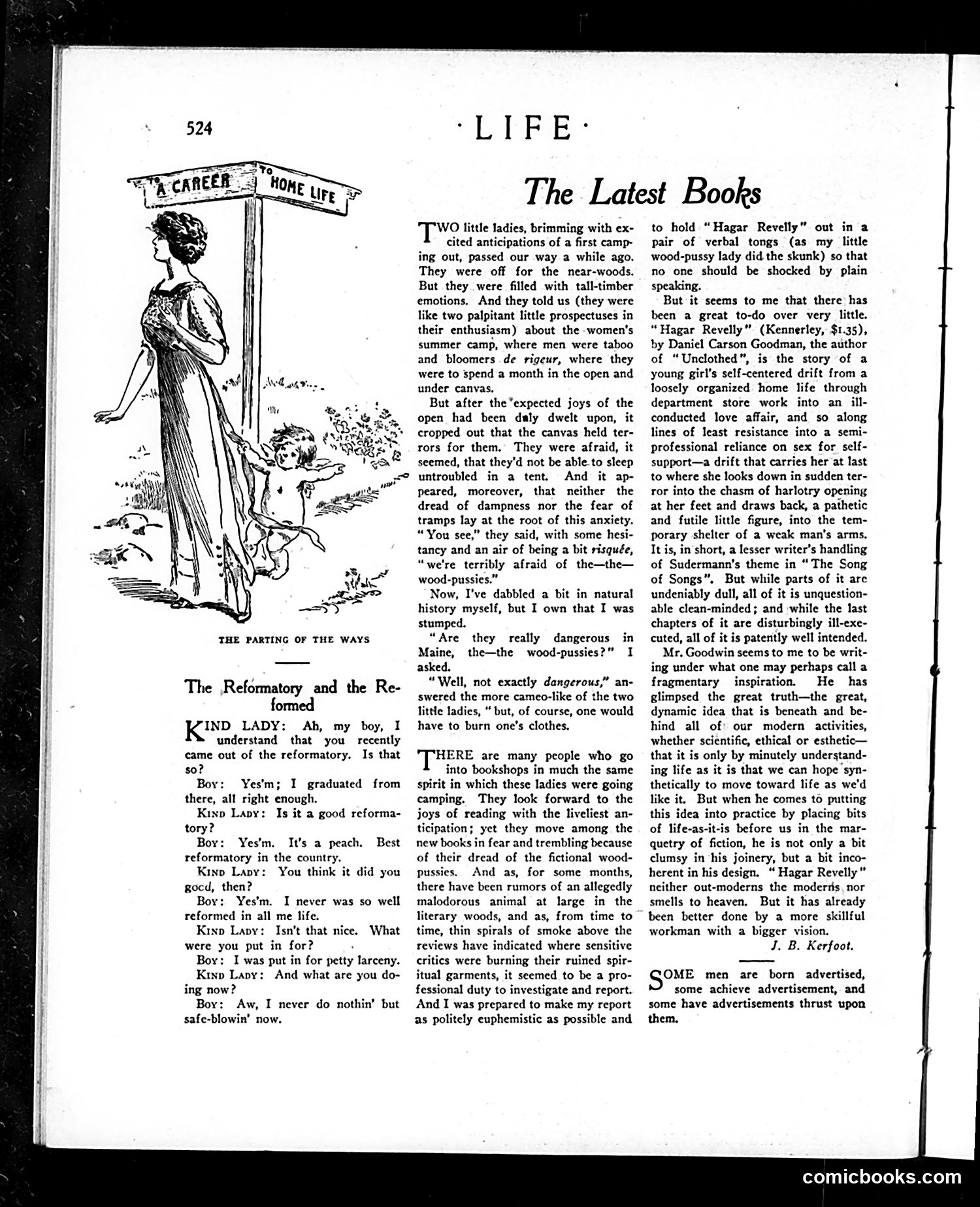
This page contains two distinct satirical pieces from early 20th-century Life magazine. **"The Parting of the Ways"** (left) mocks the ineffectiveness of reformatories. A "Kind Lady" congratulates a boy on graduating from reform school, praising its quality. The joke's dark twist: he's now committing safe-breaking instead of petty larceny—the reformatory apparently trained him in more serious crime rather than rehabilitation. **"The Latest Books"** (right) uses a clever extended metaphor. Two young women fear "wood-pussies" (skunks) at their camping trip, requiring them to burn contaminated clothes. The reviewer compares this to readers' anxiety about the novel *Hagar Revelly*—treating it as a dangerous literary "animal" that might corrupt them. He argues the book, while dull, is actually "clean-minded" and not the moral threat critics claim. The satire targets both overly-cautious literary critics and readers' prudishness about candid fiction addressing sexuality and women's economic vulnerability.
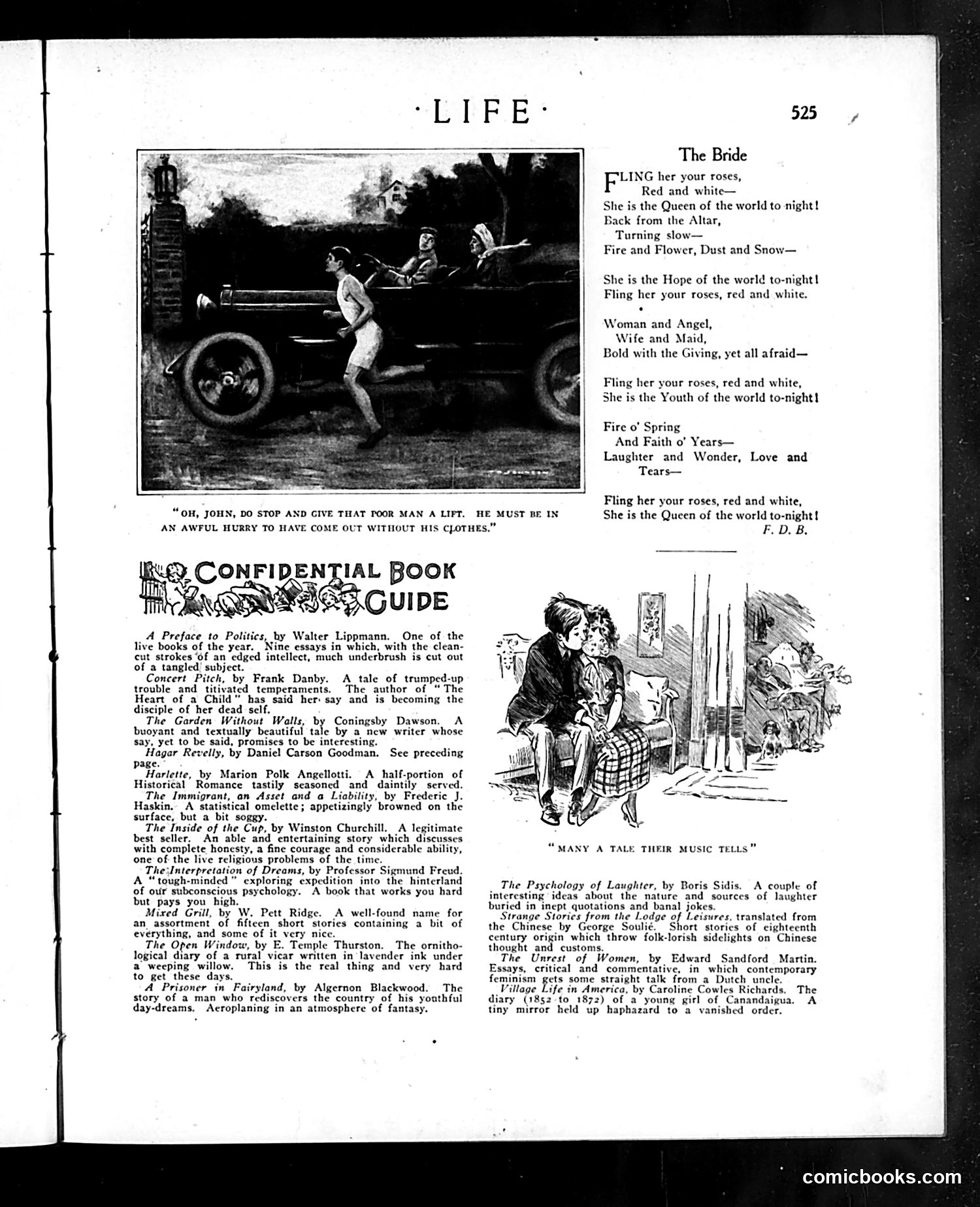
**The Poem "The Bride"** (by F.D.B.) is sentimental verse celebrating a newlywed woman as idealized femininity—"Queen of the world," "Hope of the world," embodying "Woman and Angel" simultaneously. It reflects early 20th-century romanticization of marriage and wifelihood. **The Cartoon** depicts a newly married couple in an automobile (a modern luxury vehicle). The bride, still in wedding dress, urges her impatient groom: "Oh, John, do stop and give that poor man a lift. He must be in an awful hurry to have come out without his clothes." **The Joke**: A poorly dressed (or possibly nude) pedestrian has been left behind—apparently the groom was in such a rush to leave the wedding that he abandoned someone without proper clothing. The satire gently mocks newlyweds' self-absorbed haste, contrasting the bride's charitable impulse with the groom's inconsiderate urgency. The juxtaposition with the idealized poem above creates ironic commentary on romantic honeymoon reality.
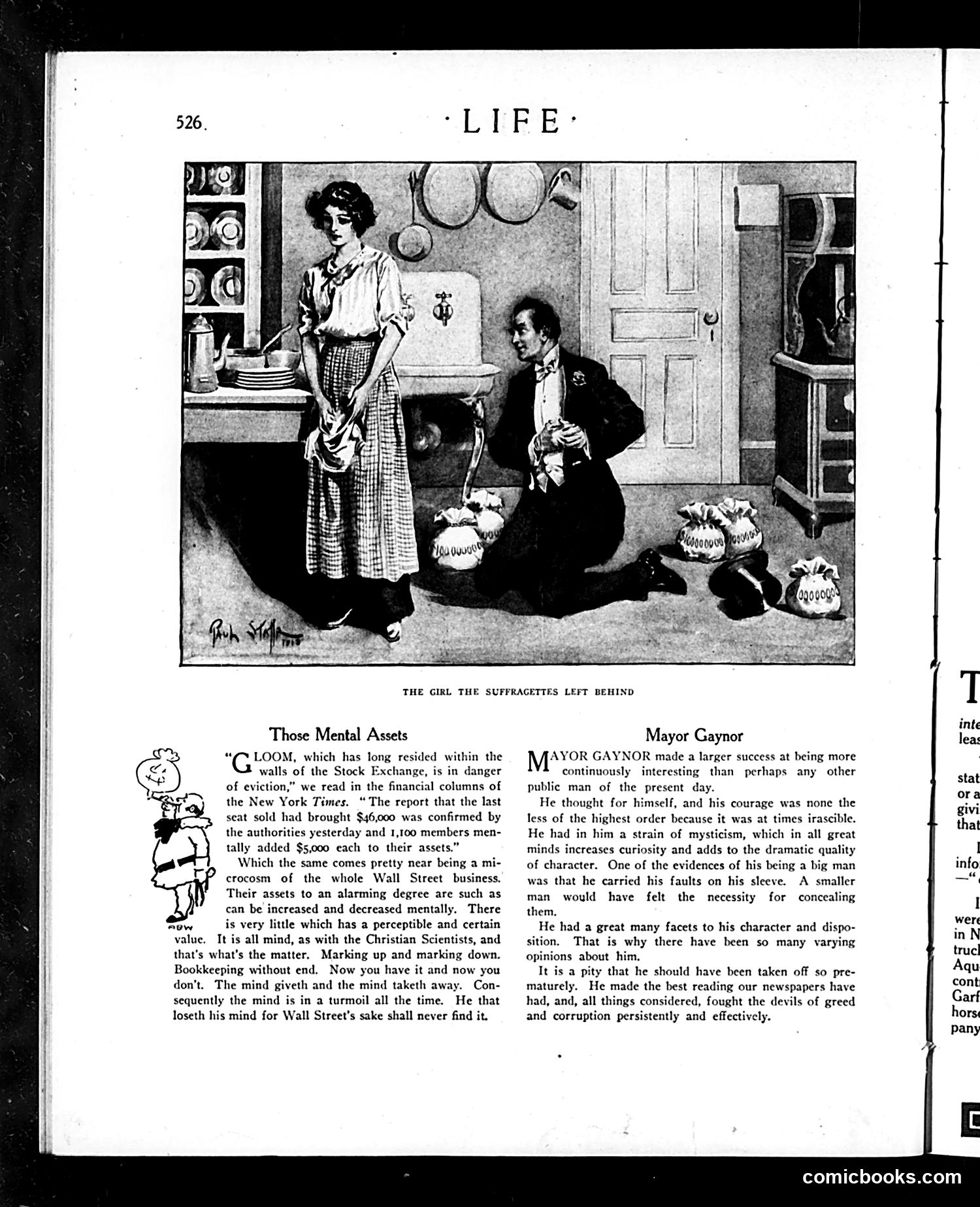
This satirical illustration depicts a domestic kitchen scene where a woman stands while a man sits on the floor surrounded by overturned pots and pans—suggesting domestic chaos or incompetence in her absence. The caption's title references the suffrage movement: "the girl the suffragettes left behind" implies criticism of women pursuing political activism (voting rights) at the expense of traditional domestic duties. The joke suggests that while women fought for equality, their homes and domestic responsibilities suffered—a common anti-suffrage argument of the era. The accompanying text "Those Mental Assets" mocks Wall Street speculation as purely psychological—value existing only in traders' minds rather than tangible assets. The separate section on Mayor Gaynor praises his independent thinking and anti-corruption stance, presenting him as refreshingly authentic compared to typical politicians. Together, the page contrasts frivolous domestic humor with admiration for principled civic leadership.
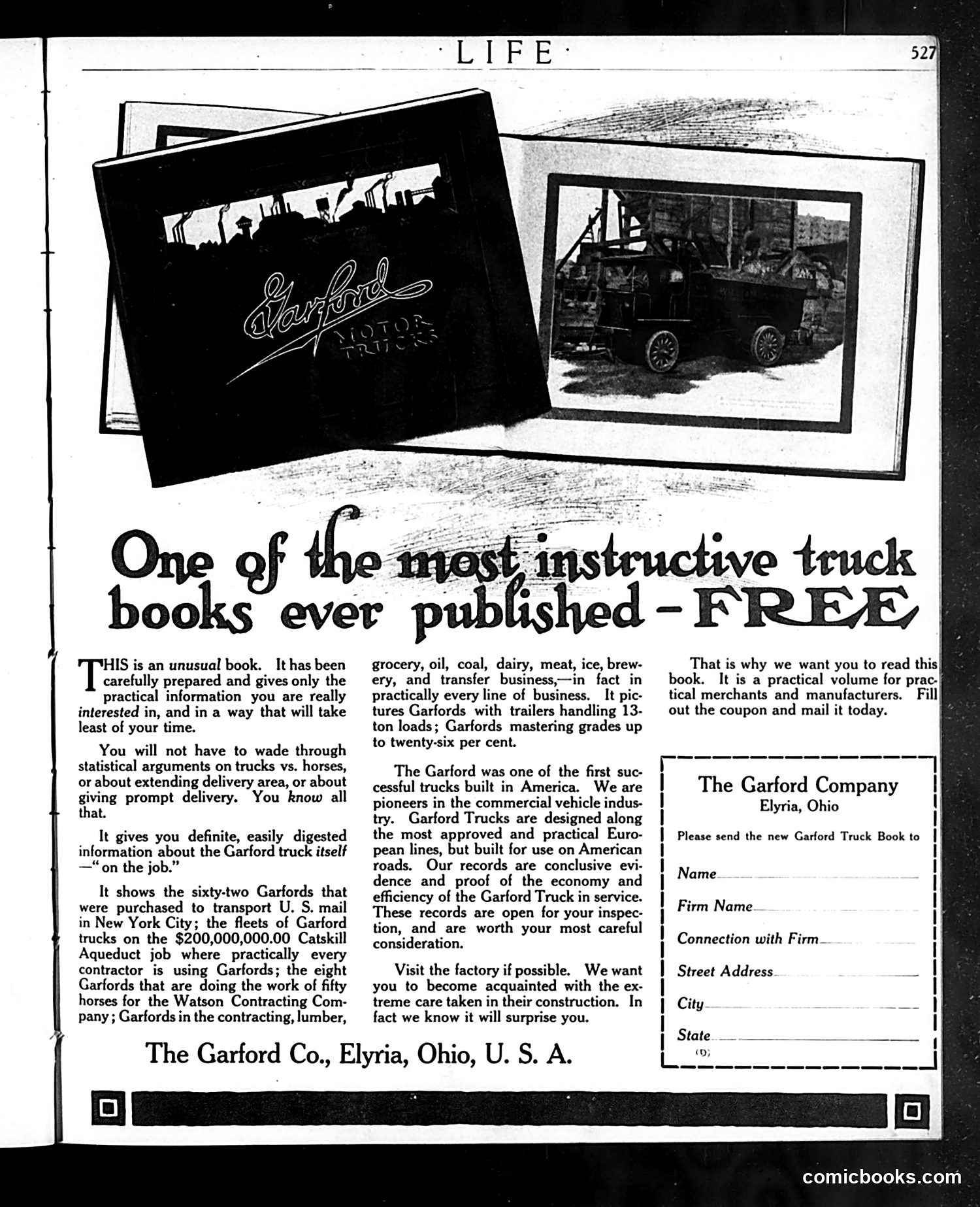
This is primarily a **truck advertisement**, not political satire. It appears in *Life* magazine (page 527) promoting the Garford Motor Truck Company of Elyria, Ohio. The ad offers a free instructional booklet about Garford trucks, positioning it as practical reading for "merchants and manufacturers." The text emphasizes the truck's proven reliability through specific examples: its use by the U.S. Postal Service in New York City, on the Catskill Aqueduct construction project, and by various businesses (Watson Contracting Company, lumber operations, dairies, etc.). The ad's key appeal is **anti-theoretical marketing**: it explicitly rejects "statistical arguments on trucks vs. horses" in favor of concrete, on-the-job evidence. This reflects early automotive industry strategy—demonstrating trucks could replace horse-drawn transport through documented performance rather than abstract arguments. The imagery shows the truck book itself and a Garford vehicle. This is straightforward commercial advertising rather than satirical content.
This page is the magazine's "Letters to the Editor" section—a reader feedback column titled "What Do You Think?" **Key letters discussed:** 1. **"Never Again!"** complains that editor Edward Sandford Martin traveled to Europe, depriving readers of his editorials during his absence. The writer sarcastically suggests Martin must have consulted a "famous European specialist" who assured him of a long life. 2. **"Is This True?"** is a complaint from an enlisted soldier in the Philippines detailing recruitment deceptions. He was promised he could purchase discharge after one year for $120, but discovered the actual cost is $170+ and requires two years' service. He also criticizes retroactive pay cuts affecting his travel allowance home—he'll arrive jobless in February wearing a military uniform. 3. **"From the Other Side"** (partially visible) appears to be a response from a military medical officer regarding serum treatment for meningitis. **Context:** These letters reflect 1913 military grievances, recruiting fraud concerns, and early 20th-century Army administration issues. The cartoon illustration (bottom right, labeled "Yours Received") appears decorative rather than directly connected to specific letters.
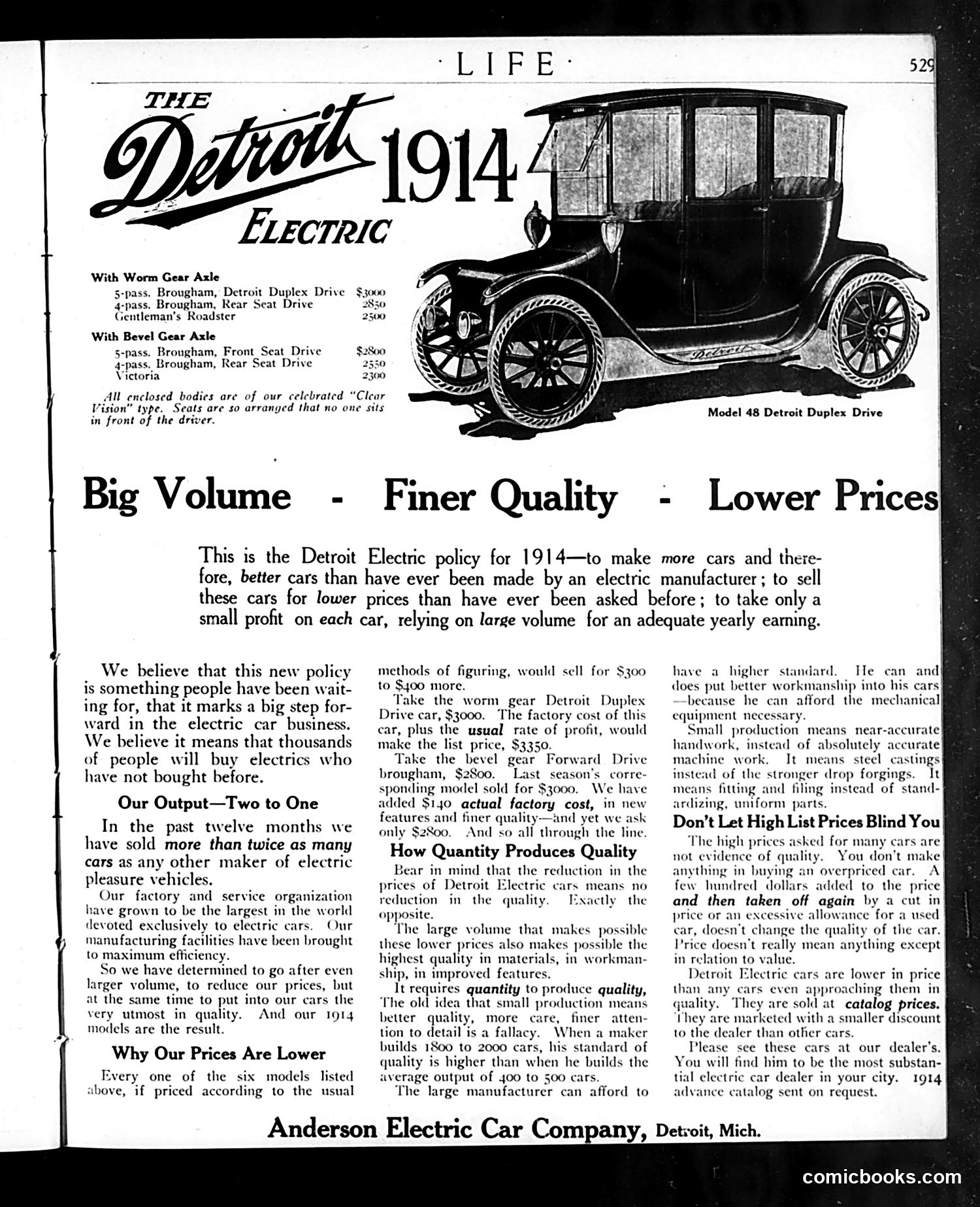
This is primarily a **full-page advertisement**, not satire or political cartoon. It promotes the Anderson Electric Car Company's 1914 Detroit Electric automobile line. The key message targets a modern concern: the company claims to achieve **lower prices through high-volume manufacturing without sacrificing quality**—a counter-intuitive argument for 1914. The ad argues that mass production *enables* better quality (standardized parts, precision machinery, stronger materials) versus small-batch production (hand-fitting, weaker forgings). A secondary argument warns consumers: **don't equate high list prices with quality**. The copy suggests competitors inflate prices artificially, then discount them—the final price alone reveals true value. The electric car itself appears dated to modern readers (this vehicle was already obsolete by the 1920s), but the **manufacturing philosophy—volume production yielding affordability and reliability—became standard** in American industry, notably via Henry Ford's contemporaneous Model T strategy.
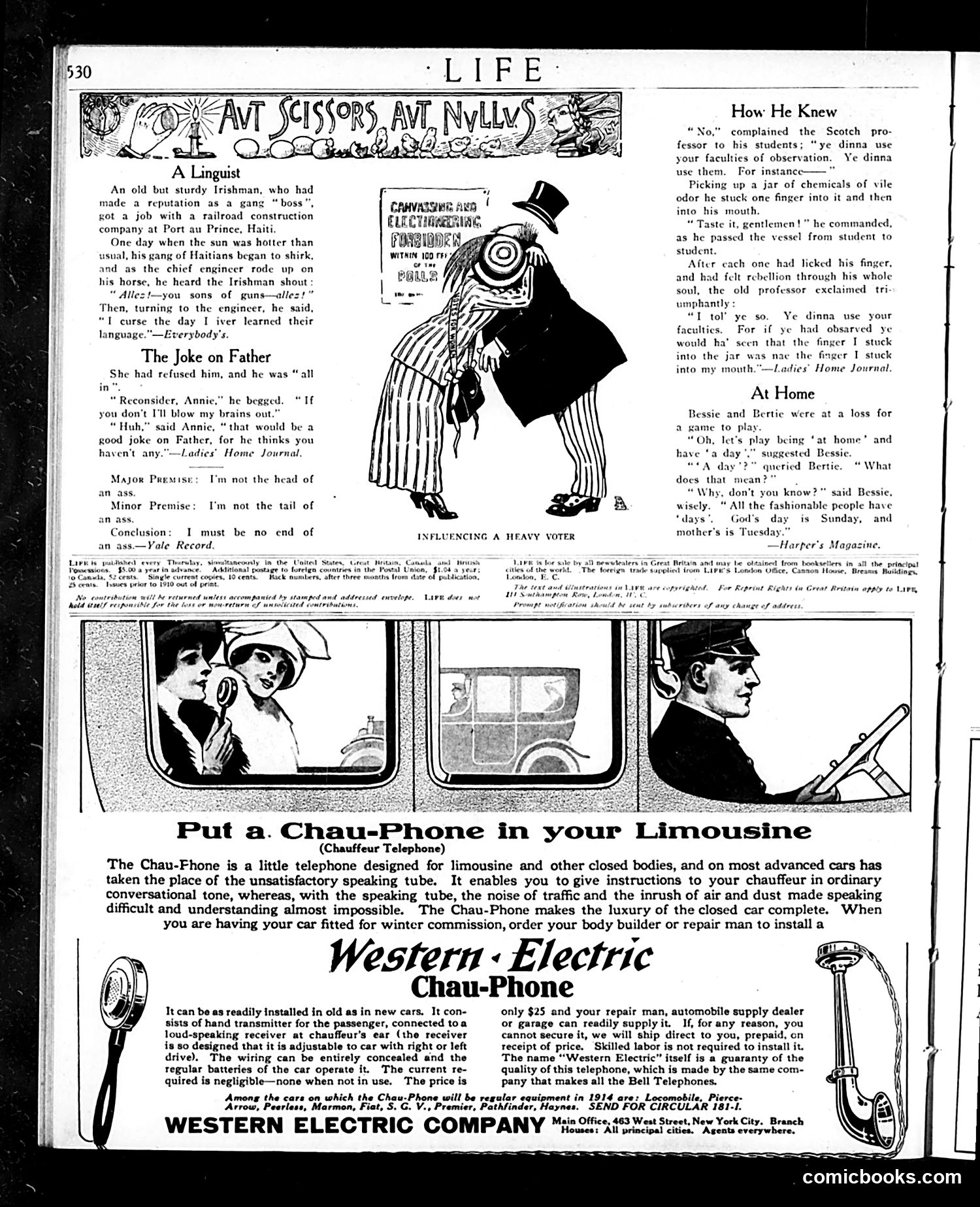
This page contains several humorous anecdotes typical of early 20th-century American humor magazines, plus a substantial advertisement. **The Cartoons/Jokes:** The sketches illustrate short comedic stories about linguistic and social mishaps. "A Linguist" depicts an Irish railroad boss cursing Haitian workers in French, then complaining he learned their language. "The Joke on Father" involves a rejected suitor's suicide threat. These jokes rely on period stereotypes about Irish immigrants and working-class humor. One illustrated piece shows a Scottish professor demonstrating "observation" to students by passing around a jar of foul chemicals, deliberately deceiving them—the joke being they failed to notice his finger switched jars, illustrating carelessness. **The Advertisement:** The bulk of the page advertises the "Chau-Phone"—a telephone system for limousines allowing passengers to communicate with chauffeurs without shouting through a speaking tube. This reflects the era's fascination with automotive luxury and modern convenience technology for wealthy car owners. The content reflects 1910s-era humor, class attitudes, and technological optimism.
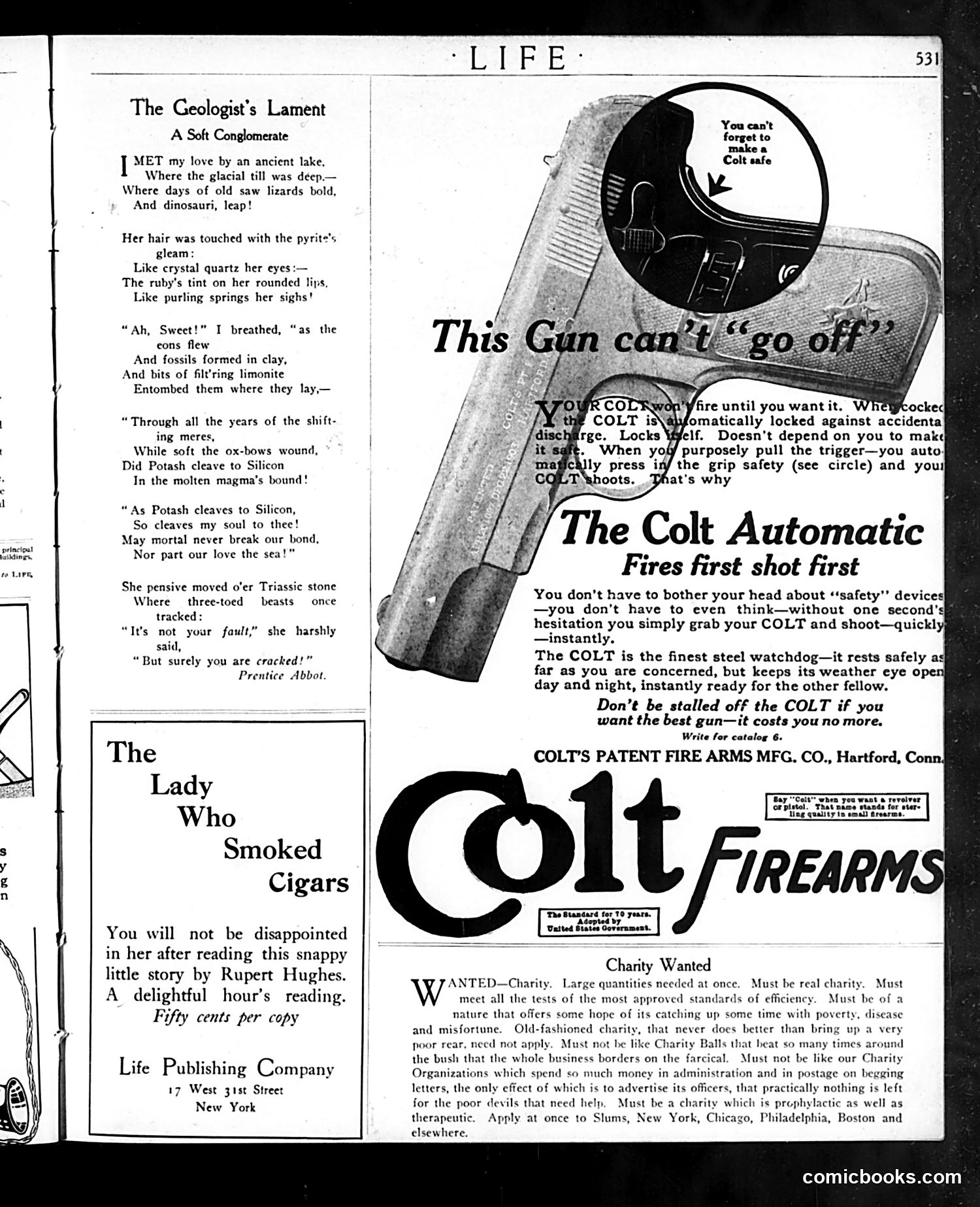
This page from *Life* magazine combines literary satire with advertising. **"The Geologist's Lament"** is a humorous poem mocking overly romantic Victorian poetry by substituting geological jargon for conventional love metaphors. A geologist professes love using terms like "glacial till," "pyrite," "silicon," and "potash"—transforming sentiment into pseudo-scientific absurdity. The punchline arrives when his beloved dismissively calls him "cracked" (a geological pun), rejecting this ridiculous courtship. The **Colt Automatic advertisement** emphasizes the gun requires no safety thought—just grab and shoot instantly. It's marketing through reassurance of simplicity and readiness. **"The Lady Who Smoked Cigars"** advertises a short story by Rupert Hughes, promising entertaining reading. The **"Charity Wanted"** advertisement sarcastically critiques ineffectual charitable organizations that spend resources on administration rather than helping the poor, contrasting genuine aid with performative "Charity Balls." Together, the page satirizes pretension (romantic poetry, gun anxiety) while advertising entertainment and social commentary.
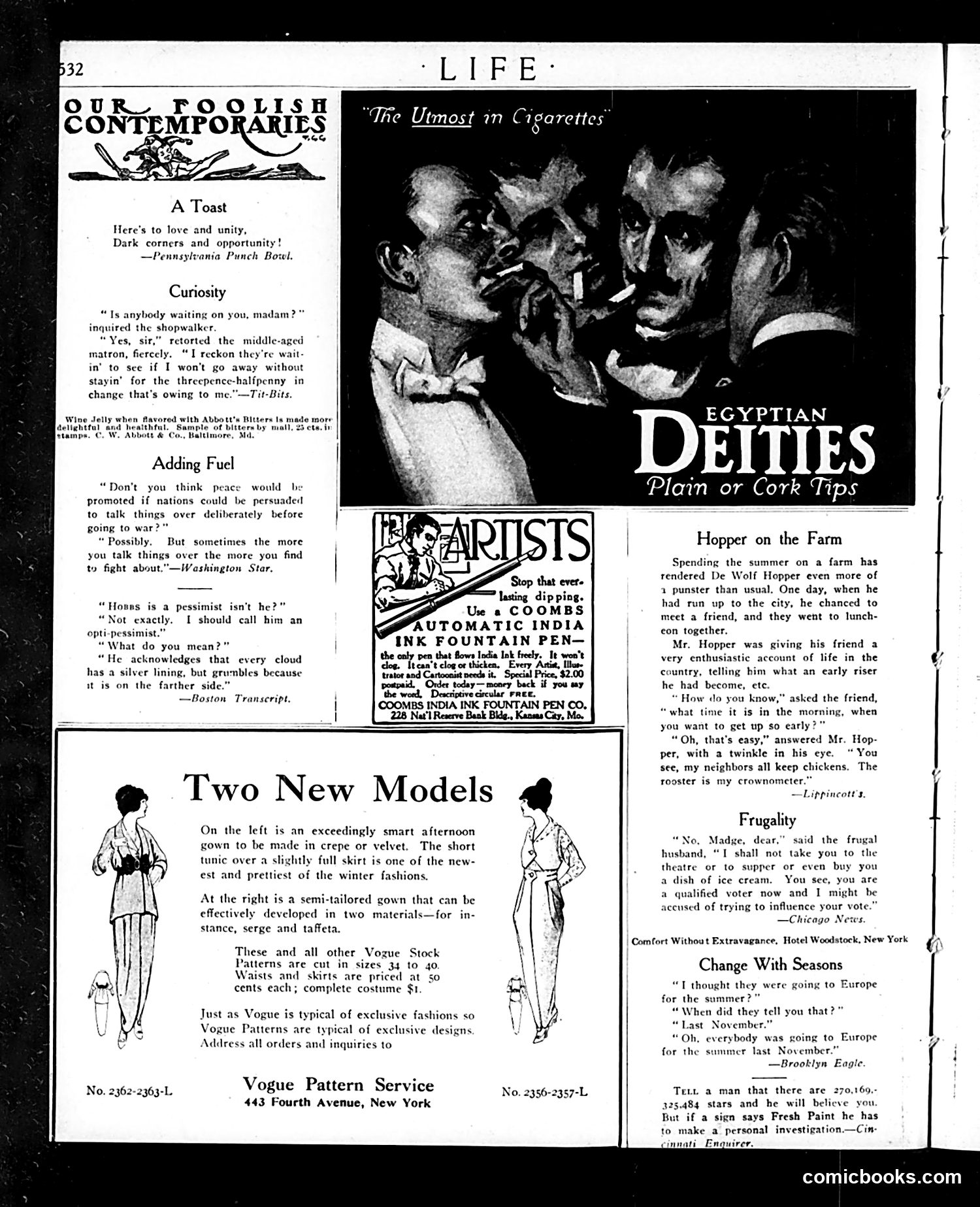
This page contains miscellaneous humor, advertisements, and fashion content typical of Life magazine's satirical format. **"Our Foolish Contemporaries"** section presents short jokes mocking social attitudes. The pieces satirize petty materialism (a woman obsessing over threepence change), pessimism masquerading as realism, and the futility of diplomatic negotiation. **The Egyptian Deities advertisement** appears to be for cigarettes, using classical imagery—unclear what the specific satire is. **"Hopper on the Farm"** is a pun-based anecdote about actor De Wolf Hopper, famous for wordplay. The joke hinges on "crownometer" (crown + chronometer), a nonsensical term describing how roosters tell time on farms. **Fashion section** shows Vogue patterns for women's winter gowns—standard advertising content. **Bottom humor pieces** mock frugal husbands, gullibility about painted signs, and seasonal travel plans. These represent typical early-20th-century domestic satire targeting recognizable social behaviors. Overall: a mixed-content page blending satirical commentary on contemporary manners with commercial advertisements.
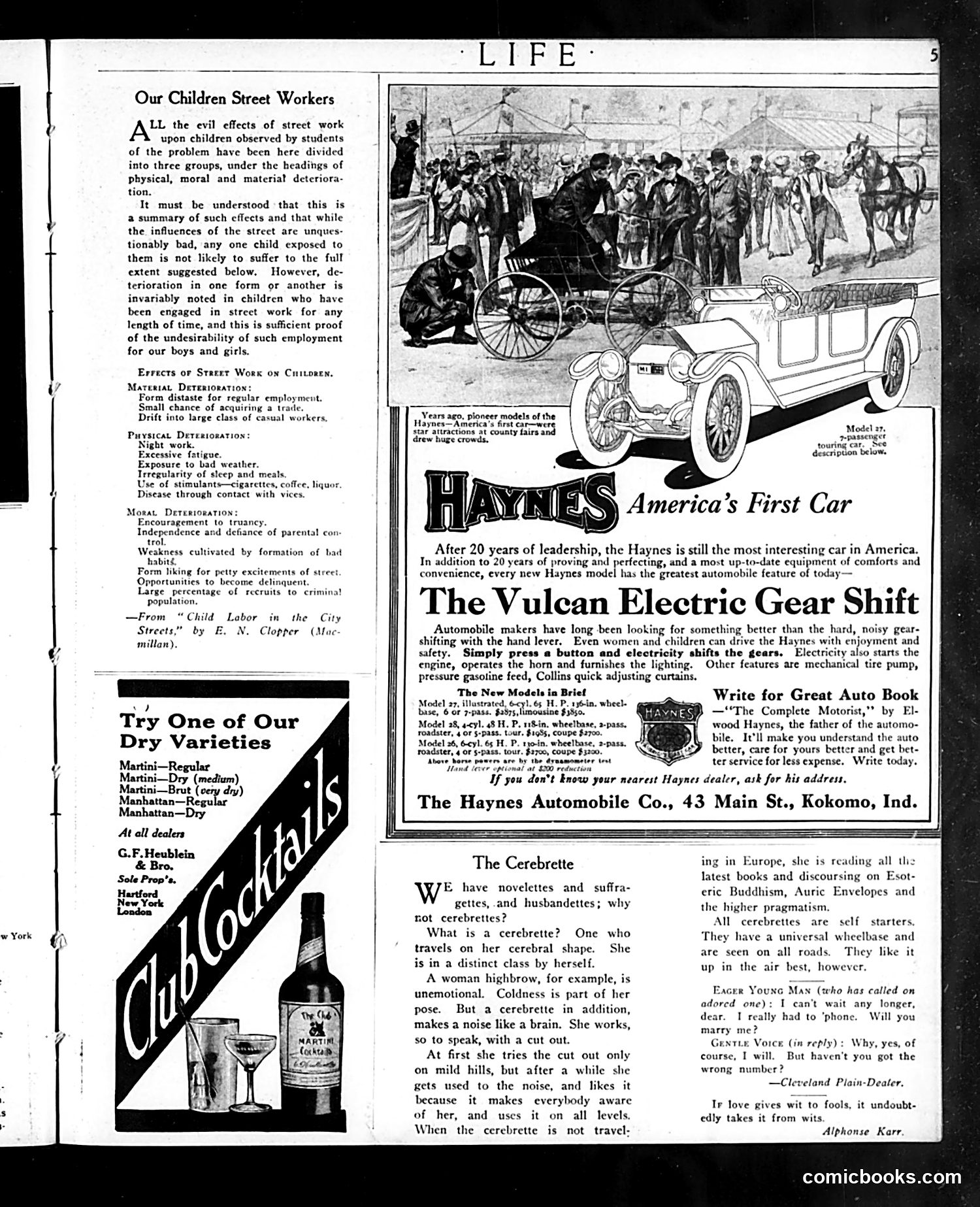
This page combines serious social commentary with period advertising. The **left column** presents a reform-focused article on child labor, cataloging the documented harms of street work on children: physical deterioration (fatigue, disease, irregular sleep), moral decay (truancy, criminal tendencies), and material decline (inability to learn trades). The article, citing E.N. Clopper's work, argues systematically that street employment damages children across all dimensions of development. The **right side** features automobile advertisements—a Haynes car and its "Vulcan Electric Gear Shift"—alongside a brief satirical column called "The Cerebrette," mocking intellectual women ("cerebrettes") who affect cerebral superiority. The juxtaposition is striking: serious documentation of child exploitation appears alongside commercial appeals and light mockery of women's intellectual pretensions. This reflects Life's identity as a satirical magazine mixing reform advocacy with humor aimed at educated, affluent readers—the very audience buying automobiles and reading about "cerebrettes."
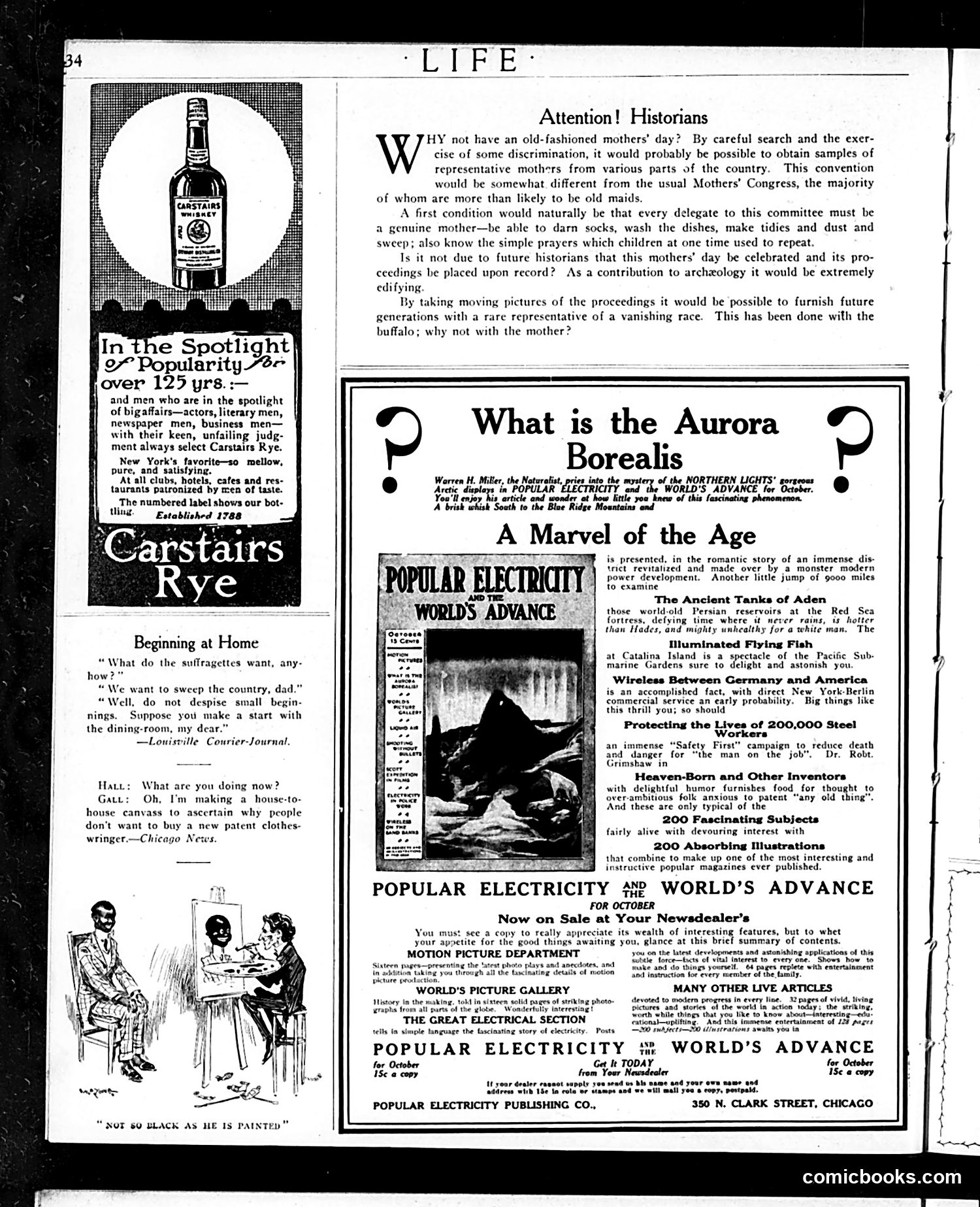
This page from *Life* magazine contains satirical commentary on early 20th-century social issues alongside period advertisements. **The Main Satire ("Attention! Historians"):** This piece mockingly proposes preserving "genuine mothers"—women who perform traditional domestic labor (darning socks, washing dishes, praying)—as specimens for future historians, comparing them to preserved buffalo. The satire targets the women's suffrage movement by implying that activist women ("old maids") aren't "real mothers," and suggests that traditional motherhood represents a "vanishing race" worth documenting. The proposal to film proceedings treats homemakers as anthropological curiosities. **The Cartoon ("Beginning at Home"):** A suffragette demanding to "sweep the country" is told to start by sweeping her own dining room—a dismissive pun suggesting women activists should focus on housework instead of political rights. **Context:** These pieces reflect anti-suffrage sentiment common before women gained voting rights in 1920. The magazine satirizes both feminism and suffragists' arguments through exaggeration and condescension.
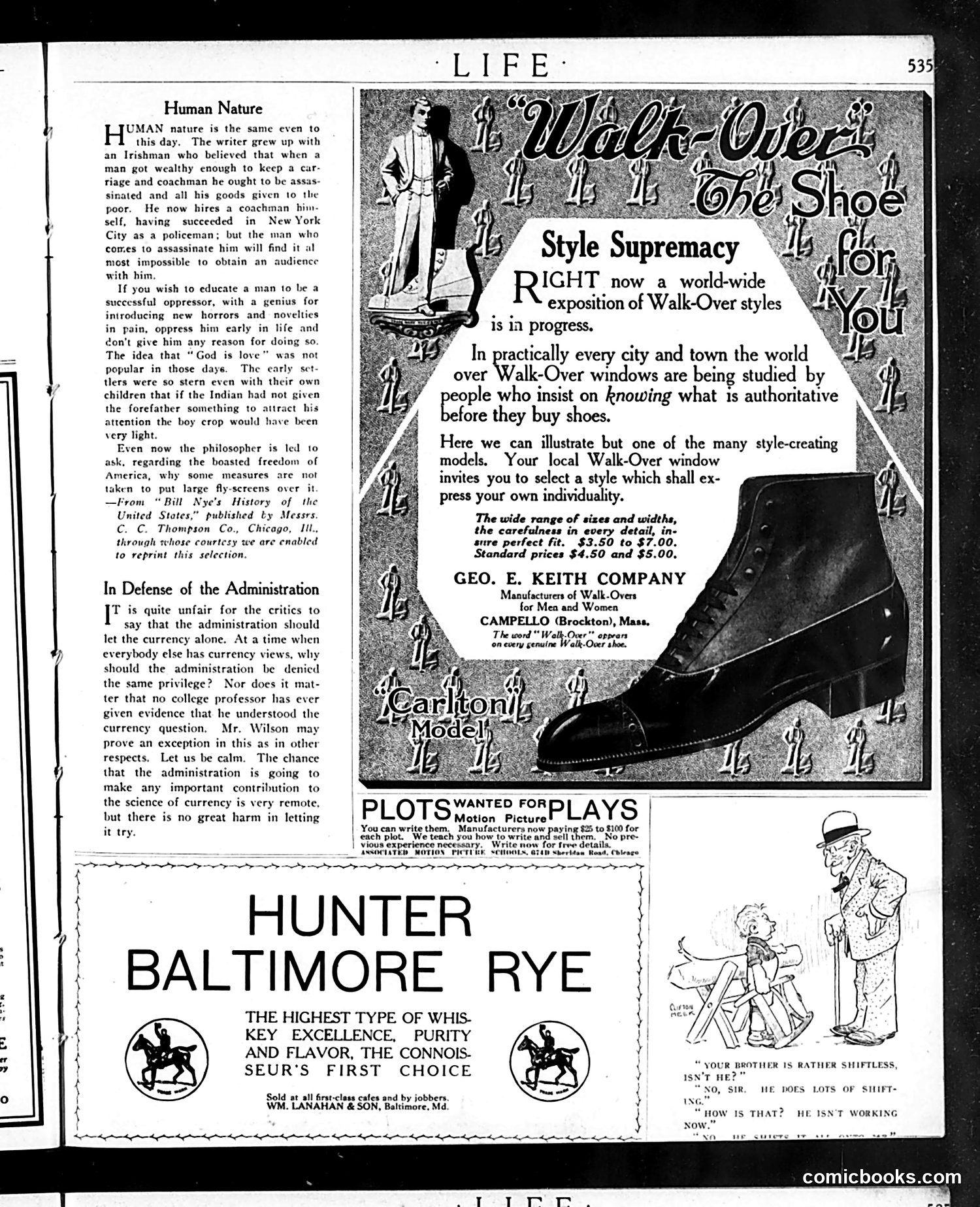
This page is primarily **advertising and editorial commentary** rather than political satire. Key elements: **Left column essays**: Two brief opinion pieces—one quoting Bill Nye humorously about human nature (the hypocrisy of the formerly oppressed becoming oppressors once wealthy), and another defending President Wilson's administration's currency policies, arguing there's "no great harm" in letting them try despite lacking expertise. **Main advertisements**: Walk-Over shoes (prominent center ad emphasizing style individuality), Hunter Baltimore Rye whiskey, and smaller ads for movie plots and acting schools. **Right-side cartoon**: A simple domestic comic strip showing an older man with a younger person, joking about the latter's brother being "shiftless" because he "isn't working now"—a mild humor piece about unemployment or laziness. **Context for modern readers**: This reflects early 1910s concerns about currency policy under Wilson, plus consumer culture promoting individual "style" through mass-produced shoes. The tone is gently satirical about American contradictions.
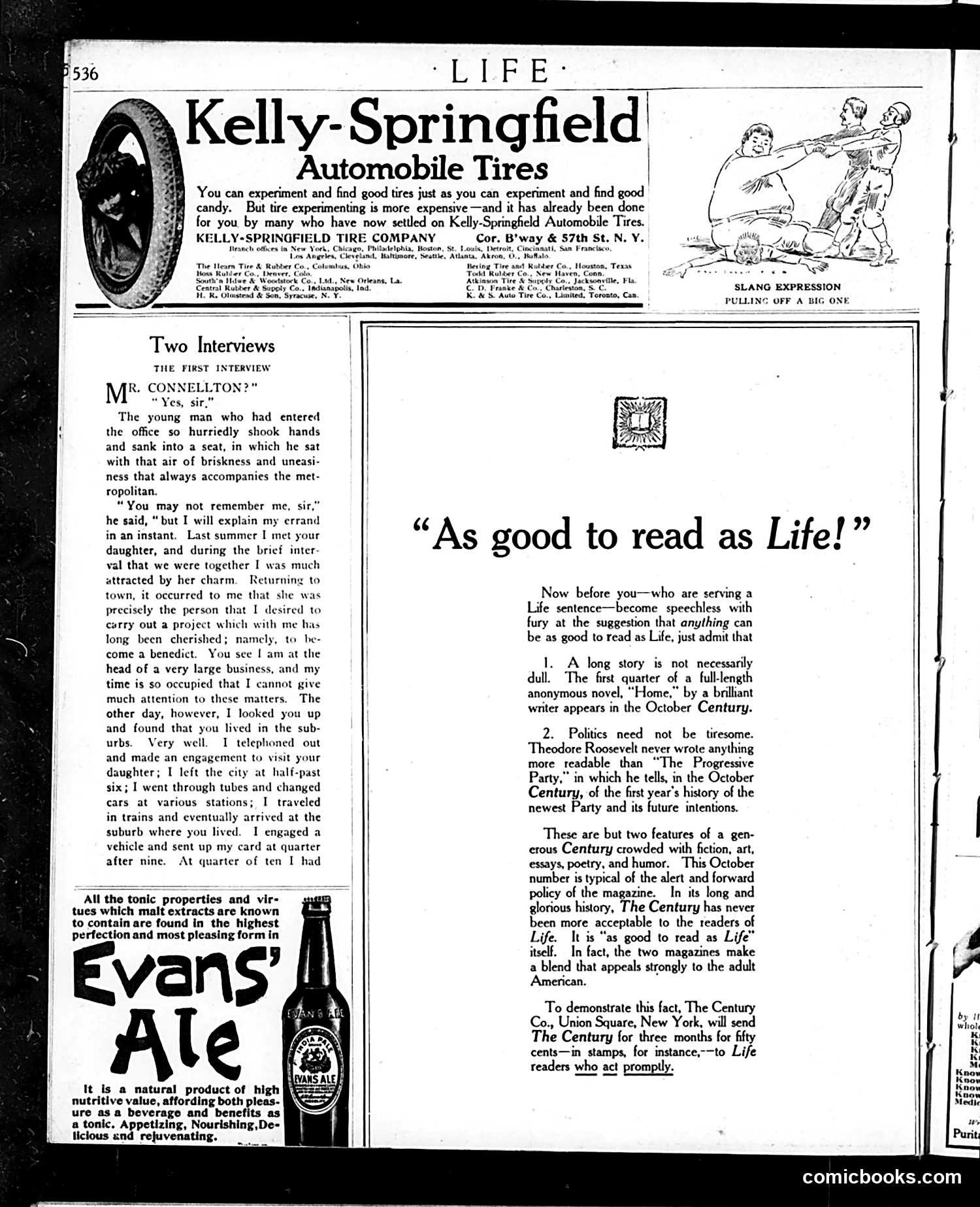
This page combines advertisements with editorial content promoting *The Century* magazine. The main content is a short story excerpt titled "Two Interviews," showing a young businessman's awkward visit to propose marriage to a woman he barely knows—the humor deriving from his elaborate explanation of the logistical effort required (tubes, trains, vehicles) to reach her suburban home, treating courtship like a business transaction. The editorial section argues that *The Century* magazine is "as good to read as Life" by highlighting quality literary content: an anonymous novel and Theodore Roosevelt's article on the Progressive Party. The pitch targets *Life* readers, offering a three-month subscription to *The Century* for fifty cents. The advertisements include Kelly-Springfield automobile tires and Evans' Ale, typical of the era's consumer marketing. The cartoon labeled "Slang Expression: Pulling Off a Big One" appears in the upper right but is not clearly visible enough to interpret definitively.
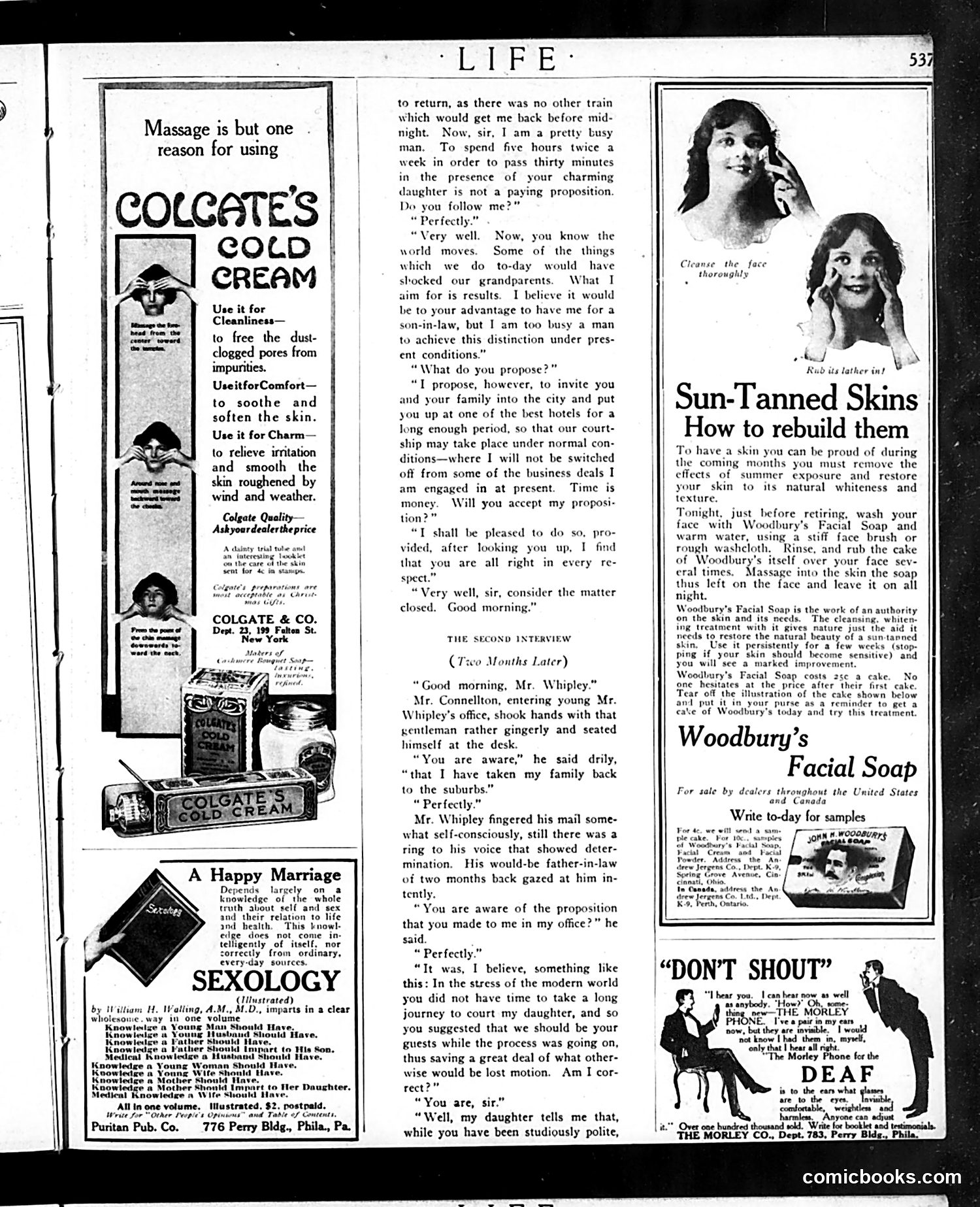
This page contains a satirical short story titled "A Happy Marriage" alongside period advertisements. The narrative presents a comedic critique of modern courtship practices. **The Story's Satire:** The protagonist, Mr. Whipley, a busy businessman, proposes an unconventional solution to courting: rather than waste time with traditional visits, he invites his girlfriend's entire family to a city hotel for an extended stay. This allows courtship to proceed "under normal conditions" while he conducts business. The humor lies in his treating romance as a business efficiency problem—quantifying time as money and eliminating "wasted motion." **The Social Critique:** The piece satirizes early-20th-century masculine values: the prioritization of business over romance, and the reduction of personal relationships to cost-benefit analysis. The father-in-law's droll response suggests disapproval of such calculating modernism, even while finding it logically sound. **Context:** Published during a period of rapid industrialization, the story mocks how businessmen applied "scientific management" principles to all life aspects, including courtship and marriage. The page is otherwise filled with period advertisements for cold cream, facial soap, and a "Sexology" guide.
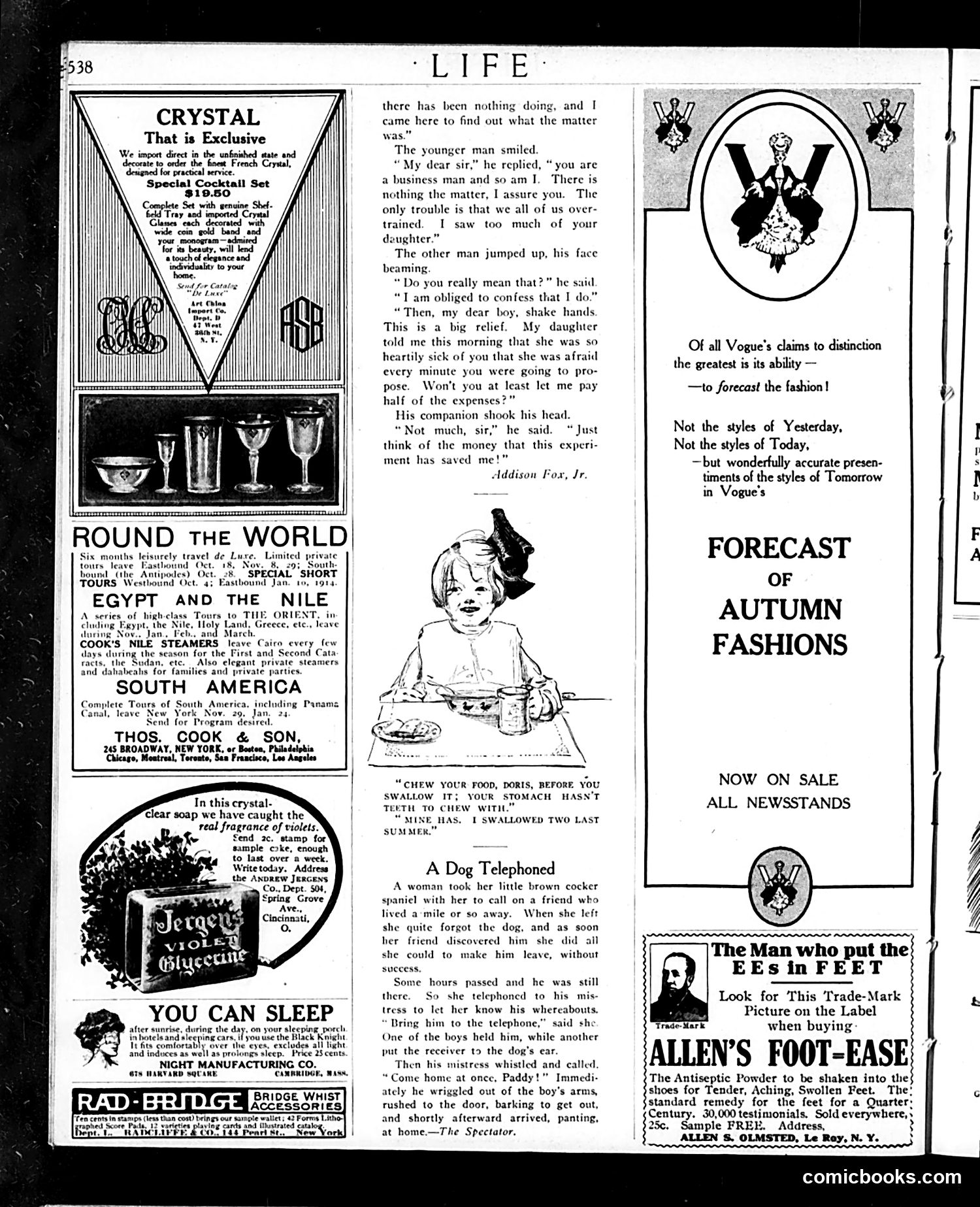
This page is primarily **advertising and light humor content**, not political satire. The main humor piece is a courtship story by Addison Fox, Jr., where a young man visits a father to propose to his daughter. The joke's appeal is the **ironic reversal**: when the father assumes his daughter loves the suitor and worries about expenses, the young man reveals the daughter actively dislikes him and wants him gone. The punchline is the young man refusing payment, joking the "experiment" actually saved him money—darkly suggesting a failed courtship was financially beneficial. A second humor piece, "A Dog Telephoned," recounts an anecdote where a dog abandoned at a friend's house responds to his mistress calling through a telephone receiver and rushes home. It's a sentimental tale showcasing animal loyalty. The page is otherwise dominated by **period advertisements**—luxury crystal sets, Thomas Cook travel tours, soap, furniture, foot powder—aimed at affluent readers. The Vogue advertisement promoting "Forecast of Autumn Fashions" reflects contemporary fashion industry marketing targeting middle and upper-class women.
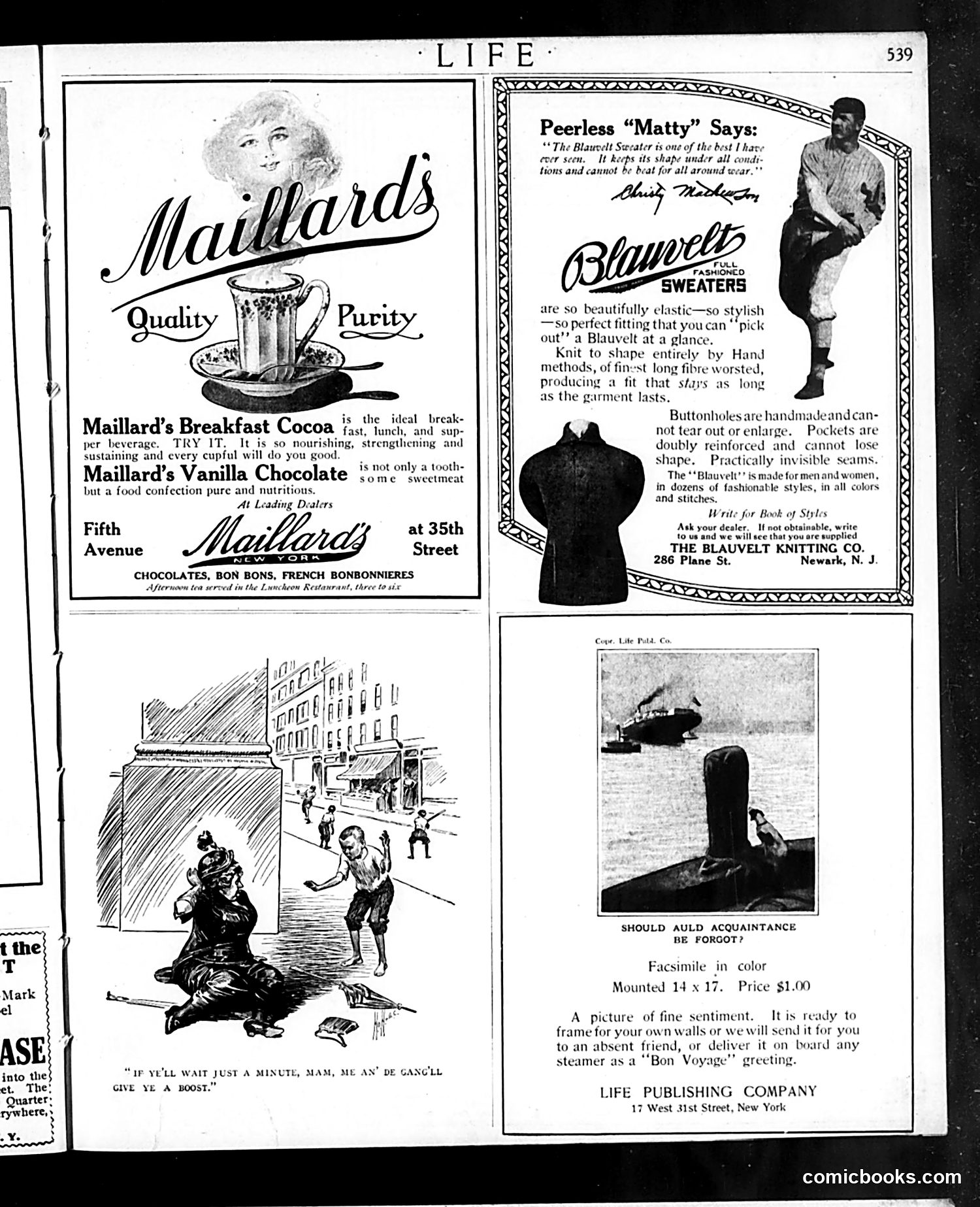
This page is **primarily advertising** with one cartoon. The main comic depicts a street scene where a man sits on the ground addressing a woman, saying "If ye'll wait just a minute, mam, me an' de gang'll give ye a boost." The humor relies on **class and ethnic stereotyping** typical of early 20th-century American satire—the character speaks in exaggerated dialect ("ye'll," "de") suggesting working-class or immigrant identity, and the "joke" appears to be about offering assistance (a "boost") in a somewhat crude or unexpected way. The rest of the page features **period advertisements**: Maillard's chocolate/cocoa (top left), Blauvelt brand sweaters with celebrity endorsement (top right), and a sentimental maritime photograph for sale (bottom right). The cartoon's satire reflects attitudes about class and immigrant communities that would be considered offensive today.
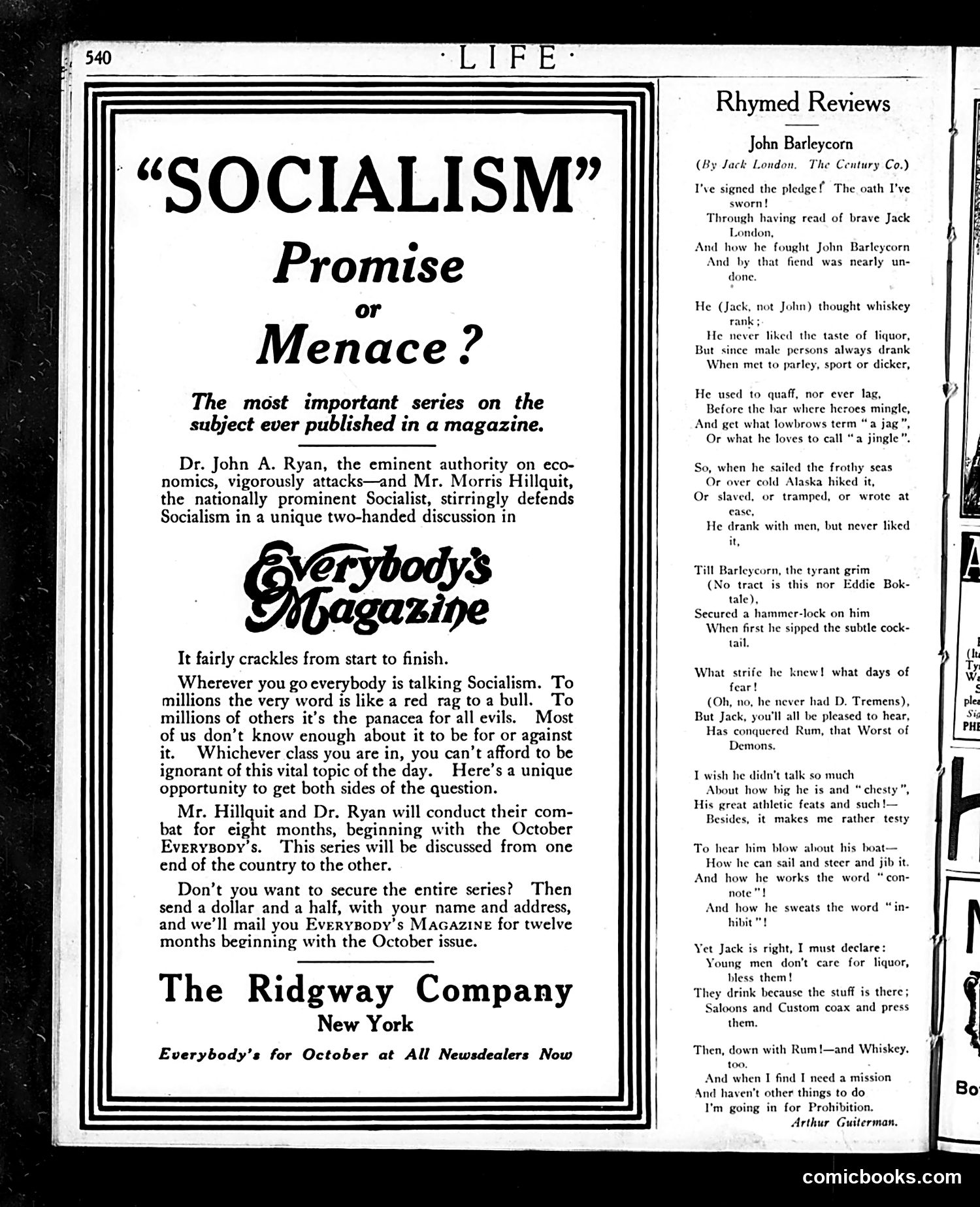
This page contains **advertising and book reviews**, not political cartoons. The left side advertises *Everybody's Magazine*, promoting an eight-month debate series on socialism between **Dr. John A. Ryan** (economist attacking socialism) and **Morris Hillquit** (prominent Socialist defending it). The ad frames socialism as a contentious topic—"Promise or Menace?"—that Americans need to understand. The right side reviews Jack London's *John Barleycorn*, a memoir about London's struggle with alcohol addiction. Reviewer Arthur Guiterman satirizes London's boastfulness about his athletic exploits and vocabulary while praising his anti-alcohol message. The review concludes with ironic support for Prohibition, suggesting the reviewer will champion the cause only when lacking other pursuits. Both pieces reflect early 20th-century American anxieties: political ideology (socialism's growing influence) and social reform (temperance/Prohibition movements).
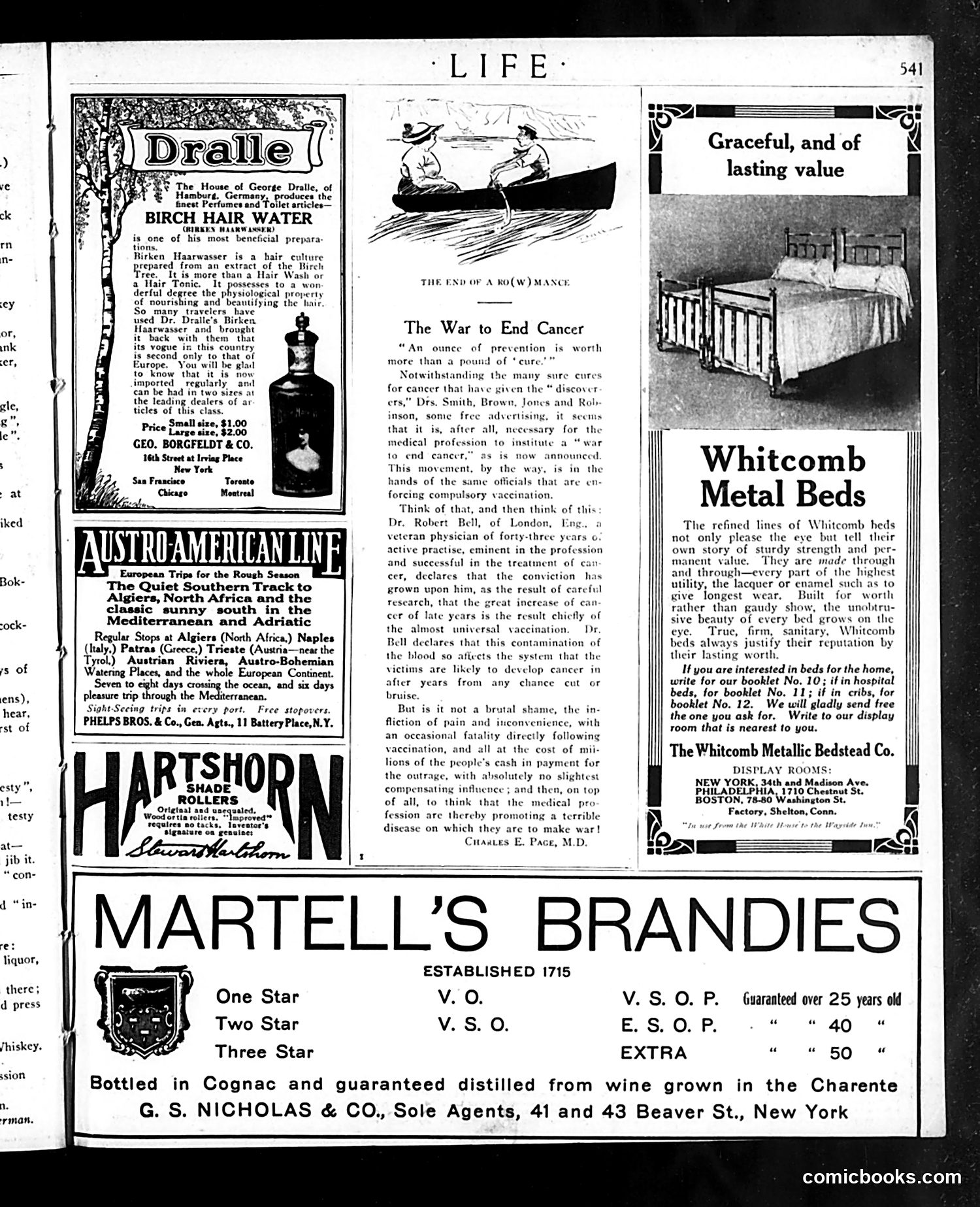
This page is primarily **advertising**, with one notable satirical article titled "The War to End Cancer." The satirical piece, attributed to Charles E. Page, M.D., **criticizes compulsory vaccination programs**. The author argues that the same government officials enforcing mandatory vaccination are now launching a "war to end cancer"—suggesting hypocrisy. Page cites Dr. Robert Bell of London, who claimed that widespread vaccination caused the increase in cancer cases by contaminating the blood. The satire attacks both the medical establishment's contradictory positions and the government's enforcement of health measures the author views as harmful. The cartoon above the article, "The End of a Ko(w)mance," depicts two people in a boat—a play on words suggesting a romance between cows or cow-related subjects has ended. The remaining content consists of period product advertisements: Dralle's hair products from Hamburg, Austro-American steamship lines, Hartshorn shade rollers, Martell's brandies, and Whitcomb metal beds—typical early 20th-century consumer goods marketing.
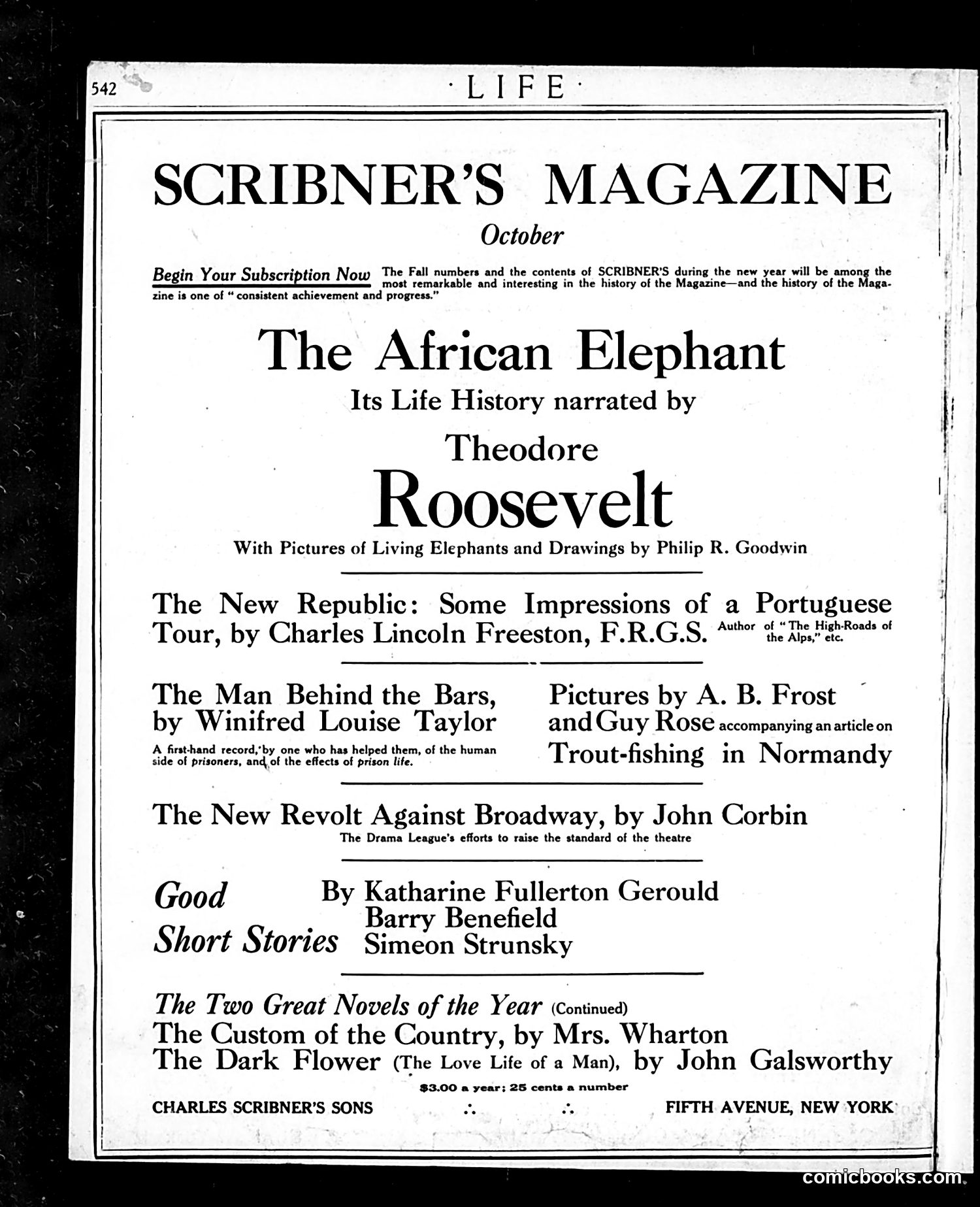
This is a table of contents/advertisement page for Scribner's Magazine (October issue), not a political cartoon. It announces upcoming articles and stories, including Theodore Roosevelt's piece on African elephants, a travel essay about Portugal, and literary works by established authors like Edith Wharton and John Galsworthy. The page emphasizes the magazine's "consistent achievement and progress" to encourage new subscriptions. The notable content reflects early 20th-century middlebrow American interests: natural history (Roosevelt was a famous conservationist and hunter), travel writing, prison reform, theater criticism, and serious fiction. There is no satire or political commentary visible—this is straightforward magazine promotion targeting educated, affluent readers.

I can see this is a page from Life magazine with "comicbooks.com" credited at the bottom. However, the image is almost entirely dark/black with very poor visibility. On the left edge, there appears to be a white border or margin with some text fragments visible ("e," "of," "n," "y," "y," "RK"), but the main content of the page—whether cartoons, illustrations, or text—is not legible enough for me to identify specific figures, political references, or satirical intent. Without being able to read the actual cartoon or article content clearly, I cannot accurately explain what this page means or what it's satirizing. I would need a clearer, higher-contrast image to provide meaningful analysis.