
Life, 1913-09-25 · page 28 of 43
Life — September 25, 1913 — page 28: what you’re looking at
What you’re looking at
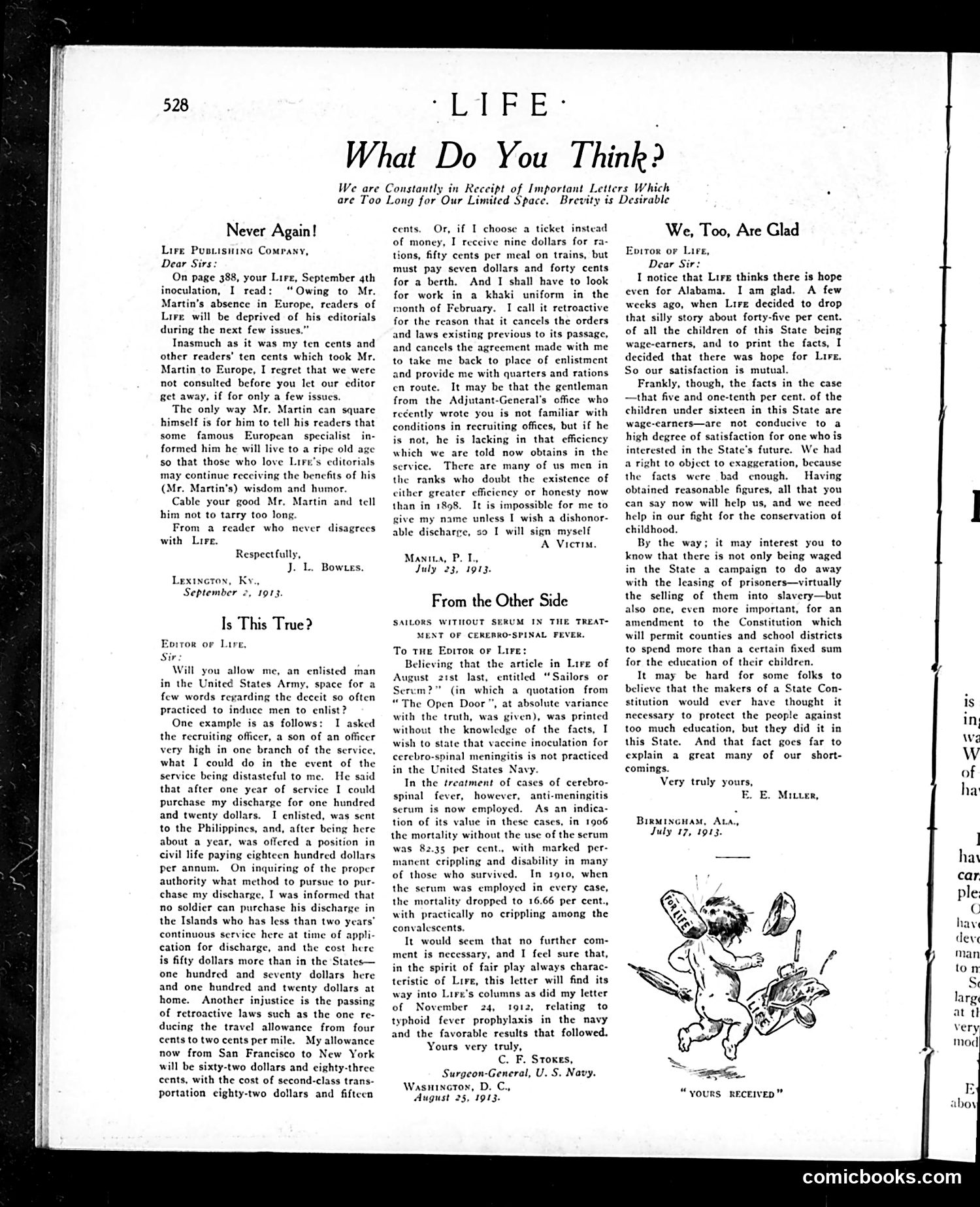
This page is the magazine's "Letters to the Editor" section—a reader feedback column titled "What Do You Think?" **Key letters discussed:** 1. **"Never Again!"** complains that editor Edward Sandford Martin traveled to Europe, depriving readers of his editorials during his absence. The writer sarcastically suggests Martin must have consulted a "famous European specialist" who assured him of a long life. 2. **"Is This True?"** is a complaint from an enlisted soldier in the Philippines detailing recruitment deceptions. He was promised he could purchase discharge after one year for $120, but discovered the actual cost is $170+ and requires two years' service. He also criticizes retroactive pay cuts affecting his travel allowance home—he'll arrive jobless in February wearing a military uniform. 3. **"From the Other Side"** (partially visible) appears to be a response from a military medical officer regarding serum treatment for meningitis. **Context:** These letters reflect 1913 military grievances, recruiting fraud concerns, and early 20th-century Army administration issues. The cartoon illustration (bottom right, labeled "Yours Received") appears decorative rather than directly connected to specific letters.
📄 Transcribed text from this page (OCR, searchable)
Machine-transcribed from the original scan — historical spelling and the odd misread are preserved.
528 yg oe What DoYou Think? We are Constantly in Re are Too Long for Our Limited Space. Never Again! Lire Pusiisninc Company, Dear Sirs: On page 388, your Lire, September 4th inoculation, I read: “Owing to Mr. Martin’s absence in Europe, readers of Lire will be deprived of his editorials during the next few issues.” Inasmuch as it was my ten cents and other readers’ ten cents which took Mr. Martin to Europe, I regret that we were not consulted before you Ict our editor get away, if for only a few issucs. The only way Mr. Martin can square himself is for him to tell his readers that some famous European specialist in- formed him he will live to a ripe old age so that those who love Lire’s editorials may continue receiving the benefits of his (Mr. Martin's) wisdom and humor. Cable your good Mr. Martin and tell him not to tarry too long. From a reader who never disagrees with Lire, Respectfully, J. L. Bown Lexixerox, Ky., September 2, 1913. Is This True? Eprror of Lire, Sir Will you allow me, an enlisted man in the United States Army, space for a few words regarding the deceit so often Practiced to induce men to enlist? One example is as follows: I asked the recruiting officer, a son of an officer very high in one branch of the service, what I could do in the event of the service being distasteful to me. He said that after one year of service I could purchase my discharge for one hundred and twenty dollars. I enlisted, was sent to the Philippines, and, after being here about a year, was offered a position in civil life paying cighteen hundred dollars per annum. On inquiring of the proper authority what method to pursue to pur- chase my discharge, I was informed that no soldier can purchase his discharge in the Islands who has less than two years’ continuous service here at time of appl: cation for discharge, and the cost here is fifty dollars more than in the States— one hundred and seventy dollars here and one hundred and twenty dollars at home. Another injustice is the passing of retroactive laws such as the one re- ducing the travel allowance from four cents to two cents per mile. My allowance now from San Francisco to New York will be sixty-two dollars and eighty-three cents, with the cost of second-class trans- portation cighty-two dollars and fifteen cents. Or, if I choose a ticket instead of money, I receive nine dollars for ra- tions, fifty cents per meal on trains, but must pay seven dollars and forty cents for a berth, And I shall have to look for work in a khaki uniform in the month of February. I call it retroactive for the reason that it cancels the orders and laws existing previous to its passage, and cancels the agreement made with me to take me back to place of enlistment and provide me with quarters and rations en route, It may be that the gentleman from the Adjutant-General’s office who recently wrote you is not familiar with conditions in recruiting offices, but if he is not, he is lacking in that efficiency which we are told now obtains in the service. There are many of us men in the ranks who doubt the existence of cither greater efficiency or honesty now than in 1898. It is impossible for me to give my name unless I wish a dishonor- able discharge, so I will sign myself A Victis. Manita, P. 1, July 23, 1913. From the Other Side SAILORS WITHOUT SERUM IN THE TREAT MENT OF CERERRO-SPINAL FEVER. To tre Evitor or Lire: Believing that the article in Lire of August 21st last, entitled “Sailors or Serem?” (in which a quotation from “The Open Door”, at absolute variance with the truth, was given), was printed without the knowledge of the facts, I wish to state that vaccine inoculation for cerebro-spinal meningitis is not practiced in the United States Navy. In the treatment of cases of cerebro- spinal fever, however, anti-meningitis serum is now employed. As an indica- tion of its value in these cases, in 1906 the mortality without the use of the serum was 82.35 per cent., with marked per- manent crippling and disability in many of those who survived. In 1910, when the serum was employed in every case, the mortality dropped to 16.66 per cent., with practically no crippling among the convalescents, It would seem that no further com- ment is necessary, and I feel sure that, in the spirit of fair play always charac- teristic of Lire, this letter will find its way into Lire’s columns as did my letter of November 24, 1912, relating to typhoid fever prophylaxis in the navy and the favorable results that followed. Yours very truly, C. F. Stokes, Surgeon-General, U. S. Navy. Wasuinotox, D. C. August 25, 1913. ‘cipt of Important Letters Which ‘ Brevity is Desirable We, Too, Are Glad Epitor or Lire, Dear Sir: I notice that Lire thinks there is hope even for Alabama. I am glad. A few weeks ago, when Lire decided to drop that silly story about forty-five per cent. of all the children of this State being wage-earners, and to print the facts, I decided that there was hope for Lire. So our satisfaction is mutual. Frankly, though, the facts in the case —that five and one-tenth per cent. of the children under sixteen in this State are wage-carners—are not conducive to a high degree of satisfaction for one who is interested in the State's future. We had a right to object to exaggeration, because the facts were bad enough. Having obtained reasonable figures, all that you can say now will help us, and we need help in our fight for the conservation of childhood. By the way; it may interest you to know that there is not only being waged in the State a campaign to do away with the leasing of prisoners—virtually the selling of them into slavery—but also one, even more important, for an amendment to the Constitution which will permit counties and school districts to spend more than a certain fixed sum for the education of their children. It may be hard for some folks to believe that the makers of a State Cot stitution would ever have thought it necessary to protect the people against too much education, but they did it in this State. And that fact goes far to explain a great many of our short- comings. Very truly yours, Miter, Birwincuast, ALA, July 17, 1913. “YOURS RECEIVED” Wa of ha deve man very mod comicbooks.com