
Life, 1913-09-25 · page 25 of 43
Life — September 25, 1913 — page 25: what you’re looking at
What you’re looking at
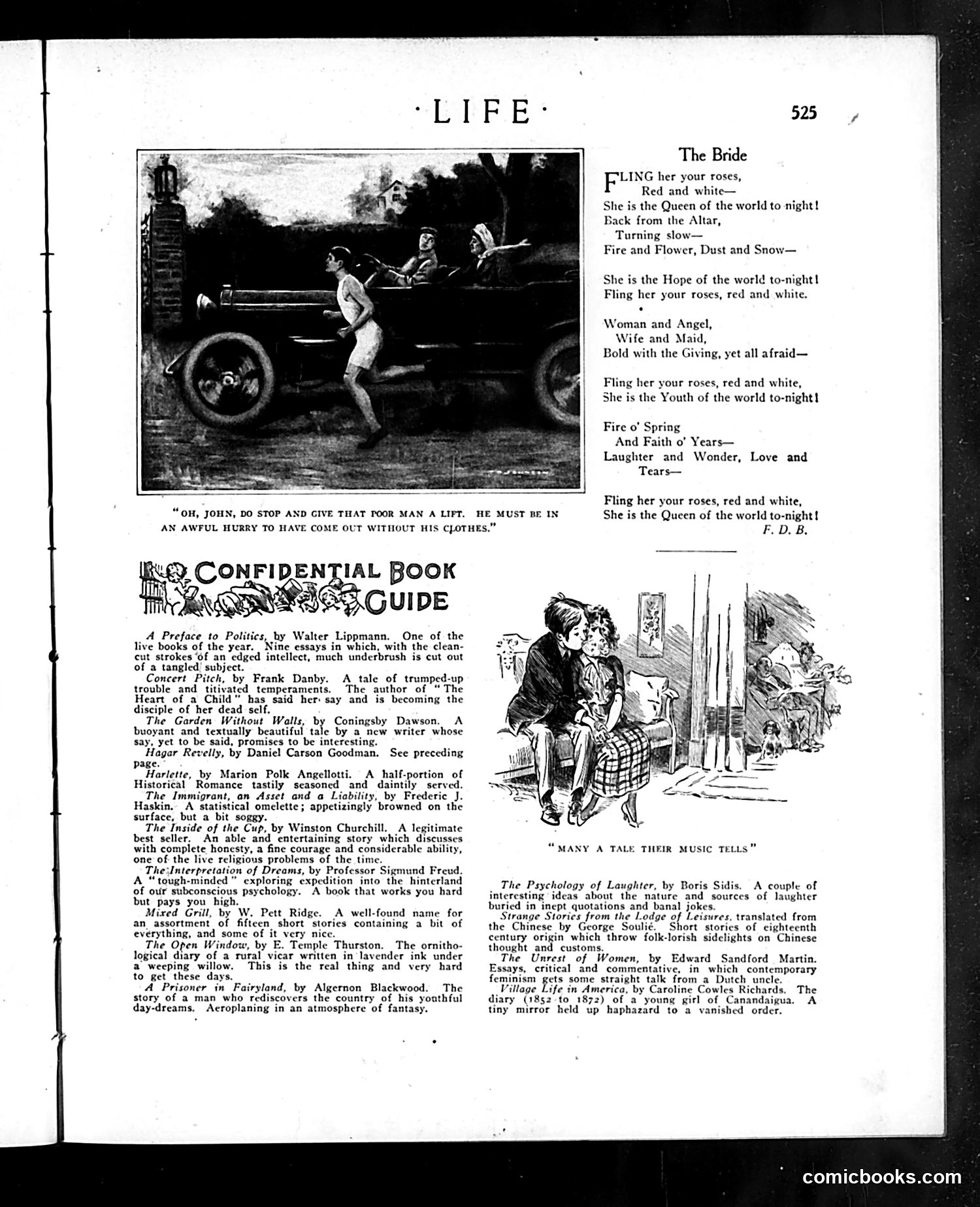
**The Poem "The Bride"** (by F.D.B.) is sentimental verse celebrating a newlywed woman as idealized femininity—"Queen of the world," "Hope of the world," embodying "Woman and Angel" simultaneously. It reflects early 20th-century romanticization of marriage and wifelihood. **The Cartoon** depicts a newly married couple in an automobile (a modern luxury vehicle). The bride, still in wedding dress, urges her impatient groom: "Oh, John, do stop and give that poor man a lift. He must be in an awful hurry to have come out without his clothes." **The Joke**: A poorly dressed (or possibly nude) pedestrian has been left behind—apparently the groom was in such a rush to leave the wedding that he abandoned someone without proper clothing. The satire gently mocks newlyweds' self-absorbed haste, contrasting the bride's charitable impulse with the groom's inconsiderate urgency. The juxtaposition with the idealized poem above creates ironic commentary on romantic honeymoon reality.
📄 Transcribed text from this page (OCR, searchable)
Machine-transcribed from the original scan — historical spelling and the odd misread are preserved.
The Bride LING her your roses, Red and white— She is the Queen of the world to night! Back from the Altar, Turning slow— Fire and Flower, Dust and Snow— She is the Hope of the world to-night! Fling her your roses, red and white. Woman and Angel, Wife and Maid, Bold with the Giving, yet all afraid— Fling her your roses, red and white, She is the Youth of the world to-night! Fire o’ Spring And Faith o’ Years— Laughter and Wonder, Tears— Love and “OH, JOHN, DO STOP AND GIVE THAT POOR MAN A LIFT. ee FIDEN] IAL BOOK GUIDE A Preface to Politics, by Walter Lippmann. One of the live books of the year. Nine essays in which, with the clean- cut strokes ‘of an edged intellect, much underbrush is cut out of a tangled’ subject. Concert Pitch, by, Frank Danby. A tale of trumped up trouble and titivated temperaments. The author of “ Heart of a Child” has said her say and is becoming an disciple of her dead self. The Garden Without Walls, by Coningsby Dawson. A buoyant and textually beautiful tale by a new writer whose say, yet to be said, promises to be interesting. Hagar Revelly, by Daniel Carson Goodman, page. Harlette, by Marion Polk Angellotti. A half-portion of Historical Romance tastily seasoned and daintily served. The Immigrant, an Asset and a Liability, by Frederic J. Haskin. A statistical omelett ippetizingly browned on the surface, but a bit so The Inside of the Cup, by Winston Churchill. A legitimate best seller. An able and entertaining story which discu with complete honesty, a fine courage and considerable abil one of the live religious problems of the time. The-Interpretation of Dreams, by Professor Sigmund Freud. A “tough-minded " exploring expedition into the hinterland of our subconscious psychology. A book that works you hard but pays you high. Mixed Grill, by W. Pett Ridge. A well-found name for an assortment of fifteen short stories containing a bit of everything, and some of it very nice. The Open Window, by E. Temple Thurston. The ornitho- logical diary of a rural vicar written in lavender ink under a. weeping willow. This is the real thing and very hard to get these d: A Prisoner in * Pairyland, by Algernon Blackwood. The story of a man who rediscovers the country of his youthful day-dreams. Acroplaning in an atmosphere of fantasy. See preceding HE MUST AN AWFUL HURRY TO HAVE COME OUT WITHOUT HIS CLOTHES.” Fling her your roses, red and white, She is the Queen of the world to-night! F. D. B, BE IN “MANY A TALE THEIR MUSIC TEL The Psychology of Laughter, by Boris Sidis. A couple of interesting ideas about the nature and sources of laughter buried in inept quotations and banal jokes. Strange Stories from the Lodge of Leisures, translated from the Chinese by George Soulié. Short stories of eighteenth century origin which throw folk-lorish sidelights on Chinese thought and customs. The Unrest of Women, by Edward Sandford Martin. Essays, critical and commentative, in which contemporary feminism gets some straight talk from a Dutch. uncle. Village Life in America, by Caroline Cowles Richards. diary (1852-to 1872) of a young girl of Canandaigua. tiny mirror held up haphazard to a vanished order. The A comicbooks.com