
Life, 1913-09-25 · page 29 of 43
Life — September 25, 1913 — page 29: what you’re looking at
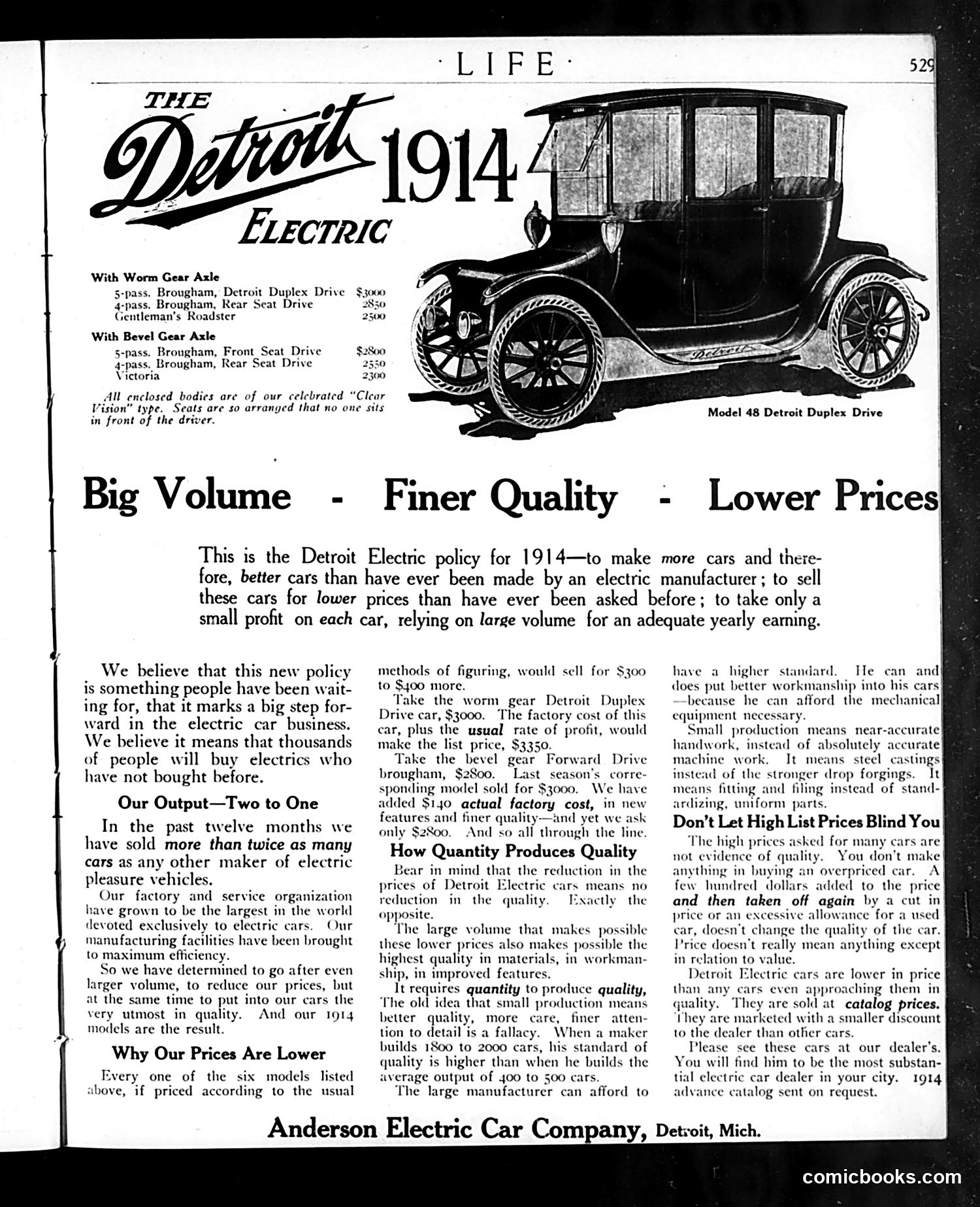
What you’re looking at
This is primarily a **full-page advertisement**, not satire or political cartoon. It promotes the Anderson Electric Car Company's 1914 Detroit Electric automobile line. The key message targets a modern concern: the company claims to achieve **lower prices through high-volume manufacturing without sacrificing quality**—a counter-intuitive argument for 1914. The ad argues that mass production *enables* better quality (standardized parts, precision machinery, stronger materials) versus small-batch production (hand-fitting, weaker forgings). A secondary argument warns consumers: **don't equate high list prices with quality**. The copy suggests competitors inflate prices artificially, then discount them—the final price alone reveals true value. The electric car itself appears dated to modern readers (this vehicle was already obsolete by the 1920s), but the **manufacturing philosophy—volume production yielding affordability and reliability—became standard** in American industry, notably via Henry Ford's contemporaneous Model T strategy.
📄 Transcribed text from this page (OCR, searchable)
Machine-transcribed from the original scan — historical spelling and the odd misread are preserved.
With Worm Gear Axle 5-pass. Brougham, Detroit Duplex Drive 4-pass. Brougham, Rear Seat Drive Gentleman's Roadster With Bevel Gear Axle 5-pass. Brougham, Front_Seat_ Drive 4-pass. Brougham, Rear Seat Drive Victoria in front of the driver. We believe that this new policy is something people have been wait- ing for, that it marks a big step for- ward in the electric car business. We believe it means that thousands of people will buy electrics who have not bought before. Our Output—Two to One In the past twelve months we have sold more than twice as many cars as any other maker of electric pleasure vehicles. Our factory and service organization have grown to be the largest in the world devoted exclusively to electric cars. Our manufacturing facilities have been brought to maximum efficiency. So we have determined to go after even larger volume, to reduce our prices, but at the same time to put into our cars the very utmost in quality. And our 1914 models are the result. Why Our Prices Are Lower Every one of the six models listed above, if priced according to the usual All enclosed bodies are of our celebrated “Clear Yision” type. Seats are so arranged that no one sits Big Volume - Finer Quality - Lower Prices This is the Detroit Electric policy for 1914—to make more cars and there- fore, better cars than have ever been made by an electric manufacturer ; to sell these cars for lower prices than have ever been asked before; to take only a small profit on each car, relying on large volume for an adequate yearly eaming. methods of figuring, would sell for $300 to $400 more. Take the worm gear Detroit Duplex Drive car, $3000. The factory cost of this car, plus the usual rate of profit, would make the list price, $3350. Take the bevel gear Forward Drive brougham, $2800, Last season’s corre- sponding model sold for $3000. We have added $140 actual factory cost, in new features and finer quality—and yet we ask only $2800. And so all through the line: How Quantity Produces Quality Bear in mind that the reduction in the prices of Detroit Electric cars means no reduction in the quality. Exactly the opposite. ‘The large volume that makes possible these lower prices also makes possible the highest quality in materials, in workman- ship, in improved features. It requires quantity to produce quality, The old idea that small production means better quality, more care, finer atten- tion to detail is a fallacy. When a maker builds 1800 to 2000 cars, his standard of quality is higher than when he builds the average output of 400 to 500 cars. The large manufacturer can afford to Anderson Electric Car Company, Detcoit, Mich. Model 48 Detroit Duplex Drive have a higher standard. He can does put better workmanship into his ca because he can afford the mechanical] equipment necessary. Small production means nea handwork, instead of absolutely machine work. It means steel a instead of the stronger drop forgings. It means fitting and filing instead of stand- ardizing, uniform parts. Don’t Let High List Prices Blind You The high prices asked for many € not evidence of quality. You don’t make anything in buying an overpriced car. A few hundred dollars added to the price and then taken off again by a cut in price or an excessive allowance for a used car, doesn’t change the quality of the car. Price doesn’t really mean anything except in relation to value. Detroit Electric cars are lower in price s even approaching them in rey are sold at catalog prices. they are marketed with a smaller discount to the dealer than other cars Please see these car: t our dealer's, You will find him to be the most substan- tial electric car dealer in your city. 1914 advance catalog sent on request. comicbooks.com